The ink is barely dry on the great promise when a famine tests it, and Abram fails. He goes down to Egypt, and, afraid, tells Sarai to say she is his sister. She is taken into Pharaoh’s house; the mother of the promised nation is in a pagan king’s harem, and Abram grows rich on the deal. The promise is in mortal danger — by the promise-bearer’s own hand. Then the one actor who matters: “But the Lord afflicted Pharaoh… with great plagues.” A rehearsal of the Exodus, and the deepest comfort: the covenant rests on God’s faithfulness, not ours. This study works Genesis 12:10–20. See the method →
Genesis 12:10, 13, 15, 17, 19
Hebrew · LXX · ESVThe Shape of the Passage
Ring compositionImmediately after the call and the sevenfold promise (12:1–9), Genesis records not a triumph but a failure — and it does so without flinching. The point is not that Abram is a hero to imitate here, but that God is faithful to a promise even the promise-bearer endangers.
Author
Moses tells the story with unsparing honesty. A famine strikes the very land God had just promised (12:7), and instead of “calling on the name of the Lord” in it (as he had just done, 12:8), Abram engineers his own survival: he “goes down to Egypt” (wayyered… Mitsraymah) — the same descent that Jacob and the whole nation will one day make. Fearing that his wife’s beauty will get him killed, he tells Sarai to say she is his sister. It is a half-truth (she was his half-sister, 20:12) deployed as a whole lie, and its motive is nakedly self-protective: “that it may go well with me… that my life may be spared.” The man entrusted with the blessing of all nations is willing to hand his wife to a foreign king to save his own skin.
The promise in the harem. The plan “works” in the worst way: “the woman was taken (wattuqqach) into Pharaoh’s house.” The passive verb is ominous — Sarai, the future mother of Isaac, is now in a pagan harem, and the promise of offspring hangs by a thread. Abram, meanwhile, is enriched: sheep, oxen, donkeys, servants (including, the text quietly notes, “female servants” — foreshadowing Hagar the Egyptian, 16:1), and camels. The gain is morally poisoned; it is the profit of a lie, and it will breed trouble for generations. Everything the promise needs is now imperiled — and the one who imperiled it is Abram.
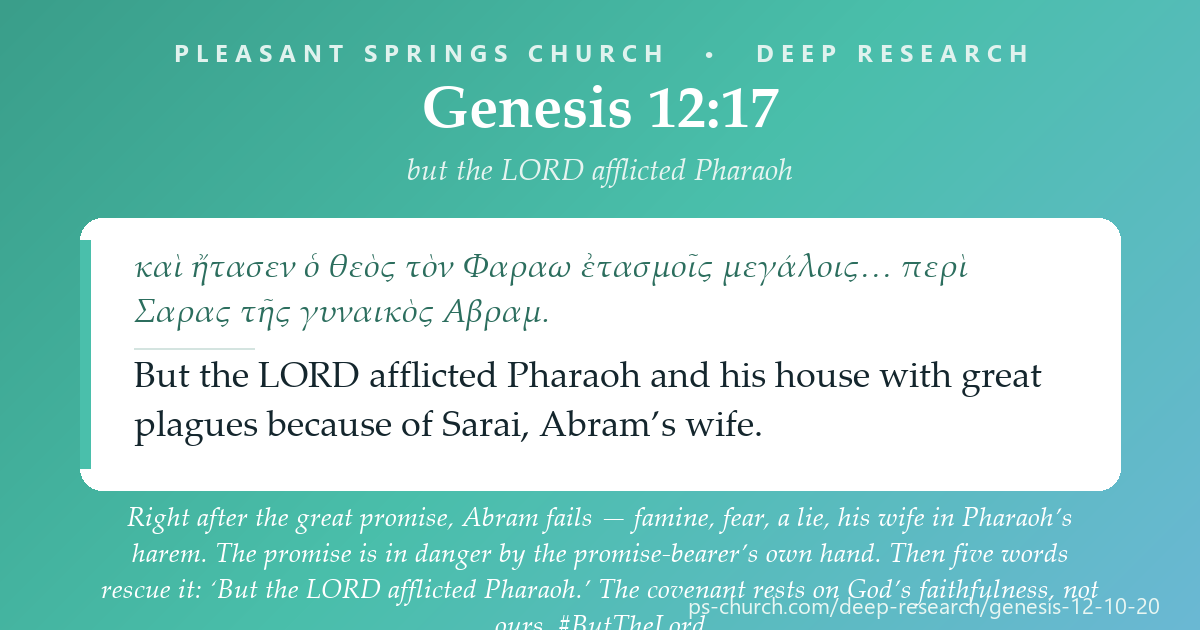
‘But the Lord.’ Then the sentence that saves the story: “But the Lord afflicted Pharaoh and his house with great plagues” (12:17). This is the only mention of the divine name in the whole episode, and it is decisive: not Abram’s cleverness, not Pharaoh’s conscience, but the Lord intervenes to rescue Sarai and the promise. The Hebrew even foreshadows the Exodus: God “struck” (wayenagga’) Pharaoh with “plagues” (nega’im) — and this very word (nega’) reappears for a plague on Egypt at the Exodus: “one more plague (nega’) I will bring on Pharaoh” (Exod 11:1). Then, as in the Exodus, the king rebukes his guest, restores the wife, and sends them away (wayeshallechu) enriched. Abram descends to Egypt in fear, and God brings him up in grace, the promise intact.
Audience
Israel — a people who would themselves go down to Egypt, be afflicted, and be brought out by the Lord’s plagues and despoiling of the Egyptians (Exod 12:35–36). The episode is a miniature of their own story, and its lesson is meant to steady them: the God who guards the promise is the God who guards us, and he does it not because we are faithful but because he is. The pagan king, tellingly, behaves better than the patriarch — “What is this you have done to me?” — a deliberate shaming that keeps Abram (and the reader) from any smugness.
Recorded, not commended. It is important to read the passage as Scripture reads it. The Bible records Abram’s deception; it does not commend it. There is no word of approval for the lie, and its bitter fruit (an Egyptian slave-girl in the household) will ripen into the Hagar crisis of chapter 16. The hero of the story is not Abram’s strategy but God’s faithfulness. And that is exactly why the passage is good news rather than merely a cautionary tale: if the covenant depended on Abram’s courage, it would have died in Egypt in chapter 12. Because it depends on God, it survives even the promise-bearer’s worst. “If we are faithless, he remains faithful—for he cannot deny himself” (2 Tim 2:13).
Orient on famine, Egypt, the wife-sister episodes, and God's faithfulness.
Search by topic: famine, Egypt, wife-sister narratives, covenant faithfulness, the plagues.
Which articles are relevant?
- Anchor Bible Dictionary — “Abraham,” “Egypt,” “Sarah,” “Wife-Sister Motif.”
- Dictionary of the OT: Pentateuch — “Abraham,” “Promise,” “Egypt,” “Faith.”
- NIDOTTE / TDOT — yarad (go down), naga’ (strike/plague), laqach (take), shalach (send away).
Bibliography surfaced:
- Gordon Wenham (WBC), Victor Hamilton (NICOT), Kenneth Mathews (NAC), Bruce Waltke, Nahum Sarna (JPS) on Genesis.
- Studies of the wife-sister narratives (12; 20; 26) and the Abram-Egypt / Exodus typology.
- Beale & Carson, Commentary on the NT Use of the OT.
The descent to Egypt, the harem, and the proto-Exodus.
Read the sister-ruse, the plagues, and the expulsion against their Ancient Near Eastern and canonical backdrop.
Which parallels shed light on religion and worldview?
Egypt, the place of refuge and of danger. When famine struck Canaan, the Nile valley was the natural place to go; Egyptian records tell of Semitic herders admitted “to keep them alive” in lean years. Abram’s descent is entirely realistic. But Genesis loads it with meaning: to “go down to Egypt” will become one of the Bible’s charged movements — a place of survival that is also a place of testing and bondage. Jacob will go down (Gen 46); the nation will be enslaved there; and the prophets will warn against ever “going back to Egypt” in unbelief (Isa 31:1). Abram’s trip is the first of the pattern: driven by a real need, he leaves the land of promise and lands in a place where the promise is nearly lost.
The wife-sister ruse. Abram’s stratagem — passing his wife off as his sister — recurs three times in Genesis (here, and 20 with Abimelech, and 26 with Isaac). Attempts to explain it by an alleged Hurrian “wife-sister” adoption custom have not held up; the text treats it simply as a frightened man’s lie. What the repetition teaches is not a legal custom but a spiritual truth: the patriarchs are not the ground of the promise. Again and again the promise is jeopardized by the very people who carry it, and again and again God rescues it. The narratives are honest about the sin (the pagan kings, remarkably, come off better than the patriarchs) precisely so that the glory will go to God, who keeps his word through flawed and frightened people.
A rehearsal of the Exodus. The Egypt episode is written to prefigure the great Exodus, detail for detail. Abram goes down to Egypt because of a famine (cf. Gen 46; 47:4). His wife/people are endangered there. The Lord strikes Pharaoh with plagues (nega’im; the same word, nega’, names a plague on Egypt at the Exodus, Exod 11:1). Pharaoh sends them away (shalach, the repeated verb of “let my people go”). And they leave enriched with Egyptian goods (cf. Exod 12:35–36, Israel “plundering” the Egyptians). Genesis is teaching Israel to see their own national story in miniature in their father: the God who brought Abram out of Egypt with the promise intact is the God who will bring them out. The pattern is grace before it is command.
- Genesis 20:1–18; 26:1–11 — the wife-sister episodes with Abimelech and Isaac: the recurring jeopardy-and-rescue of the promise.
- Genesis 46:1–7; 47:13–27; Exodus 1:8–14 — the later descents to Egypt and the bondage: the pattern this episode begins.
- Exodus 7–12; 12:35–36 — the plagues on Pharaoh, the “sending away,” and the plundering of Egypt: the Exodus Abram’s trip rehearses.
There is a pattern in the Abraham story that begins right here, in his first recorded act after the call, and it runs through everything that follows: the promise of God is repeatedly placed in jeopardy, and repeatedly it is God, not the patriarch, who saves it. It is worth feeling the scandal of the opening scene. God has just said, in effect, ‘Through you and your offspring I will bless the whole world’ — and the very next thing the man does, at the first hint of danger, is hand the mother of that offspring over to a foreign king’s harem to protect himself. If the story were about Abraham’s greatness, this is the last episode you would include. But the story is not, finally, about Abraham’s greatness; it is about God’s faithfulness, and so this episode is exactly the one you must include, first. It sets the terms for reading all the rest. When Sarah is barren, when Isaac is nearly sacrificed, when the family teeters again and again on the edge of extinction, we are meant to remember Egypt and know how the story goes: the promise does not rest on the strength or the virtue or the courage of the people who carry it. It rests on the covenant faithfulness of the God who made it. That is why the Bible can tell the truth about its heroes so unsparingly. It has no need to protect their reputations, because the weight of the promise never rested on them. ‘But the Lord afflicted Pharaoh’ — those five words carry the whole covenant safely out of Egypt, and they carry it still.
★ The proto-Exodus link, measured — and it is a Hebrew link the Greek does not carry
The paragraph above rests on a word: nega’, the noun for a plague or a stroke, joining Genesis 12:17 to Exodus 11:1. Until 30 August 2026 this shelf could state that link but could check only half of it, because the Greek of Exodus was not held here. Greek Exodus arrived that day — with Leviticus, Numbers and Joshua and the deuterocanon — taking the Greek Old Testament corpus from 44 CATSS files and 23,061 verse units to 64 files and 30,637. Both halves have now been checked, and they do not agree.
| Genesis 12:17 | Exodus 11:1 | shared? | |
|---|---|---|---|
| Hebrew | וַיְנַגַּע… נְגָעִים he struck… with plagues | נֶגַע אֶחָד one more plague | yes — the root n-g-’, verb and noun |
| Greek (LXX) | ἤτασεν… ἐτασμοῖς μεγάλοις καὶ πονηροῖς he examined… with great and evil examinations | ἔτι μίαν πληγήν one more blow | no — two unrelated roots |
Measured: the two Greek rows share a run of one word, and the word is καί. The same holds for every other Exodus verse the typology reaches for — Genesis 12:17 against LXX Exodus 12:13, 12:29, 12:33 and 12:36 each measure 1, and Genesis 12:20 against the “sending away” and despoiling verses (Exodus 5:1, 11:1, 12:33, 12:36) also each measure 1. The Greek translator did not reach for the plague word at Genesis 12:17. The ἐταζ- root he chose stands sixteen times in the whole 30,637-unit Greek Old Testament — five of them in Job — and never once of a plague on Egypt.
What follows from that, said carefully. The proto-Exodus reading is a reading of the Hebrew, and on the Hebrew the verbal link is real and checkable. It is not a claim the Greek column supports, and this page will not print it as though the two columns agreed. A reader working from an English Bible made from the Hebrew will see the link; a reader working from the Septuagint will not. Naming that costs the reading nothing: the narrative shape — descent for famine, affliction on Pharaoh’s house, expulsion, enrichment — stands in both columns. It is only the shared vocabulary that is Hebrew-only, and a study that claimed otherwise would be arguing from one text while printing the other.
The vocabulary of descent, the ruse, and the rescuing LORD.
Watch the “going down,” the sister-lie, the ominous “taken,” the Exodus “plagues,” and the single naming of the Lord.
“He went down to Egypt.” The charged movement of the Bible — a descent for survival that becomes a place of testing (Jacob, Gen 46; the nation, Exod 1). Abram leaves the land of promise at the first famine, engineering his own rescue rather than “calling on the name of the Lord” (12:8).
“My sister.” A half-truth (Sarai was Abram’s half-sister, 20:12) deployed as a whole lie, its motive nakedly self-protective (“that it may go well with me”). Recorded, not commended; the ruse recurs (ch. 20; 26).
“She was taken” — the ominous passive (Hophal of laqach). The mother of the promised nation is now in Pharaoh’s harem; the promise of offspring hangs by a thread — endangered by the promise-bearer’s own hand.
“He afflicted… with plagues” — a cognate accusative; the same word nega’ reappears for a plague on Egypt at the Exodus (Exod 11:1). The Lord — named only here in the episode — strikes Pharaoh to rescue Sarai: the decisive actor is God, not Abram’s cleverness.
“They sent him away” — the same verb (shalach) repeated for Pharaoh “letting Israel go” (Exod 5:1; 8:1). Abram leaves Egypt expelled but enriched, the promise intact — a rehearsal of the Exodus, grace before command.
“The Lord” — the only occurrence of the covenant name in the whole episode, and the hinge of it. Not Abram’s scheme nor Pharaoh’s conscience but the Lord guards the promise. The covenant rests on his faithfulness, not the patriarch’s.
How the rest of Scripture fills out the pattern:
- Genesis 20; 26:1–11 — the repeated wife-sister jeopardy and rescue: the promise endangered and preserved.
- Exodus 7–12; 12:35–36; Psalm 105:12–15 — the plagues and the plundering; “he allowed no one to oppress them… touch not my anointed”: the Exodus this episode prefigures, and God’s guarding of the patriarchs.
- Romans 4:18–21; 2 Timothy 2:13 — Abraham’s faith matured; “if we are faithless, he remains faithful”: the God who keeps the promise despite our failure (see justified by faith).
- Genesis 16:1–3 — the Egyptian servant-girl Hagar, likely acquired here: the bitter fruit of the lie (see Hagar and Ishmael).
From a failure in Egypt to the faithfulness that carries the promise.
Trace the endangered-and-rescued promise and the Exodus pattern this episode begins.
Which cross-references matter?
- Genesis 12:1–9; 15:1–6 — the call and the promise this episode immediately tests; the faith that is finally counted righteous (see the call of Abram, the covenant cut).
- Genesis 20; 26:1–11; 46:1–7 — the wife-sister repetitions and the later descents to Egypt: the recurring jeopardy and the pattern of Egypt.
- Exodus 7–12; 12:31–36 — the plagues, the “go!,” and the plundering: the great Exodus this trip rehearses (see Passover).
- Psalm 105:12–15; Romans 4; 2 Timothy 2:13 — God guarding the patriarchs; Abraham’s faith; God faithful when we are faithless: the theology of the rescue (see just and the justifier).
- Genesis 16:1–16 — Hagar the Egyptian: the lingering consequence (see Hagar and Ishmael).
Modern readers often stumble over how badly the patriarchs behave, and Genesis 12:10–20 is one of the first places they stumble. Abram lies; he endangers his wife; he profits from it; and the narrator offers not one word of condemnation, nor one word of praise. This silence is not moral confusion; it is the narrator’s method. He tells us plainly what Abram did, lets the pagan Pharaoh voice the rebuke Abram deserves, and trusts us to draw the obvious conclusion — while he keeps the spotlight where he wants it: on the single sentence, ‘But the Lord afflicted Pharaoh.’ What we are meant to carry away is not a lesson in how to handle famine, and certainly not a technique for surviving danger. It is a revelation about the character of God and the nature of his promise. The covenant with Abram was, from its first testing, a covenant kept by grace. It survived Egypt not because Abram was strong but because God was faithful, and that is the only reason it has survived every threat since — including our own faithlessness. This is enormously freeing. It means the security of the promises of God does not finally hang on the steadiness of our faith or the consistency of our obedience, real as those must be. It hangs on the One who made the promises and who, unlike us, cannot lie and will not fail. The believer who has just failed badly, and knows it, may look at Abram in Egypt and take heart: the same ‘But the Lord’ that rescued the promise from the patriarch’s fear is still at work, still faithful, still carrying what we could not carry.
The scholarship on Genesis 12:10-20.
The commentators on the Egypt episode; the studies of the wife-sister narratives and the Exodus typology.
Commentaries & studies:
- Gordon J. Wenham (WBC), Victor P. Hamilton (NICOT), Kenneth A. Mathews (NAC), Bruce K. Waltke, Nahum M. Sarna (JPS) on Genesis.
- Studies of the wife-sister narratives (rejecting the Hurrian-custom theory) and of the Genesis-Egypt / Exodus typology.
- G. K. Beale & D. A. Carson, eds., Commentary on the NT Use of the OT.
Interpretation notes worth keeping:
- Recorded, not sanctioned. The narrator reports Abram’s deception without approval (the pagan Pharaoh voices the rebuke); the lie’s bitter fruit surfaces in Hagar (ch. 16). Read it descriptively, not as a model.
- The decisive actor is God. The single naming of the Lord (12:17) is the hinge: the promise is rescued by God’s intervention, not Abram’s cleverness or Pharaoh’s conscience.
- Proto-Exodus. Descent for famine, plagues (nega’im) on Pharaoh, “sending away” (shalach), enrichment with Egyptian goods — a deliberate rehearsal of Exodus (Exod 12:35–36). Grace before command.
- Wife-sister motif. The Hurrian “wife-sister adoption” explanation is not sustained; the text presents a frightened man’s lie, repeated (ch. 20; 26) to teach that the promise rests on God, not the patriarchs.
- Covenant faithfulness. The episode grounds the whole Abraham cycle: the promise survives by God’s faithfulness (2 Tim 2:13), not the promise-bearer’s virtue.
From a failure in Egypt to a faithfulness we can rest on.
Name what you learned, why it matters, and one concrete response.
What should we carry away — and do?
- Fear makes us manage what we should entrust. Abram, afraid, schemed instead of calling on the Lord — and nearly lost everything. Self-protection that leaves God out endangers the very thing it means to save.
- The promise rests on God, not us. “But the Lord afflicted Pharaoh.” The covenant survived Egypt because God is faithful, not because Abram was — the only reason it has survived every threat since.
- Grace goes before the Exodus. The God who brought Abram up from Egypt with the promise intact is the same God who redeems his people — and he does it before he asks anything of them.
Step in response: when fear tempts you to manage a threat by cutting a corner — a shading of the truth, a self-protective compromise — stop and “call on the name of the Lord” instead. And when you have already failed, do not despair as though the promise now depends on your recovery. Preach to yourself the five words that carried the covenant out of Egypt: but the Lord — and rest on the faithfulness that keeps what you could not keep.
Genesis 12:17 · to share
LXX + ESVEvery Deep Research page traces its passage across the whole sweep — the Old Testament, the Second-Temple world between the testaments (historical witnesses, not Scripture), and the New Testament. Follow the thread:
Pleasant Springs Church — Deep Research
Research method after Michael S. Heiser’s Bible Research Method (examine dictionaries → ancient literature → important words → textual connections → academic publications → share), with the Pleasant Springs “Author & Audience” foundation. Scripture set in the Hebrew, the Greek editions named on each page and the ESV (Old Testament), and the Greek New Testament and the ESV (New Testament), per the practice of Pleasant Springs Church. Genesis 12:10–20 research grounded in Wenham, Hamilton, Mathews, Waltke, and Sarna; Abram’s sister-lie read as RECORDED, not sanctioned (the narrator offers no approval; the pagan Pharaoh voices the rebuke; the bitter fruit ripens in Hagar, ch. 16); the single naming of the Lord (12:17) as the hinge — the promise rescued by God’s intervention, not Abram’s cleverness; the episode as a deliberate proto-Exodus (descent for famine, plagues/nega’im on Pharaoh, “sending away”/shalach, enrichment with Egyptian goods, cf. Exod 12:35–36); the wife-sister “Hurrian custom” theory set aside as unsustained; the whole grounding the covenant in God’s faithfulness, not the patriarch’s virtue (2 Tim 2:13); small-caps Lord only for the Tetragrammaton at 12:17 (the LXX reads ho theos). ⚠️ The one measured claim on this page is stated with its scope. The Greek runs in Stage 2 are contiguous runs of normalised whole word forms, CATSS FORM column against CATSS FORM column, over the complete 64-file Greek Old Testament — 30,637 verse units — which is what this shelf has held since 30 August 2026, when Exodus, Leviticus, Numbers, Joshua and the deuterocanon arrived and took it from 44 files and 23,061. The Greek half of the proto-Exodus check was not runnable before that date, and the page says where it changed the picture: the nega’ link is Hebrew-only. The Hebrew side is the 39-book Masoretic corpus (Sefaria’s Miqra according to the Masorah). Nothing here asserts direction of influence, and nothing outside those two corpora is verifiable from local sources.
Scripture quotations marked ESV are from the ESV® Bible (The Holy Bible, English Standard Version®), © 2001 by Crossway, a publishing ministry of Good News Publishers. ESV Text Edition: 2016. Used by permission. All rights reserved. The ESV text may not be quoted in any publication made available to the public by a Creative Commons license, and the ESV may not be translated in whole or in part into any other language. www.esv.org
|
Did this study bless you today? 💚 Give to Support PS Church100% of gifts go to the General Fund — thank you. |