Ten years after the promise, the womb is still closed, and faith wears thin. Sarai tries to help God: she gives her Egyptian servant Hagar to Abram. The scheme “works” and curdles — Hagar despises Sarai, Sarai deals harshly, Hagar flees into the wilderness. And there, to a pregnant runaway slave, God comes first. The angel of the Lord finds her at a spring, names her son Ishmael (“God hears”), and Hagar — a foreign slave woman — does what no one else in the Bible does: she names God, “a God of seeing.” This study works Genesis 16:1–16. See the method →
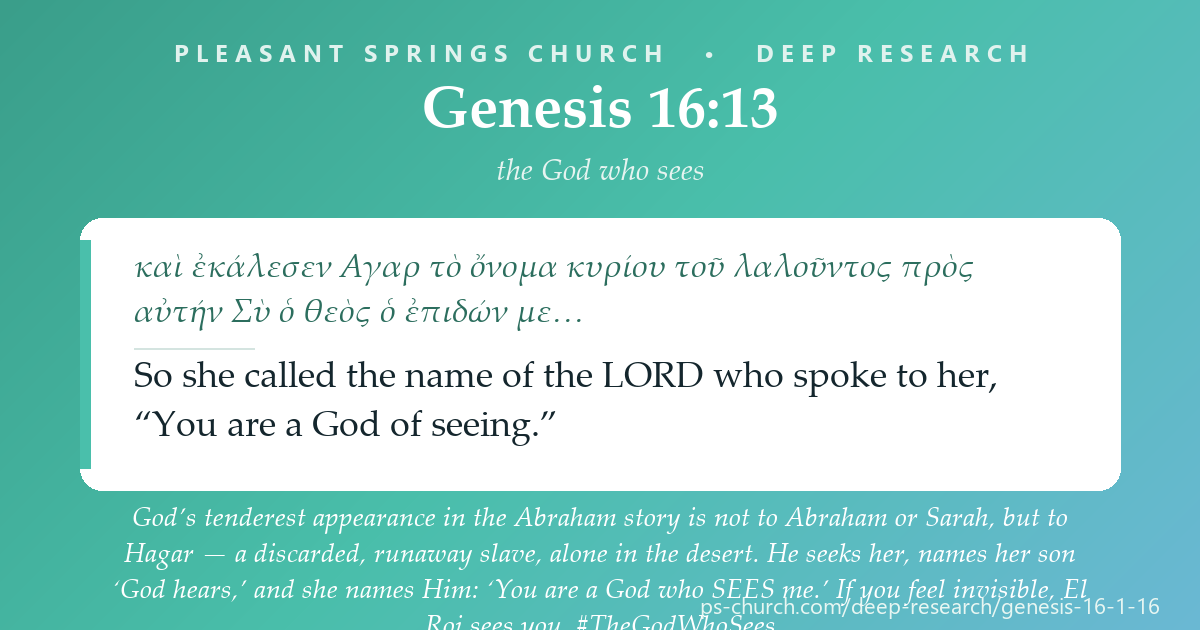
Genesis 16:2, 6–7, 11, 13
Hebrew · LXX · ESVThe Shape of the Passage
ConcentricBetween the covenant of chapter 15 and the covenant sign of chapter 17 stands this painful chapter: a family’s attempt to secure the promise by their own devising, and the mercy of a God who meets the person the family cast aside.
Author
Moses frames the whole episode as a re-run of Eden. Sarai, despairing after ten childless years, says, “the Lord has prevented me from bearing; go in to my servant, that I may be built up (’ibbaneh) by her” — and “Abram listened to the voice of Sarai” (16:2). The wording is a deliberate echo of the fall: “because you listened to the voice of your wife” (3:17); Sarai “took… and gave” (16:3) as Eve “took… and gave” (3:6). The narrator is not condemning marriage or even, in its ancient context, an unusual custom; he is flagging that this is a human scheme to accomplish by the flesh what God had promised to do by grace. Paul will later read it exactly this way — Hagar and her son “born according to the flesh,” over against the child “born through promise” (Gal 4:23).
The scheme curdles. As with every attempt to help God by cutting a corner, the plan produces the opposite of peace. Hagar conceives, and her mistress becomes “slight in her eyes” (16:4); Sarai turns on Abram, then “dealt harshly” with Hagar. The verb is ’innah — the very word used for Egypt’s later affliction of Israel (15:13; Exod 1:11–12). The irony is bitter and deliberate: a Hebrew mistress afflicts an Egyptian slave, a small dark rehearsal, in reverse, of the bondage to come. Hagar “fled” — a pregnant runaway heading “on the way to Shur,” toward Egypt, toward home. The promise-family has fractured, and the most vulnerable person in it is alone in the desert.
The God who seeks and sees. And there, God comes — not to Abram, not to Sarai, but to Hagar. “The angel of the Lord” (the first appearance of this figure in Scripture) finds her at a spring in the wilderness and speaks with startling tenderness: he calls her by name and station (“Hagar, servant of Sarai”), hears her out, and gives her a promise of her own — offspring so many they “cannot be numbered” (16:10, an echo of the promise to Abram). He tells her to name her son Ishmael — “God hears” — “because the Lord has heard your affliction.” The God who seemed absent had been listening all along. Overwhelmed, Hagar responds with one of the most remarkable acts in Genesis: she names God. No one else in the Bible does this. And the name she gives is El Roi — “a God of seeing,” “the God who sees me” — and she marks the well “Beer-lahai-roi,” “the well of the Living One who sees me.” The runaway slave becomes the Bible’s first theologian of God’s seeing grace.
Audience
Israel — who would one day be an afflicted people in a foreign land — are meant to feel the mercy in this scene, and to be humbled by it. The God of Abraham is not only the God of the chosen line; he is the God who sees the used and discarded, who seeks the fugitive in the desert, who hears the cry of the afflicted before anyone else does. That God will one day “see” Israel’s own affliction in Egypt and come down to deliver (Exod 3:7). Hagar’s theophany at the well teaches the covenant people something they will always be tempted to forget: their God’s compassion reaches beyond the boundaries of the elect family, even to a slave from the nation of their future oppressors.
Ishmael blessed, never despised. It matters greatly how we read Ishmael. God blesses him: he will become a great nation of “twelve princes” (17:20), and here God promises to multiply his offspring. The description “a wild donkey of a man” (16:12) is not a slur but a portrait of the free, untamed life of the desert Bedouin — the wild donkey is elsewhere God’s own noble, free creature (Job 39:5–8); and “he shall dwell over against all his kinsmen” means he will live in relationship alongside his brothers, not that he is cursed to endless war. Scripture never sanctions contempt for Hagar or Ishmael or their descendants; on the contrary, it makes them the objects of God’s seeing compassion. The line of the covenant runs through Isaac (Rom 9:7), but the God who chose Isaac is the same God who wept over Hagar and heard her son. And in the fullness of time, the middle wall between Jew and Gentile would be torn down in Christ (Eph 2:14), gathering into one family the descendants of both the promise and the flesh.
Orient on Hagar, the angel of the LORD, barrenness, and El Roi.
Search by topic: Hagar, Ishmael, angel of the LORD, barrenness, God Most High / names of God.
Which articles are relevant?
- Anchor Bible Dictionary — “Hagar,” “Ishmael,” “Angel of the LORD,” “Names of God.”
- Dictionary of the OT: Pentateuch — “Hagar,” “Angel of the Lord,” “Barrenness,” “Abraham.”
- NIDOTTE / TDOT — mal’ak YHWH (angel of the LORD), ’innah (afflict), ra’ah (see), shama’ (hear).
Bibliography surfaced:
- Gordon Wenham (WBC), Victor Hamilton (NICOT), Kenneth Mathews (NAC), Bruce Waltke, Nahum Sarna (JPS) on Genesis.
- Studies of the “angel of the LORD”; Phyllis Trible and others on the Hagar narrative; Paul’s Galatians 4 reading.
- Beale & Carson, Commentary on the NT Use of the OT (Galatians 4; Romans 9).
The surrogate scheme, the angel of the LORD, and the God who sees.
Read the servant-scheme, the wilderness theophany, and Hagar’s naming of God against their Ancient Near Eastern backdrop.
Which parallels shed light on religion and worldview?
The servant-surrogate. Ancient Near Eastern law codes and marriage contracts (from Mesopotamia and elsewhere) do provide for a barren wife to give her maidservant to her husband so that the resulting child counts as the wife’s — “that I may be built up by her.” So Sarai’s plan was not, in its own world, scandalous; it was a recognized legal remedy for childlessness. But Genesis is not interested in whether the custom was legal; it is interested in whether it was faith. The problem is not that Sarai broke a law but that she and Abram tried to secure by human contrivance what God had promised to give by grace — “the son of the slave was born according to the flesh” (Gal 4:23). The scene is a warning that runs through the whole Bible: our schemes to help God keep his promises, however reasonable and even lawful, tend to breed the very grief they meant to avoid.
The angel of the Lord. This chapter contains the Bible’s first “angel of the Lord” (mal’ak YHWH), and the text handles the figure in a way worth noticing carefully. The angel speaks as God (“I will multiply your offspring,” 16:10), and Hagar responds by naming “the Lord who spoke to her” — identifying the messenger with the Lord himself. Yet the term “angel” (messenger) also holds a distinction. Scripture presents this identification-yet-distinction without resolving it into a formula, and it is wise not to force it. Christians have often seen in the angel of the Lord a genuine self-manifestation of God, and some a foreshadowing of the Son who would come; but the text itself simply lets the mystery stand — God is truly present and truly speaking to Hagar, in a way that is both the Lord and his sent messenger. What is not in doubt is the tenderness: God came to the outcast in person.
‘You are a God who sees me.’ Hagar’s response is unique in Scripture: she gives God a name. Prophets receive God’s name; patriarchs build altars to it; but only Hagar — a foreign, female, enslaved fugitive, the lowest person imaginable in that society — presumes to name the God who found her, and God accepts it. She calls him El Roi, “a God of seeing” / “the God who sees me,” and marvels that she has “seen” and yet lived. (The Hebrew of her second sentence is famously difficult, hovering between “I have seen God” and “I have seen the back of the One who sees me”; the ESV renders “him who looks after me.”) The point shines through the difficulty: the God of the covenant is a God who sees — not with cold observation, but with the seeing that leads to rescue. He saw Hagar in her affliction as he would one day see his people in Egypt (Exod 2:25; 3:7). And she names the well after it: Beer-lahai-roi, “the well of the Living One who sees me” — a place where, fittingly, the child of promise Isaac would later make his home (24:62; 25:11).
- Genesis 3:6, 17; 15:1–6; 21:1–21 — the Eden echoes (listened / took / gave); the promise Sarai tried to force; the later casting-out and rescue of Hagar and Ishmael: the frame around the scheme (see the covenant cut).
- Exodus 2:23–25; 3:7–9 — God “saw” and “heard” the affliction of his people: the same seeing-and-hearing God, now toward Israel.
- Galatians 4:21–31; Romans 9:6–9 — Hagar and the child of the flesh vs. the child of promise; “through Isaac shall your offspring be named”: Paul’s reading of the two sons.
It is worth pausing to feel the sheer improbability of who receives this revelation. In a story about the founding family of the covenant, God’s tenderest personal appearance in these chapters is given not to Abraham, the father of the faithful, nor to Sarah, the mother of the promise, but to Hagar — a slave, a woman, a foreigner, a runaway, pregnant and afraid in the desert, a person with no rights and no future, discarded by the very family God had chosen. And to her God comes. He calls her by her name. He listens to her. He gives her a promise of her own and a son whose very name will mean ‘God hears.’ And she, of all people, is granted the privilege no one else in Scripture receives: she names God. The lesson is one the people of God have needed in every generation, because we so easily assume that God’s attention follows the world’s hierarchies — that he sees the important, the chosen, the powerful, and overlooks the servant in the shadows. Hagar’s well says otherwise. The God of Abraham is El Roi, the God who sees, and the ones he sees most tenderly are precisely the ones the world does not see at all: the used, the cast-off, the afflicted, the fugitive at the end of her rope. If you have ever felt invisible — overlooked, discarded, alone with a grief no one noticed — Hagar’s discovery is for you. There is a God who sees you, who has been hearing your affliction all along, and who comes, not to the strong in their strength, but to the broken in their need.
The vocabulary of the scheme, the seeking angel, and the God who sees.
Watch the “built up,” the “afflicted,” the first “angel of the Lord,” the “God hears,” and the “God who sees me.”
“I may be built up” (Niphal of banah, punning ben, “son”) — Sarai’s hope to build a family through Hagar. A human scheme to secure by the flesh what God promised by grace; “Abram listened to the voice of Sarai” echoes the fall (3:17).
“She dealt harshly / afflicted her” (Piel of ’anah) — the very verb for Egypt’s affliction of Israel (15:13; Exod 1:11). A bitter irony: the Hebrew mistress afflicts the Egyptian slave, a small reverse-rehearsal of the bondage to come.
“The angel of the Lord” — the FIRST in Scripture. Speaks as God (“I will multiply,” 16:10), yet is called “messenger”: a genuine self-manifestation of God, identification-yet-distinction, best left as Scripture presents it. God comes to the outcast in person.
“God hears” (El + shama’) — “because the Lord has heard your affliction”; the name embeds the God who was listening when he seemed absent. Ishmael is blessed (17:20), never cursed.
“A God of seeing” / “the God who sees me” (El, ordinary “God”). Hagar — a foreign slave — becomes the ONLY person in Scripture to name God, and the name is his seeing grace: he sees the afflicted, as he will see his people in Egypt (Exod 3:7).
“The well of the Living One who sees me” — the well named after Hagar’s theophany. Fittingly, the child of promise Isaac later settles there (24:62; 25:11): the place of God’s seeing mercy becomes home ground for the covenant line.
How the rest of Scripture fills out the God who sees:
- Genesis 21:8–21; 25:12–18 — God again hears Hagar and Ishmael in the wilderness; Ishmael’s twelve princes: the promise to Hagar kept.
- Exodus 2:23–25; 3:7–9; Psalm 34:15, 17–18 — God sees and hears the afflicted; near to the brokenhearted: the same seeing-and-hearing God.
- Galatians 4:21–31; Romans 9:6–9 — the child of the flesh vs. the child of promise; election through Isaac: Paul’s reading (see the covenant cut).
- Ephesians 2:11–22; Isaiah 60:6–7 — the wall between Jew and Gentile torn down; the descendants of Ishmael (Kedar, Nebaioth) bringing gifts: the outcasts gathered in.
From a self-help scheme to the God who sees the outcast.
Trace the works-scheme, the wilderness mercy, and God’s seeing compassion across Scripture.
Which cross-references matter?
- Genesis 15; 17; 21:1–21 — the covenant and its sign around this chapter; the birth of Isaac and the later rescue of Hagar and Ishmael: the promise God keeps his own way (see the covenant, the covenant of circumcision).
- Exodus 2:23–3:9; Deuteronomy 26:7 — God seeing and hearing Israel’s affliction: the seeing-and-hearing God, now toward the covenant people.
- Galatians 4:21–31; Romans 9:6–9 — the flesh vs. the promise; election through Isaac: the two sons interpreted (see justified by faith).
- Psalm 34:15–18; Luke 1:48–53; John 4:1–42 — God near the lowly; the Lord who meets an outcast woman at a well: the seeing grace of Genesis 16 fulfilled.
- Ephesians 2:11–22; Revelation 7:9 — the dividing wall abolished; a people from every nation: the outcasts gathered into one family (see the Lamb).
Genesis 16 is, at one level, a study in what happens when the people of God grow tired of waiting and decide to arrange the fulfillment of God’s promises for themselves. Ten years have passed since the promise of a son, and Sarah’s womb is still closed, and the plan she proposes is, by every worldly and even legal standard, sensible: use the maid, secure the heir, solve the problem. It is the sort of practical, reasonable step faith is always tempted to take when the promise is slow. And it is precisely the step Paul names as ‘the flesh’ — not necessarily gross sin, but the attempt to accomplish God’s ends by human devising rather than trust. The results are the perennial results of the flesh: not the promised peace but jealousy, contempt, harshness, flight, and a wound in the family that will ache for generations. And yet — and this is the wonder of the chapter — even the mess we make when we stop trusting does not fall outside the reach of God’s grace. The child of the scheme is not abandoned; he is blessed. The slave the family used and discarded is not overlooked; she is sought out, named, and given a promise of her own. God does not undo the consequences of the flesh — Ishmael and Isaac will not easily share a tent — but neither does he withhold his mercy from those the flesh has harmed. He remains the God who sees. And that is the double lesson of Hagar’s well: wait for the promise, and do not try to seize it by the flesh; but if you have already grasped, and the grasping has cost you, know that the God who sees is not finished with any of the people your failure touched — least of all the ones left crying in the wilderness.
The scholarship on Genesis 16:1-16.
The commentators on the Hagar narrative; the studies of the angel of the LORD, the surrogate custom, and Paul’s Galatians 4 reading.
Commentaries & studies:
- Gordon J. Wenham (WBC), Victor P. Hamilton (NICOT), Kenneth A. Mathews (NAC), Bruce K. Waltke, Nahum M. Sarna (JPS) on Genesis.
- Studies of the “angel of the LORD”; Phyllis Trible, Texts of Terror (the Hagar narrative); treatments of the ANE surrogate custom.
- G. K. Beale & D. A. Carson, eds., Commentary on the NT Use of the OT (Galatians 4; Romans 9).
Interpretation notes worth keeping:
- Flesh, not faith. The surrogate scheme was a recognized ANE custom, but the narrator flags it (Eden echoes: “listened… took… gave”) as securing by the flesh what God promised by grace — Paul’s reading (Gal 4:23). Not a condemnation of Sarah’s worth, but of the works-scheme.
- Angel of the Lord. Speaks as God yet is called “messenger” — a genuine divine self-manifestation, identification-yet-distinction; hold it as Scripture presents it, without forcing a Trinitarian formula (some see a foreshadow of the Son; the text leaves the mystery open).
- El Roi. Hagar — a foreign slave — is the only person in Scripture to name God; “a God of seeing” (El, ordinary “God”). The second clause of 16:13 is famously difficult; render per ESV and flag the difficulty rather than overclaiming.
- Ishmael blessed, not cursed. God blesses Ishmael (17:20; a great nation, twelve princes). “Wild donkey of a man” = the free Bedouin life (Job 39), not a slur; “dwell over against his kinsmen” = alongside, not endless war. Scripture never sanctions contempt for Hagar, Ishmael, or their descendants.
- The God who sees. God comes to the outcast first; he “sees” and “hears” the afflicted (16:11, 13) as he will Israel in Egypt (Exod 3:7) — his compassion reaches beyond the elect line.
From the flesh's grief to the God who sees you.
Name what you learned, why it matters, and one concrete response.
What should we carry away — and do?
- The flesh cannot secure the promise. Sarai’s reasonable scheme bred jealousy, harshness, and a lasting wound. Our attempts to help God keep his promises tend to breed the very grief they mean to avoid.
- God sees the invisible. His tenderest appearance in these chapters is to a discarded slave in the desert. The God of Abraham is El Roi — he sees the used, the overlooked, the afflicted, and comes to them first.
- Mercy crosses the line. Ishmael is blessed, Hagar is heard; God’s compassion reaches beyond the elect family. In Christ the wall between the peoples comes down.
Step in response: stop trying to force by the flesh what God has promised by grace — and wait, trusting the God who keeps his word his own way. And if you feel invisible — overlooked, discarded, alone with a grief no one has noticed — bring it to El Roi, the God who sees you, who has been hearing your affliction all along. Then go and see as he sees: seek out the Hagar in your own world, the person everyone else has looked past, and let her know she is not invisible to God.
Genesis 16:13 · to share
LXX + ESVEvery Deep Research page traces its passage across the whole sweep — the Old Testament, the Second-Temple world between the testaments (historical witnesses, not Scripture), and the New Testament. Follow the thread:
Pleasant Springs Church — Deep Research
Research method after Michael S. Heiser’s Bible Research Method (examine dictionaries → ancient literature → important words → textual connections → academic publications → share), with the Pleasant Springs “Author & Audience” foundation. Scripture set in the Hebrew, the Greek editions named on each page and the ESV (Old Testament), and the Greek New Testament and the ESV (New Testament), per the practice of Pleasant Springs Church. Genesis 16:1–16 research grounded in Wenham, Hamilton, Mathews, Waltke, and Sarna, with Trible on the Hagar narrative; the surrogate scheme read (with the Eden echoes “listened… took… gave”) as securing by the flesh what God promised by grace — Paul’s reading (Gal 4:23), not a condemnation of Sarah’s worth; the first “angel of the Lord” as a genuine divine self-manifestation (identification-yet-distinction), held as Scripture presents it without forcing a Trinitarian slot; El Roi (“a God of seeing,” ordinary “God”) — Hagar the only person in Scripture to name God, the difficult second clause of 16:13 rendered per the ESV and its difficulty flagged; Ishmael emphatically blessed, not cursed (17:20), “wild donkey of a man” = the free Bedouin life (Job 39) not a slur, with no sanction anywhere for contempt of Hagar, Ishmael, or their descendants; the God who “sees” and “hears” the afflicted outcast (16:11, 13) as he will Israel in Egypt (Exod 3:7); small-caps Lord only for the Tetragrammaton (16:2, 5, 7, 9, 10, 11, 13).
Scripture quotations marked ESV are from the ESV® Bible (The Holy Bible, English Standard Version®), © 2001 by Crossway, a publishing ministry of Good News Publishers. ESV Text Edition: 2016. Used by permission. All rights reserved. The ESV text may not be quoted in any publication made available to the public by a Creative Commons license, and the ESV may not be translated in whole or in part into any other language. www.esv.org
|
Did this study bless you today? 💚 Give to Support PS Church100% of gifts go to the General Fund — thank you. |