Thirteen years of silence break, and the Lord appears to the ninety-nine-year-old Abram as “God Almighty”: “walk before me, and be blameless.” He seals the everlasting covenant with new names — Abram becomes Abraham, Sarai becomes Sarah — and a sign cut in the body: circumcision. Its heart is a son, Isaac, whom barren Sarah will bear within the year (Ishmael too is blessed). But Paul notes the order: Abraham was counted righteous by faith years before he was circumcised — so the sign seals a righteousness already received, pointing to the circumcised heart. This study works Genesis 17:1–27. See the method →
Genesis 17:1, 5, 7, 11, 19
Hebrew · LXX · ESVThe Shape of the Passage
Parallel panelsAfter the failure of the Hagar scheme (ch. 16), God returns — not to scold, but to establish. Chapter 17 is the formal covenant document: new names, a body-sign, an everlasting promise, and a clear word about which son the covenant runs through. It is God re-founding the relationship on his own terms and his own power.
Author
Moses marks the moment’s weight: thirteen years of silence have passed since Ishmael’s birth, and now, when Abram is ninety-nine and any natural hope of a son by Sarai is long gone, “the Lord appeared to Abram and said, ‘I am El Shaddai’” — “God Almighty.” The name is the point: the covenant about to be sealed will be kept not by Abram’s vigor (long spent) but by Almighty God. On that foundation comes the call: “walk before me, and be blameless” — a life lived in God’s presence and toward wholeness. Notice the order: the Almighty God acts first and promises first; the call to obedient walking follows from grace, it does not earn it.
New names, everlasting covenant. God then formally “establishes” his covenant — a berit ’olam, an “everlasting covenant” — and marks it with new names. Abram (“exalted father”) becomes Abraham, explained by a wordplay as “father of a multitude of nations”; Sarai becomes Sarah (for whom, unlike Abraham, the text gives no explanation). To rename someone in the ancient world was to claim and reshape them; here God stamps his promise into the couple’s very identity, so that every time their names are spoken the promise is preached. And the covenant’s core is the most intimate promise in the Bible: “to be God to you and to your offspring after you” (17:7) — the covenant formula that will echo through Scripture (“I will be their God, and they shall be my people”) all the way to the new creation (Rev 21:3).
The sign in the flesh — and its order. The covenant is given a sign: circumcision, cut into the flesh of every male, an ’ot berit, a “sign of the covenant.” It marks the covenant people in their bodies, at the very source of the offspring the covenant is about. But the New Testament insists on getting the order right, and it is everything. Abraham had already been “counted righteous” by faith back in chapter 15 (15:6) — years before this circumcision. So Paul argues: circumcision was “a sign… a seal of the righteousness that he had by faith while he was still uncircumcised” (Rom 4:11). The sign does not create the righteousness; it certifies a righteousness already received by faith. This makes Abraham the father of two families — believing Jews who are circumcised, and believing Gentiles who are not — united not by the flesh-mark but by the faith it sealed. The physical sign always pointed beyond itself to “circumcision of the heart” (Deut 30:6; Rom 2:29), the inward reality God works in his people.
Audience
Israel — the circumcised people — are given, in their founding charter, both their identity and its meaning. The mark in their flesh was a perpetual sermon: you belong to God by covenant, and you belong by grace received in faith, not by achievement. The prophets and the New Testament will repeatedly warn against trusting the outward sign while neglecting the inward reality — against “uncircumcised hearts” behind circumcised bodies (Jer 9:25–26; Rom 2:28–29). The sign was never the substance; it was the seal of the substance.
Isaac, not Ishmael — and Ishmael blessed. Abraham, laughing in wonder (and perhaps disbelief), pleads, “Oh that Ishmael might live before you!” — naturally attached to the son he already has. But God is clear: the covenant will be established “with Isaac” (17:21), the son of promise Sarah will bear — the elective particularity Paul builds on (“through Isaac shall your offspring be named,” Rom 9:7). Yet in the same breath God blesses Ishmael: “I have heard you… I will make him fruitful… twelve princes… a great nation” (17:20). This is the pattern of biblical election: God chooses one line to carry the promise for the sake of all, and his choice of Isaac is never a rejection of Ishmael as a person — who receives genuine, tender blessing. The covenant narrows to Isaac so that, in the end, it may widen to “a multitude of nations” — the very meaning of Abraham’s new name, fulfilled when the gospel makes children of Abraham “those who are of faith” from every people on earth (Gal 3:7–9).
Orient on covenant, circumcision, the names of God, and Isaac.
Search by topic: covenant, circumcision, God Almighty (El Shaddai), name-change, Isaac / Ishmael.
Which articles are relevant?
- Anchor Bible Dictionary — “Covenant,” “Circumcision,” “El Shaddai,” “Abraham.”
- Dictionary of the OT: Pentateuch — “Covenant,” “Circumcision,” “Names of God,” “Isaac.”
- NIDOTTE / TDOT — berit (covenant), mul (circumcise), ’ot (sign), Shaddai (Almighty).
Bibliography surfaced:
- Gordon Wenham (WBC), Victor Hamilton (NICOT), Kenneth Mathews (NAC), Bruce Waltke, Nahum Sarna (JPS) on Genesis.
- Studies of the Abrahamic covenant, circumcision, and Paul’s argument in Romans 4 (sign and seal) and Galatians 3.
- Beale & Carson, Commentary on the NT Use of the OT (Romans 4; 9; Galatians 3).
The Almighty, the covenant sign, and the order of faith and sign.
Read El Shaddai, the name-changes, and circumcision against their Ancient Near Eastern and canonical backdrop.
Which parallels shed light on religion and worldview?
Covenant by an Almighty God. The name “El Shaddai” (traditionally “God Almighty”) is the patriarchs’ special name for God (Exod 6:3), and its placement here is deliberate. Abram is ninety-nine; Sarai is far past childbearing; the promise of a son by her is, humanly, absurd. Precisely there God names himself “the Almighty.” The covenant is not a partnership of equals in which God supplies the promise and Abraham supplies the ability; it is the gift of an all-powerful God who will do what no human power can. This is why the appropriate response is “walk before me” — not “achieve for me.” The whole covenant runs on Almighty grace, and the obedient walk is the grateful shape of a life lived in the presence of such a God.
The sign in the body. Circumcision was practiced by several peoples in the ancient Near East, but Israel’s form was distinctive in its meaning: it was the sign of a covenant with the one true God, applied to every male, on the eighth day, marking membership in the covenant community at the very source of the offspring. It was, so to speak, the promise written into the reproductive flesh — a bodily confession that the coming generations belonged to God and depended on his covenant, not on human potency. And it was costly and permanent: you carried the covenant in your body for life. Yet the prophets never let the sign become a substitute for the heart. To be circumcised in flesh but “uncircumcised in heart” was worthless (Lev 26:41; Jer 9:25–26); the sign always pointed to the inward reality of a heart devoted to God (Deut 10:16; 30:6), which the new covenant would finally give (Rom 2:29; Col 2:11).
Faith before the sign — Paul’s hinge. The single most important observation the New Testament makes about this chapter is a matter of chronology. Abraham believed God and it was “counted to him as righteousness” in Genesis 15:6 — and he was not circumcised until Genesis 17, some years later. Paul seizes on this order and makes it the foundation of the gospel: “How then was it counted to him? Was it before or after he had been circumcised? It was not after, but before” (Rom 4:10). Therefore Abraham’s righteousness did not come from the sign; the sign was a “seal” certifying a righteousness he already had by faith. This means the father of the faithful is the father of all who believe — circumcised or not — and that justification has always been by faith, never by the flesh-mark. Genesis 17, read in its own sequence, is one of the great biblical charters of grace: the sign seals the faith; it does not replace it.
- Genesis 15:6; 12:1–3; Exodus 6:2–3 — Abraham counted righteous by faith (before circumcision); the promise to bless all nations; El Shaddai the patriarchs’ name: the grace behind the sign (see the covenant cut).
- Deuteronomy 10:16; 30:6; Jeremiah 9:25–26; Leviticus 26:41 — circumcision of the heart; the worthlessness of the outward sign without the inward reality: the sign pointing beyond itself.
- Romans 4:9–12; 2:28–29; Colossians 2:11–12; Galatians 3:7–9 — the sign “seal” of faith-righteousness; heart-circumcision by the Spirit; children of Abraham by faith: the New Testament’s reading (see just and the justifier).
Everything hangs, in the end, on the order of two chapters. In Genesis 15 Abraham believes God, and God credits it to him as righteousness — a righteousness received by faith alone, with no ritual, no mark, no work involved, nothing but a man taking God at his word under the stars. Only afterward, in Genesis 17, does God give the sign of circumcision. And Paul, reading his Bible with the care of a lawyer, notices that this sequence cannot be reversed or blurred, and that it settles the deepest question of the gospel. If Abraham had been justified by being circumcised, then righteousness would come through a work of the flesh, and only the circumcised could ever have it. But Abraham was justified before he was circumcised — while he was, in that respect, no different from any uncircumcised Gentile. So the sign came to seal a righteousness he already possessed, the way a king’s seal certifies a document already written; it added nothing to the righteousness, it authenticated it. And that means the door was open, from the very beginning, to all who share Abraham’s faith, marked or unmarked in the flesh. The circumcised believer and the uncircumcised believer stand on exactly the same ground: not the ground of the sign, but the ground of the faith the sign sealed. This is why the Christian can look at Genesis 17 — a chapter about a very physical, very Jewish rite — and hear the gospel in it. The rite was never the righteousness. It pointed, always, to a heart made new, and to the day when God would circumcise the hearts of a people drawn from every nation, so that Abraham would truly become what his new name promised: the father of a multitude.
The vocabulary of the Almighty, the covenant, and the sign.
Watch “God Almighty,” “walk before me,” the new names, the “everlasting covenant,” the “sign,” and Isaac.
“God Almighty” — the patriarchs’ special name for God (Exod 6:3), placed here when Abram is 99 and a son by Sarai is humanly impossible. The covenant rests on Almighty grace, not Abram’s vigor. (An El-compound = ordinary “God,” not the Tetragrammaton; the LXX renders it “I am your God,” not “Almighty.”)
“Walk before me” — a habitual life lived in God’s presence (as Enoch and Noah “walked with God,” 5:24; 6:9), followed by “be blameless” (tamim, whole/complete). The obedient walk flows from the Almighty’s covenant grace; it does not earn it.
“Father of a multitude of nations” — the wordplay explaining Abraham (a theological etymology, not strict philology). The covenant narrows to one man precisely so it may widen to all nations — fulfilled when the gospel makes “those of faith” his children (Gal 3:7).
“Everlasting covenant” — its core the covenant formula “to be God to you and to your offspring,” echoing through Scripture (“I will be their God”) to the new creation (Rev 21:3). (The LXX renders berit as diathēkē, “testament” — weighty for Heb 8–9.)
“Sign of the covenant” — circumcision, cut in the flesh at the source of the offspring. Paul: a “sign… a seal of the righteousness he had by faith while still uncircumcised” (Rom 4:11) — it certifies a righteousness already received, pointing to circumcision of the heart (Deut 30:6; Rom 2:29).
“He laughs” — from Abraham’s laughter of wonder (17:17; cf. Sarah, 18:12; 21:6). The covenant is established with Isaac, the son of promise (Rom 9:7) — not by God rejecting Ishmael, who is genuinely blessed (17:20), but by narrowing the promise-line for the sake of all nations.
How the rest of Scripture fills out the covenant:
- Genesis 15:6; 18:9–15; 21:1–7 — Abraham’s faith counted righteous; the promise of Isaac renewed and fulfilled: the grace behind the sign (see the covenant cut).
- Deuteronomy 10:16; 30:6; Jeremiah 4:4; 9:25–26 — circumcision of the heart; the flesh-sign worthless without the inward reality: the sign’s true aim.
- Romans 4:9–12; 2:25–29; Galatians 3:6–9, 29; Colossians 2:11–12 — sign as seal of faith-righteousness; heart-circumcision by the Spirit; children of Abraham by faith; the “circumcision of Christ”: the fulfillment (see justified by faith).
- Romans 9:6–9; Genesis 21:8–21 — the covenant through Isaac; Ishmael blessed and heard: election for the sake of all, without rejecting Ishmael as a person.
From a sign in the flesh to a circumcised heart in every nation.
Trace the covenant, its sign, and its true aim from Genesis to its fulfillment in Christ.
Which cross-references matter?
- Genesis 12:1–3; 15:1–21; 22:15–18 — the promise, the faith counted righteous, the covenant sworn: the grace the sign seals (see the call, the covenant, the Akedah).
- Deuteronomy 10:16; 30:6; Jeremiah 31:31–34; Ezekiel 36:26–27 — the circumcised heart and the new heart of the new covenant: the inward reality the sign pointed to (see the new covenant, a new heart).
- Romans 4:9–25; Galatians 3:6–29; Colossians 2:11–12 — the father of all who believe; children of Abraham by faith; buried and raised with Christ in baptism: the covenant fulfilled (see just and the justifier).
- Romans 9:6–13; Galatians 4:21–31 — the covenant through Isaac, the child of promise: election and the two sons (see Hagar and Ishmael).
- Revelation 21:3, 7 — “I will be their God, and they will be my people… my son”: the covenant formula of 17:7 consummated (see the new creation).
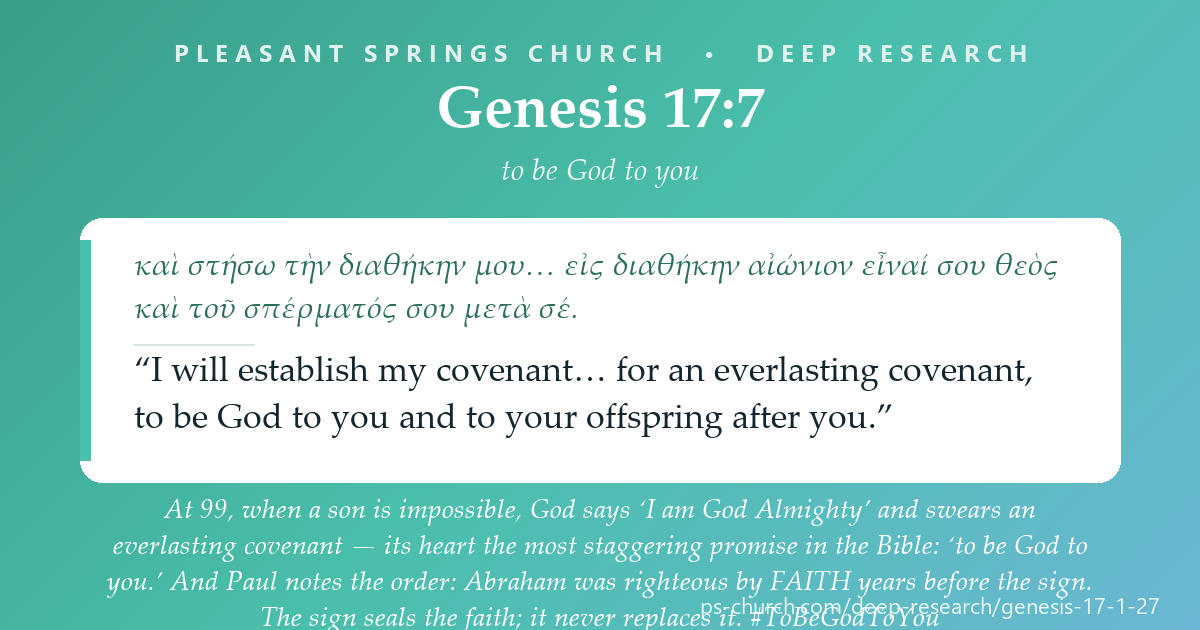
At the center of the covenant God makes with Abraham stands a single clause that is easy to read past and impossible to exhaust: ‘to be God to you and to your offspring after you.’ Everything else in the chapter — the new names, the promise of nations and kings, the land, even the sign cut in the flesh — serves this one thing: God binding himself, by an everlasting covenant, to be God to a people. It is the most staggering promise in the Bible, because it is God pledging not merely to give things to his people but to give himself — to be their God, which is to say their portion, their protector, their treasure, their home. This clause becomes the refrain of the whole covenant story: ‘I will be their God, and they shall be my people.’ It is spoken to Israel at Sinai, renewed by the prophets in the ruins of exile, deepened in the new covenant where God writes his law on the heart, and it does not reach its final form until the very last pages of Scripture, where the loud voice from the throne declares over the new creation: ‘Behold, the dwelling place of God is with man… and God himself will be with them as their God.’ Genesis 17 is where that promise is first formally sworn, and the sign of circumcision was its ancient seal — a mark in the body saying, in effect, ‘this one belongs to the God who has bound himself to be his God forever.’ The sign has passed; the promise has only deepened. To be a Christian is to have been brought, by faith, inside that ancient clause — to have the God of Abraham say to you, ‘I will be your God’ — and to know that the covenant which began with a barren couple and a knife will end with God at home among his people forever.
The scholarship on Genesis 17:1-27.
The commentators on the covenant of circumcision; the studies of El Shaddai, the name-changes, and Paul’s sign-and-seal argument.
Commentaries & studies:
- Gordon J. Wenham (WBC), Victor P. Hamilton (NICOT), Kenneth A. Mathews (NAC), Bruce K. Waltke, Nahum M. Sarna (JPS) on Genesis.
- Studies of the Abrahamic covenant and circumcision; treatments of Romans 4 (sign/seal), Galatians 3, and Colossians 2.
- G. K. Beale & D. A. Carson, eds., Commentary on the NT Use of the OT (Romans 4; 9; Galatians 3).
Interpretation notes worth keeping:
- Almighty grace, then walking. El Shaddai (17:1) grounds the covenant in God’s power (Abram is 99); “walk before me and be blameless” follows from grace — the obedient walk is the shape of gratitude, not the earning of the covenant. (El Shaddai = ordinary “God”; the LXX reads “I am your God,” not “Almighty.”)
- Faith before the sign. Abraham was counted righteous (15:6) before circumcision (ch. 17); Paul makes the order decisive — circumcision is a “sign… seal” of faith-righteousness (Rom 4:11), never its cause. This is a charter of justification by faith.
- Sign, not substance. The flesh-mark always pointed to circumcision of the heart (Deut 30:6; Rom 2:29); circumcised bodies with “uncircumcised hearts” were condemned. The sign has passed; the inward reality (by the Spirit, Col 2:11) remains.
- The covenant formula. “To be God to you and to your offspring” (17:7) is the heart of the covenant — God giving himself — echoing to the new creation (Rev 21:3, 7).
- Isaac, and Ishmael blessed. The covenant is with Isaac (17:21; Rom 9:7), but Ishmael is genuinely blessed (17:20 — a great nation, twelve princes). Election of one line is for the sake of all nations (17:5; Gal 3:7–9), not the rejection of Ishmael as a person. Name-changes: Abraham a wordplay on “multitude”; Sarah given no etymology — don’t invent one.
From a sign in the flesh to the God who binds himself to you.
Name what you learned, why it matters, and one concrete response.
What should we carry away — and do?
- The covenant runs on Almighty grace. God introduces himself as El Shaddai when a son is humanly impossible. What he promises, he will do — and the call to “walk before me” flows from his grace, it does not earn it.
- The sign seals a faith it does not create. Abraham was righteous by faith before he was circumcised. Signs, rituals, and marks certify a righteousness received by trust — they never replace it.
- God binds himself to be your God. The covenant’s heart is God giving himself — “to be God to you.” It began with a barren couple and ends with God at home among his people forever.
Step in response: examine whether you are trusting a sign or the substance — leaning on baptism, church membership, or outward religion as if the mark were the righteousness. Return to the ground Abraham stood on: a righteousness received by faith, sealed but never earned by any sign. And let the covenant formula do its work on you: the Almighty God has bound himself, in Christ, to be your God — so “walk before him,” not to earn his covenant, but as the grateful shape of belonging to him.
Genesis 17:7 · to share
LXX + ESVEvery Deep Research page traces its passage across the whole sweep — the Old Testament, the Second-Temple world between the testaments (historical witnesses, not Scripture), and the New Testament. Follow the thread:
Pleasant Springs Church — Deep Research
Research method after Michael S. Heiser’s Bible Research Method (examine dictionaries → ancient literature → important words → textual connections → academic publications → share), with the Pleasant Springs “Author & Audience” foundation. Scripture set in the Hebrew, the Greek editions named on each page and the ESV (Old Testament), and the Greek New Testament and the ESV (New Testament), per the practice of Pleasant Springs Church. Genesis 17:1–27 research grounded in Wenham, Hamilton, Mathews, Waltke, and Sarna; the covenant grounded in El Shaddai’s power (Abram at 99), with “walk before me and be blameless” flowing from grace, not earning it (El Shaddai = ordinary “God”; the LXX renders “I am your God,” not “Almighty”); the decisive faith-then-sign order — Abraham counted righteous (15:6) before circumcision (ch. 17), so the sign is a “seal” of faith-righteousness (Rom 4:11), never its cause; the flesh-mark always pointing to circumcision of the heart (Deut 30:6; Rom 2:29; Col 2:11); the covenant formula “to be God to you and your offspring” (17:7) as its heart, echoing to Rev 21:3, 7; the covenant established with Isaac (17:21; Rom 9:7) while Ishmael is genuinely blessed (17:20), election of one line being for the sake of all nations (17:5; Gal 3:7–9), not a rejection of Ishmael; Abraham’s name a wordplay on “multitude,” Sarah given no etymology; small-caps Lord only for the Tetragrammaton at 17:1.
Scripture quotations marked ESV are from the ESV® Bible (The Holy Bible, English Standard Version®), © 2001 by Crossway, a publishing ministry of Good News Publishers. ESV Text Edition: 2016. Used by permission. All rights reserved. The ESV text may not be quoted in any publication made available to the public by a Creative Commons license, and the ESV may not be translated in whole or in part into any other language. www.esv.org
|
Did this study bless you today? 💚 Give to Support PS Church100% of gifts go to the General Fund — thank you. |