Amid the ruin of Jerusalem, Jeremiah announces something new: a covenant God will write not on stone but on the heart. “I will put my law within them… and I will remember their sin no more.” It answers the deepest problem of the Old Testament — a people who cannot keep covenant — with a promise only God can fulfill. The New Testament quotes it in full (Hebrews 8) and hears it sealed the night Jesus lifted the cup: “the new covenant in my blood.” This study works Jeremiah 31 from tablets of stone to tablets of the heart. See the method →
Jeremiah 31:31–34 (selections)
Hebrew · LXX · ESVThe Shape of the Passage
SequenceJeremiah prophesied through Judah’s last days and the fall of Jerusalem (587 BC). Chapters 30–33, the “Book of Consolation,” promise restoration — and, at its center, a covenant unlike the one Israel broke.
Author
The prophet Jeremiah ministered as Judah collapsed under Babylon. Most of his book is warning and lament; but chapters 30–33 turn to hope. The new-covenant oracle (31:31–34) is the summit: the old covenant, written on tablets and repeatedly broken (31:32), will give way to a covenant God writes within — on the heart — so that knowing and obeying God flow from a transformed inner life, and sins are forgiven and forgotten.
What is “new.” The content is not a different law; the newness is in its internalization (law on the heart), its universality (“all shall know me”), and its finality of forgiveness (“remember their sin no more”). It answers the problem the whole Old Testament exposes — a people who cannot keep covenant — with a promise only God can fulfill.
Audience
Judah in exile and ruin — a people whose covenant-breaking had brought the very judgment they were living through. To them, the promise of a covenant that cannot be broken because God himself writes it within was almost too good to believe: not another chance to fail, but a new heart and a clean slate.
How they heard it. The exiles clung to it as the ground of return and renewal. Some later communities (like the group behind the Dead Sea Scrolls) even called themselves people of “the new covenant.” And the earliest church heard it fulfilled in Jesus, who at the Last Supper named the cup “the new covenant in my blood” — and whose Spirit writes God’s law on human hearts (2 Cor 3).
Orient on covenant, the new covenant, forgiveness, and the heart.
Search by topic: new covenant, covenant, forgiveness, heart, Jeremiah.
Which articles are relevant?
- Anchor Bible Dictionary — “Covenant,” “New Covenant,” “Forgiveness,” “Jeremiah.”
- Dictionary of the OT: Prophets — “Covenant,” “New Covenant,” “Heart,” “Restoration.”
- NIDOTTE / TDOT — בְּרִית (bərîṯ, covenant), חָדָשׁ (ḥāḏāš, new), לֵב (lēḇ, heart), סָלַח (sālaḥ, forgive).
Bibliography surfaced:
- J. A. Thompson (NICOT), F. B. Huey (NAC), Jack Lundbom (Anchor) on Jeremiah.
- Studies of the new covenant and its NT reception (Hebrews 8; 2 Corinthians 3).
- Beale & Carson, Commentary on the NT Use of the OT (Hebrews).
Broken covenants, the law on the heart, and the cup of the new covenant.
Read the new covenant against the broken old covenant, note the Second-Temple “new covenant” hope, then follow it to the Lord’s Table.
Which parallels shed light on religion and worldview?
A covenant that cannot be broken. Ancient covenants bound two parties under sanctions; Israel’s old covenant, though gracious, could be — and was — broken (31:32). The startling promise here is a covenant whose keeping is guaranteed from God’s side: he writes the law within, so that obedience springs from a changed heart rather than external command. This is not lawlessness but law fulfilled from the inside.
‘The new covenant.’ The very phrase became a banner of hope. The Qumran community described itself as those who had entered “the new covenant,” longing for the renewal Jeremiah promised. But the fulfillment the New Testament proclaims is not a stricter rule-keeping; it is the forgiveness and the indwelling Spirit that only the death and resurrection of Jesus secure.
- ANE covenant and treaty forms — the binding-under-sanctions shape of the old covenant that this oracle transcends with a heart-written law.
- Damascus Document (CD 6:19; 8:21) (Dead Sea Scrolls — a witness, not Scripture) — the Qumran group as those who “entered the new covenant in the land of Damascus.”
- Ezekiel 36:26–27 — the parallel promise of “a new heart… and a new spirit,” God’s Spirit causing obedience: the same hope in a prophet-contemporary.
- The LXX / Greek Jeremiah — a shorter, differently-ordered edition (this text = LXX Jer 38:31–34), witnessed in a Hebrew form at Qumran (4QJerᵇ): the book circulated in two editions.
On the night he was betrayed, Jesus took the cup and said, “This cup that is poured out for you is the new covenant in my blood” (Luke 22:20; 1 Cor 11:25) — naming Jeremiah’s promise as fulfilled in his own death. Hebrews then quotes Jeremiah 31:31–34 in full — the longest Old Testament citation in the New Testament — to show that the very existence of a “new” covenant makes the first “obsolete” (Heb 8:8–13), and requotes its climax to seal the argument: “I will remember their sins… no more” — therefore “there is no longer any offering for sin” needed (Heb 10:16–18). Paul calls himself and his fellow workers ministers “of a new covenant… not of the letter but of the Spirit” (2 Cor 3:6), the law now written “on tablets of human hearts” by the Spirit of the living God (2 Cor 3:3). What Israel could not do, God does: a forgiven people with the law within.
The vocabulary of new covenant, heart, and final forgiveness.
Watch the “new covenant,” the law “on the heart,” and the sin “remembered no more.”
“New covenant” — the only Old Testament occurrence of the exact phrase (LXX διαθήκη καινή); the term Jesus takes for the cup and Hebrews for the whole gospel.
“I will write it on their hearts” — the law relocated from stone to the inner person; the newness is internalization, fulfilled by the Spirit (2 Cor 3:3).
“They shall know me” — direct, universal knowledge of God, “from the least… to the greatest”: not mediated by another’s teaching alone but given to all the covenant people.
“I will remember no more” (the verb is zākar, remember) — the finality of forgiveness; the same verse opens “I will forgive their iniquity” (ʾeslaḥ, from sālaḥ). Hebrews draws the conclusion: no further offering for sin is needed (Heb 10:17–18).
How the New Testament reuses the new covenant:
- Luke 22:20; 1 Corinthians 11:25 — “this cup… is the new covenant in my blood”: Jeremiah’s promise sealed at the Table (see Exodus 24).
- Hebrews 8:8–12; 10:16–18 — the whole oracle quoted; the new covenant makes the old “obsolete,” and its forgiveness ends the sacrifices.
- 2 Corinthians 3:3–6 — ministers of a new covenant, the law written “on tablets of human hearts” by the Spirit.
- Matthew 26:28; Romans 11:27 — “the blood of the covenant… for the forgiveness of sins”; the covenant that takes away sin.
From tablets of stone to tablets of the heart.
Trace the new-covenant promise through its prophetic parallels to its fulfillment in Christ and the Spirit.
Which cross-references matter?
- Exodus 24:8; Deuteronomy 30:6 — the old covenant sealed in blood, and the promise to “circumcise your heart” to love God: the trajectory Jeremiah completes (see Exodus 24).
- Ezekiel 36:24–28 — “a new heart… a new spirit… my Spirit within you”: the same hope, the Spirit causing obedience.
- Jeremiah 32:37–40; Isaiah 59:21 — the everlasting covenant and God’s Spirit and words placed within his people.
- Luke 22:20; Hebrews 8–10; 2 Corinthians 3 — the new covenant enacted in Christ’s blood and applied by the Spirit.
- Jeremiah 31:35–37 — the covenant as sure as the fixed order of creation: God’s pledge that his people will never be cast off.
Hebrews builds its central argument on Jeremiah 31. Quoting the oracle in full (Heb 8:8–12) is not decoration; it is the load-bearing proof that a better covenant has come. The writer’s logic is precise: God’s promise of a “new” covenant implies the first is “becoming obsolete” (8:13); the new covenant’s interior law and universal knowledge of God surpass the old; and its final clause — “I will remember their sins no more” — is the hinge of the letter’s doctrine of atonement: because sins are remembered no more, “there is no longer any offering for sin” (10:18). What the animal sacrifices could only picture, the once-for-all sacrifice of Christ achieves. Jeremiah promised a covenant God would keep from the inside; Hebrews announces it kept, in the blood of Jesus and the writing of the Spirit.
The scholarship on the new covenant.
The commentators on Jeremiah; the studies of the new covenant and its NT use; Beale & Carson on Hebrews.
Commentaries & studies:
- J. A. Thompson (NICOT), F. B. Huey (NAC), Jack R. Lundbom (Anchor) on Jeremiah.
- Studies of Jeremiah 31 in Hebrews and 2 Corinthians; the two editions of Jeremiah (MT / LXX).
- G. K. Beale & D. A. Carson, eds., Commentary on the New Testament Use of the Old Testament.
Interpretation notes worth keeping:
- “New” = renewed and surpassing. The law is not replaced but internalized; the newness is heart-writing, universal knowledge of God, and final forgiveness — a qualitative advance, not a different morality.
- Made with Israel and Judah. The covenant is promised to God’s people; the New Testament announces it fulfilled in Christ and shared by the church, without implying God has finished with Israel (Rom 11:27–29).
- Two editions of Jeremiah. The shorter Greek (LXX) order (this text = 38:31–34) and a Hebrew form at Qumran show the book circulated in two editions — a normal feature of its transmission, not a doctrinal problem.
From the law on the heart to your own transformed life.
Name what you learned, why it matters, and one concrete response.
What should we carry away — and do?
- God changes hearts, not just rules. The gospel is not a better set of commands but a new inner life — the law written within by the Spirit, so obedience flows from love, not fear.
- Your sin is remembered no more. In Christ, forgiveness is final: God does not keep a ledger he has closed. There is no offering left to make, because the offering has been made.
- You may know God directly. The new covenant gives every believer, “from the least to the greatest,” personal knowledge of God — not secondhand religion but a living relationship.
Step in response: where you are trying to change by sheer willpower, ask instead for the new-covenant gift — a heart on which God writes his law — and act on the forgiveness that is already final: stop rehearsing a sin God has promised to “remember no more,” and live as one whose slate is truly clean.
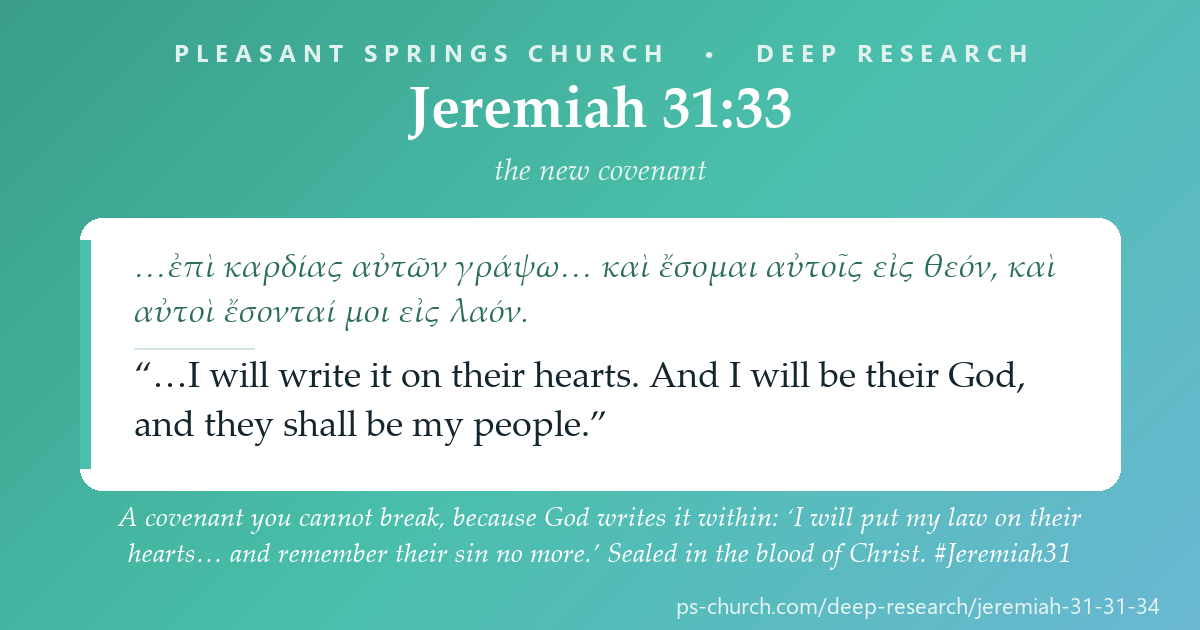
Jeremiah 31:33 · to share
LXX + ESVEvery Deep Research page traces its passage across the whole sweep — the Old Testament, the Second-Temple world between the testaments (historical witnesses, not Scripture), and the New Testament. Follow the thread:
Pleasant Springs Church — Deep Research
Research method after Michael S. Heiser’s Bible Research Method (examine dictionaries → ancient literature → important words → textual connections → academic publications → share), with the Pleasant Springs “Author & Audience” foundation. Scripture set in the Hebrew, the Greek editions named on each page and the ESV (Old Testament), and the Greek New Testament and the ESV (New Testament), per the practice of Pleasant Springs Church. Jeremiah 31:31–34 research grounded in Thompson, Huey, and Lundbom, with Beale & Carson on the New Testament use; ANE covenant background; Second-Temple material per the Dead Sea Scrolls (Damascus Document; 4QJer) read as witnesses, not Scripture.
Scripture quotations marked ESV are from the ESV® Bible (The Holy Bible, English Standard Version®), © 2001 by Crossway, a publishing ministry of Good News Publishers. ESV Text Edition: 2016. Used by permission. All rights reserved. The ESV text may not be quoted in any publication made available to the public by a Creative Commons license, and the ESV may not be translated in whole or in part into any other language. www.esv.org
|
Did this study bless you today? 💚 Give to Support PS Church100% of gifts go to the General Fund — thank you. |