Moses reads the covenant aloud, and Israel answers: “All that the Lord has spoken we will do.” Then he takes the blood and throws it on the people: “Behold the blood of the covenant.” The elders climb the mountain, behold God, and eat and drink; the glory blazes like a devouring fire. Centuries later, over a cup, Jesus says those same words — “my blood of the covenant” — and Sinai finds its fulfillment. This study works Exodus 24 from the mountain to the Lord’s Table and Hebrews 9. See the method →
Exodus 24:1–18 (selections)
Hebrew · LXX · ESVThe Shape of the Passage
SequenceThe same Author and audience as Exodus 19 and the Ten Commandments — and now the words the people heard are sealed with blood, and Moses goes up into the glory.
Author
The Torah of Moses brings the Sinai covenant to its ratification. Chapters 20–23 gave the words (the Ten Commandments and the Book of the Covenant); chapter 24 enacts the covenant — altar, sacrifice, the reading of the words, the people’s oath, and the blood applied to both altar and people. Then, astonishingly, the leaders ascend and “beheld God, and ate and drank” (24:11), and Moses enters the cloud for forty days to receive the pattern of the tabernacle. The chapter is the covenant’s signing ceremony.
Blood, oath, and meal. Ancient covenants were sealed with sacrifice; here the blood binds the two parties — God and Israel — to “all these words.” The pattern (word heard, oath sworn, blood applied, meal shared, glory seen) is the template the New Testament will read straight through to the cross and the Lord’s Table.
Audience
Israel — the redeemed nation now formally bound to its God. They answer together: “All that the Lord has spoken we will do, and we will be obedient” (24:7). The blood thrown upon them makes the covenant real and solemn: they belong to the Lord, bound by oath and sprinkled with sacrifice.
How they heard it. To be sprinkled with the blood of the covenant is to be consecrated — set apart, claimed, and warned. Israel’s glad “we will do” is sincere; yet while Moses is still on the mountain, the golden calf (ch. 32) breaks it. The ceremony therefore points beyond itself: to a covenant whose blood does not merely bind sinners but cleanses them — the new covenant in the blood of Christ.
Orient on covenant ratification, blood rites, and theophany.
Search by topic: covenant, blood, sacrifice, ratification, theophany, glory.
Which articles are relevant?
- Anchor Bible Dictionary — “Covenant,” “Blood,” “Sacrifice,” “Glory (of God).”
- Dictionary of the OT: Pentateuch — “Covenant,” “Sacrifice and Offerings,” “Theophany,” “Blood.”
- NIDOTTE / TDOT — דָּם (dām, blood), בְּרִית (bərîṯ, covenant), כָּרַת (kāraṯ, to cut [a covenant]), כָּבוֹד (kāḇôḏ, glory).
Bibliography surfaced:
- Childs (OTL), Durham (WBC), Stuart (NAC) on Exodus.
- Gordon Wenham on OT sacrifice; Jon Levenson, Sinai and Zion.
- Beale & Carson, Commentary on the NT Use of the OT (Matt 26; Heb 9).
Covenant-cutting, blood rites, and the covenant meal.
Read the ratification against ANE covenant-making, then follow the blood and the meal toward the New Testament.
Which parallels shed light on religion and worldview?
Covenants were cut in blood. Across the ancient Near East, a binding covenant (Hebrew כָּרַת בְּרִית, “to cut a covenant”) was sealed by sacrifice, sometimes by passing between the pieces of slain animals (as in Genesis 15). Blood signified life given and a bond sworn under sanction. Exodus 24 uses this idiom: the blood divided between altar (God’s side) and people binds the two together under “all these words.”
The covenant meal. Eating together sealed and celebrated a covenant. That the elders “beheld God, and ate and drank” (24:11) on the mountain is extraordinary — a shared table in the divine presence, and no harm came to them. The New Testament sees the pattern completed at the Lord’s Table, where the new covenant’s blood is not thrown on us but given to us to drink (Luke 22:20; 1 Cor 11:25).
- ANE treaty and covenant rites — sacrifice, oath, and shared meal as the standard machinery of covenant-making (cf. Gen 15; 31:44–54).
- The reverential LXX of 24:10–11 — “they saw the place where the God of Israel stood”: Second-Temple caution about claiming to see God directly (cf. John 1:18).
- Jubilees 1:1–4 (Pseudepigrapha — a witness, not Scripture) — Moses on the mountain in the cloud forty days and forty nights, receiving the covenant.
- Philo, Life of Moses 2; Questions on Exodus 2 — first-century reflection on the ascent, the sapphire pavement, and the glory.
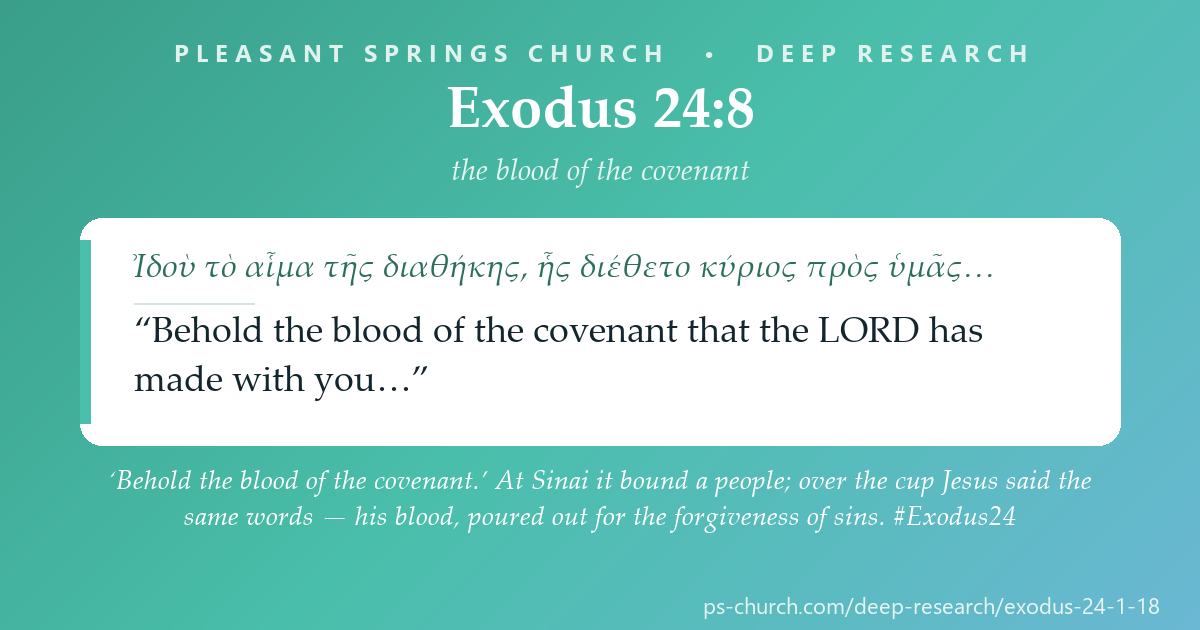
“Behold the blood of the covenant that the Lord has made with you” (24:8). On the night he was betrayed, Jesus took the cup and said, “this is my blood of the covenant, which is poured out for many for the forgiveness of sins” (Matt 26:28) — deliberately echoing Sinai, and announcing something greater: not the blood of oxen thrown on a people, but his own blood, the “new covenant in my blood” (Luke 22:20). Hebrews draws the line explicitly: the first covenant, too, was inaugurated with blood — “This is the blood of the covenant” (Heb 9:18–20) — but the blood of Christ can “purify our conscience” and secures “an eternal redemption” (9:12–14). Sinai’s blood bound; Christ’s blood cleanses.
The vocabulary of covenant, blood, and glory.
Watch “the blood of the covenant,” the people’s oath, and the glory like devouring fire.
“The blood of the covenant” (LXX τὸ αἷμα τῆς διαθήκης) — the phrase Jesus lifts at the Last Supper (Matt 26:28) and Hebrews quotes of the first covenant (Heb 9:20). Blood binds the covenant; in Christ it also cleanses.
“We will do, and we will be obedient” — lit. “we will do and we will hear”: Israel’s wholehearted oath. Sincere — and, as ch. 32 shows, soon broken; the covenant needs a better keeper.
“To cut a covenant” — the standard Hebrew idiom (here kārat, “made”), rooted in the sacrifice that seals it (cf. Gen 15:10, 18).
“Glory” — the weighty, blazing presence of God, “like a devouring fire” on the mountain; the same glory fills the tabernacle (Exod 40:34) and, at last, shines in the face of Christ (2 Cor 4:6).
“Sapphire” — the gleaming blue pavement under God’s feet; it echoes in Ezekiel’s sapphire throne (Ezek 1:26) and the crystal sea before the throne (Rev 4:6).
How the New Testament reuses the covenant blood:
- Matthew 26:27–28; Mark 14:24; Luke 22:20; 1 Corinthians 11:25 — “the blood of the covenant… poured out for many”; the “new covenant in my blood.”
- Hebrews 9:18–22 — “not even the first covenant was inaugurated without blood… ‘This is the blood of the covenant’… without the shedding of blood there is no forgiveness of sins.”
- Hebrews 10:19–22; 12:24; 13:20 — the blood of Jesus that opens the way, “speaks a better word,” and seals the eternal covenant.
- 2 Corinthians 3:7–18; 4:6 — the glory that shone at Sinai now shining, unveiled, in the face of Christ.
From the blood on the people to the cup in the upper room.
Trace the covenant blood and the covenant meal from Sinai to the Lord’s Table, and the glory from the mountain to Christ.
Which cross-references matter?
- Genesis 15:7–21 — the covenant cut between the pieces; God alone passes through (see Genesis 15).
- Exodus 12:1–14; 19:1–25; 20:1–17 — the Passover blood, the Sinai theophany, and the words now sealed.
- Zechariah 9:11 — “because of the blood of my covenant with you, I will set your prisoners free”: the covenant blood as the ground of rescue.
- Matthew 26:28; Hebrews 9:18–22; 13:20 — the blood of the covenant taken up by Jesus and fulfilled at the cross.
- Exodus 32:1–35 — the covenant just sworn is broken at the golden calf (see Exodus 32): why the oath needs a better Mediator.
The New Testament reads the Lord’s Supper through Exodus 24. When Jesus says “this is my blood of the covenant” (Matt 26:28), he casts himself as the sacrifice whose blood seals a new and better covenant — and casts his disciples as the new-covenant people, gathered at a covenant meal in the presence of God, as the elders once ate and drank on the mountain. Hebrews completes the argument: the first covenant’s blood could bind and cleanse ceremonially, but the blood of Christ, offered “through the eternal Spirit,” cleanses the conscience and opens the way into God’s very presence (Heb 9:11–22; 10:19–22). The presence the elders only glimpsed is, in Christ, one his people are welcomed to enter (Heb 10:19–22).
The scholarship on covenant ratification and the blood rite.
The commentators for the ceremony; Wenham for the sacrifice; Beale & Carson for the NT trajectory.
Commentaries & studies:
- Brevard Childs (OTL), John Durham (WBC), Douglas Stuart (NAC) on Exodus.
- Gordon J. Wenham, The Book of Leviticus (on blood and sacrifice); Jon D. Levenson, Sinai and Zion.
- G. K. Beale & D. A. Carson, eds., Commentary on the New Testament Use of the Old Testament.
Interpretation notes worth keeping:
- Two applications of blood. Blood on the altar (God’s side) and on the people binds both parties; the rite is about covenant relationship, not merely purification — though Hebrews draws out the cleansing dimension for the new covenant.
- “They beheld God, and ate and drank” (24:11) is deliberately startling; the reverential LXX (“the place where God stood”) shows later Jewish caution, but the Hebrew’s boldness — a meal in God’s presence, unharmed — is the point the gospel fulfills.
- “We will do and be obedient” is sincere yet self-confident; the golden calf follows within chapters. The narrative itself teaches that the covenant will need a keeper Israel cannot supply.
From the blood on the mountain to the cup in your hands.
Name what you learned, why it matters, and one concrete response.
What should we carry away — and do?
- The covenant costs blood. Belonging to God was never cheap; it is sealed in sacrifice. At the cross, the sacrifice is God’s own Son — the measure of how far his covenant love will go.
- The cup is Sinai fulfilled. When you take the Lord’s Supper, you hold the “blood of the covenant” Jesus named at Sinai’s echo — not thrown on you in warning, but given to you for forgiveness.
- Our ‘we will do’ needs a better keeper. Israel’s glad oath broke at the calf. The new covenant rests not on our resolve but on Christ’s faithfulness and the Spirit who writes the law within (Jer 31:33).
Step in response: the next time you come to the Lord’s Table, come as one sprinkled with the blood of a better covenant — consecrated, forgiven, and welcomed to eat and drink in the presence of God. Let it turn your gratitude into obedience that leans on his faithfulness, not your own.
Exodus 24:8 · to share
LXX + ESVEvery Deep Research page traces its passage across the whole sweep — the Old Testament, the Second-Temple world between the testaments (historical witnesses, not Scripture), and the New Testament. Follow the thread:
Pleasant Springs Church — Deep Research
Research method after Michael S. Heiser’s Bible Research Method (examine dictionaries → ancient literature → important words → textual connections → academic publications → share), with the Pleasant Springs “Author & Audience” foundation. Scripture set in the Hebrew, the Greek editions named on each page and the ESV (Old Testament), and the Greek New Testament and the ESV (New Testament), per the practice of Pleasant Springs Church. Exodus 24:1–18 research grounded in Childs, Durham, Stuart, Wenham, and Levenson, with Beale & Carson on the New Testament use; ANE covenant-rite background; Second-Temple material per Jubilees, Philo, and the reverential LXX (read as witnesses, not Scripture).
Scripture quotations marked ESV are from the ESV® Bible (The Holy Bible, English Standard Version®), © 2001 by Crossway, a publishing ministry of Good News Publishers. ESV Text Edition: 2016. Used by permission. All rights reserved. The ESV text may not be quoted in any publication made available to the public by a Creative Commons license, and the ESV may not be translated in whole or in part into any other language. www.esv.org
|
Did this study bless you today? 💚 Give to Support PS Church100% of gifts go to the General Fund — thank you. |