Three months out of Egypt, Israel reaches the mountain of God — and God comes down. In fire, smoke, and trumpet-blast, the Lord gives a freed-slave people a breathtaking vocation: “you shall be to me a kingdom of priests and a holy nation.” But first he names the grace beneath it: “I bore you on eagles’ wings and brought you to myself.” This study works Exodus 19 from Sinai’s trembling mountain to Peter’s “royal priesthood” and Mount Zion in Hebrews 12. See the method →
Exodus 19:1–25 (selections)
Hebrew · LXX · ESVThe Shape of the Passage
SequenceThe same Author and audience as Exodus 3 — and here the promise of Exodus 3:12, “you shall serve God on this mountain,” is kept: Israel arrives at Sinai, and God comes down.
Author
The Torah of Moses sets the stage for the covenant. Exodus 19 is the hinge of the book: rescue is complete (chs. 1–18), and now God gathers the freed slaves to himself to make them his covenant people. Moses is the go-between, climbing and descending the mountain; the narrative is built on the rhythm of God’s descent and the people’s consecration. The chapter frames everything that follows — the Ten Words (ch. 20) and the covenant code — as the terms of a relationship God himself has initiated.
Grace before summons. The vocation (“a kingdom of priests”) rests on redemption already given (“I bore you on eagles’ wings”). Election is for mission: Israel is set apart not merely from the nations but for them — to mediate the knowledge of God to all the earth, “for all the earth is mine” (19:5).
Audience
Israel — a people three months out of Egypt (19:1), still learning who their God is. They stand at the foot of a mountain wrapped in fire, smoke, and trumpet-blast, told to wash their garments and not to touch the mountain on pain of death. The holiness of God is overwhelming and dangerous; the boundaries (19:12–13, 21–24) teach a people that they cannot approach the Holy One casually or on their own terms.
How they heard it. To be brought “to myself” is the goal of the exodus — rescue was never an end in itself but a bringing-home to God. And to be a “kingdom of priests” is dignity and duty together: a whole nation given priestly access and a priestly task. Later Israel would read this as its charter; the church would read it as fulfilled in Christ, who makes his people “a royal priesthood” (1 Pet 2:9).
Orient on Sinai, theophany, covenant, and priesthood.
Search by topic: Sinai, theophany, covenant, holiness, kingdom of priests.
Which articles are relevant?
- Anchor Bible Dictionary — “Sinai, Mount,” “Theophany,” “Covenant,” “Priesthood.”
- Dictionary of the OT: Pentateuch — “Sinai,” “Theophany,” “Holiness,” “Election.”
- NIDOTTE / TDOT — סְגֻלָּה (səḡullâ, treasured possession), קֹדֶשׁ (qōḏeš, holiness), כֹּהֵן (kōhēn, priest), בְּרִית (bərîṯ, covenant).
Bibliography surfaced:
- Childs (OTL), Durham (WBC), Stuart (NAC); T. D. Alexander, From Paradise to the Promised Land.
- John Davies, A Royal Priesthood (on Exod 19:6); G. K. Beale, The Temple and the Church’s Mission.
- Jon Levenson, Sinai and Zion.
The mountain of God, the storm-theophany, and a nation of priests.
Read the Sinai theophany against ANE mountain-and-storm imagery, then note how Israel’s priestly vocation reshapes it.
Which parallels shed light on religion and worldview?
The mountain and the storm. In the ancient Near East, gods were pictured on high mountains, appearing in storm — thunder, cloud, and fire (the storm-god Baal-Hadad, enthroned on Zaphon). Exodus uses that familiar imagery — cloud, fire, smoke, quaking, trumpet — but the God who descends is no nature-force to be manipulated; he is the covenant Lord who has just defeated Egypt and its gods, and who now speaks moral words. The furniture is shared; the meaning is transformed.
A whole nation of priests. In the surrounding cultures, priesthood was a guild — a class set apart to mediate between the people and the divine. Israel’s calling is startling: the whole people is to be a “kingdom of priests,” given access to God and charged with representing him to the nations. Priestly holiness is democratized into a national vocation — a vision the New Testament extends to every believer (1 Pet 2:9; Rev 1:6).
- Ugaritic Baal Cycle — the storm-god enthroned on Mount Zaphon amid thunder and cloud: the ANE mountain-theophany idiom Exodus adopts and subverts.
- ANE suzerain treaties — a great king binds a people to himself after recounting his deeds: the covenant shape framing chs. 19–24.
- Jubilees 1; 6:17–22 (Pseudepigrapha — a witness, not Scripture) — sets the Sinai covenant at the Feast of Weeks (Shavuot), reading the giving of the law as covenant renewal.
- Philo, On the Decalogue 32–49; Life of Moses 2 — first-century meditations on the divine voice and fire at Sinai.
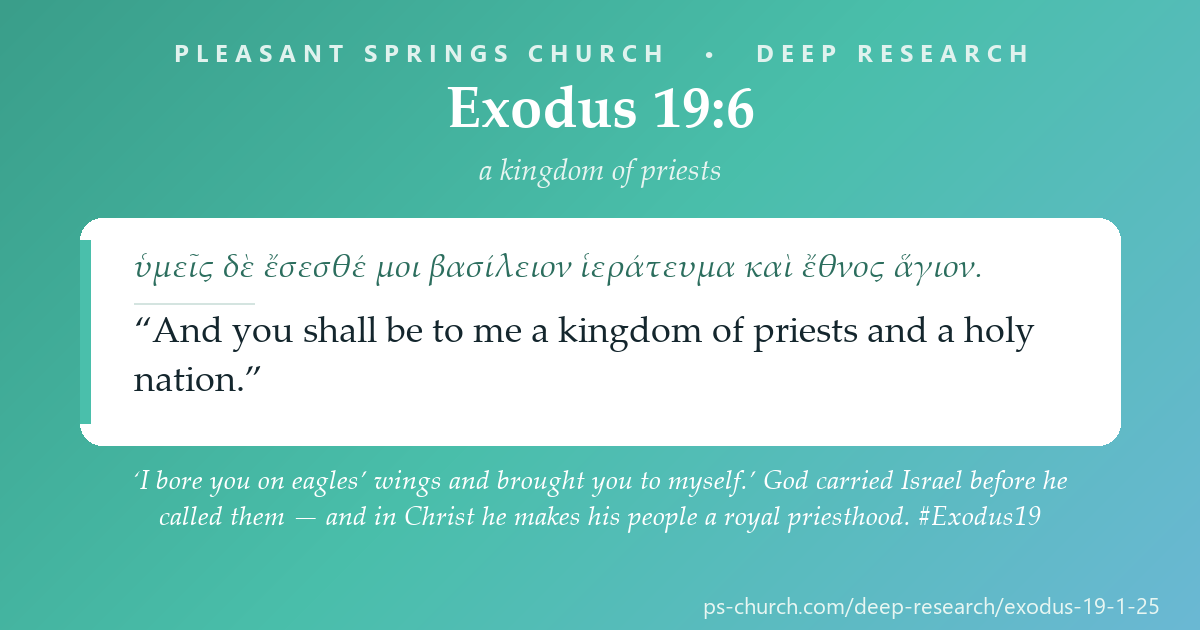
Exodus 19:6 is Israel’s charter: “you shall be to me a kingdom of priests and a holy nation.” A priest stands between God and others — given access, and given a people to bless. Israel’s election was never mere favoritism; it was vocation for the sake of “all the earth” (19:5). The New Testament announces the vocation fulfilled: through Christ, the church is “a chosen race, a royal priesthood, a holy nation, a people for his own possession” (1 Pet 2:9) — Peter weaving Exodus 19:6 in the LXX’s own words (βασίλειον ἱεράτευμα… ἔθνος ἅγιον) together with Isaiah 43:20–21. What Israel was called to be, the people of the Messiah become — the church extending, not cancelling, the calling first given to Israel (Rom 11:29) — and will be forever: “a kingdom, priests to his God” (Rev 1:6).
The vocabulary of election, holiness, and priestly calling.
Watch “treasured possession,” “kingdom of priests,” and the fire-and-trumpet of the theophany.
“Treasured possession” — a king’s personal treasure, his prized property (LXX λαὸς περιούσιος). Israel is God’s own treasure among all peoples (Deut 7:6; Mal 3:17) — language Paul applies to the redeemed in Christ (Titus 2:14).
“A kingdom of priests” (LXX βασίλειον ἱεράτευμα) — a whole nation given priestly access and a priestly task. Quoted of the church in 1 Pet 2:9; echoed in Rev 1:6; 5:10.
“A holy nation” (LXX ἔθνος ἅγιον) — set apart to God and for the nations; holiness as belonging, not merely separation.
“Eagles’ wings” — the strong, carrying love of God who bore Israel out of Egypt and home to himself; the same image in Moses’ song (Deut 32:11).
“The sound of the trumpet” — the blast that summoned Israel trembling to the mountain; Hebrews recalls it (Heb 12:19), and a trumpet heralds the last day (1 Thess 4:16).
How the New Testament reuses Sinai:
- 1 Peter 2:9–10 — “a chosen race, a royal priesthood, a holy nation, a people for his own possession”: Exodus 19:5–6 fulfilled in the church.
- Revelation 1:6; 5:10; 20:6 — Christ “made us a kingdom, priests to his God”: the vocation consummated.
- Titus 2:14 — Christ redeems “a people for his own possession” (the LXX’s λαὸς περιούσιος, Exod 19:5): the segullah of Sinai.
- Hebrews 12:18–24 — “you have not come to what may be touched… but… to Mount Zion”: Sinai’s terror answered by Zion’s welcome in Christ.
From Sinai to Zion, from a mountain of fear to the city of the living God.
Trace the “kingdom of priests” through the prophets to the church, and the Sinai theophany forward to Hebrews 12.
Which cross-references matter?
- Deuteronomy 7:6; 14:2; 26:18 — Israel as God’s segullah, his treasured people; Deuteronomy 32:11 — borne like an eaglet on its parent’s wings.
- Isaiah 61:6 — “you shall be called the priests of the Lord”: the priestly vocation renewed (see Isaiah 61).
- 1 Peter 2:9; Revelation 1:6; 5:10 — Exodus 19:6 applied to the whole people of the Messiah.
- Hebrews 12:18–29 — the two mountains: Sinai’s blazing fire and trumpet, and Mount Zion, with Jesus the mediator and blood that “speaks a better word.”
- Exodus 20:1–17; 24:1–18 — the words spoken from this mountain (see the Ten Commandments) and the covenant sealed in blood (see Exodus 24).
Hebrews sets the two mountains side by side. At Sinai, Israel “could not endure the order that was given” — what may be touched, a blazing fire, darkness, tempest, a trumpet, and a voice so terrible they begged it to stop (Heb 12:18–21). But believers, Hebrews says, “have come to Mount Zion… to the city of the living God… and to Jesus, the mediator of a new covenant” (12:22–24). Sinai’s holiness has not been cancelled — “our God is a consuming fire” (12:29) — but in Christ the barrier is answered. The God who could only be approached from a distance now draws his people to himself, which was Sinai’s aim all along (Exod 19:4).
The scholarship on Sinai and the priestly nation.
Davies and Beale for the priestly vocation; Levenson for Sinai and Zion; the commentators for the theophany.
Commentaries & studies:
- Brevard Childs (OTL), John Durham (WBC), Douglas Stuart (NAC) on Exodus.
- John A. Davies, A Royal Priesthood: Literary and Intertextual Perspectives on an Image of Israel in Exodus 19.6.
- G. K. Beale, The Temple and the Church’s Mission; Jon D. Levenson, Sinai and Zion.
Interpretation notes worth keeping:
- Election is for mission. “For all the earth is mine” (19:5) grounds Israel’s set-apartness in God’s claim on every nation: chosen to be a blessing (Gen 12:3), not chosen instead of the world.
- “Kingdom of priests” can be read as a priestly kingdom or a kingdom made up of priests; either way the point is a mediating, God-representing people — the reading the NT confirms.
- The boundaries (19:12–24) are not arbitrary cruelty but a lesson in holiness: sinful people cannot presume on the Holy One. The gospel’s wonder is that the same God opens a new and living way (Heb 10:19–22).
From the foot of the mountain to your own calling.
Name what you learned, why it matters, and one concrete response.
What should we carry away — and do?
- You were carried before you were called. “I bore you on eagles’ wings and brought you to myself.” God’s claim on us rests on his rescue of us — grace first, then vocation.
- You are a priest. In Christ, the whole church is a royal priesthood (1 Pet 2:9) — given access to God and sent to represent him. Your ordinary life is a priestly offering (Rom 12:1).
- Holiness and welcome meet in Christ. Sinai’s fire is real; but in Jesus we come not to the mountain of terror but to Mount Zion. Draw near with confidence — and with reverence, for our God is a consuming fire.
Step in response: take one part of ordinary life this week — your work, a relationship, a hidden habit — and offer it deliberately as a priest would: consecrated to God, and turned outward to bless someone else. You were brought near “to himself” so that others might be brought near too.
Exodus 19:6 · to share
LXX + ESVEvery Deep Research page traces its passage across the whole sweep — the Old Testament, the Second-Temple world between the testaments (historical witnesses, not Scripture), and the New Testament. Follow the thread:
Pleasant Springs Church — Deep Research
Research method after Michael S. Heiser’s Bible Research Method (examine dictionaries → ancient literature → important words → textual connections → academic publications → share), with the Pleasant Springs “Author & Audience” foundation. Scripture set in the Hebrew, the Greek editions named on each page and the ESV (Old Testament), and the Greek New Testament and the ESV (New Testament), per the practice of Pleasant Springs Church. Exodus 19:1–25 research grounded in Childs, Durham, Stuart, Alexander, John Davies, Beale, and Levenson; ANE mountain-theophany and treaty background; Second-Temple material per Jubilees and Philo (read as witnesses, not Scripture).
Scripture quotations marked ESV are from the ESV® Bible (The Holy Bible, English Standard Version®), © 2001 by Crossway, a publishing ministry of Good News Publishers. ESV Text Edition: 2016. Used by permission. All rights reserved. The ESV text may not be quoted in any publication made available to the public by a Creative Commons license, and the ESV may not be translated in whole or in part into any other language. www.esv.org
|
Did this study bless you today? 💚 Give to Support PS Church100% of gifts go to the General Fund — thank you. |