Amid fire, smoke, and trumpet-blast, God speaks ten words that would shape the conscience of the world. And they begin not with “you shall” but with grace: “I am the Lord your God, who brought you out.” The commands — love God, love neighbor — are the shape of life for a people already rescued. This study works the Ten Words from Sinai’s tablets of stone to the new-covenant promise of the law written on the heart in Christ. See the method →
Exodus 20:1–17 (selections)
Hebrew · LXX · ESVThe Shape of the Passage
Parallel panelsSame Author and audience as Exodus 3 — and at Sinai, amid fire and smoke and trumpet, the redeemed people receive the terms of covenant life.
Author
The Torah of Moses gives the covenant its charter. The order matters: God first rescues Israel from Egypt (chs. 1–15), then gives the law (ch. 20). The Ten Words open with the redemptive prologue — “I am the Lord… who brought you out” — and only then command. The commands fall into two “tables”: the first about love for God (no other gods, no idols, the Name, the Sabbath), the second about love for neighbor (honor parents; no murder, adultery, theft, false witness, coveting).
Grace, then law. These are not a ladder to earn God’s favor but the shape of life for a people already redeemed. Law flows from grace, obedience from gratitude — the pattern the whole Bible keeps.
Audience
Israel — a freed-slave people being formed into God’s covenant nation and “kingdom of priests” (19:6). The form would have been familiar: ANE kings made covenants (treaties) with their vassals, opening with the king’s deeds and then stipulations — but here the Great King is the Lord, and the terms are personal and moral.
How they heard it. To belong to this God is to live his way — toward him and toward one another. The commands are boundary-markers of a covenant of love; they define what it looks like for a rescued people to reflect the character of their Redeemer.
Orient on the Decalogue, covenant, and Sinai.
Search by topic: Ten Commandments/Decalogue, covenant, Sinai, law, treaty form.
Which articles are relevant?
- Anchor Bible Dictionary — “Ten Commandments,” “Covenant,” “Law (OT),” “Sinai.”
- Dictionary of the OT: Pentateuch — “Ten Commandments,” “Law,” “Covenant,” “Ethics.”
- NIDOTTE / TDOT — דָּבָר (dāḇār, word), בְּרִית (bərîṯ, covenant), מִצְוָה (miṣwâ, command), תּוֹרָה (tôrâ).
Bibliography surfaced:
- Childs (OTL), Durham (WBC), Stuart (NAC); Patrick Miller, The Ten Commandments.
- Meredith Kline, Treaty of the Great King; George Mendenhall on covenant and treaty form.
- Christopher Wright, Old Testament Ethics for the People of God.
The covenant-treaty, the law codes, and love as the law’s heart.
Read the Decalogue against ANE treaties and law codes, then note how Scripture and Jesus gather the commands under love.
Which parallels shed light on religion and worldview?
The treaty form. Ancient Near Eastern suzerain-vassal treaties open with the great king’s self-identification and gracious deeds, then list stipulations, with blessings and curses — the very shape of the Sinai covenant. Kline and Mendenhall correlate it specifically with second-millennium Hittite treaties (an argument for an early date); others note first-millennium Neo-Assyrian parallels as well. Either way, Exodus 20 casts the Lord as the Great King who redeemed Israel and now binds them in covenant loyalty.
The law codes. The Code of Hammurabi and other ANE collections share individual laws with Israel (against theft, false testimony, etc.). But the Decalogue is distinctive: it is apodictic (“you shall not”), addressed personally by God (“I am the Lord… you shall”), grounded in redemption, and it commands the heart (“you shall not covet”) — not just outward acts.
- Hittite suzerain-vassal treaties — the historical prologue + stipulations form behind the Sinai covenant (Kline, Mendenhall).
- Code of Hammurabi; the laws of Eshnunna, Ur-Nammu — shared legal content, but casuistic (“if… then”) and royal, not the personal, apodictic covenant of Sinai.
- Philo, On the Decalogue; Josephus, Antiquities 3.91–92 — first-century Jewish expositions; the Nash Papyrus (2nd c. BC) preserves the Decalogue with the Shema.
- The tefillin & mezuzah tradition — binding the commands on hand and door (Deut 6): the law written on Israel’s life.
Jesus gathers the whole Decalogue under two commands: “You shall love the Lord your God… and… your neighbor as yourself. On these two… depend all the Law and the Prophets” (Matt 22:37–40) — exactly the two tables. Paul agrees: “love is the fulfilling of the law” (Rom 13:10). And the deepest hope of the prophets is that the law would be written not on stone but on hearts (Jer 31:33; 2 Cor 3:3) — which is the gift of the new covenant in Christ, who both perfectly kept the law and bore its curse for us (Gal 3:13). The commandments show us God’s character and our need; Christ fulfills them and, by his Spirit, writes them within.
The vocabulary of the covenant words.
Watch the “ten words,” the redemptive prologue, and the command that reaches the heart.
“The Ten Words” — hence “Decalogue.” Not merely rules but the covenant words of the Great King to his redeemed people.
“I… brought you out” — the redemptive prologue. Grace comes first; the commands are the shape of a life already rescued.
“You shall not bear false witness” — truthfulness as covenant loyalty; the neighbor’s good name guarded.
“You shall not covet” — the command that reaches the heart, not just the hand. Paul says it exposed his sin (Rom 7:7).
“Sabbath” — rest rooted in creation (Gen 2:2–3) and, in Deut 5, in redemption from slavery: the rhythm of a free, God-centered life (cf. Heb 4). How the Sabbath command applies to Christians is debated among evangelicals — a weekly day of rest, or its rest fulfilled in Christ (cf. Col 2:16–17).
“Honor” — lit. “give weight to”; the hinge between the two tables — the first command with a promise (Eph 6:2).
How the New Testament reuses the Ten Commandments:
- Matthew 22:37–40; Mark 12:29–31 — the two great commands (love God / love neighbor) as the summary of the two tables and “all the Law.”
- Romans 13:8–10 — the commandments “summed up in this word: ‘You shall love your neighbor as yourself.’ Love… is the fulfilling of the law.”
- Matthew 5:17–48 — Jesus deepens the commands to the heart (anger, lust) — and fulfills, not abolishes, the law.
- Jeremiah 31:33; 2 Corinthians 3:3–6; Galatians 3:13, 24 — the law written on hearts in the new covenant; Christ redeeming from its curse and being its goal.
From tablets of stone to tablets of the heart.
Trace the Decalogue through the Torah, the prophets’ “law on the heart,” and Jesus’ summary — then note the Beale & Carson trajectory.
Which cross-references matter?
- Deuteronomy 5:6–21 — the Decalogue restated (Sabbath grounded in the exodus); Deuteronomy 6:4–5 — the Shema, “love the Lord… with all your heart.”
- Leviticus 19:18 — “love your neighbor as yourself”: the second table’s summary, quoted by Jesus and Paul.
- Psalm 19:7–11; 119 — the law loved and delighted in as the gift of a redeeming God.
- Matthew 5:17–48; 22:37–40; Romans 13:8–10 — Jesus and Paul on the law fulfilled in love.
- Jeremiah 31:31–34; Hebrews 8:10; 2 Corinthians 3 — the new covenant, the law written within by the Spirit.
The commentary’s handling of the Sermon on the Mount and Romans shows the New Testament’s balanced word on the law: Christ fulfills it (Matt 5:17), bears its curse (Gal 3:13), and by the Spirit writes it on the heart (2 Cor 3), so that love becomes its fulfilling (Rom 13:10). The Ten Words are not discarded but deepened and internalized — the character of God, once carved on stone, now formed in his people. The commandments still reveal how a redeemed people lives; and the grace that opens them (“I brought you out”) is the same grace that empowers them in Christ.
The scholarship on the Decalogue.
Kline and Mendenhall for the treaty form; Miller and Wright for the theology and ethics.
Commentaries & studies:
- Childs (OTL), Durham (WBC), Stuart (NAC); Patrick D. Miller, The Ten Commandments (Interpretation).
- Meredith Kline, Treaty of the Great King; George Mendenhall, Law and Covenant in Israel and the Ancient Near East.
- Christopher J. H. Wright, Old Testament Ethics for the People of God.
Interpretation notes worth keeping:
- The covenant-treaty form (prologue of grace + stipulations) is widely recognized (Kline, Mendenhall) and frames the law as covenant loyalty, not a merit system.
- Numbering differs among traditions (Jewish, Catholic/Lutheran, Reformed) — but all count “ten words,” and the two-table structure (God / neighbor) is the interpretive key Jesus uses.
- Apodictic and heart-reaching: “you shall not covet” shows the law was always aimed at the inner person — the point Jesus makes explicit (Matt 5) and the new covenant fulfills (Jer 31).
From Sinai to your own obedience.
Name what you learned, why it matters, and one concrete response.
What should we carry away — and do?
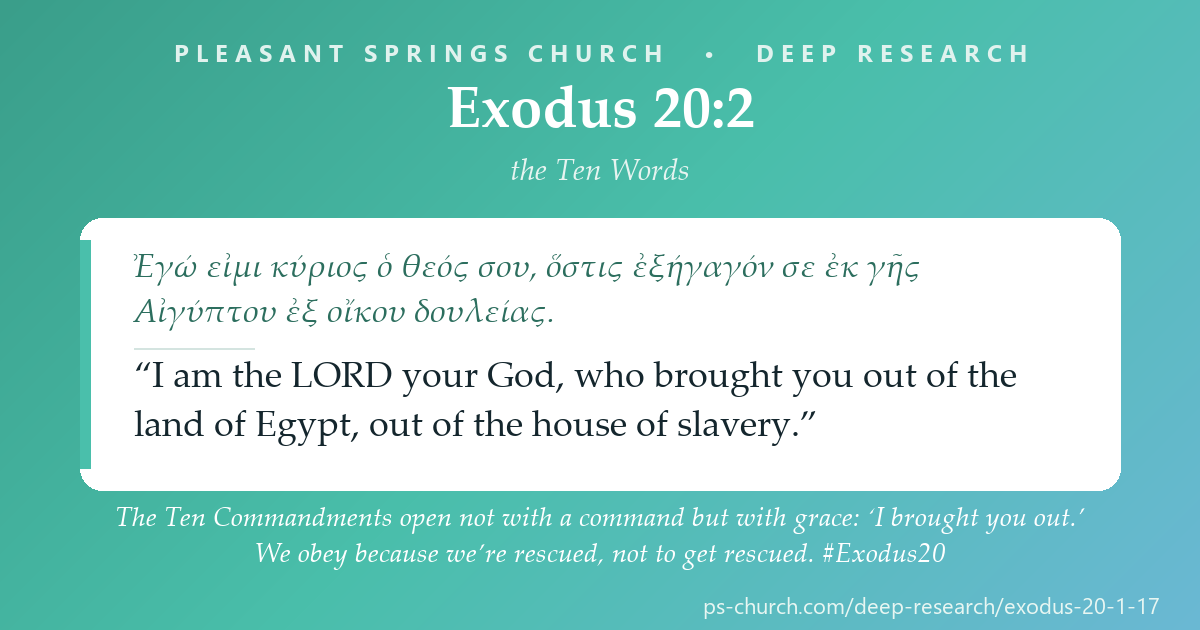
- Grace comes first. The commands open with “I brought you out.” We obey because we are rescued, not to get rescued. Gospel order: redemption, then response.
- The whole law is love. Love God, love neighbor — the two tables in one word. If love is missing, the letter is kept in vain (1 Cor 13).
- The law is being written on your heart. Christ kept it, bore its curse, and by his Spirit writes it within (2 Cor 3). Obedience is no longer stone-cold duty but the Spirit’s work in a freed people.
Step in response: pick one command that presses on your heart this week (perhaps the tenth — coveting), and bring it to Christ — not as a ladder to climb but as a place to let his Spirit form his character in you, out of gratitude for the rescue already given.
Exodus 20:2 · to share
LXX + ESVEvery Deep Research page traces its passage across the whole sweep — the Old Testament, the Second-Temple world between the testaments (historical witnesses, not Scripture), and the New Testament. Follow the thread:
Pleasant Springs Church — Deep Research
Research method after Michael S. Heiser’s Bible Research Method (examine dictionaries → ancient literature → important words → textual connections → academic publications → share), with the Pleasant Springs “Author & Audience” foundation. Scripture set in the Hebrew, the Greek editions named on each page and the ESV (Old Testament), and the Greek New Testament and the ESV (New Testament), per the practice of Pleasant Springs Church. Exodus 20:1–17 research grounded in Childs, Durham, Stuart, Miller, Kline, Mendenhall, and C. J. H. Wright; ANE suzerain-treaty and law-code background; Second-Temple material per Philo, Josephus, and the Nash Papyrus (read as witnesses, not Scripture).
Scripture quotations marked ESV are from the ESV® Bible (The Holy Bible, English Standard Version®), © 2001 by Crossway, a publishing ministry of Good News Publishers. ESV Text Edition: 2016. Used by permission. All rights reserved. The ESV text may not be quoted in any publication made available to the public by a Creative Commons license, and the ESV may not be translated in whole or in part into any other language. www.esv.org
|
Did this study bless you today? 💚 Give to Support PS Church100% of gifts go to the General Fund — thank you. |