After the thunder of the Ten Words comes something quieter and just as holy: the rules — the case laws that show what love of God and neighbor looks like when a servant’s six years are up, when a blow proves fatal, when an ox is known to gore. The Book of the Covenant begins here. A Hebrew servant goes free in the seventh year; a kidnapper who sells a human being is put to death — the Bible’s own word against the slave-trade; “eye for eye” caps vengeance rather than licensing it. This study works Exodus 21:1–36 — and how the church rightly reads Old Testament law: for its enduring moral principles, fulfilled in Christ. See the method →
Exodus 21:1, 2, 6, 12, 16, 24
Hebrew · LXX · ESVThe Shape of the Passage
SequenceSame Author and audience as the Ten Commandments — and now the moral law is worked into cases: what love of God and neighbor looks like when a servant’s six years are up, when a blow proves fatal, when an ox is known to gore.
Author
The Torah of Moses sets the Book of the Covenant (21:1–23:33) immediately after the Decalogue and its altar law (20:22–26). If chapter 20 gives the principles — do not murder, do not steal, honor father and mother — chapter 21 gives the rulings (מִשְׁפָּטִים, mishpāṭîm): the moral law applied to specific situations by a covenant court. The grammar shifts from apodictic command (“you shall not”) to casuistic case (“when you buy a Hebrew slave… in the seventh he shall go out free”), the form Israel shared with the great law codes around her — yet transposed into the key of redemption.
The servant laws (21:2–11) — read with care. These regulate Hebrew debt-servitude: a time-limited, protected institution in which a person in poverty could sell his labor for a fixed term and then go free. The term is capped at six years, with release in the seventh — and “for nothing” (21:2; expanded in the sabbatical release of Deut 15:12–18, where the freed servant is even sent out with provisions). One who loves his master and household may choose to stay: brought “to God” (before the sanctuary/judges), his ear is pierced at the doorpost — a permanent mark of chosen, loving belonging (21:5–6). A daughter given as a maidservant is not disposable chattel: she has rights to food, clothing, and marital treatment, and if these are denied “she shall go out for nothing, without payment” (21:7–11). This is not the race-based, lifelong, kidnap-fed chattel slavery of later centuries — which Scripture flatly condemns (see the Audience panel). The very next breath makes it a capital crime to steal and sell a human being (21:16).
The sanctity of life (21:12–36). A single principle runs through the rest of the chapter: human life bears the image of God and may not be treated cheaply. Deliberate murder is capital (21:12, 14); but accidental killing — “God let him fall into his hand” (21:13, הָאֱלֹהִים, not a false god of fate) — is met with mercy: a place of refuge, the seed of the later cities of refuge (Num 35; Deut 19). Striking or reviling a parent is grave (21:15, 17); kidnapping is death (21:16). The famous law of retaliation — “eye for eye, tooth for tooth” (21:23–25) — is a judicial formula of proportion and limit: the punishment must fit, and may not exceed, the harm. The goring-ox laws (21:28–36) weigh negligence and liability, and even here the animal that kills a person is destroyed — life is not cheap, even before an ox.
Audience
Israel — a freed-slave people (19:4–6) receiving the terms of covenant life. The engine of these laws is memory: because “you were slaves in Egypt” and the Lord redeemed you, you will not grind the poor, the servant, the stranger under your heel (the theme swells in chapter 22 and chapter 23). A nation once enslaved is being taught to build a society where servitude is bounded and mercy is law.
How the church reads Old Testament case law. These are the civil and case laws of Israel’s ancient theocracy — the moral law applied to a particular society at a particular time. The church does not take them as binding civil code, nor act as a civil enforcer of their penalties; the theocratic death sentences belong to that theocratic context. We read them for their enduring moral principles: the sanctity of life, proportionate justice, protection of the vulnerable, restitution, and the equal dignity of every person made in God’s image. And we read them as fulfilled in Christ, who came “not to abolish… but to fulfill” the Law (Matt 5:17) and who deepens even “eye for eye” to the heart (Matt 5:38–39).
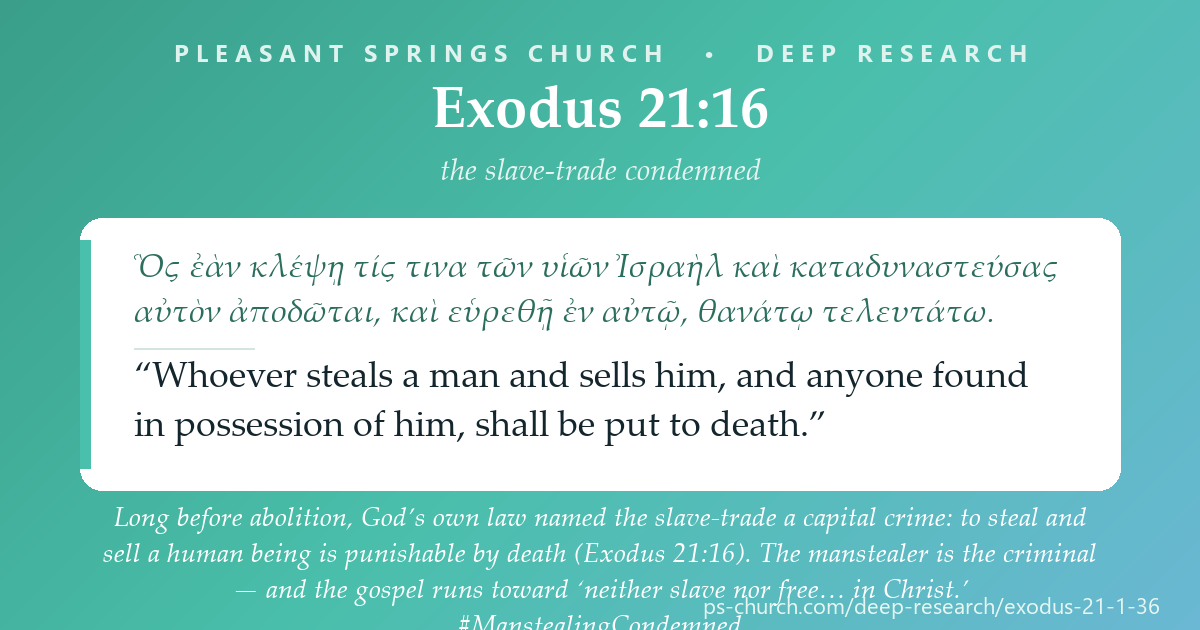
On slavery, named plainly. The Bible’s own law here condemns the practice that would later be called the slave-trade: “Whoever steals a man and sells him… shall be put to death” (21:16; so too Deut 24:7). The New Testament names “enslavers” (kidnappers, manstealers) among the worst of lawbreakers (1 Tim 1:10). Race-based, kidnap-fed chattel slavery was never sanctioned by God’s law — it was a capital crime under it; and Scripture’s redemptive trajectory runs toward liberation and toward “there is neither slave nor free… you are all one in Christ Jesus” (Gal 3:28; and the whole letter to Philemon). To read Exodus 21 rightly is to hear it condemn the very evil for which it has sometimes been wrongly blamed.
Orient on the Book of the Covenant, case law, servitude, and lex talionis.
Search by topic: Book of the Covenant, law (OT), casuistic/apodictic, slavery and servitude in Israel, cities of refuge, retaliation / lex talionis, image of God.
Which articles are relevant?
- Anchor Bible Dictionary — “Covenant, Book of the,” “Law (OT),” “Slavery (OT),” “Cities of Refuge,” “Talion.”
- Dictionary of the OT: Pentateuch — “Book of the Covenant,” “Law,” “Slavery,” “Ethics,” “Retribution.”
- NIDOTTE / TDOT — מִשְׁפָּט (mishpāṭ, rule/justice), עֶבֶד (ʿeḇeḏ, servant/slave), חָפְשִׁי (ḥofshî, free), גָּנַב (gānaḇ, steal/kidnap).
Bibliography surfaced:
- Brevard Childs (OTL), John Durham (WBC), Nahum Sarna (JPS), Douglas Stuart (NAC) on Exodus.
- Joe M. Sprinkle, ‘The Book of the Covenant’: A Literary Approach; Bernard S. Jackson, Wisdom-Laws.
- Christopher J. H. Wright, Old Testament Ethics for the People of God; William J. Webb, Slaves, Women & Homosexuals (the redemptive-movement question).
The law codes of the ancient Near East, and the covenant’s counter-key.
Read Israel’s case laws beside Hammurabi, Eshnunna, and the Hittite laws — noting both the shared legal grammar and the covenant’s distinctive valuation of persons.
Which parallels shed light on religion and worldview?
A shared legal world. Israel’s case laws speak the common dialect of ancient jurisprudence. The Code of Hammurabi (c. 1750 BC), the Laws of Eshnunna, of Ur-Nammu, and the Hittite Laws all use the same casuistic “if a man… then” form, and treat many of the same cases — theft, assault, deposits, and famously the goring ox (Eshnunna §53–55; Hammurabi §250–252 read almost like Exodus 21:28–36). Manstealing is capital in Hammurabi (§14) as in Exodus 21:16; retaliation “eye for eye” appears in Hammurabi (§196–197). Moses is not writing in a vacuum; he is legislating within a recognizable ancient legal culture.
The covenant’s counter-key. But the differences are the message. Hammurabi’s talion is stratified by class — an aristocrat’s eye is worth an eye, a commoner’s only silver, a slave’s still less. Israel’s law flattens this: the principle of proportion applies to persons as persons, and — astonishingly for its world — a master who destroys a servant’s eye or knocks out a tooth must set the servant free (21:26–27). The servant is no mere property; he is a neighbor with a claim. Where Hammurabi lets a wealthy killer of another’s slave simply pay, Exodus grounds every ruling in the image of God and in Israel’s own rescue from bondage. The same grammar, a different God.
- Code of Hammurabi §14 (kidnapping), §117 (debt-service released in the fourth year), §196–201 (talion, stratified by class), §250–252 (the goring ox) — the closest law-code parallels to Exodus 21.
- Laws of Eshnunna §53–55; Laws of Ur-Nammu; the Hittite Laws — the shared casuistic tradition of ANE jurisprudence.
- Josephus, Antiquities 4.271–280; Philo, Special Laws 2–4 — Second-Temple Jewish expositions of the Mosaic laws on theft, servitude, and injury (witnesses, not Scripture).
The law of talion (lex talionis, 21:23–25) is the most misquoted line in the Torah. It is not a charter for private revenge or literal mutilation as a way of life; it is a judicial principle addressed to the court, and its whole force is restraint. In a world of blood-feud, where a slighted clan might kill a dozen for one, talion says: the penalty may match the harm and may go no further — one eye for an eye, not a head for an eye. It is the birth of proportionate justice and equal standing before the law. Ancient Jewish interpretation (and the surrounding laws themselves, which assign monetary compensation for injuries, 21:18–19, 26–27, 30) read talion largely as a measure of ransom — the value of the eye, not the eye itself. When Jesus takes it up (“You have heard… ‘An eye for an eye’… But I say to you, Do not resist the one who is evil,” Matt 5:38–39), he is not overturning the court’s duty of justice; he is forbidding his disciples to privatize it — to nurse the personal grudge the law was written to cap. The magistrate still bears the sword for justice (Rom 13:4); the disciple lays down the fist for mercy. Both flow from the same God, who is at once perfectly just and abounding in steadfast love.
The vocabulary of the case laws: rulings, servitude, freedom, and proportion.
Watch the “rules,” the bounded “Hebrew servant,” the goal of “free,” the pierced ear of love, the capital crime of manstealing, and the measured “eye for eye.”
“Rules” / “case laws” — the rulings that apply the Ten Words to real situations. The Book of the Covenant (21:1–23:33) is Israel’s applied ethics, the moral law worked into cases.
“Hebrew servant” — a debt-bondservant, not a chattel slave: six years’ labor, then freedom in the seventh, gratis. A regulated, time-limited institution grounded in Israel’s own liberation (Deut 15:12–15).
“Free” — the goal of the servant laws. Even a lost eye or tooth buys the servant his freedom (21:26–27): the direction of the law is always toward release, never toward permanent bondage.
“Pierce his ear” — for the servant who says, “I love my master… I will not go out free” (21:5). At the doorpost, before God, the awl marks a belonging freely chosen out of love (cf. Ps 40:6).
“Steals a man” — kidnapping to enslave and sell: a capital crime. This is Scripture’s own condemnation of the slave-trade (Deut 24:7; “enslavers,” 1 Tim 1:10) — the manstealer, not the slave, is the criminal.
“Eye for eye” — the law of talion: a rule of proportion and limit for the court, capping vengeance rather than licensing it. Jesus forbids the disciple to privatize it into a grudge (Matt 5:38–39).
How the rest of Scripture takes up these laws:
- Deuteronomy 15:12–18 — the seventh-year release expanded: free the servant, and “furnish him liberally… remember you were a slave in Egypt.” Mercy grounded in memory.
- Deuteronomy 24:7; 1 Timothy 1:10 — manstealing (kidnapping to sell) named a capital crime, and “enslavers” ranked among the lawless: the Bible’s word against the slave-trade.
- Numbers 35:9–34; Deuteronomy 19:1–13 — the cities of refuge, the mercy for accidental death that Exodus 21:13 first promises.
- Matthew 5:38–39; Romans 12:19; 13:4 — talion internalized: the disciple renounces private revenge; the magistrate still bears the sword for public justice.
- Galatians 3:28; Philemon — the redemptive trajectory: “neither slave nor free… one in Christ,” and a runaway received “no longer as a slave… but a beloved brother.”
From regulated servitude to 'no longer slave or free.'
Trace the sanctity of life, the bounded servitude, and the law of proportion toward their Old Testament development and New Testament fulfillment.
Which cross-references matter?
- Exodus 20:1–17 — the Decalogue these rulings apply: “you shall not murder / steal / commit adultery” worked into cases.
- Leviticus 24:17–22; Deuteronomy 19:16–21 — the talion principle restated: “life for life… as he has done, so shall it be done to him” — proportion as the measure of justice.
- Leviticus 25:39–43 — the fellow Israelite in poverty is not to be made a slave but treated as a hired worker: “you shall not rule over him ruthlessly… for they are my servants.”
- Amos 2:6; 8:6; Nehemiah 5:1–13 — the prophets and Nehemiah indict Israel for violating these very protections — selling the poor, enslaving kin — proof the law aimed at mercy, not oppression.
- Matthew 5:17–48; Galatians 3:28; Philemon 15–16 — the law fulfilled and deepened in Christ; the trajectory that runs, in the gospel, clean past every bondage.
No text of Scripture has been more cynically abused than the servant laws of Exodus 21 — quoted, in the era of the Atlantic slave-trade, as if the Bible sanctioned what it in fact makes a capital crime three verses later. So the distinctions must be named clearly. Hebrew debt-servitude was a bounded, temporary institution: entered by poverty rather than conquest or race, capped at six years, ended in release with provisions, and hedged with protections a servant could invoke in court (freedom for a knocked-out tooth, 21:27). It has nothing in common with the lifelong, hereditary, kidnap-fed chattel slavery of later centuries — which the same chapter condemns with death: ‘whoever steals a man and sells him… shall be put to death’ (21:16; Deut 24:7). Every engine that drove modern race-slavery — the manstealing, the trafficking, the treating of a human being as mere property — the law of Moses names as crime. And the Bible does not merely regulate; it moves. The memory of Egypt makes mercy law (Deut 15:15); the Jubilee sets a horizon of release (Lev 25); the prophets thunder against those who buy the poor for silver (Amos 2:6); and the gospel arrives announcing liberty to captives (Luke 4:18) and dissolving the very categories: ‘there is neither slave nor free… you are all one in Christ Jesus’ (Gal 3:28). Paul sends a runaway back to his master — and tells the master to receive him ‘no longer as a slave… but as a beloved brother’ (Philem 16), a sentence that, taken seriously, cannot leave the institution standing. The direction is unmistakable, and it points one way: toward the freedom of the children of God.
The scholarship on the Book of the Covenant.
Childs, Durham, Sarna, and Stuart on Exodus; Sprinkle and Jackson on biblical law; Wright and Webb on the ethics and the trajectory.
Commentaries & studies:
- Brevard S. Childs (OTL), John I. Durham (WBC), Nahum M. Sarna (JPS Torah), Douglas K. Stuart (NAC) on Exodus.
- Joe M. Sprinkle, ‘The Book of the Covenant’: A Literary Approach; Bernard S. Jackson, Wisdom-Laws: A Study of the Mishpatim of Exodus 21:1–22:16.
- Christopher J. H. Wright, Old Testament Ethics for the People of God; William J. Webb, Slaves, Women & Homosexuals: Exploring the Hermeneutics of Cultural Analysis.
Interpretation notes worth keeping:
- Casuistic vs. apodictic. Chapter 20 commands absolutely (“you shall not”); chapter 21 rules on cases (“when… then”). Both are covenant law — the second is the first applied. Reading the case laws requires distinguishing the principle from its ancient civil application.
- ‘To God’ (21:6, 13). The Hebrew הָאֱלֹהִים means “God” — here at the sanctuary or before the appointed judges who act in God’s name (cf. 22:8–9). It is not the divine name YHWH, so this chapter carries no small-caps Lord; and 21:13’s “God let him fall into his hand” confesses providence, not blind fate.
- The talion formula. Widely recognized as a principle of proportion and limitation for the court, not a mandate for literal mutilation as ordinary practice (the surrounding laws compensate injuries monetarily). Its target is runaway vengeance.
- The servant laws and the trajectory. Scholars across traditions distinguish Israel’s regulated debt-servitude from chattel slavery, and read the canon’s movement (Exodus → Deuteronomy → the prophets → the gospel) as running toward liberation — the redemptive-movement reading pressed by Webb and others.
From ancient case law to a life that honors the image of God.
Name what you learned, why it matters, and one concrete response.
What should we carry away — and do?
- Every person bears God’s image. The whole chapter defends the dignity of the vulnerable — the servant, the injured, the accidental manslayer, even the poor debtor. Cheapening a human life, in any form, is what the law will not allow.
- Read the law rightly. These are ancient Israel’s civil case laws, fulfilled in Christ (Matt 5:17). We keep the abiding principles — sanctity of life, proportionate justice, mercy to the vulnerable, restitution — not the theocratic penalties. The church is a family of grace, not a civil enforcer.
- The Bible condemns the slave-trade. “Whoever steals a man and sells him… shall be put to death” (21:16). Manstealing is the crime; the gospel’s direction is liberty and “neither slave nor free… in Christ” (Gal 3:28). Name that clearly, and grieve where the church once did not.
Step in response: take the principle of proportion and mercy into one relationship this week. Where you have been wronged, refuse the private grudge that “eye for eye” was written to cap (Matt 5:38–39); leave justice, where it is owed, to those charged with it, and choose mercy where you can. And where you hold any measure of power over another — as employer, parent, leader — ask whether you treat them as an image-bearer with a claim on your justice, or as a means to your ends. The God who freed slaves is watching how the freed treat the weak.
Exodus 21:16 · to share
LXX + ESVEvery Deep Research page traces its passage across the whole sweep — the Old Testament, the Second-Temple world between the testaments (historical witnesses, not Scripture), and the New Testament. Follow the thread:
Pleasant Springs Church — Deep Research
Research method after Michael S. Heiser’s Bible Research Method (examine dictionaries → ancient literature → important words → textual connections → academic publications → share), with the Pleasant Springs “Author & Audience” foundation. Scripture set in the Hebrew, the Greek editions named on each page and the ESV (Old Testament), and the Greek New Testament and the ESV (New Testament), per the practice of Pleasant Springs Church. Exodus 21:1–36 research grounded in Childs, Durham, Sarna, and Stuart, with Sprinkle and Jackson on the mishpatim and C. J. H. Wright and Webb on the ethics; the case laws read against the ANE codes (Hammurabi, Eshnunna, Ur-Nammu, the Hittite laws) — the same casuistic grammar, transposed by covenant and the image of God; the divine name YHWH absent from the chapter (the references at 21:6, 13 are hā-ʾĕlōhîm, “God” / “the judges,” so no small-caps Lord); Hebrew debt-servitude distinguished plainly from chattel slavery, which the chapter itself makes a capital crime (21:16; Deut 24:7; 1 Tim 1:10); the law of talion (21:23–25) read as judicial proportion and a limit on vengeance (Matt 5:38–39); and the whole read as fulfilled in Christ (Matt 5:17), its trajectory running toward liberation (Gal 3:28; Philemon) — per the house discipline for Old Testament case law.
Scripture quotations marked ESV are from the ESV® Bible (The Holy Bible, English Standard Version®), © 2001 by Crossway, a publishing ministry of Good News Publishers. ESV Text Edition: 2016. Used by permission. All rights reserved. The ESV text may not be quoted in any publication made available to the public by a Creative Commons license, and the ESV may not be translated in whole or in part into any other language. www.esv.org
|
Did this study bless you today? 💚 Give to Support PS Church100% of gifts go to the General Fund — thank you. |