The Book of the Covenant keeps unfolding — and its case laws reveal the heart of the Lawgiver. Here justice is not merely punishment but restitution: the thief restores, and restores generously. And here God stoops to guard the defenseless — the sojourner, the widow, the fatherless, the poor debtor whose only blanket is a pawned cloak — grounding it all in his own character: “if they cry out to me, I will surely hear their cry… for I am compassionate.” The same God who heard Israel’s cry in Egypt now hears the cry of every oppressed one. This study works Exodus 22:1–31, reading Israel’s case law for its enduring moral principle, fulfilled in Christ. See the method →
Exodus 22:1, 21, 22–23, 26–27
Hebrew · LXX · ESVThe Shape of the Passage
Parallel panelsSame Author and audience as the covenant just given at Exodus 20 and continued in Exodus 21 — the moral law of Sinai now applied, case by case, to the ordinary life of a redeemed people.
Author
The Torah of Moses continues the Book of the Covenant (Exod 20:22–23:33), the first body of case law given to Israel at Sinai. Chapter 22 falls into two movements. The first (22:1–15) is property and restitution: theft of livestock (repay fivefold, fourfold), burglary, grazing and fire damage, and the safekeeping of goods entrusted to a neighbor. Its logic is not merely punitive but restorative — the offender makes the victim whole, and then some. The second movement (22:16–31) turns to the vulnerable and the holy: the seduced young woman, capital prohibitions (sorcery, bestiality, sacrificing to other gods), and then the great social core — do not wrong the sojourner, the widow, the fatherless, or the poor; lend without interest; return the poor man’s cloak by nightfall; give God the firstfruits and firstborn; be a holy people.
Casuistic law with a beating heart. Much of the chapter is casuistic (“if… then”) in the manner of ancient legal collections. But at three points the law breaks its own form and speaks in the first person of God himself: “if they cry out to me, I will surely hear” (22:23); “I will hear, for I am compassionate” (22:27); “I am holy” (22:31, implied in v. 31’s “you shall be consecrated to me”). Here the statute becomes self-disclosure: the laws that protect the weak are grounded not in social utility but in the character of God, who hears the cry of the oppressed and defends those who have no defender (Deut 10:18; Ps 68:5).
How to read Israel’s case law. These are the civil and case laws of Israel’s ancient theocracy — the moral law of God applied to specific situations in one nation’s common life. The church does not receive them as binding civil code (we are not a state, and the death penalties belonged to that theocratic order, not to the church as a civil enforcer). We read them, rather, for their enduring moral principles: the sanctity of life and property, proportionate and restorative justice, restitution, protection of the vulnerable, and the dignity of every image-bearer. They are fulfilled and completed in Christ, who did not abolish but fulfilled the law (Matt 5:17).
Audience
Israel — a freed-slave people (19:4–6) learning to build a society that looks like their Redeemer. The refrain is unmistakable: “you were sojourners in the land of Egypt” (22:21). The memory of their own oppression is meant to become the engine of their compassion; a people rescued by grace treat others the way grace treated them. The God who once heard their cry under Pharaoh (2:23–25; 3:7) now warns that he will just as surely hear the cry of any widow, orphan, sojourner, or poor debtor whom they oppress. Same God, same ear, same cry — now they must not become the new Egypt.
How they heard it — and how the church does. Israel heard that worship and justice are inseparable: the same covenant that forbids sacrificing to other gods (22:20) forbids crushing the poor (22:25–27). Holiness is not merely ritual; it is compassion (cf. Jas 1:27, “religion that is pure… visit orphans and widows”). For the church, these laws survive as principle and are deepened in Christ: restitution as a fuller justice than mere punishment (Zacchaeus, “I restore it fourfold,” Luke 19:8); God’s special care for the vulnerable quartet he defends throughout Scripture (Deut 10:18; Ps 68:5; Isa 1:17; Jas 1:27); and the cry of the oppressed that God still hears. The heart of the Lawgiver, glimpsed in these statutes, is fully unveiled at the cross.
Orient on restitution, the Book of the Covenant, and the vulnerable.
Search by topic: Book of the Covenant, restitution, theft and property law, widow / orphan / sojourner, usury and interest, pledge, firstfruits.
Which articles are relevant?
- Anchor Bible Dictionary — “Covenant, Book of the,” “Law (OT),” “Restitution,” “Widow,” “Orphan,” “Sojourner / Stranger,” “Usury.”
- Dictionary of the OT: Pentateuch — “Book of the Covenant,” “Law,” “Social Justice,” “Poverty,” “Slavery.”
- NIDOTTE / TDOT — שָׁלַם (šālam, make whole / restore), גֵּר (gēr, sojourner), אַלְמָנָה (ʾalmānāh, widow), יָתוֹם (yātōm, orphan), צָעַק (tsāʿaq, cry out), חַנּוּן (ḥannûn, gracious).
Bibliography surfaced:
- Childs (OTL), Durham (WBC), Stuart (NAC), Sarna (JPS) on Exodus.
- Christopher J. H. Wright, Old Testament Ethics for the People of God; Roy Gane, Old Testament Law for Christians.
- Studies of the Book of the Covenant (Mishpatim) and of biblical care for the widow, orphan, and sojourner.
The law codes, restitution, and a covenant that defends the defenseless.
Read Exodus 22 against ancient Near Eastern law codes, then note where Israel’s covenant bends the common legal world toward mercy.
Which parallels shed light on religion and worldview?
The shared legal world. The Code of Hammurabi, the Laws of Eshnunna, and other Mesopotamian collections cover much of the same ground — theft and multiple restitution, deposits and safekeeping, damage by a grazing animal or a spreading fire, the seduction of an unbetrothed girl. Israel’s case law lives inside this ancient world and often looks like it. But the differences are telling. ANE codes are royal (the king’s justice) and famously class-stratified — penalties scale with the victim’s social rank. Exodus 22 is the covenant of a divine King, addressed personally to the whole people, and it tips its weight not toward the powerful but toward the powerless: the widow, the orphan, the sojourner, the poor debtor.
Restitution over retribution. A striking feature of the property laws is that the wronged neighbor is restored, not merely avenged. The thief who has profited pays back multiple times over (five oxen for an ox; double for what is found in his hand, 22:4); the careless are made to compensate for what their negligence destroyed (22:5–6). Justice here is not the state extracting pain but the offender repairing the victim — a fuller, more healing justice than punishment alone, and one the New Testament honors when Zacchaeus, converted, restores fourfold (Luke 19:8).
Interest, pledges, and the poor. The ancient economy ran on debt, and default could mean losing land, cloak, or freedom. Israel’s covenant restrains the creditor: no interest charged to a poor brother (22:25); a garment taken in pledge must be returned by nightfall, “for that is his only covering… in what else shall he sleep?” (22:26–27). The law reaches into a lender’s heart on behalf of a shivering debtor — and stakes it on God’s own hearing: “if he cries to me, I will hear, for I am compassionate.”
- Code of Hammurabi; the Laws of Eshnunna, Ur-Nammu, Lipit-Ishtar — multiple restitution for theft, deposit and safekeeping law, goring / grazing / fire liability, seduction: the shared casuistic tradition Exodus works within and reshapes.
- Deuteronomy 24:6, 10–13, 17–22 — the pledge and gleaning laws that expand Exodus 22’s protection of the poor, widow, orphan, and sojourner.
- Josephus, Antiquities 4.270–276; Philo, Special Laws 4.30–40, 2.74–78 — first-century Jewish restatement of the restitution, deposit, and lending laws, and of care for the vulnerable.
- Job 24:3–12; 31:16–22; Amos 2:8; 8:4–6 — the prophets and wisdom writers indict exactly the oppressions Exodus 22 forbids (the widow’s ox, the pledged cloak, cheating the poor).
The social laws of Exodus 22 are unusual in the ancient world not because their content is unique — other codes protect widows and restrain creditors too — but because of the reason they give. They do not appeal to the king’s reputation, or to social stability, or even to fairness in the abstract. They appeal to God: ‘you were sojourners in the land of Egypt’ (22:21); ‘if they cry out to me, I will surely hear’ (22:23); ‘I am compassionate’ (22:27). Israel’s ethics are theological ethics — a matter of imitating the God who redeemed them. The same voice that thundered ‘you shall have no other gods’ also says ‘do not afflict the widow,’ and means it just as seriously; in this covenant, how you treat the powerless is a form of worship. That is why the prophets could later measure Israel’s faithfulness to God by her treatment of the orphan and the alien, and why James can define ‘pure religion’ as visiting orphans and widows in their affliction (Jas 1:27). The heart of the Lawgiver is compassion; the case law is that compassion written into the fabric of a nation’s ordinary transactions — its debts, its lost oxen, its pawned coats — so that the vulnerable would find, in Israel, a people shaped like their God.
The vocabulary of restitution, the vulnerable, and the cry God hears.
Watch how “make whole,” “cry out,” and “afflict” carry the exodus into the case law — and how the law grounds itself in God being “compassionate.”
“Make whole / restore” — the root of the property laws (and of shalom): the offender does not merely suffer a penalty but restores the neighbor to wholeness, and generously (fivefold, fourfold, double). Justice that repairs, not merely punishes.
“Sojourner / resident alien” — the outsider without kin-protection. Israel must not wrong him, “for you were gērîm in Egypt”: the memory of their own vulnerability made the ground of their mercy (Lev 19:34; Deut 10:19).
“Widow and orphan” — with the sojourner and the poor, the quartet of the vulnerable God defends throughout Scripture (Deut 10:18; Ps 68:5; Isa 1:17; Jas 1:27). To harm the defenseless is to answer to their Defender.
“Cry out” — the verb of Israel’s cry under Pharaoh (3:7, 9; the near-synonym byform zaʿaq at 2:23). The same cry that launched the exodus God now promises to hear from any oppressed one: “I will surely hear their cry.” God has an ear tuned to the powerless.
“Afflict / mistreat” — the same root used of Egypt’s affliction of Israel (Gen 15:13; Exod 1:11–12). The rescued must never inflict on others the affliction from which they were rescued; the doubled form (‘if you truly afflict’) intensifies the warning.
“Gracious / compassionate” — a signature word of God’s self-revelation (34:6; Ps 86:15; 103:8). The pledge law is grounded not in policy but in God’s character: he hears the shivering debtor because compassion is who he is (LXX ἐλεήμων).
How the rest of Scripture fills out these laws:
- Leviticus 19:33–34; Deuteronomy 10:17–19; 24:10–22 — love the sojourner as yourself; God “executes justice for the fatherless and the widow”; the pledge and gleaning laws expanded.
- Psalm 68:5; 146:9; Isaiah 1:17; Jeremiah 22:3; Zechariah 7:10; Malachi 3:5 — God as Father of the fatherless and the prophets’ standing charge to defend the same quartet Exodus 22 names.
- Exodus 2:23–25; 3:7–9 — the cry (tsāʿaq) that God heard under Pharaoh: the engine of the exodus, now the guarantee behind these laws (see the birth of Moses and the burning bush).
- Luke 19:8; James 1:27; 2:15–16; 1 John 3:17 — restitution fourfold; “pure religion” as visiting widows and orphans; love that meets the neighbor’s bodily need.
From the pledged cloak to the compassion of God in Christ.
Trace restitution, the vulnerable quartet, and the heard cry through the Torah, the prophets, and the gospel — then note the case-law hermeneutic.
Which cross-references matter?
- Exodus 21:16; Deuteronomy 24:7; 1 Timothy 1:10 — the sober counterpoint to the regulated, time-limited Hebrew servitude of ch. 21: kidnapping and trafficking a person (“manstealing”) is a capital crime. Scripture condemns chattel and race-based slavery as the theft of a human being; its redemptive trajectory runs toward liberation and “no longer slave nor free… in Christ” (Gal 3:28; Philem).
- Leviticus 25:35–38; Deuteronomy 15:7–11; 23:19–20 — lending to the poor without interest; open-handedness because “the Lord your God brought you out of Egypt.”
- Amos 2:8; 5:11–12; Job 22:6; 24:9 — the prophets condemn the very abuses this chapter forbids: the pledged garment kept overnight, the poor trampled at the gate.
- Luke 19:1–10; Matthew 5:17; 25:31–46 — Zacchaeus’ fourfold restitution; the law fulfilled, not abolished; the King who receives mercy shown to “the least of these” as done to himself.
How does the church read a chapter of ancient civil statutes — oxen and pledges, sorceresses and firstfruits — as the word of God for today? Not by lifting the penalties onto a modern state (the church is not a theocracy and not a civil enforcer; the death sentences belonged to Israel’s covenant order), and not by discarding the chapter as obsolete. We read it, with the historic church, for the moral principle that the civil form embodies — and every one of those principles endures: that theft must be repaired and not merely punished; that the vulnerable have a divine Defender; that mercy to the poor is not optional charity but covenant obligation; that worship and justice cannot be divorced. Jesus said he came not to abolish but to fulfill the Law (Matt 5:17), and he does so precisely here: he embodies the compassion the law commands, restores what sin stole, hears the cry of the wretched, and makes his people — ‘consecrated to me’ (22:31) — into a community shaped like the compassionate God. The letter of the ox-law passes; the heart of it, the character of a God who defends the defenseless and calls his people to do the same, is written deeper than ever in the new covenant.
The scholarship on the Book of the Covenant.
The commentators on Mishpatim; the studies of biblical justice, restitution, and the theology of the vulnerable.
Commentaries & studies:
- Brevard Childs (OTL), John Durham (WBC), Douglas Stuart (NAC), Nahum Sarna (JPS) on Exodus.
- Christopher J. H. Wright, Old Testament Ethics for the People of God; Roy E. Gane, Old Testament Law for Christians; Walter Kaiser, Toward Old Testament Ethics.
- Studies of the Covenant Code and ANE law (Bernard Jackson; David Wright, Inventing God’s Law), and of biblical care for the widow, orphan, and stranger.
Interpretation notes worth keeping:
- Restorative justice. The multiple-restitution laws (fivefold, fourfold, double) show a justice aimed at restoring the victim, not only penalizing the offender — a principle the gospel honors (Luke 19:8) and modern restorative-justice movements rediscover.
- The vulnerable quartet. Sojourner, widow, orphan, poor — the recurring objects of God’s special defense (Deut 10:18; Ps 68:5). Their protection is a load-bearing test of covenant faithfulness across the whole canon (Isa 1; Jas 1:27).
- Death penalties in context. The capital clauses (sorcery, bestiality, sacrificing to other gods, 22:18–20) belong to Israel’s theocratic order, guarding the covenant nation’s exclusive loyalty. The church, not being a civil state, does not enforce them; it reads them for the seriousness of the sins named, under the mercy of Christ.
- The servant laws next door (21:2–11). Hebrew debt-servitude was a regulated, six-year, protection-bound institution born of Israel’s own liberation — not chattel slavery. The Bible names the slave-trade (kidnapping persons) a capital evil (21:16; 1 Tim 1:10); its trajectory ends at Galatians 3:28. None of this endorses the race-based chattel slavery of later history, which Scripture condemns as manstealing.
From an ancient cloak-pledge to the compassion you can practice this week.
Name what you learned, why it matters, and one concrete response.
What should we carry away — and do?
- Justice restores, not just punishes. The thief repays and repairs. Where you have wronged someone, do not settle for feeling sorry — make it right, generously, as Zacchaeus did (Luke 19:8).
- God defends the defenseless. The widow, orphan, sojourner, and poor have a divine Advocate whose ear is tuned to their cry. To be his people is to have that same ear — and to become, ourselves, no one’s Egypt.
- Compassion is the character of God. “I am compassionate” is the reason behind the law. Mercy to the vulnerable is not sentiment but obedience — the shape of a redeemed life (Jas 1:27).
Step in response: let the memory of your own rescue become the engine of someone else’s mercy this week. Do one concrete thing for a person in the “quartet” — a widow, a fatherless child, a stranger, a struggling debtor — and, if you have taken more than justice from anyone, return it before the sun goes down. We love because he first loved us; we restore because he first restored us.
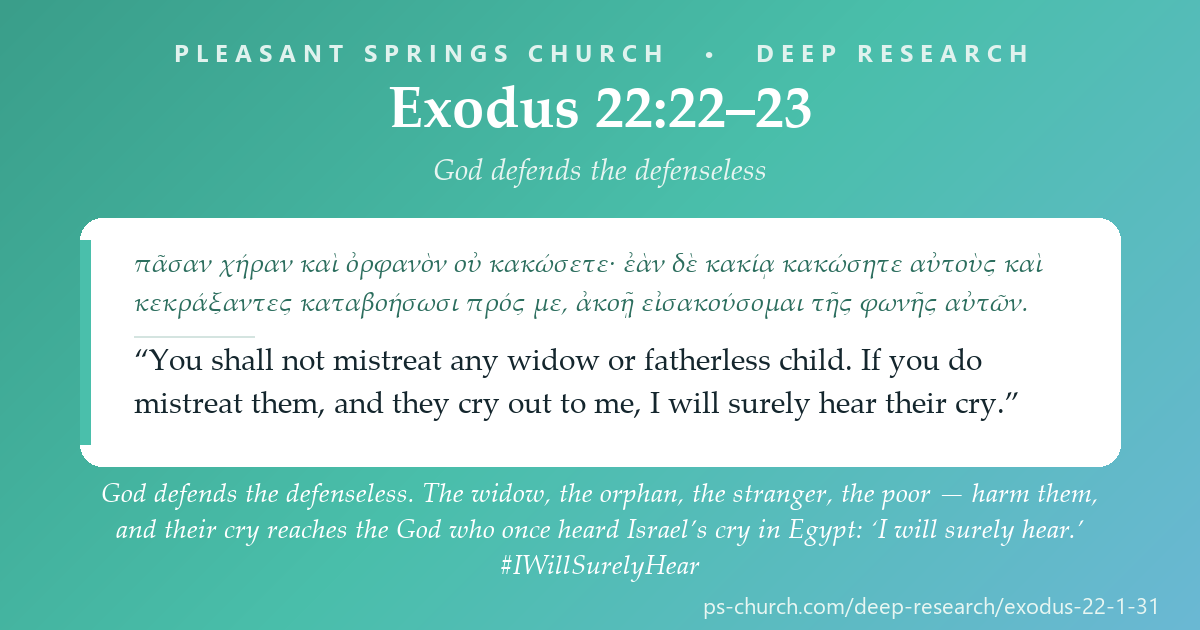
Exodus 22:22–23 · to share
LXX + ESVEvery Deep Research page traces its passage across the whole sweep — the Old Testament, the Second-Temple world between the testaments (historical witnesses, not Scripture), and the New Testament. Follow the thread:
Pleasant Springs Church — Deep Research
Research method after Michael S. Heiser’s Bible Research Method (examine dictionaries → ancient literature → important words → textual connections → academic publications → share), with the Pleasant Springs “Author & Audience” foundation. Scripture set in the Hebrew, the Greek editions named on each page and the ESV (Old Testament), and the Greek New Testament and the ESV (New Testament), per the practice of Pleasant Springs Church. Exodus 22:1–31 research grounded in Childs, Durham, Stuart, and Sarna, with C. J. H. Wright and Roy Gane on Old Testament law and ethics; the Book of the Covenant read against ANE law codes (Hammurabi, Eshnunna) and its distinctive turn toward the vulnerable; the property laws as restorative justice (restitution, not merely retribution), and the social laws grounded in God’s own character — the memory of Egypt (22:21) and the cry God hears (22:23, 27; tsāʿaq, cf. 3:7) — read for their enduring moral principle and fulfilled in Christ (Matt 5:17), with Israel’s theocratic penalties held in their historical context, not as a template for the church as civil enforcer; Second-Temple material per Philo (Special Laws 4) and Josephus (Antiquities 4) as witnesses, not Scripture.
Scripture quotations marked ESV are from the ESV® Bible (The Holy Bible, English Standard Version®), © 2001 by Crossway, a publishing ministry of Good News Publishers. ESV Text Edition: 2016. Used by permission. All rights reserved. The ESV text may not be quoted in any publication made available to the public by a Creative Commons license, and the ESV may not be translated in whole or in part into any other language. www.esv.org
|
Did this study bless you today? 💚 Give to Support PS Church100% of gifts go to the General Fund — thank you. |