A Levite mother sees her newborn is “a fine child,” hides him from Pharaoh’s death-decree, and sets him in an ark of bulrushes — the same word as Noah’s — on the very Nile ordered to drown him. The death-river becomes a cradle: Pharaoh’s daughter draws him out and names him Moses. Grown, he strikes down an Egyptian, is rebuffed by his own people, and flees to Midian, a sojourner far from home. Then four verbs turn a family’s groaning into an Exodus: “God heard… remembered his covenant… saw… and knew.” This study works Exodus 2:1–25. See the method →
Exodus 2:2, 3, 10, 14, 22, 24–25
Hebrew · LXX · ESVThe Shape of the Passage
Parallel panelsPharaoh decreed the Nile a grave for Hebrew sons (1:22). Chapter 2 answers by floating the deliverer on that same river in an ark — and closes with the four verbs that turn a family’s groaning into an Exodus.
Author
The Torah of Moses narrates its author’s own beginnings with startling restraint. A Levite man marries a Levite woman (2:1); a son is born and — in words that reach back to Genesis 1 — his mother “saw that he was a fine child” (כִּי־טוֹב, “that he was good,” 2:2). Against Pharaoh’s death-decree she hides him three months, then sets him in a תֵּבָה (tevah) — the same word as Noah’s ark — daubed with bitumen and pitch, and places it among the reeds of the very Nile ordered to drown him (2:3). The death-river becomes a cradle. Pharaoh’s own daughter draws him out; by his sister’s quick wit (unnamed here; Miriam in Num 26:59) the child is nursed by his own mother — and Egypt pays her to do it (2:7–9). Named Moses (Mosheh), “because I drew him out (mashah) of the water” (2:10), he is a Hebrew raised in the palace of the house that meant to destroy him.
The failed deliverer. Grown, Moses “went out to his people and looked on their burdens” (2:11); seeing an Egyptian beat a Hebrew, he kills the man and hides him in the sand. It is deliverance attempted on Moses’ own timetable and terms — and it fails at once: the next day a fellow Hebrew throws it in his face, “Who made you a prince and a judge over us?” (2:14). Pharaoh seeks his life, and the prince of Egypt becomes a fugitive. The narrator neither sanctions the killing nor caricatures Moses; Scripture simply records that the man who would one day be sent must first be un-made. Forty hidden years in Midian (Acts 7:23, 30, read as a New Testament witness) lie between this failure and the burning bush.
Midian and the well. Moses flees to Midian and sits down by a well — and any Israelite reader knows what wells mean: this is a betrothal scene (cf. Genesis 24; 29). He defends the seven daughters of Reuel (Jethro) from shepherds, waters their flock, is taken into the household, and marries Zipporah (2:16–21). Their son he names Gershom — “ger I have been, a sojourner in a foreign land” (2:22): the deliverer of Israel is himself, for now, a stranger far from his people’s promised home.
Audience
Israel — still hearing the story of how their rescue began — is taught first that God’s providence outruns Pharaoh’s power. The empire’s river, its palace, its own princess, are all quietly bent to preserve the child the empire condemned. Nothing miraculous is reported in the whole rescue: a mother’s courage, a sister’s wit, a woman’s pity at the water’s edge. That is the point — the God who is never named in the rescue is unmistakably its author.
Not yet, and not by these means. The audience also learns that zeal is not the same as calling. Moses’ premature, self-appointed “deliverance” — violence on his own authority — sets Israel’s liberation back by forty years. The deliverer must be sent, not self-launched (Exod 3). Honest laments and hard waiting are part of the making of a servant.
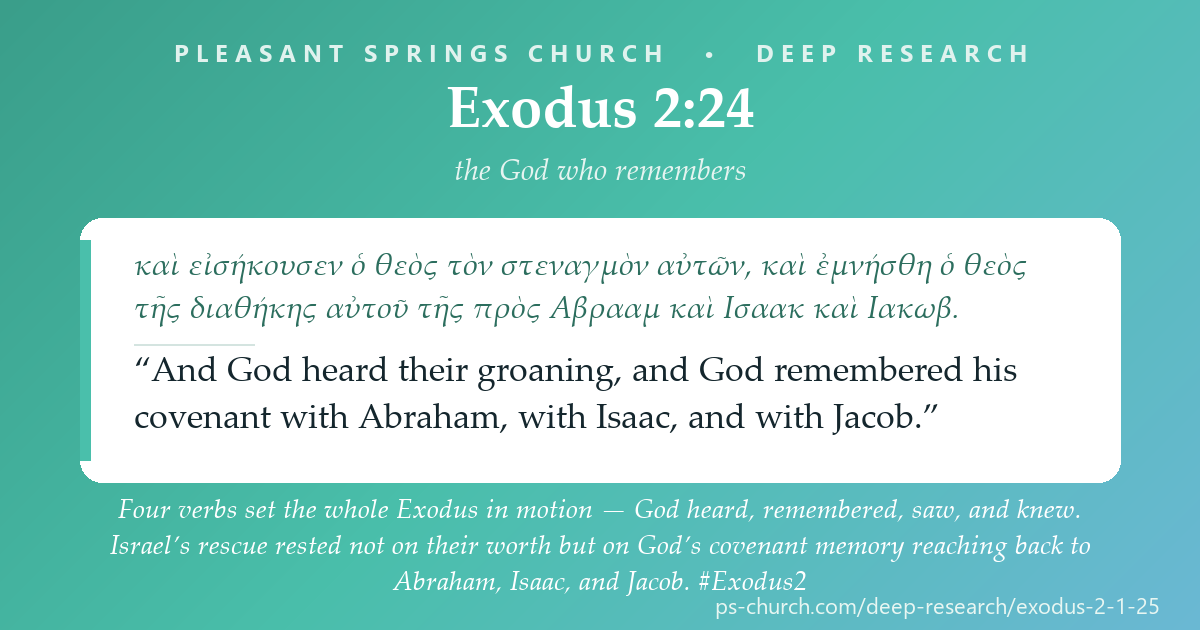
The God who remembers. The chapter’s last four verbs are its theology: after a long time the king of Egypt dies, Israel groans, and their cry goes up to God — and “God heard… God remembered his covenant with Abraham, Isaac, and Jacob… God saw… and God knew” (2:24–25). To “remember” (זָכַר, zakar) is not to recall what was forgotten but to act on a standing commitment. The whole Exodus is set in motion not by Israel’s merit but by God’s ancient covenant with the patriarchs — grace reaching back generations to keep a promise.
Orient on Moses, Midian, the covenant, and God’s “remembering.”
Search by topic: Moses, Midian / Jethro / Reuel, Levi, covenant (berit), remembrance (zakar), providence.
Which articles are relevant?
- Anchor Bible Dictionary — “Moses,” “Midian,” “Jethro,” “Zipporah,” “Covenant.”
- Dictionary of the OT: Pentateuch — “Moses,” “Birth of Moses,” “Midianites,” “Providence,” “Election.”
- NIDOTTE / TDOT — תֵּבָה (tevah, ark/basket), זָכַר (zakar, remember), בְּרִית (berit, covenant), גֵּר (ger, sojourner).
Bibliography surfaced:
- Brevard Childs, The Book of Exodus (OTL); Douglas Stuart, Exodus (NAC); John Durham, Exodus (WBC); Peter Enns, Exodus (NIVAC).
- Nahum Sarna, Exploring Exodus; Terence Fretheim, Exodus (Interpretation).
- Studies on the birth-of-the-hero motif and on zakar (divine remembering) in covenant theology.
The exposed-infant tale, the tevah, and the betrothal at the well.
Read the birth story against the ANE “exposed royal infant” tales and the Noah-ark echo, then hear the Second-Temple retellings as witnesses, not Scripture.
Which parallels shed light on religion and worldview?
The exposed child who becomes a deliverer. The ancient world told stories of infants set adrift or exposed and rescued to greatness — most famously the Akkadian Legend of Sargon, whose priestess-mother places him in a reed basket sealed with bitumen and sets him on the river. Exodus knows this narrative world and turns it inside out: the child is not abandoned to fate but hidden in faith; the river is not neutral but a decreed grave; and the rescuer is not chance but the pity God stirs in an Egyptian princess. Above all, the basket is a תֵּבָה (tevah) — the word used only here and for Noah’s ark: a little vessel of salvation riding the waters of judgment, bearing the one through whom God will save a people (Gen 6:14; 7:23).
Midian, and the well type-scene. Moses’ flight lands him where Israel’s founding marriages began — at a well. The pattern (a man far from home, women at the water, a service rendered, a betrothal) recurs with Isaac’s bride, Jacob and Rachel, and now Moses and Zipporah; the New Testament will set the Messiah himself at a well (Jn 4). Midian, descended from Abraham through Keturah (Gen 25:1–4), is on the edge of the promise — a fitting exile for a man not yet sent.
- The Legend of Sargon of Akkad — the birth-of-the-hero tale (basket of reeds, bitumen, the river): the ANE backdrop Exodus both echoes and subverts.
- Genesis 6:14–9:18; 24; 29:1–12 — the tevah of Noah, and the betrothal-at-the-well type-scene reused in Moses’ story.
- Jubilees 47 — a Second-Temple retelling that names Moses’ parents (Amram and Jochebed) and elaborates his infancy (a historical witness to how the era read the story, not Scripture).
- Josephus, Antiquities 2.9–11; Philo, Life of Moses 1 — expansive Hellenistic-Jewish lives of Moses (dreams, the princess Thermuthis, palace learning) — witnesses to interpretation, not the text itself.
The New Testament looks back on this chapter and reads faith where the narrative is spare. Hebrews says Moses “was hidden for three months by his parents, because they saw that the child was beautiful, and they were not afraid of the king’s edict” (Heb 11:23) — taking up the LXX’s word ἀστεῖος (“beautiful,” the same term Stephen uses, “beautiful in God’s sight,” Acts 7:20). What the Hebrew calls “good” (כִּי־טוֹב, the refrain of creation, Gen 1) the New Testament calls the object of a parent’s faith: they saw more than a lovely baby — they saw a child worth defying an empire for. And Stephen frames the whole failed first “deliverance” with sober honesty: “He supposed that his brothers would understand that God was giving them salvation by his hand, but they did not understand” (Acts 7:25). The deliverer arrived forty years before he was sent — and the God who remembers was in no hurry.
The vocabulary of rescue: the ark, the good child, the drawn-out one, the sojourner, the remembering God.
Watch the tevah–Noah link, the ki-tov of creation, the mashah wordplay in “Moses,” the honest ger of Gershom, and the covenant force of zakar.
“Ark, basket” — used only here and of Noah’s ark (Gen 6–9). A little vessel of salvation on the waters of judgment; the LXX θῖβις loses the echo the Hebrew makes.
“That he was good / fine” — the same phrase as God’s verdict over creation (Gen 1). A mother sees, and hides in faith; Hebrews reads it as courage against the king’s edict (Heb 11:23).
“Moses” — explained by mashah, “to draw out”: “I drew him out of the water.” The Hebrew form is active (“one who draws out”) — the drawn-out child will draw a people out of the sea.
“Sojourner, resident alien” — the root of Gershom. Moses names his exile honestly; Israel will be commanded to love the ger, “for you were sojourners in Egypt” (Exod 22:21; 23:9).
“Remember” — not recalling the forgotten but acting on a standing commitment. God “remembers” his covenant with the patriarchs; the whole Exodus follows from it (cf. Gen 8:1; Luke 1:72).
“Groaning” — the wordless cry of the enslaved. God “heard” it; the first movement of redemption is that the sufferer’s inarticulate groan reaches the God who was never named in their rescue (cf. Rom 8:26).
How the rest of Scripture fills out the scene:
- Genesis 8:1; 19:29; 30:22 — God “remembered” Noah, Abraham, Rachel: zakar as covenant action, the pattern behind Exodus 2:24.
- Acts 7:20–29; Hebrews 11:23–27 — Stephen and the writer to the Hebrews reread the birth, the failed deliverance, and the flight as faith and providence (New Testament witnesses).
- Exodus 22:21; 23:9; Deuteronomy 10:19 — “you were sojourners (gerim) in Egypt”: Gershom’s name becomes Israel’s ethic of mercy to the stranger.
- Luke 1:72–73 — “to remember his holy covenant… the oath he swore to… Abraham”: the same covenant-remembering behind the coming of Christ.
From an ark on the Nile to the covenant God who remembers.
Trace the ark of salvation, the drawn-out deliverer, the sojourner, and the covenant-remembering — forward to the burning bush and to Christ.
Which cross-references matter?
- Exodus 1:1–22 — the death-decree over the Nile that chapter 2 answers: the river ordered to kill becomes the cradle that saves.
- Exodus 3:1–15 — the burning bush: the God who “remembered” now speaks his name and sends the deliverer he has been forty years preparing.
- Exodus 6:2–8 — “I have remembered my covenant… I will redeem you”: 2:24 unfolded into the Exodus program.
- Genesis 24; 29:1–12 — the betrothal-at-the-well type-scene behind Moses and Zipporah in Midian.
- Acts 7:17–36; Hebrews 11:23–27 — the New Testament’s reading of the birth, the palace, the failed deliverance, and the forty years.
Exodus 2 ends not with an event but with four verbs, and everything after them flows from them: “God heard their groaning, and God remembered his covenant with Abraham, with Isaac, and with Jacob. God saw the people of Israel—and God knew” (2:24–25). Nothing in the chapter’s human drama — the brave mother, the clever sister, the pitying princess, the fugitive prince — is the engine of the Exodus. The engine is a promise made centuries earlier to three dead men, which the living God now moves to keep. “Remember” here is not memory recovered but loyalty enacted: the same verb that had God ‘remember’ Noah in the flood and Abraham over Sodom (Gen 8:1; 19:29). Israel’s rescue rests on nothing in Israel — not their worth, not even their prayer, only their groan — and everything in God’s covenant faithfulness. The chapter that never once names the Lord in the rescue closes by naming him four times as the God who hears, remembers, sees, and knows. Zechariah will sing the same note in the Benedictus: God has come ‘to remember his holy covenant… the oath he swore to Abraham’ (Luke 1:72–73). The Exodus, and the greater Exodus, both begin in the memory of God.
The scholarship on Exodus 2:1-25.
Childs, Durham, Stuart, and Sarna for the exegesis; the studies on the birth-of-the-hero motif and on covenant remembrance.
Commentaries & studies:
- Brevard Childs, The Book of Exodus (OTL); John Durham, Exodus (WBC); Douglas Stuart, Exodus (NAC); Peter Enns, Exodus (NIVAC).
- Nahum Sarna, Exploring Exodus; Terence Fretheim, Exodus (Interpretation); Cornelis Houtman, Exodus (HCOT).
- Studies of the Sargon birth-legend parallel and of zakar / covenant remembrance (e.g., Childs, Memory and Tradition in Israel).
Interpretation notes worth keeping:
- The tevah (2:3). The deliberate reuse of Noah’s ark-word (found nowhere else) frames Moses as a second bearer-of-salvation through the waters; best read as intentional canonical echo, not coincidence.
- The killing of the Egyptian (2:11–12). Recorded, not commended. Moses’ zeal is real but self-appointed and premature; the text (and Acts 7:25) treat it as deliverance attempted before the deliverer is sent — not a warrant for private violence.
- “Prince and judge” (2:14). The very titles Moses will in fact hold — but not yet, and not on his own authority. Calling, not self-assertion, makes the leader.
- “And God knew” (2:25). The MT’s absolute “knew” (intimate, covenantal knowing) the LXX reads as “he was made known to them” (ἐγνώσθη αὐτοῖς); both hold the same truth — God turns toward his people in saving attention.
From an ark on the Nile to the God who remembers you.
Name what you learned, why it matters, and one concrete response.
What should we carry away — and do?
- Providence outruns power. No miracle rescues the baby — only a mother’s courage, a sister’s wit, a stranger’s pity. The God never named in the rescue is unmistakably its author. Your unremarkable faithfulness may be exactly how he is working.
- Zeal is not calling. Moses’ self-launched “deliverance” cost forty years. Wait to be sent. Hidden preparation is not wasted time; it is the making of a servant.
- God remembers his covenant. He heard, remembered, saw, and knew — and the Exodus began. Your rescue rests not on your worth but on his faithfulness to his own promise (Luke 1:72).
Step in response: bring your wordless groan to the God who hears (Rom 8:26), and rest not in your merit but in his memory. Then, because Gershom’s name became Israel’s ethic, do one deliberate kindness to a stranger or sojourner this week — “for you were sojourners.”
Exodus 2:24–25 · to share
LXX + ESVEvery Deep Research page traces its passage across the whole sweep — the Old Testament, the Second-Temple world between the testaments (historical witnesses, not Scripture), and the New Testament. Follow the thread:
Pleasant Springs Church — Deep Research
Research method after Michael S. Heiser’s Bible Research Method (examine dictionaries → ancient literature → important words → textual connections → academic publications → share), with the Pleasant Springs “Author & Audience” foundation. Scripture set in the Hebrew, the Greek editions named on each page and the ESV (Old Testament), and the Greek New Testament and the ESV (New Testament), per the practice of Pleasant Springs Church. Exodus 2:1–25 research grounded in Childs, Durham, Stuart, Enns, Sarna, and Fretheim; the tevah–Noah echo (Gen 6–9) and the Sargon birth-legend parallel; the betrothal-at-the-well type-scene (Gen 24; 29) behind Moses and Zipporah; Moses’ killing of the Egyptian recorded, not commended, and his premature “deliverance” read with Acts 7:25 as arriving forty years before he was sent; the covenant force of zakar (2:24; cf. Gen 8:1; Luke 1:72); Jubilees 47, Josephus (Ant. 2), and Philo (Life of Moses 1) cited as Second-Temple witnesses, not Scripture. The name YHWH is deliberately withheld until Exodus 3–6 — chapter 2 speaks only of “God” (Elohim).
Scripture quotations marked ESV are from the ESV® Bible (The Holy Bible, English Standard Version®), © 2001 by Crossway, a publishing ministry of Good News Publishers. ESV Text Edition: 2016. Used by permission. All rights reserved. The ESV text may not be quoted in any publication made available to the public by a Creative Commons license, and the ESV may not be translated in whole or in part into any other language. www.esv.org
|
Did this study bless you today? 💚 Give to Support PS Church100% of gifts go to the General Fund — thank you. |