A bush blazes in the desert but is not consumed, and a voice calls a runaway shepherd to take off his sandals: he is on holy ground. God announces he has seen his people’s suffering and has come down to deliver — and when Moses asks his name, gives the deepest self-revelation in the Old Testament: “I AM WHO I AM.” This study — the library’s first in Exodus — works the burning bush and the divine Name YHWH all the way to Jesus’ “before Abraham was, I am.” See the method →
Exodus 3:1–15 (selections)
Hebrew · LXX · ESVThe Shape of the Passage
Type-sceneWith Exodus the Deep Research library enters its second book — still the Torah of Moses, now telling how the God of the patriarchs becomes Israel’s Redeemer, beginning at a burning bush.
Author
The Torah of Moses opens the exodus with a fire that does not consume — a sign of God’s presence that burns without destroying. God announces himself as the covenant-keeper of the patriarchs (“the God of Abraham, Isaac, and Jacob”), declares “I have surely seen the affliction of my people… I have come down to deliver,” and commissions a reluctant Moses. When Moses asks God’s name, the answer is the deepest self-revelation in the Old Testament: “I AM WHO I AM” (אֶהְיֶה אֲשֶׁר אֶהְיֶה) — the self-existent, ever-present God, whose covenant name יְהוָה (YHWH) is woven from the verb “to be.”
The name as promise. “I AM” is not abstract philosophy but covenant assurance: the God who simply is, and who will be with Moses (“I will be with you,” 3:12, the same verb ehyeh). His being is his faithfulness.
Audience
Israel — slaves in Egypt, who needed to know that the God of their long-dead fathers was still alive, still covenant-bound, and about to act. The name YHWH would be spoken over their whole existence: the God who is, who hears, who comes down.
How they heard it. So holy is the name that later Israel would not pronounce it, reading “Adonai” (Lord) instead — which is why English Bibles print “the Lord” in small capitals. The bush that burns unconsumed is the God who dwells with his people without destroying them — a holiness that saves.
Orient on the divine name, holiness, and the call of Moses.
Search by topic: YHWH / divine name, I AM, holiness, theophany, call narrative.
Which articles are relevant?
- Anchor Bible Dictionary — “Yahweh,” “Names of God (OT),” “Moses,” “Theophany.”
- Dictionary of the OT: Pentateuch — “God, Names of,” “Moses,” “Holiness,” “Call Narratives.”
- NIDOTTE / TDOT — הָיָה (hāyâ, to be), יהוה (the Tetragrammaton), קֹדֶשׁ (qōḏeš, holy), סְנֶה (səneh, bush).
Bibliography surfaced:
- Brevard Childs, The Book of Exodus (OTL); Douglas Stuart, Exodus (NAC); John Durham, Exodus (WBC).
- R. W. L. Moberly, The Old Testament of the Old Testament — the name YHWH and patriarchal religion.
- Studies on the Tetragrammaton (e.g., de Vaux) and the LXX ὁ ὤν.
Naming a god, the reverence for the Name, and “the One who is.”
Read the name-revelation against ANE ideas of divine names and power, then note the Second-Temple reverence for the Name and its Greek rendering.
Which parallels shed light on religion and worldview?
Knowing a god’s name. In the ANE, to know a deity’s name was to have a handle on its power (Egyptian magic prized secret divine names). Moses’ question “what is his name?” fits that world — but God’s answer refuses to be a manipulable formula: “I AM WHO I AM.” God names himself by his own free being. He is not a force to be leveraged but the Lord who is who he is.
- Egyptian “name” theology — the belief that a god’s secret name conferred power (e.g., the myth of Isis and the name of Ra): the backdrop against which YHWH’s self-naming stands out.
- Second-Temple reverence for the Name — by this era Jews avoided pronouncing YHWH, substituting Adonai (“Lord”); the Dead Sea Scrolls sometimes write the Tetragrammaton in archaic script to mark its holiness.
- The LXX Ἐγώ εἰμι ὁ ὤν — “I am the One who is”: the Greek translators render the Name with the language of being, a bridge later used by Philo and the Fathers.
- Philo, On the Life of Moses 1.75; On the Change of Names (Pseudepigraphal-era Jewish philosophy — not Scripture) — expounds God as τὸ ὄν, “that which is,” pure Being.
The most electrifying use of this name is on the lips of Jesus. In John’s Gospel he says, “Before Abraham was, ἐγώ εἰμι” (John 8:58) — taking up the divine “I am” that runs through the LXX (its closest echo is Isaiah’s “I am he,” Isa 43:10; 48:12) — and his hearers pick up stones, understanding the claim. The chain of great “I am” sayings draws on this whole tradition, with Exodus 3 at its headwater. The bush that burned unconsumed, the God who “is,” who came down to deliver, is revealed in the New Testament as the one who took flesh and came down finally — “God with us,” the great I AM in person (John 1:14; Rev 1:8, “who is and who was and who is to come”).
The vocabulary of the Name and the holy fire.
Watch the bush/Sinai pun, the holy ground, the “I AM” from the verb “to be,” and the LXX’s “the One who is.”
“Bush” — a thornbush; a wordplay with Sinai, where God will later descend in fire. Humble, lowly — and ablaze with the presence.
“Holy ground” — ground made holy by God’s presence, requiring bare feet and reverence. The first “holy place” is wherever God is.
“I AM WHO I AM” / “I will be who I will be” — God’s self-definition by the verb “to be”: self-existent (or dynamically, “I will be”), free, and faithfully present.
The Tetragrammaton — the covenant name, from the same root “to be.” So holy Israel would not speak it, reading “Adonai”; hence “the Lord” in English Bibles.
“The One who is” — the LXX’s rendering of “I AM,” read by the Fathers as the God of pure, underived being. Reused by Jesus (“ἐγώ εἰμι”) and John (Rev 1:8).
“I will be with you” — the same verb as the Name. God’s being is his presence-with: “I AM” means “I am with you.”
How the New Testament reuses the Name:
- John 8:58 — “before Abraham was, ἐγώ εἰμι”: Jesus claims the divine “I am” of Exodus 3, and his hearers take up stones.
- John 6:35; 8:12; 11:25; 14:6; 18:5–6 — the great “I am” sayings, and the soldiers falling back when Jesus says “I am he.”
- Mark 12:26–27 — Jesus proves the resurrection from “I am the God of Abraham” (Exod 3:6): “he is not God of the dead, but of the living.”
- Revelation 1:8; 4:8 — “the Lord… who is and who was and who is to come”: the “I AM” unfolded across time.
From the bush to the great I AM.
Trace the Name, the holy presence, and the “God of the fathers” theme — then note the Beale & Carson trajectory at John.
Which cross-references matter?
- Exodus 6:2–3; 33:19; 34:5–7 — the Name proclaimed and expounded: “The Lord, the Lord, a God merciful and gracious…”
- Genesis 12; 15; 28 — “the God of Abraham, Isaac, and Jacob”: the burning bush ties the exodus back to the patriarchal promises.
- Isaiah 41:4; 43:10–13; 48:12 — “I am he” (ἐγώ εἰμι in the LXX): the exilic prophet’s divine self-declarations, the bridge to Jesus’ “I am.”
- John 8:58; 18:5–6; Mark 6:50 — Jesus’ “I am,” and the divine self-identification on the sea.
- Revelation 1:4, 8 — “him who is and who was and who is to come”: the Name as the shape of eternity.
The commentary’s John treatment reads the “I am” sayings against Exodus 3 and Isaiah 40–55: Jesus deliberately takes up the divine Name. “Before Abraham was, I am” is not bad grammar but a claim to the timeless being of Exodus 3:14 — which is why the response is stones. The God who named himself “I AM” at the bush, who is his own being and his people’s ever-present help, has come near in the Son who says “I am” — and who is, at the last, “the Alpha and the Omega… who is and who was and who is to come” (Rev 1:8).
The scholarship on the Name and the call.
Childs and Durham for the exegesis; Moberly on the Name and patriarchal religion; the studies on ὁ ὤν.
Commentaries & studies:
- Brevard Childs, The Book of Exodus (OTL); John Durham, Exodus (WBC); Douglas Stuart, Exodus (NAC); Peter Enns, Exodus (NIVAC).
- R. W. L. Moberly, The Old Testament of the Old Testament; studies on the meaning of ʾehyeh ʾăšer ʾehyeh (causative vs. existential).
- On the Johannine “I am”: Catrin Williams, I Am He; the standard John commentaries.
Interpretation notes worth keeping:
- “I AM WHO I AM” can be read existentially (“I am the one who is”) or dynamically (“I will be who I will be” — ever-present in action); the context (“I will be with you,” 3:12) favors both truth of being and faithful presence.
- The Name and Genesis: whether the patriarchs already knew the name YHWH (cf. Exod 6:3) is debated; either way, Exodus 3 marks its covenantal unveiling as the Redeemer’s name.
- The LXX ὁ ὤν shaped centuries of theology (God as Being itself), and undergirds the NT’s ἐγώ εἰμι Christology.
From the bush to your own holy ground.
Name what you learned, why it matters, and one concrete response.
What should we carry away — and do?
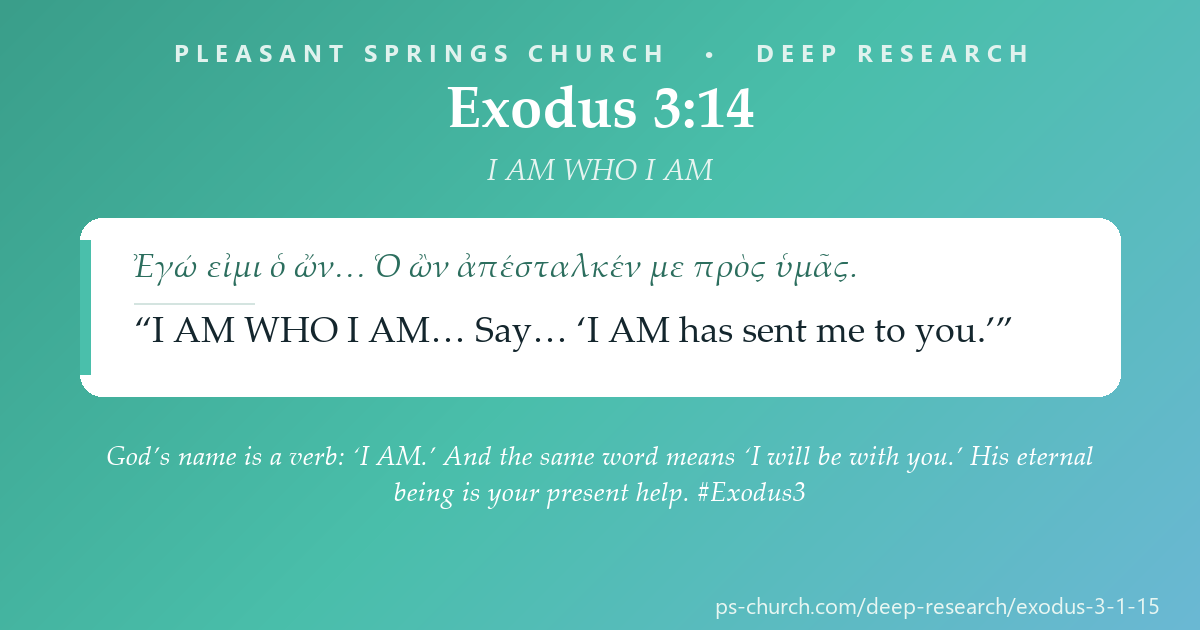
- God simply is — and is with you. “I AM” is not cold philosophy: the same word means “I will be with you” (3:12). His eternal being is your present help.
- He has seen, and he comes down. “I have surely seen the affliction of my people… I have come down to deliver.” The God who is is not distant; he stoops to rescue — finally in the Incarnation.
- The great I AM took flesh. The Name at the bush is on Jesus’ lips: “before Abraham was, I am.” To meet Christ is to stand on holy ground before the God who is.
Step in response: take off your sandals — make one deliberate space of reverence this week — and rest in the Name: not just that God is, but that “I AM” has said “I will be with you.”
Exodus 3:14 · to share
LXX + ESVEvery Deep Research page traces its passage across the whole sweep — the Old Testament, the Second-Temple world between the testaments (historical witnesses, not Scripture), and the New Testament. Follow the thread:
Pleasant Springs Church — Deep Research
Research method after Michael S. Heiser’s Bible Research Method (examine dictionaries → ancient literature → important words → textual connections → academic publications → share), with the Pleasant Springs “Author & Audience” foundation. Scripture set in the Hebrew, the Greek editions named on each page and the ESV (Old Testament), and the Greek New Testament and the ESV (New Testament), per the practice of Pleasant Springs Church. Exodus 3:1–15 research grounded in Childs, Durham, Stuart, Enns, and Moberly; ANE divine-name background; Second-Temple reverence for the Tetragrammaton and the LXX ὁ ὤν; Philo on God as Being (read as witnesses, not Scripture).
Scripture quotations marked ESV are from the ESV® Bible (The Holy Bible, English Standard Version®), © 2001 by Crossway, a publishing ministry of Good News Publishers. ESV Text Edition: 2016. Used by permission. All rights reserved. The ESV text may not be quoted in any publication made available to the public by a Creative Commons license, and the ESV may not be translated in whole or in part into any other language. www.esv.org
|
Did this study bless you today? 💚 Give to Support PS Church100% of gifts go to the General Fund — thank you. |