Moses keeps objecting — they will not believe me… I am slow of speech… please send someone else — and the Lord keeps answering: three signs, the promise “I will be with your mouth,” and at last Aaron as spokesman. Sent back to Egypt, Moses carries the whole exodus in one sentence — “Israel is my firstborn son… let my son go” — passes through the sobering night of the covenant sign (“a bridegroom of blood”), and finds a people who believe when they hear that “the Lord has visited” them. This study works Exodus 4:1–31. See the method →
Exodus 4:1, 11–12, 22–25, 31
Hebrew · LXX · ESVThe Shape of the Passage
InclusioThe burning-bush call runs on into chapter 4: God has commissioned Moses (Exodus 3); now Moses argues back, and the Lord answers every objection — not with rebuke first, but with equipment.
Author
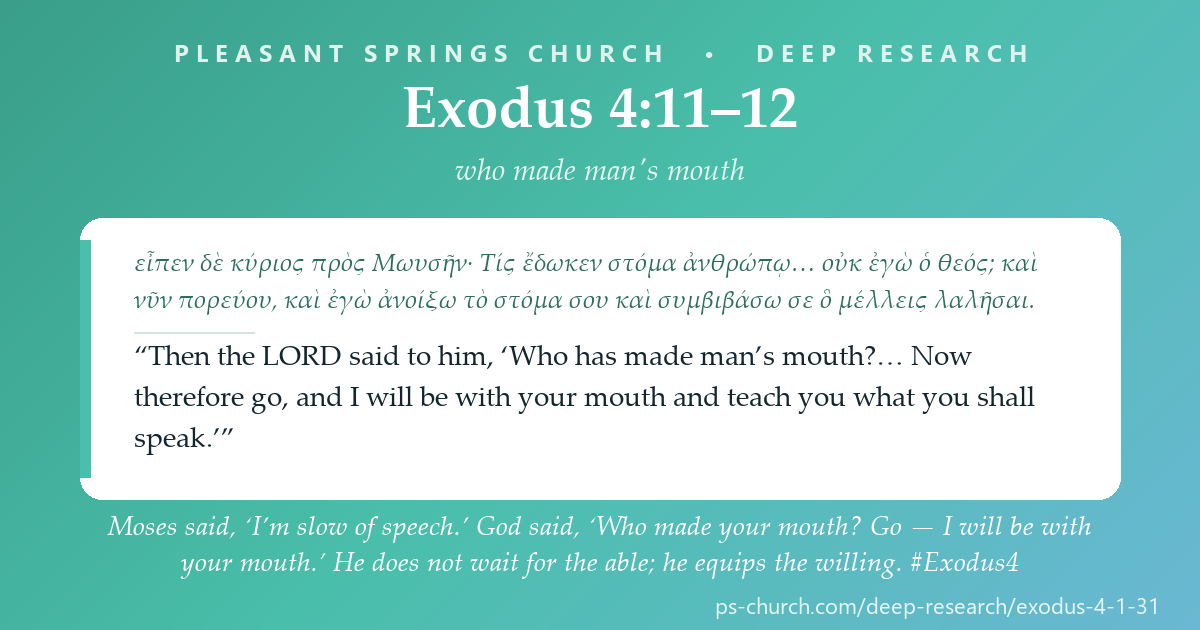
The Torah of Moses lets the reluctant prophet speak for himself — and the honesty is disarming. Four times Moses objects (3:11; 3:13; 4:1; 4:10), and a fifth time he simply asks to be excused (4:13). To the fear “they will not believe me” God gives three signs: the staff that becomes a serpent and returns to a staff, the hand made leprous and healed in his own bosom, and Nile water poured out as blood on dry ground (4:2–9) — each a small foretaste of the power that will meet Egypt at its river. To the plea “I am slow of speech and of tongue” (כְבַד־פֶּה, “heavy of mouth”) comes the great answer: “Who has made man’s mouth?… Now therefore go, and I will be with your mouth and teach you what you shall speak” (4:11–12).
When patience meets refusal. Only when Moses finally says “please send someone else” (4:13) is the Lord’s anger kindled — and even that anger is met with provision: Aaron the Levite is already on his way, and will be Moses’ mouth, while “you shall be as God to him” (4:14–16) — a commission repeated when Moses is made “as God to Pharaoh” with Aaron as his prophet (7:1). Returning to Egypt with Jethro’s blessing, Moses is warned that God will harden Pharaoh’s heart (4:21) and told the last word of the last plague in advance: “Israel is my firstborn son… let my son go… I will kill your firstborn son” (4:22–23) — the whole exodus in a sentence.
The night at the lodging place. Then a scene as sobering as it is brief (4:24–26): “the Lord met him and sought to put him to death,” and Zipporah, taking a flint, circumcises their son and touches Moses’ feet with the foreskin — “a bridegroom of blood.” The narrative is deliberately spare, but its logic is not obscure: the man sent to demand that Pharaoh release God’s firstborn son had left the covenant sign uncut on his own son. The deliverer who bears God’s covenant cannot himself neglect the covenant; God’s holiness is not partial to his chosen instrument. Zipporah’s swift obedience turns away the danger, and the mission goes on.
Audience
Israel — still in Egypt, still afraid — needed to know that their deliverer was no self-appointed hero but a man dragged to the task, and that the power was wholly God’s. Every objection Moses raised, they had felt: who will believe us? we cannot speak before Pharaoh; find someone else. The chapter answers the fear of the whole nation in the person of one man: the God who makes the mouth will be with the mouth; the signs will authenticate the messenger; the Lord himself has taken responsibility for the outcome.
“The Lord has visited.” The chapter ends where hope begins: Aaron meets Moses, the elders are gathered, the signs are done, “and the people believed… and when they heard that the Lord had visited (פָּקַד, pāqad) the people of Israel and had seen their affliction, they bowed their heads and worshiped” (4:31). That word pāqad is the seal on Joseph’s coffin: “God will surely visit you” (Gen 50:24–25). Four centuries later, the promise is kept. Israel learned, and the church after them, that God equips the objecting and the inadequate, authenticates his word by his own acts, binds even his deliverers to his covenant, and never forgets what he has sworn.
Orient on the signs, the call narrative, Aaron, and the hardening.
Search by topic: signs and wonders, call narrative, Moses, Aaron, prophecy / spokesman, hardening of heart, circumcision, firstborn.
Which articles are relevant?
- Anchor Bible Dictionary — “Moses,” “Aaron,” “Signs and Wonders,” “Circumcision,” “Firstborn.”
- Dictionary of the OT: Pentateuch — “Call Narratives,” “Signs and Wonders,” “Aaron,” “Hardening,” “Circumcision.”
- NIDOTTE / TDOT — אוֹת (ʾōṯ, sign), חָזַק / קָשָׁה (ḥāzaq / qāšāh, to harden), פָּקַד (pāqad, to visit / attend to), בְּכוֹר (bəḵôr, firstborn).
Bibliography surfaced:
- Brevard Childs, The Book of Exodus (OTL); Douglas Stuart, Exodus (NAC); John Durham, Exodus (WBC); Peter Enns, Exodus (NIVAC).
- Studies of the prophetic call form (Habel) and of the “signs” motif in Exodus.
- Treatments of the hardening of Pharaoh (Beale; on Exod 4–14 and Rom 9) and of the circumcision episode (4:24–26).
The reluctant prophet, the spokesman, the blood on the doorpost of a family.
Read the objection-and-answer pattern against the call narratives, the “mouth/prophet” relation, and the covenant weight of circumcision — then hear how the Second-Temple world retold Moses’ commission (as witnesses, not Scripture).
Which parallels shed light on religion and worldview?
The prophet who says no. The call of Moses follows a form that recurs across the prophets — confrontation, commission, objection, reassurance, and a sign (compare Gideon, Judg 6; Isaiah, Isa 6; Jeremiah, Jer 1). What marks Moses is the sheer persistence of his reluctance: five objections, ended not by his willingness but by God’s provision of Aaron. Scripture is unembarrassed to show that its greatest human deliverer had to be argued into his calling — the glory belongs to the Sender, not the sent.
“As God to him.” The Moses–Aaron relation defines biblical prophecy in miniature: Moses receives the word, Aaron speaks it; Moses is “as God” and Aaron is his “mouth” (4:16), a pattern restated as “I have made you like God to Pharaoh, and your brother Aaron shall be your prophet” (7:1). A prophet, in Israel’s grammar, is not a genius but a mouth — one who says what he is given to say (cf. Deut 18:18, “I will put my words in his mouth”).
- Numbers 12:1–8; Deuteronomy 18:15–18; 34:10–12 — Moses the unequalled prophet, the “mouth” in which God puts his words; the pattern of the prophet to come.
- Jubilees 47–48 (Second-Temple retelling — witness, not Scripture) — expands Moses’ infancy, flight, and return, and dramatizes the exodus as a conflict with the angel Mastema; a window on how the era read Exodus 1–14.
- Philo, Life of Moses 1.83–84; Josephus, Antiquities 2.12–13 (Hellenistic-Jewish witnesses, not Scripture) — retell the signs and the commission, smoothing the reluctance and the lodging-place scene in ways that reveal their apologetic aims.
- Egyptian sign-culture — a serpent (the uraeus) crowned Pharaoh’s brow as a symbol of royal and divine power; a staff turned serpent and mastered is a pointed first sign, aimed at Egypt’s own imagery.
No scene in the chapter is harder, and none should be handled more soberly. On the very road back to deliver God’s firstborn son, “the Lord met him and sought to put him to death” — and Zipporah, with a flint, circumcises their son, touches Moses’ feet with the foreskin, and calls him “a bridegroom of blood.” The text is spare on purpose, but its point is not hidden: the deliverer commissioned to confront a king over covenant sonship had left the covenant sign uncut on his own son (Gen 17:9–14 made circumcision the non-negotiable mark, its neglect a “cutting off”). God’s holiness is not softened by his choice of an instrument — if anything the chosen are held closer to the covenant, not looser. The rescue comes through a woman’s decisive obedience and the shed blood of the sign — a foreshadow, held as devotional analogy rather than strict exegesis, of the greater night when blood on the doorposts will turn away the destroyer from Israel’s own firstborn (Exod 12:12–13, 23). The LXX reads differently at two points — “an angel of the Lord” meets him, and Zipporah says “the blood of the circumcision has stopped” — an early witness that even ancient readers found the passage weighty.
The vocabulary of signs, the equipped mouth, sonship, and the visit.
Watch the “sign,” the “heavy mouth” answered by ʾehyeh, “my firstborn son,” the “bridegroom of blood,” and the seal-word pāqad.
“Sign” — the three wonders (staff/serpent, leprous hand, water to blood) that authenticate the messenger. Signs do not compel faith (some will not believe, 4:9); they warrant the word of the one God sends.
“Heavy of mouth” — ESV “slow of speech.” Moses pleads inadequacy; God answers not by denying the weakness but by claiming the mouth: “I made it, and I will be with it” (4:11–12).
“I will be with your mouth” — the verb ʾehyeh of the Name (“I AM… I will be with you,” 3:12, 14). The great I AM stoops to a stammering tongue. (LXX: “I will open your mouth.”)
“My firstborn son” — Israel’s sonship, and its privilege of nearness and inheritance. The plague of the firstborn (4:23; 12:29) is measured against Pharaoh’s refusal to release God’s son (cf. Hos 11:1).
“Bridegroom of blood” — Zipporah’s enigmatic cry at the circumcision that turns away the danger. The covenant sign, in blood, binds even the deliverer’s household to the Lord.
“Visited” — to attend to, to keep in view and act. “The Lord has visited” fulfills Joseph’s dying word (Gen 50:24). LXX ἐπεσκέψατο: God has looked in on his people.
How the rest of Scripture fills out the scene:
- Deuteronomy 18:15–18; Jeremiah 1:6–9 — the prophet as “mouth”: “I will put my words in his mouth”; “I have put my words in your mouth” — Moses’ commission becomes the pattern (see the prophet like Moses).
- Exodus 4:22 ↔ Hosea 11:1; Matthew 2:15 — “Israel is my firstborn son”; “out of Egypt I called my son” — read of the true Son who recapitulates Israel’s story.
- Genesis 50:24–25 ↔ Exodus 3:16; 4:31; 13:19 — the fourfold pāqad: Joseph’s promise (“God will surely visit you”), the elders told, the people believing, and Joseph’s bones carried up — the visit kept.
- Luke 1:68; 7:16 — “the Lord God… has visited (ἐπεσκέψατο) and redeemed his people” — the same LXX verb, now of the coming of Christ.
From the reluctant mouth to the Word made flesh.
Trace the equipped messenger, the firstborn son, and the covenant blood — and hold the hardening of Pharaoh in its full biblical balance.
Which cross-references matter?
- Exodus 3:1–15 — the call and the Name behind “I will be with your mouth”; the objections of ch. 3 continue into ch. 4.
- Exodus 7:1–13 — “you shall be as God to Pharaoh, and Aaron… your prophet”; the staff-serpent sign done before Pharaoh; the hardening begins.
- Exodus 4:21; 7:3; 8:15, 32; 9:12; 10:1 — the hardening motif: Pharaoh first hardens his own heart, then God hardens — judicial confirmation of settled defiance, held together with Pharaoh’s real guilt.
- Romans 9:14–18 — “I raised you up… that my name might be proclaimed” (Exod 9:16): God’s righteous freedom over a vessel that had made itself fit for destruction — not arbitrary reprobation (see Romans 8:31–39 on the security of those who are his).
- Hosea 11:1; Matthew 2:15; John 1:14; Luke 1:68 — the firstborn son, the true Son called out of Egypt, the Word who “tabernacled among us,” the Lord who has “visited” his people.
Exodus 4:21 forewarns Moses that God “will harden his heart, so that he will not let the people go” — and readers rightly ask how that squares with Pharaoh’s guilt. The narrative itself is the answer. Across the plagues the verbs are distributed with care: again and again Pharaoh hardens his own heart (8:15, 32; 9:34), and only then, confirming a defiance already settled, does the text say the Lord hardened Pharaoh’s heart (9:12; 10:1). This is judicial hardening — God handing a rebel over to the choice he has made, deepening a resolve that was his own (cf. Rom 1:24, 26, 28). When Paul cites this in Romans 9:17–18, his point is God’s righteous freedom to make his power and name known through a vessel that had made itself fit for destruction — not a decree of arbitrary reprobation over an innocent, and not a denial of Pharaoh’s culpability. God foreknew and declared the outcome (4:21–23) without coercing the wickedness; the Lord remains just, and Pharaoh remains guilty, and the deliverance of the firstborn son is sure. The chapter that opens with a servant God patiently equips closes the same book’s theology: mercy on whom he wills, and no charge against those he calls his own.
The scholarship on the call, the signs, and the hard scene.
Childs and Durham for the exegesis; the call-narrative form-criticism; the studies on the hardening and on 4:24–26.
Commentaries & studies:
- Brevard Childs, The Book of Exodus (OTL); John Durham, Exodus (WBC); Douglas Stuart, Exodus (NAC); Peter Enns, Exodus (NIVAC).
- Norman Habel, “The Form and Significance of the Call Narratives” (ZAW 1965) — the objection-and-reassurance pattern of Exodus 3–4.
- Studies on the hardening of Pharaoh and Romans 9 (e.g., Beale); and on the circumcision episode (Exod 4:24–26) and the LXX divergences there.
Interpretation notes worth keeping:
- “I will be with your mouth” (4:12). The answer to inadequacy is not self-confidence but the promise of presence — the same ʾehyeh as the Name (3:12, 14). The MT’s “be with” and the LXX’s “open” both land on God as the enabler of speech.
- Aaron given (4:14–16). God’s anger at the fifth objection is real, yet answered with provision, not rejection. Aaron is a concession that becomes a partnership — and later a liability (the golden calf, Exod 32); the reader is not to over-read either the anger or the gift.
- The circumcision night (4:24–26). The most debated verses in the chapter; the soundest reading ties the danger to the uncircumcised son of the man sent over God’s firstborn son. Handle soberly: God’s holiness binds his deliverer; do not sensationalize.
- The hardening (4:21). Foreannounced, but unfolded across the plagues with Pharaoh hardening himself first; judicial, not arbitrary. Romans 9 reads it as God’s righteous freedom, not a warrant against human responsibility.
From a stammering mouth to a visited people.
Name what you learned, why it matters, and one concrete response.
What should we carry away — and do?
- God equips the objector. Moses’ five “but”s met five gifts. Your inadequacy is not a disqualification; “who made your mouth?” is still the question — and “I will be with your mouth” is still the promise.
- Holiness is not partial to the chosen. The lodging-place night is a warning to any who would serve God while neglecting his covenant at home. God takes his own instruments no less seriously than anyone else — more.
- The Lord has visited. Four hundred years of silence did not cancel Joseph’s promise. The God who pāqad his people in Egypt has visited us in Christ (Luke 1:68) — he does not forget what he has sworn.
Step in response: take the excuse you keep offering God — “I can’t speak, I’m not able, send someone else” — and hand it back to the One who made your mouth. Then set right one neglected obligation at home before you take up any work abroad. And when you are tempted to think God has forgotten, say the seal-word over your own waiting: he has visited, he will visit.
Exodus 4:11–12 · to share
LXX + ESVEvery Deep Research page traces its passage across the whole sweep — the Old Testament, the Second-Temple world between the testaments (historical witnesses, not Scripture), and the New Testament. Follow the thread:
Pleasant Springs Church — Deep Research
Research method after Michael S. Heiser’s Bible Research Method (examine dictionaries → ancient literature → important words → textual connections → academic publications → share), with the Pleasant Springs “Author & Audience” foundation. Scripture set in the Hebrew, the Greek editions named on each page and the ESV (Old Testament), and the Greek New Testament and the ESV (New Testament), per the practice of Pleasant Springs Church. Exodus 4:1–31 research grounded in Childs, Durham, Stuart, and Enns, with Habel on the call-narrative form; the three signs read as authenticating the messenger; “I will be with your mouth” (4:12) tied to the ʾehyeh of the Name (3:12, 14; LXX “I will open your mouth”); “Israel is my firstborn son” (4:22) read toward Hosea 11:1 and Matthew 2:15; the circumcision night (4:24–26) handled soberly as God’s holiness binding even the deliverer (the LXX reading “an angel of the Lord” and “the blood has stopped” noted); the hardening of Pharaoh (4:21) held in balance — Pharaoh hardening himself first, then judicial confirmation, with Romans 9:17–18 as God’s righteous freedom, not arbitrary reprobation; and pāqad “the Lord has visited” (4:31) sealing Joseph’s promise (Gen 50:24) and answered in Luke 1:68.
Scripture quotations marked ESV are from the ESV® Bible (The Holy Bible, English Standard Version®), © 2001 by Crossway, a publishing ministry of Good News Publishers. ESV Text Edition: 2016. Used by permission. All rights reserved. The ESV text may not be quoted in any publication made available to the public by a Creative Commons license, and the ESV may not be translated in whole or in part into any other language. www.esv.org
|
Did this study bless you today? 💚 Give to Support PS Church100% of gifts go to the General Fund — thank you. |