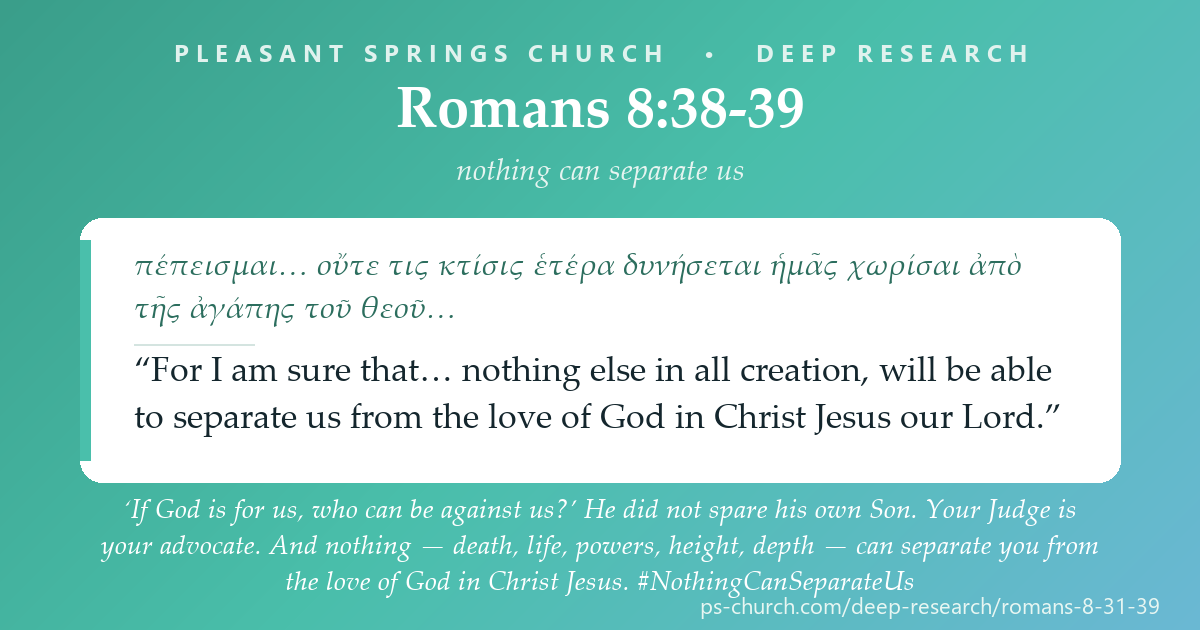
“If God is for us, who can be against us?” Paul reaches the summit of Romans and stages a trial in which every threat to the believer collapses. The God who “did not spare his own Son” will give us all things; the Judge has justified us; our only possible condemner, the risen Christ, is interceding for us. And through the longest list of terrors Paul can name, one answer stands: nothing — not death, not life, not powers, not height or depth — can separate us from the love of God in Christ Jesus. This study works Romans 8:31–39 — the great capstone of Christian assurance. See the method →
Romans 8:31–32, 34, 37–39
Greek NT · ESVThe Shape of the Passage
SequencePaul reaches the summit of his gospel with a series of courtroom questions — and shows that for those God has justified, there is no charge that sticks, no condemnation that stands, and no power in all creation that can sever them from his love.
Author
Paul gathers up everything since 3:21 — justification, the Spirit, the golden chain of 8:29–30 (“foreknew… predestined… called… justified… glorified”) — and turns it into assurance by a set of unanswerable questions. The first sets the tone: “If God is for us, who can be against us?” The proof that God is for us is the cross: “he who did not spare (ouk epheisato) his own Son but gave him up for us all” — language that deliberately echoes the Lord’s word to Abraham, “you have not withheld your son” (Gen 22:16; see the Akedah). Where God stayed Abraham’s hand and spared Isaac, God did not spare his own Son. And if he gave the greatest gift, he will not withhold the lesser: “how will he not also… graciously give us all things?”
The courtroom cleared. Paul stages a trial. “Who shall bring a charge against God’s elect?” — but the Judge himself has already acquitted them (“It is God who justifies”). “Who is to condemn?” — but the only one with standing to condemn, Christ, is the one who died, was raised, sits at God’s right hand (Ps 110:1), and “intercedes for us” (8:34). The believer’s Judge is also the believer’s advocate. It is the echo of Isaiah’s Servant: “he who vindicates me is near… who will declare me guilty?” (Isa 50:8–9).
Audience
Believers under pressure — Paul writes to Christians who face “tribulation, or distress, or persecution, or famine, or nakedness, or danger, or sword” (8:35), and who might wonder whether such things prove God has abandoned them. Paul answers with Scripture: the suffering is exactly what the psalmist foresaw — “for your sake we are being killed all the day long” (8:36, quoting Ps 44:22) — and it separates us from nothing. “In all these things we are more than conquerors” (hypernikōmen) — not merely surviving but triumphing, and “through him who loved us,” so the victory is Christ’s, received.
Nothing can separate us. Paul ends with a settled certainty: “I am sure” (pepeismai, a perfect — an abiding conviction). He then sweeps the universe for any power that could sever the believer from God’s love — death, life, angels, rulers, the present, the future, powers, height, depth, “anything else in all creation” — and finds none. This is the church’s ground of assurance: not the strength of our hold on God, but the unbreakable love of God for us “in Christ Jesus our Lord.” The kept are truly kept — and they also endure, held fast by the One who will not let them go.
Orient on assurance, perseverance, election, intercession, and the love of God.
Search by topic: assurance / perseverance, election, justification, intercession of Christ, love of God.
Which articles are relevant?
- Anchor Bible Dictionary — “Election,” “Perseverance,” “Intercession,” “Love,” “Assurance.”
- Dictionary of Paul and His Letters — “Assurance,” “Election and Predestination,” “Death of Christ,” “Exaltation.”
- NIDNTT / TDNT — χωρίζω (chōrizō, separate), ἐντυγχάνω (entynchanō, intercede), ὑπερνικάω (hypernikaō, more than conquer).
Bibliography surfaced:
- C. E. B. Cranfield (ICC), Douglas Moo (NICNT), Thomas Schreiner (BECNT), James Dunn (WBC), Leon Morris on Romans.
- Studies of Pauline assurance and perseverance; the intercession of the ascended Christ (Heb 7:25).
- Beale & Carson, Commentary on the NT Use of the OT (Romans).
The anti-Akedah, the cleared courtroom, and the love nothing can sever.
Read the Genesis-22 echo, the courtroom drama, and the perseverance capstone — held with the call to endure.
Which parallels shed light on religion and worldview?
The God who did not spare his Son. “He who did not spare (ouk epheisato) his own Son” (8:32) is one word away from Genesis 22, where God says to Abraham, “you have not withheld (ouk epheisō) your son, your only son” (Gen 22:16; see the Akedah). Paul makes God the anti-Abraham: on Moriah God provided a ram and spared the son; at Calvary God provided no substitute for his own Son — the Son was the substitute. But the Akedah is a type, not an equation: Isaac was spared, and a ram died in his place; Christ was not spared, because he is himself the Lamb God provided. And the point is assurance: if God gave the costliest gift — his own Son — while we were enemies, the lesser gift of “all things” is certain. This is the same “much more” logic as Romans 5.
A trial with no case. Paul’s questions are courtroom questions, drawn from Isaiah’s Servant, who taunted his accusers: “He who vindicates me is near… who will contend with me?… who will declare me guilty?” (Isa 50:8–9). Who can accuse God’s elect? The Judge has already justified them. Who can condemn? The one entitled to — Christ — is the one who died and rose and now “intercedes for us” at God’s right hand (8:34; Ps 110:1). The believer’s Judge is the believer’s advocate (cf. Heb 7:25; 1 John 2:1). And the Spirit, too, intercedes within us (8:26–27) — a Trinitarian intercession, the Son above and the Spirit within, both the outworking of the Father’s love. This is why there is now “no condemnation” (8:1): the case against the justified has been dismissed by the only Judge who counts.
Kept — and called to endure. The climax is the perseverance of the saints: “nothing… will be able to separate us from the love of God” (8:39). This is real, God-secured assurance — grounded not in the believer’s performance but in Christ’s death, resurrection, session, and intercession, and in a love proved at the cross. It stands behind the “golden chain” of 8:29–30, where every link is God’s act, even “glorified” in the past tense — God’s sovereign, effectual election of his people, which he foreknew and brings surely to glory. Yet this security is never an excuse for presumption: the same list of trials that cannot separate us are trials the elect actually pass through, as “more than conquerors” — kept by God’s love, they also endure by it. Assurance and perseverance are two sides of one grace: the God who keeps his people also holds them fast to the end.
- Genesis 22:16–17; Isaiah 53:6, 12 — “you have not withheld your son”; the Lord “laid on him the iniquity of us all… he was delivered up”: the Son not spared, given up (see the Akedah, the Servant).
- Isaiah 50:8–9; Psalm 110:1 — “who will declare me guilty?… the Lord God helps me”; “sit at my right hand”: the courtroom taunt and the session/intercession (see the priest-king).
- Psalm 44:22 — “for your sake we are being killed all the day long; we are regarded as sheep to be slaughtered”: the suffering Paul quotes (Ps 44:22 = Greek Ps 43:23).
Romans 8:31–39 is the high-water mark of Christian assurance, and it is important to see both what it secures and how. What it secures is total: nothing — and Paul ransacks the cosmos for a counter-example, from death to demonic powers to the farthest reaches of height and depth — can separate the believer from the love of God. This is the perseverance of the saints, and it is not a fragile hope but a settled certainty: “I am persuaded.” But notice how it is secured. Paul does not ground assurance in the believer’s feelings, resolve, or track record. He grounds it entirely in God’s action: God is for us; God did not spare his Son; God justifies; Christ died, rose, reigns, and intercedes; God loves us in Christ. Every link in the chain is divine. That is why the assurance is unshakable — because it does not depend on the shakable. And yet this is no charter for carelessness. The very people who cannot be separated from God’s love are the people who are being “killed all the day long,” who go through tribulation and persecution and sword as “more than conquerors.” The kept are not the passive but the persevering; God’s preserving grace does not bypass their endurance but produces it. So the doctrine of eternal security, rightly held, is not a pillow for the presumptuous but a rock for the pressured — the promise that the God who began the good work will carry it through to the day of Christ, and that no trial, however fierce, can pry his loved ones from his hand.
The vocabulary of the unspared Son, intercession, and unbreakable love.
Watch the Genesis-22 echo, the intercession of the enthroned Christ, the repeated “separate,” and the settled “I am sure.”
“Did not spare his own Son” — the verb pheidomai echoes Gen 22:16 LXX (ouk epheisō, “you have not withheld your son”). God is the anti-Abraham: where he spared Isaac and provided a ram, he did not spare his own Son — the ground of the “how will he not… give us all things?”
“To intercede” — the ascended, enthroned Christ (Ps 110:1, LXX 109:1) pleads for his people; the same verb used of the Spirit’s intercession within us (8:27), framing a Trinitarian intercession (cf. Heb 7:25; 1 John 2:1). The believer’s Judge is the believer’s advocate.
“To separate” — the load-bearing verb (“who shall separate us”…“will be able to separate us”) that frames the climax. No trial and no cosmic power has the power (dynēsetai) to sever the bond of divine love. The ground of perseverance.
“To be more than a conqueror” — an intensive compound (hyper- + nikaō), perhaps Paul’s coinage: not merely surviving the trials but overwhelmingly triumphing — and “through him who loved us,” so the victory is Christ’s, received. Present tense: a present reality amid the suffering.
“I am sure / persuaded” — perfect tense: a settled, abiding conviction. The ground of assurance is not the believer’s feeling but Christ’s finished work and God’s love; Paul states it as personal certainty — the pastoral capstone of the perseverance argument.
“The love of Christ” (8:35) and “the love of God” (8:39) — the frame of the climax. A subjective genitive: God’s/Christ’s love for us. Assurance rests on God’s steadfast covenant love, not the fluctuating strength of our love for him.
How the New Testament fills out the believer's security:
- Romans 8:1, 28–30 — “no condemnation”; “all things work together for good”; the golden chain (foreknew, predestined, called, justified, glorified): the argument this passage crowns.
- John 10:27–29; 6:37–40 — “no one will snatch them out of my hand”; “I will lose nothing… but raise it up on the last day”: the kept sheep.
- Hebrews 7:25; 1 John 2:1 — “he always lives to make intercession”; “we have an advocate with the Father”: the ongoing intercession of Christ.
- Philippians 1:6; Jude 24–25 — “he who began a good work… will bring it to completion”; “him who is able to keep you from stumbling”: God’s preserving grace.
From the son not withheld to the love nothing can sever.
Trace the atonement and the courtroom through Genesis, Isaiah, and the Psalms into the believer’s assurance.
Which cross-references matter?
- Genesis 22:16–17; Isaiah 53:6, 12 — the son not withheld; the Servant delivered up: the ground of “did not spare his own Son” (see the Akedah, the Servant).
- Isaiah 50:8–9; Psalm 110:1; Psalm 44:22 — “who will declare me guilty?”; the session at the right hand; “sheep to be slaughtered”: the courtroom, the intercession, and the suffering (see Psalm 110).
- Romans 3:21–26; 5:1–11; 8:1, 28–30 — justified; reconciled; no condemnation; the golden chain: the whole argument gathered up (see just and the justifier, peace with God).
- John 10:27–29; Hebrews 7:25; 1 John 2:1–2 — the sheep no one can snatch; Christ who ever intercedes; our advocate: the security spelled out.
- Philippians 1:6; 1 Peter 1:3–5 — the good work God will complete; “guarded through faith for a salvation ready to be revealed”: kept and persevering.
It would have been enough, one feels, for Paul to say that in all these things we conquer — that the tribulation and persecution and sword do not, in the end, defeat us. But Paul is not content with “enough.” He coins a word: hypernikōmen, “we are more than conquerors,” we super-conquer. What could be more than conquering? The answer lies in the little phrase that follows: “through him who loved us.” A conqueror overcomes his enemies and is left standing amid the wreckage; but the Christian does something greater — the very things that were meant to destroy him become, in the hand of the God who loves him, the instruments of his good (8:28) and the occasions of his triumph. Persecution does not merely fail to separate the believer from Christ’s love; it drives him deeper into it. The sword that means to sever the bond only proves its strength. This is not stoic endurance, gritting the teeth against fate; it is participation in a victory already won by the One who loved us to the death and beyond it. And so Paul can look at the worst the world and hell can do — and at death itself, first on his list — and pronounce them all powerless to do the one thing that would truly harm us. They can kill us “all the day long”; they cannot separate us from the love of God in Christ Jesus our Lord. That is more than conquering. That is being loved by God.
The scholarship on Romans 8:31-39.
The commentators on Romans 8; the studies of assurance, perseverance, election, and the Genesis-22 echo.
Commentaries & studies:
- C. E. B. Cranfield (ICC), Douglas J. Moo (NICNT), Thomas R. Schreiner (BECNT), James D. G. Dunn (WBC), Leon Morris on Romans.
- Studies of Pauline assurance/perseverance and the intercession of Christ; the Akedah echo in Rom 8:32.
- Bruce Metzger on the Rom 8:34 [Iēsous] bracket and the Rom 8:35 “love of Christ/God” variant.
Interpretation notes worth keeping:
- Assurance grounded in God, not us. Every link is divine (God for us, did not spare his Son, justifies, Christ intercedes, God loves us) — the perseverance of the saints, held on the church’s ROSES/eternal-security frame; assurance is not presumption, and the kept also endure.
- The golden chain and election. Present God’s sovereign, effectual election (8:29–30, all past tense) on the church’s Molinist / middle-knowledge frame — real and effectual, yet ordained through (not against) the authentic human choices God foreknew; neither hyper-Calvinist fatalism nor Pelagian self-salvation.
- Not divine child abuse. The Father’s “giving up” of the Son is the shared saving act of the one God in love (Rom 5:8; Gal 2:20 the Son gives himself); the Akedah is type, not equation (Isaac spared, a ram substituted; Christ the substitute).
- Intercession, not a reluctant Father. Christ’s heavenly intercession (Ps 110:1; Heb 7:25) and the Spirit’s (8:26–27) apply the finished atonement — the outworking of the Father’s own love (8:31–32), not the Son placating a hostile Father.
- Text notes. Rom 8:34 “Christ [Jesus]” (NA28 brackets); Rom 8:35 “love of Christ” (NA28, with ℵ A B); a few witnesses read “of God,” and P46 the longer “of God… in Christ Jesus” — all theologically compatible; Rom 8:36 quotes the Greek Psalm 43:23 (= Ps 44:22) verbatim.
From every threat to no separation.
Name what you learned, why it matters, and one concrete response.
What should we carry away — and do?
- If God is for you, the case is closed. The Judge has justified you; your Judge is also your advocate, interceding at God’s right hand. There is no charge that sticks, no condemnation that stands.
- The worst cannot separate you. Death, life, powers, height, depth — Paul searched the universe and found nothing able to sever you from God’s love. Not even your own failures can undo what God has done.
- You are more than a conqueror. The very trials meant to destroy you become, in the hand of the God who loves you, the occasions of your triumph — through him who loved you.
Step in response: take the fear that most threatens your security — a failure, a suffering, a “what if” — and answer it with Paul’s certainty: “I am sure that… nothing… will be able to separate us from the love of God in Christ Jesus our Lord.” Let that settled love make you not presumptuous but persevering — more than a conqueror through him who loved you.
Romans 8:38–39 · to share
Greek NT + ESVEvery Deep Research page traces its passage across the whole sweep — the Old Testament, the Second-Temple world between the testaments (historical witnesses, not Scripture), and the New Testament. Follow the thread:
Pleasant Springs Church — Deep Research
Research method after Michael S. Heiser’s Bible Research Method (examine dictionaries → ancient literature → important words → textual connections → academic publications → share), with the Pleasant Springs “Author & Audience” foundation. Scripture set in the Hebrew, the Greek editions named on each page and the ESV (Old Testament), and the Greek New Testament and the ESV (New Testament), per the practice of Pleasant Springs Church. Romans 8:31–39 research grounded in Cranfield, Moo, Schreiner, Dunn, and Morris, with Beale & Carson on the OT background; the perseverance of the saints held on the church’s ROSES/eternal-security frame (assurance grounded in God’s action, not presumption; the kept also endure); election and the “golden chain” on the Molinist/middle-knowledge frame (no fatalism, no self-salvation); the Akedah echo of Gen 22:16 (type, not equation); the cross as the triune God’s loving act (not the Father abusing the Son); Christ’s intercession applying the finished atonement; Ps 44:22 quoted from the Greek (= Ps 43:23).
Scripture quotations marked ESV are from the ESV® Bible (The Holy Bible, English Standard Version®), © 2001 by Crossway, a publishing ministry of Good News Publishers. ESV Text Edition: 2016. Used by permission. All rights reserved. The ESV text may not be quoted in any publication made available to the public by a Creative Commons license, and the ESV may not be translated in whole or in part into any other language. www.esv.org
|
Did this study bless you today? 💚 Give to Support PS Church100% of gifts go to the General Fund — thank you. |