“Since we have been justified by faith, we have peace with God.” Justification is not the end of the story but the door into it: peace, access, joy, and an assurance even suffering cannot shake. Paul grounds it in the timing of the cross — “while we were still sinners, Christ died for us” — and builds an unbreakable “much more”: if God reconciled us as enemies, how much more will he save the reconciled? This study works Romans 5:1–11 — peace with God — a love proved at the worst possible moment. See the method →
Romans 5:1, 5, 8, 10–11
Greek NT · ESVThe Shape of the Passage
InclusioPaul has just shown how God justifies the ungodly (3:21–4:25). Now he unfolds what justification brings: peace, access, hope, and an assurance that even suffering cannot shake — all grounded in a love God proved at the worst possible moment.
Author
Paul draws the consequence of justification with a “therefore”: “since we have been justified by faith, we have peace with God” (5:1). The peace is not a mood but a status — the objective end of hostility between the sinner and God, secured “through our Lord Jesus Christ.” (A single letter of Greek here has been much discussed: some manuscripts read “let us have peace” instead of “we have peace” — but the flow of Paul’s argument, stating facts, makes “we have peace” the reading the ESV rightly follows.) From that peace flow access into grace, a place to stand, and joy “in hope of the glory of God.”
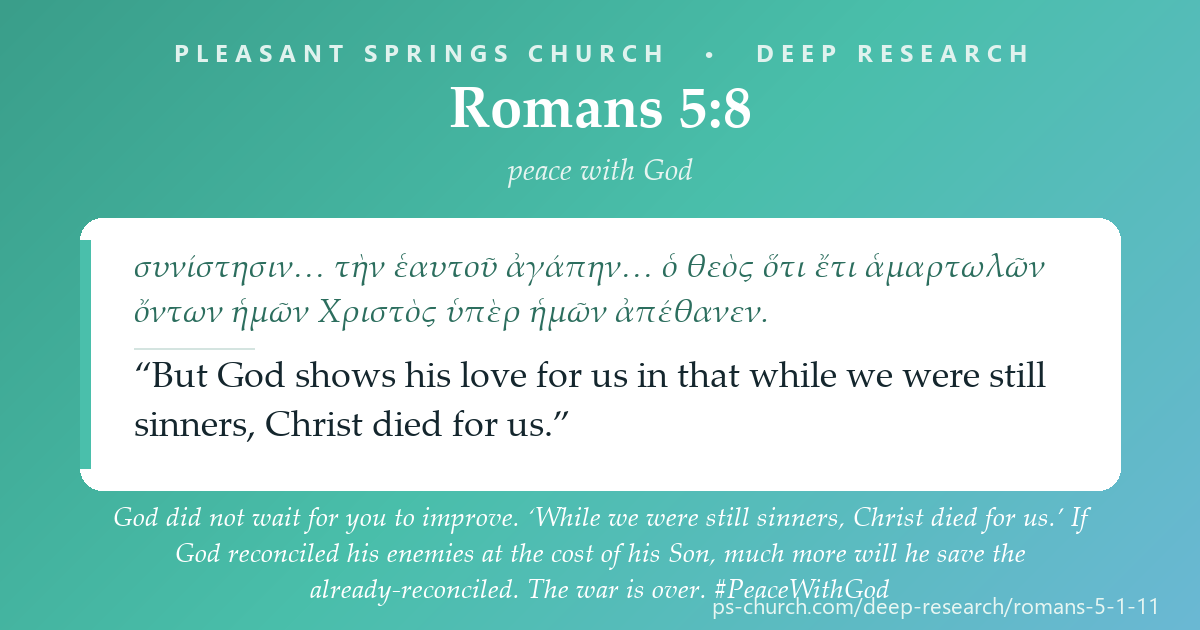
Love proved at the worst moment. The center of the passage is the timing of the cross. Christ died “while we were still weak” (5:6), “for the ungodly,” “while we were still sinners” (5:8), “while we were enemies” (5:10). Paul stacks the words to make the point unmistakable: God did not wait for us to improve. “God shows his love for us in that while we were still sinners, Christ died for us” — the demonstration of a love that moves toward its enemies, before any change in them.
Audience
Believers who need assurance — then and now. Paul is building a case that the justified are safe, and he builds it by a “much more” (5:9–10): if God did the harder thing — reconciling us while we were his enemies, at the cost of his Son’s death — then the easier thing, saving the already-reconciled, is certain. The logic runs from the cross forward: the God who loved you at your worst will not abandon you now.
Reconciled, and rejoicing. The word that gathers it up is reconciliation (5:10–11): the enmity is removed, and it is God who removes it, “by the death of his Son.” Reconciliation is not something we achieve but something we receive (“we have now received reconciliation”). And so the section ends where it began, in joy: “we also rejoice in God through our Lord Jesus Christ.” Even our sufferings are folded into this — not because pain is good, but because God works it toward hope, and because his love is already “poured into our hearts through the Holy Spirit.”
Orient on peace, reconciliation, hope, wrath, and the love of God.
Search by topic: peace (with God), reconciliation, hope, wrath of God, love of God / Holy Spirit.
Which articles are relevant?
- Anchor Bible Dictionary — “Peace,” “Reconciliation,” “Hope,” “Wrath of God,” “Love.”
- Dictionary of Paul and His Letters — “Reconciliation,” “Peace,” “Assurance,” “Death of Christ.”
- NIDNTT / TDNT — εἰρήνη (eirēnē, peace), καταλλάσσω (katallassō, reconcile), ὀργή (orgē, wrath).
Bibliography surfaced:
- C. E. B. Cranfield (ICC), Douglas Moo (NICNT), Thomas Schreiner (BECNT), James Dunn (WBC), Leon Morris on Romans.
- Studies of reconciliation in Paul (2 Cor 5; Col 1) and the “much more” (a fortiori) assurance of Romans 5–8.
- Beale & Carson, Commentary on the NT Use of the OT (Romans).
Peace with God, love poured out, and the 'much more' of assurance.
Read “peace” and “reconciliation” as objective realities, then follow the “much more” logic and the place of suffering.
Which parallels shed light on religion and worldview?
Peace as a restored relationship. “Peace with God” (5:1) is not the inner calm we often mean by the word; it is the biblical shalom — the end of war, the restoration of a broken relationship. Paul’s language is relational and objective: peace toward God, the reversal of the enmity he names in 5:10. Isaiah had foreseen it: “the effect of righteousness will be peace” (Isa 32:17), and the Servant bore “the chastisement that brought us peace” (Isa 53:5; see the Suffering Servant). The war between the holy God and the guilty sinner is over — not by a truce, but by the death of God’s Son.
The love already poured out. Hope “does not put us to shame” (5:5) because it rests on something already given: “God’s love has been poured into our hearts through the Holy Spirit.” The verb (ekkechytai) is the prophets’ word for the outpouring of the Spirit in the last days (Joel 2:28–29; Ezek 36:26–27; see the Spirit poured out). Assurance is not wishful thinking; it is the felt reality of a love that has flooded the believer’s heart by the Spirit God has given. And that love was proved in history: “God shows his love for us in that while we were still sinners, Christ died for us” (5:8). Note carefully whose love this is — it is the Father’s love that the cross demonstrates (“God shows his love”), not merely the Son’s. The cross is never the Father punishing an unwilling Son; it is the triune God, in love, reconciling his enemies.
The ‘much more’ of assurance. Twice Paul argues from the greater to the lesser (5:9–10). If God justified us by Christ’s blood, “much more shall we be saved by him from the wrath of God.” If God reconciled us “while we were enemies… by the death of his Son” — the costliest, hardest thing — “much more… shall we be saved by his life.” The logic is airtight: the God who loved you at your very worst, and paid the highest price to reconcile you, will not fail to bring you home. This is the ground of the believer’s security — not the strength of our grip on God, but the proven, unbreakable love of God for us (a security Paul will crown in 8:31–39). The reconciled are those justified by faith (5:1); the “much more” is real assurance, not a promise that no one need believe.
- Isaiah 32:17; 53:5; 57:19 — “the effect of righteousness… peace”; “the chastisement that brought us peace”; “Peace, peace, to the far and the near”: the peace the cross secures (see the Servant).
- Joel 2:28–29; Ezekiel 36:26–27; Zechariah 12:10 — the pouring-out of the Spirit and “a spirit of grace”: the love poured into the heart (see Joel, a new heart).
- 2 Corinthians 5:18–21; Ephesians 2:14–16; Colossians 1:20–22 — the ministry of reconciliation; “he himself is our peace”; “reconciled… by his death”: reconciliation across Paul.
The engine of Romans 5:1–11 is a small phrase Paul repeats: “much more.” It is a form of argument the rabbis called qal wahomer — from the lighter to the heavier, or here from the harder to the easier — and Paul uses it to build a fortress of assurance. His reasoning is deceptively simple. The hardest thing God ever did for us, he did while we were his enemies: he reconciled us to himself “by the death of his Son.” Reconciling enemies at the cost of a beloved Son’s life — that is the mountain. By comparison, keeping the already-reconciled, saving those now at peace with him, is the foothill. If God scaled the mountain for us when we hated him, he will not stumble on the foothill now that we are his. This is why the believer’s confidence does not rest on the believer. It rests on what God has already done, at the point when we deserved it least. Paul is not offering a technique for feeling secure; he is showing that security is a fact, anchored in the timing of Calvary. The love that died for sinners will not abandon saints. And that is why even suffering cannot finally shake the Christian — not because suffering is pleasant, but because it cannot separate us from a love already poured into our hearts and already proved at the cross. The “much more” is the mathematics of grace: the greater gift guarantees the lesser, forever.
The vocabulary of peace, reconciliation, wrath, and boasting.
Watch the objective “peace with God,” the received “reconciliation,” the real “wrath,” and the exultant “boast.”
“Peace with God” — the biblical shalom (not a subjective calm) — the objective, restored relationship between the justified sinner and God, the end of the enmity of 5:10. A Godward, relational reality secured through Christ.
“Having been justified” — aorist passive: a completed, past act on which present peace rests. “Justified by his blood” (5:9) — declared righteous, not made inherently good; the ground is Christ’s death, received by faith.
“To reconcile / reconciliation” — God’s completed act “by the death of his Son,” which believers “receive” (elabomen) as a gift, not an achievement. God is the reconciler; the enmity removed is real.
“Wrath” — God’s settled, holy, judicial opposition to sin (1:18; 2:5), not a temper. Its reality is the premise of the “much more”: those justified by blood will surely be saved “from the wrath.”
“To exult, rejoice, glory” — the structural verb: we exult in hope of glory (5:2), in sufferings (5:3), and in God (5:11). Not sinful boasting (contrast 3:27) but confident, God-grounded joy that carries assurance.
“Has been poured out” — perfect passive: God’s love, via the Spirit, is an accomplished, abiding flood in the heart. Echoes the prophets’ promise of the Spirit poured out (Joel 2:28; Ezek 39:29).
How the New Testament fills out reconciliation and assurance:
- 2 Corinthians 5:18–21 — “God… reconciled us to himself through Christ… not counting their trespasses”; “be reconciled to God”: the ministry of reconciliation.
- Ephesians 2:13–18; Colossians 1:20–22 — “he himself is our peace”; “reconciled… by his death… to present you holy”: peace and reconciliation in the wider letters.
- Romans 8:1, 28–39 — “no condemnation”; “all things work together for good”; “nothing… will separate us”: where the “much more” assurance leads (see no separation).
- Romans 5:12–21 — Adam and Christ; “much more” the grace of the one man Jesus Christ abounded to many: the next movement of the argument.
From the enmity of Eden to peace with God through Christ.
Trace peace and reconciliation from the prophets and the cross into the believer’s unshakable hope.
Which cross-references matter?
- Genesis 3:15, 24; Isaiah 32:17; 53:5 — the primal enmity and barred access; “the effect of righteousness… peace”; the chastisement that brought us peace: the enmity reversed (see the fall, the Servant).
- Romans 3:21–26; 4:25 — justified by his grace through the propitiation; “raised for our justification”: the ground of the peace of 5:1 (see just and the justifier).
- Joel 2:28–29; Ezekiel 36:26–27 — the Spirit poured out and put within: the love poured into the heart (see Joel, a new heart).
- Romans 8:31–39; John 10:28–29 — “if God is for us”; nothing can separate us; “no one will snatch them out of my hand”: the “much more” crowned (see no separation).
- 2 Corinthians 5:18–21; Ephesians 2:14–16 — the ministry of reconciliation; “he is our peace”: reconciliation received and proclaimed.
The heart of the passage is a single, staggering claim about when Christ died. Human love, at its best, is drawn to something lovely — we love the good, the kind, the deserving; “perhaps for a good person one would dare even to die” (5:7). But the love of God does not wait to be attracted. Paul piles up the words to leave no room for a comfortable misreading: Christ died for us while we were weak, while we were ungodly, while we were sinners, while we were enemies. Not after we cleaned ourselves up; not once we had shown promise; but at the point of our deepest unworthiness and active hostility. This is love of a different order — not a response to worth but a creator of it, not drawn out of God by anything in us but poured out of God because of what he is. And this is why the passage is finally about assurance. A love that could be earned could also be forfeited; a love given to us at our worst cannot be lost by our being anything less than that again. “God shows his love for us” — the present tense matters; the cross is God’s permanent demonstration — “in that while we were still sinners, Christ died for us.” If that is the love that saved you, then nothing you fear can un-save you; the God who reached you in your rebellion will not let you go now that you are his.
The scholarship on Romans 5:1-11.
The commentators on Romans 5; the studies of reconciliation, the ‘much more’ assurance, and the Rom 5:1 variant.
Commentaries & studies:
- C. E. B. Cranfield (ICC), Douglas J. Moo (NICNT), Thomas R. Schreiner (BECNT), James D. G. Dunn (WBC), Leon Morris on Romans.
- Studies of Pauline reconciliation (2 Cor 5; Col 1; Eph 2) and the assurance of Romans 5–8.
- Bruce Metzger on the Romans 5:1 echomen/echōmen variant.
Interpretation notes worth keeping:
- Peace and reconciliation are objective. “Peace with God” (5:1) and “reconciliation” (5:10–11) are a restored, God-ward status — the passives (“we were reconciled”) and the received gift show God is the reconciler, not merely a change in our feelings.
- Wrath is real. “Saved from the wrath” (5:9) assumes God’s settled judicial opposition to sin (1:18) — the premise of the “much more”; deny the wrath and you gut both the cross and the assurance.
- The Father’s love. Rom 5:8 makes the cross the demonstration of God’s (the Father’s) love, not merely the Son’s — the triune God is one agent of atonement, against every “angry Father / kind Son” caricature.
- ‘Much more’ assurance, not universalism. The a fortiori grounds real security for the justified (read with 8:31–39); the reconciled are those who have received reconciliation by faith (5:11) — not all humanity automatically.
- Rom 5:1 variant. The indicative “we have peace” (NA28/ESV) fits Paul’s fact-stating argument, though the subjunctive “let us have” has strong external support (the o/ō are homophones in Koine).
From enmity to peace, and a love proved at the cross.
Name what you learned, why it matters, and one concrete response.
What should we carry away — and do?
- The war is over. “Peace with God” is not a feeling to work up but a fact to rest in — the enmity ended by the death of God’s Son. If you are in Christ, God is no longer against you.
- God loved you at your worst. Christ died “while we were still sinners” — not after you improved. A love that reached you in rebellion cannot be lost by your weakness now.
- ‘Much more’ you are safe. If God reconciled you as an enemy, he will surely keep you as a child. Your security rests not on your grip on him but on his proven love for you.
Step in response: when accusation or doubt tells you God is against you, preach Romans 5 back to yourself — “while we were still sinners, Christ died for us… much more… shall we be saved.” Rest in the peace you already have, let the love “poured into our hearts” steady you in suffering, and rejoice in the God who reconciled his enemies and will not let them go.
Romans 5:8 · to share
Greek NT + ESVEvery Deep Research page traces its passage across the whole sweep — the Old Testament, the Second-Temple world between the testaments (historical witnesses, not Scripture), and the New Testament. Follow the thread:
Pleasant Springs Church — Deep Research
Research method after Michael S. Heiser’s Bible Research Method (examine dictionaries → ancient literature → important words → textual connections → academic publications → share), with the Pleasant Springs “Author & Audience” foundation. Scripture set in the Hebrew, the Greek editions named on each page and the ESV (Old Testament), and the Greek New Testament and the ESV (New Testament), per the practice of Pleasant Springs Church. Romans 5:1–11 research grounded in Cranfield, Moo, Schreiner, Dunn, and Morris, with Beale & Carson on the OT background; “peace with God” and “reconciliation” read as objective, God-ward realities received by faith (not mere feeling, not universalism); the cross as the demonstration of the Father’s love (Rom 5:8), not the Father coercing the Son; the “much more” a fortiori as real assurance on the church’s ROSES/Molinist frame; the wrath of God affirmed (5:9); the Rom 5:1 echomen/echōmen variant noted (ESV: “we have peace”).
Scripture quotations marked ESV are from the ESV® Bible (The Holy Bible, English Standard Version®), © 2001 by Crossway, a publishing ministry of Good News Publishers. ESV Text Edition: 2016. Used by permission. All rights reserved. The ESV text may not be quoted in any publication made available to the public by a Creative Commons license, and the ESV may not be translated in whole or in part into any other language. www.esv.org
|
Did this study bless you today? 💚 Give to Support PS Church100% of gifts go to the General Fund — thank you. |