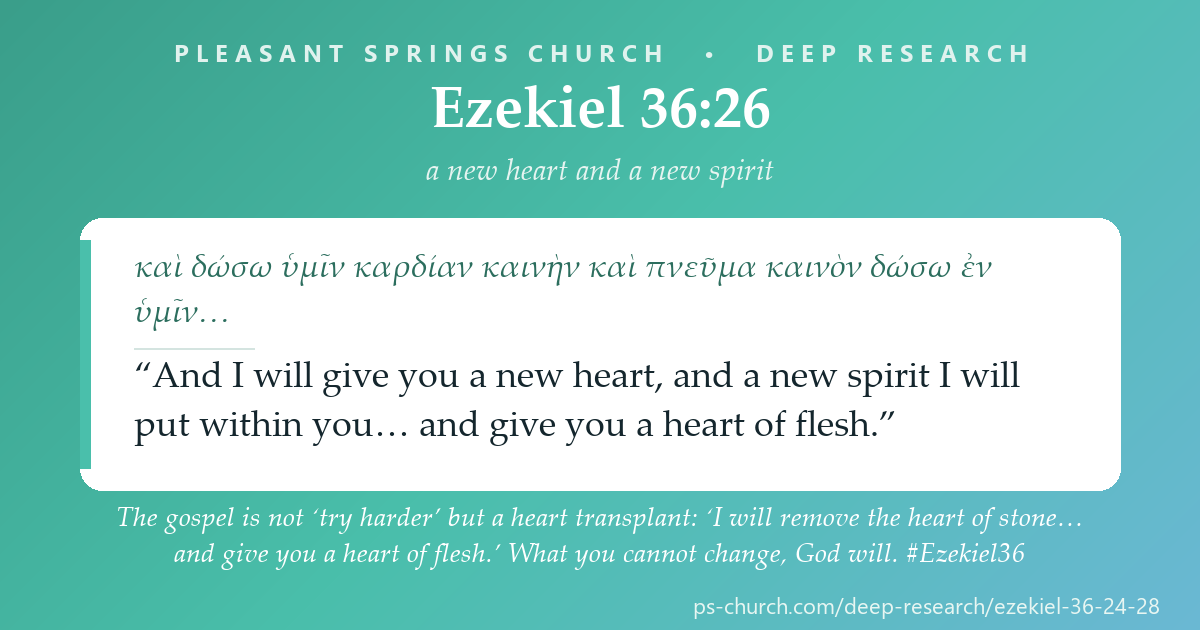
I will give you a new heart, and a new spirit I will put within you.” To exiles who had broken every law, God does not say “try harder” — he promises a heart transplant no one can perform on himself: the stubborn heart of stone removed, a living heart of flesh given, cleansed by clean water and made new by God’s own Spirit. This is the new birth Jesus told Nicodemus he must have (John 3:5), the interior side of the new covenant. This study works Ezekiel 36:24–28 from the heart of stone to the indwelling Spirit. See the method →
Ezekiel 36:24–28 (same numbering in MT, LXX & English)
Hebrew · LXX · ESVThe Shape of the Passage
InclusioEzekiel prophesied among the exiles in Babylon (6th c. BC) after Jerusalem’s fall. Chapter 36 promises that God will restore his scattered people to their land — and, deeper still, give them new hearts. It is the twin of the dry-bones vision that follows (see Ezekiel 37) and the covenant-cousin of Jeremiah 31.
Author
Ezekiel, priest and prophet in exile, speaks to a people whose sin has emptied the land and profaned God’s name among the nations. God announces that he will act — not because Israel deserves it, but “for the sake of my holy name” (36:22). He will regather them, and then do the deeper work: cleanse them with clean water, replace the stubborn heart of stone with a responsive heart of flesh, and put his own Spirit within so that obedience finally flows from the inside out.
A renewed spirit and God’s Spirit. The promise moves in two steps. First a “new heart” and “new spirit” — the inner person remade, soft and alive toward God. Then, decisively, “my Spirit” — the Holy Spirit himself indwelling, the power that “causes” the walking in God’s ways. Grace does not merely command a new life; it creates one and then lives it from within.
Audience
The exiles — and every heart that has found the law true and itself unable. To a people who had broken every statute, God does not say “try harder”; he promises to change the very organ of willing. The immediate horizon is Israel’s national restoration; the deeper horizon is the regeneration of all who would be his.
How it was read. The hope of a “new/clean heart” and God’s indwelling Spirit ran deep in Second-Temple prayer (the Community Rule at Qumran; the Book of Jubilees pleading, “create in them a holy spirit”). Jesus assumed Nicodemus — “the teacher of Israel” — should have known it: one must be “born of water and the Spirit” (John 3:5, 10). Paul and Titus name it regeneration; it is the interior side of the new covenant.
Orient on the new heart, the Spirit, cleansing, and regeneration.
Search by topic: Ezekiel, new heart, Holy Spirit, regeneration, new covenant, cleansing.
Which articles are relevant?
- Anchor Bible Dictionary — “Ezekiel,” “Heart,” “Spirit / Holy Spirit,” “Regeneration.”
- Dictionary of the OT: Prophets — “Ezekiel, Book of,” “Spirit of God,” “Heart,” “Covenant.”
- NIDOTTE / TDOT — לֵב (lēḇ, heart), רוּחַ (rûaḥ, spirit/Spirit), זָרַק (zāraq, sprinkle), טָהוֹר (ṭāhôr, clean).
Bibliography surfaced:
- Daniel I. Block (NICOT, Ezekiel 25–48), Walther Zimmerli (Hermeneia), Moshe Greenberg (Anchor Yale), Leslie C. Allen (WBC) on Ezekiel.
- Johan Lust and Ingrid Lilly on the Papyrus 967 text of Ezekiel 36–39.
- Beale & Carson, NT Use of the OT (John; the Ezekiel background to John 3).
Water and Spirit, the heart of stone, and a note on the Greek text.
Read the cleansing and the new heart, note the Greek manuscript history honestly, then follow the promise to the new birth.
Which parallels shed light on religion and worldview?
Cleansing and the new heart. Ezekiel’s images are priestly. “Sprinkle clean water” recalls the purification rites (Num 19; the washings of Leviticus) — but the uncleanness being washed away is idolatry (“from all your idols I will cleanse you”), and the cure is not a ritual but a remade heart. The “heart of stone” is the will hardened against God (like the tablets of stone that only accused); the “heart of flesh” is a living, responsive inner life. And the engine of it all is God’s rûaḥ — his Spirit, breath, and power — the same word that will animate the dry bones one chapter later.
A note on the Greek text. Honesty about the manuscripts: this whole section (Ezekiel 36:23c–38) is missing from the oldest major Greek witness, Papyrus 967 (2nd–3rd c. AD), and from an Old Latin manuscript — so some scholars think it entered the Greek tradition a little later. But it stands firmly in the Hebrew (Masoretic) text and in the standard Greek of Codex Vaticanus and Rahlfs, and it is quoted as Scripture’s own hope throughout the New Testament. Its place in the canon is not in doubt; the manuscript history is simply part of telling the truth about the text — and this study prints the genuine Greek that the main tradition preserves.
- Ezekiel 11:19–20; 18:31; 37:1–14 — the same promise in miniature (“one heart… a new spirit”), the call to “make yourselves a new heart,” and the Spirit breathing life into the dead (see Ezekiel 37).
- Jeremiah 31:31–34; Deuteronomy 30:6 — the law written on the heart; the heart circumcised to love God: the new covenant Ezekiel’s promise belongs to (see Jeremiah 31).
- Community Rule (1QS) 4:20–21 (Dead Sea Scrolls — a Second-Temple witness, not Scripture) — God will “sprinkle upon him the spirit of truth like waters of purification”: a living reading of Ezekiel 36 in Jesus’ own era.
- Jubilees 1:23 (2nd c. BC — a Second-Temple witness, not Scripture) — “I will create in them a holy spirit… and they shall be my people”: the same hope prayed before Christ (see Jubilees 1).
When Nicodemus stumbles over “you must be born again,” Jesus points him to Ezekiel: “unless one is born of water and the Spirit, he cannot enter the kingdom of God” — and then, pointedly, “Are you the teacher of Israel and yet you do not understand these things?” (John 3:5, 10). A teacher of Israel should have understood, because Ezekiel 36 had already joined them: clean water that cleanses (v.25) and God’s Spirit that makes new (v.27). The new birth is not a second effort but a fresh creation — the heart of stone taken out, the Spirit put in. Paul says the same: God saved us “by the washing of regeneration and renewal of the Holy Spirit” (Titus 3:5), and the Corinthians are a letter written “not on tablets of stone but on tablets of human hearts” (2 Cor 3:3), echoing Ezekiel’s very words. Two guardrails keep the reading true. First, hold both horizons: the promise is genuinely for Israel — regathered to the land (vv.24, 28) — and, in the new covenant, for all who are in Christ; the church shares these blessings without displacing Israel (Rom 11). Second, hold the grace: every verb is God’s, and the obedience of verse 27 flows from the Spirit’s prior work — new hearts are given, not achieved.
The vocabulary of the heart, the Spirit, and cleansing.
Keep “a new spirit” (v.26, the human heart remade) and “my Spirit” (v.27, God indwelling) distinct.
“A new heart” — lēḇ is the whole inner person (mind, will, affections). A wholly renewed inner life, not merely new feelings.
“Heart of stone” / “heart of flesh” — the will hardened against God, replaced by a living, responsive heart. Here flesh is positive; Paul reuses the word (2 Cor 3:3).
“A new spirit” — the renewed human spirit/disposition God places within. Deliberately distinct from “my Spirit” in v.27.
“My Spirit” — God’s own Holy Spirit, given to indwell (“within you”) and to enable obedience (“cause you to walk in my statutes”). The decisive gift.
“I will sprinkle” — the verb for dashing sacrificial blood or water (Exod 24:6). Cleansing from idolatry; a background to baptism and the new birth (John 3:5), not a proof of any single ritual theology.
How the New Testament reuses Ezekiel 36:
- John 3:5–10 — “born of water and the Spirit”: the new birth Nicodemus, teacher of Israel, should have known from Ezekiel.
- Titus 3:5 — “the washing of regeneration and renewal of the Holy Spirit”: water and Spirit again.
- 2 Corinthians 3:3, 6 — written “on tablets of human hearts”; ministers of “a new covenant… of the Spirit”: Ezekiel’s stone/flesh joined to Jeremiah’s heart-covenant.
- Romans 8:9–11; Ezekiel 11:19–20 — the indwelling Spirit who gives life; the in-book twin of the promise.
From the heart of stone to the indwelling Spirit of the new covenant.
Trace the new-heart promise from Ezekiel through the new covenant into Christian regeneration.
Which cross-references matter?
- Ezekiel 11:19–20; 18:31; 37:1–14 — the promise in miniature, the summons, and the Spirit raising the dead nation (see Ezekiel 37).
- Jeremiah 31:31–34; Deuteronomy 30:6 — the law on the heart; the circumcised heart: the new covenant Ezekiel shares (see Jeremiah 31).
- John 3:1–10; Titus 3:5; 1 Corinthians 6:11 — the new birth; the washing of regeneration; “you were washed… sanctified… by the Spirit.”
- 2 Corinthians 3:3–6; Romans 8:1–11 — the Spirit writing on hearts; the indwelling Spirit of life.
- Hebrews 8:10–12; Ezekiel 36:28 — “I will be their God, and they shall be my people”: the covenant formula fulfilled.
Ezekiel 36 is one of Scripture’s clearest windows into how God saves. The whole paragraph is a chain of divine first-person verbs — take, gather, sprinkle, cleanse, give, remove, put, cause — with the people as the objects of grace, not its engine. God does not merely raise the standard and wait; he performs the surgery, exchanging the dead heart for a living one and moving in by his Spirit. The obedience he desires (v.27) is real, but it is the fruit of the Spirit’s indwelling, not the price of it. This is why the New Testament reaches for Ezekiel to explain the new birth: what Nicodemus could not do for himself, and what the law could only demand, the Spirit accomplishes from within. Two balances keep the hope faithful. The promise still has Israel in view — a real people regathered to a real land — and it opens to all who are in Christ, without the church elbowing Israel aside (Rom 11:25–29). And the ‘already’ of the given Spirit waits for a ‘not yet’: the new heart is ours now, its perfection still to come. The God who promised the heart of flesh will finish what he began.
The scholarship on Ezekiel 36:24-28.
The commentators on Ezekiel; the studies of the Papyrus 967 text and the NT use.
Commentaries & studies:
- Daniel I. Block (NICOT, Ezekiel 25–48), Walther Zimmerli (Hermeneia), Moshe Greenberg (Anchor Yale, Ezekiel 21–37), Leslie C. Allen (WBC) on Ezekiel.
- Johan Lust, “Ezekiel 36–40 in the Oldest Greek Manuscript” (CBQ 1981); Ingrid Lilly, Two Books of Ezekiel (on Papyrus 967).
- G. K. Beale & D. A. Carson, eds., Commentary on the NT Use of the OT (John).
Interpretation notes worth keeping:
- ‘A new spirit’ vs ‘my Spirit.’ Verse 26’s “new spirit” is the renewed human disposition; verse 27’s “my Spirit” is the indwelling Holy Spirit — keep them distinct.
- Grace, all the way down. Every verb is God’s; the obedience of v.27 flows from the Spirit’s prior work. Guard against a “try harder” reading.
- Both horizons. The primary referent is Israel’s national restoration (vv.24, 28); the deeper is regeneration for all in Christ — hold both, without supersessionism (Rom 11).
- The Papyrus 967 note. 36:23c–38 is absent from the oldest Greek witness but firm in the Hebrew and the main Greek tradition; disclose the manuscript history without doubting canonicity.
From the heart of stone to a heart alive.
Name what you learned, why it matters, and one concrete response.
What should we carry away — and do?
- You cannot change your own heart — but God can. The gospel is not “try harder” but a transplant: the stone taken out, a living heart put in. Ask for what only he can give.
- The Spirit lives it from within. God does not leave you to obey on your own; he puts his Spirit within to “cause you to walk” in his ways. Obedience is grace continued, not grace repaid.
- This is the new birth. What Ezekiel promised, Jesus told Nicodemus he must have: born of water and the Spirit. It is the beginning of everything.
Step in response: stop trying to squeeze life out of a heart of stone. Bring the specific hardness you cannot fix — a resentment, a compulsion, a coldness toward God — and ask him to do what he promised: take out the stone, put in his Spirit. Then walk, this week, in the strength he supplies rather than the strength you don’t have.
Ezekiel 36:26 · to share
ESVEvery Deep Research page traces its passage across the whole sweep — the Old Testament, the Second-Temple world between the testaments (historical witnesses, not Scripture), and the New Testament. Follow the thread:
Pleasant Springs Church — Deep Research
Research method after Michael S. Heiser’s Bible Research Method (examine dictionaries → ancient literature → important words → textual connections → academic publications → share), with the Pleasant Springs “Author & Audience” foundation. Scripture set in the Hebrew, the Greek editions named on each page and the ESV (Old Testament), and the Greek New Testament and the ESV (New Testament), per the practice of Pleasant Springs Church. Ezekiel 36:24–28 research grounded in Block, Zimmerli, Greenberg, and Allen, with Lust and Lilly on the Papyrus 967 text and Beale & Carson on the Ezekiel background to John 3; 1QS and Jubilees 1:23 as Second-Temple witnesses.
Scripture quotations marked ESV are from the ESV® Bible (The Holy Bible, English Standard Version®), © 2001 by Crossway, a publishing ministry of Good News Publishers. ESV Text Edition: 2016. Used by permission. All rights reserved. The ESV text may not be quoted in any publication made available to the public by a Creative Commons license, and the ESV may not be translated in whole or in part into any other language. www.esv.org
|
Did this study bless you today? 💚 Give to Support PS Church100% of gifts go to the General Fund — thank you. |