Four chapters, one hundred and seven verses, and the end of the book: a strip of land cut out before any tribe is named, a ruler who is told twice to stop evicting people, water coming out from under a threshold and getting deeper every thousand cubits, a border list, twelve tribes, twelve gates — and then two words. The measurement that decided what this page is about is those two words. The Masoretic text ends יְהוָה שָׁמָּה — The Lord Is There — and the CATSS Greek ends ἐσται τὸ ὄνομα αὐτῆς, shall be its name, and never says the name. The whole difference is in the vowels: three consonants, שמה, read as there in one column and as its name in the other. The two Greek words are not missing from the Greek Old Testament: κύριος ἐκεῖ stands eight times in the 30,348 screened verse units held here, twice inside Greek Ezekiel, and 35:10 reads καὶ κύριος ἐκεῖ ἐστιν. What the Greek column does not do is put those words at 48:35. And the surviving Greek clause is the deepest New Testament contact in the whole passage — καὶ τὸ ὄνομα τῆς πόλεως, five words, tie band one, against Revelation 3:12, where the name is given. Meanwhile the connection everybody knows — Ezekiel’s twelve gates and Revelation’s twelve gates — measures one, and the word is and. See the method →
Ezekiel 45:1–48:35 — sixteen rows across all four chapters (the Greek chapter and verse numbers in this table are the English ones. There is no offset anywhere in this passage. Ezekiel 45, 46, 47 and 48 hold 25, 24, 23 and 35 verses in the Masoretic text and 25, 24, 23 and 35 rows in the CATSS Greek file, with no gaps and no renumbering — derived by reading the files, see the footer.)
Hebrew (Masoretic) · Greek (CATSS/Rahlfs) · ESVThe Shape of the Passage
Sequence — eleven units in the order the text prints them, inside one measured frameNothing on this page settles who wrote Ezekiel 40–48, when, or whether these nine chapters came into the book at the same time as the rest of it. That question is one of the oldest in the study of the prophets and this page has no instrument that can decide it. What it can do is measure where the language of these four chapters also stands, and report it.
Author
A priest, drawing a map. Ezekiel 1:3 names יְחֶזְקֵאל בֶּן־בּוּזִי הַכֹּהֵן, Ezekiel son of Buzi the priest, and these four chapters are the most priest-shaped in the book: a holy portion measured before any tribe is fed, sin offerings on the first of the month, the difference between the sons of Zadok and the rest of the Levites, and two sets of kitchens so that holy food is not carried into the outer court (46:20).
And the writer is drawing a constitution, not just a floor plan. Three of the four chapters are interrupted by law. 45:9 tells the princes to stop; 45:10–12 fixes the weights; 46:16–18 forbids the prince to take anyone else’s land; 47:22 gives the resident foreigner an inheritance. A blueprint does not need any of that. This one keeps stopping to say who may not be robbed.
What the measurement can say about internal cohesion, and what it cannot. Exactly SIX of the 107 verses reach a run of six or more, and every one of the six finds its deepest partner inside Ezekiel — 45:7 and 48:21 with each other (eight, band one); 45:3, 48:9 and 48:13 with each other (seven, band two apiece); and 45:9 with 44:6 (six, band one). Not one of the six points outside the book. That a book repeats itself is not evidence of a single author — a school, a tradition and an editor all produce the same pattern — and this page does not claim otherwise. It reports the distribution.
Audience
People with no land, being given the survey of a country. The vision is dated at 40:1 to the twenty-fifth year of the exile, fourteen years after the city fell. The audience is in Babylonia. They are handed boundary lines, cubit measurements and a tribal allotment for a country none of them is standing in.
The word for their ruler is chosen, and the word for king is refused. מלך, king, occurs thirty-seven times in Ezekiel (counting every king-word and excluding ממלכה, kingdom). Its last occurrence is 43:9 — where the kings are corpses whose burials have defiled the house — and from 44:1 to the end of the book, 138 verses, the word never occurs again. The ruler of the restored land is a נשיא, twenty times in those five chapters, and he is given a fixed estate, a fixed liturgy and a standing prohibition against eviction.
And the last thing said to them is a name they cannot yet use. 48:35 in the Masoretic text: and the name of the city from that day: the Lord is there. To an audience whose complaint in 11:15 was that distance from the temple meant distance from God, the book ends by naming a city after the fact that God is in it. שם, there, is the last word — and in the Greek column it is not.
Before anything is measured, find out what the terms in the passage are already known to mean — the terumah, the nasi, the deror, the ger — and where the reference works leave a question open.
A dictionary gives the range of a word and the consensus about an institution. It does not tell you what this text does with either. Stage 1 collects the questions; stages 3 and 4 test them against the files.
The terumah, and why it is not simply ‘an offering’.
תְּרוּמָה is normally a portion lifted off a larger quantity and given to God or to the priests — the wave offering of Exodus, the priests’ share of the sacrifices in Leviticus, the tithe of the tithe in Numbers. It is a share, not a sacrifice.
What is unusual here is that the thing lifted off is real estate. Ezekiel 45:1 sets apart a תרומה of land, twenty-five thousand by ten thousand (or twenty thousand — see the table), before the tribes are given anything. The dictionary can tell you the word usually means the priest’s cut of an animal. It cannot tell you why this text applies it to a map.
Stage 3 counted it. The consonantal string תרומ occurs 21 times in Ezekiel and 18 of the 21 are in chapters 45 and 48. The other three are 20:40 and 44:30. Chapters 46 and 47 do not have it at all.
The nasi — chieftain, prince, or something the English words do not cover.
נָשִׂיא is the word for a tribal chief. It occurs 125 times in the Masoretic corpus on a consonantal-form count, and 59 of them are in Numbers, where it is the title of the twelve men who lead the twelve tribes round the tent. Thirty-seven more are in Ezekiel. Numbers and Ezekiel between them hold 96 of the 125.
Reference works are divided about what Ezekiel means by it, and the division is real. Is the nasi a demoted Davidic king — the same figure 34:24 and 37:25 call my servant David, a nasi among them? Or is he deliberately not a king, a tribal chief restored to a pre-monarchic pattern? Both readings are held by serious scholars and this page cannot decide between them. What it can report is that the book stops saying מלך after 43:9 and does not say it again.
The Greek made a decision the Hebrew did not. CATSS renders the nasi ἀφηγούμενος — one who leads out in front — and βασιλεύς does not stand anywhere in chapters 44–48. The Greek word occurs twenty-three times in CATSS Ezekiel, which is a count of a word and not an alignment: two of the twenty-three stand where the Masoretic text has something else (שרי at 11:1, נביאיה at 22:25), and the Hebrew נשיא stands thirty-seven times in the book. At 44:3 and 45:7 it uses the simpler ἡγούμενος instead.
Deror, the jubilee, and the ger.
דְּרוֹר is the word Leviticus 25:10 uses when the trumpet sounds and everyone returns to his own property, and the word Isaiah 61:1 uses for the liberty proclaimed to captives. Jeremiah 34 uses it four times, for a release that was proclaimed and then revoked. Ezekiel 46:17 binds it to שנת, year of, and that two-word phrase occurs exactly once in the Hebrew Bible.
The גֵּר is the resident foreigner — the person who lives with Israel without belonging to a tribe. Every dictionary will tell you the Torah protects him: same law, same sabbath, same Passover if he is circumcised, love him as yourself. What no dictionary entry prepares you for is 47:22, where he is given land inside a tribe. Land is what a גר by definition does not have.
What Stage 1 could not settle, and stages 3 and 4 had to measure. Whether Ezekiel’s nasi is a king under another name; whether his year of liberty is Leviticus’ jubilee; whether the river of chapter 47 and the gates of chapter 48 stand behind Revelation 22 and Revelation 21; and whether the boundary list of 47:13–20 is drawn from Numbers 34. Three of those four were answerable from the files and the answers are not the expected ones. The first was not answerable at all, and the page says so where it stands.
A temple plan with measurements, a land grant with boundaries, and a city whose name is a sentence — three genres the ancient Near East knew well.
This stage names what the ancient world holds and states plainly which of it was consulted for this page and which was not. Nothing below was collated from a tablet, an inscription or a critical edition; the sources are named so a reader can go further than the page did.
Temple plans and building accounts.
Gudea of Lagash’s cylinders describe a god showing a ruler the plan of a temple in a vision, with measurements. The statue of Gudea known as ‘the architect with a plan’ has a temple ground-plan and a measuring rod carved on its lap. That is the closest cultural analogue to a prophet being walked round a building by a man with a measuring line, and it is an analogue, not a source.
Mesopotamian and Egyptian building inscriptions routinely give dimensions, name the deity who commissioned the work, and end with a curse on whoever alters it. Ezekiel 40–48 has the dimensions and the commission and replaces the curse with a law about not stealing land. No cuneiform text, transliteration or photograph was examined for this page; the description here is second-hand from the standard literature, and the English gateway is Pritchard’s anthology.
Land grants, boundary stones and the kudurru.
Babylonian kudurru stones record royal grants of land with the boundaries spelled out and divine witnesses invoked. Assyrian and Neo-Babylonian grant texts read very like Ezekiel 47:15–20: from such a place to such a place, this side and that side.
The difference is who grants and who receives. A kudurru is a king giving land to a servant. In Ezekiel 45–48 the land is allotted by God, the ruler receives a fixed portion like everyone else, and the ruler is specifically forbidden to enlarge it (46:18). That inversion is a literary observation about two bodies of text, not a measurement; no kudurru was consulted for this page.
Cities named after a sentence.
Naming a city or a place with a whole clause is a biblical habit and an ancient Near Eastern one. Genesis 22:14 יהוה יראה, Exodus 17:15 יהוה נסי, Judges 6:24 יהוה שלום, Jeremiah 33:16 יהוה צדקנו. Ezekiel 48:35 belongs to that series and is the last member of it in the Hebrew Bible’s prophetic corpus.
Which is what makes the Greek column interesting. A sentence-name has to be translated or transliterated, and the CATSS Greek does neither: it reads the last word as a noun with a suffix and produces shall be its name. The page notes that the Greek Ezekiel does not carry the name, and does not claim to know whether its translator could not read it, chose not to, or had a different text in front of him. Other Greek witnesses — Aquila, Symmachus, Theodotion, the hexaplaric material — were not consulted and would be the first place a reader should go.
The Dead Sea, and what the geography of chapter 47 assumes.
The water in 47:8 goes east, down through the Arabah, and into the sea. The Dead Sea is the lowest exposed surface on earth, roughly ten times as saline as the ocean, and nothing lives in it. That is why 47:9’s ‘very many fish’ is a claim and not a description, and why 47:11’s swamps left for salt is worth its own sentence. Salt extraction from the shallows at the south end is attested for antiquity, and salt was required for every offering (Leviticus 2:13). The chapter therefore leaves the salt industry standing inside the healed sea, which is either an exemption or a supply line, and the text does not say which.
No archaeological report was consulted for this page and no claim is made here about the ancient shoreline, which has moved.
- Pritchard, J. B. (ed.) Ancient Near Eastern Texts Relating to the Old Testament, 3rd ed. — the standard English gateway to the Gudea material and the grant texts named above.
- Hurowitz, V. I Have Built You an Exalted House (1992) — temple-building accounts in the Bible and in Mesopotamian writings. Not consulted for this page.
- Slanski, K. The Babylonian Entitlement narûs (kudurrus) (2003) — for the land-grant genre. Named as a door, not as evidence.
- Field, F. Origenis Hexaplorum quae supersunt — where the readings of Aquila, Symmachus and Theodotion at Ezekiel 48:35 would be found. Not consulted, and it is the first gap a reader should fill.
Seven words carry these four chapters, and every one of them was checked by exhaustive count against a named corpus rather than looked up.
Every count below is a machine count over a named corpus: 23,204 Masoretic verse units, 30,348 screened Greek Old Testament verse units (the 64 CATSS files held here, less the Odes) and 7,927 Greek New Testament verses. A count is only ever a count of what is held here, and a count of consonantal forms is not a count of a lexicon’s lemma.
The last word of the book, and the two columns read it two ways. Masoretic שָׁמָּה, there; the CATSS Greek gives τὸ ὄνομα αὐτῆς, its name, which is שְׁמָהּ — the same three consonants.
The two-word sequence stands in exactly TWO verses of the Hebrew Bible: Deuteronomy 28:37 and Ezekiel 48:35. In Deuteronomy it is part of the curse — among all the peoples where the Lord will drive you — and that verse also opens with לְשַׁמָּה, a horror, the same consonants in a third sense. Adjacency, not quotation. The page prints it as a coincidence and says so.
The consonantal string תרומ occurs 89 times in the Masoretic corpus; 21 are in Ezekiel; 18 of the 21 are in chapters 45 and 48 — six in 45, twelve in 48 — and NONE in 46 or 47. The Greek renders it ἀπαρχή, firstfruits.
125 occurrences in the Masoretic corpus: 59 in Numbers, 37 in Ezekiel, 12 in Joshua. Twenty of Ezekiel’s 37 are in chapters 44–48. Meanwhile מלך, king, occurs thirty-seven times in Ezekiel and its last occurrence is 43:9; the last 138 verses of the book do not have it.
37 occurrences in the 30,348-unit screened Greek Old Testament, and 23 of them are in Ezekiel. ZERO in the 7,927-verse Greek New Testament. The word CATSS chose for Ezekiel’s ruler is a word the New Testament never uses — while the simpler ἡγούμενος, which CATSS uses at 44:3 and 45:7, is the word of Matthew 2:6 and Hebrews 13:7.
Seven occurrences in six verses in the release sense: Leviticus 25:10, Isaiah 61:1, Jeremiah 34:8, 34:15, 34:17 twice, Ezekiel 46:17. Three more are homographs (myrrh in Exodus 30:23, a bird in Psalm 84:3 (Hebrew 84:4) and Proverbs 26:2). The bound phrase שנת הדרור stands in one verse of the Hebrew Bible. Greek: ἔτος τῆς ἀφέσεως — and in Greek Ezekiel 46:17 shares five consecutive words with Leviticus 25:40, tie band one, which the Hebrew does not.
ONE occurrence in the whole Masoretic corpus: Ezekiel 47:12. The CATSS Greek does not use a healing noun for it at all — it reads ἀνάβασις αὐτῶν εἰς ὑγίειαν, their growth for health, where the Hebrew has its leaf for healing.
Two Greek words for one Hebrew word, in the same passage.
CATSS Ezekiel calls the נשיא ἀφηγούμενος at 45:8, 45:9, 45:16, 45:17, 45:22, 46:2, 46:4, 46:8, 46:10, 46:12, 46:16, 46:17, 46:18, 48:21 and 48:22 — and ἡγούμενος at 44:3 and 45:7.
That is a fact about a file. The page does not say why, because the reasons available — a second translator, a revision, a Vorlage difference, or nothing at all — cannot be told apart without manuscript evidence this page does not have. It is worth noticing only because of the New Testament count: ἀφηγούμενος appears nowhere in the Greek New Testament, and ἡγούμενος is the word Matthew 2:6 uses of the one who will shepherd Israel and Hebrews 13 uses three times of church leaders. A reader coming to Ezekiel from the Greek New Testament meets the prince under the rarer name.
What the counts are, and what they are not.
⚠️ Every figure in the chips above is a consonantal-form count or a Greek surface-form count, not a lemma count. Published lexicon figures for תרומה are usually given as 76 occurrences; the 89 above is a count of every word containing the string תרומ, which is a different count of a different thing arrived at by a different method. Where these figures differ from a reference work, the reference work was not wrong — it was counting something else. The distributions are what matter here, and the distributions are robust: whichever way you count, תרומה is absent from Ezekiel 46 and 47 and dense in 45 and 48.
⚠️ And a Greek-side count is not comparable to a Hebrew-side one. The CATSS translator uses more than one Greek word for נשיא and more than one for תרומה (ἀπαρχή and ἀφορισμός), so no single figure runs across both columns and this page does not present one.
Three screens, run on 31 August 2026: every Hebrew verse of Ezekiel 45–48 against the whole Masoretic corpus, every Greek row against the whole Greek New Testament, and every Greek row against the rest of the Greek Old Testament.
The Hebrew screen runs with the unigram fallback OFF, so a zero would mean no two consecutive words anywhere and a one means isolated shared words only. The Greek screen runs with it ON. Both screens are exhaustive and deterministic. Every run is reported with its tie band, because a run without a band is misleading.
The last two words of the book, and the one place they land in the New Testament.
Ezekiel 48:35 ↔ Revelation 3:12 — FIVE consecutive Greek words, tie band one. It is the deepest New Testament contact in all 107 rows.
καὶ τὸ ὄνομα τῆς πόλεως
In CATSS Ezekiel 48:35 that clause opens a sentence which then declines to give the name: and the name of the city, from whatever day it comes to be, shall be its name. In Revelation 3:12 the same five words open a sentence which gives three names at once — I will write on him the name of my God, and the name of the city of my God, the new Jerusalem… and my own new name.
What the page will not say. It will not say that Revelation is quoting Ezekiel. Five words in a formulaic register is not a citation; Revelation gives no citation signal here; and the name of the city is an ordinary Greek phrase. What the page says is narrower: on this instrument, the single deepest New Testament contact in Ezekiel 45–48 is the clause with which Greek Ezekiel introduces a name it never supplies, and the New Testament verse it lands in is the one that supplies names. That is a fact about where words fall.
And the tie band is the point. Three other rows also reach five, band one each: 46:4 and 46:12 against Luke 4:16 — ἐν τῇ ἡμέρᾳ τῶν σαββάτων, on the sabbath day — and 47:3 against Matthew 3:12, ἐν τῇ χειρὶ αὐτοῦ καί, in his hand and. Three of the four deepest New Testament contacts in these chapters are pure formula. The instrument cannot tell them apart from the fourth; a reader can, and the page prints all four so the reader must.
The counter-examples this page prints against itself.
Ezekiel 48:31 ↔ Revelation 21:12 — ONE. The word is καί. “It had a great, high wall, with twelve gates, and at the gates twelve angels, and on the gates the names of the twelve tribes of the sons of Israel were inscribed” — against Ezekiel’s twelve gates named for the twelve tribes of Israel, three on each side. The verbatim contact is a conjunction. Against Revelation 21:13, which lists the sides, the run is also one.
Ezekiel 47:12 ↔ Revelation 22:2 — TWO. The words are τοῦ ποταμοῦ. Trees on both sides of the river, fruit every month, leaves for healing. Revelation 22:2 has all three, and the measurement finds of the river. Revelation writes φύλλα and θεραπείαν; CATSS Ezekiel writes ἀνάβασις and ὑγίειαν. Two texts can be saying the same thing in different words, and a run screen is blind to it.
Ezekiel 47:13–20 ↔ Numbers 34 — TWO in Hebrew, SEVEN in Greek. This one turned round under measurement and the page prints both halves. Two boundary lists for the same country. Measured verse against verse in Hebrew across the whole of Numbers 34, the deepest contact anywhere in the comparison is two consecutive words: מן הים, לכם בנחלה, אשר תתנחלו. Measured in Greek, Ezekiel 47:15 shares SEVEN consecutive words with Numbers 34:7, tie band one — πρὸς βορρᾶν ἀπὸ τῆς θαλάσσης τῆς μεγάλης, toward the north from the Great Sea.
And the reason the Hebrew run is short is visible in the consonants. Ezekiel 47:15 has מן הים הגדול and Numbers 34:7 has מן הים הגדל — the Great Sea, written full in one and defective in the other. The screen compares consonantal forms and will not weld them, so a run a reader would call three stops at two. The Greek has no such variation and runs to seven. This page had written the short Hebrew figure up as a counter-example before the Greek screen was run, and the Greek screen corrected it. Both numbers are printed here because a page that only printed the first would have been telling you something false with a true number.
Ezekiel 47:1 ↔ Revelation 22:1 — ONE, and the word is καί. Water from under the threshold of the house; a river of the water of life from the throne of God and of the Lamb. The measurement finds a conjunction.
The eight, and why it is the page’s structural finding.
Ezekiel 45:7 ↔ Ezekiel 48:21 — eight consecutive Hebrew words, tie band one. The deepest run in the passage.
מזה ומזה לתרומת הקדש ולאחזת העיר אל פני
on this side and on that side of the holy portion and of the possession of the city, in front of… — and no third verse in the Hebrew Bible reaches that depth with either of them. These are the two verses that give the prince his land, and they stand three chapters apart at the two ends of the passage.
Under it there is a whole layer of shorter agreement between the same two blocks: 45:3 ↔ 48:9 ↔ 48:13, seven each, band two apiece (ארכ חמשה ועשרימ אלפ ורחב עשרת אלפימ); 45:1 ↔ 48:13, five, band one; 48:18 → 45:6, three, band one; 45:13 → 48:8 and 48:9, three, band two. Every one of the runs of six or more in these four chapters is internal to Ezekiel, and most of them are internal to the frame.
And the vocabulary agrees with the runs. תרומה stands eighteen times in these four chapters and every one of the eighteen is in 45:1–16 or 48:8–21. Chapters 46 and 47 — the liturgy, the year of liberty, the kitchens, the river, the boundaries, the sojourner — do not use the word at all. That is what the structure diagram is drawing.
What it does not prove. It does not establish that 48:8–22 was written after 45:1–8, or before it, or by the same hand. A frame is a shape in a finished text. Direction is not measurable and this page never asserts it. And the Greek does not carry the frame as deeply: measured Greek against Greek, 45:7 and 48:21 share five, and 45:3 and 48:9 share four, because the Greek of those verses gives different dimensions.
Where the two columns read the same consonants differently — four places, and the last one is the name of the city.
1. 48:35 — שמה. שָׁמָּה there / τὸ ὄνομα αὐτῆς its name (שְׁמָהּ). The Masoretic column names the city; the Greek column does not.
2. 48:15 — חל. חֹל common ground, profane / προτείχισμα a rampart, an outwork (חֵל). One column makes the city’s five-thousand strip ordinary ground; the other makes it a defensive wall.
3. 47:8 — גלילה. the eastern region / εἰς τὴν Γαλιλαίαν into Galilee. The Greek reads a common noun as a place name.
4. 47:8 again — הערבה. the Arabah / ἐπὶ τὴν Ἀραβίαν to Arabia. In one verse the Greek turns two Hebrew common nouns into two countries, and the water of Ezekiel 47 runs down through Galilee into Arabia.
Three further places where the columns differ, and the difference is not vowels: 45:1 ten thousand / twenty thousand — and the ESV column follows the Greek. 45:5 twenty chambers / cities to dwell in — and the ESV column follows the Greek here too. 45:12 a mina of sixty shekels / a mina of fifty. 48:9 and 48:13 restate the totals, 10,000 twice in the Hebrew against 25,000 and 20,000 in the Greek — so the two columns disagree three times (45:1, 48:9, 48:13) about the summary width of the holy portion and never once about the width of any individual strip. 48:10 מקדש יהוה the sanctuary of the Lord / τὸ ὄρος τῶν ἁγίων the mountain of the holy things. 48:11 who kept my charge / who keep the charges of the house.
The page asserts nothing about any of these. Not that a translator misread, not that a scribe changed anything, not that one edition is earlier. Every one is a manuscript question and no critical apparatus, no Qumran fragment and no Greek manuscript was consulted for this page. What is printed is what the two files on this disk contain, side by side.
A third screen, and it says the opposite of the second: Greek Ezekiel against the Greek Old Testament.
Every one of the 107 CATSS rows was also screened against the other 29,081 Greek Old Testament verse units held here — the 30,348 screened units less the whole of Ezekiel. The rows fall out like this: 1 reaches eight, 3 reach seven, 1 reaches six, 23 reach five, 45 reach four, 32 reach three and 2 reach two.
And the partners are the priestly legislation, again and again — with one prophet standing in the middle of the list.
45:19 ↔ Leviticus 14:14 and 14:25 — EIGHT, tie band two. καὶ λήμψεται ὁ ἱερεὺς ἀπὸ τοῦ αἵματος τοῦ, and the priest shall take of the blood of the… The deepest Greek Old Testament contact in the passage. In Ezekiel the blood is put on the doorposts of the house; in Leviticus 14 on the ear, the thumb and the toe of a cleansed leper. Same eight words, and then the two rites go different ways.
45:17 ↔ Leviticus 9:22 — SEVEN, band one. καὶ τὰ ὁλοκαυτώματα καὶ τὰ τοῦ σωτηρίου.
46:3 ↔ 2 Chronicles 2:3 — SEVEN, band one. ἐν τοῖς σαββάτοις καὶ ἐν ταῖς νουμηνίαις.
47:15 ↔ Numbers 34:7 — SEVEN, band one, the boundary formula discussed above.
46:12 ↔ Jeremiah 17:21, 17:22, 17:24 and 17:27 — SIX, band four. ἐν τῇ ἡμέρᾳ τῶν σαββάτων καί. Not priestly legislation. It is printed here because it is the fifth-deepest row on this screen, and because Jeremiah, not Leviticus, is the second most frequent partner in it after Numbers.
45:21 ↔ Numbers 28:17 — FIVE, band one. ἑορτή ἑπτὰ ἡμέρας ἄζυμα ἔδεσθε — a feast, seven days you shall eat unleavened bread. Note what has happened to this verse across the two screens: in Hebrew its band-one five is with Numbers 9:5, the wilderness Passover; in Greek its band-one five is with Numbers 28:17, the festival calendar.
46:17 ↔ Leviticus 25:40 — FIVE, band one. ἕως τοῦ ἔτους τῆς ἀφέσεως, until the year of release. In Hebrew Ezekiel’s year of liberty is a phrase that occurs nowhere else; in Greek it is verbatim jubilee legislation.
47:22 ↔ Numbers 15:15 — FIVE, band one. ὑμῖν καὶ τοῖς προσηλύτοις τοῖς — for you and for the sojourners who… Numbers 15:15 gives the sojourner the same law; Ezekiel 47:22 gives him land, in the same five words.
What this third screen is for. Ezekiel 45–48 does not reach the New Testament verbatim — its deepest contact there is five and three of the four fives are formulas. It reaches Numbers, Jeremiah and Leviticus. That is a fact about vocabulary shared between two Greek translations, and it is not evidence about the Hebrew: on three of the seven pairs above the Hebrew run is much shorter, because two Greek translators can converge on a stock phrase where two Hebrew writers did not. The page reports both screens and does not let either one stand alone.
The two verses that reach only one.
Ezekiel 47:11 — ONE, tie band 1,437. בצאתו וגבאיו ולא ירפאו למלח נתנו. Six words. No two of them stand together in any other verse of the Hebrew Bible; the only shared word is ולא. The widest band on this page is attached to the shortest run on it, which is exactly what a band is for: a run of one against 1,437 verses is the instrument saying nothing at all.
Ezekiel 46:10 — ONE, tie band 195. והנשיא בתוכם בבואם יבוא ובצאתם יצאו. Six words, and the only shared word is יצאו. The sentence that puts the ruler in the middle of the crowd is not made out of anybody else’s sentence.
Both of these are Hebrew-side zeros in all but name, and the Hebrew screen runs with the unigram fallback off, so ‘one’ here means ‘shares no two consecutive words with any of the other 23,203 verse units’, not ‘shares one word’ in any richer sense. No other verse in these four chapters is as isolated.
The scope of both screens, stated so the numbers can be checked. Hebrew: each of the 107 verses of Ezekiel 45–48 against the other 23,203 verse units of the 39-book Masoretic corpus (Sefaria’s Miqra according to the Masorah) — the whole Hebrew Bible less the verse itself, with nothing else held back, which is why neighbouring verses inside the passage can and do appear as each other’s partners. Markup stripped, the qere read, points and cantillation removed, final letter-forms folded, maqqef treated as a separator. Greek: 107 CATSS rows against all 7,927 verses of the SBL Greek New Testament as digitized by MorphGNT, with MorphGNT’s own spelling equivalences applied — οὐ/οὐκ/οὐχ, ἐκ/ἐξ and the movable nu. Figures published on this shelf before 30 August 2026 are lower for that reason; nothing here was copied from a sibling page and every figure was re-measured. Greek Old Testament: the same 107 CATSS rows against the other 29,081 Greek verse units held here — the 30,348 screened units less the whole of Ezekiel, so that the book cannot match itself. Greek Old Testament counts are scoped to the 64 CATSS files held here, 30,637 verse units, screened to 30,348 with the Odes excluded — two of the Odes are New Testament text (Ode 9 is Luke 1, Ode 13 is Luke 2) and ten more are second copies of passages already in the corpus.
The stage where the page says what it could not check, what it did not read, and where it is weakest.
Everything above was measured on files held on one disk. The literature below was NOT consulted for this page except where a sentence says otherwise; it is named so that a reader can go past where the page stopped, and so that nobody mistakes a measurement for a commentary.
What was not consulted at all.
No commentary was opened for this page. Not Greenberg (Anchor Yale), not Zimmerli (Hermeneia), not Block (NICOT), not Cooke (ICC), not Eichrodt (OTL), not Joyce, not Tuell — whose monograph on the law of the temple in Ezekiel 40–48 is the standard treatment of exactly these chapters. They are named below as doors; nothing on this page rests on any of them.
No critical apparatus was consulted for the Hebrew. Not BHS, not BHQ, not the Hebrew University Bible Project. The Hebrew here is the Masoretic text as printed in the single edition consulted — Sefaria’s Miqra according to the Masorah. No Qumran Ezekiel fragment was collated, and there are several, including material from chapters 40–48.
No Greek manuscript or hexaplaric witness was examined. The Greek is Rahlfs’ Septuaginta as digitized by CATSS. Papyrus 967 — the third-century Greek Ezekiel whose order and content differ from the received text — was not consulted, and neither were Aquila, Symmachus or Theodotion. That matters more on this page than on most, because the page’s headline finding is a reading in one Greek edition of one verse. Anything this page says about “the Greek” means the CATSS file and nothing wider.
No rabbinic or targumic material was consulted. The Targum Jonathan reading of 48:35, and the whole later Jewish and Christian history of the name YHWH Shammah, are outside what was checked here.
Where this page is weakest.
1. The headline finding is a fact about one file, and its significance depends on evidence this page does not have. That CATSS Ezekiel 48:35 does not name the city is certain — the row is printed and can be read. Whether that reflects an early Greek reading, a translator’s difficulty, or a different Hebrew Vorlage is a manuscript question, and the page cannot answer it. A reader with Ziegler’s Göttingen Ezekiel or with Field would know in ten minutes what this page could not establish in a day.
2. The ESV column was not verified against a held ESV text. There is no ESV file for Ezekiel on this disk and no Crossway API key in this project. The English was typed; its verse alignment rests on verse counts and chapter openings. The Hebrew and Greek columns were pulled programmatically from the corpus files and are machine-faithful. If any single thing on this page is wrong, the most likely candidate is a word of the English — and the likeliest of all are the numbers at 45:1, where the English column is reported as reading 20,000 against the Masoretic 10,000. If your ESV reads otherwise, this page wants to be told.
3. The word counts are consonantal-form counts. They are not lemma counts and will not always agree with a lexicon. Where they differ, the page states its own method and does not claim the lexicon is wrong.
4. The structure diagram’s unit boundaries are partly a judgement. The frame (A / A′) is measured. The split at 46:16 is not; it is a reading, and it is flagged as one on the diagram.
5. The passage is quoted at sixteen verses out of one hundred and seven. Rows were chosen partly for what they measure, which is a selection effect this page cannot screen out of itself. Anyone wanting to test the argument should read all four chapters.
6. The page says nothing about how any of this is to be fulfilled. Whether Ezekiel 40–48 describes a building to be built, a symbol, a programme for the returned exiles, or the age to come, is a question this instrument cannot touch, and readers will find the house position on the eschatology elsewhere on this site. No measurement on this page supports or refutes any of those readings.
The arguments a reader should go and find, none of which this page joins.
The nasi: demoted king or restored chieftain? Ezekiel 34:24 and 37:25 call the coming David a נשיא. Chapters 44–48 give the nasi a liturgy, an estate and a prohibition. Whether that is the same figure and whether the silence about מלך is deliberate is genuinely disputed. This page contributes one count — the last מלך in the book is 43:9 — and joins neither side.
Ezekiel 40–48 and the Priestly literature. Whether these chapters presuppose the Pentateuch’s priestly legislation, stand behind it, or grow beside it, is a century-old argument, and it is the one place where this page’s three screens most obviously disagree with each other. In Hebrew the contacts are sharp, short and scattered — מאזני צדק with Leviticus 19:36 (two words, band one), the fifteenth-day formula with Exodus 16:1 and Leviticus 23 (four, band five), 45:19 with Leviticus 4:25 and 4:34 (four, band three), מי מריבת קדש with Numbers 27:14 (three, band one). In Greek they are much deeper — eight with Leviticus 14, seven with Leviticus 9, seven with Numbers 34, five with Leviticus 25 and five with Numbers 15, band one on four of the five. A depth that appears in one language and not the other is evidence about translators before it is evidence about authors, and this page draws no conclusion from it at all. It is stated because a reader who ran only the Hebrew screen would come away with a different impression of these chapters than a reader who ran only the Greek one, and both would be reading real numbers.
Revelation’s use of Ezekiel. Revelation 21–22 walks Ezekiel’s ground: a city measured, twelve gates named for twelve tribes, a river, trees, leaves for healing. Measured verbatim, the whole of it comes to one run of five (48:35 / Revelation 3:12), four runs of four, and nothing else above three. Beale and Carson’s volume treats this at length and was not consulted. The measurement is not an argument against a literary relationship; it is a demonstration that whatever the relationship is, it is not verbatim.
Papyrus 967 and the shape of Greek Ezekiel. The case that the Greek preserves an earlier edition of the book bears on every column-difference listed in Stage 4, and this page cannot evaluate it.
- Tuell, S. S. The Law of the Temple in Ezekiel 40–48 (1992) — the standard monograph on exactly these chapters. Not consulted for this page.
- Greenberg, M. ‘The Design and Themes of Ezekiel’s Program of Restoration’, Interpretation 38 (1984). Not consulted.
- Zimmerli, W. Ezekiel 2, Hermeneia (ET 1983) — the fullest treatment of the Greek of chapters 40–48. Not consulted.
- Block, D. I. The Book of Ezekiel: Chapters 25–48, NICOT (1998). Not consulted.
- Ziegler, J. Ezechiel, Septuaginta: Vetus Testamentum Graecum XVI/1 (Göttingen) — the critical edition of the Greek, and the book that would settle what this page could only report. Not consulted, and it is the gap this page most regrets.
- Field, F. Origenis Hexaplorum quae supersunt — for Aquila, Symmachus and Theodotion at 48:35. Not consulted.
- Beale, G. K. and Carson, D. A. (eds.) Commentary on the New Testament Use of the Old Testament (2007) — for Revelation 21–22 and Ezekiel 40–48, which this page measured and did not read about. Not consulted.
The last stage of Heiser’s method is not private. Put the finding where somebody can argue with it.
Everything above is reproducible: the corpora are named, the screens are named, the date is given and the tie bands are printed. If a figure here is wrong, it is checkable, and that is the point.
Four things to take to a class, and one to take alone.
1. Read the last verse of Ezekiel twice. Once from an English Bible, which ends The Lord Is There. Then read the Greek column, which ends shall be its name and stops. Ask the room what changes about a book if its final word is a name or a promise of a name. Then show them that the difference is three consonants and no letters at all — only vowels that the oldest Hebrew manuscripts did not write.
2. Put Ezekiel 48:31 beside Revelation 21:12 and ask what a connection is. Twelve gates, names of twelve tribes, three to a side, in both. Verbatim contact: one word, and the word is and. Something is obviously happening between these two texts. Ask the room to say what kind of thing it is, given that it is not shared wording.
3. The ruler has no private door. 46:9 says the crowd may not leave by the gate it entered. 46:10 says the prince comes in when they come in and goes out when they go out. 46:18 says he may not take anyone’s land. 45:9 says enough. Four verses, and between them they describe a ruler by what he is not allowed to do. And the word king has not been used since the kings were called corpses in 43:9.
4. The sojourner gets land. 47:22–23. Read it to people who know the Torah’s laws about the גר, and let them notice the difference: not the same law, not the same festival — the same inheritance, in the middle of a tribe. The vision of the restored land ends up wider than the land it restores.
And alone, a fifth: 47:11. In the middle of the chapter where the water heals a dead sea, one sentence says the marshes stay salt. Measured, it is the most isolated verse in these four chapters — six words that share no adjacent pair with anything in the Hebrew Bible, tie band 1,437. Sit with the fact that the vision has an exception clause, and that the text did not feel the need to explain it.
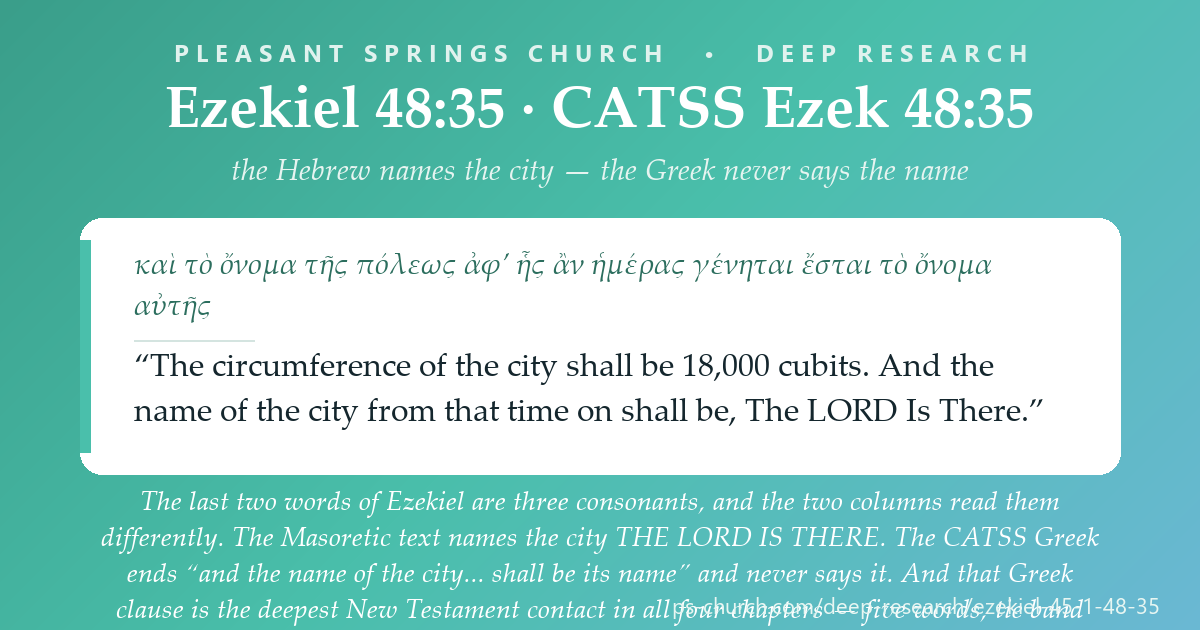
“And the name of the city from that time on shall be, The Lord Is There.” — and the CATSS Greek row for the same verse ends ἔσται τὸ ὄνομα αὐτῆς, shall be its name, and never says it.Ezekiel 48:35 · CATSS Ezek 48:35 · ESV 48:35
What this page would like corrected.
If you hold Ziegler’s Göttingen Ezekiel, Field’s Hexapla, a critical apparatus, or anything from Papyrus 967, this page wants to hear from you. Its central finding — that the CATSS Greek row for 48:35 does not name the city — is a fact about the file on this disk. What that fact means depends entirely on manuscript evidence that was not available here, and the page would rather be corrected than repeated.
And if a word of the ESV column is wrong, say so. It was typed, not fetched, and it is the one column on the page that no machine checked.
Every Deep Research page traces its passage across the whole sweep — the Old Testament, the Second-Temple world between the testaments (historical witnesses, not Scripture), and the New Testament. Follow the thread:
Pleasant Springs Church — Deep Research
Research method after Michael S. Heiser’s Bible Research Method (examine dictionaries → ancient literature → important words → textual connections → academic publications → share), with the Pleasant Springs “Author & Audience” foundation. Scripture set in the Hebrew, the Greek editions named on each page and the ESV (Old Testament), and the Greek New Testament and the ESV (New Testament), per the practice of Pleasant Springs Church. Ezekiel 40–48 research grounded in Tuell, Greenberg, Zimmerli, Block and Cooke; on the Greek in Ziegler’s Göttingen edition and the Papyrus 967 literature; on Revelation’s use of Ezekiel in Beale and Carson. None of those was consulted for this page — Stage 5 says so at length. Text: Hebrew from the Masoretic text as printed in the edition consulted — Sefaria’s Miqra according to the Masorah; no critical apparatus was consulted for the Hebrew and no Qumran Ezekiel fragment was collated. Greek from Rahlfs’ Septuaginta as digitized by CATSS; Papyrus 967, Ziegler’s critical edition and the hexaplaric witnesses were not consulted. Greek New Testament from the SBL edition as digitized by MorphGNT. The standing caution for this shelf applies: these pages say “the CATSS Greek text reads…” and never call a Greek reading early or late, and never say which text acted on which. ⚠️ Verse numbering — there is no offset anywhere in this passage, and the page states that rather than passing over it. Ezekiel 45, 46, 47 and 48 hold 25, 24, 23 and 35 verses in the Masoretic text and the CATSS Greek file holds 25, 24, 23 and 35 rows. There is no missing row and no renumbering: Greek 45:1 is Hebrew 45:1 and Greek 48:35 is Hebrew 48:35. Across the whole book the two corpora differ in six chapters by one verse unit each — 1, 10, 27, 32, 33 and 40 — and in none of them does the chapter or verse numbering shift; the shortfalls are omissions, not renumberings, and none of the six is in this passage. This was derived by reading the two corpus files on this disk with python -m dr_tools versify Ezekiel --derive, not by copying a printed table. That command returns nothing for the ESV column, because no ESV Ezekiel is held here. ⚠️ The ESV column was NOT verified against a held ESV text. No ESV file for Ezekiel exists on this disk and no Crossway API key exists in this project; the English was typed and its verse alignment rests on verse counts and chapter openings. The Hebrew and Greek columns were pulled programmatically from the corpus files. At 45:1 and 45:5 the ESV column is translating the Greek reading rather than the Hebrew one printed beside it, and both rows say so. ⚠️ Every cross-corpus run figure on this page was measured on 31 August 2026 and applies MorphGNT’s own spelling equivalences — οὐ/οὐκ/οὐχ, ἐκ/ἐξ and the movable nu — so that a shared run is not cut at a word the two editions merely spell differently. Figures published on this shelf before 30 August 2026 are lower for that reason; nothing was copied from a sibling page and every number above was re-measured. ⚠️ A run of one on the Hebrew screen means NO TWO CONSECUTIVE WORDS. The Hebrew-side screen runs with the unigram fallback off, so the ones at 46:10 (band 195) and 47:11 (band 1,437) mean those two verses share no adjacent word pair with any of the other 23,203 Masoretic verse units — not that they share only one word in any richer sense. The Greek-side screen runs with the fallback ON, so the 1 reported for Ezekiel 48:31 against Revelation 21:12 means the two verses share isolated words and no adjacent pair at all, and the word is καί. ⚠️ Two reported Hebrew maxima in these chapters are inflated by a scribal marker and are not argued from. The Masoretic file counts {ס} and {פ} as words. The fours reported at 47:23 and 48:29 each end on one and are really threes; the four at 45:15 also stands without a marker, against Ezekiel 44:12, and is real. Every run this page argues from was checked and crosses no marker. normalize.py is frozen and was not edited. ⚠️ Greek Old Testament figures are scoped to the 64 CATSS files held here, 30,637 verse units, screened to 30,348 with the Odes excluded. Two of the Odes are New Testament text — Ode 9 is Luke 1 and Ode 13 is Luke 2 — and ten more are second copies of Exodus 15, Deuteronomy 32, 1 Samuel 2, Habakkuk 3, Isaiah 26, Jonah 2, Daniel 3, Isaiah 5 and Isaiah 38, so leaving them in would inflate any tie band that touched one. ⚠️ Three of the four deepest New Testament runs on this page are formulas, and the passage’s two best-known New Testament connections measure one and two. The page says so in four places. Typology is handled per the house position: what the text says, what the New Testament itself draws, and what we see from this side of the cross — with the seeing left to the reader.
Scripture quotations marked ESV are from the ESV® Bible (The Holy Bible, English Standard Version®), © 2001 by Crossway, a publishing ministry of Good News Publishers. ESV Text Edition: 2016. Used by permission. All rights reserved. The ESV text may not be quoted in any publication made available to the public by a Creative Commons license, and the ESV may not be translated in whole or in part into any other language. www.esv.org
|
Did this study bless you today? 💚 Give to Support PS Church100% of gifts go to the General Fund — thank you. |