A hundred and four verses, and most of them are numbers. Six cubits, twenty cubits, five hundred cubits; jambs, side chambers, galleries, a yard nobody can identify, doors, palm trees, cherubim with two faces. Then at 43:1 the glory comes back from the east and the arithmetic stops. Measured against the whole Hebrew Bible, the deepest thing in these four chapters is not where anyone points. Three rows reach six consecutive Hebrew words or more. Two of the three are the messenger formula. The third is 44:4 — the glory of the Lord filled the house of the Lord — and its only two partners in all of Scripture are 1 Kings 8:11 and 2 Chronicles 7:2, the dedication of Solomon’s temple. In a hundred and four verses of architecture, the one deep verbatim tie the Hebrew makes outside this book is to the day the first house was filled. And in Greek that same row shares ONE word with 3 Kingdoms 8:11, and the word is and, because the Greek of Solomon has a verb and the Greek of Ezekiel has an adjective. Seven verses here share no two consecutive words with anything else in the Bible, four of them in chapter 41 — including 41:20, whose last word carries a dot over every letter and is missing from the Greek. And the deepest reach into the Greek New Testament is five words, reached twice — one of the two, Ezekiel 44:12 into Acts 15:17, turns out to be a phrase Acts itself says it is quoting, and it is quoting Amos. See the method →
Ezekiel 41:1–44:31 — sixteen rows, all four chapters represented (⚠️ there is NO versification offset anywhere in these four chapters. Hebrew, CATSS Greek and English all carry 26, 20, 27 and 31 verses, and every verse number means the same verse in all three columns. The nearest disagreement in the book is one verse earlier — Ezekiel 40, where the Hebrew has 49 verses and the Greek 48. The whole alignment is in the footer.)
Hebrew (Masoretic) · Greek (CATSS/Rahlfs) · ESVThe Shape of the Passage
Sequence with one measurable hinge — and one inclusio inside a single verse. No chiasm.These four chapters are the architectural half of a vision report, and the audience is a congregation of deportees who cannot go and look. What follows reports what the text says about who is speaking, who is listening, and what the two ancient columns measurably do. It does not settle the composition history of Ezekiel 40–48, and nothing measured on this page depends on settling it.
Author
A priest with a measuring reed, who is told nothing and shown everything. Across chapters 41 and 42 the speaker of the book is almost silent. The guide measures; Ezekiel reports numbers. The verb ויאמר אלי, and he said to me, stands twice in those forty-six verses and four times in chapters 43–44 — and at 41:22, the one place in the measuring chapters where God is named, the verb is not ויאמר at all but וידבר, and he spoke. The man who spent twenty-two chapters shouting is here a note-taker.
He is a priest, and the second half of the passage proves it from the vocabulary. Nineteen rows in this passage reach four consecutive Hebrew words or more. Eight of them carry a partner outside Ezekiel at their maximum; one of the eight is the messenger formula (44:9, tie band 132); and five of the remaining seven are priestly law: 43:19 into Leviticus 4:14, 43:20 into Exodus 29:20, 43:23 into Leviticus 4:3, 44:5 into Exodus 6:29 and 44:25 into Leviticus 21:3. Of the last two, one is a stock divine title (44:2, tie band three, into Joshua 10:42, Isaiah 21:17 and 2 Chronicles 13:5) and the other is 44:4, which goes to Solomon. Sorted by chapter, the pattern is sharper still: of the rows reaching three or more, chapter 41 has 8 and one of them looks outside Ezekiel; chapter 42 has 7 and one looks outside; chapter 43 has 18 and ten look outside; chapter 44 has 17 and eleven do. The measuring chapters are sealed. The glory chapters are not.
What the Greek column adds and what it takes away. The CATSS file holds all 104 verses of this passage in the same chapters and the same order as the Hebrew. What it changes is wording, and the changes printed above are at 41:1 and 41:4 (a transliteration and a dimension), 41:20 (a clause the Greek does not have), 42:13 (Zadok named where the Hebrew does not name him), 42:20 (a wall for a category), 43:2 (a camp for water), 43:5 and 44:4 (an adjective for a verb), 43:7 (a name for a presence), 43:10 (ceasing for shame), 43:12 (no frame at all) and 44:2 (a future for a perfect). Every one of those is printed in full above and none of them is called a mistake, a correction or a change.
The Greek is used here as a witness to a second ancient text, never as evidence about who wrote the Hebrew one. The shelf never asserts direction of influence.
Audience
Exiles in Babylon, in the twenty-fifth year, being handed a building they cannot visit. The temple they remember has been rubble for fourteen years when this vision is dated. The measurements are not instructions — nobody in the passage is told to build anything. At 43:10 the prophet is told to describe the house to the house of Israel, and the stated purpose is that they be ashamed. The Greek of that verse says instead that they will cease from their sins. Both columns make the plan an instrument of repentance rather than a blueprint.
And what they are actually promised is a return, measured against the one they remember. The phrase מָלֵא כְבוֹד יְהוָה, the glory of the Lord filled, stands in five verses of the Hebrew Bible. Three are Solomon dedicating the first temple — 1 Kings 8:11, 2 Chronicles 5:14, 2 Chronicles 7:2 — and two are this vision, 43:5 and 44:4. No other event in Scripture is described with those words. An exile who knew the dedication story would have heard the quotation without being told it was one, and 44:4 measures six consecutive words with two of the three.
They are also told, twice, what their priests failed at. 44:23 gives the priests the duty of teaching the difference between the holy and the common. The only other verse in the Hebrew Bible with those three words is Ezekiel 22:26, where the priests are convicted of not doing it. Twenty-two chapters earlier, the same congregation heard the charge; here they hear the job description. The measurement makes the pairing exact: three consecutive words, tie band one.
How it has been carried. 44:2, the shut gate, became the porta clausa of Latin Christianity and of a thousand paintings of the Annunciation; 43:2, the glory from the east, is read every Advent; 43:7 supplied the phrase the place of my throne. What this page adds is the measurement, and in two of those three cases it complicates the reading rather than supporting it: 44:2 reads as a perfect in Hebrew and a future in Greek, and 43:2 has water in Hebrew and a camp in Greek.
Before anything is measured, find out what the rooms, the words and the offices in these chapters are already known to mean — and, more useful here than usual, find out where the reference works admit they do not know.
A dictionary gives the range of a word and the consensus about an institution. In a passage this technical it also marks the places where there is no consensus at all, and those are the places worth counting.
What is the הֵיכָל and what is the קֹדֶשׁ הַקֳּדָשִׁים?
הֵיכָל is the main hall of a temple — the nave, the long room you stand in — and behind it stands the קֹדֶשׁ הַקֳּדָשִׁים, the Most Holy Place. The reference works agree on that. What they do not agree on is the dimensions here, and the reason is that the two ancient columns do not agree either. At 41:4 the Hebrew measures twenty cubits by twenty; the CATSS Greek measures forty by twenty and calls it τὸ μῆκος τῶν θυρῶν.
Both numbers are real numbers from Solomon’s temple. 1 Kings 6:2 gives the house sixty cubits by twenty; 6:17 gives the nave in front of the inner sanctuary forty cubits; 6:20 gives the inner sanctuary twenty by twenty by twenty. So the Hebrew of Ezekiel 41:4 matches the first temple’s inner sanctuary and the Greek of Ezekiel 41:4 matches its nave. This page reports that and does not say which column is measuring what the guide meant.
What is a גִּזְרָה? What is an אַתִּיק?
Nobody knows, and the honest lexica say so. These are two of the words that make chapters 41–42 the hardest Hebrew prose in the Bible, and this page can add one hard count to the dictionary entries: between them they stand twelve times in Ezekiel 41–42, and that is where all but a handful of their occurrences in the whole Hebrew Bible are.
הַגִּזְרָה — usually rendered the separate yard, the temple yard, or simply left as the gizrah — returns five occurrences of the exact form הגזרה in the whole 23,204-unit Masoretic corpus, and all five are in this passage: 41:12, 41:15, 42:1, 42:10 and 42:13 — and the same noun stands twice more here with the conjunction, וְהַגִּזְרָה at 41:13 and 41:14, so seven in all, every one of them in Ezekiel 41–42. Its root גזר means to cut or separate, which is why the glosses tend toward the cut-off place. Outside this passage the consonants גזרה stand three more times — Leviticus 16:22 (אֶרֶץ גְּזֵרָה, a land cut off), Lamentations 4:7 (גִּזְרָתָם, of a body’s form) and 1 Chronicles 14:16, where it is the town Gezer — and whether any of the three is the same word as Ezekiel’s is a lexicographer’s question this page counts but does not settle. The CATSS Greek does not settle on one rendering for it either: at 42:13 it has τῶν διαστημάτων, the intervals; at 41:12, 41:15, 42:1 and 42:10 it works with forms of τὸ διορίζον, the dividing thing, and τὸ ἀπόλοιπον, the remainder. Several renderings for five occurrences is what a translator does with a word he does not know either.
אַתִּיק — gallery, ledge, terrace, nobody is sure — occurs five times, at 41:15, 41:16, 42:3 (twice) and 42:5, and nowhere else in the Bible. Both words are counted here exhaustively over the corpus on this disk, not taken from a dictionary’s count.
Who are the sons of Zadok, and who are “the Levites who went far from me”?
Zadok is the priest who backed Solomon against Adonijah in 1 Kings 1 and displaced Abiathar; his descendants held the Jerusalem high priesthood. Ezekiel 44 draws a line through the priesthood that no other law code in the Bible draws: Levites who served at the high places are demoted to gatekeepers and butchers (44:11), and only בְּנֵי צָדוֹק may come near to minister (44:15).
The reference works treat this as one of the sharpest historical problems in the Hebrew Bible, because Deuteronomy 18 knows no such division and Numbers 3 divides priests from Levites on different grounds. This page does not enter that argument. What it can add is a count. The name צָדוֹק stands in exactly four verses of Ezekiel — 40:46, 43:19, 44:15 and 48:11 — and in no other prophetic book; its other 48 occurrences in the Hebrew Bible are in Samuel, Kings, Chronicles, Ezra and Nehemiah. The exact string בני צדוק, sons of Zadok, stands in two of the four (40:46 and 44:15); 43:19 reads of the seed of Zadok and 48:11 from the sons of Zadok. And the CATSS Greek names him in a fifth place where the Hebrew does not: 42:13.
What are the puncta extraordinaria?
They are the dotted words of the Masoretic tradition: a small number of words, traditionally fifteen, over which the scribes placed dots. The Talmudic and later explanations vary — a doubtful reading, a word to be treated with reserve, a mark of exegetical attention — and the reference works do not settle what they mean.
What can be settled here is where one of them is. The Sefaria Miqra according to the Masorah file on this disk carries five U+05C4 upper dots in the whole of Ezekiel 41–44, and all five sit on the five letters of the last word of 41:20, הַהֵיכָל. See Stage 4 for the two other measurable facts about that word.
What does חֹל mean, and why is it not the opposite of “clean”?
חֹל is the common or profane — not the unclean, but the ordinary. The dictionaries are unanimous that Israel’s priestly system runs on two independent axes, holy/common and clean/unclean, and that collapsing them is the commonest mistake in reading Leviticus and Ezekiel.
44:23 states both axes in one verse and keeps them apart: teach the difference between the holy and the common, and make known the difference between the unclean and the clean. The Greek keeps them apart too: ἀνὰ μέσον ἁγίου καὶ βεβήλου, then ἀνὰ μέσον ἀκαθάρτου καὶ καθαροῦ. Two pairs, four terms, and the verse does not cross them.
A guided tour of a temple, given in a vision, with dimensions in cubits, is a recognisable ancient genre. Read the passage beside what else the ancient world produced in it — and beside the two other temple accounts in the Bible itself.
The point is not to explain the vision away by parallels. It is to know what an ancient reader would have recognised, so that what is unusual here can be seen as unusual.
Temple building accounts in the ancient Near East.
Mesopotamian kings left long building inscriptions describing temples they had raised, often with a divine plan revealed in a dream. Gudea of Lagash (c. 2100 BC) is the standard comparison: the Gudea Cylinders record a dream in which a god shows him the plan of the Eninnu, a female figure holds a stylus and a tablet of the star-filled sky, and a man holds a lapis lazuli tablet on which he draws the ground plan of the house. Gudea then builds it.
The comparison is worth making mainly for where it fails. Gudea receives a plan and constructs a building. Ezekiel receives a completed building and is told to describe it. Nobody in Ezekiel 40–48 is commanded to build anything, and the stated purpose of the description at 43:10 is shame, not construction. Gudea’s cylinders were not consulted in the original for this page; the comparison rests on standard translations and is offered as context, not as evidence.
The other two temple accounts in the Bible, and how this one differs.
Exodus 25–31 and 35–40 give the tabernacle; 1 Kings 6–7 and 2 Chronicles 3–4 give Solomon’s temple. Both are building accounts with a builder and a completion. Ezekiel 41–42 has a visitor with a reed and no builder at all.
Here is a measurement that sharpens the comparison and also corrects it. Counting consonantal word forms that occur nowhere else in the Hebrew Bible, Ezekiel 41–44 has 149 such forms out of 727 distinct forms, 20.5%. That is the highest of any block of Ezekiel tested here (Ezekiel 1–5 gives 14.1%, 33–37 gives 17.8%, 45–48 gives 14.3%). But it is not remarkable by the standards of the whole Bible: Job 38–41 gives 25.7% and Isaiah 40–42 gives 20.0%. And the nearest comparison in subject matter, 1 Kings 6–7 — Solomon’s building account — gives 19.6%, almost the same as Ezekiel. Building descriptions in Hebrew use rare words. That is a fact about the genre, not a fact about Ezekiel, and this page corrects itself on the point rather than leaving the higher number to do rhetorical work.
By contrast Exodus 25–27 gives 9.0% and Exodus 36–38 gives 5.9%, because the tabernacle account repeats its own vocabulary relentlessly across two tellings.
The shut gate, and what a shut gate meant.
In the ancient city a gate was where business was done, judgement given and armies came in. A permanently shut gate is a statement about who has already passed — and the closest analogue inside the Bible is not another gate but the veil, which is also a barrier defined by who may cross it. Comparative material on sealed temple doors in the ancient world was not consulted in the primary sources for this page and is therefore not cited.
What is measurable here is what the two columns do with the tense. The Hebrew perfect בָּא makes it a report: he has come in, seal it. The CATSS Greek future εἰσελεύσεται makes it a promise: he will come in, so it stays shut. The Latin tradition that read this gate as the womb of the Virgin — Ambrose, Jerome, and the whole porta clausa iconography — is reading a past tense. This page prints both columns and takes no side, and it notes that the Vulgate is not held on this disk and was not consulted.
Cherubim with two faces.
The winged guardian figures carved on the walls at 41:18–19 have two faces, a man’s and a lion’s. The living creatures of Ezekiel 1 and the cherubim of Ezekiel 10 have four. Ancient Near Eastern art gives both: the two-faced arrangement is what a relief carved flat on a wall can actually show, and the four-faced arrangement is what a free-standing throne-bearer can.
The measurement adds one thing. 41:18 is one of the seven verses in this passage that share no two consecutive words with any other verse in the Hebrew Bible — the sentence that puts two faces on a cherub is unlike anything else in Scripture at the level of wording, not only of iconography.
The altar that is called a table.
At 41:22 the guide describes a wooden altar and then calls it הַשֻּׁלְחָן אֲשֶׁר לִפְנֵי יְהוָה, the table that is before the Lord. In the tabernacle and in Solomon’s temple these are two different pieces of furniture: the incense altar and the table of the bread of the Presence.
The phrase is unique. It stands in one Masoretic verse, this one, and its Greek counterpart ἡ τράπεζα ἡ πρὸ προσώπου κυρίου stands in one screened Greek Old Testament unit, this one. The nearest thing to it anywhere else is Malachi 1:7, שֻׁלְחַן יְהוָה, where the table of the Lord is being despised; in Greek that phrase, τράπεζα κυρίου, stands at Malachi 1:7 and 1:12, and its only New Testament occurrence is 1 Corinthians 10:21. These are separate verses connected by a noun phrase, not by a measured run, and this page is not calling them a chain.
Six words carry this passage, and four of them can be counted exhaustively over the corpora on this disk. Where a count is possible it is given; where it is not, the page says so.
A word study on this shelf is a count, not an impression. Every figure below was produced by an exhaustive pass over the files held here and can be reproduced from the tooling.
Five occurrences in Ezekiel 41–44, ALL of them in chapters 43–44 (43:2 twice, 43:4, 43:5, 44:4). Zero in the 46 verses of chapters 41–42.
Five verses in the whole Hebrew Bible: 1 Kings 8:11, 2 Chronicles 5:14, 2 Chronicles 7:2, Ezekiel 43:5 and Ezekiel 44:4. Three dedications and one vision, and nothing else.
Seven occurrences in the Masoretic corpus, all seven in Ezekiel 41–42 — five as הגזרה, two with the conjunction at 41:13 and 41:14. The consonants stand three more times elsewhere and not certainly as the same word (Leviticus 16:22, Lamentations 4:7, 1 Chronicles 14:16).
Five occurrences in the Masoretic corpus — 41:15, 41:16, 42:3 twice, 42:5 — and none anywhere else in the Bible.
Two verses in the 30,348 screened Greek Old Testament units: Ezekiel 43:5 and 44:4. An adjective where the Hebrew has a verb.
A transliteration, not a Greek word. 66 occurrences across the 64 CATSS files held here: 39 architectural and 27 the name Elam. The architectural ones cluster in 3 Kingdoms 6–7, 2 Chronicles 3 and Ezekiel 40–46.
אַמָּה, the cubit, chapter by chapter — and what the count shows.
Counting the forms אמה and אמות with their prefixes across the passage: chapter 41 has 27, chapter 42 has 7, chapter 43 has 12, and chapter 44 has none at all. Forty-six cubits in the passage, thirty-four of them before the glory arrives, twelve in the altar block, and zero afterwards.
Set that beside the divine name. The unprefixed form יהוה stands nineteen times in these four chapters: once in chapter 41, not at all in chapter 42, six times in chapter 43 and twelve times in chapter 44. The one occurrence in the measuring chapters is 41:22. Counting the prefixed forms too — לַיהוָה at 42:13 and again at 43:24 — makes it twenty-one: 1, 1, 7 and 12.
Cubits 27–7–12–0 against the name 1–0–6–12. That is the shape of the passage, and it is a count, not an impression.
Why this page does not build an argument on קֹדֶשׁ.
קדש and its derivatives appear thirteen times in chapters 41–42 and twenty-three times in 43–44 by a simple substring count. That count is not clean and the page will not lean on it: the substring catches קֹדֶשׁ the noun, קָדוֹשׁ the adjective, מִקְדָּשׁ the sanctuary and הַקֳּדָשִׁים in the superlative construction, which are four different things doing four different jobs.
What can be said exactly is what the exhaustive phrase searches returned: בין הקדש לחל stands in one verse (42:20) and בין קדש לחל stands in two (22:26 and 44:23). The definite article is the whole difference between a unique verse and a pair.
The words the Greek gave up on.
Twice in this passage and repeatedly in chapter 40 the CATSS Greek writes a Hebrew word in Greek letters instead of translating it. At 41:1 αιλαμ stands where the Hebrew has אֵילִים, and again where it has אֹהֶל. In chapter 40 the string θεε stands thirteen times for תָּא, the guardroom — a form which elsewhere in the Greek Bible is the vocative O God, so that the same six letters mean two unrelated things depending on which book you are in.
This is worth naming as a limit on the page as much as a finding. Where a translator transliterates, the Greek column stops being a second witness to the meaning of the Hebrew and becomes only a witness to its consonants.
Every figure in this section was produced by an exhaustive run screen over the corpora held on this disk on 31 August 2026. Runs are contiguous sequences of whole word forms, never lemmas. The tie band — how many other verses reach the same depth — is reported beside every run, because a run without its band is misleading.
The screen finds verbatim contact. It does not find allusion, and it cannot tell a quotation from a formula from an accident. Reading each result by eye is part of the method, and this section prints the ones that failed that reading as well as the ones that passed.
THE HEADLINE: the only content-bearing run of six or more in a hundred and four verses goes to Solomon.
Screened chapter by chapter against the rest of the 23,204-unit Masoretic corpus, three rows in Ezekiel 41–44 reach six consecutive Hebrew words or more:
- 44:6 — seven words, tie band two. אל בית ישראל כה אמר אדני יהוה. Partners: Ezekiel 14:6 and Ezekiel 20:30. A messenger formula, both partners inside the book.
- 43:18 — six words, tie band two. בן אדם כה אמר אדני יהוה. Partners: Ezekiel 7:2 and Ezekiel 39:17. The same formula with a different opening.
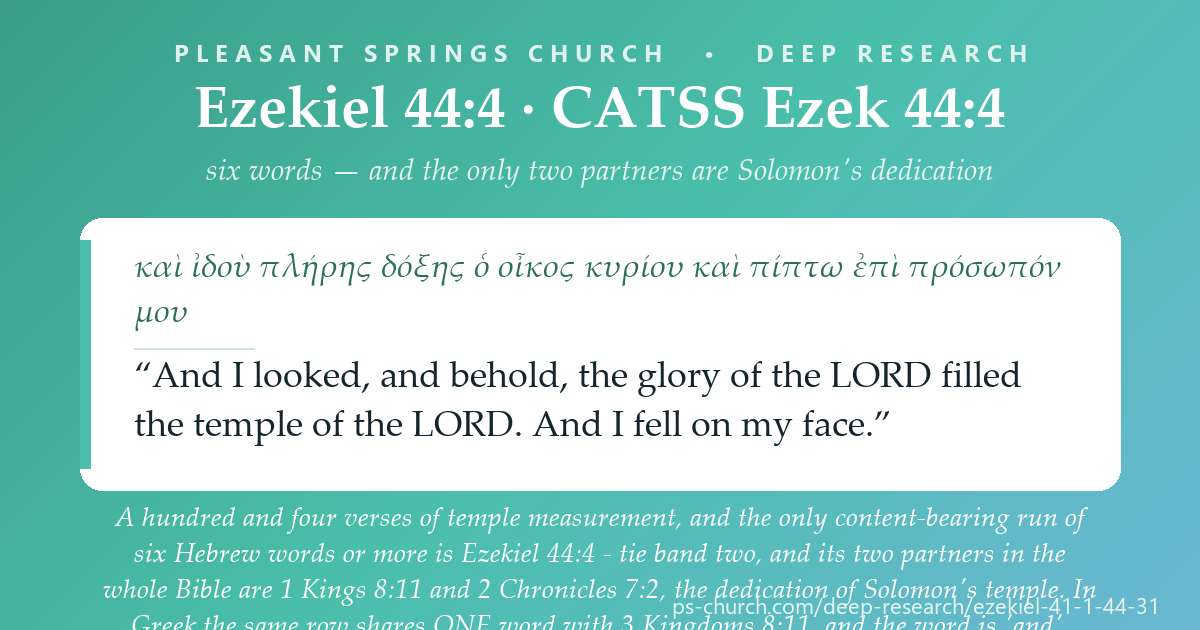
- 44:4 — six words, tie band two. מלא כבוד יהוה את בית יהוה. Partners: 1 Kings 8:11 and 2 Chronicles 7:2.
Two formulas and one sentence. The exhaustive phrase search confirms the shape from the other direction: מלא כבוד יהוה את בית יהוה returns three hits in the whole corpus (1 Kings 8:11, Ezekiel 44:4, 2 Chronicles 7:2); drop the last word and it returns four, adding 2 Chronicles 5:14, which writes the house of God rather than the house of the Lord; drop to three words, מלא כבוד יהוה, and it returns five, adding Ezekiel 43:5.
Five verses in the Bible say that the glory of the Lord filled something. Three are the dedication of the first temple and two are this vision. There is no sixth. This page does not say Ezekiel is quoting Kings, or that Chronicles is quoting Ezekiel, or that any of them is quoting anything. It says the five verses exist and that the run between two of them is six words long.
AND THE COUNTER-EXAMPLE TO THAT HEADLINE, printed straight after it.
The tabernacle is filled too. Exodus 40:34–35: the cloud covered the tent of meeting, and the glory of the Lord filled the tabernacle. Anyone reading this page’s headline should immediately ask why Exodus is not in the list.
Because Hebrew word order puts it out of reach of a contiguous-run screen. Exodus writes וכבוד יהוה מלא — subject first, then verb. Ezekiel and Kings write מלא כבוד יהוה — verb first. The exhaustive search on the subject-first order returns exactly three hits: Exodus 40:34, Exodus 40:35 and 2 Chronicles 7:1. Measured verse against verse, Ezekiel 44:4 and Exodus 40:34 share ONE consecutive word, and the word is מלא.
Two verses say the same thing and the screen scores them at one. That is the honest limit of this method, stated on the page that most benefits from the method. One further fact, offered without interpretation: 2 Chronicles 7 is the only chapter in the Bible that uses both orders, in consecutive verses — 7:1 subject-first, 7:2 verb-first.
What the Greek column does to the headline: six becomes one.
The same row, measured on the Greek side, does not exist.
- CATSS Ezekiel 44:4 against CATSS 3 Kingdoms 8:11: run = 1. The word is καί.
- CATSS Ezekiel 44:4 against CATSS 2 Chronicles 7:2: run = 1.
- CATSS Ezekiel 43:5 against CATSS 3 Kingdoms 8:11: run = 1.
The reason is grammatical and visible in the codex above. Solomon’s Greek has a finite verb: ἔπλησεν δόξα κυρίου τὸν οἶκον at 3 Kingdoms 8:11 and 2 Chronicles 7:2, and the compound ἐνέπλησεν δόξα κυρίου τὸν οἶκον τοῦ θεοῦ at 2 Chronicles 5:14, so that the run all three share is the four words δόξα κυρίου τὸν οἶκον. Ezekiel’s Greek has an adjective phrase, πλήρης δόξης, which stands in exactly two of the 30,348 screened Greek Old Testament units, and both of them are Ezekiel 43:5 and 44:4.
So the single deepest literary tie in this passage is a feature of one ancient column and not of the other. A reader working from the Greek alone would have no way to find it; a reader working from the Hebrew alone would not know it was fragile. That is the whole reason this shelf prints both.
The deepest reaches into the Greek New Testament — and why BOTH of them are formulas.
Screened against all 7,927 verses of the Greek New Testament, the 104 CATSS rows of this passage give: all 104 reach two, 80 reach three, 22 reach four, 2 reach five, and nothing reaches six. The two fives:
1. Ezekiel 44:12 → Acts 15:17, five words, tie band one. μου ἐπ’ αὐτοὺς λέγει κύριος. It looks like James reaching into the temple vision at the Jerusalem Council. It is not. Acts 15:17 sits inside a quotation that Acts 15:15 itself introduces with as it is written, and what is written is Amos 9:11–12, and the direct measurement is decisive: CATSS Ezekiel 44:12 against CATSS Amos 9:12 runs SEVEN consecutive words — μου ἐπ’ αὐτοὺς λέγει κύριος ὁ θεός — two more than Ezekiel shares with Acts, and Amos 9:12 against Acts 15:17 runs FOURTEEN. The five words in Acts are Amos’s words. The screen cannot see that; a human reading the result can.
2. Ezekiel 44:2 → Luke 1:68, five words, tie band one. κύριος ὁ θεὸς τοῦ Ισραηλ — the shut-gate verse against the opening of the Benedictus. This one is more interesting and still not a link. The exact string with the article τοῦ stands in four of the 30,348 screened Greek Old Testament units (2 Maccabees 9:5, Ezekiel 4:13, Ezekiel 44:2, Malachi 2:16) and in one New Testament verse, Luke 1:68. But the Benedictus is built on the psalm-blessing formula εὐλογητὸς κύριος ὁ θεὸς Ισραηλ, which stands WITHOUT the article in seven Greek Old Testament verses — 1 Kingdoms 25:32, 3 Kingdoms 1:48, 3 Kingdoms 8:15, 2 Chronicles 2:11, 2 Chronicles 6:4, Psalm 40:14 and Psalm 105:48. A single article is what makes Ezekiel 44:2 Luke’s unique five-word partner. That is a coincidence of spelling, and the page says so.
Nothing in Ezekiel 41–44 reaches the Greek New Testament in a way this measurement can call distinctive.
MORE COUNTER-EXAMPLES: the fours that mean nothing.
- 43:10 → Matthew 1:21 and Hebrews 10:17, four words, tie band two. ἀπὸ τῶν ἁμαρτιῶν αὐτῶν. The Greek of Ezekiel says Israel will cease from their sins; Matthew says Jesus will save his people from their sins. It is the ordinary Greek way to say it, and it is an accident.
- 44:9 → four words, tie band 132. כה אמר אדני יהוה on the Hebrew side. A hundred and thirty-two other verses reach the same depth. This is what a formula looks like when the band is printed beside it.
- 44:4 → Revelation, four words, tie band five. All five partners are the same phrase, καὶ εἶδον καὶ ἰδού, at Revelation 6:2, 6:5, 6:8, 14:1 and 14:14. The deepest row on the Hebrew side has a purely formulaic deepest row on the Greek side.
- 41:22 → Acts 22:21, four words, tie band one. καὶ εἶπεν πρός με. Band one, and still meaningless: it is narrative furniture that happens to be rare in that exact form.
Where the passage does connect: Leviticus, Exodus, and only in the second half.
Nineteen rows in this passage reach four consecutive Hebrew words or more. Eight of them carry a partner outside Ezekiel at their reported maximum, and one of the eight is the messenger formula (44:9, tie band 132). Of the remaining seven, five are priestly law: 43:19 into Leviticus 4:14 (פר בן בקר לחטאת, band one), 43:20 into Exodus 29:20 (ולקחת מדמו ונתתה על, band two), 43:23 into Leviticus 4:3 (פר בן בקר תמים, band two), 44:5 into Exodus 6:29 (band one) and 44:25 into Leviticus 21:3 (אשר לא היתה לאיש, band one). The other two are 44:2, a stock divine title at tie band three (Joshua 10:42, Isaiah 21:17, 2 Chronicles 13:5), and 44:4.
Sorted by chapter, the asymmetry is the finding. Of the rows reaching three or more: chapter 41 has eight, of which one has a non-Ezekiel partner at its maximum; chapter 42 has seven, of which one does; chapter 43 has eighteen, of which ten do; chapter 44 has seventeen, of which eleven do.
Two out of fifteen in the measuring chapters, twenty-one out of thirty-five in the glory chapters. The text turns outward at exactly the point the vocabulary changes, and the seam is 43:1. Direction of influence is not asserted; shared priestly language between Ezekiel and the Torah is one of the oldest live questions in the field and this page does not enter it.
41:20, and three facts that this page refuses to join up.
Fact one. The last word of Hebrew 41:20 is הַהֵיכָל, and it carries an upper dot on every letter. Five U+05C4 dots, the only ones in these four chapters.
Fact two. The CATSS Greek of 41:20 has no equivalent of וְקִיר הַהֵיכָל. The verse ends at διαγεγλυμμένοι.
Fact three. The Hebrew of 41:21 opens with הַהֵיכָל again, so the word stands twice across the verse boundary in the Hebrew and once in the Greek.
The obvious story is that a scribe wrote the word twice, that the Masoretes marked the first, and that the Greek reflects a text with only one. This page is not telling that story. It has three observations off two files and no manuscript evidence whatever; Papyrus 967 was not consulted, the Cairo Genizah was not consulted, and no critical apparatus was opened. The three facts are printed and the explanation is left where it belongs, with people who have collated the witnesses. Note also that 41:20 is one of the seven verses here with no verbatim partner anywhere in the Hebrew Bible.
What a zero means here, and where the zeros are.
Seven of the 104 Hebrew rows report a maximum of zero: 41:18, 41:20, 41:21, 41:23, 42:5, 42:9 and 43:13. The Hebrew-side screen runs with the unigram fallback off, so zero means this verse shares no two consecutive words with any other verse in the Hebrew Bible. It does not mean the verse shares no words.
Four of the seven are in chapter 41 and chapter 44 has none. The verses concerned are: cherubim with two faces (41:18), the dotted word (41:20), the square doorposts and the appearance like the appearance (41:21), the two doors for the nave and the holy place (41:23), the galleries of the chambers (42:5), the entrance at the head of the way (42:9) and the measurements of the altar in cubits (43:13).
The Greek-side screen runs with the fallback ON, so a zero there would mean no shared word at all — and there are none: all 104 CATSS rows reach at least two. The two screens do not mean the same thing by a small number and this page uses both.
Two screens, two meanings of zero, and this page uses both. The Hebrew screen compares each chapter against the rest of the 23,204-unit Masoretic corpus with the unigram fallback OFF: a reported 0 means no two consecutive words are shared with anything. The Greek screen compares the 104 CATSS rows against all 7,927 Greek New Testament verses with the fallback ON: a reported 0 would mean no single word is shared, and none of the rows reports one. Where this page says a phrase ‘stands in N verses’ that is a separate exhaustive phrase search over the same files, not a run screen, and the two tools answer different questions. Greek Old Testament figures are scoped to 30,348 screened verse units — the 30,637 units held in the 64 CATSS files, less the Odes.
This is where the page says what it could not check. Ezekiel 40–48 has a live manuscript problem, a live composition problem and a live halakhic problem, and this page touches none of them competently. Read this section before citing anything above it.
The measurements above are reproducible from the files on this disk. The scholarship below is not on this disk. Naming the gap is the only honest way to publish the measurement.
WHAT THIS PAGE COULD NOT CHECK — read this before citing anything above.
- Papyrus 967 was not consulted, and it matters more here than almost anywhere else in the Greek Bible. The oldest substantial Greek witness to Ezekiel differs from the received Greek in chapter order and in the length of chapters 36–39, and specialists disagree about what that implies for 40–48. Every “the Greek reads…” statement on this page is about one digitized edition — Rahlfs as digitized by CATSS — and about nothing else.
- Ziegler’s critical edition of Greek Ezekiel was not consulted, and no Greek apparatus was opened. Where this page says the Greek lacks a clause — 41:20, 43:12 — it means the CATSS file lacks it. It does not mean the Septuagint lacks it.
- No Hebrew critical apparatus was consulted and no Dead Sea Scroll was collated. There is Ezekiel material at Qumran and Masada; none of it is on this disk. The dotted word at 41:20 in particular is exactly the sort of place where a scroll reading would matter, and the page does not have one.
- The Vulgate and the Peshitta were not consulted. The porta clausa discussion at 44:2 turns on a Latin reading this page has not seen.
- The ESV column was typed by hand. No ESV file for Ezekiel exists on this disk and no Crossway API key exists in this project. The Hebrew and Greek columns were pulled programmatically from the corpus files; the English was not. Any typographical error in it is this page’s, not Crossway’s.
- No acrostic or letter screen was run. The passage is technical prose with no poetic structure to screen, and running one would have produced a null result dressed as a finding.
The argument this page is standing next to and not joining: who wrote Ezekiel 40–48.
The composition of the temple vision is one of the long-running questions of the field. Positions range from a substantially unified vision from the prophet to a core expanded by later priestly hands, with the Zadokite legislation of chapter 44 usually treated as the sharpest test case. Zimmerli, Gese, Levenson, Block, Tuell and Ganzel all have positions and they do not agree.
Nothing on this page adjudicates it, and nothing on this page depends on it. The asymmetry reported in Stage 4 — chapters 41–42 pointing almost entirely inward, chapters 43–44 pointing outward to Leviticus and Exodus — is a description of the finished text’s wording. It is exactly the sort of observation that gets recruited into composition arguments, and it should be resisted here: a measuring account and a legal code use different vocabulary for the same reason that a recipe and a lease do.
The 41:4 dimensions, and what a specialist would say about them.
This page reports that the Hebrew measures the Most Holy Place twenty by twenty and the CATSS Greek measures forty by twenty. A specialist would immediately raise haplography, the possibility that the Greek reflects a different Hebrew, and the possibility that the Greek translator harmonised to 1 Kings. All three are plausible and none of them can be tested from the files on this disk.
Where this page is exposed: the observation that forty by twenty is the shape of Solomon’s nave is drawn from 1 Kings 6:2 and 6:17 read in translation, not from a text-critical study, and it is offered as context. It is not offered as an explanation of the Greek reading.
The five-verse מלא כבוד יהוה result — what a critic would attack.
The strongest objection to the page’s headline is the one the page prints itself: a contiguous-run screen cannot see across a word-order change, and Exodus 40:34–35 says the same thing in the other order. A second objection is subtler and worth stating: the phrase is short. Four content words, one of them the divine name, in a language with a small vocabulary for filling and glory. A sceptic could argue that any two writers describing a theophany in a building would land on those words.
What the page can answer is only this: they did not. Across 23,204 verse units, exactly five say it, and they belong to two events. That is not proof of dependence and this page does not claim dependence. It is a distribution, and the distribution is unusually tight.
A third objection, freely granted: the ESV renders הַבַּיִת as the temple in both Ezekiel verses and as the house of the Lord in Kings, so a reader working from the English alone cannot see the run at all. The run is a fact about the Hebrew.
Things a specialist would raise that this page cannot answer.
- The relationship between Ezekiel 44 and the Holiness Code. The priestly rules of 44:17–31 track Leviticus 21–22 closely in subject and loosely in wording. The screen catches only 44:25 into Leviticus 21:3 at four words and 44:16 into Leviticus 22:9 at three. A verbatim screen is the wrong instrument for a relationship of this kind and this page says so rather than reporting the low numbers as a result.
- Whether the vision has a real architectural referent. Attempts to draw the building from these chapters have been made since the Middle Ages and none commands assent, largely because of words like גִּזְרָה and אַתִּיק. This page counts those words; it does not draw the building.
- The halakhic afterlife. Rabbinic tradition records the difficulty of reconciling Ezekiel 40–48 with the Torah, and the tradition about Hananiah ben Hezekiah’s three hundred jars of oil is well known. This page has not read the primary sources for it and does not cite them as evidence.
- Christian typological readings of 44:2. Large, old and outside this page’s competence in the primary languages of its transmission, which are Latin and Syriac.
Where this page is weakest.
Three places.
First, the ESV column. It is typed, not fetched. Everything measured on this page was measured on the Hebrew and Greek columns, which were pulled from files; but a reader trusting the English is trusting typing.
Second, the unique-word-form statistic in Stage 2. 20.5% sounds impressive until it is put beside 1 Kings 6–7 at 19.6%, and the page prints that comparison because without it the number would be doing rhetorical work it has not earned. It counts consonantal forms, not lexemes, so a rare prefix on a common word counts the same as a genuine hapax.
Third, and most important: the headline is a Hebrew-only finding. Six words at 44:4 collapses to one word in Greek. A page that had been written from the Greek would have had no headline at all. That is not a flaw in the measurement; it is the measurement telling you that the two ancient columns are two different books at this point, and the page has tried to say so on every row where it is true.
- Block, Daniel I. The Book of Ezekiel, Chapters 25–48. NICOT. Eerdmans.
- Zimmerli, Walther. Ezekiel 2: A Commentary on the Book of the Prophet Ezekiel, Chapters 25–48. Hermeneia. Fortress.
- Greenberg, Moshe. “The Design and Themes of Ezekiel’s Program of Restoration.” Interpretation 38 (1984).
- Levenson, Jon D. Theology of the Program of Restoration of Ezekiel 40–48. Scholars Press.
- Tuell, Steven S. The Law of the Temple in Ezekiel 40–48. Scholars Press.
- Ganzel, Tova. Ezekiel’s Visionary Temple in Babylonian Context. De Gruyter.
- Lust, Johan, ed. Ezekiel and His Book: Textual and Literary Criticism and their Interrelation. Leuven — on Papyrus 967 and the Greek text.
- Ziegler, Joseph, ed. Ezechiel. Septuaginta: Vetus Testamentum Graecum XVI/1. Vandenhoeck & Ruprecht. NOT consulted for this page.
- Yeivin, Israel. Introduction to the Tiberian Masorah — on the puncta extraordinaria.
The measurements are done and reproducible. What they mean is a conversation, and this passage rewards slow reading more than most.
Take one row at a time. The counter-examples are as much a part of the finding as the headline is.
Sit with 44:4 and 1 Kings 8:11 side by side.
Read them in that order: Solomon’s priests unable to stand because the glory filled the house, and then a deportee by a canal in Babylon, four hundred years and one burned temple later, using the same six words. Then read Ezekiel 10:18, where the same glory goes out over the threshold. The book takes thirty-three chapters to get from the departure to the return.
Then sit with the counter-example.
Exodus 40:34 says the same thing in the other order and the screen scores it at one. Ask yourself how many other real connections in Scripture are invisible to a method like this one, and then ask what that should do to your confidence in any run figure, on this page or anywhere else.
Then sit with the cubits.
Twenty-seven in chapter 41, seven in chapter 42, twelve in chapter 43, none in chapter 44. One unprefixed divine name in the first two chapters and eighteen in the last two. Whatever else the passage is doing, it stops measuring when God shows up. That is not a homiletical flourish; it is a word count anyone can reproduce.
Bring us the checks this page could not run.
If you have access to Papyrus 967, to Ziegler, to a Hebrew apparatus or to the Qumran Ezekiel fragments, 41:20 and 43:12 are the two places where a real witness would change what this page can say. If you find that a figure here does not reproduce, we want to know: every number was measured on 31 August 2026 with the tooling described in the footer, and a page that will not be corrected is not research.
Every Deep Research page traces its passage across the whole sweep — the Old Testament, the Second-Temple world between the testaments (historical witnesses, not Scripture), and the New Testament. Follow the thread:
Pleasant Springs Church — Deep Research
Research method after Michael S. Heiser’s Bible Research Method (examine dictionaries → ancient literature → important words → textual connections → academic publications → share), with the Pleasant Springs “Author & Audience” foundation. Scripture set in the Hebrew, the Greek editions named on each page and the ESV (Old Testament), and the Greek New Testament and the ESV (New Testament), per the practice of Pleasant Springs Church. Ezekiel research grounded in Block (NICOT), Zimmerli (Hermeneia), Greenberg (Interpretation 38, 1984 — his Anchor volumes stop at chapter 37 and do not cover this passage), Levenson, Tuell and Ganzel. Text: Hebrew from the Masoretic text as printed in the edition consulted — Sefaria’s Miqra according to the Masorah; no critical apparatus was consulted for the Hebrew and no Dead Sea Scroll was collated. Greek from Rahlfs’ Septuaginta as digitized by CATSS; Greek New Testament from the SBL edition as digitized by MorphGNT. The standing caution for this shelf applies: these pages say “the CATSS Greek text reads…” and never call a Greek reading early or late, and never say which text acted on which. ⚠️ Verse numbering — there is NO offset in this passage, and this page states that rather than passing over it. Derived from the files on this disk on 31 August 2026, not copied from a printed table: Masoretic Ezekiel 41, 42, 43 and 44 hold 26, 20, 27 and 31 verses, and the CATSS Greek file holds 26, 20, 27 and 31. The English numbering of Ezekiel follows the Hebrew throughout the book, so every verse reference on this page means the same verse in all three columns and no row above needed a second reference. The nearest disagreement anywhere near this passage is one verse before it begins — Hebrew Ezekiel 40 has 49 verses and the CATSS Greek has 48 — and elsewhere in the book the Greek is one verse short at chapters 1, 10, 27, 32 and 33. None of those touch chapters 41–44. The Greek of Ezekiel 40–48 is well known to be shorter than the Hebrew in places, and this page shows several of those places row by row — 41:20, 43:10, 43:12 — but the shortfalls are omitted clauses, not renumbered verses, and the verse counts above are the evidence. ⚠️ The ESV column was NOT verified against a held ESV text. No ESV file for Ezekiel exists on this disk and no Crossway API key exists in this project; the English was typed and its verse alignment rests on verse counts and chapter openings. The Hebrew and Greek columns were pulled programmatically from the corpus files. ⚠️ Every cross-corpus run figure on this page was measured on 31 August 2026 and applies MorphGNT’s own spelling equivalences — οὐ/οὐκ/οὐχ, ἐκ/ἐξ and the movable nu — so that a shared run is not cut at a word the two editions merely spell differently. Figures published on this shelf before 30 August 2026 are lower for that reason, and nothing on this page was copied from a sibling page. ⚠️ A run of zero on the Hebrew screen means NO TWO CONSECUTIVE WORDS. The Hebrew-side screen runs with the unigram fallback off, so max = 0 at 41:18, 41:20, 41:21, 41:23, 42:5, 42:9 and 43:13 means those verses share no adjacent word pair with any other Masoretic verse unit; they do share individual words. The Greek-side screen runs with the fallback ON, and no Greek row on this page reports 1: all 104 reach at least two. The Hebrew screen was run twice, once reading every ketiv and once reading every qere, and the two passes agree completely — identical distributions, the same seven zeros and the same three rows at six or more with the same partners — so no figure on this page turns on a ketiv/qere decision. ⚠️ The Masoretic text held here counts the scribal section markers as words, and every deep row on this page was checked for it. {ס} and {פ} stand inside the verse text of the Sefaria file and the frozen normaliser tokenises them. The passage carries six of them in five verses — at 43:9, inside and at the end of 43:27, at 44:8, 44:14 and 44:31 — and the three rows reaching six or more were checked individually: none of their reported runs ends on a marker. normalize.py is frozen and was not edited. ⚠️ Greek Old Testament figures are scoped to the 64 CATSS files held here, 30,637 verse units, screened to 30,348 with the Odes excluded. Two of the Odes are New Testament text — Ode 9 is Luke 1 and Ode 13 is Luke 2 — and ten more are second copies of Exodus 15, Deuteronomy 32, 1 Samuel 2, Habakkuk 3, Isaiah 26, Jonah 2, Daniel 3, Isaiah 5 and Isaiah 38, so leaving them in would inflate any tie band that touched one. ⚠️ Papyrus 967 and Ziegler’s critical edition were NOT consulted. Greek Ezekiel has a live manuscript question in its second half and this page does not enter it; every “the Greek reads” statement above is about one digitized edition. Typology is handled per the house position: what the text says, what the New Testament itself draws, and what we see from this side of the cross — with the seeing left to the reader.
Scripture quotations marked ESV are from the ESV® Bible (The Holy Bible, English Standard Version®), © 2001 by Crossway, a publishing ministry of Good News Publishers. ESV Text Edition: 2016. Used by permission. All rights reserved. The ESV text may not be quoted in any publication made available to the public by a Creative Commons license, and the ESV may not be translated in whole or in part into any other language. www.esv.org
|
Did this study bless you today? 💚 Give to Support PS Church100% of gifts go to the General Fund — thank you. |