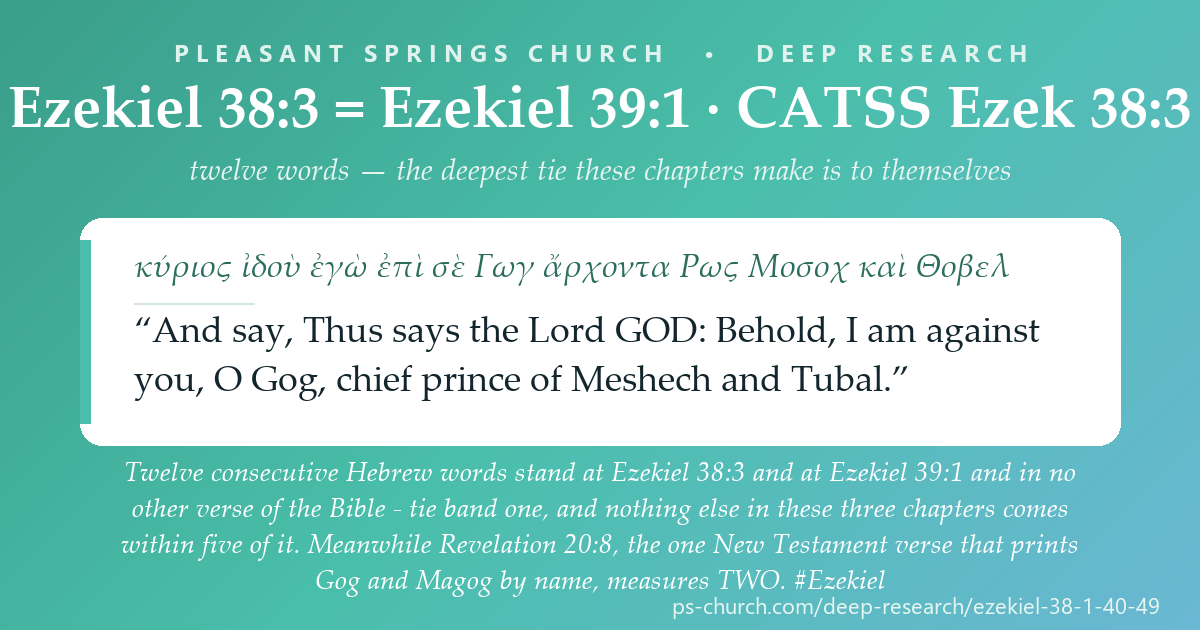
Three chapters, a hundred and one verses: a king from the uttermost north with hooks in his jaws; seven years of burning weapons and seven months of burying bones in a valley renamed after him; birds and beasts invited to a sacrifice made of soldiers; and then, without warning, a date, a very high mountain, and a man whose appearance was like bronze holding a linen cord and a measuring reed. These are the chapters everyone reads through Revelation. Measured, the deepest verbatim tie they make is to themselves. Twelve consecutive Hebrew words stand at Ezekiel 38:3 and at Ezekiel 39:1 and in no other verse of the 23,204-unit Masoretic corpus, tie band one — and say, Thus says the Lord GOD: Behold, I am against you, O Gog, chief prince of Meshech and Tubal. Nothing else in these three chapters comes within five of it. Meanwhile every place the New Testament visibly reaches for this material measures at or below two. Revelation 20:8, which prints both names, measures TWO against Ezekiel 38:2. Revelation 19:17–21, the supper for the birds, measures TWO against Ezekiel 39:17–20. Revelation 11:1 and Revelation 21:15, the two measuring reeds, measure ONE against Ezekiel 40:3. Revelation 21:10, the seer carried to a great high mountain and shown a city, measures ONE against Ezekiel 40:2. For calibration this page also prints what a citation looks like: Acts 2:17 against the Greek of Joel 3:1 measures NINETEEN. See the method →
Ezekiel 38:1–40:49 — sixteen rows across all three chapters (⚠️ ONE OFFSET IN THIS PASSAGE — THE GREEK HAS NO 40:30. Ezekiel 38 holds 23 verses in the Masoretic text and 23 in the CATSS Greek; Ezekiel 39 holds 29 and 29. Ezekiel 40 holds 49 in the Hebrew and 48 in the Greek: there is no 40:30 in the Greek file on this disk, and the numbering does not shift — the Greek's 40:31 is the Hebrew's 40:31. Every reference on this page is the same number in all three columns.)
Hebrew (Masoretic) · Greek (CATSS/Rahlfs) · ESVThe Shape of the Passage
Sequence — eight oracle units opened by seven messenger formulas, then a vision with noneNothing on this page settles when Ezekiel 38–40 reached the form it has, or in what order. The Gog oracles are the most-disputed block in the book, and the dispute has a documentary edge: the oldest substantial Greek witness, Papyrus 967, carries chapters 38–39 in a different place from the Masoretic text. That papyrus was not consulted for this page and nothing here should be read as an argument about it. What follows is measurement of the two texts on this disk.
Author
The most measurable thing about this author is that he repeats himself on purpose. The twelve-word run at 38:3 and 39:1 is not a stock phrase that happens to occur twice. Its first five words are ואמרת plus the messenger formula כה אמר אדני יהוה, which stands in 122 verses of Ezekiel — but the last seven are content: a name, a title and two peoples that occur together in only three verses of the Bible, and all three are in this passage — 38:2, 38:3 and 39:1. The author opened the same oracle twice with the same sentence, and the measurement can see him doing it.
He is the recognition-formula writer. וידעו כי אני יהוה — and they shall know that I am the LORD — stands in 29 verses of the whole Hebrew Bible: 28 in Ezekiel and one in Exodus (29:46). Three of the 28 are in this passage, at 38:23, 39:6 and 39:28. The point of the Gog oracle, stated in its own vocabulary, is not the destruction of an army. It is that a watching world learns a name.
And he is a priest, which is why chapter 40 reads like a survey. וַיָּמָד, and he measured, stands in 22 verses of the Hebrew Bible; 21 are Ezekiel and 13 of those are chapter 40. The Greek noun κάλαμος stands 29 times across the 30,348 screened verse units of the Greek Old Testament held here and 18 of the 29 are Ezekiel 40–42, eleven of them in chapter 40 alone. The man never explains the building. He only ever gives its dimensions.
Audience
The audience is dated twice, and the second date is the louder one. 40:1 is the twenty-fifth year of the exile and the fourteenth year after the city was struck down. These people have been in Babylon a quarter of a century and their temple has been rubble for fourteen years. Into that, a man with a ruler measures a building none of them will see, in cubits, to the handbreadth. The vision does not argue that the house will be rebuilt. It hands them its measurements.
And the enemy in chapters 38–39 is deliberately not their enemy. Babylon is not named. Gog comes from יַרְכְּתֵי צָפוֹן, the uttermost parts of the north, with Persia, Cush and Put; Sheba, Dedan and the merchants of Tarshish stand off and ask whether he has come for plunder. The four names of 38:2 — Gog, Magog, Meshech, Tubal — are, apart from Gog himself, Table-of-Nations names: Magog, Meshech and Tubal are all sons of Japheth at Genesis 10:2. The audience is being shown an enemy assembled out of the map of the world rather than out of their own century.
Then the address changes hands. בן אדם, son of man, occurs five times in this passage: 38:2, 38:14, 39:1, 39:17 and 40:4. The first four are God speaking. The fifth is the man with the measuring reed. And the man said to me, Son of man, look with your eyes, and hear with your ears, and set your heart upon all that I shall show you. The audience that has spent two chapters being told what God will do to an army is now told to pay attention to a floor plan.
Find out what the names and objects in these chapters are already known to mean — and, more usefully, find the places where the reference works say plainly that nobody knows.
A dictionary gives the range of a word and the state of the consensus. It does not tell you what this text does with either, and it will not tell you where two of your columns disagree. Stage 1 collects the open questions; stages 3 and 4 test them against the files on this disk.
Who or what is Gog?
The reference works do not agree, and the better ones say so. The three standing proposals are: (1) Gyges of Lydia, whose name appears in Assyrian records as Gugu; (2) a symbolic figure built out of the Table of Nations rather than out of history; (3) a title rather than a person, on the analogy of Pharaoh. None of the three can be tested from the corpora on this disk and this page does not pick one.
What can be tested is where the name stands. גוג stands in nine verses of the Masoretic corpus — eight of them in Ezekiel (38:2, 38:3, 38:14, 38:16, 38:18, 39:1, 39:11 and 39:15), plus 1 Chronicles 5:4, where Gog is a Reubenite in a genealogy and has nothing to do with any of this. That is twelve occurrences in all, because 39:1 has the name twice and 39:11 has it three times. מגוג occurs in four verses: Genesis 10:2, 1 Chronicles 1:5, Ezekiel 38:2 and Ezekiel 39:6. In the Hebrew Bible, Magog is a son of Japheth and Gog is a person in Ezekiel. Stage 3 shows what happens to that tidy picture in Greek.
Chief prince, or prince of Rosh?
This is the single best-known lexical dispute in the passage and it is visible in the codex above. The Hebrew of 38:2, 38:3 and 39:1 reads נְשִׂיא רֹאשׁ מֶשֶׁךְ וְתֻבָל. רֹאשׁ is the ordinary word for a head or a chief, and the ESV, the KJV, the NIV and most English versions take it that way: chief prince of Meshech and Tubal.
The CATSS Greek does not. It reads ἄρχοντα Ρως Μοσοχ καὶ Θοβελ — ruler of Rhos, Meshech and Tubal — treating the consonants as a proper name. Every modern identification of ‘Rosh’ with Russia depends on the Greek reading, not the English one, and the Greek reading is a reading of the same three consonants. This page prints both columns, names the choice, and does not decide it. No manuscript apparatus was consulted.
Meshech, Tubal, Gomer, Beth-togarmah — and Persia, Cush and Put.
Two lists, and they are not the same kind of list. Meshech and Tubal are usually identified with the Anatolian peoples the Assyrians called Mushki and Tabal; Gomer with the Cimmerians; Beth-togarmah with a place in eastern Anatolia. All four are also names in the Table of Nations at Genesis 10:2–3. Persia, Cush and Put at 38:5 are not from Japheth's line at all — they are from the south and east.
The measurable observation is about pairing, not identity. כוש ופוט, Cush and Put, is a two-word run that stands in three verses of the Hebrew Bible — here, Jeremiah 46:9 and Ezekiel 30:5 — and in the other two the subject is Egypt's army. Ezekiel 38 is assembling an enemy out of the extremes of a known map, and the run screen shows the pieces coming from ordinary places.
What is a measuring reed, and what is a long cubit?
40:5 defines its own unit and the dictionaries mostly just repeat it. The reed is six cubits, each being a cubit and a handbreadth — the so-called long or royal cubit, about 52 centimetres against the ordinary 45. The verse is not describing a known standard; it is telling the reader which of two standards to use.
The man himself is left undescribed. The Hebrew says only אִישׁ, a man, whose appearance was like bronze. He is not called an angel, and the text never names him. The dictionaries that call him an angel are importing Revelation 21:15 backwards, which stage 4 measures.
Hamon-gog, Hamonah, and the Valley of the Travelers.
Three place-names invented in eight verses, and none of them exists anywhere else. גֵּיא הֲמוֹן גּוֹג, the valley of the horde of Gog, at 39:11 and 39:15; and הֲמוֹנָה, Hamonah, a city name at 39:16. The passage is naming a graveyard after the thing buried in it.
The Greek does not keep the names as names. At 39:11 CATSS reads τὸ γαι τὸ πολυάνδριον τοῦ Γωγ — the Hebrew word for valley carried over untranslated, then glossed as a mass grave. πολυάνδριον is a real Greek word for a common burial ground; γαι is not Greek at all.
Put the chapters back among the documents their first readers had — Assyrian royal annals, Mesopotamian temple-building texts, and the Second Temple literature that took Gog and the measured city and ran with them.
Stage 2 is where a page is most tempted to overreach, because the comparanda are vivid and not on this disk. Everything in this section that could not be measured is marked as not measured. The rule for this shelf is that a parallel we cannot screen is reported as a parallel someone else asserted, never as a finding of ours.
Gugu of Lydia in the annals of Ashurbanipal.
Ashurbanipal's annals record a king of Lydia named Gugu — the Gyges of Herodotus — who sent envoys to Nineveh, later switched his allegiance to Egypt, and was killed when the Cimmerians overran his land. This is the strongest historical candidate for the name and it is genuinely attractive: a far-northern king, remembered for being destroyed by a horde out of the north.
⚠️ NOT VERIFIABLE FROM LOCAL CORPORA. No Assyrian royal inscription is held on this disk. The identification is reported here because the reference literature reports it; nothing on this page tests it, and the resemblance of a name is not a measurement.
A god, a seer and a measured house: the Mesopotamian temple-vision pattern.
The Gudea cylinders from Lagash, some centuries before Ezekiel, describe a ruler given a vision of a temple: a figure appears, the plan is shown, dimensions are given, and the building is then constructed to those dimensions. The pattern — vision, guide, plan, measurements — is a known ancient Near Eastern genre, and Ezekiel 40 fits inside it.
⚠️ NOT VERIFIABLE FROM LOCAL CORPORA. No cuneiform text is held here. What this shelf can add is one internal observation: the tour of Ezekiel 40 is structured by a verb, not by a floor plan. ויביאני, and he brought me, marks 40:17, 40:28, 40:32 and 40:35, and its defective spelling ויבאני marks 40:48 — five moves — and וימד, and he measured, occurs thirteen times between them.
The New Jerusalem text from Qumran — the closest known parallel, and one we cannot screen.
Among the Dead Sea Scrolls is a composition known as the New Jerusalem text (surviving in copies catalogued 1Q32, 2Q24, 4Q554–555, 5Q15 and 11Q18), written in Aramaic. In it a seer is led round an enormous city by a guide with a measuring reed, and the dimensions are recited street by street. It is, on any account, standing between Ezekiel 40–48 and Revelation 21.
⚠️ NOT VERIFIABLE FROM LOCAL CORPORA. This is the single biggest hole in this page. No Qumran text of any kind is held on this disk. The New Jerusalem text cannot be screened against either Ezekiel or Revelation here, which means the one Second Temple document most likely to explain the relationship this page keeps failing to measure is the one document the page cannot open. A future pass with an Aramaic Qumran corpus would be worth more than anything in stage 4 below.
Gog in the literature between the Testaments.
Gog and Magog travel. They appear in the Sibylline Oracles, in rabbinic material about the war of Gog and Magog preceding the age to come, in the Targums, and later in the Alexander Romance tradition where they become nations shut behind a wall. By the time Revelation 20:8 prints the two names side by side as τὸν Γὼγ καὶ Μαγώγ, both had a long career behind them.
⚠️ NOT VERIFIABLE FROM LOCAL CORPORA for the Sibyllines, the Targums and the rabbinic material, none of which is held here. What IS measurable is the shape of the pair. In the Hebrew Bible, Gog and Magog never form a pair of nations: Magog is a land or a person of Japheth's line and Gog is a ruler. Revelation 20:8 is the first place in the corpora held here where the two are two peoples. That is an observation about usage, not a claim about who changed it.
Why the birds matter: the sacrifice that is a battlefield.
39:17–20 does something no other ancient battle text on this shelf does: it calls the corpses a sacrifice and invites the scavengers as guests. Assemble and come, gather from all around to the sacrificial feast that I am preparing for you. The birds and beasts are not described as desecrating the dead; they are described as eating at a table.
The nearest Hebrew comparison the screen finds is Isaiah 34:6, which shares two words with 39:18, tie band one: כרים ועתודים, lambs and goats. Isaiah 34 is also a sacrifice-as-slaughter oracle. Two consecutive words is all the contact there is.
Six words, each measured across a named corpus, and each printed with the number of places it actually stands.
A word study on this shelf is a count, not an impression. Every figure below names its corpus: 23,204 verse units for the Masoretic text, 30,348 for the Greek Old Testament (all 64 CATSS files held here with the Odes excluded), and 7,927 for the Greek New Testament. Where a count differs between the Hebrew and the Greek, both are given.
Nine verses in the Masoretic corpus — eight in Ezekiel 38–39 and one Reubenite at 1 Chronicles 5:4. FOURTEEN occurrences in the Greek across eleven verses, and two of the fourteen are outside Ezekiel at places where the Hebrew has no Gog at all. See the box below; this is the page's second finding.
One set of consonants read as a common noun by the English tradition and as a proper name by the Greek, three times over, at 38:2, 38:3 and 39:1. The page prints both and adjudicates neither.
Two verses in the whole Hebrew Bible: Judges 9:37 and Ezekiel 38:12. The Greek matches it with ὀμφαλός in both, and that Greek noun stands in five places across the 30,348 screened verse units of the Greek Old Testament held here. The ESV writes center of the earth.
At 39:18 and 39:20 the Hebrew's warriors become the Greek's giants. γίγας occurs 42 times in the screened Greek Old Testament; two of the 42 are Genesis 6:4 and six are Ezekiel.
The Greek noun κάλαμος stands 29 times across the screened Greek Old Testament and 18 of the 29 are Ezekiel 40–42 — eleven in chapter 40 alone. In the Greek New Testament there are 13 καλαμ– forms and exactly three are measuring reeds: Revelation 11:1, 21:15 and 21:16.
At 39:29 the Hebrew pours out God's Spirit and the CATSS Greek pours out God's wrath. The last verse before the temple vision, and the two columns are not saying the same thing.
The finding: in the Greek, Gog gets out of Ezekiel.
Screened across all 64 CATSS files held on this disk — 30,348 verse units with the Odes excluded — Γωγ stands fourteen times, across eleven verses. Twelve of the fourteen are in Ezekiel 38–39, in nine verses. The other two are Numbers 24:7 and Amos 7:1, and in neither of those verses does the Masoretic Hebrew have Gog.
Numbers 24:7. The Greek reads ὑψωθήσεται ἢ Γωγ βασιλεία αὐτοῦ — his kingdom shall be exalted higher than Gog. The Hebrew reads וְיָרֹם מֵאֲגַג מַלְכּוֹ — his king shall be higher than Agag, the Amalekite king of 1 Samuel 15.
Amos 7:1. The Greek reads καὶ ἰδοὺ βροῦχος εἷς Γωγ ὁ βασιλεύς — and behold, one locust: Gog the king. The Hebrew reads וְהִנֵּה־לֶקֶשׁ אַחַר גִּזֵּי הַמֶּלֶךְ — and behold, the latter growth after the king's mowings. There is no proper name in the Hebrew at all.
What the two Greek verses have in common is kingship. In one Gog is the standard a kingdom is measured against; in the other Gog is the king. This page states the difference between the columns and stops there. It does not say the translator misread אגג, it does not say the Greek had a different Hebrew in front of it, and it does not say which text is older. Those are manuscript questions and no manuscript was collated here. What can be said is that a reader of the Greek Old Testament met the name Gog in three books, and a reader of the Hebrew met it in one.
Magog does not travel with him.
The counter-check matters, so print it. Μαγωγ stands in exactly three places in the screened Greek corpus — Genesis 10:2, 1 Chronicles 1:5 and Ezekiel 38:2 — and מגוג stands in four in the Hebrew: those three plus Ezekiel 39:6, where the Greek has Gog instead. Apart from that one verse the two corpora agree about Magog exactly.
So the spread is Gog's alone. That asymmetry is worth more than the raw count: if the Greek Old Testament simply liked apocalyptic names, both would have spread. Only one did, and it spread into two verses about kings.
One phrase that occurs once in the whole Hebrew Bible.
בְּרֹאשׁ הַשָּׁנָה — at the head of the year — stands in exactly one verse of the 23,204-unit Masoretic corpus, and it is Ezekiel 40:1. The phrase later became the name of the Jewish new year; here it is a date on a vision.
The Greek column does not have it. CATSS reads ἐν τῷ πρώτῳ μηνί, in the first month. A reader of the Hebrew is given a festival; a reader of the Greek is given a calendar. Whether that is interpretation or a different Hebrew text is a manuscript question, and no manuscript was consulted.
Every figure in this section was produced by an exhaustive, deterministic screen over named corpora on 31 August 2026. Nothing was sampled and nothing was copied from another page.
Two screens run here. The Hebrew screen puts each of the 101 Masoretic verses of Ezekiel 38–40 against every Masoretic verse unit outside its own chapter — 23,181 units for chapter 38, 23,175 for chapter 39 and 23,155 for chapter 40 — and reports the longest run of consecutive word forms, with a tie band — how many other verses reach the same depth. It runs with the unigram fallback OFF, so a reported 0 means the verse shares no two consecutive words with anywhere. The Greek screen puts each of the 100 CATSS rows against all 7,927 verses of the Greek New Testament, with the fallback ON, so a reported 1 there means isolated shared words and no adjacent pair. A run measures verbatim contact. It does not measure allusion, and this page is mostly a demonstration of the difference.
The deepest run in the passage, and its distance from everything else.
Ezekiel 38:3 against Ezekiel 39:1: TWELVE consecutive Hebrew words, tie band ONE.
ואמרת כה אמר אדני יהוה הנני אליך גוג נשיא ראש משך ותבל
And say, Thus says the Lord GOD: Behold, I am against you, O Gog, chief prince of Meshech and Tubal. Those twelve words in that order stand in two verses of the Hebrew Bible and nowhere else.
The gap below it is the point. The next-deepest run in the passage is seven (39:17 into Ezekiel 7:2, tie band one — and all seven of those words are the commission and messenger formulas). Then two at six, and nine more at five. Nothing in these chapters sits between seven and twelve. The twelve is not the top of a gradient. It is a separate object.
The Greek keeps eleven of it. CATSS 38:3 against CATSS 39:1 measures eleven — κύριος ἰδοὺ ἐγὼ ἐπὶ σὲ Γωγ ἄρχοντα Ρως Μοσοχ καὶ Θοβελ — because CATSS doubles the divine name at 38:3 and not at 39:1. The bracket survives translation; it loses one word to a divine name.
What the Hebrew screen found across all 101 verses.
97 reach two · 57 reach three · 30 reach four · 14 reach five · 5 reach six · 3 reach seven · 2 reach twelve. Nothing reaches thirteen.
Three verses reach nothing at all — 39:3, 40:40 and 40:41 — and a fourth, 39:16, has only a two-word pair whose second token is a scribal section marker rather than a word. Remember what zero means on this screen: no two consecutive words, not no words — and remember that the screen excludes the row's own chapter. Only 39:3 is a zero against the whole Hebrew Bible. 39:3 is I will strike your bow from your left hand; every noun in it is common and no other verse in the Hebrew Bible ever puts two of them side by side. 40:40 and 40:41 are zeros only against everything outside chapter 40: 40:40 shares three consecutive words with 40:39, and 40:41 shares two with 40:39 and with 40:42.
Now the fourteen fives, sorted by what they actually are:
Ten are standing formulas. 38:1 the word-event formula (band 46 — ויהי דבר יהוה אלי לאמר stands in 47 verses of the Hebrew Bible: 39 in Ezekiel, 6 in Jeremiah, 2 in Zechariah and nowhere else); 38:2 the commission formula (band 5, every partner in Ezekiel); 39:5, 39:8 and 39:29 the declaration formula; 39:6, 39:7 and 39:28 the recognition formula; 39:17 the commission plus messenger formula; 39:25 the messenger formula (band 29).
One is the temple's own vocabulary. 40:22 into 42:15, tie band one — השער אשר פניו דרך הקדים, the gate facing east. Ezekiel measuring the same gate twice.
One is an accident, and the page prints it deliberately. 38:20 into Numbers 12:3, tie band one: האדם אשר על פני האדמה, the people who were on the face of the earth. Numbers 12:3 is Now the man Moses was very meek, more than all people who were on the face of the earth. Five identical words, one tie, and no relationship of any kind. If this page did not print its own accidents, its twelve would not be worth anything.
The remaining two are 38:3 and 39:1.
What the Greek screen found against the New Testament.
Across the 100 CATSS rows against 7,927 verses of the Greek New Testament: 99 reach two, 73 reach three, 24 reach four, 4 reach five, and NOTHING reaches six.
The four fives, with their bands:
- 38:17 — ἐν ταῖς ἡμέραις ἐκείναις καί, band 2, into Luke 4:2 and Acts 7:41. A calendar phrase. It sits, with some irony, in the one verse of the passage that claims earlier prophets said all this.
- 38:20 — καὶ τὰ πετεινὰ τοῦ οὐρανοῦ, band 6, into Matthew 8:20, Matthew 13:32, Luke 8:5, Luke 9:58, Luke 13:19 and Acts 11:6. Birds, at the wrong verse.
- 39:7 — καὶ τὸ ὄνομά μου τό, band 1, into Revelation 3:12. Ezekiel: God's holy name made known in Israel. Revelation: the new name written on the one who conquers. Four words of overlap and one coincidence.
- 40:3 — καὶ ἐν τῇ χειρὶ αὐτοῦ, band 1, into Revelation 14:14. Ezekiel: a measuring reed in his hand. Revelation: a sharp sickle in his hand. The deepest tie chapter 40 makes to the New Testament is to the wrong implement.
Two of the four deepest Greek runs in these chapters land in Revelation, both with tie band one, and neither of them is where Revelation is actually looking.
The counter-examples: every place Revelation visibly uses this material.
This is the section that decides what the page is allowed to claim. Each figure below is a direct verse-against-verse run on the Greek.
- Revelation 20:8 against Ezekiel 38:2 — TWO. Γωγ καί. Revelation 20:8 is the only verse in the Greek New Testament containing either name, and it contains both. The clearest use of Ezekiel 38–39 anywhere in the New Testament is a run of two. Against 39:1 and 39:6 it is also two.
- Revelation 19:17–21 against Ezekiel 39:17–20 — TWO at best. All twenty pairings were measured. Four reach two — πάντα τά, καὶ πάντα, καὶ οἱ and τῆς γῆς — and the other sixteen are one. The supper of the birds is unmistakably the same scene in both texts and the vocabulary barely touches — Revelation says ὄρνεον, a noun that stands in three verses of the Greek New Testament and all three are Revelation (18:2, 19:17, 19:21); Ezekiel's Greek says ὀρνέῳ πετεινῷ.
- Revelation 11:1 against Ezekiel 40:3 — ONE. John is given a reed like a staff and told to measure the temple. One shared word, and the word is καί.
- Revelation 21:15 against Ezekiel 40:3 — ONE. Revelation 21:16 — TWO. The angel with the golden measuring reed measuring a city.
- Revelation 21:10 against Ezekiel 40:2 — ONE. He carried me away in the Spirit to a great, high mountain, and showed me the holy city. Ezekiel 40:2: he set me down on a very high mountain, on which was a structure like a city. Same event, same order of elements, one shared word.
- Revelation 20:10 against Ezekiel 38:22 — ONE. Fire and sulphur in both.
- Acts 2:17 against Ezekiel 39:29 — TWO. And it could hardly be more, because the CATSS Ezekiel 39:29 pours out wrath, not Spirit.
Now the calibration, and it is the most important number on this page. Acts 2:17 against the Greek of Joel 3:1 — Joel 2:28 in English — measures NINETEEN consecutive words. ἐκχεῶ ἀπὸ τοῦ πνεύματός μου ἐπὶ πᾶσαν σάρκα καὶ προφητεύσουσιν οἱ υἱοὶ ὑμῶν καὶ αἱ θυγατέρες ὑμῶν καὶ οἱ…
That is what it looks like when a New Testament writer is quoting the Greek Old Testament. Nineteen. Not two, not one. Every figure in the list above should be read against that number, and the honest conclusion is the uncomfortable one: Revelation's use of Ezekiel 38–40 is real, obvious to any reader, and completely invisible to a word-run screen. The measurement cannot see it, and this page will not pretend that the measurement's silence is evidence of anything except the limits of the measurement.
Where the passage does connect: inside its own book.
Almost every deep Hebrew run in these chapters has an Ezekiel partner. Of the fourteen rows reaching five, eleven have Ezekiel as their nearest partner; the exceptions are 38:1 (Jeremiah, band 46), 38:20 (Numbers 12:3, the accident) and 39:25 (Isaiah and Jeremiah, band 29 — the messenger formula).
Four are worth naming.
- 40:1 into 37:1, four words, tie band one — היתה עלי יד יהוה, the hand of the LORD was upon me. The temple vision opens with the same four words as the valley of dry bones.
- 38:9 into 39:4, four words, tie band one — אתה וכל אגפיך ועמים, you and all your hordes and the peoples. The muster and the fall use the same line.
- 39:17 into 7:2, seven words, tie band one — the second-deepest run in the passage, and it is entirely formula.
- 40:22, 40:30, 40:33 and 40:36 into 42:15 and 42:20, tie band one each — the surveyor's own repeated phrases, two chapters apart.
Read together with the twelve, this is the finding: Ezekiel 38–40 is in verbatim conversation with Ezekiel and with very little else. That is a statement about vocabulary. It is not a statement about authorship, and it is not a statement about date.
What the literature argues, what this page did not consult, what it could not check, and where it is weakest.
Stage 5 exists so that a reader can tell how far to trust the rest. The rule on this shelf is that the limits section is written before the conclusions and never thinned. Everything below is a limit on this page, not a summary of somebody else's book.
What was NOT consulted.
No critical apparatus was consulted for the Hebrew. The Hebrew column is Sefaria's Miqra according to the Masorah, a diplomatic text. Where this page reports a difference between the Hebrew and the Greek, it is reporting a difference between two printed editions on one hard disk.
No Dead Sea Scroll was collated. There are Ezekiel fragments from Qumran and Masada; none is held here.
⚠️ Papyrus 967 was not consulted, and for THIS passage that matters more than for any other page on this shelf. Papyrus 967 is the oldest substantial Greek witness to Ezekiel, and it is famous precisely because it arranges these chapters differently — the Gog material does not sit where the Masoretic text puts it, and it also lacks a block of chapter 36. Every statement on this page about the order of Ezekiel 38–40 is a statement about the Masoretic order and the CATSS order only. A page about Gog that has not opened 967 has not opened the main file.
No Qumran Aramaic was screened, which means the New Jerusalem text — a seer led round a measured city by a man with a reed — could not be compared with either Ezekiel 40 or Revelation 21. Stage 2 calls this the biggest hole in the page and stage 5 repeats it.
No Assyrian, Babylonian or Sumerian text is held here, so the Gugu-of-Lydia identification and the Gudea temple-vision parallel are both reported second-hand and neither was tested.
What the ESV column is, and is not.
⚠️ The ESV column on this page was NOT verified against a held ESV text. There is no ESV file for Ezekiel on this disk and no Crossway API key in this project. The English was typed; its alignment to the Hebrew and Greek rows rests on verse numbering alone. The Hebrew and Greek columns were pulled programmatically from the corpus files and are exactly what those files hold. If a word of the English column is wrong, it is wrong here and not in the ESV.
There is no second English column. The English is the ESV until the church's own translation is far enough along to take its place.
What the measurement cannot do, stated plainly.
1. It cannot see allusion. This page is the strongest demonstration of that on the shelf. Revelation 20:8 names Gog and Magog; Revelation 19:17–21 stages Ezekiel 39's bird-supper scene by scene; Revelation 11:1 and 21:15 hand a seer a measuring reed. Every one of those measures one or two. Nobody should read this page as an argument that Revelation is not using Ezekiel. It plainly is. The measurement simply cannot see it, and the page reports the blindness rather than hiding it.
2. It cannot assign direction. Nothing here says Ezekiel is prior to anything or posterior to anything, and nothing says a Greek reading is early or late. When the Greek reads Γωγ at Numbers 24:7 where the Hebrew reads אגג, this page says the columns differ. It does not say the translator misread, and it does not say the Hebrew was later corrected. Both are conclusions that require manuscripts nobody here has opened.
3. It cannot settle the composition question. Whether the Gog oracles are original to the book, whether 38:17 (are you he of whom I spoke in former days?) is a later editor's cross-reference, and whether chapters 40–48 came from Ezekiel or a school — the literature argues all three at length and no run screen touches any of them.
4. The tie band is doing more work than the run length. A run of five with a band of 46 is a formula everybody used. A run of five with a band of one may be a signal or may be Numbers 12:3. Depth alone proves nothing, which is why every figure on this page carries its band.
Where this page is weakest.
The weakest claim on this page is the Gog-in-the-Greek finding. Two verses is a small sample. Numbers 24:7 and Amos 7:1 are both places where the Greek and the Hebrew differ in more ways than the name, and a fuller treatment would have to work through the whole verse in each case rather than the one word. What the page can defend is the count — fourteen Greek Gogs, twelve of them in Ezekiel, two elsewhere, and no Hebrew Gog at either of the two. Any explanation of that count is somebody else's argument, not this page's measurement.
The second weakest is the structure diagram's chapter-40 half. The oracle units in 38–39 are marked by a formula that can be counted. The divisions inside chapter 40 are marked by and he brought me, which is a weaker marker: it can indicate a new section or simply another step on the same tour. The diagram says so, and the reader should discount it accordingly.
The third is the ESV column, for the reason given above.
- Daniel I. Block, The Book of Ezekiel (NICOT), on chapters 38–39 and the Gog oracles as a literary unit.
- Walther Zimmerli, Ezekiel (Hermeneia), on the growth of the Gog material and on the temple vision.
- Moshe Greenberg, Ezekiel 1–20 and Ezekiel 21–37 (Anchor Bible 22, 22A), on the Hebrew of Ezekiel — the two volumes stop at chapter 37 and do not reach this passage.
- Johan Lust and Emanuel Tov, on the Greek Ezekiel and the arrangement of Papyrus 967.
- Sverre Bøe, Gog and Magog: Ezekiel 38–39 as Pre-text for Revelation 19,17–21 and 20,7–10 — the standing monograph on exactly the relationship this page failed to measure.
- Michael Lyons and others on Ezekiel's internal reuse of its own language.
- The New Jerusalem text (1Q32, 2Q24, 4Q554–555, 5Q15, 11Q18) — named here because it is the parallel this page could not open.
The last stage of the method is not private. Take one measured thing to somebody and let them push back on it.
Heiser's sixth stage is the check on the other five. A finding that has never been said out loud to somebody who might disagree has not been tested.
Three things from this page worth saying out loud.
1. “The deepest verbal tie in the Gog chapters is to themselves.” Twelve words, twice, tie band one, and nothing else within five. Ask whoever you are talking to what they think a writer is doing when he opens the same oracle twice with the same sentence.
2. “Revelation is obviously using Ezekiel 38–40, and the measurement cannot see it.” Revelation 20:8 measures two; Acts 2:17 against Greek Joel measures nineteen. That is a good place to talk about what evidence is, and about what it means when a tool you trust returns nothing.
3. “In Greek, Gog is in three books. In Hebrew he is in one.” Numbers 24:7 and Amos 7:1 both read Gog in the Greek and neither reads Gog in the Hebrew. Say the fact; resist the explanation.
“And the man said to me, ‘Son of man, look with your eyes, and hear with your ears, and set your heart upon all that I shall show you, for you were brought here in order that I might show it to you. Declare all that you see to the house of Israel.’”Ezekiel 40:4 (ESV) — the one place in this passage where son of man is not God speaking
A last observation, offered as an observation.
The passage ends the war and starts the survey in consecutive verses, and three separate formulas stop at the boundary. Thus says the Lord GOD appears seven times in chapters 38–39 and not once in chapter 40. On that day appears five times and then stops. And they shall know that I am the LORD appears three times and then stops. What begins at 40:1 instead is a date, a hand, a mountain, a man, and a ruler.
What that means is a matter for a congregation and not for a screen. The measurement's contribution is only this: the change of register at 40:1 is not a reader's impression. It is three countable formulas ending at the same verse.
Every Deep Research page traces its passage across the whole sweep — the Old Testament, the Second-Temple world between the testaments (historical witnesses, not Scripture), and the New Testament. Follow the thread:
Pleasant Springs Church — Deep Research
Research method after Michael S. Heiser’s Bible Research Method (examine dictionaries → ancient literature → important words → textual connections → academic publications → share), with the Pleasant Springs “Author & Audience” foundation. Scripture set in the Hebrew, the Greek editions named on each page and the ESV (Old Testament), and the Greek New Testament and the ESV (New Testament), per the practice of Pleasant Springs Church. Ezekiel research grounded in Block (NICOT) and Zimmerli (Hermeneia), and in Greenberg (Anchor Bible) for the book as a whole — his two Anchor volumes stop at chapter 37 and do not cover this passage; on the Gog oracles in Bøe; on the Greek text and the arrangement of Papyrus 967 in Lust and Tov. Text: Hebrew from the Masoretic text as printed in the edition consulted — Sefaria’s Miqra according to the Masorah; no critical apparatus was consulted for the Hebrew, no Dead Sea Scroll was collated, no Qumran Aramaic was screened, and Papyrus 967 — the oldest substantial Greek witness to Ezekiel, and the witness that arranges these very chapters differently — was NOT consulted. Greek from Rahlfs’ Septuaginta as digitized by CATSS; Greek New Testament from the SBL edition as digitized by MorphGNT. The standing caution for this shelf applies: these pages say “the CATSS Greek text reads…” and never call a Greek reading early or late, and never say which text acted on which. ⚠️ Verse numbering — there IS one offset in this passage, and it is a gap rather than a shift. The chapter lengths were derived from the files on this disk, not copied from a table. Masoretic Ezekiel 38, 39 and 40 hold 23, 29 and 49 verses; the CATSS Greek holds 23, 29 and 48. The missing Greek row is 40:30: there is no such verse in the Greek file, and the numbering does not shift — the Greek’s 40:31 is the Hebrew’s 40:31, and every reference on this page is the same number in all three columns. Across the whole book the Masoretic text holds 1,273 verse units and the CATSS Greek 1,267; the Greek is one row short in chapters 1, 10, 27, 32, 33 and 40, and chapter 40 is the only one of the six inside this passage. ⚠️ The ESV column was NOT verified against a held ESV text. No ESV file for Ezekiel exists on this disk and no Crossway API key exists in this project; the English was typed and its verse alignment rests on verse numbering. The Hebrew and Greek columns were pulled programmatically from the corpus files. There is no second English column on this shelf. ⚠️ Every cross-corpus run figure on this page was measured on 31 August 2026 and applies MorphGNT’s own spelling equivalences — οὐ/οὐκ/οὐχ, ἐκ/ἐξ and the movable nu — so that a shared run is not cut at a word the two editions merely spell differently. Figures published on this shelf before 30 August 2026 are lower for that reason; nothing was copied from a sibling page and every number above was re-measured. ⚠️ A run of zero on the Hebrew screen means NO TWO CONSECUTIVE WORDS. The Hebrew-side screen runs with the unigram fallback off, so max = 0 at 39:3, 40:40 and 40:41 means those three verses share no adjacent word pair with any Masoretic verse unit outside their own chapter — not that they share no words at all. The screen excludes each row's own chapter, so only 39:3 is a zero against the whole Hebrew Bible; 40:40 shares three consecutive words with 40:39 and 40:41 shares two with 40:39 and 40:42. The Greek-side screen runs with the fallback ON, so a 1 reported on the Greek side — as for Revelation 11:1 against Ezekiel 40:3 — means isolated shared words and no adjacent pair. ⚠️ Three reported Hebrew maxima in this passage are inflated by a scribal marker and every figure above is the corrected one. The Masoretic file counts {ס} and {פ} as words. At 39:10, 39:16 and 39:29 the reported run ends on a marker and is one shorter than it looks; the count of verses reaching five is 14 corrected and 14 uncorrected, but 39:29 is a corrected five rather than a six and 39:16 falls to a bare unigram. normalize.py is frozen and was not edited. ⚠️ Greek Old Testament word counts on this page are scoped to all 64 CATSS files held here, 30,637 verse units, screened to 30,348 with the Odes excluded. Two of the Odes are New Testament text — Ode 9 is Luke 1 and Ode 13 is Luke 2 — and ten more are second copies of Exodus 15, Deuteronomy 32, 1 Samuel 2, Habakkuk 3, Isaiah 26, Jonah 2, Daniel 3, Isaiah 5 and Isaiah 38, so leaving them in would inflate any tie band that touched one. The tool’s own scope string names 35 mapped books; the search itself runs over all 64 files, which is why Numbers 24:7 appears in the Gog count above. ⚠️ The New Testament connection this page exists to test is the one it could not find. Revelation is using these chapters; the run screen measures one and two. The page says so in the intro, in stage 4, in stage 5 and here, on purpose. Typology is handled per the house position: what the text says, what the New Testament itself draws, and what we see from this side of the cross — with the seeing left to the reader.
Scripture quotations marked ESV are from the ESV® Bible (The Holy Bible, English Standard Version®), © 2001 by Crossway, a publishing ministry of Good News Publishers. ESV Text Edition: 2016. Used by permission. All rights reserved. The ESV text may not be quoted in any publication made available to the public by a Creative Commons license, and the ESV may not be translated in whole or in part into any other language. www.esv.org
|
Did this study bless you today? 💚 Give to Support PS Church100% of gifts go to the General Fund — thank you. |