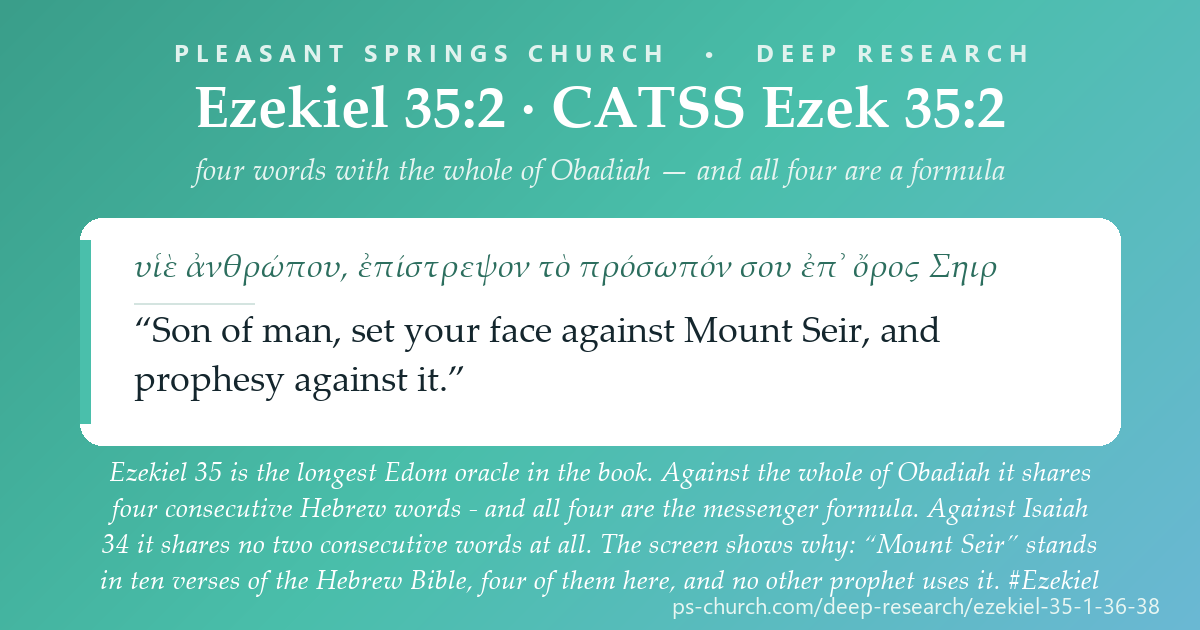
Two chapters, fifty-three verses, two mountains. One is sentenced to perpetual desolation; the other is told to shoot out branches and bear fruit for a people that is coming home. Between them stands a single hinge verse in which the prophet turns his head. The obvious way to read Ezekiel 35 is as one more entry in the Bible’s long file against Edom — Obadiah, Jeremiah 49, Isaiah 34, Amos 1, Psalm 137, Lamentations 4. Measured, it is not. Against the whole of Obadiah, Ezekiel 35 tops out at four consecutive Hebrew words, and the four are the messenger formula. Against Jeremiah 49 it reaches three, and the three are the oracle formula. Against Isaiah 34 — the other long Edom oracle in the prophets — it shares no two consecutive words at all. Against Psalm 137, two, and they are an oath particle. Against Genesis 36, one. And the screen shows why: this chapter is not using their word for the place. The compound Mount Seir stands in ten verses of the Hebrew Bible; four are this chapter and the other six are Deuteronomy, Joshua and 2 Chronicles — itinerary and battle report. No other prophetic book calls Edom that, and this chapter withholds the name ‘Edom’ until its fifteenth and final verse. Meanwhile the chapter next door carries the deepest verbatim repetition in the entire book: thirteen consecutive Hebrew words shared by Ezekiel 36:4 and Ezekiel 6:3, the address that once opened the sentence of doom on the mountains of Israel and now opens their restoration. Ezekiel is not repeating the prophets. Ezekiel is repeating Ezekiel. See the method →
Ezekiel 35:1–36:38 — sixteen rows, seven of them in chapter 35 (⚠️ NO VERSIFICATION OFFSET ANYWHERE IN THIS PASSAGE. Chapter 35 holds fifteen verses in the Masoretic text, fifteen in the CATSS Greek and fifteen in the ESV; chapter 36 holds thirty-eight, thirty-eight and thirty-eight. Every one of the 53 Hebrew verses has a Greek row and every reference on this page is the same number in all three columns. The offsets in Ezekiel are elsewhere — see the footer.)
Hebrew (Masoretic) · Greek (CATSS/Rahlfs) · ESVThe Shape of the Passage
Sequence — two oracles, two mountains, one measured inclusioNothing on this page settles when Ezekiel 35–36 reached the form it has, and one piece of evidence bearing on that question was deliberately not consulted. Papyrus 967 is reported to lack 36:23c–38 and to run the chapters in a different order; it was not collated here, and the Greek column prints Rahlfs, which has the whole chapter. Where the literature argues that 36:23c–38 is a later addition, this page reports the argument and does not join it. See Stage 5.
Author
The most measurable thing about this writer is that he repeats himself on purpose. The whole book was screened for this page — all 48 chapters, all 1,273 Masoretic verse units, against the other 23,000-plus units of the Hebrew Bible. The two deepest rows in Ezekiel are 6:3 and 36:4, thirteen words, tie band one. Then 38:3 and 39:1 at twelve; 14:4 and 14:7 at eleven; 3:17 with 33:7 and 18:6 with 18:15 at ten. Twenty-three pairs in the book reach eight consecutive words or more, and every verse in every one of them is Ezekiel. No verse of this book shares eight consecutive words with anything outside this book — the mountains sentenced and restored, Gog addressed twice, the idols in the heart, the watchman commissioned twice, the temple measured twice. The repetition is internal all the way down.
And the vocabulary is his own. Four phrases in this passage stand in the Hebrew Bible ONLY in Ezekiel: הָרֵי יִשְׂרָאֵל, the mountains of Israel, in fourteen verses, all Ezekiel; שִׂים פָּנֶיךָ, set your face, in nine, all Ezekiel; אֵיבַת עוֹלָם, perpetual enmity, in two, both Ezekiel; and וְיָדְעוּ הַגּוֹיִם כִּי־אֲנִי יְהוָה, and the nations shall know that I am the LORD, in three, all Ezekiel. That is a fact about vocabulary and not about a person. It tells you these chapters belong with the rest of the book; it does not tell you who held the pen or when.
What the text itself claims. The speaker is addressed as בֶּן־אָדָם, son of man, at 35:2 and 36:1 and 36:17, and the words are given to him twice with the word-event formula. Neither chapter carries a date. Ezekiel is the most heavily dated book in the prophets, and these two chapters sit in the undated stretch between the dated notice at 33:21 and the dated vision at 40:1.
Audience
Two addressees, and only one of them can hear. Chapter 35 is spoken to a mountain range in Edom by a prophet sitting in Babylonia. Chapter 36 is spoken to a different mountain range that is equally unable to listen. The audience that can actually hear is the third party: the exiles standing where the prophet is standing. The text says so at 36:22, where the oracle stops addressing hills and turns to בֵּית יִשְׂרָאֵל, the house of Israel, for eleven verses.
And the thing that audience is told is not flattering. The eleven verses that contain the gathering, the clean water, the new heart and the new spirit are bracketed at both ends by the same four words: it is not for your sake. לֹא לְמַעַנְכֶם אֲנִי עֹשֶׂה stands in exactly two verses of the Hebrew Bible and they are the two ends of that bracket. The reason given is the name — שֵׁם קָדְשִׁי, my holy name, which the exiles profaned among the nations simply by being visible there as a people whose God had apparently failed. 36:20 states the slander in the nations’ own words: these are the people of the LORD, and yet they had to go out of his land.
A caution about the third audience. Christian readers arrive at 36:25–27 with John 3 in hand. Measured, John 3:5 shares one Greek word with each of 36:25, 36:26 and 36:27 — καί at 36:25 and 36:27, ἐκ at 36:26. That does not sever the connection; it locates it. The connection is thematic and it is a reading decision, not a run.
Where a reference work would send you, and what this page checked instead of quoting it.
No dictionary or encyclopaedia article is quoted anywhere on this page. The entries are named so a reader can go and check them; every number below was derived from the corpus files on this disk. Where a standard reference claim could not be tested with the tools here, it is marked NOT VERIFIABLE FROM LOCAL CORPORA and left alone.
What is ‘Mount Seir’, and why does Ezekiel call Edom that?
A dictionary will tell you that Seir is the highland spine east of the Arabah, that Genesis identifies it with Esau, and that Edom and Seir are used interchangeably. That last claim is the one this page could test, and the result is sharper than the claim.
The compound הַר שֵׂעִיר stands in TEN verses of the Hebrew Bible. Deuteronomy 1:2, 2:1 and 2:5; Joshua 15:10 and 24:4; 2 Chronicles 20:23; and Ezekiel 35:2, 35:3, 35:7 and 35:15. Four of the ten are this chapter. The other six are itinerary, border list and battle report — not one is prophetic oracle. Obadiah does not use it. Jeremiah 49 does not use it. Isaiah 34 does not use it. Amos 1 does not use it. Isaiah 21:11 says Seir, but not Mount Seir.
And Edom’s own name is rationed. The unprefixed form אֱדוֹם stands in five verses of the whole book of Ezekiel: 25:12, 25:13, 32:29, 35:15 and 36:5, with 25:14 carrying it under a preposition. Chapter 35 runs fourteen verses without it and lands it in the fifteenth. The Greek holds the name back in exactly the same place: CATSS writes Σηιρ at 35:2, 35:3, 35:7 and 35:15 and the name Ιδουμαία only at 35:15, then again at 36:5. Across the whole book the Greek carries that name in five verses — 25:12, 25:13, 25:14, 35:15 and 36:5. At 32:29, where the Hebrew has אֱדוֹם, the CATSS Greek reads Ασσουρ. No manuscript was collated and no direction is asserted.
What is the ‘recognition formula’, and how much of this passage is it?
Every handbook on Ezekiel names it: and you shall know that I am the LORD. Here is what it measures.
Seven of these 53 verses end on it in a form the phrase screen can catch — 35:4 and 35:12 with וְיָדַעְתָּ (8 verses in the Hebrew Bible), 35:9 and 36:11 with וִידַעְתֶּם (26 verses), 35:15 and 36:38 with וְיָדְעוּ (29 verses), and 36:23 with the nations inserted, וְיָדְעוּ הַגּוֹיִם כִּי־אֲנִי יְהוָה, which stands in three verses of the Hebrew Bible and all three are Ezekiel: 36:23, 37:28 and 39:7. An eighth, 36:36, carries the formula with words wedged into it and the phrase screen does not see it — which is exactly the kind of miss a page should declare.
Two of these are the passage’s architecture, not its ornament. 35:15 and 36:38 are the last verses of the two halves and they carry the identical four words. That is the only end-to-end echo in the passage that survives measurement.
What are ‘the mountains of Israel’?
הָרֵי יִשְׂרָאֵל stands fifteen times in the Hebrew Bible, in fourteen verses, all fourteen of them Ezekiel. 6:2, 6:3, 19:9, 33:28, 34:13, 34:14, 35:12, 36:1 (twice), 36:4, 36:8, 38:8, 39:2, 39:4 and 39:17. It is not a geographical term the Bible shares; it is this book’s way of saying ‘the land’. In the Greek Old Testament held here, ὄρη Ισραηλ stands in nine verses and all nine are Ezekiel too — fewer than fifteen because the Greek varies its case and article where the Hebrew does not vary its form.
Watch where the phrase sits in this passage. Its single appearance in chapter 35 is at 35:12, inside a quotation of what Edom said. Its four appearances in chapter 36 are at 36:1 (twice), 36:4 and 36:8, all of them God addressing the mountains directly. The phrase is taken out of one mouth and put in another across the hinge.
What a dictionary would tell you that this page could NOT check.
NOT VERIFIABLE FROM LOCAL CORPORA. The date of Edom’s expansion into the Negev; whether Edom took part in the sack of Jerusalem in 586 or only profited from it; the identification of biblical Seir with any particular archaeological site; the relationship between Edom and the later Idumea of the Hasmonean period. None of these can be measured from a Hebrew and Greek word corpus and none of them is asserted anywhere on this page.
What the two columns show about the world behind them — and a plain list of what was not consulted.
This shelf holds a Masoretic Hebrew corpus, 64 CATSS Greek Old Testament files and the Greek New Testament. It holds no inscriptions, no ostraca, no Akkadian, no Egyptian and no Josephus. Everything below is either measured in those files or explicitly flagged as outside them.
The gloat: one syllable, and the Psalms know it.
הֶאָח is not a word. It is a noise. It stands fifteen times in the Hebrew Bible, in eleven verses. Three of the verses are Ezekiel and all three are somebody gloating over Jerusalem — Ammon at 25:3, Tyre at 26:2, and the unnamed enemy of the mountains at 36:2. Four more are Psalms, and there it is what the mocked man’s enemies say over him: Psalm 35:21 twice, 35:25, 40:16 twice and 70:4 twice, seven of the fifteen occurrences in four verses. The rest are Isaiah 44:16, Jeremiah 36:22 and 36:23, and Job 39:25, where it is the war-horse smelling battle.
The CATSS Greek renders it εὖγε — well done, bravo. A Greek reader of Ezekiel 36:2 hears applause where a Hebrew reader hears a jeer. Both are printed above; neither is corrected.
‘The two nations and the two countries’ — a land claim in a legal voice.
35:10 is the only place in these two chapters where the enemy states a programme rather than an emotion: Judah and Israel, both territories, are to be annexed. The Hebrew counts them twice over — שְׁנֵי הַגּוֹיִם and שְׁתֵּי הָאֲרָצוֹת, two peoples and two lands — and the Greek follows exactly: τὰ δύο ἔθνη καὶ αἱ δύο χῶραι.
And then the sentence is stopped by a clause about presence. וַיהוָה שָׁם הָיָה, and the LORD was there. The two columns disagree on the tense: the Greek καὶ κύριος ἐκεῖ ἐστιν is present. A reader will hear the last two words of the whole book, יְהוָה שָׁמָּה, the LORD is there, at 48:35 — and the reader is doing that, not the screen. The forms differ; the run screen measures nothing between them. Said plainly: this is a resonance, not a measurement, and the page marks it as one.
The vocabulary of the sanctuary, used outside the sanctuary.
The restoration half of this passage borrows the priest’s vocabulary and applies it to a nation. 36:17 compares the defiled land to כְּטֻמְאַת הַנִּדָּה, the ritual impurity of menstruation, rendered κατὰ τὴν ἀκαθαρσίαν τῆς ἀποκαθημένης. 36:25 uses וְזָרַקְתִּי — the verb used for tossing blood against the altar — with water as its object, and the Greek switches to ῥανῶ, the sprinkling verb. 36:38 compares a city full of returned people to צֹאן קָדָשִׁים, a flock of consecrated animals.
The measurable part of that observation. ὕδωρ καθαρόν, clean water, stands in three verses of the 30,348 Greek Old Testament verse units screened here: Ezekiel 36:25, Job 11:15 and Numbers 5:17 — and Numbers 5:17 is the ordeal of the suspected wife. In Hebrew, מַיִם טְהוֹרִים stands in ONE verse of the entire Hebrew Bible, and it is Ezekiel 36:25.
What is NOT being claimed. That Ezekiel was a priest is what the book says at 1:3; the vocabulary above is consistent with it and proves nothing about it. No priestly source theory is assumed, argued or needed for any number on this page.
What was NOT consulted — named so it can be held against this page.
No extra-biblical source of any kind was read for this study. Specifically not consulted: the Idumean ostraca from Khirbet el-Kom and Maresha; the Egyptian references to the Shasu of Seir; the Babylonian Chronicles and the Nabonidus material; the excavation reports from Busayra, Tawilan and Umm el-Biyara; Josephus on Idumea; 1 Esdras 4:45, which blames the Edomites for burning the temple; and the whole of the rabbinic identification of Edom with Rome. Several of those bear directly on how Ezekiel 35 was heard and later re-heard. This page cannot speak to any of them and does not.
Nine words and phrases, each with the number of verses it stands in and the corpus that number was counted over.
Hebrew counts are exhaustive over the 23,204 verse units of the Masoretic corpus held here and match consonantal word FORMS, never lemmas and never roots — so a word carrying a different prefix is a different form and is not counted. Greek counts are exhaustive over the 30,348 CATSS verse units screened (the Odes excluded) and the 7,927 verses of the Greek New Testament.
Ten verses in the Hebrew Bible; four are Ezekiel 35. The other six are Deuteronomy 1:2, 2:1, 2:5; Joshua 15:10, 24:4; 2 Chronicles 20:23. No other prophetic book uses the compound. Greek ὄρος Σηιρ.
Fifteen occurrences in fourteen verses of the Hebrew Bible, and all fourteen are Ezekiel (36:1 has it twice). Greek ὄρη Ισραηλ, nine verses, all Ezekiel. In this passage the phrase crosses from Edom’s mouth at 35:12 into God’s at 36:1.
Nine verses in the Hebrew Bible; all nine Ezekiel — 6:2, 13:17, 21:2, 21:7, 25:2, 28:21, 29:2, 35:2, 38:2. With בֶּן־אָדָם and עַל attached it narrows to two: 29:2 and 35:2. Greek ἐπίστρεψον τὸ πρόσωπόν σου.
Two verses in the Hebrew Bible, both Ezekiel — 25:15 of the Philistines and 35:5 of Edom. Greek ἔχθρα αἰωνία. The charge is duration, not intensity.
Fifteen occurrences in eleven verses of the Hebrew Bible. Three verses in Ezekiel (25:3, 26:2, 36:2), four in the Psalms of the mocked man, plus Isaiah 44:16, Jeremiah 36:22 and 36:23, and Job 39:25 for a war-horse. Greek εὖγε.
One verse in the entire Hebrew Bible: Ezekiel 36:2 — and the count is on the form that stands there, with the וּ attached; unprefixed בָּמוֹת עוֹלָם stands nowhere. בָּמָה is the ordinary word for an illicit high place — the thing Ezekiel 6:3 promised to destroy. The CATSS Greek does not carry the noun at all: ἔρημα αἰώνια.
Eleven occurrences in ten verses of the Hebrew Bible. Three verses are Leviticus (20:3, 22:2, 22:32), one is Amos 2:7, and six are Ezekiel: 20:39, 36:20, 36:21, 39:7, 43:7, 43:8. (36:22 carries it under a preposition and is not one of the ten.) Greek τὸ ὄνομά μου τὸ ἅγιον.
One verse in the entire Hebrew Bible: Ezekiel 36:25 — which is also the one verse in this passage that shares no two consecutive words with any verse outside its own chapter. Greek ὕδωρ καθαρόν, three verses: Ezekiel 36:25, Job 11:15, Numbers 5:17.
Two verses in the Hebrew Bible: Ezekiel 36:35 and Joel 2:3. The Greek renders the same Hebrew differently in each: κῆπος τρυφῆς here — the only occurrence of that pair in the 30,348 Greek verse units screened — and παράδεισος τρυφῆς at Joel 2:3 — and Genesis 3:23 and 3:24 read παραδείσου τῆς τρυφῆς, the same noun under an article. Neither Greek column here says Eden.
Two Greek words worth one paragraph each.
γνώσεσθε ὅτι ἐγώ εἰμι — you shall know that I am. In the Greek Old Testament held here, that four-word sequence stands in exactly three verses, all Ezekiel: 36:11, 37:6 and 37:13. All three continue with κύριος. In the Greek New Testament it stands in exactly one verse, John 8:28, where it does NOT continue with κύριος: then you will know that I am. Four words, tie band one on both sides. The page reports the contact and declines to say what it means. What it will say is that two of the three Greek Old Testament partners are the dry bones — see Ezekiel 37:1–14.
ζῶ ἐγώ λέγει κύριος — as I live, says the Lord. Seventeen verses of the Greek Old Testament, twelve of them Ezekiel, including 35:6 and 35:11 on this page. One verse of the Greek New Testament: Romans 14:11. A screen run from the New Testament side reports a tie band of ONE and makes it look distinctive. It is a band of seventeen looked at from the other end.
Every run, every tie band, and every counter-example this page could find against itself.
Two screens, and they mean different things. The Hebrew screen runs with the unigram fallback OFF and screens each row against every Masoretic verse unit OUTSIDE THE CHAPTER THAT ROW STANDS IN — 23,189 units for a chapter 35 row, 23,166 for a chapter 36 row. A result of 0 means the verse shares no two consecutive words with any of those — not that it shares no words, and not that it shares nothing inside its own chapter. The Greek screen runs with the fallback ON: a 1 means isolated shared words and no adjacent pair. Both find verbatim contact and neither finds allusion. Direction of influence is never asserted.
The thesis, measured: Ezekiel 35 against every other Edom oracle in the Bible.
Each of the fifteen verses of Ezekiel 35 was screened directly against each target passage. The figure is the deepest run any verse of Ezekiel 35 reaches anywhere in that target.
| Ezekiel 35 against… | deepest run | and it is… |
|---|---|---|
| Obadiah (all 21 verses) | 4 | כה אמר אדני יהוה — the messenger formula, which stands in 134 verses of the Hebrew Bible. Best non-formula run: 2. |
| Jeremiah 49 | 3 | נאם אדני יהוה — the oracle formula. |
| Amos 1 | 3 | אמר אדני יהוה — the messenger formula again. |
| Deuteronomy 2 | 3 | את הר שעיר — the place name, and the only non-formula three in the table. |
| Lamentations 4 | 2 | חללי חרב, slain of the sword. |
| Isaiah 34 | 1 | No two consecutive words at all. Isolated words only — and the isolated words include אֱדוֹם, חֶרֶב, עוֹלָם and the divine name. The two longest Edom oracles in the prophets share subject matter and not a single adjacent pair. |
| Psalm 137 | 2 | אִם־לֹא, if not — Ezekiel 35:6 against Psalm 137:6. An oath particle in both, and nothing else. |
| Genesis 36 (Esau and Seir) | 1 | isolated words only, among them the object marker, שֵׂעִיר at 35:2 and אֱדוֹם at 35:15. |
| Ezekiel 25 (the earlier Edom oracle) | 5 | the word-event formula — and this is the deepest figure in the table, inside the same book. |
Read the table as a whole. Every figure above 2 is a standing formula, and the highest figure in it belongs to the book’s own earlier chapter. The Bible’s file against Edom is not a shared text. Whatever holds those passages together, a word-run screen cannot see it, and this page will not pretend otherwise. Compare the Obadiah study, where the overlap with Jeremiah 49 was deep enough to have an edge. Ezekiel 35 has no such edge with anything.
The thirteen, and why it is not this page’s thesis.
Ezekiel 36:4 ↔ Ezekiel 6:3 — thirteen consecutive Hebrew words, tie band one. Nothing anywhere in the book goes deeper. All 48 chapters of Ezekiel were screened for this page, every verse against every other verse of the whole Hebrew Bible. Twenty-three pairs in the book reach eight consecutive words or more, and here is the fact that matters: all forty-two verses standing in those twenty-three pairs are Ezekiel. No verse of Ezekiel shares eight consecutive words with anything outside the book of Ezekiel. The deepest five pairs are 36:4 with 6:3 at thirteen; 38:3 with 39:1 at twelve; 14:4 with 14:7 at eleven; and, at ten, 3:17 with 33:7 and 18:6 with 18:15. Four more pairs reach nine: 7:4 with 7:9, 7:3 with 7:8, 40:33 with 40:36, and 14:6 with 20:30. The mountains, Gog, the idols in the heart, the watchman, the temple measurements — the book’s deepest repetitions are all it repeating itself, and the deepest of them all is the address to the mountains.
Why it is not the thesis here. Because it is already the thesis of the companion study, argued from the judgement side: Ezekiel 6:1–11:25. This page prints it because a study of chapter 36 that omitted the deepest run in the book would be hiding evidence, and because it is the counterweight to the Edom table above: the writer who shares nothing but formula with Obadiah shares thirteen words with himself.
Two details worth the space. The run is not pure formula: six content words (O mountains of Israel, hear the word of the Lord GOD), then the four-word messenger formula, then three more content words (to the mountains and to the hills, to the ravines). And it breaks on a spelling — the fifteenth word of each verse is and to the valleys, written three different ways across 6:3’s ketiv, 6:3’s qere and 36:4. In the Greek, which has no such variation, the same pair runs to SEVENTEEN.
The whole passage against the whole Hebrew Bible: twenty fives, and sixteen of them are formula.
Screened outside its own chapter, each row: 52 of the 53 verses reach two; 42 reach three; 30 reach four; 20 reach five; 9 reach six; 3 reach seven; one reaches thirteen. Let the chapter back in and two figures move and only two: every one of the 53 reaches two, and 33 rather than 30 reach four. The twenty at five or more are the same twenty either way.
The twenty rows at five or more, sorted honestly:
Sixteen are Ezekiel’s own discourse formulas. The word-event formula at 35:1 and 36:16 (band 46 each). The commission formula at 35:2 (band 1). The messenger formula, alone or stacked, at 35:3, 36:2, 36:3, 36:5, 36:6, 36:7, 36:13, 36:22, 36:33 and 36:37 (bands from 1 to 29). The oath formula at 35:6 and 35:11 (band 1 each). The recognition formula at 36:23 (band 2).
Four are content, and all four are in chapter 36. 36:1 — five words into Ezekiel 6:3, band 1. 36:4 — thirteen into Ezekiel 6:3, band 1. 36:26 — five, band 2: לָכֶם לֵב חָדָשׁ וְרוּחַ חֲדָשָׁה into Ezekiel 18:31, and וְרוּחַ חֲדָשָׁה אֶתֵּן בְּקִרְבְּכֶם into Ezekiel 11:19. 36:28 — seven, band 2: וִהְיִיתֶם לִי לְעָם וְאָנֹכִי אֶהְיֶה לָכֶם לֵאלֹהִים, the covenant formula, and both partners are Jeremiah, 11:4 and 30:22. That last is the only run of five or more anywhere in these 53 verses whose partners are outside the book of Ezekiel and are not a formula this book invented.
Chapter 35 has five rows at five or more — 35:1, 35:2, 35:3, 35:6 and 35:11 — and every single one of the five is a formula. The Edom oracle has no content run of five with anywhere in the Bible.
The loneliest verse in the passage is the most famous one.
Ezekiel 36:25 returns 0 — on the screen that excludes its own chapter. Screened against the 23,166 Masoretic verse units outside Ezekiel 36 with the unigram fallback off, it shares no two consecutive words with any of them. It is the only such verse in these two chapters. I will sprinkle clean water on you, and you shall be clean from all your uncleannesses. Say the scope out loud, because inside chapter 36 the verse is not alone: מִכֹּל טֻמְאוֹתֵיכֶם, from all your uncleannesses, stands again four verses later at 36:29, and that single adjacent pair is the whole of 36:25’s contact with the rest of the Hebrew Bible.
Two supporting counts. מַיִם טְהוֹרִים, clean water, stands in one verse of the Hebrew Bible — this one. וְזָרַקְתִּי עֲלֵיכֶם, and I will throw upon you, stands in one verse — this one. The sentence Christians know best from Ezekiel is, lexically, the sentence with the fewest neighbours.
And its deepest New Testament contact is an accident. The Greek row 36:25 reaches four words into Luke 24:27, tie band one, and the four are καὶ ἀπὸ πάντων τῶν — and from all the. Luke 24:27 is Jesus on the Emmaus road beginning with Moses and all the prophets. The four words are identical and the two sentences have nothing to do with each other. Print the accidents beside the signals or the signals cannot be judged. The verse itself is typeset at Ezekiel 36:24–28.
Three famous New Testament connections, measured. All three come out lower than the cross-reference columns suggest.
1. Romans 2:24 — ONE against Ezekiel 36:20, FOUR against Isaiah 52:5. Paul writes the name of God is blasphemed among the Gentiles because of you and marks it καθὼς γέγραπται. The theme is Ezekiel 36:20–23 exactly. The wording is Isaiah’s: βλασφημεῖται ἐν τοῖς ἔθνεσιν, four words. Against Ezekiel 36:20 the run is one, and the word is τό. This page does not say Paul was thinking of Isaiah and not Ezekiel. It says the measurable overlap is with Isaiah, and prints that against its own interest.
2. John 3:5 — ONE against each of Ezekiel 36:25, 36:26 and 36:27. The pairing of born of water and the Spirit with the clean water, the new heart and the new spirit is one of the oldest readings in Christian exegesis. Measured, the shared material is one word per verse: καί against 36:25 and 36:27, ἐκ against 36:26 — and ἐκ is the preposition born OF water turns on. The connection is real as a reading; it is not a run, and a page that reported it as a run would be lying with numbers.
3. Romans 14:11 — FOUR against Ezekiel 35:6 and 35:11 with a tie band of ONE, and SIX against Isaiah 45:23. This is the deepest New Testament contact anywhere in these two chapters and it is the least significant. ζῶ ἐγώ, λέγει κύριος is the standard Greek oath formula; it stands in seventeen Greek Old Testament verses, twelve of them Ezekiel. Band one on the New Testament side, band seventeen on the Old. Report the tie band, and report which side you counted it on.
The full New Testament picture: nine fours, no fives, no citations.
Screened against all 7,927 verses of the Greek New Testament, the 53 CATSS rows reach 53 at two, 43 at three, 9 at four, and nothing at five.
The nine fours, with their bands: 35:6 and 35:11 — Romans 14:11, band 1, the oath formula, discussed above. 35:8 — Matthew 2:16 and Matthew 23:20, band 2, καὶ ἐν πᾶσιν τοῖς, an accident. 36:11 — John 8:28, band 1, γνώσεσθε ὅτι ἐγώ εἰμι, the recognition formula meeting the Johannine ἐγώ εἰμι: the one contact on this page that is worth arguing about, and the page does not argue it. 36:20 — Revelation 3:12 and John 3:31, band 2. 36:21 and 36:22 — διὰ τὸ ὄνομά μου, band 7 (Matthew 10:22, Matthew 24:9, Mark 13:13, Luke 21:17, John 15:21 among them): a formula, not a citation. 36:23 — Revelation 3:12, Colossians 1:27 and Mark 9:36, band 3. 36:25 — Luke 24:27, band 1, an accident.
Not one of the nine is signalled as a quotation by the New Testament text itself. Where the New Testament does signal a quotation near this material — Romans 2:24 — the measurable partner is Isaiah, not Ezekiel.
What was not consulted, what could not be checked, and where this page is weakest.
This is the section that makes the rest of the shelf usable. Everything below is a limit on the study above, stated so that a reader who disagrees knows exactly where to push.
The largest textual question in this passage was NOT checked.
Papyrus 967 is reported to lack Ezekiel 36:23c–38 and to place chapter 37 after chapters 38–39. The Old Latin Codex Wirceburgensis is reported to agree with it. That is a well-known crux: it bears on whether the gathering, the clean water, the new heart, the new spirit and the covenant formula stood in the Greek text a third-century reader had, and therefore on whether 36:23c–38 is an expansion.
Papyrus 967 was not consulted for this page and neither was Codex Wirceburgensis. Nothing on this page is a first-hand report of either. The Greek column above prints Rahlfs’ Septuaginta as digitized by CATSS, which has all thirty-eight verses of chapter 36 with no gap. Everything this page says about the Greek of 36:23–38 is a statement about that edition and about nothing else. A reader who wants the question settled needs a critical apparatus this project does not hold.
The one honest consequence: the inclusio this page reports at 36:22/36:32 sits entirely inside the disputed block. If the block is an expansion, the inclusio is a feature of the expansion. The measurement is unaffected — the four words really do stand in exactly two verses of the Masoretic Hebrew — but what it proves about the passage’s original shape is less than a reader might assume, and this page says so rather than letting the diagram imply otherwise.
Where the Hebrew screen overstated itself, and by how much.
Three reported maxima in this passage are inflated by a scribal marker, and every figure printed on this page is the corrected one. The Masoretic file counts the section markers {ס} and {פ} as words. At 35:15 and 36:38 the reported run of five is וידעו כי אני יהוה פ — four words plus a marker; the true run is four. At 36:15 a reported four is נאם אדני יהוה פ; the true run is three. All partners at those depths carry the same marker, so the correction is unambiguous. Uncorrected, 22 of the 53 rows would reach five; corrected, 20 do. normalize.py is frozen and was not edited.
Nine of the 53 verses carry a marker: 35:10, 35:13, 35:15, 36:12, 36:15, 36:21, 36:32, 36:36 and 36:38. The word counts in the structure diagram have the markers removed by hand.
One robustness check that did pass. The whole Hebrew screen was run twice, once reading the qere and once reading the ketiv. The two passes are identical — the same distribution (52 rows at two, 42 at three, 30 at four, 20 at five, 9 at six, 3 at seven, one at thirteen) and the same single row below two, 36:25. The two ketiv/qere in chapter 35 do not move a single figure on this page.
The English column is the weakest column on this page.
There is no ESV file for Ezekiel on this disk and no Crossway API key in this project. The Hebrew column was pulled programmatically from Sefaria’s Miqra according to the Masorah and the Greek column programmatically from the CATSS Ezekiel file. The English was typed. Its alignment to the verse numbers rests on verse numbering rather than on a held text, and no automated check exists for it here. If a word of the English is wrong, nothing in this project would catch it. Report it and it will be fixed.
The ESV is quoted under Crossway’s standing permission, which allows not more than half of any one book. Across the whole shelf, including this page, the Ezekiel footprint measured 153 of the book’s 1,273 verses — 12.0 per cent — on 31 August 2026. Ezekiel pages are still being added to this shelf, so that figure rises; the ceiling it is measured against is half the book, 637 verses.
Six things this study could not check at all.
1. No commentary was read. Greenberg, Zimmerli, Block, Allen, Joyce, Odell and Cooke all treat these chapters at length; none was consulted and nothing on this page is a report of what any of them says.
2. No Dead Sea Scroll or Masada fragment was collated. Ezekiel material is reported from Qumran and from Masada, and some of it is reported to cover this range. None was examined here.
3. No critical apparatus for the Hebrew was consulted. The two ketiv/qere at 35:9 and 35:12 are reported because the Sefaria file carries them, not because a Hebrew apparatus was read.
4. Direction of influence was never tested and is never asserted. Ezekiel 36:4 and Ezekiel 6:3 share thirteen words; this page does not say which was written first, or whether either was. Ezekiel 36:28 and Jeremiah 11:4 share seven; this page does not say who took the covenant formula from whom, or whether both took it from somewhere older.
5. No archaeology, epigraphy or Second Temple historiography was consulted. See the list in Stage 2. The claim that Edom participated in the fall of Jerusalem — which is what Ezekiel 35:5 is usually taken to allege — cannot be tested from a word corpus, and this page neither confirms nor denies it.
6. An acrostic screen was run and found nothing, which is what should be expected. Ezekiel 35 matches three of the twenty-two letters in verse-initial position; Ezekiel 36 matches two. Neither chapter is an acrostic and no source consulted claims one. The negative is reported because a screen that is only mentioned when it succeeds is not a screen.
Where an opponent should push first.
The Edom table in Stage 4 is the softest thing on this page, and here is why. It measures verbatim word runs. It is entirely possible for two texts to be in deep conversation and share no runs at all — that is precisely what this shelf found on Ezekiel 15 against Isaiah 5, and on Ezekiel 16:8 against Ruth 3:9. So the table does not show that Ezekiel 35 is independent of the Edom tradition. It shows that if there is a relationship, it is not a verbal one. The Mount Seir count is offered as an explanation for the measurement, not as a proof of independence — a writer can use a different name for a place he learned about from the very texts he is not quoting.
Second softest: the structure diagram. Four of its markers are measured phrases and one — the hinge at 36:1 — is a judgement about addressee. It is labelled as a judgement.
Three things worth handing to somebody else, and four questions this page could not answer.
Every claim below is either a number from this page or a question this page could not answer. Nothing here is a devotional inference dressed as a finding.
Three things from this page worth saying out loud.
1. The Bible’s oracles against Edom are not a shared text. Ezekiel 35 against the whole of Obadiah: four words, and the four are the messenger formula. Against Isaiah 34: no adjacent pair at all. Against Psalm 137: two, an oath particle. Six passages — four prophetic books, a psalm and Lamentations — say the same thing about the same nation in six vocabularies. That is worth knowing about how the Bible actually cross-references itself — it usually does not do it by quoting.
2. The deepest verbatim repetition in the book of Ezekiel is an address to a mountain range, said twice. Thirteen words, tie band one, Ezekiel 6:3 and Ezekiel 36:4. O mountains of Israel, hear the word of the Lord GOD. Thus says the Lord GOD to the mountains and the hills, to the ravines… The first time it introduces a sword; the second time it introduces branches and fruit. Read them one after the other and stop at the fourteenth word: there is no way to tell from the first thirteen which one you are in.
3. The chapter says twice, in identical words, that none of it is for their sake. לֹא לְמַעַנְכֶם אֲנִי עֹשֶׂה stands in two verses of the Hebrew Bible and they are the two ends of the same bracket, 36:22 and 36:32. Everything the chapter is famous for — the gathering, the clean water, the new heart, the new spirit, the covenant formula — is inside it. The text puts the disclaimer before the gift and again after it.
Four questions this study could not answer.
Did the Greek text a third-century reader held contain 36:23c–38? Papyrus 967 is reported not to. It was not consulted, and the Greek column here prints an edition that has the whole chapter.
Why does Ezekiel call Edom ‘Mount Seir’ when no other prophet does? The count is measurable; the reason is not.
Is the four-word contact between Ezekiel 36:11 and John 8:28 anything at all? γνώσεσθε ὅτι ἐγώ εἰμι: three verses in the Greek Old Testament, all Ezekiel; one verse in the Greek New Testament. The Ezekiel verses continue κύριος; John 8:28 stops. The screen can show you that and cannot tell you what it means.
Whose is the covenant formula at 36:28? Seven words, tie band two, and both partners are Jeremiah. It is the only content run of five or more in these 53 verses that reaches outside the book of Ezekiel. Direction untestable, and untested.
Every Deep Research page traces its passage across the whole sweep — the Old Testament, the Second-Temple world between the testaments (historical witnesses, not Scripture), and the New Testament. Follow the thread:
Pleasant Springs Church — Deep Research
Research method after Michael S. Heiser’s Bible Research Method (examine dictionaries → ancient literature → important words → textual connections → academic publications → share), with the Pleasant Springs “Author & Audience” foundation. Scripture set in the Hebrew, the Greek editions named on each page and the ESV (Old Testament), and the Greek New Testament and the ESV (New Testament), per the practice of Pleasant Springs Church. Ezekiel research grounded in Greenberg (Anchor Bible), Zimmerli (Hermeneia), Block (NICOT), Allen (Word) and Joyce; on the Papyrus 967 question in Lust, Block and Crane; on the Greek text in Lust and Tov. None of them was read for this page and no claim here is a report of what any of them says. Text: Hebrew from the Masoretic text as printed in the edition consulted — Sefaria’s Miqra according to the Masorah; no critical apparatus was consulted for the Hebrew, no Dead Sea Scroll or Masada fragment was collated, and Papyrus 967 — the oldest substantial Greek witness to Ezekiel, and the witness that is reported to lack 36:23c–38 entirely — was not consulted. Greek from Rahlfs’ Septuaginta as digitized by CATSS; Greek New Testament from the SBL edition as digitized by MorphGNT. The standing caution for this shelf applies: these pages say “the CATSS Greek text reads…” and never call a Greek reading early or late, and never say which text acted on which. ⚠️ Verse numbering — there is no offset in this passage. The Hebrew and Greek chapter lengths were derived from the files on this disk, not copied from a table. Masoretic Ezekiel 35 and 36 hold 15 and 38 verses and the CATSS Greek holds 15 and 38. The ESV figures — 15 and 38 — are the standard English chapter lengths and could NOT be derived here, because no ESV file for Ezekiel exists on this disk. Every one of the 53 Hebrew verses has a Greek row and every reference on this page is the same number in all three columns. That is not true of the book as a whole. Across the 48 chapters the Masoretic text holds 1,273 verse units and the CATSS Greek 1,267; the Greek is one row short in chapters 1, 10, 27, 32, 33 and 40. None of those six is in this passage — but the shortfalls elsewhere are omissions, not renumberings, so no reference on any Ezekiel page on this shelf shifts. ⚠️ The ESV column was NOT verified against a held ESV text. No ESV file for Ezekiel exists on this disk and no Crossway API key exists in this project; the English was typed and its verse alignment rests on verse numbering. The Hebrew and Greek columns were pulled programmatically from the corpus files. The ESV is quoted under Crossway’s standing permission, which allows not more than half of any one book; across the whole shelf the Ezekiel footprint measured 153 of 1,273 verses, 12.0 per cent, on 31 August 2026, against a ceiling of half the book. ⚠️ Every cross-corpus run figure on this page was measured on 31 August 2026 and applies MorphGNT’s own spelling equivalences — οὐ/οὐκ/οὐχ, ἐκ/ἐξ and the movable nu — so that a shared run is not cut at a word the two editions merely spell differently. Figures published on this shelf before 30 August 2026 are lower for that reason; nothing was copied from a sibling page and every number above was re-measured, including the whole-book screen of all 48 chapters of Ezekiel reported in Stage 4. ⚠️ A run of zero on the Hebrew screen means NO TWO CONSECUTIVE WORDS. The Hebrew-side screen runs with the unigram fallback off, so max = 0 at 36:25 means that verse shares no adjacent word pair with any of the 23,166 Masoretic verse units outside Ezekiel 36 — not that it shares no words, and not that it shares none inside its own chapter, where 36:29 repeats מִכֹּל טֻמְאוֹתֵיכֶם. The Greek-side screen runs with the fallback ON, so a 1 reported on the Greek side means isolated shared words and no adjacent pair, which is what the 1 for John 3:5 against Ezekiel 36:25 means. ⚠️ Three reported Hebrew maxima in this passage are inflated by a scribal marker and every figure on this page is the corrected one. The Masoretic file counts {ס} and {פ} as words. At 35:15, 36:15 and 36:38 the reported run ends on a marker and is one shorter than it looks; the count of verses reaching five is 20 corrected and 22 uncorrected. normalize.py is frozen and was not edited. ⚠️ Greek Old Testament figures are scoped to the 64 CATSS files held here, 30,637 verse units, screened to 30,348 with the Odes excluded. Two of the Odes are New Testament text — Ode 9 is Luke 1 and Ode 13 is Luke 2 — and ten more are second copies of Exodus 15, Deuteronomy 32, 1 Samuel 2, Habakkuk 3, Isaiah 26, Jonah 2, Daniel 3, Isaiah 5 and Isaiah 38, so leaving them in would inflate any tie band that touched one. ⚠️ The deepest New Testament contact on this page is a formula; the one nearby New Testament citation formula points at Isaiah and not at Ezekiel; and the best-known link in the passage, Ezekiel 36:25–27 with John 3:5, measures ONE. The page says all three of those things more than once, on purpose. Typology is handled per the house position: what the text says, what the New Testament itself draws, and what we see from this side of the cross — with the seeing left to the reader.
Scripture quotations marked ESV are from the ESV® Bible (The Holy Bible, English Standard Version®), © 2001 by Crossway, a publishing ministry of Good News Publishers. ESV Text Edition: 2016. Used by permission. All rights reserved. The ESV text may not be quoted in any publication made available to the public by a Creative Commons license, and the ESV may not be translated in whole or in part into any other language. www.esv.org
|
Did this study bless you today? 💚 Give to Support PS Church100% of gifts go to the General Fund — thank you. |