A priest in a Babylonian refugee
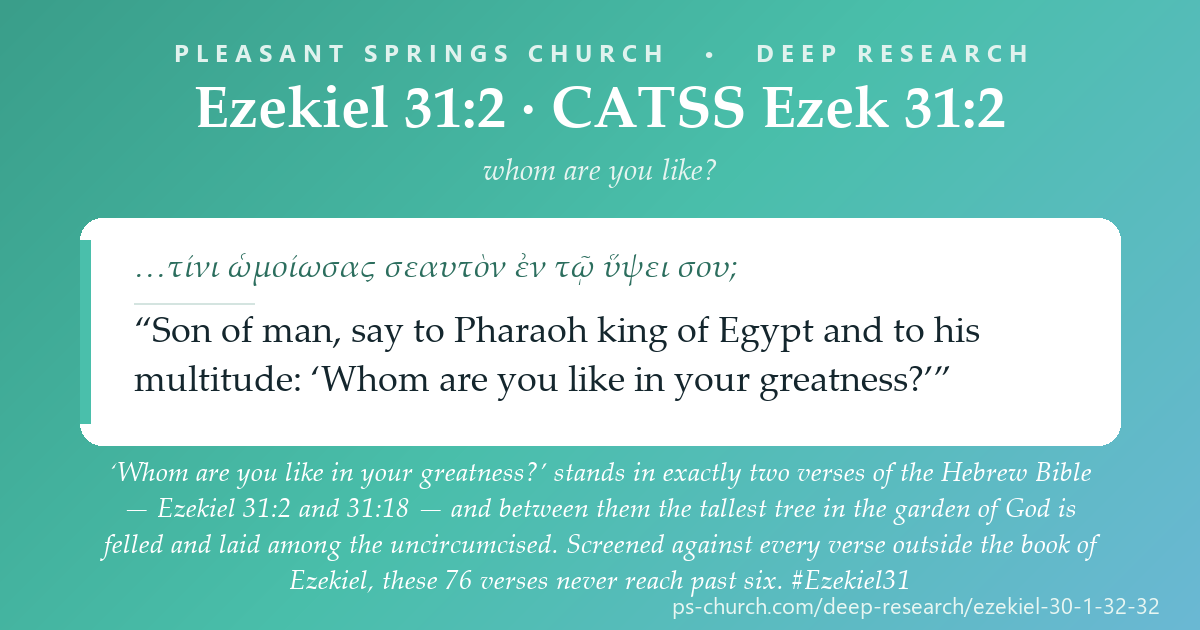
camp asks a king six hundred miles away a question, twice, sixteen verses apart: whom are you
like in your greatness? Measured, those three Hebrew words stand in exactly two verses of
the entire Hebrew Bible — Ezekiel 31:2 and Ezekiel 31:18 — and they are the first and last
verses of the same oracle. Between them a cedar taller than anything in the garden of God is
felled and dropped into the world below, and the closing sentence of that oracle turns out to be the
closing sentence of the next one too: Pharaoh and all his multitude, declares the Lord
God, six consecutive Hebrew words standing at 31:18
and 32:32 and nowhere else in Scripture.
And here is what the numbers would not let this page say. Screened against every verse
outside the book of Ezekiel, the deepest run any of these 76 Hebrew verses reaches is
six — and the six is a way of starting a sentence, shared with Isaiah 28:16.
Inside the book the same verses reach eight, seven, seven, seven and seven, and every one of
those partners is Ezekiel. The two chapters every commentary pairs with Ezekiel 31
— Isaiah 14 and Daniel 4 — share no two consecutive Hebrew words with it at all.
This passage talks to its own book.
The Greek screen is stranger still. The deepest contact these three chapters have with
the Greek New Testament is five, tied five ways, tie band 1 in every case. Three of the five
are the same stock phrase — the birds of the air, which stands in 24 Greek Old Testament
verses and 8 New Testament ones. One is Revelation 2:7’s in the paradise of God, a
phrase with exactly one home in each corpus. And one is Luke 15:22, where a father puts a ring
on his son’s hand and the screen matches it, word for word, to God putting a sword into
Nebuchadnezzar’s. Meanwhile Ezekiel 32:7 — the sun covered, the moon giving no
light, the language behind Matthew 24:29 — measures two. The screen
finds the accident and misses the allusion, and this page prints both. Along the way: a cedar
that is a cypress in Greek, an Eden that is a common noun, mighty men who are giants, a verse the Greek
numbers differently rather than omits, and the one verse in these three chapters that shares no two
consecutive words with anything in the Hebrew Bible.
See the method →
Ezekiel 30:1–32:32 (selections)
Hebrew · Greek (CATSS / Rahlfs) · ESVEvery row here was chosen by a measurement, and several of them were chosen because the measurement was disappointing. 30:2 is printed because it is the deepest Hebrew run on the page and its only partner is Ezekiel. 30:22 is printed because it carries the ceiling for this whole passage outside its own book, which is six. 30:24 is printed because it is a five-word run with a tie band of 1 that means nothing at all. 31:3 is printed because it matches nothing in the Hebrew Bible. 31:8 is printed because it is a singleton in both Greek corpora at once. 32:7 is printed because it is the most famous verse here and it measures two. 32:19 is printed because the verse-count table is misleading about it. Where the Hebrew and the Greek say different things, both are printed and neither is corrected.
The Shape of the Passage
Sequence — five oracles, four of them dated, with two brackets measured inside themThese are the last three chapters of Ezekiel’s oracles against the nations, and the darkest continuous stretch in the book. The shelf already studies Ezekiel 36:24–28 and 37:1–14, both of them resurrections. This page is the burial that comes first.
Author
A priest in Babylon, writing about Egypt, and dating it by the calendar of the empire that deported him. Every oracle here but the first is dated to a year of the exile of King Jehoiachin — the eleventh year and the twelfth — and the dates run forward without a stumble: eleventh year first month seventh day (30:20), eleventh year third month first day (31:1), twelfth year twelfth month first day (32:1), twelfth year fifteenth day (32:17). Measured: the date formula at 32:17 shares seven consecutive Hebrew words with Ezekiel 29:1, tie band 1, and the formula at 31:1 and 32:1 shares seven with Ezekiel 26:1 and 29:17. The man is keeping a file.
And he is writing almost entirely in his own vocabulary. Screened against every verse OUTSIDE the book of Ezekiel, the deepest run any of these 76 verses reaches is six — and the six is לָכֵ֞ן כֹּה אָמַ֣ר אֲדֹנָ֣י יֱהֹוִ֗ה הִנְנִי֙, a way of starting a sentence, shared with Isaiah 28:16. Screened against the whole Hebrew Bible, the same verses reach eight (30:2), seven (30:22, 31:1, 32:1, 32:17) and six (30:20, 31:10) — and every one of those partners is a verse of Ezekiel. The passage is loud inside its book and nearly silent outside it.
The best-known cross-reference in the chapter is not there. Every commentary pairs Ezekiel 31 with Isaiah 14, the taunt over the king of Babylon who is brought down to Sheol, and with Daniel 4, the world-tree that is cut down. Measured verse against verse, Ezekiel 31 shares no two consecutive Hebrew words with any verse of Isaiah 14 — the maximum is one shared word — and no two consecutive words with any verse of Daniel 4 either. (The Daniel comparison is close to a category error, because Daniel 4 is in Aramaic; it is printed so that its absence is not read as a result. The Isaiah 14 figure is not.) Whatever relation these passages have, it is not a verbal one this screen can see.
Audience
People who had bet on Egypt and lost. Judah’s last two kings rebelled against Babylon on the strength of Egyptian promises; Pharaoh Hophra marched out in 588 and went home again, and the siege of Jerusalem resumed. The audience of Ezekiel 30 is a room full of deportees who watched that happen. When 30:21 says the arm has been broken and not set, it is describing a specific disappointment, and everyone present knew which one.
They were also being insulted on Egypt’s behalf, in a very precise way. The word this passage buries Egypt under is עֲרֵלִ֤ים, the uncircumcised. Measured: the plural stands in 21 verses of the Hebrew Bible, and 11 of the 21 are in Ezekiel 31:18–32:32 — 10 of them in chapter 32 alone. Egypt practised circumcision. To assign Pharaoh a grave among the uncircumcised is not a description; it is a demotion, and Stage 3 sets out what could and could not be checked about it.
And later, people reading it in Greek, in a book divided slightly differently. The Greek held here has 75 verse units where the Hebrew has 76. It is not missing a verse: the words of Hebrew 32:19 stand inside Greek 32:21. But the Greek congregation heard a cypress where the Hebrew has a cedar; heard the trees of delight where the Hebrew names Eden; heard giants where the Hebrew has mighty men; heard both of Pharaoh’s arms broken at once instead of one and then two; and at 32:27 heard that the fallen did lie with the giants, where the Hebrew says they did not. Both columns are printed on this page and neither is ranked.
Orient on the oracles against the nations, on Egypt in the last years of the kingdom of Judah, on the cosmic tree, on Sheol and the Pit, and on the fact that Greek Ezekiel is a measurably different book.
Search by topic: oracles against the nations; Egypt, Old Testament; Hophra (Apries); Amasis; Nebuchadnezzar II; the day of the Lord; cosmic tree / world tree; Eden, garden of God; Sheol; the Pit (bor); circumcision; Nephilim and the Rephaim; Septuagint of Ezekiel; Papyrus 967. Read the dictionary entry before the commentary, and read the commentary after the text.
Where do these three chapters sit in the book?
They close a block. Ezekiel 25–32 is the book’s collection of oracles against the nations — Ammon, Moab, Edom, Philistia, Tyre, Sidon, and then seven oracles against Egypt running from 29:1 to 32:32. These three chapters are the last five of the seven, and 32:32 is the last verse before the watchman is re-commissioned in chapter 33 and the book turns toward restoration.
The hinge is a date, and the date is the fall of Jerusalem. 33:21 reports the fugitive arriving with the news in the twelfth year, tenth month, fifth day. The oracle at 32:1 is dated to the twelfth year, twelfth month — that is, after it. The Hebrew of 32:17 gives a twelfth year and a fifteenth day but no month, so whether the pit roll-call was spoken before or after the news reached the camp is not something the text on this disk settles.
And the same book that buries Egypt here opens the graves of Israel five chapters later. The vocabulary is shared and inverted: I will open your graves and raise you from your graves (37:12) against he shall be laid to rest among the uncircumcised (32:32). Nothing on this page measures that as a verbal link, because it is not one — it is a theme, and the page labels it as such.
Who is the Pharaoh, and what actually happened?
Hophra, the Apries of the Greek historians, reigned 589–570. He marched to relieve besieged Jerusalem in 588 (Jeremiah 37:5–11), the Babylonians lifted the siege, and then he withdrew and the siege resumed. That is the broken arm of 30:21, and the oracle is dated four months after the relief force went home.
What the page can and cannot tell you about the sequel. Ezekiel 29:19–20 and 30:10–12 promise Egypt to Nebuchadnezzar as wages for the siege of Tyre. The one cuneiform text that records a Babylonian campaign against Egypt is a broken tablet, printed at ANET 308 and read at first hand for this page — and it is broken at the point where the result would be, and it names Amasis, not Hophra. Stage 2 quotes it. Egypt was never annexed by Babylon. How that bears on the oracle is a real question and Stage 5 lists it as unsettled rather than answering it.
What is the Pit, and how is it different from Sheol?
Two words, used together here. שְׁא֖וֹל, Sheol, is the gathering-place of the dead; בֽוֹר, bor, is a pit or cistern — the same ordinary word used of the pit Joseph was thrown into. Measured: the phrase י֥וֹרְדֵי בֽוֹר, ‘those who go down to the Pit’, occurs 11 times in the Hebrew Bible, and 6 of the 11 are in these three chapters (31:14, 31:16, 32:18, 32:24, 32:25, 32:30); two more are at Ezekiel 26:20, and the remaining three are Isaiah 38:18, Psalm 28:1 and Psalm 88:5.
What the Old Testament does not do here is describe torment. The dead in Ezekiel 32 are not punished; they are filed. Each nation has a grave, a company round about it, and a position relative to the others. Stage 2 sets that beside the Mesopotamian netherworld, where the dead are levelled to dust and darkness, and the contrast is the point.
Is Greek Ezekiel a different book?
Measurably, yes — and this passage is a mild case. Across the whole book the Masoretic text has 1,273 verses and the CATSS Greek has 1,267 rows; the two differ in length in six chapters (1, 10, 27, 32, 33, 40). In these three chapters the only difference is chapter 32, and it is a difference of division, not of content — see the row on 32:19. The Greek text is also shorter phrase by phrase throughout: no cloud at 30:3, no repeated ‘trees of Eden’ at 31:18, a compressed 31:9 and 32:31.
What the page is NOT holding. Papyrus 967, the third-century Greek codex whose Ezekiel is shorter still and whose chapters 36–39 stand in a different order, is not on this disk. Neither is Ziegler’s Göttingen edition or its apparatus. Every Greek figure on this page is a figure about the CATSS digitisation of Rahlfs, and nothing whatever is claimed about the manuscript tradition behind it.
Egypt’s own royal titles, Babylon’s own account of felling the cedars of Lebanon, and the Mesopotamian land of no return — all read at first hand in Pritchard.
Texts read at first hand for this page from James B. Pritchard, Ancient Near Eastern Texts Relating to the Old Testament, 3rd edition. Page numbers are Pritchard’s. These are witnesses to a world, not Scripture, and they identify nobody and date nothing.
“The Mighty of Arm” — Egypt’s own words for what Ezekiel 30 breaks
The arm is not Ezekiel’s image. It is Pharaoh’s job title. From the annals of Thutmose III at Megiddo, ANET 236, read at first hand:
His majesty set forth in a chariot of fine gold, adorned with his accoutrements of combat, like Horus, the Mighty of Arm, a lord of action like Montu, the Theban, while his father Amon made strong his arms.Annals of Thutmose III, ANET 236
And in the same account the soldiers are rallied with “may ye extol the might of his majesty, because his arm is greater than that of any king” (ANET 236), and the defeated princes beg for breath “because his arm was so great, because the prowess of Amon was so great” (ANET 237).
Set that beside Ezekiel 30:21–25. The arm is broken. It has not been bound up. There is no bandage and no dressing. It cannot hold a sword. And then — the sentence the Egyptian scribes would have found unthinkable — I will strengthen the arms of the king of Babylon and put my sword in his hand. The god who makes a king’s arms strong is doing it for somebody else.
What this does and does not show. It shows that the idiom is Egyptian royal language and not a private metaphor. It does not show that Ezekiel read Thutmose III — the annals are eight centuries earlier and there is no evidence of contact. The epithet was standard for the whole pharaonic period; that is exactly why it is worth printing.
Nebuchadnezzar on felling the cedars of Lebanon — in his own inscription
Ezekiel 31:12 says foreigners, the most ruthless of nations, cut the great cedar down. Here is a king of Babylon saying he did it. From the Wadi Brisa inscription of Nebuchadnezzar II, ANET 307, read at first hand:
At that time, the Lebanon, the Cedar Mountain, the luxurious forest of Marduk, the smell of which is sweet, the high cedars of which … no other king has felled … over which a foreign enemy was ruling and robbing it of its riches — its people were scattered, had fled to a far away region … I cut through steep mountains, I split rocks, opened passages and thus I constructed a straight road for the transport of the cedars.Nebuchadnezzar II, Wadi Brisa inscription, ANET 307
The two texts are within a generation of each other. Ezekiel 31 is dated to the eleventh year of the exile — 587 — and Nebuchadnezzar is the king reigning. The page does not claim that Ezekiel knew this inscription, and asserts nothing about direction. It prints what the woodcutter said about the same forest.
Gilgamesh in the Cedar Forest — the mountain is the abode of the gods
Ezekiel 31 puts the cedar in the garden of God. So does the oldest surviving epic in the world. From the Assyrian version of the Gilgamesh Epic, Tablet V, ANET 82, read at first hand:
They stood still and gazed at the forest, they looked at the height of the cedars … They beheld the cedar mountain, abode of the gods, throne-seat of Irnini.Gilgamesh V, ANET 82
And then the felling, and the price of it (ANET 83, 85):
Gilgamesh seized the axe in his hand … and felled the cedar. But when Huwawa heard the noise, he became angry: “Who has come, has slighted the trees which had been grown in my mountains, and has felled the cedar?” … ‘the one of them who stripped the mountains of the cedar must die.’Gilgamesh V and VII, ANET 83, 85
The shared furniture is real and it is worth naming: a mountain forest of cedars that belongs to the divine world, a guardian, a felling, and a death that follows the felling. What Ezekiel does with it is the difference. In Gilgamesh the man who fells the cedar is the hero and the death is his friend’s. In Ezekiel 31 the cedar is the king, and the one who fells it is God’s instrument. The tree is the defendant, not the scenery.
The land of no return — and why Ezekiel 32 is not it
The Mesopotamian underworld is a levelling. From the Descent of Ishtar to the Nether World, ANET 107, read at first hand:
To the Land of no Return, the realm of Ereshkigal … To the dark house, the abode of Irkalla, to the house which none leave who have entered it, to the road from which there is no way back … where dust is their fare and clay their food, where they see no light, residing in darkness, where they are clothed like birds, with wings for garments.Descent of Ishtar, ANET 107
Now read Ezekiel 32:22–30. Assyria is there and all her company, her graves all around her. Elam is there, and all her multitude around her grave. Meshech and Tubal, and all their multitude, their graves all around them. Edom, the princes of the north, the Sidonians. Nobody is dust. Everybody has an address.
That is the contrast, and it is the reason this section exists. The pit of Ezekiel 32 is not a place where identity dissolves; it is a place where the empires are still recognisably themselves and still ranked — and Pharaoh is walked past all of them, in order, so that he can see where he has been put. Whether that seating plan is comfort or humiliation is left to the reader; 32:31 says Pharaoh will be comforted, and the page prints the word without explaining it away.
Honest limit. These texts were read in Pritchard’s English, not in Akkadian or Egyptian, and no run screen touches them — there is no shared-corpus measurement between a cuneiform tablet and the Hebrew Bible on this shelf, and nothing here is presented as one.
Nine words, each counted over a named corpus, and each printed with the scope of the count.
Counts here are counts of word forms over the corpora held on this disk — 23,204 Masoretic verse units, 30,348 Greek Old Testament units (the 30,637 units of the 64 CATSS files held, less the Odes), and 7,927 Greek New Testament verses. ⚠️ Where a Hebrew form is a homograph, the count is given per book rather than Bible-wide, and the homograph is named.
The word the first oracle is built on, and it appears in four verses (30:21, 22, 24, 25) and then not again in these three chapters. The phrases זְר֛וֹעַ פַּרְעֹ֥ה (30:21) and זְרֹע֣וֹת פַּרְעֹ֔ה (30:24) each stand in exactly one verse of the Hebrew Bible. No Bible-wide lexeme count is given: the consonants זרע are also the ordinary word for ‘seed / to sow’, and a form-based screen folds the two. ⚠️ And the fold is not hypothetical here. The one other place those consonants stand in these three chapters is 31:17, וּזְרֹע֛וֹ — and the Greek reads it τὸ σπέρμα αὐτοῦ, his seed, not his arm. The ancient translator hit the same ambiguity the normaliser does. Greek elsewhere: βραχίων, and always plural.
The Hebrew tree of 31:3 is a cedar. The Greek tree is a cypress. κυπάρισσος at 31:3, κυπάρισσοι at 31:8 where the Hebrew has אֲרָזִ֣ים. The whole botanical list shifts: Hebrew cedars, firs and plane trees become Greek cypresses, pines and firs. The page prints both and picks neither.
17 occurrences of the form in the Hebrew Bible; four of them in this one chapter (31:9, 31:16, 31:18 twice), plus Ezekiel 36:35. The phrase עֲצֵי־עֵ֔דֶן, the trees of Eden, stands in three verses, all of them Ezekiel 31. The Greek does not carry the name at all: it translates τρυφή, delight, luxury — τὰ ξύλα τῆς τρυφῆς, the trees of delight.
Two occurrences of בְּגַן־אֱלֹהִים֒ in the whole Hebrew Bible and both are inside Ezekiel 31:8. The bare גַּן־אֱלֹהִ֜ים stands once more, at Ezekiel 28:13 over the king of Tyre. Greek: ἐν τῷ παραδείσῳ τοῦ θεοῦ — one verse in 30,348 Greek Old Testament units, this one, where it stands twice; and one verse in 7,927 Greek New Testament verses, Revelation 2:7.
The signature word of the pit oracle. The plural stands in 21 verses of the Hebrew Bible; 12 are in Ezekiel; 11 are in Ezekiel 31:18–32:32; 10 are in chapter 32 alone. Greek ἀπερίτμητος: 36 occurrences in the Greek Old Testament files held here, 12 in Ezekiel, 7 in these three chapters (31:18, 32:21, 24, 26, 28, 30, 32) — four fewer than the Hebrew, because the two columns do not divide the same verses the same way. In the Greek New Testament the word occurs exactly once: Acts 7:51, where Stephen calls the council uncircumcised in heart and ears. The page notes the contact and claims no dependence.
Four occurrences in Ezekiel 32 (32:12, 32:21, and twice in 32:27) out of five in the whole book — the fifth is at 39:18. The Greek renders them γίγαντες, giants — the word the Greek Genesis uses at 6:4. Measured: οἱ γίγαντες stands in exactly four verses of the 30,348 Greek Old Testament units held here — Genesis 6:4, Isaiah 14:9, Ezekiel 32:21, Baruch 3:26 — and in none of the 7,927 Greek New Testament verses. What that means is a translator’s lexical choice, repeated; the page does not build a doctrine on it.
25 occurrences of the form in the Hebrew Bible, spread over 24 verses; 10 of the occurrences are in Ezekiel and 8 in these three chapters. ⚠️ The same word is an ordinary cistern — the pit Joseph was thrown into — so the Bible-wide figure mixes two senses and is given only as a denominator. The Greek is not consistent: βόθρος at 31:14, 32:18, 32:24, 32:29 and 32:30, but λάκκος at 31:16. (βόθρος also stands at 32:21 and 32:22, where the Hebrew has no בּוֹר.)
56 verses of the Hebrew Bible carry a form beginning המונ — 61 occurrences in all; 22 of the verses are in Ezekiel and 14 in these three chapters. It is the word in the sentence that brackets chapters 31 and 32 — Pharaoh and all his הֲמוֹנֹ֔ה. Greek: πλῆθος, and at 31:18 τὸ πλῆθος τῆς ἰσχύος αὐτοῦ, the multitude of his strength.
The Greek word for what Pharaoh is at 32:2, where the Hebrew has the plural form כַּתַּנִּ֣ים. It is the word Revelation uses of the great dragon — and the measured run between Ezekiel 32:2 and Revelation 12:9 is two. The image is the same; the words are not, and this page reports words.
One thing this section could not settle
Egypt practised circumcision, which is what makes 32:19 an insult rather than a description. That is the standard reading and it rests on Egyptian iconography and on Herodotus Histories 2.36–37 and 2.104. Neither Herodotus nor any Egyptian text on the subject was read at first hand for this page. Pritchard prints a text called “Circumcision in Egypt” at ANET 326 — and the copy of Pritchard held here stops at page 325. The claim is therefore reported as the standard scholarly position and is not verified from anything on this disk.
Every run on this page with its tie band, including the ones that ruin the story.
A run is a contiguous sequence of identical whole word forms, never lemmas and never roots. The tie band is the number of target verses that reach the same maximum, and it is printed beside every figure. Cross-corpus Greek runs apply MorphGNT’s own spelling equivalences (ou / ouk / ouch, ek / ex, the movable nu), so the figures here are higher than any run figure published on this shelf before 30 August 2026 and were re-measured for this page rather than copied from a sibling.
The Greek New Testament screen — all 75 CATSS rows against all 7,927 verses
The distribution first, because a number without a distribution is a boast. Across the 75 CATSS rows of Ezekiel 30–32 against 7,927 verses of the Greek New Testament: all 75 reach two, 59 reach three, 20 reach four, 5 reach five, and nothing reaches six.
The whole-book baseline, so that a five is read at its true size. Over all 1,267 CATSS rows of Greek Ezekiel: 1,257 reach two, 941 reach three, 258 reach four, 27 reach five, 3 reach six, 1 reaches seven, and nothing reaches eight. Forty-five of the book’s 48 chapters top out at five or lower; only chapters 3, 20 and 24 reach six. These three chapters are 75 of the book’s 1,267 rows (5.9%) and carry 5 of its 27 fives (18.5%) — a mild concentration of a shallow figure, and the page will not call it more.
All five of the fives, with their bands. Every one is tie band 1.
- Ezekiel 31:6 → Matthew 13:32 — run 5, band 1. τὰ πετεινὰ τοῦ οὐρανοῦ καί. The mustard seed.
- Ezekiel 31:13 → Matthew 13:32 — run 5, band 1. The same five words.
- Ezekiel 32:4 → Matthew 13:32 — run 5, band 1. The same five words again.
- Ezekiel 31:8 → Revelation 2:7 — run 5, band 1. ἐν τῷ παραδείσῳ τοῦ θεοῦ. One home in each corpus.
- Ezekiel 30:24 → Luke 15:22 — run 5, band 1. εἰς τὴν χεῖρα αὐτοῦ καί. A sword and a ring.
Three of the five are the same stock phrase, and the page deflates it in place. τὰ πετεινὰ τοῦ οὐρανοῦ without Matthew’s conjunction stands in 24 verses of the Greek Old Testament held here and 8 verses of the Greek New Testament — Matthew 6:26, 8:20, 13:32, Mark 4:32, Luke 8:5, 9:58, 13:19, Acts 11:6. Mark 4:32 and Luke 13:19, the same parable, measure four against Ezekiel 31:6, and so does Daniel 4:12, the tree that commentators actually cite. The band of 1 is the work of a single καί.
One of the five is an accident and is printed as one. Luke 15:22 is the prodigal’s father. Nothing connects it to Ezekiel 30:24 except five Greek words in the same order.
One of the five is genuinely distinctive, and even that is stated carefully. ἐν τῷ παραδείσῳ τοῦ θεοῦ stands in one Greek Old Testament verse (Ezekiel 31:8, twice inside it) and one Greek New Testament verse (Revelation 2:7). That is a distinctive arrangement. It is not evidence that Revelation is quoting Ezekiel, and the tree of life in Revelation 2:7 comes from Genesis 2, not from Ezekiel 31.
The counter-examples — the connections everyone knows, measured
This is the section that decides whether the rest of the page can be trusted. Here are the links the standard literature draws between this passage and the rest of Scripture, measured by the same method that produced the fives above.
- Ezekiel 32:7 → Matthew 24:29 — run 2. σελήνη οὐ. The sun darkened and the moon not giving its light, in the Olivet discourse.
- Ezekiel 32:7 → Mark 13:24 — run 2. The same two words.
- Ezekiel 32:7 → Revelation 8:12 — run 3. μὴ φάνῃ τό.
- Ezekiel 32:7 → Revelation 6:12 — run 1. καί.
- Ezekiel 32:8 → Matthew 24:29, Acts 2:20, Revelation 6:12 and Revelation 8:12 — run 1 against each. One word, and the word is and.
- Ezekiel 32:2 → Revelation 12:9 — run 2. δράκων ὁ. Against Revelation 12:3, 13:1 and 20:2 it is one.
- Ezekiel 32:27 → Greek Genesis 6:4 — run 3, and the band is at least 11. ἀπὸ αἰῶνος οἱ; ἀπὸ αἰῶνος stands in eleven Greek Old Testament verses and three New Testament ones.
- Ezekiel 32:21 → Greek Isaiah 14:9 — run 2. οἱ γίγαντες. In Hebrew the same pair measures one.
- Ezekiel 31 → Isaiah 14, verse against verse — maximum run 1. No verse of Ezekiel 31 shares two consecutive Hebrew words with any verse of Isaiah 14.
- Ezekiel 31 → Daniel 4, verse against verse — maximum run 1. Daniel 4 is in Aramaic; this figure is printed so that it cannot be mistaken for a finding.
Read that list next to the one above it. The screen’s five deepest rows are a stock phrase, a stock phrase, a stock phrase, a genuine singleton and an accident. The passages that every reader of the New Testament actually hears behind Ezekiel — the darkened sun, the dragon, the cosmic tree — measure two, two and one. The measurement finds verbatim contact. It does not find allusion, and on this page the gap between the two is unusually wide.
The Hebrew screen — all 76 Masoretic verses against the Hebrew Bible
Two targets, and the page distinguishes them everywhere.
(1) Against every verse of the Hebrew Bible outside these three chapters, the deepest rows are: 30:2 — eight, band 1, Ezekiel 21:33; 30:22 — seven, band 1, Ezekiel 13:20; 32:17 — seven, band 1, Ezekiel 29:1; 31:1 and 32:1 — seven, band 2, Ezekiel 26:1 and 29:17; 30:20 — six, band 3; 31:10 — six, band 6. Every single partner is a verse of Ezekiel. Five rows come back zero — 30:4, 30:14, 30:16, 31:3, 32:19.
(2) Against every verse outside the book of Ezekiel, the ceiling collapses to six — 30:22 against Isaiah 28:16, band 1 — and six rows come back zero: 30:4, 30:7, 30:14, 30:16, 31:3, 32:19.
(3) And against the whole Hebrew Bible with only the verse itself excluded, four of those five zeros disappear. 30:4 finds Ezekiel 30:9 at two; 30:14 finds 30:16 and 30:19 at two; 30:16 finds 30:8 and 30:14 at two; 32:19 finds 32:29 at two. Exactly one verse survives: Ezekiel 31:3, which shares no two consecutive words with any other verse in the Hebrew Bible. The whole-book baseline is printed beside it: 43 of Ezekiel’s 1,273 verses do that, 3.4%, against 1 of 76 here, 1.3%. These chapters are less isolated than their own book, and the page says so in the same breath as the finding.
⚠️ What a Hebrew zero means here. The Hebrew screen runs with unigram_fallback off, so 0 means “shares no two consecutive words”, not “shares no word”. Ezekiel 31:3 shares plenty of individual words — behold, Lebanon, height — with the rest of Scripture.
⚠️ And the normaliser has a known edge that touches this page. It treats the Masoretic section markers ס and פ as tokens. The 31:18 / 32:32 bracket is reported by the screen as seven and is printed on this page as six, because the seventh token is a shared פ. The other deep figures — eight at 30:2, seven at 30:22, seven at 32:17 — were checked word by word and none carries a marker inside the run.
Where the real work is, what this page could not check, and where it is weakest.
Consult the technical literature last, so that it corrects the reading rather than supplying it. This section is also where the page states its own limits, because a shelf that only reports what it found is not trustworthy.
Where the real work on this passage is:
- Commentaries. Walther Zimmerli, Ezekiel 2 (Hermeneia, 1983) — still the fullest on the Greek and on the growth of chapters 25–32. Moshe Greenberg, Ezekiel 21–37 (Anchor Yale, 1997), arguing the opposite method: read the received text whole. Daniel Block, The Book of Ezekiel, Chapters 25–48 (NICOT, 1998). Leslie Allen, Ezekiel 20–48 (WBC, 1990). Margaret Odell, Ezekiel (Smyth & Helwys, 2005).
- On the oracles against Egypt in particular. Lawrence Boadt, Ezekiel’s Oracles against Egypt (Biblica et Orientalia 37, 1980) — the standard monograph, and the obvious first stop for anyone testing the claims on this page.
- On the Greek Ezekiel and Papyrus 967. Joseph Ziegler’s Göttingen Ezechiel; Emanuel Tov on the text-critical use of the Septuagint; Johan Lust and the Leuven work on the shorter Greek text; Ingrid Lilly, Two Books of Ezekiel (2012). None of this was consulted at first hand; the Greek column here is CATSS/Rahlfs and nothing else.
- On the cosmic tree and the netherworld. The specialist literature on Ezekiel 31 and the Mesopotamian tree; the standard treatments of Sheol and the Rephaim; and, for the giants, the literature on Genesis 6:1–4 and its Second Temple reception.
- Egyptian and Babylonian primary texts. James Pritchard, ANET (3rd ed.) — the annals of Thutmose III at pp. 235–238, Nebuchadnezzar’s Wadi Brisa inscription at p. 307, the fragmentary Nebuchadnezzar-and-Amasis tablet at p. 308, Gilgamesh V and VII at pp. 82–85 and the Descent of Ishtar at pp. 106–109 were read at first hand from that volume for this page.
What this page could not check — stated plainly
The headline is a negative, and negatives are the fragile kind of finding. “These 76 verses never reach past six outside their own book” and “Ezekiel 31:3 shares no two consecutive words with anything” are statements about the 23,204-verse Masoretic corpus held on this disk and about nothing else. No Qumran material is held here — and Ezekiel is represented at Qumran and Masada. No Hebrew Ben Sira, no Mishnah, no inscription, no Ugaritic. A partner in any of those would not appear on this screen. That is the sentence a critic should press first.
The most disputed word in the passage is one the page reads and does not defend. At 31:3 the Masoretic text reads אַשּׁ֜וּר, Assyria, and a very large body of scholarship emends it to תְּאַשּׁוּר, a box tree / cypress, on the grounds that an oracle against Egypt has no business opening with Assyria. The Greek held here supports the Masoretic reading — Ασσουρ — and the page therefore prints Assyria and flags the question rather than resolving it. If the emendation is right, the sentence in the codex note about “the most disputed word in the chapter” is the only part of this page that changes; the zero-row measurement does not depend on how the word is vocalised.
The Greek here is Rahlfs, not Ziegler, and Papyrus 967 is not held. Every Greek figure on this page — the absent verse number at 32:19, the cypress at 31:3, the missing negative at 32:27, the 30,348-unit denominator — is a figure about the CATSS digitisation of Rahlfs’s Septuaginta. No Göttingen apparatus is held, so no variant is known to this page and nothing is claimed from one. In particular the page cannot say whether any Greek manuscript numbers a verse 19 in chapter 32, or whether any carries a negative at 32:27.
The Greek New Testament here is the SBLGNT via MorphGNT, and no New Testament apparatus was consulted.
Direction of influence is nowhere asserted. Not between Ezekiel 31:8 and Revelation 2:7, not between Ezekiel 31:6 and Matthew 13:32, not between Ezekiel 32:27 and Genesis 6:4, not between Gilgamesh and Ezekiel 31, not between the Wadi Brisa inscription and Ezekiel 31:12, and not between the Hebrew and Greek editions of this book. The page reports arrangements and counts.
The two brackets are measured; what they mean is not. That 31:2 and 31:18 are the only two verses in the Hebrew Bible carrying אֶל־מִ֖י דָּמִ֥יתָ, and that 31:18 and 32:32 are the only two carrying the six-word closing sentence, are facts about a corpus. Whether either was designed, and whether they mark an editorial seam, is a question about composition history that no screen held here touches.
The claim that Egypt practised circumcision was not verified here. It is the standard position, it rests on Herodotus 2.36–37 and 2.104 and on Egyptian iconography, and neither was read at first hand. Pritchard prints a relevant text at ANET 326 and the copy held here ends at page 325.
The Babylonian evidence for what happened to Egypt is thin and the page does not stretch it. ANET 308 is a broken tablet; the Babylonian Chronicle entry for the 601 clash between Nebuchadnezzar and Necho sits in ANET’s supplement at p. 564, which is beyond the end of the copy of Pritchard held here and was not read. Whether Ezekiel 29:19–20 was fulfilled, and in what sense, is left open.
The ancient Near Eastern texts were read in English. Thutmose III, Nebuchadnezzar, Gilgamesh and the Descent of Ishtar were read at first hand in Pritchard’s translations, not in Egyptian or Akkadian, and were not screened against anything. There is no shared-corpus measurement on this shelf between a cuneiform tablet and the Hebrew Bible, and none is implied here.
Nothing here is an acrostic or a letter-set finding. The acrostic and pangram screens were not run on this passage, because Ezekiel 30–32 is prose and poetic oracle with no alphabetic structure to test. Their absence is not a negative result.
No commentary was consulted at first hand. The works listed above are named as where a reader should go. No claim on this page rests on any of them — including the standard readings that Matthew 24:29 draws on this passage and that Ezekiel 31 stands in the same tradition as Isaiah 14, both of which this page’s own screen fails to see.
The ESV column was typed from the printed 2016 text edition, because no ESV API key has ever been issued to this site. Any transcription error is ours. The ESV follows the Masoretic numbering and the Masoretic readings throughout — cedar, Eden, mighty men, they do not lie, and a verse 19 in chapter 32 — and where the Greek differs the page says so in the row rather than quietly printing columns that disagree.
Where the page is weakest. Its central claim is comparative — that this passage talks to its own book and not outward — and it is built on one book-internal baseline. The page did not screen a control passage. It is entirely possible that most prophetic oracle blocks behave this way and that Ezekiel 30–32 is unremarkable; the honest form of the finding is “here is what these chapters do” and not “here is what makes them special.” The page would rather write that sentence itself than have it written about it.
A question asked twice, sixteen verses apart, that nobody in the passage is able to answer.
Name what you learned, why it matters, and one concrete response.
What should we carry away — and do?
- The question is the whole oracle. Whom are you like in your greatness? is asked at 31:2 and again at 31:18, and those are the only two verses in the Hebrew Bible that ask it. Between the two askings the tallest tree in the garden of God is felled and dropped into the world below. The answer to “whom are you like” turns out to be: the others already down there.
- The arm was a title before it was an injury. Egypt’s kings were the Mighty of Arm, and their god made their arms strong. Ezekiel 30 does not deny the title; it says the arm has been broken and left unset, and that the sword has been handed to somebody else. Strength that is real can still be reassigned.
- The pit has a seating plan, and that is not nothing. The Mesopotamian underworld is dust and darkness and no way back. Ezekiel 32 gives every buried empire a grave, a company and a position. Even in the book’s darkest chapter the dead are still somebody in particular. Five chapters later the same book opens the graves.
- And the honest thing about the measurement. The deepest verbal contact these chapters have with the New Testament is a phrase about birds. The verse everyone hears behind Matthew 24 measures two words. A method that can only see what it can count will miss most of what Scripture is doing — which is why this shelf prints the counts and then prints what the counts missed.
- One concrete response. There is something in your life you would name if somebody asked what are you like in your greatness? — a competence, a reputation, a role, the thing people come to you for. This week, write down what would still be true of you if that were broken and not bound up. Ezekiel 31 is addressed to people who never did that exercise.
Ezekiel 31:2 · to share
Hebrew + Greek (CATSS / Rahlfs) + ESVEvery Deep Research page traces its passage across the whole sweep — the Old Testament, the Second-Temple world between the testaments (historical witnesses, not Scripture), and the New Testament. Follow the thread:
Pleasant Springs Church — Deep Research
Research method after Michael S. Heiser’s Bible Research Method (examine dictionaries → ancient literature → important words → textual connections → academic publications → share), with the Pleasant Springs “Author & Audience” foundation. Scripture set in the Hebrew, the Greek editions named on each page and the ESV (Old Testament), and the Greek New Testament and the ESV (New Testament), per the practice of Pleasant Springs Church. Ezekiel 30–32 research grounded in Zimmerli (Hermeneia), Greenberg (Anchor Yale), Block (NICOT), Allen (WBC), Odell and Boadt’s Ezekiel’s Oracles against Egypt, with Ziegler, Tov, Lust and Lilly on the Greek Ezekiel, and Pritchard’s ANET for the annals of Thutmose III, Nebuchadnezzar’s Wadi Brisa inscription, the fragmentary Nebuchadnezzar-and-Amasis tablet, Gilgamesh V and VII and the Descent of Ishtar. Book name: in the Septuagint this book is Iezekiel, Ἰεζεκιήλ; the Hebrew titles it יְחֶזְקֵ֨אל. Text & numbering: Hebrew from the Masoretic Text (Sefaria, Miqra according to the Masorah), cantillation retained and the qere read — one ketiv/qere stands in the printed rows, at 32:32 (חתיתו / חִתִּיתִ֖י), and it is flagged in place; Greek from the CATSS digitisation of Rahlfs’s Septuaginta, printed without editorial punctuation and with proper names unaccented; English ESV. ⚠️ THE VERSIFICATION OFFSET, DERIVED FROM THE FILES ON THIS DISK RATHER THAN COPIED FROM A TABLE. THERE IS NO CHAPTER OFFSET IN EZEKIEL AND NO VERSE OFFSET IN THIS PASSAGE. Masoretic, CATSS and ESV Ezekiel run chapter for chapter across all 48 chapters, and inside chapters 30, 31 and 32 they carry the same verse numbers, so every reference on this page means the same verse in all three columns. THE ONE BOUNDARY THAT MOVES IS OUTSIDE THIS PASSAGE: Masoretic 21:1–5 stands as English 20:45–49, which is why the note at 30:2 gives Ezekiel 21:33 as English 21:28. THE VERSE COUNTS ARE NOT IDENTICAL. Measured on disk: Masoretic 26 / 18 / 32 = 76; CATSS 26 / 18 / 31 = 75. THE SINGLE DIFFERENCE IS THAT CATSS CHAPTER 32 CARRIES NO ROW NUMBERED 19, running verse 18 straight into verse 20 without renumbering anything after it — AND THE WORDS OF HEBREW 32:19 ARE NOT MISSING FROM THE GREEK. They stand inside CATSS 32:21: τίνος κρείττων εἶ κατάβηθι καὶ κοιμήθητι μετὰ ἀπεριτμήτων. It is a division of the text, not a loss of it, and the page corrects its own verse-count table in the codex row. Across the whole book the same screen finds six chapters where the two differ in length — 1, 10, 27, 32, 33 and 40. The ESV follows the Masoretic numbering throughout. Counted, not assumed. Measurements. The Hebrew screen ran all 76 Masoretic verses of Ezekiel 30–32 against the whole 23,204-verse corpus held here; runs are contiguous whole consonantal word forms, never lemmas and never roots, with the qere read, cantillation and vowel points removed, final letter-forms folded and maqqef treated as a word separator. It was run against three targets and the page distinguishes them everywhere: against every verse outside these three chapters (five zero rows — 30:4, 30:14, 30:16, 31:3, 32:19 — and a ceiling of eight at 30:2, tie band 1, Ezekiel 21:33); against every verse outside the book of Ezekiel (six zero rows, and a ceiling of six at 30:22, tie band 1, Isaiah 28:16); and verse by verse against the whole Hebrew Bible with only the source verse excluded, on which exactly one row survives as a zero: Ezekiel 31:3. On the Hebrew screen a row of 0 means the verse shares no two consecutive words with any other verse; it may still share individual words. The whole-book baseline is printed beside the finding — 43 of Ezekiel’s 1,273 verses are zeros on that third screen, 3.4%, against 1 of 76 here, 1.3% — so that the finding cannot be read without its scale, and the page states plainly that these chapters are LESS isolated than their own book. ⚠️ The normaliser treats the Masoretic section markers ס and פ as tokens, which can inflate a run by one where two verses end at the same kind of break; the 31:18 / 32:32 bracket is reported by the screen as seven and is printed on this page as SIX for exactly that reason, and the other deep figures — eight at 30:2, seven at 30:22, seven at 32:17 — were checked word by word and none carries a marker inside the run. The Greek New Testament screen ran all 75 CATSS verse units of LXX Ezekiel 30–32 against all 7,927 verses of the SBLGNT via MorphGNT, with the edition’s own spelling equivalences applied (ou / ouk / ouch, ek / ex, the movable nu), so figures here are higher than any run figure published on this shelf before 30 August 2026 and were re-measured rather than copied from a sibling page. Distribution: all 75 reach two, 59 reach three, 20 reach four, 5 reach five, and nothing reaches six — against a whole-book baseline of 27 fives, 3 sixes, 1 seven and nothing at eight across 1,267 rows, with 45 of the 48 chapters topping out at five or lower. Phrase and word counts on the Greek side were exhaustive over 30,348 verse units — the 30,637 units of the 64 CATSS files held, less the Odes, which are excluded from run screens because two of them are New Testament text (Ode 9 is Luke 1, Ode 13 is Luke 2) and ten more are second copies of Exodus 15, Deuteronomy 32, 1 Samuel 2, Habakkuk 3, Isaiah 5, Isaiah 26, Isaiah 38, Jonah 2 and Daniel 3. Every run on this page is reported with its tie band, the five deepest Greek rows are listed together so that the three duplicates among them are visible, the five-word run at 31:6 is deflated in place by printing the 24 Greek Old Testament and 8 Greek New Testament verses that carry the same phrase without Matthew’s conjunction, and ten counter-examples are printed against the page’s own findings — Matthew 24:29 at two, Mark 13:24 at two, Revelation 8:12 at three, Revelation 6:12 at one, Ezekiel 32:8 at one against four separate New Testament verses, Revelation 12:9 at two, Genesis 6:4 at three with a band of eleven, Greek Isaiah 14:9 at two, Isaiah 14 at a maximum of one across the whole chapter, and Daniel 4 at a maximum of one with the Aramaic caveat attached. ⚠️ Direction of influence is never asserted. Not between Ezekiel 31:8 and Revelation 2:7, not between Ezekiel 31:6 and Matthew 13:32, not between Ezekiel 32:27 and Genesis 6:4, not between Gilgamesh and Ezekiel 31, not between the Wadi Brisa inscription and Ezekiel 31:12, and not between the two editions of this book. MT/LXX divergences inside the passage are disclosed rather than smoothed: 30:2 (the Greek has two bare cries for the Hebrew imperative), 30:3 (the Hebrew says near twice and has a day of cloud; the Greek says it once and has no cloud, and reads an end of nations for a time of nations), 30:21 (the Hebrew breaks one arm, the Greek both), 30:22 (Hebrew the broken one, Greek the outstretched), 30:24 (different endings), 31:3 and 31:8 (Hebrew cedar, Greek cypress; the whole tree-list shifts), 31:9 and 31:16 (Hebrew Eden, Greek delight), 31:18 (the Greek turns the second half of the question into two imperatives), 32:2 (Hebrew plural, Greek singular δράκων), 32:19 (no Greek verse number; the words stand inside 32:21), 32:27 (the Hebrew says they do NOT lie with the mighty and the Greek says they DID lie with the giants; and fallen from among the uncircumcised against fallen from of old), and 32:32 (the Greek sides with the ketiv, his terror, against the qere the ESV follows). Limits are stated in Stage 5 and are load-bearing: the headline is a negative and a negative holds only over the corpus screened, which is the 39-book Masoretic Bible and nothing else — no Qumran, no Hebrew Ben Sira, no epigraphy; the Greek is Rahlfs and not Ziegler and Papyrus 967 is not held, so nothing is claimed about whether any manuscript numbers a verse 19 in chapter 32 or carries a negative at 32:27; the Greek New Testament is the SBLGNT and no apparatus was consulted; the emendation of אַשּׁ֜וּר to box tree at 31:3 is named and declined, and the Greek held here supports the Masoretic reading; the בֽוֹר and זָ֑רַע counts fold homographs and are therefore given per book or not at all; the claim that Egypt practised circumcision was NOT verified here, because the relevant text sits at ANET 326 and the copy of Pritchard held here ends at page 325; the Babylonian Chronicle entry for the 601 clash sits at ANET 564 and was likewise not read; the acrostic and letter-set screens were not run because the passage has no alphabetic structure, and their absence is not a result; the ANE texts were read in Pritchard’s English, identify nobody and date nothing; the commentaries named were not consulted at first hand and no claim rests on them, including the standard readings that Matthew 24:29 draws on this passage and that Ezekiel 31 belongs with Isaiah 14 — both of which this page’s own screen fails to see; and no control passage was screened, so ‘this passage talks to its own book’ is a description of these chapters and not a demonstration that they are unusual; and the ESV column was typed from the printed 2016 text edition because no ESV API key has ever been issued to this site. The literary structure is labelled a sequence — five oracles, four of them dated, in the order their dates put them — and not a chiasm; the two brackets drawn inside it were found by counting and are printed at their true size, three consecutive Hebrew words at 31:2 and 31:18 (two verses in the whole Hebrew Bible) and six consecutive Hebrew words at 31:18 and 32:32 (two verses in the whole Hebrew Bible), and the page explicitly declines to claim that either bracket was designed or that it marks an editorial seam. Typology is handled per the house position: what the text says, what the New Testament itself draws, and what we see from this side of the cross — with the seeing left to the reader.
Scripture quotations marked ESV are from the ESV® Bible (The Holy Bible, English Standard Version®), © 2001 by Crossway, a publishing ministry of Good News Publishers. ESV Text Edition: 2016. Used by permission. All rights reserved. The ESV text may not be quoted in any publication made available to the public by a Creative Commons license, and the ESV may not be translated in whole or in part into any other language. www.esv.org
|
Did this study bless you today? 💚 Give to Support PS Church100% of gifts go to the General Fund — thank you. |