On a dated morning in Babylonia a
deported priest is told to write down the day, because the siege of Jerusalem has begun. The
four Hebrew words he writes stand in exactly three verses of the whole Hebrew Bible — 2 Kings
25:1, Jeremiah 52:4 and Ezekiel 24:1 — and the other two are the historians’ report of the
same morning, six hundred miles away. That evening his wife dies, and he is told not to mourn
her. Then the book turns outward: four small neighbours who cheered, and a trading city that saw a
market opening.
Here is what the numbers would not let this page say. Screened against all 7,927
verses of the Greek New Testament, the deepest run in these 100 Greek verses is seven,
tie band 1 — and it is an accident. Ezekiel 24:21 and Acts 2:17 share
your sons and your daughters, seven words; but Acts 2:17 is quoting Joel 3:1,
where the same pair measures nineteen. Nothing else on the page reaches five.
Meanwhile Revelation 18 — the chapter every commentary builds out of Ezekiel
26–27, with its merchants and its cargo list and its shipmasters standing off at a distance
— tops out at four, and the four is “of you, and all the”. The one
real echo, Ezekiel 26:13 behind Revelation 18:22, measures three.
The screen finds the coincidence and misses the allusion, and this page prints both at the
same size.
On the Hebrew side the passage is unusually alone. Nine of these 101 verses share no
two consecutive words with any other verse in the Hebrew Bible — 8.9%, against 3.4% for
Ezekiel as a whole — and seven of the nine are butchery, demolition and cargo manifests.
Along the way: one noun that names a wife, a temple and a generation of children inside twelve verses;
a boast that Tyre makes about herself and Lamentations makes about the ruins of Jerusalem, standing in
exactly two verses of Scripture; a sentence Deuteronomy wrote for an apostate Israelite town, handed to
a Phoenician port; Tarshish read as Carthage; and the most famous line in chapter 27 —
who is like Tyre? — standing in exactly one Hebrew verse and missing from the Greek
column printed beside it.
See the method →
Ezekiel 24:1–27:36 (selections)
Hebrew · Greek (CATSS / Rahlfs) · ESVEvery row here was chosen by a measurement, and three of them were chosen because the measurement is embarrassing. 24:21 is printed because it is the deepest run on the page and it is an accident. 24:27 is printed because its four-word run has a tie band of thirteen. 26:12 is printed because it shares no two consecutive words with any verse of Scripture and its closest relative is an Assyrian prism. 27:32 is printed because the line everybody quotes is absent from the Greek column standing beside it. Where the Hebrew and the Greek say different things, both are printed and neither is corrected.
The Shape of the Passage
Sequence — five movements, two of them dated, with two measured rules inside themThese four chapters are the hinge of the book of Ezekiel — the last word before the fall and the first of the oracles against the nations. The shelf already studies Ezekiel 17:1–22:31 before them and 30:1–32:32 after them. With this page every chapter of Ezekiel is now on the shelf.
Author
A deported priest who kept a dated file, and who buried his wife on a day he had already written down. The passage opens with the most specific date in the book: the ninth year, the tenth month, the tenth day. Measured: the phrase בַּחֹדֶשׁ הָעֲשִׂירִי בֶּעָשׂוֹר לַחֹדֶשׁ stands in exactly three verses of the Hebrew Bible — 2 Kings 25:1, Jeremiah 52:4 and Ezekiel 24:1 — and the other two are the historians’ report of the day Nebuchadnezzar's army arrived at Jerusalem. The next date in the passage, at 26:1, is famously incomplete: in the eleventh year, on the first of the month, with no month named. The Greek held here does not fill the gap either — ἐν τῷ ἑνδεκάτῳ ἔτει μιᾷ τοῦ μηνὸς — and Stage 5 lists that as an open question rather than answering it.
And he writes almost entirely in his own vocabulary. Screened against every verse OUTSIDE the book of Ezekiel, the deepest run any of these 101 Hebrew verses reaches is six — twice, at 25:16 and 26:3, both times against Isaiah 28:16, and both times the six words are לָכֵן כֹּה אָמַר אֲדֹנָי יֱהֹוִה הִנְנִי, a way of starting a sentence. Screened against the whole Hebrew Bible the same verses reach eight (25:3, tie band 2, Ezekiel 6:3 and 36:4) and seven (24:21, 26:1, 26:3, 27:36) — and every one of those partners is a verse of Ezekiel. This passage talks to its own book.
It is also more isolated than its own book, which is the opposite of what the last Ezekiel page found. Screened verse by verse against all 23,204 Masoretic verse units with only the source verse excluded, nine of these 101 verses share no two consecutive words with anything at all — 24:5, 24:10, 24:11, 26:9, 26:12, 27:6, 27:19, 27:20 and 27:28. That is 8.9%, against a whole-book baseline of 43 zeros in 1,273 verses, 3.4%. Ezekiel 30–32 came out at 1.3% on the same screen, LESS isolated than the book; these four chapters are two and a half times MORE isolated than it. Seven of the nine are butchery, demolition and cargo manifests — the pieces of meat in the pot, the walls and stones and soil, the oars and decking and the trade goods of Dan and Javan. Where this text is at its most concrete it is at its most alone in Scripture.
Audience
People who were about to hear that the city had fallen, and who had a fortnight’s warning that they would not be allowed to grieve normally. The sign-act of 24:15–24 is addressed to exiles who still had family inside the walls. You shall do as I have done: you shall not cover your lips nor eat the bread of men. The word the chapter uses three times is מַחְמָד — the same word for the prophet's wife, for the temple, and for the audience's own sons and daughters. Nobody in that room could miss which of the three was theirs.
They were also being told something about their neighbours that they would not have enjoyed. Chapter 25 is not comfort; it is a list of five sentences passed on nations that said things. Ammon said Aha over the sanctuary; Moab said look, the house of Judah is like all the other nations; Edom took vengeance; Philistia acted with everlasting enmity. Measured: יַעַן, because, stands five times in that one chapter out of 38 in the whole book. The judgement is on speech, and the audience had been doing plenty of it.
And later, people reading it in Greek, in a book with one fewer verse. The Greek held here has 100 verse units where the Hebrew has 101, and the difference is a real absence, not a renumbering: CATSS Ezekiel 27 carries no verse 31, and the mourning rites of Hebrew 27:31 — shaved heads, sackcloth, bitter weeping — are not anywhere in the Greek chapter. A Greek-reading congregation also heard Carthaginians where the Hebrew says Tarshish; heard no “Aha!” from Ammon, only a verb; heard the prophet's wife die in a battle-line rather than at a stroke; heard great vengeances without the rebukes of wrath; and did not hear anyone ask “who is like Tyre?” at all. Both columns are printed on this page and neither is ranked.
Orient on the chronology of 588–586, on prophetic sign-acts, on Ezekiel’s muteness, on the oracles against the nations, on Tyre as a city and as a trading system, and on the fact that Greek Ezekiel is a measurably different book.
Search by topic: Ezekiel, book of; sign-acts (Zeichenhandlungen); dumbness of Ezekiel; siege of Jerusalem 588–586; Zedekiah; oracles against the nations; Ammon; Moab; Edom; Philistia; Cherethites; Tyre; Phoenicia; Tarshish; Carthage; mourning rites, Israelite; lament (qinah); Septuagint of Ezekiel; Papyrus 967. Read the dictionary entry before the commentary, and read the commentary after the text.
What actually happens in these four chapters?
Five things, in order. (1) 24:1–14 — on a dated morning Ezekiel is told to write down the date, because the siege of Jerusalem has begun that day. He gives an allegory of a cooking pot: the meat is boiled out, the bones are burned, and the corrosion on the metal will not come off. (2) 24:15–27 — God tells him that the delight of your eyes will be taken at a stroke and that he must not perform any of the ordinary mourning rites. His wife dies that evening. He obeys. When the people ask what it means he tells them: the sanctuary will go the same way, and they will not be allowed to mourn either. (3) 25:1–17 — five short oracles against four neighbours, each one for something said or done at Jerusalem’s expense. (4) 26:1–21 — a dated oracle against Tyre, who welcomed the fall as a commercial opportunity. (5) 27:1–36 — a lament in which Tyre is described as a ship: her materials, her crew, her clients, her cargo, and her wreck.
Why is the death of Ezekiel’s wife in the Bible at all?
Because the book presents it as a sign, and says so explicitly: “Ezekiel shall be a sign for you; according to all that he has done you shall do” (24:24). The sign is not the death. The sign is the refusal to mourn. Everything Israelite mourning normally involved — uncovering the head, going barefoot, covering the moustache, eating the bread brought by neighbours — is forbidden in 24:17, and the prophet is told to sigh, but not aloud.
What the text does not do is explain it. There is no theodicy here, no comment on whether she deserved it, no word about what he felt. Measured: 24:18 is eleven Hebrew words and its deepest verbal contact anywhere in the Hebrew Bible is two — a preposition and a noun. The verse is unlike anything else in Scripture because it is unlike anything else in Scripture, and the honest thing a measurement can say about it is very little. Readers who find this chapter hard are reading it correctly. The page states its position plainly: it does not know why, it will not manufacture a reason, and it notes that the book itself puts the weight on the sanctuary rather than on the marriage.
Where does Ezekiel’s silence begin and end?
It begins at 3:26 — I will make your tongue cling to the roof of your mouth, and you shall be mute — and 24:27 promises the release: on that day your mouth will be opened to the fugitive, and you shall speak and be no longer mute. Ezekiel 33:21–22 reports it: a fugitive arrives from Jerusalem, the hand of the Lord comes on the prophet the evening before, and his mouth is opened. ⚠️ The run screen cannot see this link. Measured pair against pair, Ezekiel 24:27 and 33:22 share one word contiguously, because one promises in the second person and the other narrates in the first. It is a real connection that verbatim measurement misses entirely, and this page prints that fact rather than hiding it.
Four witnesses from outside Scripture, all of them read at first hand in Pritchard’s Ancient Near Eastern Texts. They are witnesses to a world, not Scripture, and none of them is offered as a source for anything.
The house rule on ancient parallels: cite the translation as printed in ANET by page; characterise the text as a witness to a world, never as a source; identify nobody and date nothing from it; and if a text was not actually read, say so. Everything quoted below was read in the copy of Pritchard held here, which runs to ANET page 325. Anything past that page is named in Stage 5 as unread.
An Assyrian king says he did what Ezekiel 26:12 threatens.
Ezekiel 26:12 is one of the nine verses in this passage that share no two consecutive words with any other verse in the Hebrew Bible. Its nearest verbal relative is not Scripture at all. Esarhaddon of Assyria, on Prism B, describing the destruction of Sidon — Tyre’s sister city, about ninety years before Ezekiel:
“As to Sidon, his fortress town, which lies in the midst of the sea, I leveled it as (if) an abūbu-storm (had passed over it), its walls and foundations I tore out and threw (them) into the sea destroying (thus) its emplacement completely.”Esarhaddon, Prism B ii 65–82, ANET 291
Ezekiel 26:12: your stones and timber and soil they will cast into the midst of the waters. The threat is not a poetic exaggeration and it is not new. It is a thing kings said about island cities, and the audience had heard it said before about one twenty miles up the coast. No direction of influence is asserted — there is no verbal contact between the two texts and none is claimed. What the parallel shows is that Ezekiel 26 is speaking a known genre to people who knew it.
Esarhaddon’s vassal list contains Ezekiel’s entire roster.
Chapters 25 and 26 name Ammon, Moab, Edom, Philistia and Tyre. A single Assyrian summons, on the same prism, calls up twenty-two kings:
“Ba’lu, king of Tyre, Manasseh, king of Judah, Qaushgabri, king of Edom, Musuri, king of Moab, Sil-Bel, king of Gaza, Metinti, king of Ashkelon, Ikausu, king of Ekron, Milkiashapa, king of Byblos, Matanba’al, king of Arvad, Abiba’al, king of Samsimuruna, Puduil, king of Beth-Ammon, Ahimilki, king of Ashdod — 12 kings from the seacoast … Damusi, king of Qarti-hadasti (Carthage) … together 22 kings of Hatti, the seashore and the islands; all these I sent out and made them transport … big logs, long beams (and) thin boards from cedar and pine trees, products of the Sirara and Lebanon mountains.”Esarhaddon, Prism B v 54–vi 1, ANET 291
Tyre, Edom, Moab, Ammon and four Philistine cities, in one list, with Judah standing among them. Ezekiel 25–26 is not a random selection of enemies; it is a recognisable political neighbourhood, the same set of small states that Assyrian and then Babylonian administration handled together. And the timber is the same timber. The tribute here is cedar and pine from Lebanon; Ezekiel 27:5 builds the ship’s mast from a cedar of Lebanon. Note also who is in the list: Damusi, king of Qarti-hadasti — the Phoenician name Pritchard renders Carthage. The Greek Ezekiel translates Tarshish as Carthaginians (27:12, 27:25). The page does not connect the two, and points out the coincidence so that a reader can see the shape of the world both texts sit in.
What was actually traded through Tyre, according to an Assyrian who took it.
Ezekiel 27 lists Tyre’s cargo across twenty verses. Ashurnasirpal II lists what he received from the same coast as tribute:
“The tribute of the seacoast — from the inhabitants of Tyre, Sidon, Byblos, Mahallata, Maiza, Kaiza, Amurru, and (of) Arvad which is (an island) in the sea, (consisting of): gold, silver, tin, copper, copper containers, linen garments with multicolored trimmings, large and small monkeys, ebony, boxwood, ivory from walrus tusk — (thus ivory) a product of the sea, (this) their tribute I received and they embraced my feet.”Annals of Ashurnasirpal II, ANET 276
Gold (Ezekiel 27:22), silver and tin (27:12), vessels of copper (27:13), embroidered linen from Egypt (27:7), ivory tusks and ebony (27:15). Seven of the commodities on Ezekiel’s manifest stand on this one Assyrian tribute list, nearly three centuries earlier. This is the strongest thing Stage 2 has to say about chapter 27, and it is not a literary point: it is that the manifest is a real manifest. The trade goods are the trade goods of that coast, in the quantities and combinations an Assyrian bookkeeper recorded. It is also why chapter 27 is so verbally isolated in Scripture — nothing else in the Bible is a customs ledger.
What was NOT checked here.
The thirteen-year Babylonian siege of Tyre. Every commentary on Ezekiel 26 discusses whether Nebuchadnezzar’s long siege took the city, and Ezekiel 29:18 concedes that his army got no wages from it. The primary evidence for that siege is Josephus quoting the Phoenician historian Menander, and the Babylonian Chronicle at ANET 563 — and neither was read here. The copy of Pritchard held on this disk ends at page 325, and Josephus was not consulted for this page. Nothing on this page rests on the outcome of that siege, and the page makes no claim about whether the oracle was fulfilled, partially fulfilled, or reapplied to Alexander two centuries later. That is a real question and this is a real limit.
Five words, each with an exhaustive count. Three are Hebrew, two are Greek, and every count states the corpus it was taken over.
Counts are of NORMALISED word forms, never lemmas and never roots — so a count here is a count of the form as it stands, and suffixed or prefixed forms are counted separately and labelled. Hebrew is screened over all 23,204 Masoretic verse units; Greek over 30,348 Greek Old Testament verse units (the 30,637 units of the 64 CATSS files held here, less the Odes) and all 7,927 verses of the SBLGNT.
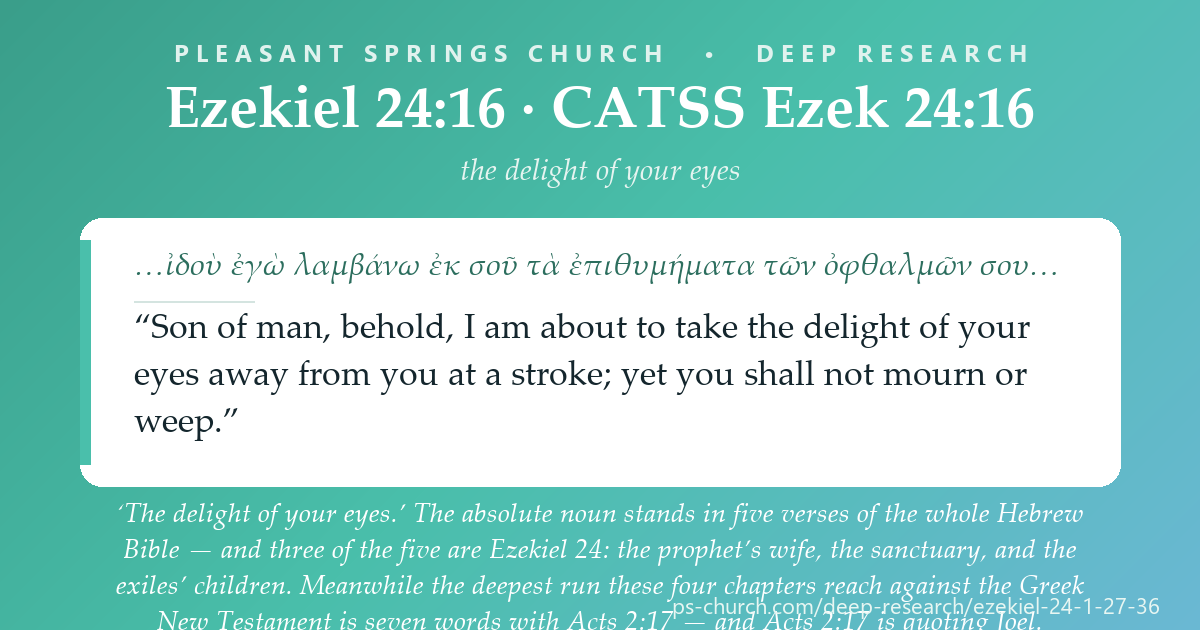
Five verses in the absolute form, and three of them are Ezekiel 24. The screen over all 23,204 Masoretic units returns 1 Kings 20:6, Ezekiel 24:16, 24:21, 24:25 and Hosea 9:6. Counting the suffixed plurals as well — מַחֲמַדֶּיהָ and its relatives — brings the total to fourteen verses, and the largest cluster outside Ezekiel is Lamentations 1:7, 1:10, 1:11 and 2:4, all of them over the loss of the temple; 2 Chronicles 36:19 is its burning. The Greek renders it ἐπιθύμημα, which stands in 17 verse units of the Greek Old Testament — the three in Ezekiel 24, four in Lamentations, and ten scattered. The word is not a rare poetic term; it is the ordinary word for what you would hate to lose. The finding is not the word, it is the density.
Five times in Ezekiel 25 alone, out of 38 in the whole book. The oracles at 25:3, 25:6, 25:8, 25:12 and 25:15 each open with it, and each is answered with לָכֵן, therefore. Chapter 26 opens the Tyre oracle the same way at 26:2. The Greek does not keep one word for it: 25:3 has ἀνθ᾽ ὧν, in return for which, and elsewhere ἀντὶ τοῦ or a plain causal conjunction. The Hebrew chapter is built as a legal indictment — charge, then sentence, five times — and the Greek reads more like narration.
Nine verses in the Hebrew Bible. Three are the Tyre oracles — Ezekiel 26:21, 27:36, 28:19 — one is Psalm 73:19, and five are Job (18:11, 18:14, 24:17, 27:20, 30:15). Outside these three verses of Ezekiel it is essentially a word from Job. The form וְאֵינֵךְ, and you are no more, stands in four verses, and three of the four are the same three oracles. ⚠️ The Greek does not carry the refrain. 27:36 has ἀπώλεια, destruction, and 26:21 has ἀπώλειάν σε δώσω, I will make you destruction. What is a repeated noun in Hebrew is a repeated idea in Greek.
Seven verse units in the 30,348 Greek Old Testament units screened here, and in every one of the seven the Hebrew reads Tarshish. Isaiah 23:1, 23:6, 23:10, 23:14 — the great oracle against Tyre — and Ezekiel 27:12, 27:25 and 38:13. Everywhere else the Greek simply transliterates: Θαρσις, 19 verse units (23 occurrences) across Genesis, Kings, Chronicles, Song of Songs, Isaiah, Jeremiah, Jonah, Psalms and Daniel — including Ezekiel 1:16 and, curiously, Ezekiel 27:16, where the Hebrew has Aram. Two translators, both working on Tyre, made the same identification, and nobody else in the corpus held here did. The page reports the distribution and asserts nothing about who was right or when either translation was made.
Twenty-two occurrences in Greek Ezekiel; eighteen of them are chapter 27, and the other four are 28:5, 28:16, 28:18 and 38:13. In the Greek New Testament the stem stands in nine verses — and four of the nine are Revelation 18 (18:3, 18:11, 18:15, 18:23). The other five are Matthew 13:45 (the pearl merchant), Matthew 22:5, John 2:16, James 4:13 and 2 Peter 2:3. It is the ordinary Greek word for a trader, not a technical term, and a shared common noun is not contact. What the count does show is that both texts are doing the same kind of thing: a city described through its customers, and its customers described weeping over the loss of a market. Stage 4 measures how much verbatim contact there actually is between them. The answer is four words.
Two phrases that stand in exactly two verses of the Hebrew Bible.
כְּלִילַת יֹפִי, perfect in beauty — Ezekiel 27:3 and Lamentations 2:15. Tyre says it of herself; the mockers say it of the ruins of Jerusalem. Tie band 1, no third verse. (The related phrase in Psalm 50:2 is מִכְלַל יֹפִי — a different construction, and the screen correctly does not return it. It is named here so that the count is not read as saying more than it does.)
לֹא תִבָּנֶה עוֹד, it shall never be rebuilt — Deuteronomy 13:17 — English 13:16 — and Ezekiel 26:14. Deuteronomy 13 is the law of the Israelite town that has gone after other gods: burn it whole, leave it a ruin-heap forever, never rebuild it. Ezekiel gives a Phoenician trading capital the sentence written for a covenant-breaking town of Israel. Three words, tie band 1, and the page states plainly that three words will not carry a doctrine. What it will carry is the observation that the phrase has no other home.
And one that stands in exactly one: נְקָמוֹת גְּדֹלוֹת, great vengeances, Ezekiel 25:17 and nowhere else in the Hebrew Bible.
The measured section. Every figure below is a count of contiguous whole word forms, every one is reported with its tie band, and the two figures the page cares most about are both disappointments.
Runs are contiguous whole word FORMS, never lemmas and never roots. The Greek cross-corpus screen applies MorphGNT’s own spelling equivalences — ou/ouk/ouch, ek/ex, the movable nu — so figures here are HIGHER than any run figure published on this shelf before 30 August 2026, and every figure on this page was re-measured rather than copied from a sibling. Tie band = how many verses in the target corpus tie for the deepest run. A run without its band is not reportable.
The deepest run in the whole passage, and why it means nothing.
Screened against all 7,927 verses of the Greek New Testament, the 100 Greek verse units of Ezekiel 24–27 reach SEVEN exactly once, tie band 1.
Ezekiel 24:21 ↔ Acts 2:17 — οἱ υἱοὶ ὑμῶν καὶ αἱ θυγατέρες ὑμῶν — your sons and your daughters.
Acts 2:17 is not quoting Ezekiel. Peter at Pentecost is quoting Joel, and measured pair against pair, Acts 2:17 and Greek Joel 3:1 (English Joel 2:28) share NINETEEN consecutive words. The seven-word phrase itself stands in four verse units of the 30,348 Greek Old Testament units screened here — Deuteronomy 12:12, 2 Chronicles 29:9, Ezekiel 24:21 and Joel 3:1 — and in one New Testament verse.
The distribution behind that seven: of the 100 rows, all 100 reach at least one, 97 reach two, 58 reach three, 15 reach four, and then no row whose maximum is five, none at six, and one at seven. There is a two-word cliff between the deepest run on the page and everything else on it, and the thing on the far side of the cliff is a coincidence. This is the clearest example on the whole shelf of why a run must be reported with its band and then read by eye.
Revelation 18 — the page’s largest counter-example.
Every commentary on Revelation 18 reads it against Ezekiel 26–27: the merchants of the earth weeping over a fallen trading city, the cargo list, the shipmasters standing off and crying out, the dust on the head, the silence of harpers and millstones. Measured, the contact is four words.
- Ezekiel 24–27 against the whole of Revelation: maximum FOUR, three rows tied, tie band 1 each — 25:7 with Revelation 11:9, 26:13 with Revelation 9:9, and 27:9 with Revelation 18:14, where the four words are σου καὶ πάντα τὰ, of you, and all the.
- Against Revelation 18 alone: maximum FOUR, one row. The distribution across all 100 rows is 28 at one, 63 at two, 8 at three, 1 at four. Nothing reaches five.
- The real echo measures three. Ezekiel 26:13 — ἡ φωνὴ τῶν ψαλτηρίων σου οὐ μὴ ἀκουσθῇ ἔτι, the sound of your harps shall be heard no more — against Revelation 18:22, the sound of harpists … shall be heard in you no more. Three consecutive words, tie band 2.
So the page has a seven that means nothing and a three that means something, and it prints both figures the same size. Nothing here argues that Revelation 18 is not built on Ezekiel 26–27. It argues that verbatim run depth is not the instrument that would show it, and that a shelf which only reported its deep runs would have told you the opposite of the truth.
What the Hebrew screen found.
Three separate screens, and the page keeps them apart everywhere.
- Against every verse OUTSIDE these four chapters (23,103 target verses): the ceiling is eight, at 25:3, tie band 2, against Ezekiel 6:3 and 36:4. Then seven at 24:21 (band 1, Ezekiel 36:22), 26:1 (band 3), 26:3 (band 1, Ezekiel 5:8) and 27:36 (band 1, Ezekiel 28:19). Every partner at seven or eight is a verse of Ezekiel. Thirteen rows come out at zero.
- Against every verse OUTSIDE the book of Ezekiel (21,931 target verses): the ceiling collapses to six, twice, both times against Isaiah 28:16, both times the words לָכֵן כֹּה אָמַר אֲדֹנָי יֱהֹוִה הִנְנִי. Sixteen rows come out at zero.
- Verse by verse against the whole Hebrew Bible with only the source verse excluded: nine rows survive as zeros — 24:5, 24:10, 24:11, 26:9, 26:12, 27:6, 27:19, 27:20, 27:28.
⚠️ On the Hebrew screen a 0 means the verse shares no two consecutive words with any other verse. It may still share individual words, and all nine of these do.
The scale matters more than the finding, so the page prints the baseline beside it. Nine zeros in 101 verses is 8.9%. The same screen run over all 1,273 verses of Ezekiel returns 43 zeros, 3.4%. These four chapters are two and a half times more isolated than their own book — and the shelf’s page on Ezekiel 30–32 found the reverse there, one zero in 76 verses, 1.3%. Seven of the nine zeros are concrete inventories: the choicest of the flock and the wood stacked under the pot (24:5), the logs heaped and the fire kindled under it (24:10), the demolition of the walls (26:12), the ship’s oars and decking (27:6), the wares of Dan and Javan (27:19), the saddlecloths of Dedan (27:20), the shaking at the cry of the pilots (27:28). Where this text is at its most physical it is at its most alone.
Two more counter-examples, printed on purpose.
A four with a band of thirteen. Ezekiel 24:26 and 24:27 both reach four against the Greek New Testament, and the four is ἐν ἐκείνῃ τῇ ἡμέρᾳ, on that day — thirteen New Testament verses tie for it, from Matthew 7:22 to 2 Timothy 4:8. A four with a band of thirteen is a way of starting a sentence.
A five with a band of forty-four. On the Hebrew side, Ezekiel 24:15 reaches five against verses outside these chapters — וַיְהִי דְבַר יְהֹוָה אֵלַי לֵאמֹר, and the word of the Lord came to me, saying — and forty-four verses tie for it, thirty-six of them in Ezekiel and the rest in Jeremiah and Zechariah. The same run against verses outside the book still has a band of eight. It is the way this literature opens a paragraph, and if a page printed it as a link between Ezekiel and Zechariah it would be lying with a true number.
The verse-count difference between the two ancient columns.
Measured on disk: Masoretic 27 / 17 / 21 / 36 = 101 verses. CATSS 27 / 17 / 21 / 35 = 100. The single difference is chapter 27, which carries no row numbered 31 in the Greek, running 27:30 straight into 27:32 without renumbering anything after it.
⚠️ And this one really is an absence, not a division. The shelf’s page on Ezekiel 30–32 reports a missing verse number there — 32:19 — whose words turn out to stand inside a neighbouring Greek verse, 32:21. That is not what happens here. The mourning rites of Hebrew 27:31 — they make themselves bald for you and gird themselves with sackcloth, and weep over you in bitterness of soul, with bitter mourning — are not in Greek 27:30, not in Greek 27:32, and not anywhere in the Greek chapter. Greek 27:32 is also shorter than its Hebrew counterpart: it ends at a lamentation for you and does not carry “who is like Tyre, like one destroyed in the midst of the sea?”
Across the whole book the same screen finds six chapters where the two differ in length — 1, 10, 27, 32, 33 and 40. The ESV follows the Masoretic numbering throughout, so every reference on this page means the same verse in all three columns. What the page does NOT say: that the Greek translator omitted anything, that a Hebrew scribe added anything, or that either text is prior. It reports two editions of a book and prints both.
Where this page is weakest, what was not consulted, and what could not be checked from the corpora held here. This section is longer than the finding it qualifies, on purpose.
The shelf rule: a page may only claim what it measured, over the corpus it measured, with the tie band attached. Everything else is either named as a limit or left out. “NOT VERIFIABLE FROM LOCAL CORPORA” is a good answer and appears several times below.
What was NOT consulted.
No commentary was read at first hand for this page. The names in the attribution line below — Zimmerli, Greenberg, Block, Allen, Odell, Joyce — are there so a reader knows where the standard discussion lives, not because any claim here rests on them. That includes the standard readings this page’s own screen fails to confirm: that Revelation 18 is built out of Ezekiel 26–27, and that Ezekiel 27 is a reworked secular ship-lament. Both may well be right. The screen simply cannot see them.
No apparatus was consulted on either side. The Greek here is the CATSS digitisation of Rahlfs, not Ziegler’s Göttingen edition; Papyrus 967 is not held. So when this page says Greek Ezekiel 27 has no verse 31 and no “who is like Tyre”, that is a statement about the text on this disk and about nothing else. Whether some Greek witness carries either is NOT VERIFIABLE FROM LOCAL CORPORA. The Greek New Testament is the SBLGNT via MorphGNT and no variants were checked.
Josephus was not read. Neither was the Babylonian Chronicle, which sits at ANET 563; the copy of Pritchard held here ends at page 325. This page therefore makes no claim of any kind about whether Nebuchadnezzar took Tyre, about the relationship between Ezekiel 26 and Ezekiel 29:17–20, or about Alexander’s causeway.
What could not be checked.
The missing month at 26:1. The Hebrew reads in the eleventh year, on the first of the month and names no month; the Greek held here does the same. Whether the month dropped out, was never written, or is to be supplied from 26:2’s reference to Jerusalem’s fall is NOT VERIFIABLE FROM LOCAL CORPORA. The page states the reading and declines the reconstruction.
The trade names in chapter 27. Several are disputed or unknown — פַּנַּג at 27:17, מְאוּזָּל at 27:19, בַּת אֲשֻׁרִים at 27:6, and the Greek’s Ῥοδίων at 27:15 and Ασηλ at 27:19, against the Hebrew’s Dedan at 27:15 and Dan, Javan and מְאוּזָּל at 27:19 — no word-for-word correspondence is asserted. No lexicon was consulted and no identification is offered. The page prints the words and their count and stops there. Note in particular that this page’s own reading of 27:12 — the Greek names Carthage — is a report of the form on the page, not an argument about what Tarshish was.
The 24:27 ↔ 33:22 link. The page asserts that Ezekiel’s muteness ends in chapter 33 as promised in chapter 24. That is a reading, not a measurement — the run screen measures the pair at ONE shared word — and it is flagged as a reading in place.
No acrostic or letter-set screen was run, because nothing in these four chapters has an alphabetic structure. Their absence is not a result.
Where this page is weakest.
1. The headline is a negative, and a negative holds only over the corpus screened. “Revelation 18 tops out at four” is true of the SBLGNT against CATSS Rahlfs with MorphGNT’s spelling equivalences applied. A different Greek Ezekiel, or a screen on lemmas instead of forms, would give a different number. The page says which screen produced which figure everywhere, and a reader who disagrees can name the screen they would rather have.
2. No control passage was screened. “These four chapters are two and a half times more isolated than their own book” compares this passage to Ezekiel and to the shelf’s figure for Ezekiel 30–32. It does NOT show that the passage is unusual among comparable prophetic texts, because no comparable prophetic text was screened as a control. It is a description, not a demonstration.
3. The normaliser counts the Masoretic section markers ס and פ as tokens, which inflates a run by one where two verses end at the same kind of break. The 27:36 / 28:19 refrain is reported by the screen as seven and printed on this page as SIX for exactly that reason. The deep figures at 25:3 (eight) and 26:3 (seven) were checked word by word and neither carries a marker inside the run.
4. Three-word and two-word findings are the page’s softest evidence and are labelled as such. Perfect in beauty is two words; never be rebuilt is three; the delight of your eyes is two. Each has a tie band of 1 and no third verse, which is why they are printed — but two words are two words, and none of these carries a doctrine on its own.
5. The ESV column was typed from the printed 2016 text edition, because no ESV API key has ever been issued to this site. The English on this page is the ESV until the church’s own translation is complete enough to take its place.
6. On Ezekiel 24:15–18 the page has almost nothing to measure and says so. The most theologically difficult verses in the passage are the ones this method is least able to help with. A method that can only see what it can count will miss most of what Scripture is doing, and pretending otherwise is the failure mode this whole section exists to prevent.
- Walther Zimmerli, Ezekiel 1 (Hermeneia) — on the sign-acts and the dumbness.
- Moshe Greenberg, Ezekiel 21–37 (Anchor Yale) — on the holistic reading of chapters 24–28.
- Daniel I. Block, The Book of Ezekiel: Chapters 1–24 and 25–48 (NICOT).
- Leslie C. Allen, Ezekiel 20–48 (WBC).
- Margaret S. Odell, Ezekiel (Smyth & Helwys) — on the oracles against the nations as a structural unit.
- Paul M. Joyce, Ezekiel: A Commentary (LHBOTS).
- Joseph Ziegler, Ezechiel (Septuaginta: Vetus Testamentum Graecum, Göttingen) — not held here; the Greek on this page is Rahlfs via CATSS.
- James B. Pritchard, ed., Ancient Near Eastern Texts Relating to the Old Testament, 3rd ed. — Esarhaddon Prism B at 291, Ashurnasirpal II at 276. Read at first hand. The copy held here ends at page 325, so the Babylonian Chronicle at 563 was not read.
What a reader can carry out of four chapters this dark, and one thing to do with it.
The date came first. Ezekiel 24:1 is the same four Hebrew words as 2 Kings 25:1 and Jeremiah 52:4 — the tenth month, the tenth day — and the man writing them was six hundred miles from the wall. Before anything else happens in this passage, God fixes a date so that later there can be no argument about what was known and when.
One word does all the work. The delight of your eyes is the prophet’s wife at 24:16, the sanctuary at 24:21, and the exiles’ children at 24:25 — three of the five places the absolute noun stands in the whole Hebrew Bible. The chapter is not comparing a marriage to a temple. It is saying that God is about to lose something, and using the audience’s own word for it.
Tyre is judged for an accounting decision. Not for idolatry, not for violence — for saying, at 26:2, Aha, the gate of the peoples is broken; now I shall be filled, she is laid waste. A neighbouring city fell and Tyre calculated the upside. Ezekiel 27 then answers in Tyre’s own idiom: twenty verses of inventory, and one verse of wreck.
And the honest thing about the measurement. The deepest verbal contact these four chapters have with the New Testament is a coincidence with Acts 2:17, and the New Testament chapter that is genuinely built on them — Revelation 18 — measures four. A method that can only see what it can count will miss most of what Scripture is doing, which is why this shelf prints the counts and then prints what the counts missed.
One concrete response. Ezekiel was told to write down a date. This week, write down the date of something you are still arguing with God about — not the feeling, the date. Ezekiel 24 is addressed to people who were about to be told that grief has a shape even when it is not allowed its usual noise, and the first thing the chapter does is put a day on the calendar.
Ezekiel 24:16 · to share
Hebrew + Greek (CATSS / Rahlfs) + ESVEvery Deep Research page traces its passage across the whole sweep — the Old Testament, the Second-Temple world between the testaments (historical witnesses, not Scripture), and the New Testament. Follow the thread:
Pleasant Springs Church — Deep Research
Research method after Michael S. Heiser’s Bible Research Method (examine dictionaries → ancient literature → important words → textual connections → academic publications → share), with the Pleasant Springs “Author & Audience” foundation. Scripture set in the Hebrew, the Greek editions named on each page and the ESV (Old Testament), and the Greek New Testament and the ESV (New Testament), per the practice of Pleasant Springs Church. Ezekiel 24–27 research grounded in Zimmerli (Hermeneia), Greenberg (Anchor Yale), Block (NICOT), Allen (WBC), Odell and Joyce, with Ziegler, Tov and Lust on the Greek Ezekiel, and Pritchard’s ANET for Esarhaddon’s Prism B and the annals of Ashurnasirpal II. Book name: in the Septuagint this book is Iezekiel, Ἰεζεκιήλ; the Hebrew titles it יְחֶזְקֵ֨אל. Text & numbering: Hebrew from the Masoretic Text (Sefaria, Miqra according to the Masorah), cantillation retained and the qere read — no ketiv/qere stands inside the printed rows; Greek from the CATSS digitisation of Rahlfs’s Septuaginta, printed without editorial punctuation and with proper names unaccented; English ESV. ⚠️ THE VERSIFICATION OFFSET, DERIVED FROM THE FILES ON THIS DISK RATHER THAN COPIED FROM A TABLE. THERE IS NO CHAPTER OFFSET IN EZEKIEL AND NO VERSE OFFSET IN THIS PASSAGE. Masoretic, CATSS and ESV Ezekiel run chapter for chapter across all 48 chapters, and inside chapters 24, 25, 26 and 27 they carry the same verse numbers, so every reference on this page means the same verse in all three columns. THE VERSE COUNTS ARE NOT IDENTICAL. Measured on disk: Masoretic 27 / 17 / 21 / 36 = 101; CATSS 27 / 17 / 21 / 35 = 100. THE SINGLE DIFFERENCE IS THAT CATSS CHAPTER 27 CARRIES NO ROW NUMBERED 31, running verse 30 straight into verse 32 without renumbering anything after it — AND UNLIKE THE PARALLEL CASE AT EZEKIEL 32:19, THE WORDS OF HEBREW 27:31 ARE NOT RELOCATED INTO A NEIGHBOURING GREEK VERSE. The mourning rites of 27:31 — shaved heads, sackcloth, bitter weeping — stand nowhere in CATSS Ezekiel 27, and Greek 27:32 also lacks the clause ‘who is like Tyre, like one destroyed in the midst of the sea?’ This is a statement about the Rahlfs text held here and about nothing else; Ziegler’s critical edition and Papyrus 967 are NOT held, and no claim is made about any other Greek witness. Across the whole book the same screen finds six chapters where the two differ in length — 1, 10, 27, 32, 33 and 40. The ESV follows the Masoretic numbering throughout. A SEPARATE NUMBERING QUESTION STANDS AT 26:1 AND IS LEFT OPEN: the Hebrew reads ‘in the eleventh year, on the first of the month’ and names no month, and the Greek held here does not supply one either. Counted, not assumed. Measurements. The Hebrew screen ran all 101 Masoretic verses of Ezekiel 24–27 against the whole 23,204-verse corpus held here; runs are contiguous whole consonantal word forms, never lemmas and never roots, with the qere read, cantillation and vowel points removed, final letter-forms folded and maqqef treated as a word separator. It was run against three targets and the page distinguishes them everywhere: against every verse outside these four chapters (thirteen zero rows, and a ceiling of eight at 25:3, tie band 2, Ezekiel 6:3 and 36:4); against every verse outside the book of Ezekiel (sixteen zero rows, and a ceiling of six reached twice, at 25:16 and 26:3, tie band 1 each, both against Isaiah 28:16); and verse by verse against the whole Hebrew Bible with only the source verse excluded, on which nine rows survive as zeros: 24:5, 24:10, 24:11, 26:9, 26:12, 27:6, 27:19, 27:20 and 27:28. On the Hebrew screen a row of 0 means the verse shares no two consecutive words with any other verse; it may still share individual words, and all nine of these do. The whole-book baseline is printed beside the finding — 43 of Ezekiel’s 1,273 verses are zeros on that third screen, 3.4%, against 9 of 101 here, 8.9% — so that the finding cannot be read without its scale, and the page states plainly that these chapters are MORE isolated than their own book, which is the opposite of what the shelf’s Ezekiel 30–32 page found there. ⚠️ The normaliser treats the Masoretic section markers ס and פ as tokens, which can inflate a run by one where two verses end at the same kind of break; the 27:36 / 28:19 refrain is reported by the screen as seven and is printed on this page as SIX for exactly that reason, and the other deep figures — eight at 25:3, seven at 24:21, seven at 26:3 — were checked word by word and none carries a marker inside the run. The Greek New Testament screen ran all 100 CATSS verse units of LXX Ezekiel 24–27 against all 7,927 verses of the SBLGNT via MorphGNT, with the edition’s own spelling equivalences applied (ou / ouk / ouch, ek / ex, the movable nu), so figures here are higher than any run figure published on this shelf before 30 August 2026 and were re-measured rather than copied from a sibling page. Distribution: all 100 rows reach one, 97 reach two, 58 reach three, 15 reach four, no row tops out at five or six, and exactly one reaches seven — Ezekiel 24:21 against Acts 2:17, tie band 1, and Acts 2:17 is quoting Joel 3:1, with which it shares nineteen consecutive words. Phrase and word counts on the Greek side were exhaustive over 30,348 verse units — the 30,637 units of the 64 CATSS files held, less the Odes, which are excluded from run screens because two of them are New Testament text (Ode 9 is Luke 1, Ode 13 is Luke 2) and ten more are second copies of Exodus 15, Deuteronomy 32, 1 Samuel 2, Habakkuk 3, Isaiah 5, Isaiah 26, Isaiah 38, Jonah 2 and Daniel 3. Every run on this page is reported with its tie band, and the page’s counter-examples are printed in the body rather than the footnotes — the seven at 24:21 deflated in its own codex row as a coincidence; Revelation 18 measured at four against the whole passage and at four against Revelation 18 alone, with the distribution 28/63/8/1 printed; the real Revelation 18:22 echo at three with a band of 2; the four at 24:26 and 24:27 with a tie band of 13; and the five at 24:15 with a tie band of 44. ⚠️ Direction of influence is never asserted. Not between Ezekiel 24:21 and Acts 2:17, not between Ezekiel 26–27 and Revelation 18, not between Ezekiel 27:3 and Lamentations 2:15, not between Ezekiel 26:14 and Deuteronomy 13:17, not between Esarhaddon’s prism and Ezekiel 26:12, and not between the two editions of this book. MT/LXX divergences inside the passage are disclosed rather than smoothed: 24:1 (the Greek keeps the order of the date and drops the idiom on the tenth), 24:16 (Hebrew at a stroke, Greek in a battle-line), 24:18 (clauses reordered), 24:21 (the Hebrew wordplay machmad / machmal is not reproducible in Greek), 25:3 (the Hebrew has Ammon shout Aha!, the Greek has a verb), 25:17 (the Greek has no ‘rebukes of wrath’), 26:12 (Hebrew water, Greek the sea), 26:14 (the Greek has one divine name where the Hebrew has two), 27:3 (Hebrew I am perfect in beauty, Greek I put my beauty round myself), 27:12 (Hebrew Tarshish, Greek Carthaginians — and the Greek adds gold to the metals), 27:16 (Hebrew Aram, Greek Tharsis), 27:31 (no Greek verse and no Greek equivalent), 27:32 (the Greek lacks ‘who is like Tyre’), and 27:36 (Hebrew a horror, Greek destruction, so the three-oracle refrain that holds in Hebrew does not hold the same way in Greek). Limits are stated in Stage 5 and are load-bearing: no commentary was read at first hand and no claim rests on one, including the two standard readings this page’s own screen fails to confirm — that Revelation 18 is built out of Ezekiel 26–27, and that Ezekiel 27 reworks a secular ship-lament; no apparatus was consulted on either side; Ziegler and Papyrus 967 are not held, so every statement about what Greek Ezekiel 27 does or does not contain is a statement about the Rahlfs text on this disk; Josephus and the Babylonian Chronicle at ANET 563 were not read, because the copy of Pritchard held here ends at page 325, and the page therefore makes no claim whatever about whether Nebuchadnezzar took Tyre or about Ezekiel 29:17–20; the missing month at 26:1 is reported and not reconstructed; the disputed trade names in chapter 27 are printed without identification and no lexicon was consulted; the 24:27 / 33:22 muteness link is labelled a reading rather than a measurement, because the run screen measures that pair at ONE shared word; the acrostic and letter-set screens were not run because the passage has no alphabetic structure, and their absence is not a result; the ANE texts were read in Pritchard’s English, identify nobody and date nothing; no control passage was screened, so ‘more isolated than its own book’ is a description of these chapters against Ezekiel and not a demonstration that they are unusual among prophetic texts; the two-word and three-word findings are named as the page’s softest evidence in place; and the ESV column was typed from the printed 2016 text edition because no ESV API key has ever been issued to this site. The literary structure is labelled a sequence — five movements, two of them dated, in the order the text puts them — and not a chiasm; the two vertical rules drawn inside it were found by counting and are printed at their true size, three of the five absolute occurrences of מַחְמָד inside twelve verses of chapter 24, and six consecutive Hebrew words shared by 27:36 and 28:19 (two verses in the whole Hebrew Bible, with 26:21 joining if the phrase is widened by a word), and the page explicitly declines to claim that either was designed or that it marks an editorial seam. Typology is handled per the house position: what the text says, what the New Testament itself draws, and what we see from this side of the cross — with the seeing left to the reader.
Scripture quotations marked ESV are from the ESV® Bible (The Holy Bible, English Standard Version®), © 2001 by Crossway, a publishing ministry of Good News Publishers. ESV Text Edition: 2016. Used by permission. All rights reserved. The ESV text may not be quoted in any publication made available to the public by a Creative Commons license, and the ESV may not be translated in whole or in part into any other language. www.esv.org
|
Did this study bless you today? 💚 Give to Support PS Church100% of gifts go to the General Fund — thank you. |