Six chapters, one hundred and eighty-two verses: a riddle about two eagles, a courtroom argument about whose sin kills whom, a funeral song for princes, the exodus retold with nothing good in it, a sword that will not go back in its sheath, and a search for one man to stand in a gap. Every cross-reference these chapters are famous for turns out to be shallow. Ezekiel 18:2 and Jeremiah 31:29 quote the same street proverb and share TWO consecutive Hebrew words. Ezekiel 22:30 and Psalm 106:23 both put a man in the breach and share ONE. Ezekiel 21:27 and Genesis 49:10 both wait for the one whose right it is and share ONE, and the word is not. The deep contact is somewhere nobody points. Twenty-one rows in this passage reach six consecutive Hebrew words or more; between them they carry fifty-three partner verses; forty-nine of the fifty-three are inside Ezekiel, and the four that are not name only three verses — Exodus 6:8 twice, Leviticus 18:5 once, Isaiah 49:26 once. Three of those four are in chapter 20. And the deepest reach into the Greek New Testament in all six chapters is six words, tie band one, from Ezekiel 20:39 into Revelation 3:12 — where it breaks on the last word: Ezekiel’s name is holy, Revelation’s is new. See the method →
Ezekiel 17:1–22:31 — sixteen rows, every chapter represented (⚠️ the Hebrew and the Greek agree with each other throughout and the ENGLISH is the outlier. English Ezekiel 20 has 49 verses where both ancient columns have 44. Two rows below carry the offset and print it in bold. The whole alignment is in the footer.)
Hebrew (Masoretic) · Greek (CATSS/Rahlfs) · ESVThe Shape of the Passage
Sequence — six oracle blocks by the scribal section markers, one inclusio inside them, and no chiasmThese six chapters are the argument half of Ezekiel’s judgement oracles, and the argument is with the audience, not about them. What follows reports what the text says about who is speaking, who is answering back, and what the two ancient columns measurably do. It does not settle the composition history of the book, and nothing measured on this page depends on settling it.
Author
A priest, in Babylon, addressed ninety-three times as “son of man”. The vocative בן אדם stands in ninety-nine verses of the Hebrew Bible. Ninety-three of the ninety-nine are in Ezekiel, and fifteen of those are in these six chapters. The remaining six are four in Jeremiah (49:18, 49:33, 50:40 and 51:43), one in the Psalms (80:18) and one in Daniel (8:17). It is not a title in this book; it is what God calls him every time he opens his mouth, and the effect of fifteen repetitions in six chapters is that the speaker is never once allowed to be anything but a mortal.
He is a man being argued with, and the book records the other side of the argument. Three times in this passage the audience is quoted. At 18:2 they are quoting a proverb: the fathers have eaten sour grapes. At 18:25 and 18:29 they are quoting an objection: לא יתכן דרך אדני, the way of the Lord is not just — and 18:25 measures five consecutive words with 33:20, tie band one, because they say it again fifteen chapters later. At 21:5 they are quoting nothing; they are simply dismissing him. That is the shape of an author who is losing an argument in public and writing the other side down verbatim.
What the Greek column adds and what it takes away. Here, unusually for a Major Prophet, it takes away almost nothing structural: the CATSS file holds all 182 verses of this passage, in the same chapters and the same order as the Hebrew. What it changes is wording, and the changes on this page are at 17:2 (riddle to tale), 18:2 (land to sons), 20:13 (a rebellion into a refusal), 21:5 (a taunt into a shrug), 21:14 (participles into imperatives), 21:32 (three ruins into two injustices), 22:30 (the wall and the breach gone entirely) and 22:31 (upon them into upon her). Every one of those is printed in full above and none of them is called a mistake, a correction or a change.
The Greek is used here as a witness to a second ancient text, never as evidence about who wrote the Hebrew one. The shelf never asserts direction of influence.
Audience
Exiles, in Babylon, who think they are being punished for their fathers. That is the whole occasion of chapter 18 and it is stated by the audience themselves. The proverb they are repeating is a complaint about inherited guilt, and Ezekiel does not answer it with comfort. He answers it with a legal ruling in three generations — a righteous man, his violent son, his righteous grandson — and a sentence that stands in two verses of the Bible and nowhere else: הנפש החטאת היא תמות, the soul who sins shall die.
And the same audience is given the exodus back, with the good parts removed. Chapter 20 is a recital of Israel’s history in which nothing goes right. No Red Sea, no Sinai theophany, no golden calf, no spies — four cycles of rebellion, and four times God says he acted for the sake of my name. גִּלּוּלִים, the contemptuous word for idols, stands in thirty-nine verses of the Hebrew Bible; thirty-six of them are in Ezekiel and seven are in this one chapter. And at 20:25 the recital says the thing no other page of Scripture says: I gave them statutes that were not good. Both ancient columns say it without flinching.
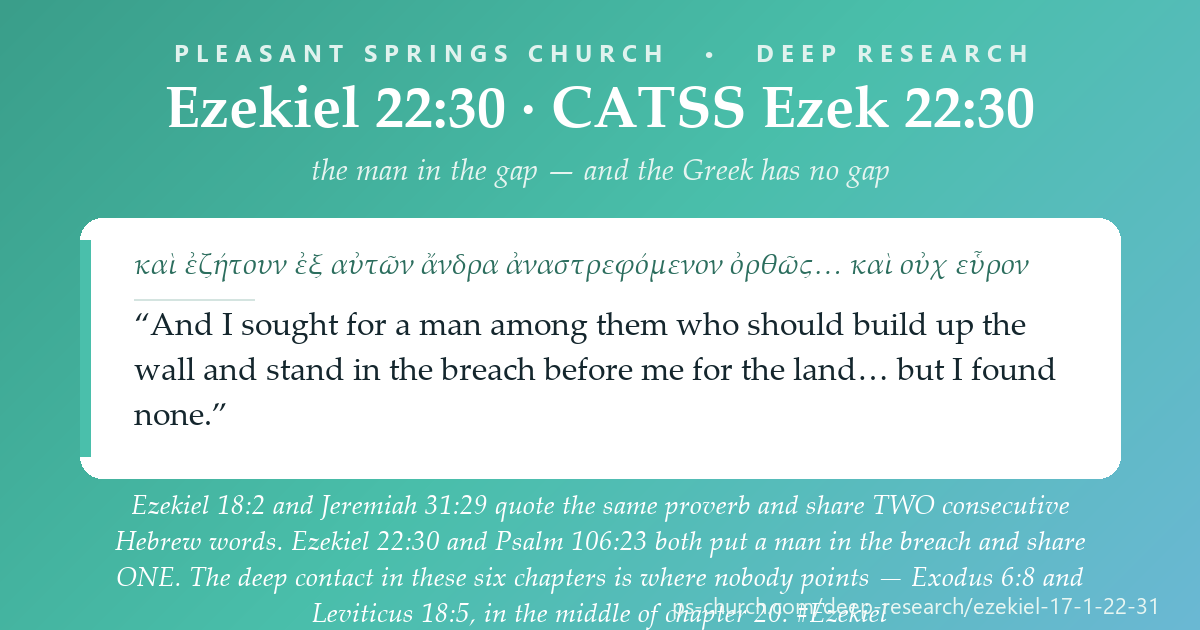
What the audience is finally told is that nobody was standing where they should have been standing. 22:30 is the last verse but one of the passage. God looks for one man to build the wall and stand in the breach and does not find him. The exact form בַּפֶּרֶץ stands in two verses of the Hebrew Bible: this one and Psalm 106:23, where Moses does stand there. The two verses share ONE consecutive word, because Ezekiel writes ועמד and the psalm writes עמד, and Ezekiel writes לפני and the psalm writes לפניו. A vav and a suffix, and the run collapses from four to one.
How it has been carried. 18:4 became the proof-text of individual moral responsibility for the whole Western tradition; 18:31 and 18:32 are read at funerals and revivals; 22:30 has produced more sermons on intercession than any other verse in the book. What this page adds is the measurement, and the measurement is deflationary in every one of those three cases: 18:4 tops out at two consecutive words, 22:30 at two, and 22:30’s famous partner in the Psalms shares one.
Before anything is measured, find out what the words, the forms and the institutions in these chapters are already known to mean, and where the reference works leave a question open.
A dictionary gives the range of a word and the consensus about a genre. It does not tell you what this text does with either. Use it to frame the question, then go and count.
What is a מָשָׁל, and what is a חִידָה?
The lexica give מָשָׁל a very wide range — proverb, byword, taunt, allegory, oracle, parable — unified by the idea of a comparison or a likeness. חִידָה is narrower: an enigma, a puzzle set to be solved, the thing Samson proposes at his wedding feast and the thing the Queen of Sheba brings to Solomon. The dictionaries agree that the two overlap and that 17:2 pairs them deliberately.
What the files show, rather than the dictionaries. The bare noun חִידָה, unprefixed and without the article, stands in exactly two verses of the 23,204-unit Masoretic corpus: Judges 14:12 and Ezekiel 17:2. The verb-plus-noun sequence חוד חידה stands in one: this verse. And the Greek column does not carry a riddle at all — CATSS reads διήγημα, a tale, which stands in six verses of the whole 30,348-unit screened Greek Old Testament and in only this one prophetic verse.
What is a קִינָה?
A funeral dirge, sung over a dead man by professional women, with a characteristic limping metre (the so-called qinah line, three beats followed by two) that the handbooks describe and dispute in equal measure. Amos 5:1–2 sings one over Israel while Israel is still standing, and that is the move Ezekiel 19 makes.
What the files show. קִינָה stands in fifteen verses of the Hebrew Bible. Eight are in Ezekiel — 19:1, 19:14, 26:17, 27:2, 27:32, 28:12, 32:2 and 32:16 — and the rest are in 2 Samuel, Jeremiah, Amos and one place-name in Joshua. Inside chapter 19 it stands in the first verse and the last and nowhere between. The chapter is a labelled box, and the label is on both ends.
What are גִּלּוּלִים?
Ezekiel’s standing word for idols, and the reference works are unanimous that it is an insult. The most widely repeated proposal connects it with גֵּל, a lump or pellet, and specifically with dung pellets, vocalised on the pattern of שִׁקּוּצִים, detestable things. Others read it as rolled things, blocks or logs. The dictionaries flag the etymology as uncertain and the contempt as certain.
What the files show. The word stands in thirty-nine verses of the Hebrew Bible. Thirty-six of those thirty-nine are in Ezekiel, and seven of them are in chapter 20 alone (20:7, 8, 16, 18, 24, 31, 39). The CATSS Greek does not reproduce the insult: it renders the word with ἐπιτηδεύματα, practices, or εἴδωλα, images — at 20:39 it uses ἐπιτηδεύματα for both occurrences in the verse.
What is the “lifting of the hand” in chapter 20?
Repeatedly in chapter 20 God says he lifted his hand — וָאֶשָּׂא יָדִי twice in 20:5, נָשָׂאתִי יָדִי at 20:6 and 20:15, and נָשָׂאתִי אֶת־יָדִי at 20:23, 20:28 and 20:42 — and every English version renders it I swore. The reference works treat it as the standard gesture of oath-taking, comparable to the raised hand in Deuteronomy 32:40 and Daniel 12:7.
What the files show. The idiom is the hinge of this chapter’s deepest external run. Ezekiel 20:28 and 20:42 each share seven consecutive Hebrew words with Exodus 6:8, tie band one apiece — אל הארץ אשר נשאתי את ידי לתת, to the land which I lifted my hand to give. Exodus 6:8 is the verse in which the promise to the patriarchs is restated to Moses. The exact sequence נשאתי את ידי stands in seven verses of the Hebrew Bible: Exodus 6:8, Numbers 14:30, and five in Ezekiel — 20:23, 20:28, 20:42, 36:7 and 47:14. And the Greek loses it: Greek Ezekiel 20:28 against Greek Exodus 6:8 runs THREE, because the two Greek verses render the raised hand differently.
What is a “breach” and what is “building the wall”?
The dictionaries take פֶּרֶץ as a gap torn in a city wall and גָּדֵר as the dry-stone field wall or terrace wall. The combined image at 22:30 is a man physically filling a hole in a defence, and it is usually read alongside Psalm 106:23, where Moses stands in the breach and turns the wrath away.
What the files show. The two-word sequence גֹּדֵר־גָּדֵר stands in exactly one verse of the Hebrew Bible and this is it. The exact form בַּפֶּרֶץ stands in two: Ezekiel 22:30 and Psalm 106:23. A third verse, Ezekiel 13:5, has the plural בַּפְּרָצוֹת with the same verb — and it is an accusation that the prophets did not go up into the breaches. 22:30 is the answer to 13:5, nine chapters later: the man who was told to go up was never found. Neither image survives into the Greek column at either verse.
What the world outside the Bible says about the eagle-and-cedar image, about the treaty chapter 17 is describing, and about the divination at the fork of the road — and how much weight any of it can carry here.
Ancient sources set a scene. They do not settle a text. Everything in this section is cited from published translations at second hand, and none of the measured claims on this page depends on any of it.
The vassal treaty behind chapter 17.
Ezekiel 17 is an allegory of a real, datable political event: Nebuchadnezzar installed Zedekiah on the throne of Judah under oath in 597 BC, and Zedekiah then sent envoys to Egypt for horses. 2 Kings 24:17–20 and 2 Chronicles 36:13 report the same sequence, and 2 Chronicles specifies the oath was sworn by God.
Neo-Assyrian and Neo-Babylonian vassal treaties — the Esarhaddon succession treaties are the best preserved — follow a shape the chapter reproduces: a suzerain, an installed local king, an oath sworn by the gods of both parties, and a long list of curses for breaking it. What the chapter does with the form is the unusual part: 17:19 makes the broken oath an offence against God’s covenant, not Babylon’s.
What that licenses. It makes the allegory datable. It says nothing about when the poem was composed, and this page does not use it that way. Cited from Pritchard’s Ancient Near Eastern Texts and the standard published treaty editions; no cuneiform was read for this page.
Belomancy and hepatoscopy at Ezekiel 21:21.
Hebrew 21:26 (English 21:21) describes the king of Babylon halting where the road forks and using three techniques: shaking arrows, consulting תְּרָפִים, and inspecting a liver. All three are attested in Mesopotamian practice, and extispicy in particular is one of the best-documented activities in the cuneiform record — there are clay liver models with inscribed omens, and whole libraries of bārû reports.
What the two columns do with it. The Greek keeps all three: τοῦ ἀναβράσαι ῥάβδον (to shake up a rod), ἐπερωτῆσαι ἐν τοῖς γλυπτοῖς (to enquire by the carved images), and the single compound verb ἡπατοσκοπήσασθαι, to inspect a liver. Neither column offers any comment on whether the divination worked. The oracle simply says the lot fell on Jerusalem.
Cited from Pritchard and the standard published Akkadian omen literature at second hand; no Akkadian was read for this page.
The cedar of Lebanon as an image of empire.
Kings of the ancient Near East cut Lebanese cedar and said so in their inscriptions — Egyptian, Assyrian and Babylonian royal texts all record cedar expeditions, and the tree functions as a standing image of unreachable height. The Bible uses it the same way at Isaiah 2:13, Ezekiel 31 (Assyria as a cedar) and Daniel 4 (Nebuchadnezzar as a tree).
What the files show. Ezekiel 17 uses the image twice and reverses it in the middle: at 17:3 a foreign eagle takes the top of the cedar, and at 17:22 God says I myself will take from the top of the cedar. The verb and the object are the same in both verses — לקח plus צַמֶּרֶת — and צַמֶּרֶת occurs in five verses of the Hebrew Bible and all five are in Ezekiel — 17:3, 17:22, and 31:3, 31:10 and 31:14, where Assyria is the cedar.
Reading chapter 20 beside the Priestly and Deuteronomic histories.
Chapter 20 tells the exodus and omits almost everything the Pentateuch narrates. There is no plague cycle, no sea, no Sinai, no calf, no spies. What there is instead is a repeated legal formula (I gave them my statutes… they did not walk in them) and a repeated motive clause (I acted for the sake of my name). The commentaries treat the chapter as a rewriting of the tradition rather than a summary of it, and disagree sharply about which written sources, if any, the writer had.
What the measurement can and cannot say about that. It can say that the two verses in the chapter that reach deepest outside Ezekiel land on Exodus 6:8 (seven words, twice) and Leviticus 18:5 (six words). It cannot say whether the writer had those verses in front of him, whether all three draw on a common formula, or which is earlier. The shelf never asserts direction of influence.
Six words and phrases, each one counted across a named corpus rather than described.
Every count below is exhaustive over a named corpus — 23,204 Masoretic verse units, 30,348 screened Greek Old Testament units, 7,927 Greek New Testament verses — and the corpus is named because a count without one means nothing.
The bare form, unprefixed and without the article, stands in exactly two verses of the Hebrew Bible: Judges 14:12 and Ezekiel 17:2. The verb-plus-noun sequence חוד חידה stands in one, and it is Ezekiel 17:2. Samson’s wedding wager and the parable of the two eagles are the only two places in Scripture where somebody sets a riddle in those words.
Two verses in the whole 23,204-unit Masoretic corpus: Ezekiel 18:4 and Ezekiel 18:20. No other writer in the Bible says it. The Greek ἡ ψυχὴ ἡ ἁμαρτάνουσα stands in the same two verses of Greek Ezekiel and nowhere else in the book. The most influential sentence in these chapters is also one of the least connected: 18:4 tops out at TWO consecutive words against the rest of the Hebrew Bible.
Thirty-nine verses of the Hebrew Bible; thirty-six of them in Ezekiel. Seven of the thirty-six are in chapter 20 alone. The CATSS Greek does not carry the contempt across — at 20:39 it renders both occurrences with the same neutral noun, ἐπιτηδεύματα, practices, so the Greek sentence tells them to put away their practices and stop profaning the name with their practices.
That exact form stands in two verses of the Hebrew Bible: Ezekiel 22:30 and Psalm 106:23. Ezekiel 13:5 has the plural with the same verb. And the two verses share exactly ONE consecutive word, because Ezekiel writes ועמד against the psalm’s עמד and לפני against לפניו. The image is shared; the wording is not.
That exact adverb stands in two verses of the whole 30,348-unit screened Greek Old Testament: 1 Esdras 6:27 and Ezekiel 22:30 — the only one in a prophet. A third verse, 3 Maccabees 5:31, carries the adjective ὁλοσχερῆ; this shelf counts forms, not lemmas. It is what the CATSS Greek puts where the Hebrew has in the breach. The Greek Ezekiel is not short of a wall: words on the τειχ- stem stand in thirteen of its verses, one of them at 17:4 in this passage.
Nine verses of Greek Ezekiel carry it, and five of the nine are in this passage — 17:2, 18:2, 18:3, 19:14 and 21:5; the other four are 12:22, 12:23, 16:44 and 24:3. At 19:14 the Greek has εἰς παραβολὴν θρήνου where the Hebrew has no such phrase. The word the Gospels use for how Jesus taught is the word this prophet’s audience used to dismiss him.
מָשָׁל across these six chapters, form by form.
The letters משל stand in eighteen places across eleven verses of Ezekiel — but one of the eleven, 42:6 (מְשֻׁלָּשׁוֹת, in three storeys), is a different root altogether and is excluded from everything that follows. Inside this passage: 17:2 (וּמְשֹׁל מָשָׁל, the commission), 18:2 and 18:3 (the proverb taken away), 19:11 (מֹשְׁלִים — a homograph, rulers, not proverbs), and 21:5 (מְמַשֵּׁל מְשָׁלִים, the dismissal). Outside it: 12:22, 12:23, 14:8, 16:44 and 24:3.
The homograph at 19:11 is worth naming because it is a trap. The consonants are identical to the word for proverb and the meaning is unrelated: the vine had strong stems for the sceptres of rulers. A screen that counted roots rather than forms would fold the two together and produce a thread that is not there. Here even the form does not separate them — 18:2 and 19:11 carry the identical form מֹשְׁלִים — so the two are told apart above by reading, not by the screen, and the separation is editorial and is labelled as such.
Why the page does not build an argument on נֶפֶשׁ.
נֶפֶשׁ in 18:4 is rendered soul by the ESV, ψυχή by the Greek, and person or life by most modern versions. The word covers throat, appetite, life, self and person; whether 18:4 is asserting anything about an immaterial soul is a question about theology and translation history, not about this text.
What can be said from the files is only this: the clause הנפש החטאת is unique to two verses; the Greek renders it the same way in both; and neither column offers any comment on what a נֶפֶשׁ is. Anyone wanting the doctrinal discussion should read it somewhere it is actually being argued, not off a run screen.
The measurement itself: every verse of this passage against the whole Hebrew Bible, and every Greek verse of it against the whole Greek New Testament.
Contiguous runs of whole word forms, exhaustive and deterministic, with the tie band beside every figure. The screen finds verbatim contact. It does not find allusion, and several of the best-known readings below score one and two precisely because allusion is what they are.
THE HEADLINE: twenty-one deep rows, fifty-three partners, and only four of them leave the book.
Screened against the other 23,022 Masoretic verse units, twenty-one of the 182 Hebrew rows reach six consecutive words or more. Between them they carry fifty-three partner verses at their reported maxima. Forty-nine of the fifty-three are inside Ezekiel. Exactly four are not, and they name three verses:
Exodus 6:8, twice — from 20:28 and from 20:42, seven consecutive words each, tie band one each: אל הארץ אשר נשאתי את ידי לתת.
Leviticus 18:5, once — from 20:13, six consecutive words, tie band one: אשר יעשה אתם האדם וחי בהם.
Isaiah 49:26, once — from Hebrew 21:10 (English 21:5), six consecutive words, tie band one: וידעו כל בשר כי אני יהוה. Hebrew 21:4 reaches five with the same Isaiah verse.
Three of the four are in chapter 20, the chapter that retells the Torah. The single deepest row in the whole passage — nine consecutive words at 20:30, tie band one — does not leave the book: its partner is Ezekiel 14:6, and the nine words are a stack of two messenger formulae, לכן אמר אל בית ישראל כה אמר אדני יהוה. The deepest measured thing in these six chapters is boilerplate. Say that plainly, because it is the sort of number a page could quietly let a reader misread.
AND THE COUNTER-EXAMPLES, printed next rather than last.
Ezekiel 18:2 and Jeremiah 31:29: TWO consecutive words. The same proverb, quoted by two prophets, and the shared run is בסר ושני and nothing else. Jeremiah has a perfect verb and no article on sons; Ezekiel has an imperfect and an article. Two morphemes cut the run from six to two.
Ezekiel 22:30 and Psalm 106:23: ONE consecutive word — בפרץ. A prefixed vav on the participle and a suffix on before do the rest.
Ezekiel 21:27 and Genesis 49:10: ONE consecutive word, and the word is לא. That row’s absolute maximum against the entire Hebrew Bible is two, with a tie band of 114.
Ezekiel 17:23 and Mark 4:32: FOUR Greek words, tie band one. This is the closest thing on the page to a real allusion — a great tree, birds sheltering under its shade — and four is what an allusion measures. Compare the six-word run at 20:39, which is almost certainly not an allusion at all.
If a page prints only the numbers that flatter its thesis it is not a measurement, it is an argument with decoration. These four are printed near the top on purpose.
The deepest reach into the Greek New Testament, and why it is not a citation.
Screened against all 7,927 verses of the Greek New Testament, the 182 CATSS rows give 182 at two, 134 at three, 32 at four, 3 at five, 1 at six, nothing at seven. The single six is Ezekiel 20:39 into Revelation 3:12, tie band one: μου καὶ τὸ ὄνομά μου τὸ, breaking on ἅγιον against καινόν.
Here is the reason not to read it as a quotation. Revelation 3:12 is also the sole maximum partner of Greek Ezekiel 20:14 and of Greek Ezekiel 20:22, both at four, both tie band one. Three rows of one chapter, one partner verse. Ezekiel 20 says my name over and over; Revelation 3:12 says τὸ ὄνομα three times in one sentence. That is two formulae colliding.
For scale: across all 1,267 rows of the whole Greek book of Ezekiel only THREE reach six or more — 24:21 at seven (Acts 2:17), 3:3 at six (Revelation 10:10) and this one. So the row is genuinely near the top of its own book, and still not a citation.
THE RED HERRING: Ezekiel 20:6 and 20:9 against Hebrews 8:9.
The runners-up on the Greek side are two rows at five, tie band one apiece: Ezekiel 20:6 and Ezekiel 20:9 into Hebrews 8:9, sharing ἐξαγαγεῖν αὐτοὺς ἐκ γῆς Αἰγύπτου. A five with a band of one looks like contact.
It is not. Hebrews 8:9 shares TWENTY-THREE consecutive Greek words with Greek Jeremiah 38:32 (Masoretic and English Jeremiah 31:32) — τοῖς πατράσιν αὐτῶν ἐν ἡμέρᾳ ἐπιλαβομένου μου τῆς χειρὸς αὐτῶν ἐξαγαγεῖν αὐτοὺς ἐκ γῆς Αἰγύπτου ὅτι αὐτοὶ οὐκ ἐνέμειναν ἐν τῇ διαθήκῃ μου. Hebrews is quoting the new-covenant passage of Jeremiah at length, and Ezekiel happens to use the same five-word exodus idiom.
Five against twenty-three. That is what the tie band cannot tell you and a second screen can. A run figure is only ever a floor on how much work a reader still has to do.
What a zero means here, and where the zeros are.
Eight of the 182 Hebrew rows come out at zero: 17:6, 17:7, 19:3, 19:6, 21:21, 22:5, 22:10 and 22:15 (all in Hebrew numbering; 21:21 is English 21:16). The Hebrew-side screen runs with the unigram fallback OFF, so zero means “shares no two consecutive words with any other verse in the Hebrew Bible”. Every one of the eight shares individual words.
The distribution of the zeros is the finding, not the zeros themselves. Four of the eight are pictures: the vine and the second eagle in chapter 17, the two lion cubs in chapter 19. Three are in the indictment of chapter 22. Chapters 18 and 20 — the two chapters that argue a case — have no zeros at all, and between them hold twelve of the twenty-one rows that reach six or more.
An honest reading of that: when this book reasons it uses the shared vocabulary of Israelite prophecy, and when it draws it stops resembling anything. Whether that is one writer changing register or two hands is a question the screen cannot reach.
The one place the two ancient columns disagree about depth.
Three of this passage’s measured connections behave differently in Hebrew and in Greek, and all three go the same way — deep in Hebrew, shallow in Greek:
20:13 to Leviticus 18:5: six in Hebrew, THREE in Greek.
20:28 to Exodus 6:8: seven in Hebrew, THREE in Greek.
22:30 to Psalm 106:23: one in Hebrew, and in Greek the shared image is not there to measure, because the CATSS Ezekiel has no breach.
And one goes the other way: 18:31 to 36:26 measures five in Hebrew and five in Greek — καρδίαν καινὴν καὶ πνεῦμα καινόν — the only cross-reference on this page that survives translation at full depth.
No conclusion is drawn from this about which text is older or what the translator was doing. It is reported because a page that measured only one column would have produced a different set of headlines and not known it.
Two screens, two meanings of zero, and this page uses both. The Hebrew-side screen (passage_vs_tanakh) runs with the unigram fallback OFF: a reported 0 means no adjacent word pair anywhere in the other 23,022 Masoretic verse units. The Greek-side screen (book_vs_nt) runs with the fallback ON: a reported 1 would mean the two verses share isolated words and no adjacent pair. On this page no Greek row reports 1 — all 182 reach at least two. Every run figure here was measured on 31 August 2026 and applies MorphGNT’s own spelling equivalences, so nothing was copied from a sibling page and nothing here should be compared with a figure published on this shelf before 30 August 2026.
What the specialists argue about in these six chapters and — the part that matters — what this page could not check.
This is the section that makes the shelf usable. Everything above is either quoted from a file on this disk or measured on one. Everything that is neither is named here.
WHAT THIS PAGE COULD NOT CHECK — read this before citing anything above.
No critical apparatus was consulted for the Hebrew. The Masoretic text used is Sefaria’s digitization of Miqra according to the Masorah. No variant readings were collated from BHS or BHQ, and no Dead Sea Scroll was examined — the Masada and Qumran Ezekiel fragments included.
The Greek is Rahlfs as digitized by CATSS, and that is one edition. Ziegler’s Göttingen Ezechiel was not consulted, and neither was Papyrus 967, which is the manuscript question in Greek Ezekiel: it carries a different chapter order in the second half of the book and is missing 36:23c–38. Every statement above of the form “the Greek reads…” is a statement about one digitized edition on one disk. The claim that most concerns 967 — the missing wall and breach at 22:30 — was not checked against it and could look different there.
No ESV file exists on this disk for Ezekiel and no Crossway API key exists in this project. The English column above was typed. Its verse alignment rests on verse counts and chapter openings, not on a held text. The Hebrew and Greek columns were pulled programmatically from the corpus files and can be re-derived by anyone with the repository.
Where the corpus itself is thin, and what that cost this page.
Greek Exodus, Leviticus and Numbers ARE held here and were searched — the whole-corpus screens run over 30,348 Greek Old Testament verse units including all three — but they sit outside the named book map used by the per-book helper, so the Greek Torah comparisons above were run by explicit file reference rather than by book name. If that mapping is wrong, the two figures at risk are the Greek 20:13–Leviticus 18:5 run of three and the Greek 20:28–Exodus 6:8 run of three. Both were spot-checked by printing the two Greek verses in full and reading them.
The Odes are excluded from every Greek screen on this page. The CATSS collection held here is 64 files and 30,637 verse units; the screened corpus is 30,348, because Ode 9 is Luke 1 and Ode 13 is Luke 2 copied into a Greek Old Testament manuscript, and ten more Odes are second copies of Exodus 15, Deuteronomy 32, 1 Samuel 2, Habakkuk 3, Isaiah 26, Jonah 2, Daniel 3, Isaiah 5 and Isaiah 38. Leaving them in would inflate any tie band that touched one, and two of them would have put New Testament text into an Old Testament screen.
The argument this page is standing next to and not joining: chapter 20 and the Torah.
Chapter 20 rewrites the exodus with the salvation removed and adds a sentence — I gave them statutes that were not good (20:25) — that has generated a very large literature. The main proposals are that it refers to child sacrifice (reading 20:26 as its explanation), that it refers to a body of law the writer regarded as illegitimate, that it is a judicial hardening comparable to Isaiah 6:9–10, or that it is a rhetorical concession rather than a claim about the Sinai legislation.
This page has nothing to contribute to that and says so. What it can report is that 20:25 is a deliberate negative of 20:11 and 20:13 in both columns — the same two nouns, the same live by them — and that 20:11 and 20:13 are the verses standing closest to Leviticus 18:5. The measurement establishes that the negation is aimed at a specific sentence. It cannot tell you what the negation means.
The relationship between Ezekiel 18 and Jeremiah 31, and what a run screen cannot settle.
The standard treatments read Ezekiel 18 and Jeremiah 31:29–30 as two prophets taking up the same current proverb, and disagree about whether either knew the other, and about whether both are reacting to Exodus 20:5 and Deuteronomy 5:9.
The screen’s answer is two consecutive words, and that answer is compatible with every one of those positions. A shared proverb quoted from memory in two different grammatical shapes is exactly what a low run looks like; so is no relationship at all. The number rules out one thing only: that either verse was copied from the other in writing. It cannot rule out dependence, and this page does not claim it does.
Things a specialist would raise that this page cannot answer.
Is the Greek of 22:30 translating a different Hebrew text, or paraphrasing? Unanswerable from one digitized edition. The page reports that the same file does the same thing at 13:5, which is consistent with either.
Is chapter 19 poetry in a strict qinah metre, and does that metre exist? Metrical analysis is not something a word-form screen can do, and the handbooks disagree about the metre itself.
Why does the Greek add εἰς παραβολὴν θρήνου at 19:14? The page counts the word and stops.
Does the fivefold repetition of the recognition formula in chapter 20 structure the chapter? Probably; the section markers do not agree with it, and this page built its diagram from the markers because the markers are in the file.
Why does Greek Ezekiel reach the New Testament so shallowly for a book of 1,267 verses? Only three of its rows reach six or more — 24:21, 3:3 and 20:39 — against 258 that reach four. Whether that is a fact about Ezekiel’s Greek, about how the New Testament uses Ezekiel, or about the screen, this page does not know.
Where this page is weakest.
One. The ESV column is typed, not held. It is the only column on this page that was not machine-read from a file, and the two rows carrying the chapter-20/21 offset are the ones where a typing error would be hardest to see.
Two. The eight-zero finding rests on eight rows out of 182, and the claim that four of them cluster in the “picture” chapters is an observation about a small number. It is reported as an observation and nothing is built on it.
Three. Stage 2 is entirely second-hand and none of it can be checked here.
Four. The comparison passage is one comparison. Ezekiel 33–37 was measured on the same day with the same settings; no systematic survey of the whole book was run, and the claim that this passage is unusually deep on the Hebrew side is supported against that one neighbour and against the general run of this shelf.
Five. The literary-structure diagram is built from one edition’s section markers. The Greek file has no markers, so the internal shape shown is a Hebrew-side shape and is labelled as one.
- Block, The Book of Ezekiel: Chapters 1–24 (NICOT) — the fullest recent English commentary on this exact span.
- Greenberg, Ezekiel 1–20 (Anchor Bible) — the holistic reading, and the classic treatment of chapter 20 as a unity.
- Zimmerli, Ezekiel 1 (Hermeneia) — the redaction-critical account these chapters are usually read through.
- Joyce, Divine Initiative and Human Response in Ezekiel — on whether chapter 18 is about individuals at all.
- Matties, Ezekiel 18 and the Rhetoric of Moral Discourse — on the disputation form.
- Lust (ed.), Ezekiel and His Book, and the literature on Papyrus 967 — the Greek textual question, NOT consulted for this page.
- Ziegler, Ezechiel (Septuaginta: Vetus Testamentum Graecum, Göttingen) — the critical Greek edition, NOT consulted for this page.
- Pritchard (ed.), Ancient Near Eastern Texts Relating to the Old Testament — the vassal treaties and the omen literature, cited at second hand.
The measurements are done and printed. What you make of them is the part this page cannot do for you.
Everything above can be re-derived from the files. Bring what you find — including where you think this page is wrong.
Sit with the counter-examples first.
The three best-known cross-references in these chapters measure two, one and one. The two deepest connections outside the book are to Exodus 6:8 and Leviticus 18:5, and almost nobody cites either. What everyone quotes and what actually repeats are two different lists, and only one of them can be counted.
That is not an argument that the famous cross-references are wrong. Ezekiel 18 and Jeremiah 31 really are answering the same proverb; Ezekiel 22:30 and Psalm 106:23 really are the same picture. It is an argument that agreement of meaning and agreement of wording are two different measurements, and a page that reports one should never let a reader take it for the other.
Then sit with 20:39 and Revelation 3:12.
Six consecutive Greek words, tie band one, and they break on the adjective. Ezekiel: my name, the holy one, you shall not profane again. Revelation: and my name, the new one. Only three rows in the whole Greek book of Ezekiel reach six or more, and this is one of them.
The page has already told you not to call it a citation, and the reason is printed above: the same Revelation verse is the top partner of two other verses in the same Ezekiel chapter. So the honest question is not “did John quote Ezekiel here”. It is: what is it about the phrase my name that makes two books three centuries apart build the same six words without either one reaching for the other?
Then sit with the gap.
22:30 is the verse that has launched the most sermons in these six chapters, and it is the verse where the two ancient columns are furthest apart. The Hebrew wants a builder standing in a hole in a wall. The Greek wants a man whose conduct is upright, standing wholly before God. Neither column has anybody who qualifies.
Read 13:5 first — the accusation nine chapters earlier that the prophets did not go up into the breaches — and then read 22:30 as its verdict. And notice what the chapter does next: it does not find a man. It pours out the wrath. The passage that begins with an eagle carrying off a king ends with God looking for one person and not finding one.
Bring us the checks this page could not run.
Anyone with Ziegler’s Ezechiel, or with a transcription of Papyrus 967, can check three things this page explicitly could not: whether another Greek edition has a wall and a breach at 22:30, whether 19:14 carries εἰς παραβολὴν θρήνου outside CATSS, and whether the chapter numbering of Ezekiel 17–22 is stable across the Greek witnesses as it is in this file.
Send corrections. A page that names its weak points is asking to be checked at them.
Every Deep Research page traces its passage across the whole sweep — the Old Testament, the Second-Temple world between the testaments (historical witnesses, not Scripture), and the New Testament. Follow the thread:
Pleasant Springs Church — Deep Research
Research method after Michael S. Heiser’s Bible Research Method (examine dictionaries → ancient literature → important words → textual connections → academic publications → share), with the Pleasant Springs “Author & Audience” foundation. Scripture set in the Hebrew, the Greek editions named on each page and the ESV (Old Testament), and the Greek New Testament and the ESV (New Testament), per the practice of Pleasant Springs Church. Ezekiel research grounded in Block (NICOT), Greenberg (Anchor), Zimmerli (Hermeneia), Joyce and Matties. Text: Hebrew from the Masoretic text as printed in the edition consulted — Sefaria’s Miqra according to the Masorah; no critical apparatus was consulted for the Hebrew and no Dead Sea Scroll was collated. Greek from Rahlfs’ Septuaginta as digitized by CATSS; Greek New Testament from the SBL edition as digitized by MorphGNT. The standing caution for this shelf applies: these pages say “the CATSS Greek text reads…” and never call a Greek reading early or late, and never say which text acted on which. ⚠️ Verse numbering — there IS an offset in this passage, and for once it is the English that is out of step, not the Greek. Ezekiel is aligned chapter for chapter between the Masoretic text and the CATSS Greek throughout these six chapters: Hebrew 17, 18, 19, 20, 21 and 22 hold 24, 32, 14, 44, 37 and 31 verses, and the CATSS file holds 24, 32, 14, 44, 37 and 31 — identical, with no verse of the passage missing from either column. The English chapter division is the one that differs. English Ezekiel 20 runs to 49 verses and English Ezekiel 21 to 32; the ancient columns put the same 81 verses as 44 and 37. English 20:45–49 is Hebrew and Greek 21:1–5, and from there to the end of the chapter English 21:n is Hebrew and Greek 21:n+5. So the sword-song of English 21:9–17 is Hebrew and Greek 21:14–22; Nebuchadnezzar at the fork of the road, English 21:21, is Hebrew and Greek 21:26; and a ruin, ruin, ruin, English 21:27, is Hebrew and Greek 21:32. Chapters 17, 18, 19 and 22 have no offset at all and the passage as a whole has the same first and last verse in all three columns. Every codex row above leads with the ENGLISH reference and prints the ancient one beside it; the two rows where they differ print it in bold. The alignment was derived by reading the verse counts and the verse texts off the files on this disk, not by copying a printed table. ⚠️ The ESV column was NOT verified against a held ESV text. No ESV file for Ezekiel exists on this disk and no Crossway API key exists in this project; the English was typed and its verse alignment rests on verse counts and chapter openings. The Hebrew and Greek columns were pulled programmatically from the corpus files. ⚠️ Every cross-corpus run figure on this page was measured on 31 August 2026 and applies MorphGNT’s own spelling equivalences — οὐ/οὐκ/οὐχ, ἐκ/ἐξ and the movable nu — so that a shared run is not cut at a word the two editions merely spell differently. Figures published on this shelf before 30 August 2026 are lower for that reason; nothing was copied from a sibling page, and the Ezekiel 33–37 comparison figures quoted above were re-measured here. ⚠️ A run of zero on the Hebrew screen means NO TWO CONSECUTIVE WORDS. The Hebrew-side screen runs with the unigram fallback off, so max = 0 at 17:6, 17:7, 19:3, 19:6, 21:21, 22:5, 22:10 and 22:15 — Hebrew numbering, so 21:21 is English 21:16 — means those verses share no adjacent word pair with any of the other 23,022 Masoretic verse units; they do share individual words. The Greek-side screen runs with the fallback ON, and on this page no Greek row reports 1: all 182 reach at least two. The Hebrew screen was run twice, once reading every ketiv and once reading every qere; the two passes agree on all eight zeros, on the single nine and on both eights, and differ on one row only — 17:13, which moves between two and three and is not reported as a finding. ⚠️ The Masoretic text held here counts the scribal section markers as words, and every deep row on this page was checked for it. {ס} and {פ} stand inside the verse text of the Sefaria file and the frozen normaliser tokenises them. All twenty-one rows reaching six or more, including the single nine and both eights, were checked individually and none of their reported runs ends on a marker. normalize.py is frozen and was not edited. ⚠️ Greek Old Testament figures are scoped to the 64 CATSS files held here, 30,637 verse units, screened to 30,348 with the Odes excluded. Two of the Odes are New Testament text — Ode 9 is Luke 1 and Ode 13 is Luke 2 — and ten more are second copies of Exodus 15, Deuteronomy 32, 1 Samuel 2, Habakkuk 3, Isaiah 26, Jonah 2, Daniel 3, Isaiah 5 and Isaiah 38, so leaving them in would inflate any tie band that touched one. ⚠️ Papyrus 967 and Ziegler’s critical edition were NOT consulted. Greek Ezekiel has a live manuscript question in its second half and this page does not enter it; every “the Greek reads” statement above is about one digitized edition. Typology is handled per the house position: what the text says, what the New Testament itself draws, and what we see from this side of the cross — with the seeing left to the reader.
Scripture quotations marked ESV are from the ESV® Bible (The Holy Bible, English Standard Version®), © 2001 by Crossway, a publishing ministry of Good News Publishers. ESV Text Edition: 2016. Used by permission. All rights reserved. The ESV text may not be quoted in any publication made available to the public by a Creative Commons license, and the ESV may not be translated in whole or in part into any other language. www.esv.org
|
Did this study bless you today? 💚 Give to Support PS Church100% of gifts go to the General Fund — thank you. |