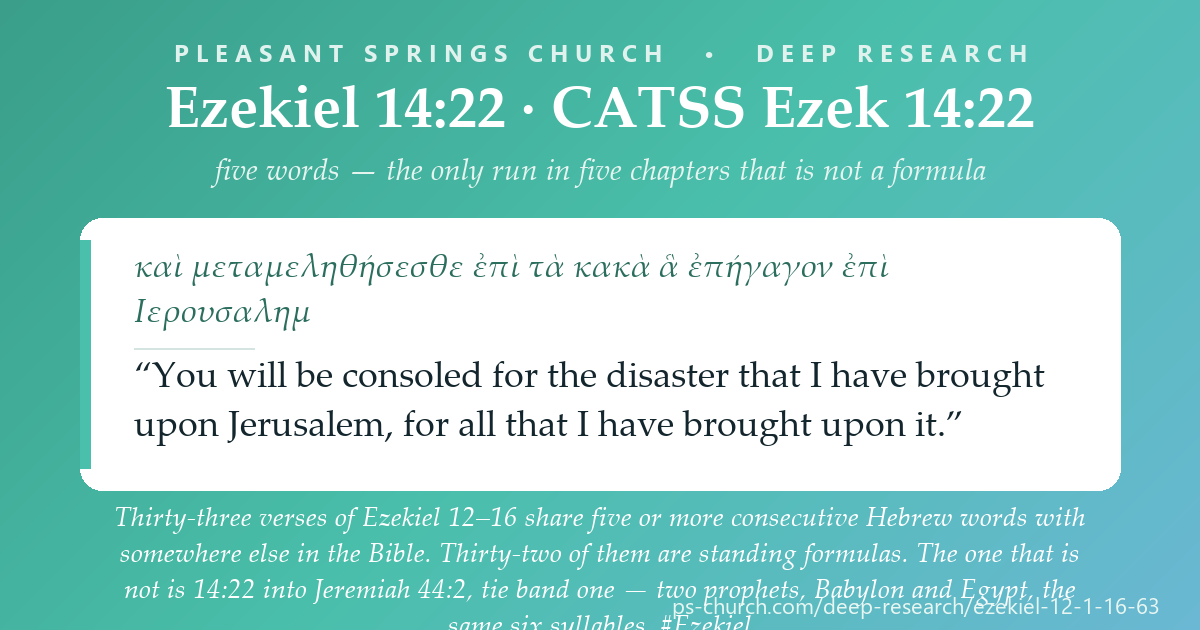
Five chapters, one hundred and forty-five verses: a prophet packing an exile's bag and digging through his own wall; prophets who say peace and daub the cracks; elders who come to enquire with idols already in their hearts; Noah and Danel and Job, who could not save a city; a vine that is good for nothing but the fire; and a baby girl thrown out in a field, rescued, dressed, married and then accused for forty-eight verses. These are among the most vivid pages in the prophets. Measured, they are verbatim contact with almost nothing. Thirty-three of the 145 Hebrew verses reach five or more consecutive words somewhere else in the Hebrew Bible — and thirty-two of those thirty-three are standing formulas: the word-event formula, the messenger formula, the oath, the recognition formula, the covenant formula. Exactly one is content, and it is Ezekiel 14:22 against Jeremiah 44:2, tie band one: the disaster that I have brought upon Jerusalem. Meanwhile every famous cross-reference in these chapters measures at or below three. Ezekiel 16:8 against Ruth 3:9 — the spread garment — shares no two consecutive Hebrew words at all. Ezekiel 15 against the whole of Isaiah 5 does not reach two on a single one of its eight verses. Ezekiel 16:49 against the whole of Genesis 19 shares no adjacent word pair, and one of the isolated words it does share is “Sodom”. The imagery in these chapters is not borrowed. It is theirs. See the method →
Ezekiel 12:1–16:63 — sixteen rows across all five chapters (⚠️ NO VERSIFICATION OFFSET ANYWHERE IN THIS PASSAGE. Unusually for this book, the Masoretic text, the CATSS Greek and the ESV agree on every chapter length and every verse number across the whole passage — 28, 23, 23, 8, 63 in all three. Every one of the 145 Hebrew verses has a Greek row. The offsets in Ezekiel are elsewhere; see the footer.)
Hebrew (Masoretic) · Greek (CATSS/Rahlfs) · ESVThe Shape of the Passage
Sequence — eleven units, ten of them opened by the same five wordsNothing on this page settles when Ezekiel 12–16 reached the form it has. The book is dated, first-person and tightly formulaic, and the formulas are exactly what the measurement finds. That is a fact about vocabulary, not about authorship. Where the literature argues for later expansion — chapter 16's closing sections are the usual candidate — this page reports the argument and does not join it.
Author
The most measurable thing about this author is how he starts. The formula וַיְהִי דְבַר־יְהוָה אֵלַי לֵאמֹר — and the word of the LORD came to me, saying — stands in 47 verses of the whole Hebrew Bible: 39 in Ezekiel, 6 in Jeremiah, 2 in Zechariah, and nowhere else. Nine of Ezekiel’s occurrences are in these five chapters — 12:8 opens the same way but puts בַּבֹּקֶר inside the formula. Nine of the passage’s thirty-three runs of five are that one sentence.
And the most measurable thing about his vocabulary is one insult. גִּלּוּלִים — the word the ESV renders idols, built on a root for dung-pellets or rolled things — occurs across 46 verses of the Hebrew Bible, and 36 of the 46 are Ezekiel. Six of the thirty-six are here: 14:3, 14:4, 14:5, 14:6, 14:7 and 16:36. The CATSS Greek does not keep the insult. At 14:6 it renders the word ἐπιτηδευμάτων, practices. A reader of the Greek column is not being told what a reader of the Hebrew column is being told.
He is a priest, and the passage keeps proving it. The categories are priestly ones: טָמֵא, defile; תּוֹעֵבָה, abomination; and at the very last word of the passage כִּפֶּר, to atone — the verb of the Day of Atonement, which CATSS renders ἐξιλάσκεσθαι. Ezekiel 16 ends on a cultic verb, not a moral one.
Audience
The audience is in Babylon and the subject is in Jerusalem. That gap is the whole engine of chapters 12–16. The proverbs quoted and cancelled at 12:22 and 12:27 are exile proverbs: the days grow long and every vision comes to nothing, the vision he sees is for many days from now. These are the words of people who have been told the city will fall and have watched it not fall. The prophet packs a bag and digs through a wall in front of them because they are not listening to sentences.
The elders come to him and he is told not to answer them. 14:1 — אֲנָשִׁים מִזִּקְנֵי יִשְׂרָאֵל, men of the elders of Israel, three words shared with Ezekiel 20:1, tie band one, and with nothing else in the Hebrew Bible. Twice in the book a delegation sits down in front of the prophet, and both times the answer is that God will answer them himself.
And chapter 16 is addressed to a woman who is a city. Every verb addressed to her from 16:3 to 16:63 is second-person feminine singular. The audience listening in Babylon is being made to overhear God speaking to Jerusalem — to her infancy, her wedding, her adulteries and her sisters. The people hearing it are the ones who have already lost her. Nothing in the chapter asks them to repent. The last thing it says is that God will atone, and she will have nothing to say.
Before anything is measured, find out what the words and names in these chapters are already known to mean — and, more usefully, find the places where the reference works admit they are guessing.
A dictionary gives the range of a word and the consensus about a name. It does not tell you what this text does with either. Stage 1 collects the open questions; stages 3 and 4 test them against the files on this disk.
Four words in these chapters that the dictionaries cannot pin down.
כְּסָתוֹת and מִסְפָּחוֹת (13:18, 20, 21) — the objects the women prophets make. Every lexicon marks both uncertain. The ESV renders them magic bands and veils; CATSS reads προσκεφάλαια (pillows) and ἐπιβόλαια (coverlets). Stage 3 reports how many verses of the Hebrew Bible each noun stands in. The answer is two, and two.
תָּפֵל (13:10, 11, 14, 15) — the whitewash. A dictionary will tell you it means an inferior plaster, and will point at the homograph in Job 6:6 meaning tasteless. It will not usually tell you that the same three consonants are the ordinary Hebrew for it will fall — which is what the Greek column here has.
גַּב (16:24, 31, 39) — what the woman builds. A back, a hump, an arch, a mound. The ESV guesses vaulted chamber; CATSS decides it is a brothel, πορνεῖον. Three columns, three buildings.
גִּלּוּלִים (14:3–7; 16:36) — the word for idols that most dictionaries connect to a root meaning dung-pellets. It is not a neutral term and the English idols hides that.
Three names, and what a dictionary will and will not tell you about them.
Noah, Daniel, Job (14:14, 20) — a dictionary will note that all three are non-Israelite or pre-Israelite righteous men, and that this is an odd trio if the middle one is the Daniel of the Babylonian court, who at the dramatic date of Ezekiel would be a young contemporary rather than an ancient. Stage 2 takes the question up, and Stage 3 reports what the consonants on the page actually are.
Sodom and Samaria (16:46–56) — called Jerusalem's sisters, the younger and the elder. The sting is that Jerusalem is told she is worse than both. A dictionary will report the standard later reading of Sodom's sin as sexual; 16:49 itself lists pride, food and ease.
Amorite and Hittite (16:3, 45) — your father was an Amorite and your mother a Hittite. Both are Canaanite peoples in the standard lists. The verse is an insult about parentage, not a claim about ethnography, and the only other verse of the Hebrew Bible that puts the two together like this is 16:45, forty-two verses later in the same chapter.
Where the dictionaries and this page disagree about what needs saying.
A dictionary entry on Ezekiel 16 will tell you about the marriage metaphor and point at Hosea 1–3 and Jeremiah 2–3. All of that is worth knowing and none of it is measurable as verbatim contact.
What is measurable, and what no dictionary entry says, is this: Ezekiel 16 and Ezekiel 23 — the two chapters that share the metaphor most closely, in the same book, in the same voice — share exactly one non-formula phrase of four words or more across 63 verses. That is at Stage 4. It does not mean the chapters are unrelated. It means the relationship is not made of shared sentences, and anyone who claims it is has not counted.
What did a wall, a whitewash, a foundling and a righteous ancient look like to somebody living in the sixth century BC?
This stage sets the text beside the world it was written in. Everything here is background and is labelled as background; the numbers on this page come from Stages 3 and 4, not from this section.
Danel — and the one thing about him this page CAN measure.
The claim in the literature. Since the Ras Shamra tablets were published, a long line of scholars has argued that the middle figure of Ezekiel's trio is not the Daniel of the Babylonian court but Danel, the righteous judge of the Ugaritic Aqhat epic — a legendary ancient who judges the cause of the widow and tries the case of the orphan, which is precisely the kind of righteousness Ezekiel 14 is talking about. The argument is that Noah and Job are both ancient non-Israelites from outside the national story, and that the middle name should be one too. A counter-line, argued at length, is that Ugaritic Danel is a devotee of Baal and an unlikely exemplar, and that Ezekiel means his contemporary.
What this page can add. Nothing about Ugarit — no Ugaritic corpus is held here and the Aqhat text was not consulted. But the spelling is measurable, and it was measured. In all three Ezekiel verses that carry the name — 14:14, 14:20 and 28:3 — the ketiv, the consonants written on the page, is דנאל, with no yod. That spelling occurs in exactly those three verses and nowhere else in the Masoretic corpus. Read the qere instead and the name stands in 71 verses of the Hebrew Bible — 65 in Daniel, one each in Ezra, Nehemiah and 1 Chronicles, and these three.
And what it cannot. A defective spelling is not proof of a different person. Hebrew orthography is not consistent, and the CATSS Greek column simply writes Δανιηλ. The page reports the ketiv as a measured fact and leaves the identification open.
The wall Ezekiel digs through, and the wall the prophets whitewash.
Both walls are mud brick, and that is the whole point of both scenes. A Babylonian or Judahite house wall was sun-dried brick over a stone footing. You can dig through it with your hands, which is what 12:5 and 12:7 have the prophet do in front of an audience — not a metaphor for escape, a demonstration of it.
And you have to keep the rain off it. A mud-brick wall is finished with a plaster coat; if the coat fails, the wall dissolves. 13:10–15 is a builder's image, not a decorator's: the false prophets are not making an ugly wall pretty, they are applying the one layer that is supposed to keep it standing, and applying the wrong material. Then comes an גֶּשֶׁם שׁוֹטֵף, a flooding rain, and hailstones, and a storm wind. The image works because everyone listening had watched a wall go.
Background note, and it is only background: whether the “breaches” of 13:5 are the same image as the wall of 13:10 is a reading decision, not a measurement. The CATSS Greek of 13:5 does not have breaches at all — it reads οὐκ ἔστησαν ἐν στερεώματι, they did not stand in the firm place, and adds a clause about gathering flocks (συνήγαγον ποίμνια) that the Hebrew has nothing for. The two columns are not describing the same failure.
A newborn on the ground: what 16:4–5 assumes its audience knows.
The verse lists four ordinary things nobody did for her. The cord was not cut. She was not washed in water. She was not rubbed with salt. She was not wrapped in cloths. These are the standard birth rites of the ancient Near East and the Mediterranean, and the salt-rub is attested widely as an antiseptic and toughening treatment for newborn skin. The horror of the verse is not that something exotic was withheld; it is that nothing at all was done.
Then she is thrown out into the open field. Exposure of unwanted infants is attested across the ancient world, and legal texts from Mesopotamia deal with the status of a foundling and of whoever raises one. The rescue in 16:6 is therefore a legal act as well as a merciful one.
16:8 is a marriage. Spreading the corner of a garment over a woman is a betrothal gesture; swearing an oath and “entering into a covenant” is contract language. The chapter is telling a life in the order a law court would take it: birth, custody, majority, marriage contract, breach.
Ruth 3:9 is the parallel everyone cites for the garment gesture, and it is worth citing. Measured, the two verses share no two consecutive Hebrew words — see Stage 4. The custom is shared; the wording is not.
The women of 13:17–23, and the limits of what can be said about them.
They prophesy מִלִּבְּהֶן, out of their own heart — the same charge levelled at the men in 13:2. The extra charge is manipulative: they sew objects and tie them onto wrists and heads, they hunt souls, they profane God for handfuls of barley and pieces of bread.
Comparison with Mesopotamian ritual practice is the standard move here — binding and loosing rites, knotted cords, figurines — and it is a reasonable move. But no cuneiform ritual text was consulted for this page, and the two Hebrew nouns are too rare to control. What the measurement gives is distribution, not meaning: each noun stands in exactly two verses of the Hebrew Bible and both verses of each are in this chapter.
One thing the text does say plainly and is often skipped: the oracle ends at 13:23 with you shall no more see false visions nor practice divination, and the deliverance is of their victims, not their punishment. I will deliver my people out of your hand.
Six words, each counted across the whole corpus rather than described. Every figure below was produced by the same frozen normaliser that produced the run tables in Stage 4.
A word study on this shelf is a count, not an impression. The Hebrew screen strips cantillation and vowel points, folds final letter forms, reads the qere and treats maqqef as a word break; the Greek screen drops accents and breathings and folds final sigma. Both are consonantal or near-consonantal screens, which means a count can gather homographs. Where that happens below it is said.
As a noun, this stands in exactly two verses of the 23,204-unit Masoretic corpus — Ezekiel 13:18 and 13:20 — and nowhere else. CATSS reads προσκεφάλαια, pillows.
Also exactly two verses, 13:18 and 13:21. The same three root consonants stand in Leviticus 13:6, 7 and 8 as מִסְפַּחַת, a skin eruption the priest inspects. That is a consonantal coincidence, and this page reports it as one — the vocalisation and the sense differ.
The consonantal form תפל stands in fourteen verses. In seven it is a form of fall (Exodus 15:16; Numbers 34:2; Jeremiah 36:7, 37:20, 39:18, 42:2; Esther 6:10). One is the place name Tophel, Deuteronomy 1:1. One is Job 6:6, tasteless. The whitewash sense is Ezekiel's: 13:10, 11, 14, 15 and 22:28, plus Lamentations 2:14 with a prefix.
Stands in 46 verses of the Hebrew Bible and 36 of them are Ezekiel — the rest scattered over Leviticus, Deuteronomy, Kings, Jeremiah and Zephaniah. Six of the thirty-six are in this passage. The consonantal screen also catches the personal name Gilalai at Nehemiah 12:36 and the literal dung of Ezekiel 4:12 and 4:15, none of which is this word; all three are excluded from the 46.
35 verses in the Hebrew Bible; four of them are Ezekiel, and two of the four are in this passage — 12:6 and 12:11, where the prophet himself is the portent. The other two are 24:24 and 27, where he is a portent again, on the day his wife dies.
Stands in exactly four verses of the Greek New Testament and all four are John 15 — 15:2, 4, 5, 6. In CATSS Ezekiel it stands in five verses, the first of them 15:2. And the measured run between the two chapters is one and two. Shared vocabulary; no shared phrase.
Two more counts worth printing, because both cut against an easy conclusion.
The word-event formula. ויהי דבר יהוה אלי לאמר stands in 47 verses of the Hebrew Bible — 39 Ezekiel, 6 Jeremiah, 2 Zechariah. That is why nine rows of this passage report a run of five with a tie band in the forties. A tie band of 43 is the number telling you not to be impressed.
The oath formula. חי אני נאם אדני יהוה אם — six words, and it produces three of the passage's eight sixes: 14:16, 14:20 and 16:48, each with a tie band of eight or nine. In Greek the same formula is what puts Romans 14:11 at the top of four separate rows — ζῶ ἐγώ λέγει κύριος, four words, tie band one — and Romans 14:11 is quoting Isaiah 45:23. The deepest Greek New Testament contact that chapters 14 and 16 make is with a verse citing a different book.
Every figure in this section was produced by running each of the 145 Hebrew verses against the whole Masoretic corpus, and each of the 145 CATSS Greek rows against all 7,927 verses of the Greek New Testament. The tie band is printed beside every run.
The screen finds the longest run of consecutive identical word forms shared with any other verse, and the tie band — how many other verses tie at that depth. A run of nine with a band of one is distinctive. A run of five with a band of 43 is a formula. The screen finds verbatim contact and cannot find allusion, which on this passage turns out to be the most important sentence on the page.
The whole distribution, Hebrew side — and what it is made of.
145 rows. 134 reach two, 85 reach three, 51 reach four, 33 reach five, 8 reach six, 3 reach seven, one reaches nine. Eleven reach zero, meaning they share no two consecutive words with any of the other 23,000-plus Masoretic verse units.
Now the part that decides this page. Here are all thirty-three of the verses that reach five or more, sorted by what they are made of.
- The word-event formula ויהי דבר יהוה אלי לאמר — nine rows: 12:1, 12:17, 12:21, 12:26, 13:1, 14:2, 14:12, 15:1, 16:1. Tie bands 43–46.
- The messenger formula כה אמר אדני יהוה with its various attachments — fifteen rows: 12:10, 12:23, 12:28, 13:3, 13:8, 13:13, 13:18, 13:20, 14:4, 14:6, 14:21, 15:6, 16:3, 16:36, 16:59. Tie bands 1 to 29. This is where the nine at 14:6 lives, and the seven at 13:20.
- The oath formula חי אני נאם אדני יהוה — four rows: 14:16, 14:18, 14:20, 16:48.
- The recognition formula וידעתם כי אני יהוה — two rows: 13:9, 13:14.
- The covenant formula והיו לי לעם ואני אהיה להם לאלהים — one row: 14:11, seven words, tie band four.
- The commission formula בן אדם שים פניך אל — one row: 13:17.
- Content — one row. 14:22, five words, tie band one, with Jeremiah 44:2: הרעה אשר הבאתי על ירושלם.
Thirty-two formulas and one sentence. That is the finding this page is built on, and it is a finding about method as much as about Ezekiel: on a passage this vivid, almost everything the run screen can see is furniture.
The counter-examples. Six famous connections, measured.
These are printed because the numbers above must not be read as more than they are. The first three were run chapter against chapter, every verse of one against every verse of the other; the last three verse against verse. The chapter screens run with the unigram fallback ON, so a reported 1 means the two verses share isolated words and no adjacent word pair at all.
- Ezekiel 15 against the whole of Isaiah 5 — the two vine passages. All eight verses of Ezekiel 15 report ONE. Not one verse of the chapter shares two consecutive words with the Song of the Vineyard. The shared words are isolated function words and names — יהוה, את, עוד and ירושלם among them.
- Ezekiel 15 against the whole of Psalm 80 — the vine brought out of Egypt. The best any verse manages is TWO, and the two words are בן אדם — the vocative, not the vine. 15:5 reports zero.
- Ezekiel 16:44–58 against the whole of Genesis 19 — the sisters, and the Sodom narrative. Thirteen of the fifteen verses report ONE, and in six of them one of the shared words is the name סדם. The two that reach two share אשר עשית, which you did. 16:49 — the verse that defines Sodom’s sin for the entire later tradition — shares no adjacent word pair at all with Genesis 19, and one of the isolated words it does share is ‘Sodom’.
- Ezekiel 16:8 / Ruth 3:9 — the spread garment. ZERO. Run verse against verse: no two consecutive Hebrew words in common.
- Ezekiel 12:2 / Jeremiah 5:21 — eyes that do not see. TWO (עינים להם). Against Isaiah 6:9, ONE. Against Deuteronomy 29:3, ONE.
- Ezekiel 12:2 / Mark 8:18 — in Greek, the closest thing to a New Testament quotation of this verse. TWO (καὶ οὐ). Against Matthew 13:13, THREE (οὐ βλέπουσιν καί). Against Mark 4:12, ONE.
Every one of these connections is real and none of them is verbatim. The method finds shared sentences. Ezekiel 12–16 is not built out of shared sentences; it is built out of shared situations and shared images. A screen that reported zero here and stopped would be telling the truth and missing the point.
Ezekiel 16 against Ezekiel 23 — the twin chapters, counted.
The two sister allegories are in the same book, in the same voice, on the same subject. Screened verse by verse, chapter 16 against the whole of chapter 23:
Of chapter 16's 63 verses, only 25 reach two. Fourteen reach three. Five reach four. Three reach five. Nothing reaches six.
And of the five that reach four or more, four are formulas — 16:1 (the word-event formula, against 23:1), 16:3 and 16:36 and 16:59 (the messenger formula). Exactly one is content: 16:39 against 23:26, four words, tie band one — בגדיך ולקחו כלי תפארתך, your clothes, and they shall take your beautiful jewels. That phrase stands in two verses of the Hebrew Bible and they are these two.
Ezekiel 16 is the longest chapter in the book at 63 verses; Ezekiel 23 is tied for second at 49. Between them, 112 verses, and one shared sentence. The sentence is the stripping.
What that does and does not license. It licenses the statement that the two chapters are not literary copies of one another. It does not license any statement about which was composed first, or whether one is an expansion of the other — that is an editorial question, and no run screen answers editorial questions.
The Greek New Testament screen: 145 rows, and nothing reaches five.
142 rows reach two. 112 reach three. 26 reach four. Nothing reaches five. Twenty-six rows tie at the top of the table, which is itself a sign that nothing in the table is a citation.
All 26 fours, with their partners:
- Romans 14:11 — ζῶ ἐγώ λέγει κύριος, band 1, at 14:16, 14:18, 14:20 and 16:48. The oath formula. And Romans 14:11 is citing Isaiah 45:23.
- Hebrews 8:10 — ἔσονταί μοι εἰς λαόν, band 1, at 14:11. The covenant formula. Hebrews 8:10 is citing Jeremiah 31:33.
- Revelation 5:9 — ἐν τῷ αἵματί σου, band 1, at 16:6 and 16:22. Tied for the deepest contact chapter 16 makes; ten of its rows reach four. The two ‘yours’ are different people.
- Matthew 12:18 at 12:13 and 14:9; Matthew 23:34 at 13:8 and 16:37; Mark 4:13 at 12:23; Acts 13:41 at 12:25; Luke 24:44 at 12:28; Hebrews 10:21 at 13:5; Luke 12:49 / Revelation 14:16 (band 2) at 13:14 and 14:15; 2 Corinthians 1:18 at 13:15; Acts 7:23 / Luke 9:52 (band 2) at 14:4 and 14:7; John 21:18 at 16:11; Mark 13:10 at 16:36; Revelation 2:23 / Matthew 2:18 (band 6) at 16:45; Romans 3:16 / James 1:8 (band 2) at 16:47; Romans 10:8–9 (band 3) at 16:56; 2 Corinthians 10:8 / 13:10 (band 2) at 16:61.
Read that list carefully and it says one thing: there is no New Testament citation of Ezekiel 12–16 in it. Two of the fours are the shared formulas of a covenant God, and in both cases the New Testament verse is quoting a different Old Testament book. The rest are accidents — δια τουτο ιδου εγω, επι την γην και, εν ταις οδοις αυτων. The New Testament does draw on these chapters — Revelation 17–18 works with the harlot city, John 10 with the shepherds, Acts 23:3 with a whitewashed wall — and none of that shows up here. Acts 23:3 against Ezekiel 13:10 measures ONE. Revelation 17:16 against Ezekiel 16:39 measures TWO, and the two words are γυμνὴν καί.
Where the two columns say different things.
Seven places in these sixteen rows where the Hebrew and the CATSS Greek are not saying the same thing. Every one of them is printed in the codex above with both readings side by side. The page takes no side on any of them, because no manuscript was collated for this study.
- 12:2 — Hebrew rebellious house; Greek τῶν ἀδικιῶν αὐτῶν, their iniquities.
- 13:10 — Hebrew peace twice; Greek εἰρήνη three times. And Hebrew whitewash; Greek whether it will fall.
- 13:18 — Hebrew bands and veils; Greek pillows and coverlets.
- 14:6 — Hebrew your dung-idols; Greek τῶν ἐπιτηδευμάτων ὑμῶν, your practices.
- 16:6 — Hebrew in your blood, live twice, as an imperative; Greek once, as a noun.
- 16:8 — Hebrew the time of love and one garment corner; Greek the time of those lodging and two wings.
- 16:49 — Hebrew prosperous ease; Greek abundance of wine, and they lived luxuriously.
None of these is a small difference and none of them is adjudicated here. Whether the Greek reflects a different Hebrew scroll or a translator's decision is a question for a critical apparatus and a Qumran collation, and this page had neither. What it has is two columns, and it prints both.
What the standing literature argues about these chapters, and — at more length — what this page did not check, could not check, and may have got wrong.
The measurements above are reproducible from the corpora on this disk. The scholarship below is not: it is named so a reader can go and read it, and it is separated from the numbers so that nothing on this page borrows authority it has not earned.
The live questions in the literature on Ezekiel 12-16.
The identity of Danel (14:14, 20). The Ugaritic case has been made at length and answered at length. Neither side of that argument can be tested from the files here; the ketiv spelling reported at Stage 2 is a datum both sides already know.
The composition of chapter 16. Whether 16:44–58 (the sisters) and 16:59–63 (the everlasting covenant) belong with 16:1–43 is one of the standard questions, and the fact that the CATSS Greek and the Masoretic text carry the whole chapter identically numbered does not settle it. This page prints chapter 16 as one unit because the text gives it one heading. That is a formatting decision, not a judgement.
The moral reading of chapter 16. There is a large and serious literature on the violence of the marriage metaphor here and in chapter 23 — on what it does to a reader to have a city's punishment narrated as the public stripping of a woman. That literature is not a footnote to be waved at. This page does not engage it, and the omission is a gap, not a verdict.
Ezekiel and the Holiness Code. The relationship between Ezekiel's vocabulary and Leviticus 17–26 is a long argument with a direction-of-dependence question at its centre. The four-word run this page found at 14:7 — איש איש מבית ישראל, tie band three, with Leviticus 17:3, 17:8 and 22:18 — is one data point in it and settles nothing. This shelf never asserts direction.
What was NOT consulted, and what could not be checked. Read this before citing the page.
No critical apparatus was consulted for the Hebrew. The Hebrew column is Sefaria's Miqra according to the Masorah as held on this disk. No BHS or BHQ apparatus, no variant list, no Cairo Genizah material.
No Dead Sea Scroll was collated. Ezekiel is attested at Qumran and at Masada. None of it was looked at. Where this page reports that the Hebrew of 16:6 doubles a clause and the Greek does not, it is reporting two printed editions and nothing more.
Papyrus 967 was not consulted, and it matters here more than usual. The oldest substantial Greek witness to Ezekiel is a third-century codex whose text differs from the received Greek in arrangement and in extent, and the literature discusses omissions in chapter 16 in particular. The Greek column on this page is CATSS/Rahlfs and only that. Every statement of the form “the CATSS Greek reads…” on this page is a statement about one digitised edition. It is not a statement about the Septuagint.
The ESV column was NOT verified against a held ESV text. There is no ESV file for Ezekiel on this disk and no Crossway API key in this project. The English was typed and its verse alignment rests on verse numbering and on the Hebrew and Greek that were pulled programmatically beside it. If an English line here differs from a printed ESV, the printed ESV is right and this page is wrong.
No Ugaritic, Akkadian or Egyptian text was consulted. The Aqhat epic, the Mesopotamian ritual texts behind the discussion of 13:17–23, and the legal material on foundlings are all reported at Stage 2 as background from the secondary literature. None of it was read in the original for this page and none of it was measured.
The Latin was not consulted at all. No Vulgate column, no Jerome. On a passage with this many uncertain nouns, a third ancient version would have been worth having.
The Greek Old Testament screen is scoped to what is held. Greek Old Testament figures on this shelf are scoped to 64 CATSS files, 30,637 verse units, screened to 30,348 with the Odes excluded. The Odes are excluded because two of them are New Testament text — Ode 9 is Luke 1 and Ode 13 is Luke 2 — and ten more are second copies of Exodus 15, Deuteronomy 32, 1 Samuel 2, Habakkuk 3, Isaiah 26, Jonah 2, Daniel 3, Isaiah 5 and Isaiah 38. Leaving them in would inflate any tie band that touched one.
Where this page is weakest.
Its central claim is a negative, and negatives are the most fragile thing a screen can produce. “Thirty-two of the thirty-three fives are formulas” depends on a judgement about what counts as a formula, and that judgement was made by eye. The full list of thirty-three is printed at Stage 4 precisely so a reader can disagree with the sorting. Someone might reasonably argue that בן אדם שים פניך אל at 13:17 is content and not formula, which would make it two and thirty-one.
Zero on the Hebrew screen does not mean zero words. The Hebrew-side screen runs with the unigram fallback OFF, so the eleven zeros reported here mean no adjacent word pair anywhere else in the corpus — not that the verses share no words. They share plenty. The Greek-side screen runs with the fallback ON, so a 1 on the Greek side means the two verses share isolated words and no adjacent pair.
Two reported Hebrew maxima in this passage are inflated by a scribal marker, and both are corrected on this page. The Masoretic file counts the section markers {ס} and {פ} as words. Six rows report a run that ends on one — 12:16, 12:20, 12:25, 13:16, 16:58 and 16:63 — and every figure on this page is the corrected one. The 33-at-five figure would be 35 uncorrected. normalize.py is frozen and was not edited.
The structure diagram is a sequence and could be argued differently. Its boundaries are the ten word-event formulas plus one commission formula, which is as text-internal as a boundary gets. But 13:1–16 and 13:17–23 could be one unit, and 14:1–11 could be split at 14:9. Nothing on this page depends on the diagram.
And the deepest number on the page is the least interesting one. Nine words, tie band one, at 14:6 — and all nine are formula. If you take one thing from this study, take that.
- Moshe Greenberg, Ezekiel 1–20 (Anchor Bible).
- Walther Zimmerli, Ezekiel 1 (Hermeneia).
- Daniel I. Block, The Book of Ezekiel: Chapters 1–24 (NICOT).
- Julie Galambush, Jerusalem in the Book of Ezekiel: The City as Yahweh’s Wife.
- Paul M. Joyce, Ezekiel: A Commentary.
- John Day and Harold H. P. Dressler, the exchange on the identity of Ezekiel’s Danel, Vetus Testamentum.
- Johan Lust and Emanuel Tov on the Greek text of Ezekiel and on Papyrus 967.
- None of the above was consulted in the preparation of the numbers on this page. They are listed as the places to go next.
The last stage of the method is not private. Take one of these to somebody and see whether it survives being said out loud.
Every claim below is either a number from this page or a question this page could not answer. Nothing here is a devotional inference dressed as a finding.
Three things from this page worth handing to somebody else.
1. Depth is not significance, and here is the proof. The deepest run in five chapters of Ezekiel is nine consecutive Hebrew words with a tie band of one — the strongest-looking result on the page — and all nine words are two stacked formulas. Meanwhile the verse that matters most to the later tradition, Ezekiel 16:49 on the sin of Sodom, measures two.
2. The most-cited cross-references in these chapters barely register. Ezekiel 16:8 and Ruth 3:9 share no two consecutive words. Not one of the eight verses of Ezekiel 15 shares two consecutive words with Isaiah 5. Ezekiel 16:49 shares no adjacent word pair with the whole of Genesis 19, and one of the isolated words it does share is the name Sodom. They are still connected. They are connected by image and by situation, not by wording — and that is worth knowing about how the Bible actually cross-references itself.
3. Chapter 16 ends with God atoning and the woman silent. Not repenting. The verb at 16:63 is כִּפֶּר, the Day of Atonement verb, rendered ἐξιλάσκεσθαι; the covenant at 16:60 is בְּרִית עוֹלָם, everlasting, and God is the one who remembers it. Sixty-two verses of accusation and the last move is not hers.
Four questions this study could not answer.
Is Ezekiel's Danel the Daniel of the court or the Danel of Ugarit? The ketiv is measurable; the identification is not.
Did the Greek translator of 13:10 read whitewash or it will fall? Both are possible readings of the same consonants and no manuscript was collated.
Why do Ezekiel 16 and Ezekiel 23 share one sentence and no more? Same book, same voice, same metaphor, 112 verses, and one four-word run.
What are כְּסָתוֹת and מִסְפָּחוֹת? Two verses each, and every translation on the shelf is guessing.
Every Deep Research page traces its passage across the whole sweep — the Old Testament, the Second-Temple world between the testaments (historical witnesses, not Scripture), and the New Testament. Follow the thread:
Pleasant Springs Church — Deep Research
Research method after Michael S. Heiser’s Bible Research Method (examine dictionaries → ancient literature → important words → textual connections → academic publications → share), with the Pleasant Springs “Author & Audience” foundation. Scripture set in the Hebrew, the Greek editions named on each page and the ESV (Old Testament), and the Greek New Testament and the ESV (New Testament), per the practice of Pleasant Springs Church. Ezekiel research grounded in Greenberg (Anchor Bible), Zimmerli (Hermeneia), Block (NICOT) and Joyce; on chapter 16 in Galambush; on the Danel question in the Day and Dressler exchange; on the Greek text in Lust and Tov. Text: Hebrew from the Masoretic text as printed in the edition consulted — Sefaria’s Miqra according to the Masorah; no critical apparatus was consulted for the Hebrew, no Dead Sea Scroll was collated, and Papyrus 967 — the oldest substantial Greek witness to Ezekiel — was not consulted. Greek from Rahlfs’ Septuaginta as digitized by CATSS; Greek New Testament from the SBL edition as digitized by MorphGNT. The standing caution for this shelf applies: these pages say “the CATSS Greek text reads…” and never call a Greek reading early or late, and never say which text acted on which. ⚠️ Verse numbering — there is no offset in this passage. The chapter lengths were derived from the files on this disk, not copied from a table. Masoretic Ezekiel 12, 13, 14, 15 and 16 hold 28, 23, 23, 8 and 63 verses; the CATSS Greek holds 28, 23, 23, 8 and 63; the ESV holds the same. Every one of the 145 Hebrew verses has a Greek row, and every reference on this page is the same number in all three columns. That is not true of the book as a whole. Across the 48 chapters the Masoretic text holds 1,273 verse units and the CATSS Greek 1,267; the Greek is one row short in chapters 1, 10, 27, 32, 33 and 40. None of those six is in this passage. ⚠️ The ESV column was NOT verified against a held ESV text. No ESV file for Ezekiel exists on this disk and no Crossway API key exists in this project; the English was typed and its verse alignment rests on verse numbering. The Hebrew and Greek columns were pulled programmatically from the corpus files. ⚠️ Every cross-corpus run figure on this page was measured on 31 August 2026 and applies MorphGNT’s own spelling equivalences — οὐ/οὐκ/οὐχ, ἐκ/ἐξ and the movable nu — so that a shared run is not cut at a word the two editions merely spell differently. Figures published on this shelf before 30 August 2026 are lower for that reason; nothing was copied from a sibling page and every number above was re-measured. ⚠️ A run of zero on the Hebrew screen means NO TWO CONSECUTIVE WORDS. The Hebrew-side screen runs with the unigram fallback off, so max = 0 at 12:4, 12:5, 13:4, 13:12, 16:9, 16:10, 16:38, 16:40, 16:46, 16:55 and 16:56 means those verses share no adjacent word pair with any of the other 23,000-plus Masoretic verse units — not that they share no words. The Greek-side screen runs with the fallback ON, so a 1 reported on the Greek side means isolated shared words and no adjacent pair, which is what the 1 for Acts 23:3 against Ezekiel 13:10 means. ⚠️ Six reported Hebrew maxima in this passage are inflated by a scribal marker and every figure on this page is the corrected one. The Masoretic file counts {ס} and {פ} as words. At 12:16, 12:20, 12:25, 13:16, 16:58 and 16:63 the reported run ends on a marker and is one shorter than it looks; the count of verses reaching five is 33 corrected and 35 uncorrected. normalize.py is frozen and was not edited. ⚠️ Greek Old Testament figures are scoped to the 64 CATSS files held here, 30,637 verse units, screened to 30,348 with the Odes excluded. Two of the Odes are New Testament text — Ode 9 is Luke 1 and Ode 13 is Luke 2 — and ten more are second copies of Exodus 15, Deuteronomy 32, 1 Samuel 2, Habakkuk 3, Isaiah 26, Jonah 2, Daniel 3, Isaiah 5 and Isaiah 38, so leaving them in would inflate any tie band that touched one. ⚠️ The deepest run on this page is a formula, no New Testament citation of these chapters could be measured at all, and three of the passage’s best-known cross-references measure zero. The page says all three of those things more than once, on purpose. Typology is handled per the house position: what the text says, what the New Testament itself draws, and what we see from this side of the cross — with the seeing left to the reader.
Scripture quotations marked ESV are from the ESV® Bible (The Holy Bible, English Standard Version®), © 2001 by Crossway, a publishing ministry of Good News Publishers. ESV Text Edition: 2016. Used by permission. All rights reserved. The ESV text may not be quoted in any publication made available to the public by a Creative Commons license, and the ESV may not be translated in whole or in part into any other language. www.esv.org
|
Did this study bless you today? 💚 Give to Support PS Church100% of gifts go to the General Fund — thank you. |