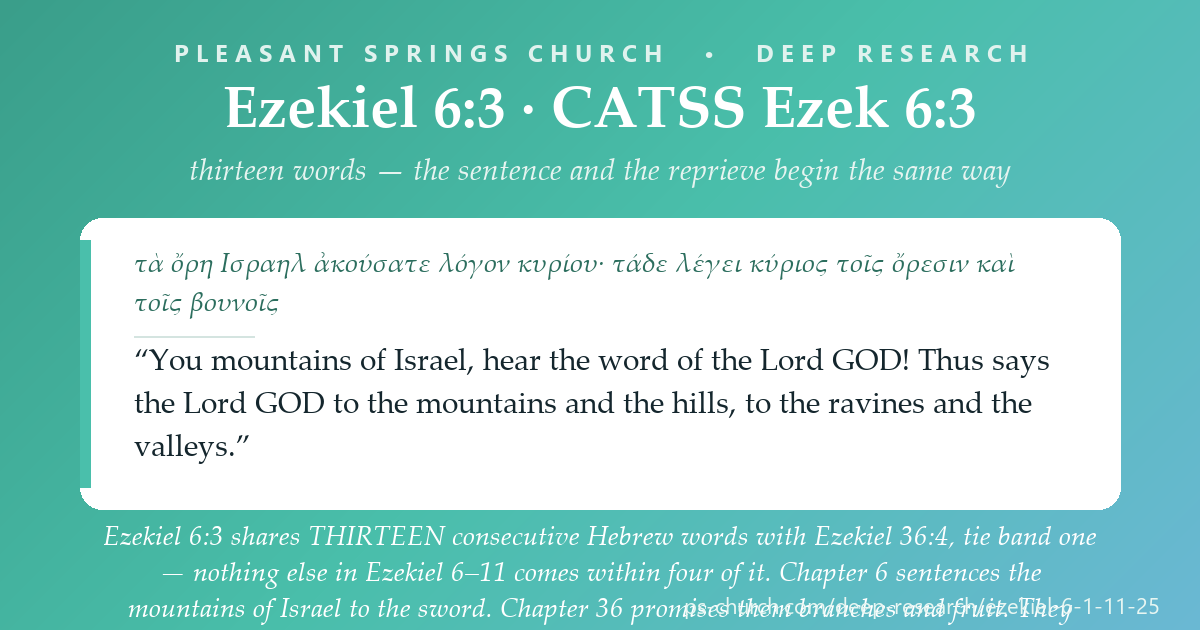
Six chapters, one hundred and seventeen verses: a sentence passed on the mountains of Israel, an oracle that says the end until the word loses its shape, and then a vision — a prophet lifted by a lock of his hair and set down in Jerusalem to watch four things being done in the temple, a slaughter that begins at the sanctuary, coals scattered over the city from between the cherubim, and the glory of God going out of the house by stages and stopping on the mountain to the east. The measurement that decided what this page is about is one run. Ezekiel 6:3 shares thirteen consecutive Hebrew words with Ezekiel 36:4, tie band one — O mountains of Israel, hear the word of the Lord God! Thus says the Lord God to the mountains and the hills, to the ravines… — and the next-deepest run in these six chapters is nine. Chapter 6 is where the mountains are sentenced to death. Chapter 36 is where they are promised branches and fruit. They begin with the same thirteen words. And the run does not break on a difference of subject: it breaks because the next word, and to the valleys, is spelled three different ways. Everything else on this page is measured against that — including the New Testament connection everyone knows, the mark on the foreheads in 9:4, which measures one. See the method →
Ezekiel 6:1–11:25 — sixteen rows across all six chapters (the Greek chapter and verse numbers in this table are the English ones. Ezekiel 6–11 runs chapter-for-chapter and verse-for-verse in the Masoretic text, the CATSS Greek and the ESV, with exactly two exceptions: 10:14 has no Greek row, and the numbering does not shift around it; and in 7:3–9 the Greek rows carry different material from the Hebrew verses of the same number — the chapter’s two halves are swapped. Both were derived by reading the files — see the footer.)
Hebrew (Masoretic) · Greek (CATSS/Rahlfs) · ESVThe Shape of the Passage
Sequence — two oracles, a vision in four scenes, and a glory that moves five timesNothing on this page settles who wrote the book of Ezekiel, when, or in how many stages. The book is dated more precisely than any other prophetic book — fourteen dates, to the day — and it has been argued for a century that the precision is editorial. This page has no instrument that can test that. What it can do is measure where the language of these six chapters also stands, and report it.
Author
The book names its writer once and then makes him a title. Ezekiel 1:3 names יְחֶזְקֵאל בֶּן־בּוּזִי הַכֹּהֵן, Ezekiel son of Buzi the priest. After that the text calls him almost nothing but בֶּן־אָדָם, son of man. The vocative occurs in eleven verses of these six chapters alone. The Greek renders it υἱὲ ἀνθρώπου every time.
He is a priest, and the passage is priest-shaped. The vision walks the temple by its gates and courts — north gate of the inner court (8:3), the wall and the hole in it (8:7–8), the entrance of the north gate of the house (8:14), the inner court between the porch and the altar (8:16), the bronze altar (9:2), the threshold (9:3, 10:4, 10:18), the east gate (10:19, 11:1). Nobody who had not stood in that building gives directions like that. And the man sent to mark the foreheads wears בַּדִּים, linen — which the Greek calls a ποδήρης, the word it uses five times in Exodus for the high priest’s robe.
What the measurement can say about the book’s internal cohesion, and what it cannot. Twelve of the 117 verses reach a run of six or more, and ELEVEN of the twelve find their deepest partner inside Ezekiel — 6:3→36:4 (thirteen, band one); the two chapter-7 doublets 7:3↔7:8 and 7:4↔7:9 (nine each, band one each); 7:2→39:17 (seven, band one); 11:12→5:7, 11:16↔11:17 and 11:21→22:31 (six each, band one each); and 11:20 (seven, band four, tied across Ezekiel 14:11, Ezekiel 37:23, Zechariah 8:8 and Jeremiah 32:38). Exactly one of the twelve points outside the book: 7:19→Zephaniah 1:18, six words, tie band one. That a book repeats itself is not evidence of a single author — a school, a tradition and an editor all produce the same pattern — and this page does not claim otherwise. It reports the distribution.
Audience
Everyone who first heard this was already in Babylonia, and the text says so twice. 8:1 has the elders of Judah sitting in front of Ezekiel in his house when the vision starts; 11:24–25 has him carried back εἰς γῆν Χαλδαίων to tell the exiles everything he had seen. The tour of the temple is given to people who cannot go to the temple.
And the passage contains the sentence the people still in Jerusalem were saying about them. 11:15: Go far from the Lord; to us this land is given for a possession. That is the audience’s problem in one line — the ones who kept the city think distance from the temple means distance from God — and 11:16 answers it with the only phrase of its kind in the Hebrew Bible: למקדש מעט, a sanctuary in small measure, out there, where they went.
The verse that describes them differs by one letter between the columns. The Masoretic 11:15 calls them אַנְשֵׁי גְאֻלָּתֶךָ, the men of your redemption — your kinsmen with the right to redeem. The CATSS Greek calls them οἱ ἄνδρες τῆς αἰχμαλωσίας σου, the men of your captivity, which is גלותך. One column calls the exiles your redeemers and the other calls them your fellow prisoners. The page prints both and asserts nothing about which is older.
Before anything is measured, find out what the names and objects in the passage are already known to mean, and where the reference works leave a question open.
A dictionary gives the range of a word and the consensus about a thing. It does not tell you what this text does with either. Stage 1 collects the questions; stages 3 and 4 test them against the files.
The four abominations of chapter 8, and what a dictionary can and cannot tell you.
1. The image of jealousy (8:3, 8:5) — סֵמֶל הַקִּנְאָה. Semel is a rare word for a carved figure; it appears in Deuteronomy 4:16, in 2 Chronicles 33:7 and 33:15 (the image Manasseh set in the house), and here. The CATSS Greek reads ἡ στήλη τοῦ κτωμένου — the pillar of the one acquiring — which is not what the Hebrew says and not what any English version says. No dictionary settles what the object was.
2. The seventy elders in the dark (8:10–12) — every form of creeping thing and beast portrayed on the wall all around, each man with his censer, saying the Lord does not see us. Egyptian, Mesopotamian and syncretistic explanations have all been proposed; the text names no god.
3. The women weeping for Tammuz (8:14) — the one place in the Hebrew Bible where this name occurs. Dumuzi in Sumerian, Tammuz in Akkadian; a shepherd-god whose descent to the underworld was mourned in the summer month that still carries his name in the Jewish calendar. What the dictionary does not have is any Israelite text describing the rite. This verse is the evidence.
4. The twenty-five with their backs to the temple (8:16) — between the porch and the altar, facing east, bowing to the sun. The location is the most sacred spot a layman could stand in, and the orientation is exactly backwards.
The man clothed in linen, the writing case, and the mark.
The writing case, קֶסֶת הַסֹּפֵר (9:2, 9:3, 9:11), is an Egyptian loanword for a scribe’s palette — a board with wells for ink and a slot for reed pens. It occurs in three verses of the Hebrew Bible and all three are in this chapter. The CATSS Greek does not have it at 9:2, 9:3 or 9:11 at all: at 9:2 it reads ζώνη σαπφείρου, a belt of sapphire, and at 9:3 and 9:11 simply a belt, where the Hebrew has a scribe’s kit.
The mark, תָּו. Dictionaries will tell you it is the name of the last letter of the alphabet and that in the palaeo-Hebrew script that letter was written as a cross or an X. Stage 3 counts it: the noun and its verb together stand in exactly four verses of the whole Hebrew Bible.
The linen, בַּדִּים — the fabric of priestly service (Leviticus 16:4, the Day of Atonement). The Greek translates it with the robe-word, not the fabric-word, which is a decision and not a translation.
What Stage 1 could not settle, and stages 3 and 4 had to measure. Whether Ezekiel 9:4’s mark is behind Revelation 7:3; whether chapter 10 is a second edition of chapter 1; whether מקדש מעט means small, or brief, or partial; and whether the passage’s language belongs to the rest of Ezekiel or to something wider. Three of those four were answerable from the files. The third was not, and the page says so where it stands.
A Babylonian shepherd-god is weeping in the temple courtyard, a scribe is carrying an Egyptian palette, and the whole vision is dated by a Babylonian regnal calendar.
This stage names what the ancient world holds and states plainly which of it was consulted for this page and which was not. Nothing below was collated from a tablet, a photograph or a critical edition; the sources are named so a reader can go further than the page did.
Dumuzi / Tammuz and the ritual behind 8:14.
Sumerian and Akkadian literature preserves a substantial body of Dumuzi material: Inanna’s Descent to the Netherworld, Dumuzi’s Dream, and a long series of laments in the voice of women. The god dies or is taken below, and he is mourned.
What that gives this page is context, not corroboration. No cuneiform text describes women weeping for Tammuz in a Jerusalem temple gate; Ezekiel 8:14 is the only witness to that. The month name Tammuz survives in the Jewish calendar, which is a real point of contact with Mesopotamian culture and is not evidence about the rite. No tablet, transliteration or photograph was examined for this page; the description here is second-hand from the standard literature, and the primary route in for an English reader is Pritchard’s anthology and Jacobsen’s translations.
The scribe’s palette, and marking people.
The קֶסֶת is an Egyptian word. The scribe’s palette is one of the most frequently depicted objects in Egyptian art, and it travelled with the profession across the Levant. The man in Ezekiel 9 has the equipment of an administrator, not a soldier, and the first thing he does is write on people.
Marking human beings is attested across the ancient Near East — slaves and devotees were tattooed or branded, and marks of ownership are referred to in Isaiah 44:5 and Leviticus 19:28. The mark in Ezekiel 9 is protective rather than possessive, and its nearest biblical relative is the blood on the doorposts in Exodus 12: something applied so that a destroyer passes over. Measured, Ezekiel 9:4 shares no two consecutive Hebrew words with Exodus 12:13. The relationship is one of idea, not language, and the page keeps those apart.
The dates, and what an eclipse of a calendar can and cannot fix.
Ezekiel 8:1 is dated to the sixth year, sixth month, fifth day — counted from the exile of Jehoiachin, which the book uses as its epoch (1:2). That places the temple vision commonly at 592 BC, about five and a half years before the city fell.
The synchronism between the Judahite and Babylonian regnal systems is the subject of a long technical literature, and the Babylonian Chronicle series fixes the 597 BC capture of Jerusalem independently. Reconciling the two systems to the month is genuinely disputed and this page does not attempt it. What matters here is only the direction of the arrow: the vision of the temple full of idols is dated years before the temple was destroyed, which is what makes chapter 11 readable as a message to people who still had a city to lose.
The cherub, and why the ox matters.
Winged composite guardians — human-headed bulls and lions with wings — stood at the gates of Assyrian palaces, and the Hebrew כְּרוּב belongs to that world. The lamassu and shedu of Nimrud and Khorsabad are the objects most often set beside the biblical cherub, and the ark’s cherubim in Exodus 25 are described as a throne-seat.
This is why Ezekiel 10:14 is worth a row of the table. In Ezekiel 1:10 the four faces are man, lion, ox and eagle. In 10:14 the ox has become the face of the cherub — which, if the cherub is a winged bull, is not a change at all but a naming. That reading is old and widely held; it is also an inference, and this page does not turn it into a finding. What this page measured is that the verse making the change is the only verse in six chapters with no row in the CATSS Greek file.
- Jacobsen, T. The Treasures of Darkness (1976) and The Harps that Once… (1987) — the Dumuzi laments in English. Not examined for this page.
- Pritchard, J. B. (ed.) Ancient Near Eastern Texts Relating to the Old Testament, 3rd ed. — the standard English gateway to the Sumerian and Akkadian material named above.
- Grayson, A. K. Assyrian and Babylonian Chronicles (1975) — the chronicle series, including the 597 BC entry that anchors Ezekiel’s epoch. Not examined.
- Parpola, S. and the Neo-Assyrian palace reliefs — for the lamassu as the physical background to כרוב. Named as a door, not as evidence for anything on this page.
Seven words carry this passage, and six of them were checked by exhaustive count against a named corpus rather than by looking them up.
Every count below is a machine count over a named corpus: 23,204 Masoretic verse units, 30,348 screened Greek Old Testament verse units (the 64 CATSS files held here, less the Odes) and 7,927 Greek New Testament verses. A count is only ever a count of what is held here, and a count of consonantal forms is not a count of a lexicon’s lemma.
The consonantal form גלולי / גללי occurs 52 times in the Masoretic corpus and 41 of the 52 are in Ezekiel. Six of the 41 occurrences are in chapter 6 alone, across five verses: 6:4, 6:5, 6:6, 6:9 and twice in 6:13. The Greek has no fixed equivalent: εἴδωλα at 6:4 and 6:13, ἐπιτηδεύματα — practices — at 6:9.
The noun stands in three verses of the Hebrew Bible: Ezekiel 9:4, Ezekiel 9:6 — הַתָּו, the mark the destroyers are told not to touch — and Job 31:35. The verb תוה stands in two: Ezekiel 9:4 and 1 Samuel 21:14 in the Masoretic numbering (ESV 21:13) — where David, feigning madness, scratches marks on the doors of the gate. Four verses in all. The CATSS Greek has τὸ σημεῖον, a sign; not a letter.
One verse in the whole Masoretic corpus: Ezekiel 8:14. The Greek transliterates, Θαμμουζ, one occurrence in the 64 CATSS files held here.
One verse in the Hebrew Bible: Ezekiel 11:16. Its Greek, ἁγίασμα μικρόν, is one verse in the 30,348-unit screened Greek Old Testament, and it is the same verse. Both columns say this once and never again.
Twelve occurrences in the 30,348-unit screened Greek Old Testament: five in Exodus for the high priest’s robe, THREE IN EZEKIEL 9 (verses 2, 3 and 11), two in Sirach, one in Wisdom, and Zechariah 3:4 where Joshua the high priest is re-robed. Exactly ONE in the 7,927-verse Greek New Testament: Revelation 1:13.
107 verses of the Hebrew Bible; 70 of the 107 are in Ezekiel; nine of the 70 are in these six chapters — and none of the nine is in chapters 8, 9 or 10. Fifty-one verses of vision without the book’s signature sentence.
One verse in the 30,348-unit screened Greek Old Testament: Ezekiel 11:21. One verse in the 7,927-verse Greek New Testament: Hebrews 10:17. Four words. Tie band one on both sides.
The robe, and a real connection this page cannot measure.
Revelation 1:13 dresses the one like a son of man in a ποδήρης. It is the only occurrence of the word in the New Testament. In the Greek Old Testament the word belongs first to Aaron and then, three times, to the man with the writing case who marks the foreheads in Ezekiel 9.
And the run between them measures TWO. Ezekiel 9:11 against Revelation 1:13 is ποδήρη καί. That is the whole of it. This page holds both facts at once, and refuses to collapse them: a rare word with a priestly life of its own travels from Exodus through Ezekiel 9 to Revelation 1, and the verbatim contact between the two verses is two words. A vocabulary link is not a quotation, and a run screen is blind to vocabulary links. Reporting only the first would inflate; reporting only the second would hide something real.
What the Greek did with the word for idols, and why it matters to the count.
גלולים is Ezekiel’s word — 41 of the 52 occurrences of the consonantal form in the whole Hebrew Bible are his. Its etymology is contested; the connection often drawn to גלל, dung-pellets, is a proposal about a root and not a fact about a text, and this page does not repeat it as though it were settled.
The Greek scatters it. Within chapter 6 alone the CATSS translator renders it εἴδωλα (6:4, 6:13) and ἐπιτηδεύματα (6:9), and at 11:21 the neighbouring שקוצים becomes βδελύγματα. A Greek-side word count for Ezekiel’s idols is therefore not comparable to the Hebrew-side one, and the page does not present a single figure across both columns.
⚠️ One caution on all seven chips above. These are consonantal-form counts, not lemma counts. Published lexicon figures for גלולים are usually given as 48 occurrences with 39 in Ezekiel; that is a different count of a different thing, arrived at by a different method, and the figures on this page are the ones this page’s method produces. Where they differ from a reference work, the reference work was not wrong — it was counting something else.
Two screens, run on 31 August 2026: every Hebrew verse of Ezekiel 6–11 against the whole Masoretic corpus, and every Greek row against the whole Greek New Testament.
The Hebrew screen runs with the unigram fallback OFF, so a zero means no two consecutive words anywhere. The Greek screen runs with it ON, so a one means isolated shared words and no adjacent pair at all. Both screens are exhaustive and deterministic. Every run is reported with its tie band, because a run without a band is misleading.
The thirteen, and why it is the page’s thesis.
Ezekiel 6:3 ↔ Ezekiel 36:4 — thirteen consecutive Hebrew words, tie band one.
הרי ישראל שמעו דבר אדני יהוה כה אמר אדני יהוה להרים ולגבעות לאפיקים
The next-deepest runs in the whole passage are the four nines inside chapter 7. This one is thirteen, and its band is one: no third verse in the Hebrew Bible reaches that depth with 6:3. The shorter core of it, הרי ישראל שמעו דבר, stands in exactly three verses — 6:3, 36:1 and 36:4 — and all three are Ezekiel.
Where it breaks is the part worth slowing down for. Both verses continue with the same word, and to the valleys. It is written ולגיאות in the ketiv of 6:3, וְלַגֵּיאָיוֹת in the qere of 6:3, and וְלַגֵּאָיוֹת at 36:4 — three spellings of one word. The screen compares consonantal forms and will not weld them, so the run stops at thirteen where a reader would say fourteen. The real parting of the ways is the fifteenth word: behold, I bring a sword upon you in chapter 6, and to the desolate ruins in chapter 36.
And the Greek, which has no spelling problem here, runs to seventeen. ὄρη Ισραηλ ἀκούσατε λόγον κυρίου τάδε λέγει κύριος τοῖς ὄρεσιν καὶ τοῖς βουνοῖς καὶ ταῖς φάραγξιν καί — and the five-word head of it, ὄρη Ισραηλ ἀκούσατε λόγον κυρίου, stands in exactly two verses of the 30,348-unit screened Greek Old Testament, which are these two. This is one of the few places on this shelf where the Greek measurement is deeper than the Hebrew one, and the reason is orthography, not theology.
What this does not prove. It does not establish that chapter 36 was written with chapter 6 open, or the reverse, or that one hand wrote both. Verbatim contact is contact; direction is not measurable and this page never asserts it.
Chapter 7 says it twice — and the Greek says it twice in the other order.
Ezekiel 7:3 ↔ 7:8 — nine consecutive Hebrew words, tie band one. Ezekiel 7:4 ↔ 7:9 — nine consecutive Hebrew words, tie band one. These are the second-deepest runs in the passage, and all four verses are in one chapter.
אפי בך ושפטתיך כדרכיך ונתתי עליך את כל תועבותיך
עליך אתן ותועבותיך בתוכך תהיין וידעתם כי אני יהוה
The same two sentences, five verses apart, with only their openings changed: 7:3 begins now the end is upon you and 7:8 begins now, soon, I will pour out my wrath; 7:4 begins my eye will not spare you and 7:9 drops the you. Everything after that is word for word.
And the CATSS Greek carries the doublet too — deeper, and in the opposite order. Measured Greek against Greek, CATSS Ezekiel 7:5 and 7:7 share thirteen consecutive words, and 7:6 and 7:8 share eleven. But the rows are not where the Hebrew verses are. Reading the two files side by side, the Greek of 7:3–9 carries the material of Hebrew 7:6, 7:7, 7:8, 7:9, 7:3, 7:4 and 7:5, in that order — so the half of the doublet the Hebrew prints first, the Greek prints second. Both files hold twenty-seven verses in the chapter and the count never diverges; only the contents of the numbered rows do, and only between 7:3 and 7:9.
This page reports the two arrangements and says nothing about which is earlier. That is a manuscript question, and the correspondence above is location work — done by eye against printed content, matching whole clauses across the two columns — not run measurement. It is stated here so that anyone checking a Greek verse number of Ezekiel 7 against this page is not misled.
The two fives into the New Testament, and why both are accidents.
Ezekiel 11:21 ↔ Hebrews 10:17 — five, tie band one. αὐτῶν καὶ τῶν ἀνομιῶν αὐτῶν. Ezekiel is announcing requital: their way I have brought upon their own heads. Hebrews is announcing amnesty: their sins and their lawless deeds I will remember no more. The same five Greek words, opposite verdicts.
And Hebrews is quoting Jeremiah when it says them. Hebrews cites Jeremiah 31:33–34 twice. At 8:12 the match with the Greek Jeremiah verse (CATSS Jeremiah 38:34) is fourteen consecutive words — that is what a real citation looks like on this instrument. At 10:17 the match with the same Jeremiah verse is four, because Hebrews has recast it and added a clause: καὶ τῶν ἀνομιῶν αὐτῶν. That clause stands in exactly one verse of the screened Greek Old Testament, and it is Ezekiel 11:21.
The page will not say Hebrews is quoting Ezekiel. Four words in a formulaic register is thin, the phrase is ordinary Greek, and Hebrews gives no citation signal pointing at Ezekiel. What the page says is narrower and harder: on this instrument, the deepest New Testament contact in six chapters of Ezekiel is deeper than the contact between Hebrews 10:17 and the verse Hebrews 10:17 is quoting. That is a fact about how these three texts overlap, and it is a warning about reading depth as dependence.
Ezekiel 9:2 ↔ Matthew 3:12 — five, tie band one. ἐν τῇ χειρὶ αὐτοῦ καί. Six men with battle-axes, and a man with a winnowing fork. The two verses are thematically close enough to be seductive and the shared words mean ‘in his hand and’. It is a coincidence.
The counter-examples this page prints against itself.
Ezekiel 9:4 ↔ Revelation 7:3 — ONE. The word is τήν. The mark on the foreheads of those who sigh, and the seal on the foreheads of the servants of God, are the single most-cited connection between this passage and the New Testament. Measured, there is almost nothing there. Against Revelation 9:4, which spares those with the seal, the run is also one and the word is καί. Ezekiel’s Greek noun is σημεῖον; Revelation’s is σφραγίς. They are not the same word.
Ezekiel 10:2 ↔ Revelation 8:5 — ONE. Coals of fire taken from between the cherubim and scattered over the city; a censer filled with fire from the altar and thrown to the earth. The shared word is καί.
Ezekiel 11:19–20 ↔ Hebrews 8:10 — FOUR, tie band one. ἔσονταί μοι εἰς λαόν, at 11:20. This is the one connection on the page that behaves like a real thread and still only measures four, because the covenant formula is shared property: measured in Hebrew, 11:20 reaches seven with Jeremiah 32:38, Ezekiel 14:11, Ezekiel 37:23 and Zechariah 8:8 at once — tie band four. A seven with a band of four is a formula. A five with a band of one is a fact about two verses. The page prints both bands so the reader can tell them apart.
Ezekiel 11:19 ↔ 2 Corinthians 3:3 — ONE. Paul’s tablets of human hearts rather than of stone is the passage most often set beside Ezekiel’s heart of flesh. The shared word is ἐν.
Where the two columns disagree, verse by verse.
These six chapters are, on the evidence of this disk, among the places where the Hebrew and the Greek most often part company — and repeatedly by a single letter.
8:2 — אֵשׁ fire / ἀνδρός of a man (אישׁ). The ESV follows the Greek.
6:9 — נשברתי I have been broken / ὀμώμοκα I have sworn (נשבעתי).
11:15 — גאלתך your redemption / αἰχμαλωσίας σου your captivity (גלותך).
11:19 — לב אחד one heart / καρδίαν ἑτέραν another heart.
9:4 — תָּו a tav / τὸ σημεῖον the sign; and the Hebrew names the speaker where the Greek does not.
8:3 — סמל הקנאה the image of jealousy / ἡ στήλη τοῦ κτωμένου the pillar of the one acquiring.
8:16 — כעשרים וחמשה איש about twenty-five men / ὡς εἴκοσι ἄνδρες about twenty men.
8:17 — they put the branch to their nose / ὡς μυκτηρίζοντες as those who sneer.
9:2, 9:3 — a writing case at his waist / ζώνη σαπφείρου a belt of sapphire at 9:2, and simply τὴν ζώνην, the belt, at 9:3.
11:12 — the Hebrew has a full verse; the entire Greek row is καὶ ἐπιγνώσεσθε διότι ἐγὼ κύριος, five words.
7:19 — the clause that ties the verse to Zephaniah 1:18 is not in the Greek row.
10:14 — no Greek row at all.
The page asserts nothing about any of these. Not that a translator misread, not that a scribe changed anything, not that one edition is earlier. Every one of these is a manuscript question and no critical apparatus, no Qumran fragment and no Greek manuscript was consulted for this page. What is printed is what the two files on this disk contain, side by side.
The scope of both screens, stated so the numbers can be checked. Hebrew: each of the 117 verses of Ezekiel 6–11 against the other 23,203 verse units of the 39-book Masoretic corpus (Sefaria’s Miqra according to the Masorah) — the whole Hebrew Bible less the verse itself, with nothing else held back, which is why neighbouring verses inside the passage can and do appear as each other’s partners. Markup stripped, the qere read, points and cantillation removed, final letter-forms folded, maqqef treated as a separator. Greek: 116 CATSS rows against all 7,927 verses of the SBL Greek New Testament as digitized by MorphGNT, with MorphGNT’s own spelling equivalences applied — οὐ/οὐκ/οὐχ, ἐκ/ἐξ and the movable nu. Figures published on this shelf before 30 August 2026 are lower for that reason; nothing here was copied from a sibling page. Greek Old Testament counts are scoped to the 64 CATSS files held here, 30,637 verse units, screened to 30,348 with the Odes excluded — two of the Odes are New Testament text and ten more are second copies of passages already in the corpus.
The stage where the page says what it could not check, what it did not read, and where it is weakest.
Everything above was measured on files held on one disk. The literature below was NOT consulted for this page except where a sentence says otherwise; it is named so that a reader can go past where the page stopped, and so that nobody mistakes a measurement for a commentary.
What was not consulted at all.
No commentary was opened for this page. Not Greenberg (Anchor Yale), not Zimmerli (Hermeneia), not Block (NICOT), not Cooke (ICC), not Eichrodt (OTL), not Joyce, not Odell. Their arguments are named below as doors; nothing on this page rests on any of them, and where this page’s prose sounds like a commentary it is describing a measurement, not repeating a scholar.
No critical apparatus was consulted for the Hebrew. Not BHS, not BHQ, not the Hebrew University Bible Project. The Hebrew here is the Masoretic text as printed in the single edition consulted — Sefaria’s Miqra according to the Masorah. No Qumran Ezekiel fragment was collated, and there are several.
No Greek manuscript was examined. The Greek is Rahlfs’ Septuaginta as digitized by CATSS. Papyrus 967 — the third-century Greek Ezekiel whose order and content differ from the received text — was not consulted, and it is the single most important witness this page is missing. Anything this page says about “the Greek” means the CATSS file and nothing wider.
No Masorah list was checked. The claim that 8:17 stands among the eighteen tiqqune sopherim is reported from secondary literature and was not verified against a Masoretic list on this disk.
Where this page is weakest.
1. The ESV column was not verified against a held ESV text. There is no ESV file for Ezekiel on this disk and no Crossway API key in this project. The English was typed; its verse alignment rests on verse counts and chapter openings. The Hebrew and Greek columns were pulled programmatically from the corpus files and are machine-faithful. If any single thing on this page is wrong, the most likely candidate is a word of the English.
2. The 8:2 row shows the English changing sides, and the page cannot tell you why. The ESV reads a man against the Masoretic fire. That is a text-critical decision made by a translation committee whose reasoning is in a footnote this page did not reproduce and an apparatus it did not open.
3. The word counts are consonantal-form counts. They are not lemma counts and they will not always agree with a lexicon. Where they differ, the page states its own method and does not claim the lexicon is wrong.
4. The five-station reading of the glory’s departure is a reading. What is measured is the distribution of כבוד יהוה מעל — three verses, all here. That the five passages form one continuous itinerary is how the text reads to this page and it is not a measurement.
5. The passage is quoted at sixteen verses out of one hundred and seventeen. Any reader who wants the argument tested should read all six chapters, because the rows in the table were chosen partly for what they measure and that is a selection effect this page cannot screen out of itself.
The arguments a reader should go and find, none of which this page joins.
Papyrus 967 and the shape of Greek Ezekiel. The Chester Beatty / Scheide papyrus is shorter than the Masoretic text in places and orders chapters 36–39 differently. The literature on whether it preserves an earlier edition is large and live. It bears directly on this page’s 10:14 finding and this page cannot evaluate it.
Chapter 10 and chapter 1. Whether 10:8–17 is a later expansion harmonising the temple vision with the river vision is a standing question. This page measured that 10:10, 10:11, 10:16 and 10:17 all find their deepest partner in chapter 1 — at five (band one, 1:16), three (band four, 1:12 and 1:17), three (band three, 1:19) and three (band two, 1:20 and 1:21). 10:22 ties chapter 1 with chapter 3 at five, and 10:12 reaches only two. That is compatible with several accounts of how the chapter came to be and decides between none of them.
The identity of the man in linen. Angelic scribe, priest-figure, or the Angel of the LORD — all three have serious defenders. The only thing this page contributes is a word count: ποδήρης, twelve times in the screened Greek Old Testament, once in the New.
Ezekiel 11:14–21 and the two peoples. Whether these verses are original here or belong with chapters 33–37 has been argued both ways for a century. Measured, 11:19 shares five words with 36:26, tie band one, and 11:20 shares seven with Jeremiah 32:38, Ezekiel 14:11, Ezekiel 37:23 and Zechariah 8:8 at once, tie band four. Language shared with chapters 33–37 is exactly what both sides of that argument predict, so the measurement does not adjudicate it.
- Greenberg, M. Ezekiel 1–20, Anchor Yale Bible (1983) — the holistic reading, and the standard treatment of chapters 8–11 as one vision. Not consulted for this page.
- Zimmerli, W. Ezekiel 1, Hermeneia (ET 1979) — the tradition-history reading, and the fullest treatment of the Greek. Not consulted.
- Block, D. I. The Book of Ezekiel: Chapters 1–24, NICOT (1997). Not consulted.
- Lust, J. and the literature on Papyrus 967 — the case that the Greek preserves an earlier edition of Ezekiel. Not consulted, and it is the gap this page most regrets.
- Tov, E. Textual Criticism of the Hebrew Bible, 3rd ed. — for the general problem of two editions and for the tiqqune sopherim. Not consulted for this page.
- Beale, G. K. and Carson, D. A. (eds.) Commentary on the New Testament Use of the Old Testament (2007) — for Revelation’s use of Ezekiel, which this page measured and did not read about. Not consulted.
The last stage of Heiser’s method is not private. Put the finding where somebody can argue with it.
Everything above is reproducible: the corpora are named, the screens are named, the dates are given and the tie bands are printed. If a figure here is wrong, it is checkable, and that is the point.
Four things to take to a class, and one to take alone.
1. The same thirteen words sentence the mountains and restore them. Read Ezekiel 6:3 and 36:4 aloud, one after the other, and stop at ravines. Ask the room to guess which one ends in a sword. There is no way to tell from the first thirteen words, and that is the point of the exercise.
2. The most famous link in the passage measures one. Ezekiel 9:4 and Revelation 7:3 are printed together in study Bibles, sermon notes and hymns. On this instrument they share the definite article. Ask what a connection is, if it is not shared words — because there plainly is one, and the measurement cannot see it.
3. Chapter 7 says it twice, and the Greek says it backwards. Read Ezekiel 7:3–4, then 7:8–9. Nine identical words, then nine more. Then look up Greek 7:5–8, which has both halves in the other order. Ask what a reader in Alexandria and a reader in Tiberias would each have thought this chapter was doing.
4. The glory leaves slowly. Five stations, over four chapters: 8:4, 9:3, 10:4, 10:18–19, 11:22–23. God does not storm out. He moves to the threshold and stops. Moves to the gate and stops. Goes up over the city and stands on the hill, facing it. Whatever else this passage is, it is not in a hurry to go.
And alone, a fifth: 11:16. A sanctuary in small measure, in the countries where they have gone. It is the only phrase of its kind in either Testament in either language — one verse in 23,204, one verse in 30,348, and it is the same verse. The people who had lost the building were told that God had been, in some small way, the building. That is said once in the whole Bible and it is said to exiles.
“And the glory of the Lord went up from the midst of the city and stood on the mountain that is on the east side of the city.”Ezekiel 11:23 · CATSS Ezek 11:23 · ESV 11:23
What this page would like corrected.
If you hold a critical apparatus, a Qumran Ezekiel fragment, or anything from Papyrus 967, this page wants to hear from you. Its 10:14 finding — that the verse giving the cherub a face has no row in the CATSS Greek — is a fact about the file on this disk. What that fact means depends entirely on manuscript evidence that was not available here.
And if a word of the ESV column is wrong, say so. It was typed, not fetched, and it is the one column on the page that no machine checked.
Every Deep Research page traces its passage across the whole sweep — the Old Testament, the Second-Temple world between the testaments (historical witnesses, not Scripture), and the New Testament. Follow the thread:
Pleasant Springs Church — Deep Research
Research method after Michael S. Heiser’s Bible Research Method (examine dictionaries → ancient literature → important words → textual connections → academic publications → share), with the Pleasant Springs “Author & Audience” foundation. Scripture set in the Hebrew, the Greek editions named on each page and the ESV (Old Testament), and the Greek New Testament and the ESV (New Testament), per the practice of Pleasant Springs Church. Ezekiel research grounded in Greenberg (Anchor Yale), Zimmerli (Hermeneia), Block (NICOT) and Cooke (ICC); on the two editions in Tov and in the Papyrus 967 literature; on Revelation’s use of Ezekiel in Beale and Carson. None of those was consulted for this page — Stage 5 says so at length. Text: Hebrew from the Masoretic text as printed in the edition consulted — Sefaria’s Miqra according to the Masorah; no critical apparatus was consulted for the Hebrew and no Qumran Ezekiel fragment was collated. Greek from Rahlfs’ Septuaginta as digitized by CATSS; Papyrus 967 was not consulted. Greek New Testament from the SBL edition as digitized by MorphGNT. The standing caution for this shelf applies: these pages say “the CATSS Greek text reads…” and never call a Greek reading early or late, and never say which text acted on which. ⚠️ Verse numbering — there is no chapter-and-verse offset in this passage, and one place where the numbers agree while the contents do not. Ezekiel 6, 7, 8, 9, 10 and 11 hold 14, 27, 18, 11, 22 and 25 verses in the Masoretic text and in the ESV. The CATSS Greek file holds 14, 27, 18, 11, 21 and 25 rows. The single missing row is 10:14, and the numbering does not shift around it: CATSS runs 10:13, then 10:15, and Greek 10:15 is Hebrew 10:15. Across the whole book the two corpora differ in six chapters by one verse each — 1, 10, 27, 32, 33 and 40 — and in none of them does the chapter or verse numbering shift. This was derived by reading the files on this disk with python -m dr_tools versify Ezekiel --derive, not by copying a printed table. ⚠️ One further warning, which the numbers alone will not give you: in Ezekiel 7:3–9 the Greek rows carry different material from the Hebrew verses of the same number. Both files hold twenty-seven verses in the chapter, but reading them side by side, CATSS 7:3–9 carries the material of Masoretic 7:6, 7:7, 7:8, 7:9, 7:3, 7:4 and 7:5 — the chapter’s doublet is printed in the opposite order. That correspondence was derived by eye from printed content, which is location work and not run measurement, and the page says which is which. Outside 7:3–9 every reference on this page prints one number, because there the three columns agree. ⚠️ The ESV column was NOT verified against a held ESV text. No ESV file for Ezekiel exists on this disk and no Crossway API key exists in this project; the English was typed and its verse alignment rests on verse counts and chapter openings. The Hebrew and Greek columns were pulled programmatically from the corpus files. At 8:2 the ESV column is translating the Greek reading, not the Hebrew one printed beside it, and the row says so. ⚠️ Every cross-corpus run figure on this page was measured on 31 August 2026 and applies MorphGNT’s own spelling equivalences — οὐ/οὐκ/οὐχ, ἐκ/ἐξ and the movable nu — so that a shared run is not cut at a word the two editions merely spell differently. Figures published on this shelf before 30 August 2026 are lower for that reason; nothing was copied from a sibling page and every number above was re-measured. ⚠️ A run of zero on the Hebrew screen means NO TWO CONSECUTIVE WORDS. The Hebrew-side screen runs with the unigram fallback off, so max = 0 at 6:8, 7:21 and 10:13 means those three verses share no adjacent word pair with any of the other 23,203 Masoretic verse units — not that they share no words. The Greek-side screen runs with the fallback ON, so a 1 reported for a Greek row means the two verses share isolated words and no adjacent pair at all — which is what the 1 for Ezekiel 9:4 against Revelation 7:3 means, and the word is τήν. ⚠️ One reported Hebrew maximum in these chapters is inflated by a scribal marker and is corrected in place. The Masoretic file counts {ס} and {פ} as words. The five reported at 7:27 ends on one and is really a four; the five at 6:14 is real, because one partner — Ezekiel 33:28 — matches five words with no marker in them. Every run this page argues from was checked and crosses no marker. normalize.py is frozen and was not edited. ⚠️ Greek Old Testament figures are scoped to the 64 CATSS files held here, 30,637 verse units, screened to 30,348 with the Odes excluded. Two of the Odes are New Testament text — Ode 9 is Luke 1 and Ode 13 is Luke 2 — and ten more are second copies of Exodus 15, Deuteronomy 32, 1 Samuel 2, Habakkuk 3, Isaiah 26, Jonah 2, Daniel 3, Isaiah 5 and Isaiah 38, so leaving them in would inflate any tie band that touched one. ⚠️ The deepest New Testament runs on this page are not quotations, and the passage’s best-known New Testament connection measures one. The page says both, in four places each. Typology is handled per the house position: what the text says, what the New Testament itself draws, and what we see from this side of the cross — with the seeing left to the reader.
Scripture quotations marked ESV are from the ESV® Bible (The Holy Bible, English Standard Version®), © 2001 by Crossway, a publishing ministry of Good News Publishers. ESV Text Edition: 2016. Used by permission. All rights reserved. The ESV text may not be quoted in any publication made available to the public by a Creative Commons license, and the ESV may not be translated in whole or in part into any other language. www.esv.org
|
Did this study bless you today? 💚 Give to Support PS Church100% of gifts go to the General Fund — thank you. |