A deported priest sits by an irrigation
canal in Babylon and the sky opens. What he sees has been painted, carved, argued over and named for two
and a half thousand years — and the chapter that records it is, measurably, one of the most
isolated in the Hebrew Bible. Screened against every verse outside the book of Ezekiel, eight of
chapter 1’s twenty-eight verses share no two consecutive Hebrew words with anything
— 28.6%, three times the book’s own rate. Not one of those eight has a partner
outside Ezekiel. Five find their only partners in chapter 1 itself or in chapter 10, where the
same creatures are seen a second time; three — 1:5, 1:13 and 1:14 — have no partner anywhere
in Scripture at all. The vision’s only echo is the vision again.
And the reason is countable. The Hebrew noun דְּמוּת,
likeness, stands 25 times in the whole Hebrew Bible and ten of the twenty-five are in this one
chapter; מַרְאֶה, appearance, stands 118 times and fifteen are here.
Twenty-five hedges in twenty-eight verses — and then not one of either word in chapters 2,
3, 4 or 5.
Then the measurement turns on itself. The deepest run against the Greek New Testament in
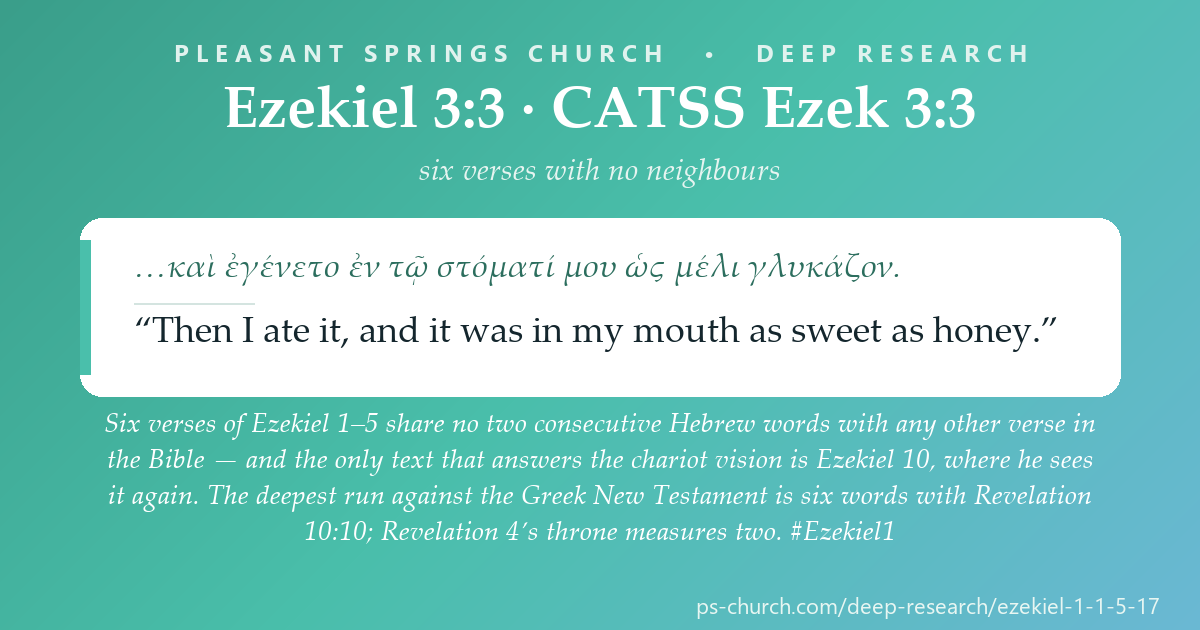
these five chapters is six words, tie band 1: Ezekiel 3:3 against Revelation 10:10, in my mouth like
honey — joint second-deepest row in the whole 1,267-row Greek book, and it stops at word seven
on a participle ending. But Revelation 4, which stands beside Ezekiel 1 image for image,
measures two. Revelation 5:1’s scroll written front and back measures one. Acts 20:26, the watchman
in a single sentence, measures zero. The screen finds the allusion everyone already knew and is
blind to the four everyone can see. Along the way: the watchman oracle printed twice in the book, ten
identical Hebrew words and fourteen Greek; 390 days in the Hebrew and 190 in the Greek; thirds in the
Hebrew and quarters in the Greek; a verse the Greek does not have at all; and the fact that the word
merkabah does not occur once in the Hebrew of Ezekiel — while the Greek held here calls
the Chebar vision a chariot at 43:3, and the page prints both.
See the method →
Ezekiel 1:1–5:17 (selections)
Hebrew · Greek (CATSS / Rahlfs) · ESVEvery row here was chosen by a measurement. 1:14 is printed because it is missing from the Greek and matches nothing in the Hebrew. 1:26 and 2:10 are printed because they are the passages everyone connects to Revelation and they measure two and one. 3:3 is printed because it is the deepest Greek row on the page. 3:17 is printed because it is the deepest Hebrew row and the partner is Ezekiel himself. 4:5 and 5:2 are printed because the two columns disagree about a number. Where the Hebrew and the Greek say different things, both are printed and neither is corrected.
The Shape of the Passage
Sequence — one vision, one commission, and four sign-acts, with a repeat measured inside itThese are the first five chapters of the book. The shelf already studies Ezekiel 36:24–28 and 37:1–14, both of them promises. This page is the other end of the same book: the call, and the sentence.
Author
He is a priest who will never serve in a temple, and the book says so in its third verse. Ezekiel the priest, the son of Buzi — and then the name is not used again until 24:24. Measured: the two-word phrase בֶּן־אָדָם, “son of man,” stands in 99 verses of the Hebrew Bible and 93 of the 99 are in Ezekiel. The other six are Daniel 8:17, Psalm 80:18, and four verses of Jeremiah in which no son of man will live in a ruined city. The man is addressed by his species for the length of a book.
He is also dated with unusual precision and by somebody else’s calendar. 1:2 counts from the exile of King Jehoiachin — not from a reign in Jerusalem, and not from a festival. Stage 2 prints Babylonian administrative tablets, read at first hand, on which that same king draws oil rations by name. The dating system of this book is the filing system of the deportation.
And the writing itself is measurably unlike anything else in the Bible in its first chapter. Screened against every verse outside the book of Ezekiel, 8 of chapter 1’s 28 verses share no two consecutive Hebrew words with anything — 28.6%, tied with chapter 6 for the highest rate in the book and three times the book’s own 9.3%. Not one of those eight has a partner outside Ezekiel. Five of them find their only partners in Ezekiel 1 itself or in Ezekiel 10, where the same creatures are seen a second time; the other three — 1:5, 1:13 and 1:14 — have no partner anywhere in the Hebrew Bible at all.
Audience
People who had already lost, being told they had not yet lost enough. Three times the elders come and sit down in front of him (8:1, 14:1, 20:1); the whole book is addressed from inside the deportation of 597 to people who assumed Jerusalem would hold and they would be going home. Chapters 4–5 are performed for that audience — the brick is scratched before you, the bread is baked in their sight, and the hair is weighed out in public.
They were being asked to watch, not to listen. Four of these five chapters end in something done rather than said, and the prophet is explicitly struck dumb at 3:26 before the sign-acts begin. The audience of Ezekiel 4–5 receives a message from a man who has been forbidden to speak. Whether that silence is total or is lifted for the oracles is one of the standard unsettled questions on this passage, and Stage 5 lists it as unsettled rather than resolving it.
And later, people reading it in Greek, in a slightly different book. The Greek held here has 98 verse units where the Hebrew has 99, does not carry 1:14 at all, counts the days of the sign-act as 190 and 150 where the Hebrew counts 390, and divides the hair into quarters where the Hebrew divides it into thirds. A Greek-reading congregation heard a sign-act of a different length and a different shape, and this page prints both without ranking them.
Orient on the throne-chariot vision and its afterlife, on prophetic sign-acts, on the watchman metaphor and blood-guilt, on the deportation of 597, and on the fact that the Greek Ezekiel is a measurably different book.
Search by topic: Ezekiel, Book of; throne-chariot (merkabah); merkabah mysticism; cherubim; living creatures (hayyot); glory of God (kabod); Chebar canal; Tel-abib; sign-act (prophetic symbolic action); watchman; blood-guilt; dumbness of Ezekiel; Jehoiachin; exile of 597; siege warfare in the ancient Near East; clean and unclean food; Septuagint of Ezekiel; Papyrus 967.
Which articles are relevant?
- Anchor Bible Dictionary — “Ezekiel, Book of,” “Merkabah Mysticism,” “Cherubim,” “Glory of God,” “Chebar,” “Tel-abib,” “Jehoiachin,” “Exile, Babylonian.”
- Dictionary of the Old Testament: Prophets (IVP) — “Ezekiel: Book of,” “Sign Acts,” “Visions, Prophetic,” “Theophany,” “Apocalypticism, Ancient Near Eastern,” “Text and Textual Criticism.”
- The New Interpreter’s Dictionary of the Bible — “Ezekiel, Book of,” §§ on chapters 1–24; “Watchman”; “Wheel”; “Brick.”
- Where the reference works disagree, and the page says so rather than choosing: whether the “thirtieth year” of 1:1 is Ezekiel’s age, a Jubilee reckoning, a Babylonian era or a later editorial note; whether the dumbness of 3:26 is total, periodic or figurative; whether the 390 days count northern Israel’s sin, the whole monarchy, or something else; whether the wheels and creatures of chapter 1 draw on Babylonian iconography, on the temple cherubim, or on neither; and whether the shorter Greek Ezekiel reflects an earlier Hebrew text or a translator’s compression. Not one of the five is decidable from any corpus held here.
The one thing to fix before reading further:
The chariot-word the vision is named for is not in this passage, and it is not in the Hebrew of this book. Screened exhaustively: 49 word forms containing the Hebrew root מרכב stand in the Hebrew Bible and none of them is in Ezekiel. Chapter 1 has creatures, wings, wheels, an expanse, a throne and a figure. It does not have a vehicle, and it never says the wheels carry anything.
⚠️ Two things the page will not let that sentence hide. First, the ordinary Hebrew word for a chariot IS in the book. רֶכֶב stands in Ezekiel 23:24, 26:7, 26:10 and 39:20 — of Babylonian and Egyptian war-chariots, never of the vision. The narrow claim is about מֶרְכָּבָה and not about the English word. Second, and larger: the Greek column this page prints does call the vision a chariot. At 43:3, where the Masoretic text reads וּמַרְאוֹת, and visions, CATSS Ezekiel reads καὶ ἡ ὅρασις τοῦ ἅρματος οὗ εἶδον … ἐπὶ τοῦ ποταμοῦ τοῦ Χοβαρ — and the vision of the chariot which I saw … by the river Chebar. ἅρμα stands five times in Greek Ezekiel (23:24, 26:7, 26:10, 27:20, 43:3). The two columns held here do not agree about this, and the page prints the disagreement rather than arguing from the Hebrew while printing the Greek. It says nothing about which reading is prior.
Where does “the chariot vision” come from, then? From outside the book, and from the Greek inside it. 1 Chronicles 28:18 describes the temple plan as the pattern of the chariot, the cherubim of gold; and Ben Sira — whose book survives here in his grandson’s Greek — looks back at this passage and says ἐπὶ ἅρματος χερουβιν, upon the chariot of the cherubim (Sirach 49:8) — the only occurrence of that phrase in the 30,348 Greek Old Testament verse units held here. The name by which the vision is universally known was supplied by its readers and by its Greek translator, not by its Hebrew. That is not a criticism of the name; it is the first fact a reader of these five chapters should have straight, because it is a small model of everything else on this page.
Three ancient texts read at first hand from Pritchard: the ration list that names the king this book dates by, an Assyrian king’s own account of a siege like the one scratched on the brick, and a Babylonian god mounting a storm-chariot behind a team of four.
Ancient texts are witnesses to the world around Scripture. They are never levelled with it. Everything quoted below was read at first hand from the edition named — Pritchard’s ANET, third edition — and nothing in this stage is a measurement.
The king Ezekiel 1:2 dates by, drawing rations in Babylon — checked at first hand:
Ezekiel 1:2 fixes the vision in the fifth year of the exile of King Jehoiachin. Tablets excavated in Babylon by the German expedition, listing deliveries of oil to prisoners of war and dependants of the crown, name him:
“10 (sila) to Ia-ku-u-ki-nu, the son of the king of Ia-ku-du (i.e. Judah); 2½ sila for the 5 sons of the king of Judah (Ia-ku-du) through Qana’a …”Babylon 28186, reverse ii 13–18 — Pritchard, ANET, p. 308
“10 (sila of oil) to … [Ia]-’-kin, king of Ia[…]; 2½ sila (oil) to [… so]ns of the king of Judah (Ia-a-hu-du); 4 sila to 8 men from Judah (a’ne Ia-a-hu-da-a-a) …”Babylon 28178, obverse ii 38–40 — Pritchard, ANET, p. 308
The calendar of the book of Ezekiel runs off that man’s deportation, and that man is on a Babylonian oil ledger with his five sons. What the page claims is only that the deported royal house existed and was administratively visible. The tablets say nothing about Ezekiel, nothing about a vision, and nothing about a canal, and the page does not use them to argue anything about the biblical text.
What is being scratched on the brick — in a besieger’s own words, checked at first hand:
Ezekiel 4:2 lists the equipment of the sign-act: siege works, a mound, camps, battering rams. Sennacherib’s annals describe doing exactly that to a Judean city a century earlier:
“… and conquered (them) by means of well-stamped (earth-)ramps, and battering-rams brought (thus) near (to the walls) (combined with) the attack by foot soldiers, (using) mines, breeches as well as sapper work … Himself I made a prisoner in Jerusalem, his royal residence, like a bird in a cage. I surrounded him with earthwork in order to molest those who were leaving his city’s gate.”Sennacherib’s annals (the Prism) — Pritchard, ANET, p. 288
Ramp, engine, encirclement, gate. That is the vocabulary of Ezekiel 4:2, and it is the vocabulary a besieging king used about Jerusalem in his own inscription. The page makes no connection between the two documents — Sennacherib is a century earlier and did not take the city. What the prism establishes is that the object Ezekiel draws on a brick was a real and familiar procedure with named parts, and that his audience would have recognised the drawing.
A god on a storm-chariot behind four — and what the comparison does not license:
Ezekiel 1:4 begins with a storm wind out of the north, a great cloud, fire flashing, and brightness around it, and out of it come four. In Babylon’s creation epic, Marduk goes out to battle:
“Then the lord raised up the flood-storm, his mighty weapon. He mounted the storm-chariot irresistible [and] terrifying. He harnessed (and) yoked to it a team-of-four, The Killer, the Relentless, the Trampler, the Swift.”Enuma Elish IV.49–52 — Pritchard, ANET, p. 66
The repertoire is shared: a storm, a divine rider, and four. That is worth knowing, and it is all the page claims. The differences are large and the page prints them rather than the resemblance alone. Marduk’s four are a yoked team pulling a war-car and they have names that mean what they do; Ezekiel’s four are not harnessed to anything, are not described as pulling, and are never given names. Marduk’s vehicle is a chariot and is called one; Ezekiel’s Hebrew never uses מֶרְכָּבָה of these four — though the Greek of 43:3 does call the Chebar vision τὸ ἅρμα, and Stage 1 prints that. And what sits above Ezekiel’s four is not a warrior but a throne with something on it the text refuses to identify. No direction of borrowing is asserted here in either direction.
How the earliest readers named it:
The best-known early text to look back at this chapter and give it a title is Ben Sira’s roll-call of the fathers — and it is not the only one, since Greek Ezekiel 43:3 has already used the same word inside the book:
Ιεζεκιηλ ὃς εἶδεν ὅρασιν δόξης ἣν ὑπέδειξεν αὐτῷ ἐπὶ ἅρματος χερουβιν
“Ezekiel, who saw a vision of glory, which he showed him upon the chariot of the cherubim.”Sirach 49:8, CATSS Greek
Two words of that sentence are Ezekiel’s own — vision and glory, both in 1:28. Two are in neither column of chapter 1: chariot and cherubim. (Ezekiel does use כְּרוּב later, from chapter 9 on, and the Greek uses ἅρμα at 43:3 — but not in chapter 1, where the four are only חַיּוֹת, living things.) Ben Sira is read here as a historical witness to what a second-century reader made of the chapter, never levelled with Scripture — and what he shows is that the interpretation began early and that it supplied vocabulary the vision withheld.
Six words, each with an exhaustive count attached, and two of them explain why this passage is so hard to connect to anything.
Counts on the Hebrew side are exhaustive over the 23,204 verse units of the Masoretic corpus held here, on consonantal word forms with the qere read. Counts on the Greek side are exhaustive over 30,348 verse units — the 30,637 units of the 64 CATSS files on disk, less the Odes, which are excluded from screens because two of them are New Testament text (Ode 9 is Luke 1, Ode 13 is Luke 2) and ten more are second copies of Exodus 15, Deuteronomy 32, 1 Samuel 2, Habakkuk 3, Isaiah 5, Isaiah 26, Isaiah 38, Jonah 2 and Daniel 3 — and over all 7,927 verses of the Greek New Testament.
As a two-word sequence, 99 verses of the Hebrew Bible — 93 of them Ezekiel, 13 of the 93 in these five chapters. The Greek vocative υἱὲ ἀνθρώπου stands in 96 of the 30,348 Greek Old Testament units, 94 of them Ezekiel. It stands in none of the 7,927 verses of the Greek New Testament.
25 occurrences in the whole Hebrew Bible; 16 in Ezekiel; 10 of the 16 inside chapter 1 — and none at all in chapters 2, 3, 4 or 5. Genesis 1:26 has it, and so does this chapter, ten times, of a throne, a firmament and a man.
118 occurrences in the whole Hebrew Bible; 37 in Ezekiel; 15 of the 37 inside chapter 1. With דְּמוּת that is twenty-five hedges in twenty-eight verses. The chapter never once says what a thing is.
The Greek Ezekiel does not call the scroll a βιβλίον. κεφαλὶς βιβλίου stands in exactly one of the 30,348 Greek Old Testament units held here — Ezekiel 2:9. The dative κεφαλίδι βιβλίου stands in one more, Septuagint Psalm 39:8 (= ESV Psalm 40:7) — which is the verse Hebrews 10:7 quotes.
The bare form stands in exactly two verses of Ezekiel — 3:17 and 33:7, and the two share ten consecutive words; counting the prefixed forms as well, the noun stands in four (3:17, 33:2, 33:6, 33:7). The Greek is σκοπός, ten occurrences of the accusative in the Greek Old Testament held here. The noun stands once in the whole Greek New Testament — Philippians 3:14, where it means the finish line. The related verb σκοπέω, “keep an eye on,” stands six times.
49 word forms built on מרכב stand in the Hebrew Bible and not one of them is in Ezekiel. The ordinary word רֶכֶב does stand in the book four times (23:24, 26:7, 26:10, 39:20), of war-chariots. The name of the vision comes from 1 Chronicles 28:18, from Sirach 49:8 and from the Greek of Ezekiel 43:3 — not from the Hebrew of the vision.
Why this passage is so hard to connect to anything: two counts side by side
Two independent measurements land on the same chapter, and the page puts them next to each other without claiming that one causes the other.
| chapter | verses | verses sharing NO two consecutive Hebrew words with anything outside Ezekiel | occurrences of דְּמוּת + מַרְאֶה |
|---|---|---|---|
| Ezekiel 1 | 28 | 8 — 28.6% | 25 |
| Ezekiel 2 | 10 | 0 | 0 |
| Ezekiel 3 | 27 | 0 | 0 |
| Ezekiel 4 | 17 | 3 — 17.6% | 0 |
| Ezekiel 5 | 17 | 1 — 5.9% | 0 |
| the whole book of Ezekiel | 1,273 | 118 — 9.3% | — |
Ezekiel 1’s 28.6% ties chapter 6 for the highest rate in the book and is three times the book’s own rate. A chapter written out of ‘like the appearance of’ and ‘the likeness of’ is a chapter of comparisons being invented on the spot, and invented comparisons have no stock phrases to share. That sentence is an explanation and not a measurement, and the page marks it as such: what is measured is the two columns of the table. A reader is free to think the isolation has some other cause.
“Son of man” — the count, and the trap in it
The vocative υἱὲ ἀνθρώπου stands in 96 of the 30,348 Greek Old Testament verse units held here. Ninety-four are Ezekiel. The other two are the same verse — Daniel 8:17 — counted once in the Old Greek file and once in Theodotion. Thirteen of the 94 are in these five chapters: 2:1, 2:3, 2:6, 2:8, 3:1, 3:3, 3:4, 3:10, 3:17, 3:25, 4:1, 4:16 and 5:1.
And it stands in none of the 7,927 verses of the Greek New Testament. Not once. The New Testament has the nominative υἱὸς τοῦ ἀνθρώπου 50 times, 45 of them carrying the article, and the anarthrous accusative υἱὸν ἀνθρώπου twice, both in Revelation (1:13 and 14:14). Neither of those is Ezekiel’s form. Ezekiel is being addressed; the New Testament phrase is a title, and the shape of the Greek is different in case, in article and in number.
⚠️ What the page claims and what it does not. It claims the counts: 96, 94, 13, 0, 50, 2. It does not claim that the New Testament title comes from Ezekiel, or that it does not. The obvious other candidate, Daniel 7:13, is on this shelf at Daniel 7:9–14, and that is where the question belongs. What this page can say is narrow and useful: the exact Greek words by which Ezekiel is addressed 94 times do not occur in the New Testament at all.
Thirds and quarters: the two columns do not divide the hair the same way
Chapter 5 is a sign-act about proportions, so the proportions are worth counting. Exhaustively, in the two verses where the fractions stand:
| verse | Hebrew | Greek held here |
|---|---|---|
| Ezekiel 5:2 (the sign) | שְׁלִשִׁית — a third — 3 times: burn, strike, scatter | τὸ τέταρτον — a quarter — 4 times: burn, burn again, cut down, scatter |
| Ezekiel 5:12 (the interpretation) | שְׁלִשִׁית — 3 times: pestilence and famine together, sword, scattering | τὸ τέταρτον — 4 times: death, famine, scattering, sword |
Each text is internally consistent and the two are not the same text. The Hebrew sign has three parts and its interpretation has three; the Greek sign has four and its interpretation has four, and the Greek gets its fourth by separating famine from pestilence. The page states the count and stops. It does not say which is prior, whether a numeral was miscopied, or whether a translator harmonised anything. Those are questions for a critical apparatus, and Stage 5 says plainly that no apparatus is held here.
Two screens, run on this disk this week, with every run reported beside its tie band — and five counter-examples printed against the page’s own findings.
Runs are contiguous whole word forms, never lemmas and never roots. The Hebrew screen ran each of the 99 Masoretic verses of Ezekiel 1–5 against the 23,204-unit corpus. The Greek screen ran each of the 98 CATSS verse units of LXX Ezekiel 1–5 against all 7,927 verses of the SBLGNT via MorphGNT, with the edition’s own spelling equivalences applied (ou / ouk / ouch, ek / ex, the movable nu). Figures here are higher than any run figure published on this shelf before 30 August 2026 and were re-measured, not copied from a sibling page.
The Greek screen: one row of six, two of five, and a whole-book baseline to read them against
Across the 98 CATSS rows against 7,927 New Testament verses: all 98 reach one, 97 reach two, 74 reach three, 21 reach four, 3 reach five, 1 reaches six, and nothing reaches seven.
| row | run | tie band | New Testament verse | shared words |
|---|---|---|---|---|
| Ezekiel 3:3 | 6 | 1 | Revelation 10:10 | ἐν τῷ στόματί μου ὡς μέλι |
| Ezekiel 2:1 | 5 | 1 | Acts 26:16 | στῆθι ἐπὶ τοὺς πόδας σου |
| Ezekiel 4:13 | 5 | 1 | Luke 1:68 | κύριος ὁ θεὸς τοῦ Ισραηλ |
| Ezekiel 1:1 | 4 | 16 | Mark 4:4, Luke 5:12 … | καὶ ἐγένετο ἐν τῷ (a formula) |
| Ezekiel 1:4, 1:15, 2:9 | 4 | 5 | Revelation 6:2, 6:5, 6:8, 14:1, 14:14 | καὶ εἶδον καὶ ἰδού |
| Ezekiel 5:11 | 4 | 1 | Romans 14:11 | ζῶ ἐγώ λέγει κύριος |
| Ezekiel 5:3 | 1 | 6,076 | — | single words only — commonly καί, at the rare end ἀριθμῷ (the shallowest row on the page) |
The baseline, before anything is made of the six. Screened whole, the Greek Ezekiel is 1,267 CATSS rows against the New Testament: one row reaches seven (24:21 against Acts 2:17), three rows reach six, twenty-seven reach five, and 45 of the 48 chapters top out at five or lower. Nothing anywhere in the book reaches eight. Ezekiel 3:3 is therefore joint second-deepest row in the entire book of Ezekiel, which is exactly why it is worth a paragraph — and also why a run of four with a band of sixteen, three rows above it in the table, is worth none.
The one run the screen finds — and it is the allusion everyone already knew
ἐν τῷ στόματί μου ὡς μέλι — in my mouth like honey — stands in exactly one of the 30,348 Greek Old Testament verse units held here, Ezekiel 3:3, and exactly one of the 7,927 verses of the Greek New Testament, Revelation 10:10. Tie band 1 on both sides. Both sentences are spoken by a man who has just eaten a written document.
And the run stops at word seven on a suffix. Ezekiel has γλυκάζον, a participle; Revelation has γλυκύ, an adjective. Same root, same meaning, different ending — and the engine, which compares word forms and not lemmas, cuts there. Change one suffix and this page’s headline number is seven instead of six. The page prints that because a reader is entitled to know how much of a measurement is grammar.
What the run does not contain is the scroll. Ezekiel’s מְגִלָּה is κεφαλίς in the Greek Ezekiel and βιβλαρίδιον in Revelation — two words that share nothing. The most conspicuous object in both scenes contributes zero to the deepest run between them.
⚠️ Direction is not asserted. Revelation 10 does not say it is quoting; there is no citation formula. The standard literature reads Revelation 10 as drawing on Ezekiel 2–3, and this page neither disputes that nor claims to have shown it. What is shown is a six-word overlap that is a singleton on both sides of the screen. The shelf measured the same run from the other end on Revelation 9:1–11:19.
Five counter-examples, printed against this page’s own findings
1. Revelation 4 stands beside Ezekiel 1 image for image and measures two. A throne in heaven with one seated on it; the one seated with the appearance of a precious stone; a rainbow around the throne; four living creatures full of eyes, with the faces of a lion, an ox, a man and an eagle. Anyone who has read both chapters can see the relationship. Measured: Ezekiel 1:26 against Revelation 4:2 is two words (καὶ ἐπί); Ezekiel 1:28 against Revelation 4:3 is one; Ezekiel 1:10 against Revelation 4:7, the four faces against the four faces, is two; and Ezekiel 1:18 against Revelation 4:8, eyes all around against eyes all around, is one. That is the single most important paragraph on this page.
2. Revelation 5:1 and Ezekiel 2:10 share a conjunction. A scroll written on both sides, in both texts, in a throne-room vision, in both texts. Run: one word, καί. The Greek Ezekiel says the back and the front; Revelation says within and on the back.
3. Acts 20:26 and the watchman measure zero. Paul at Miletus: “I am innocent of the blood of all, for I did not shrink from declaring to you the whole counsel of God” (Acts 20:26–27). That is the watchman oracle in one sentence. Measured against Ezekiel 3:17 the run is 0 — not one shared word — and against 3:18 and 3:20 it is 1. (On the Greek screen a 0 means no shared word at all, the strong sense.)
4. One of the page’s own runs of five is a formula, and the band hides it. Ezekiel 4:13 against Luke 1:68 is κύριος ὁ θεὸς τοῦ Ισραηλ, five words, tie band 1 — because Luke 1:68 is the only New Testament verse with the phrase. But in the Greek Old Testament held here the same five words stand in four verses, and drop the article τοῦ and κύριος ὁ θεὸς Ισραηλ stands in 64. It is a liturgical title, not a link. A tie band of 1 measures rarity in one corpus; it does not measure significance.
5. And the vision formula runs the other way. καὶ εἶδον καὶ ἰδού — “and I looked, and behold” — stands in 23 of the 30,348 Greek Old Testament units, nine of them Ezekiel (1:4, 1:15, 2:9, 8:2, 8:10, 10:1, 10:9, 37:8, 44:4), and in five verses of the New Testament, all five of them in Revelation (6:2, 6:5, 6:8, 14:1, 14:14). A real shared idiom, four words deep, tie band 5. The page reports it as an idiom two books hold in common and refuses to call it a citation.
The Hebrew screen: the deepest row is Ezekiel repeating himself
Across the 99 Masoretic rows, screened against every verse of the corpus outside these five chapters: 8 rows are zeros, 24 stop at two, 32 at three, 16 at four, 9 at five, 6 at six, 2 at seven, 1 at eight and 1 reaches ten. The rows that reach seven or more:
| row | run | band | match |
|---|---|---|---|
| Ezekiel 3:17 | 10 | 1 | Ezekiel 33:7 (the watchman oracle, printed twice) |
| Ezekiel 5:11 | 8 | 1 | Ezekiel 34:8 (the oath formula) |
| Ezekiel 3:18 | 7 | 1 | Ezekiel 33:8 |
| Ezekiel 5:8 | 7 | 1 | Ezekiel 26:3 |
| Ezekiel 4:6 | 6 | 1 | Numbers 14:34 — the deepest partner OUTSIDE Ezekiel |
| Ezekiel 2:5 | 6 | 1 | Ezekiel 33:33 |
| Ezekiel 2:4, 3:11, 3:27 | 6 | 5 | Ezekiel 14:4, 20:5, 20:27, 24:3 … (a messenger formula) |
| Ezekiel 5:7 | 6 | 7 | Ezekiel 13:8, 21:29, 22:19, 23:35 … (a formula) |
Every deep partner but one is a verse of Ezekiel. The exception is Numbers 14:34, and it is a good one: six consecutive words, tie band 1, and nothing else in the Hebrew Bible carries the sequence. The day-for-a-year conversion is a rule the sign-act is applying, and the wording came with the rule. The page does not say Ezekiel is quoting Numbers; it says the sequence stands in two verses of the Hebrew Bible and in no third.
The deepest row on the page is a doublet inside the book, and it is deeper in Greek than in Hebrew. Ezekiel 3:16–21 and Ezekiel 33:1–9 are the same commission twice. Measured: 3:17 against 33:7 is ten consecutive Hebrew words, tie band 1; and fourteen consecutive Greek words. The Greek 33:7 opens καὶ σύ and then tracks 3:17 to the end of the clause. But the next verse reverses the asymmetry: 3:18 against 33:8 is seven in Hebrew and three in Greek, because the Greek renders the two Hebrew verses differently from each other. A reader of the Hebrew hears one repetition; a reader of the Greek hears a longer one that ends sooner.
Six verses with no neighbours
Screened against every other verse in the Hebrew Bible, six of the 99 verses of Ezekiel 1–5 share no two consecutive words with anything:
| verse | what it says |
|---|---|
| Ezekiel 1:5 | “and from the midst of it came the likeness of four living creatures” |
| Ezekiel 1:13 | the burning coals, the torches, the fire going up and down among the creatures |
| Ezekiel 1:14 | “and the living creatures darted to and fro” — and no Greek counterpart on this disk |
| Ezekiel 4:7 | “you shall set your face toward the siege of Jerusalem, with your arm bared” |
| Ezekiel 4:12 | the barley cake baked on human dung |
| Ezekiel 5:3 | “and take from these a small number and bind them in the skirts of your robe” |
(On the Hebrew screen a 0 means the verse shares no two consecutive words with any other verse; it may still share individual words. On the Greek screen a 0 would mean no shared word at all.)
Now widen the target to everything outside the book of Ezekiel, and the count goes to twelve — eight of the twelve in chapter 1. Those eight are 1:5, 1:6, 1:8, 1:11, 1:13, 1:14, 1:17 and 1:18. Not one of the eight has a partner outside Ezekiel. Five of them have partners, and every partner is inside the book:
| verse | deepest partner anywhere in the Hebrew Bible | run | band |
|---|---|---|---|
| Ezekiel 1:5 | none | 0 | — |
| Ezekiel 1:6 | Ezekiel 10:14, Ezekiel 10:21 | 2 | 2 |
| Ezekiel 1:8 | Ezekiel 1:17, Ezekiel 10:11, Ezekiel 1:11 | 2 | 3 |
| Ezekiel 1:11 | Ezekiel 1:8, Ezekiel 1:23 | 2 | 2 |
| Ezekiel 1:13 | none | 0 | — |
| Ezekiel 1:14 | none | 0 | — |
| Ezekiel 1:17 | Ezekiel 1:12 | 4 | 1 |
| Ezekiel 1:18 | Ezekiel 10:12 | 2 | 1 |
Three verses of the chariot vision have no verbal partner in Scripture, and the only text that answers the rest of them is Ezekiel himself — chapter 1, or chapter 10, where he sees the same thing a second time in the temple. The vision’s only echo is the vision again.
And here is the deflation the page owes the reader. A run of 2 with a band of 2 is not a discovery. What carries weight here is not the depth of the partners but the address of them: every one is inside the book. The finding is a negative — an absence of partners outside Ezekiel — and a negative is only ever a negative on the corpus screened, which here is the 39-book Masoretic Bible and nothing else. No Qumran, no Ben Sira in Hebrew, no inscription.
Where to go next, what this page could not check, and where it is weakest.
Consult the technical literature last, so that it corrects the reading rather than supplying it. This section is also where the page states its own limits, because a shelf that only reports what it found is not trustworthy.
Where the real work on this passage is:
- Commentaries. Walther Zimmerli, Ezekiel 1 (Hermeneia, 1979) — still the most detailed on the Greek and on the growth of chapters 1–5. Moshe Greenberg, Ezekiel 1–20 (Anchor Yale, 1983), which argues the opposite method: read the received text whole. Daniel Block, The Book of Ezekiel, Chapters 1–24 (NICOT, 1997). Leslie Allen, Ezekiel 1–19 (WBC, 1994). Margaret Odell, Ezekiel (Smyth & Helwys, 2005) on the sign-acts.
- On the Greek Ezekiel and Papyrus 967. Joseph Ziegler’s Göttingen Ezechiel; Emanuel Tov on the text-critical use of the Septuagint; Johan Lust and the Leuven work on the shorter Greek text; Ingrid Lilly, Two Books of Ezekiel (2012). None of this was consulted at first hand; the Greek column here is CATSS/Rahlfs and nothing else.
- On the vision and its reception. Gershom Scholem on merkabah mysticism; David Halperin, The Faces of the Chariot; the specialist literature on Ezekiel 1 and Babylonian iconography; and, for Revelation, the standard commentaries on Revelation 4–5 and 10.
- Ancient Near Eastern comparisons. James Pritchard, ANET (3rd ed.) — the Weidner ration tablets at p. 308, Sennacherib’s annals at p. 288 and Enuma Elish IV at p. 66 were read at first hand from that volume for this page.
What this page could not check — stated plainly
The headline is a negative, and negatives are the fragile kind of finding. “Six verses share no two consecutive words with anything” is a statement about the 23,204-verse Masoretic corpus held on this disk and about nothing else. No Qumran material is held here — and Ezekiel is represented at Qumran and Masada. No Ben Sira in Hebrew, no Mishnah, no inscription, no Ugaritic. A partner in any of those would not appear on this screen. That is the sentence a critic should press first.
The zero rows depend on a normaliser, and the normaliser has known edges. Runs are contiguous whole consonantal word forms with the qere read, cantillation and vowel points removed, final letters folded and maqqef treated as a separator. The normaliser also treats the Masoretic section markers ס and פ as tokens, which can inflate a run by one where two verses end at the same kind of break. The deep figures on this page — 10 at 3:17, 8 at 5:11, 7 at 3:18, 6 at 4:6 — were checked word by word and none carries a marker inside the run. It also folds homographs: the form צפה counted for “watchman” is spelled identically to the verb “overlay,” which is why the Ezekiel figure is given as two verses of Ezekiel and not as a Bible-wide lexeme count.
The Greek here is Rahlfs, not Ziegler, and Papyrus 967 is not held. Every Greek figure on this page — the missing 1:14, the 190 days, the four quarters, the 30,348-unit denominator — is a figure about the CATSS digitisation of Rahlfs’s Septuaginta. No Göttingen apparatus is held, so no variant is known to this page and nothing is claimed from one. In particular, the page cannot say whether any Greek manuscript carries 1:14, or whether any Hebrew manuscript reads 190.
The Greek New Testament here is the SBLGNT via MorphGNT, and no New Testament apparatus was consulted.
Direction of influence is nowhere asserted. Not between Ezekiel 3:3 and Revelation 10:10, not between Ezekiel 2:1 and Acts 26:16, not between Ezekiel 4:6 and Numbers 14:34, not between Enuma Elish and Ezekiel 1, and not between the Hebrew and Greek editions of this book. The page reports arrangements and counts.
The explanation offered for chapter 1’s isolation is not measured. The page measures the isolation (8 of 28) and the hedging vocabulary (25 in 28 verses) and sets them side by side. The sentence connecting them — that invented comparisons have no stock phrases — is an inference and is labelled as one. It has not been tested against other simile-dense chapters, which would be the obvious way to test it.
The 3:17 / 33:7 doublet is measured; what it means is not. Whether the watchman paragraph was written once and copied, twice by the same hand, or assembled by an editor is a question about composition history, and no screen held here touches it.
Nothing here is an acrostic or a letter-set finding. The acrostic and pangram screens were not run on this passage, because Ezekiel 1–5 is prose with no alphabetic structure to test. Their absence is not a negative result.
The ancient Near Eastern texts were read in English. The Weidner tablets, Sennacherib’s prism and Enuma Elish were read at first hand in Pritchard’s translations, not in Akkadian, and were not screened against anything. They identify nobody and date nothing in the biblical text.
No commentary was consulted at first hand. The works listed above are named as where a reader should go. No claim on this page rests on any of them — including the claim, taken from the standard literature, that Revelation 10 draws on Ezekiel 2–3.
The ESV column was typed from the printed 2016 text edition, because no ESV API key has ever been issued to this site. Any transcription error is ours. The ESV follows the Masoretic numbering and the Masoretic figures throughout — 390 days, thirds, and a verse 14 in chapter 1 — and where it does, the page says so in the row rather than quietly printing three columns that disagree.
Where the page is weakest. Its title is a count of absences, and an absence is only as strong as the shelf it was searched on. If a wider Hebrew corpus turned up a partner for Ezekiel 1:14, the sentence “six verses with no neighbours” would become “five,” and the paragraph built on it would have to be rewritten. The page would rather write that sentence itself than have it written about it.
A man is shown something he is not allowed to name, and is then made responsible for other people’s blood.
Name what you learned, why it matters, and one concrete response.
What should we carry away — and do?
- The chapter that has been painted a thousand times refuses to say what it saw. Twenty-five times in twenty-eight verses it says like or the likeness of. It is not being vague; it is being exact about the limit. The last thing it says is not ‘the glory’ but ‘the appearance of the likeness of the glory’ — and then the man is on his face.
- The scroll tasted of honey and its contents were lamentation, mourning and woe. Both are in the text and neither cancels the other. Whatever ‘sweet’ means at Ezekiel 3:3, it does not mean pleasant news.
- The watchman is not asked to be right; he is asked to speak. The oracle assigns responsibility for the warning, not for the outcome. It is the only paragraph in the book important enough to be printed twice — ten consecutive Hebrew words identical, fourteen in Greek.
- One concrete response. There is a warning you have decided not to give — to a friend, a family member, someone at church — because you are not sure it would land. Ezekiel 3:17 does not make you responsible for whether it lands. This week, say it, once, kindly, and then stop.
Ezekiel 3:17 · to share
Hebrew + Greek (CATSS / Rahlfs) + ESVEvery Deep Research page traces its passage across the whole sweep — the Old Testament, the Second-Temple world between the testaments (historical witnesses, not Scripture), and the New Testament. Follow the thread:
Pleasant Springs Church — Deep Research
Research method after Michael S. Heiser’s Bible Research Method (examine dictionaries → ancient literature → important words → textual connections → academic publications → share), with the Pleasant Springs “Author & Audience” foundation. Scripture set in the Hebrew, the Greek editions named on each page and the ESV (Old Testament), and the Greek New Testament and the ESV (New Testament), per the practice of Pleasant Springs Church. Ezekiel 1–5 research grounded in Zimmerli (Hermeneia), Greenberg (Anchor Yale), Block (NICOT), Allen (WBC) and Odell, with Ziegler, Tov, Lust and Lilly on the Greek Ezekiel, and Pritchard’s ANET for the Weidner ration tablets, Sennacherib’s annals and Enuma Elish. Book name: in the Septuagint this book is Iezekiel, Ἰεζεκιήλ; the Hebrew titles it יְחֶזְקֵאל. Text & numbering: Hebrew from the Masoretic Text (Sefaria, Miqra according to the Masorah), cantillation retained and the qere read — one ketiv/qere stands in the printed rows, at 4:6 (הימיני / הַיְמָנִי), and it is flagged in place; Greek from the CATSS digitisation of Rahlfs’s Septuaginta, printed without editorial punctuation and with proper names unaccented; English ESV. ⚠️ THE VERSIFICATION OFFSET, DERIVED FROM THE FILES ON THIS DISK RATHER THAN COPIED FROM A TABLE. THERE IS NO CHAPTER OFFSET IN EZEKIEL. Masoretic, CATSS and ESV Ezekiel carry the same chapter numbers throughout, and inside this passage they carry the same verse numbers too, so every reference on this page means the same verse in all three columns. THE VERSE COUNTS ARE NOT IDENTICAL. Measured on disk: Masoretic 28 / 10 / 27 / 17 / 17 = 99; CATSS 27 / 10 / 27 / 17 / 17 = 98. ONE HEBREW VERSE HAS NO GREEK COUNTERPART HELD HERE: Ezekiel 1:14, and CATSS chapter 1 runs verse 13 straight into verse 15 without renumbering anything. Across the whole book the same screen finds six chapters where the two differ in length — 1, 10, 27, 32, 33 and 40 — and in every case the shortfall is an omission and not a renumbering. The ESV follows the Masoretic numbering throughout. Counted, not assumed. Measurements. The Hebrew screen ran all 99 Masoretic verses of Ezekiel 1–5 against the whole 23,204-verse corpus held here; runs are contiguous whole consonantal word forms, never lemmas and never roots, with the qere read, cantillation and vowel points removed, final letter-forms folded and maqqef treated as a word separator. It was run on three targets and the page names the target every time: against every other verse in the Hebrew Bible (six zero rows — 1:5, 1:13, 1:14, 4:7, 4:12, 5:3); against every verse outside these five chapters, which is the target of the Stage 4 distribution table (eight zero rows, and the deep rows of ten, eight, seven and seven); and against every verse outside the book of Ezekiel (twelve zero rows, eight of them in chapter 1). ⚠️ The normaliser also treats the Masoretic section markers ס and פ as tokens, which can inflate a run by one where two verses end at the same kind of break; the deep figures on this page — ten at 3:17, eight at 5:11, seven at 3:18, six at 4:6 — were checked word by word and none carries a marker inside the run. On the Hebrew screen a row of 0 means the verse shares no two consecutive words with any other verse; the whole-book baseline is printed beside it — Ezekiel has 118 such rows in 1,273 verses, 9.3%, against 28.6% in chapter 1 — so that the finding cannot be read without its scale. The Greek New Testament screen ran all 98 CATSS verse units of LXX Ezekiel 1–5 against all 7,927 verses of the SBLGNT via MorphGNT, with the edition’s own spelling equivalences applied (ou / ouk / ouch, ek / ex, the movable nu), so figures here are higher than any run figure published on this shelf before 30 August 2026 and were re-measured rather than copied from a sibling page. On that screen a 0 would mean “shares no word at all”; the lowest row here is Ezekiel 5:3 at 1, tie band 6,076 — and a 0 in the strong sense does occur on this page, at Ezekiel 3:17 against Acts 20:26. Phrase and word counts on the Greek side were exhaustive over 30,348 verse units — the 30,637 units of the 64 CATSS files held, less the Odes, which are excluded from run screens because two of them are New Testament text (Ode 9 is Luke 1, Ode 13 is Luke 2) and ten more are second copies of Exodus 15, Deuteronomy 32, 1 Samuel 2, Habakkuk 3, Isaiah 5, Isaiah 26, Isaiah 38, Jonah 2 and Daniel 3. Every run on this page is reported with its tie band, the whole-book baseline is printed so that a six is not mistaken for a marvel (45 of the 48 chapters of Greek Ezekiel top out at five or lower against the New Testament, and nothing in the book reaches eight), the five-word run at 4:13 is deflated in place by printing the 64 Greek Old Testament verses that carry the same title without one article, and five counter-examples are printed against the page’s own findings — Revelation 4:2 at two, Revelation 4:3 at one, Revelation 4:7 at two, Revelation 5:1 at one and Acts 20:26 at zero. ⚠️ Direction of influence is never asserted. Not between Ezekiel 3:3 and Revelation 10:10, not between Ezekiel 2:1 and Acts 26:16, not between Ezekiel 4:6 and Numbers 14:34, not between Enuma Elish and Ezekiel 1, and not between the two editions of this book. MT/LXX divergences inside the passage are disclosed rather than smoothed: 1:3 (the Hebrew’s single third-person clause is first person in the Greek), 1:14 (absent from the Greek), 1:26 (the Greek lacks “above the expanse over their heads”), 1:28 (a Greek present tense for a Hebrew past), 3:18 (ἄνομος for רָשָׁע), 4:4 (a Greek figure of 150 the Hebrew does not have), 4:5 and 4:9 (Hebrew 390, Greek 190), 4:6 (the day-for-a-year formula twice in Hebrew and once in Greek), 4:14 (the Greek adds “of Israel” to the divine title), 5:2 and 5:12 (Hebrew thirds, Greek quarters), and 5:11 (Hebrew “I will withdraw,” Greek “I will thrust you away”). Limits are stated in Stage 5 and are load-bearing: the headline is a negative and a negative holds only over the corpus screened, which is the 39-book Masoretic Bible and nothing else — no Qumran, no Hebrew Ben Sira, no epigraphy; the Greek is Rahlfs and not Ziegler and Papyrus 967 is not held, so nothing is claimed about whether any manuscript carries 1:14 or reads 190; the Greek New Testament is the SBLGNT and no apparatus was consulted; the explanation offered for chapter 1’s isolation — that similes have no stock phrases — is an inference and is labelled as one, untested against other simile-dense chapters; the צפה count folds a homograph and is therefore given per-book rather than Bible-wide; the acrostic and letter-set screens were not run because the passage is prose with no alphabetic structure, and their absence is not a result; the ANE texts were read in Pritchard’s English, identify nobody and date nothing; the commentaries named were not consulted at first hand and no claim rests on them, including the standard reading that Revelation 10 draws on Ezekiel 2–3; and the ESV column was typed from the printed 2016 text edition because no ESV API key has ever been issued to this site. The literary structure is labelled a sequence — one vision, one commission, a second commission, four sign-acts and their interpretation — and not a chiasm; the one repetition in it is measured and printed at its true size (three consecutive Hebrew words at 1:28 and 3:23), and the break between the vision and the commission is supported by a vocabulary count taken independently: 10 of the Hebrew Bible’s 25 occurrences of דְּמוּת and 15 of its 118 occurrences of מַרְאֶה stand in Ezekiel 1, and neither word occurs once in chapters 2 to 5. The page explicitly declines to claim that the chapter division was made because of the vocabulary. Typology is handled per the house position: what the text says, what the New Testament itself draws, and what we see from this side of the cross — with the seeing left to the reader.
Scripture quotations marked ESV are from the ESV® Bible (The Holy Bible, English Standard Version®), © 2001 by Crossway, a publishing ministry of Good News Publishers. ESV Text Edition: 2016. Used by permission. All rights reserved. The ESV text may not be quoted in any publication made available to the public by a Creative Commons license, and the ESV may not be translated in whole or in part into any other language. www.esv.org
|
Did this study bless you today? 💚 Give to Support PS Church100% of gifts go to the General Fund — thank you. |