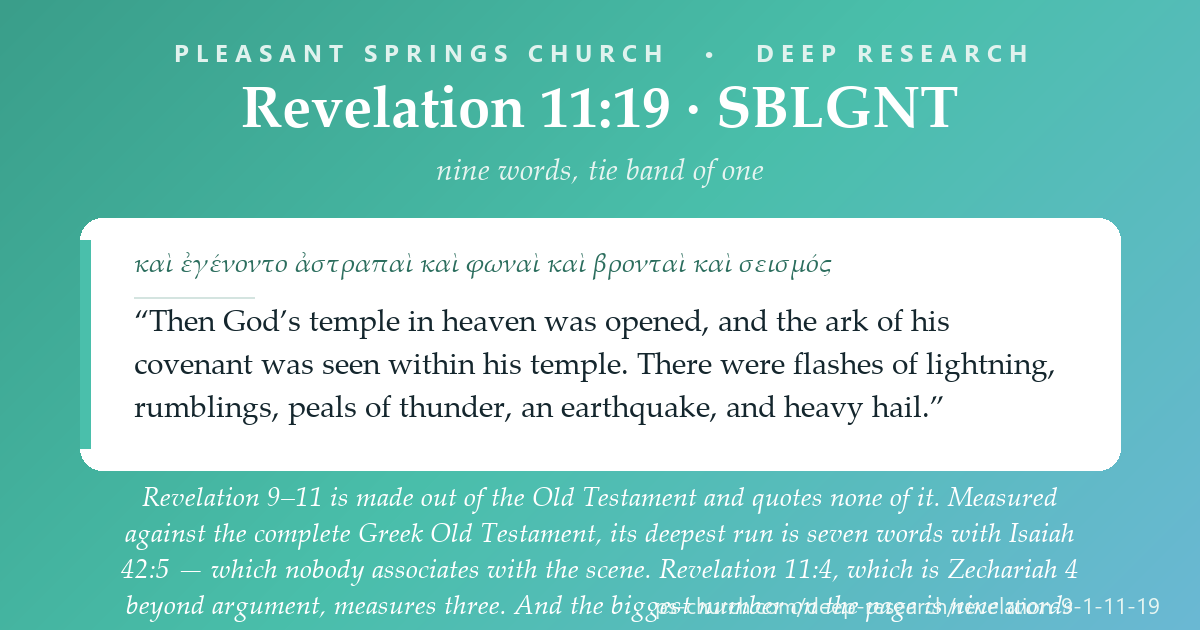
Revelation 9–11 is made out of the Old Testament and quotes none of it. Locusts out of Exodus, chariots out of Joel, a scroll eaten out of Ezekiel, two olive trees out of Zechariah, a measuring reed out of Ezekiel again, an oath out of Daniel — and not one citation formula in the whole book. So this page measured it. Fifty-one verses against the complete Greek Old Testament: 30,348 verse units — 64 CATSS files less the Odes — the last twenty of which went onto this shelf on 30 August 2026. Three results, none of them guessable. The deepest run into the Old Testament is seven words, tie band of one, and it is Isaiah 42:5 — a verse nobody sends you to. The one place the screen catches an allusion everyone already sees is Revelation 10:10 against Ezekiel 3:3, six words, tie band of one: the honey, not the scroll. And Revelation 11:4 — the two olive trees and the two lampstands, which is Zechariah 4 beyond argument — measures three. Then the largest number on the page, and it is not an Old Testament number at all: Revelation 11:19 shares nine consecutive words with Revelation 16:18. This book’s closest textual relative is itself. See the method →
Revelation 9:1–11:19 (selections)
Greek New Testament (SBLGNT / MorphGNT) · ESV⚠️ Revelation does have one verse-numbering divergence, and it is not in this passage. Over the whole book the SBLGNT counts 405 verses and the English versification 404. The single difference is at chapter 12: the sentence and he stood on the sand of the sea is printed as its own verse, 12:18, in the critical Greek, and folded into the end of 12:17 in the King James tradition and the English printings that follow it. Every other chapter of Revelation carries identical verse counts in both.
The Shape of the Passage
Sequence — three woes, counted by the text itself, and a delay inside the second⚠️ One line of the diagram is a reading, and here is the argument. Placing 10:1–11:13 inside the second woe rather than between the second and the third rests on the position of 11:14: the notice that the second woe has passed does not come at the end of the sixth trumpet (9:21) but after the two witnesses are taken up. Readers differ. The alternative — that 11:14 simply resumes a narrative the interlude interrupted, and reaches back over it to 9:21 — is held by good commentators and cannot be settled from word counts. The page prints the reading it drew and names the other.
⚠️ And the seventh trumpet breaks the pattern of the other two. Woe one is torment, woe two is death; woe three, when it finally sounds, is a coronation. Whatever the third woe is, Revelation does not describe it as a plague — it describes it as heaven singing.
These three chapters sit in the middle of the seven trumpets, and the middle is where Revelation slows down. Counted off disk: trumpets one to four take six verses between them (8:7–12) — one, two, two, one. The fifth takes eleven (9:1–11) and the sixth nine (9:13–21). Then the book stops for twenty-five verses (10:1–11:14) before the seventh sounds. The delay is the shape of the passage.
Author
A writer who never says “it is written.” The perfect γέγραπται, it is written, is the standard New Testament citation formula and stands 67 times in the Greek New Testament. Two of those are in Revelation — 13:8 and 17:8 — and neither introduces a quotation; both are about names written in the Lamb’s book of life. And the noun γραφή, Scripture, stands 49 times in the Greek New Testament by lemma and not once in Revelation. That is a count, not an argument about inspiration: this book is saturated with the Old Testament and never once stops to say so.
He does stop to translate. Twice, and both times for a name: Ἑβραϊστί, in Hebrew, at 9:11 (Abaddon) and 16:16 (Armageddon). The word occurs seven times in the Greek New Testament — five in John and these two. And 9:11 carries the only occurrence in the entire Greek New Testament of the adjective Ἑλληνική, Greek. The one sentence in the New Testament that names both languages is a sentence about the name of the angel of the abyss.
What this page does not decide. Who wrote Revelation, when, and whether the John of 1:9 is the son of Zebedee are questions no measurement here touches. Nothing on this page depends on an answer.
Audience
Readers who could hear an unquoted text. A congregation that did not know Exodus, Joel, Ezekiel, Daniel and Zechariah would have understood almost nothing in these chapters: locusts out of smoke, a scroll that tastes of honey and turns the stomach, two olive trees, a measuring rod, an ark. Revelation assumes the Old Testament the way a joke assumes a language. It never explains and it never cites — which tells you what its first hearers were expected to have by heart.
And it addresses two audiences at once. The witnesses prophesy in a city called Sodom and Egypt, where also their Lord was crucified (11:8). The onlookers are οἱ κατοικοῦντες ἐπὶ τῆς γῆς, those who dwell on the earth — a phrase that stands in seven verses of Revelation (3:10, 6:10, 8:13, 11:10, 13:8, 13:14, 17:8) and, in this book, is never neutral.
The temple in 11:1 is measured; the temple in 21:22 is absent. Whatever the measuring means, the book itself supplies the far end of the arc: ναός stands 16 times in Revelation, and the last of them says I saw no temple in the city. That end of the arc has its own study.
Orient on the trumpet cycle, the abyss, the two witnesses — and settle the numbering.
Search by topic: Revelation, book of; trumpets, seven; woe oracles; abyss / bottomless pit; Abaddon; Apollyon; locust; two witnesses; measuring vision; ark of the covenant; forty-two months; chapter and verse divisions, history of.
Which articles are relevant?
- Anchor Bible Dictionary — “Revelation, Book of,” “Abaddon,” “Apollyon,” “Abyss,” “Locust,” “Ark of the Covenant,” “Witness.”
- Dictionary of the Later New Testament & Its Developments (IVP) — “Revelation, Book of,” “Apocalyptic, Apocalypticism,” “Old Testament in Revelation,” “Temple.”
- NIDNTT / TDNT — ἄβυσσος, ἀπόλλυμι, σάλπιγξ, μάρτυς, ναός.
- Commentary on the New Testament Use of the Old Testament (Beale & Carson) — Beale & McDonough on Revelation 9–11. Named as the standard treatment and not consulted for any number on this page.
Settle the numbering — and there is almost nothing to settle
Revelation is a New Testament book. There is no Masoretic column, no Septuagint column and no offset to convert — and this shelf says so rather than passing over it.
| ch 9 | ch 10 | ch 11 | this passage | whole book | |
|---|---|---|---|---|---|
| SBLGNT (MorphGNT) | 21 | 11 | 19 | 51 | 405 |
| English versification (King James line) | 21 | 11 | 19 | 51 | 404 |
The one divergence in the whole book is at 12:17–18, and it does not touch this passage. The sentence καὶ ἐστάθη ἐπὶ τὴν ἄμμον τῆς θαλάσσης, and he stood on the sand of the sea, is verse 12:18 in the critical Greek and the tail of 12:17 in the King James line and the English printings that follow it. Established by comparing the Greek against an English text off disk chapter by chapter: every other chapter of Revelation carries the same verse count in both, and the whole-book totals differ by exactly one.
One offset does touch a footnote on this page. Abaddon stands at Psalm 88:12 in the Hebrew and 88:11 in English — the Hebrew counts the superscription as verse 1 — and at Psalm 87:12 in the Greek column, because the Greek Psalter also runs one behind from Psalm 9/10 onward. Stage 3 gives the numbers.
The three woes, the locusts, and one span counted four different ways.
The passage counts itself
Twice in these three chapters the vision stops and says how far through the woes it is. Those two sentences are the only structural markers on this page that are not somebody’s judgement.
| verse | what it says | what it fixes |
|---|---|---|
| 8:13 | an eagle in mid-heaven cries οὐαὶ οὐαὶ οὐαί to those who dwell on the earth, because of the remaining trumpet blasts of the three angels who are about to blow | three woes = trumpets five, six and seven |
| 9:12 | the first woe has passed; behold, two woes are still to come after this | woe one = the fifth trumpet, 9:1–11 |
| 11:14 | the second woe has passed; behold, the third woe is soon to come | woe two ends here, not at 9:21 |
⚠️ Revelation 8:13 is the only verse in the Greek New Testament that says οὐαί three times. Measured: the word stands 46 times in the Greek New Testament — Luke 15, Revelation 14, Matthew 13, Mark 2, 1 Corinthians 1, Jude 1 — and 8:13 is the single verse anywhere that carries three of them. Exhaustive over all 7,927 verses.
Read the table for what it is. It fixes the woes to trumpets. It does not settle whether the interlude of 10:1–11:13 belongs inside woe two or is a parenthesis that 11:14 reaches over — that is the one reading on the structure diagram, and it is labelled there.
The locusts, now that Greek Exodus is on the shelf
Until 30 August 2026 this shelf could not run Revelation 9 against Exodus 10 at all, because Greek Exodus was not among the CATSS files held here. It was fetched for this page. Here is what the comparison actually returns.
| comparison | run | the shared words |
|---|---|---|
| Rev 9:3 vs Exodus 10:12 (locusts come up over the land) | 3 | τὴν γῆν καί |
| Rev 9:3 vs Exodus 10:14 | 1 | καί |
| Rev 9:3 vs Exodus 10:15 | 2 | τῆς γῆς |
| Rev 9:2 vs Exodus 19:18 (smoke of a furnace) | 3 | ὡς καπνὸς καμίνου |
| Rev 9:9 vs Joel 2:5 (like the noise of chariots) | 3 | ὡς φωνὴ ἁρμάτων |
| Rev 9:8 vs Joel 1:6 (teeth like a lion’s) | 2 | οἱ ὀδόντες |
| Rev 9:4 vs Exodus 10:15 (they ate every plant) | 2 | τῆς γῆς |
Nothing in the locust plague reaches four with the two chapters it is obviously built from. The plague of Exodus 10 and the locust-army of Joel 1–2 are in this vision by any ordinary reading — Revelation 9:4 even reverses Exodus by telling the locusts not to touch the grass. Verbatim contact is not how they are in it. The vision remembers the pictures and does not carry the words.
The honest form of the finding. A screen that returns 3 for Joel 2:5 has not shown that Joel is absent. It has shown that Revelation is not copying Greek Joel’s sentence. Those are different claims and this shelf only ever makes the second one.
One span, four units, four chapters
The same length of time is given four different ways across Revelation 11–13, and two of the four are in this passage.
| unit | where | the Greek |
|---|---|---|
| forty-two months | 11:2 · 13:5 | μῆνας τεσσεράκοντα δύο |
| 1,260 days | 11:3 · 12:6 | ἡμέρας χιλίας διακοσίας ἑξήκοντα |
| three and a half days (of the bodies, not the span) | 11:9 · 11:11 | ἡμέρας τρεῖς καὶ ἥμισυ |
| a time, times and half a time | 12:14 (outside this passage) | καιρὸν καὶ καιροὺς καὶ ἥμισυ καιροῦ |
The fourth of those is the deepest Daniel contact in the neighbourhood, and it is not in this passage. Revelation 12:14 shares six consecutive words with Old Greek Daniel 12:7 — καιρὸν καὶ καιροὺς καὶ ἥμισυ καιροῦ — against three with Theodotion Daniel 12:7, which reads καιρὸν καιρῶν with no καί between them, and three with Theodotion Daniel 7:25, which reads καιροῦ καὶ καιρῶν in the genitive. The page reports this as a neighbour of the passage, clearly labelled, and does not fold it into any count for chapters 9–11.
What is not claimed. That the four units are the same span is arithmetic on a 30-day month, and it is what the numbers do; it is not a claim about what the span refers to. This page takes no position on whether the forty-two months are past, present, future or figurative, and offers no identification of the two witnesses. Stage 5 names the options as options.
A name the Greek Bible never transliterates, a scroll-word that exists in one chapter, and the only place the New Testament calls Greek Greek.
Revelation 9:11, once in the Greek New Testament and nowhere in the Greek Old Testament. The Hebrew noun אֲבַדּוֹן stands five times in the Masoretic text and the Greek column translates it every time. This verse is the only place in either Testament’s Greek where it stands as a Hebrew word, and Revelation itself says so.
Revelation 9:11, once as a name in the Greek New Testament. And it is not the Greek Old Testament’s word for the destroyer. Exodus 12:23 has τὸν ὀλεθρεύοντα and 1 Corinthians 10:10 τοῦ ὀλοθρευτοῦ — a different root. The form itself is not absent from the Greek Old Testament. Checked across all 64 files, ἀπολλύων stands twice — Job 12:23 and Sirach 20:22 — both times as an ordinary participle, destroying, and never as a name.
Nine occurrences in the Greek New Testament: Luke 8:31, Romans 10:7, and seven in Revelation — 9:1, 9:2, 9:11, 11:7, 17:8, 20:1, 20:3. Four of the seven are in this passage. Fifty occurrences across the complete Greek Old Testament, mostly the Psalms and Job, where it renders the deep.
Three occurrences in the whole Greek New Testament, all three in Revelation 10 — 10:2, 10:9, 10:10. Six verses in, the same object is an ordinary βιβλίον (10:8). Ezekiel’s scroll is never a βιβλαρίδιον: the Greek column calls it a κεφαλίς — a κεφαλὶς βιβλίου at Ezekiel 2:9.
Forty-five occurrences in the Greek New Testament by lemma, sixteen of them in Revelation. This passage holds four, in three verses — 11:1, 11:2 and 11:19 twice — and the last in the book is 21:22, I saw no temple in the city. The word is the sanctuary itself, not the temple precincts; the courtyard word αὐλή is what 11:2 casts out.
Revelation 9:11. The only occurrence of this adjective in the Greek New Testament. Its partner in the same verse, Ἑβραϊστί, stands seven times — five in John, and Revelation 9:11 and 16:16.
Abaddon: what the Greek column does with it, five times
The Hebrew noun אֲבַדּוֹן stands five times in the Masoretic text. In every one of them the Greek column translates rather than transliterates.
| Masoretic | Greek column | what stands there |
|---|---|---|
| Job 26:6 | Job 26:6 | τῇ ἀπωλείᾳ — destruction, beside ὁ ᾅδης |
| Job 28:22 | Job 28:22 | ἡ ἀπώλεια καὶ ὁ θάνατος — Destruction and Death, personified in both columns |
| Job 31:12 | Job 31:12 | ἀπώλεσεν — a verb, not the noun; the Greek row of this verse does not run parallel to the Hebrew |
| Psalm 88:12 (ESV 88:11) | Psalm 87:12 (the Psalter offset) | ἐν τῇ ἀπωλείᾳ — parallel to the grave |
| Proverbs 15:11 | Proverbs 15:11 | ᾅδης καὶ ἀπώλεια — Hades and Destruction are open before the Lord |
⚠️ A sixth verse is usually listed and it is spelled differently. Proverbs 27:20 pairs Sheol with אֲבַדֹּה — abaddoh, not abaddon — in the Masoretic text as this shelf holds it, and the Greek Proverbs on this disk has no verse numbered 27:20 at all, because Greek Proverbs orders and divides this material differently. The page reports the spelling and the gap and draws nothing from either.
So Revelation 9:11 is doing something the Greek Old Testament never does: it leaves the word in Hebrew and then tells you what it means. What it does not do is give the Septuagint’s equivalent. The Greek column’s word for Abaddon is ἀπώλεια, a noun — destruction. Revelation gives Ἀπολλύων, a participle — the one destroying. The place becomes a person.
Not asserted. That Revelation knew any of these five verses; that a Hebrew original lies behind 9:11; that Abaddon is a proper name in the Hebrew Bible rather than a place-word used in parallel with Sheol. The page counts where the word stands and what the Greek column put there. Second Temple developments of the name — at Qumran and elsewhere — were not consulted; see stage 5.
Fifty-one verses, two corpora, and the number that came out of the wrong one.
⚠️ Two different measurements are printed below and they are not interchangeable. A screen runs one verse against a whole corpus and returns a maximum and a tie band — how many target verses reach that same maximum. Every screen figure on this page carries its band, because a run without a band is misleading. A named-pair run compares two verses somebody chose in advance; it has no tie band, because nothing was screened. The counter-example table, the Daniel table and the storm table below are all named pairs and carry no bands by construction. Where a table has no band column, that is why.
Revelation 9–11 against the complete Greek Old Testament
Every one of the 51 verses, screened against 30,348 verse units — all 64 CATSS files less the Odes. Twenty of those files were fetched on 30 August 2026, so this study — like the other pages written on this shelf that day — was run against a Greek Old Testament with no gaps in it.
| deepest run | 2 | 3 | 4 | 5 | 6 | 7 |
|---|---|---|---|---|---|---|
| how many of the 51 verses | 5 | 14 | 19 | 11 | 1 | 1 |
Thirteen verses of fifty-one reach five or more. Two reach past five. Here are all the results at five and above with a tie band of one or two — the only band widths worth reading as anything.
| verse | deepest Old Testament partner | run | tie band | the shared words |
|---|---|---|---|---|
| Rev 10:6 | Isaiah 42:5 | 7 | 1 | τὴν γῆν καὶ τὰ ἐν αὐτῇ καί |
| Rev 10:10 | Ezekiel 3:3 | 6 | 1 | ἐν τῷ στόματί μου ὡς μέλι |
| Rev 10:2 | Zechariah 8:4 | 5 | 1 | ἔχων ἐν τῇ χειρὶ αὐτοῦ |
| Rev 11:5 | Ezekiel 34:10 | 5 | 1 | ἐκ τοῦ στόματος αὐτῶν καί |
| Rev 11:17 | Amos 9:5 | 5 | 1 | ὁ θεὸς ὁ παντοκράτωρ ὁ |
| Rev 11:18 | Psalm 60:6 (Greek; MT 61:6, ESV 61:5) | 5 | 1 | τοῖς φοβουμένοις τὸ ὄνομά σου |
| Rev 11:16 | Judith 5:8 (a file fetched 30 August 2026) | 5 | 1 | αὐτῶν καὶ προσεκύνησαν τῷ θεῷ |
| Rev 11:11 | 2 Chronicles 3:13 · Zechariah 14:12 | 5 | 2 | ἐπὶ τοὺς πόδας αὐτῶν καί |
⚠️ Read the top row twice. Revelation 10:6’s deepest Old Testament partner in the whole Septuagint is Isaiah 42:5, which is not where a reader of this verse is usually sent. That last clause is an impression of the commentary tradition and not a measurement; stage 5 lists what was not consulted. Isaiah 42:5 is thus says the Lord God, who made the heaven and fixed it, who established the earth and the things in it. Revelation 10:6 is an angel swearing by him who created heaven and the things in it, and the earth and the things in it, and the sea and the things in it. The seven words they share are τὴν γῆν καὶ τὰ ἐν αὐτῇ καί, and the tie band of one means only this: that exact seven-word sequence stands in no other verse of the 30,348. The page reports seven words with a tie band of one and calls it nothing else. Direction of influence is not asserted; that both are drawing on a common creation formula is the likeliest account, and the measurement cannot show even that.
The runner-up is worth naming for the same reason. Revelation 10:6’s second-deepest Old Testament partner is 2 Maccabees 7:28, at six — καὶ τὴν γῆν καὶ τὰ ἐν — the verse in which a mother tells her son that God made heaven and earth out of what did not exist. 2 Maccabees was not on this shelf until 30 August 2026. So this verse’s second-deepest partner in the whole Greek Old Testament became measurable on the day the page was written — which is itself a caution about how firmly any of these rankings should be held.
And read the second row for the opposite reason. Revelation 10:10 against Ezekiel 3:3 is the one place in these three chapters where the screen and the reader agree. Everybody who has ever read Revelation 10 has seen Ezekiel 2 and 3 in it; the measurement independently returns six consecutive words with a tie band of one. That is what a real verbatim contact looks like on this instrument — and it is worth noticing that the six words are the honey, not the scroll: Revelation calls the object a βιβλαρίδιον, Ezekiel a κεφαλίς, and the two nouns share nothing.
⚠️ The counter-examples, printed on purpose
If the seven words at 10:6 are going to be printed, so must these. Every one of them is an Old Testament borrowing no reader doubts, and every one of them measures small.
| the borrowing nobody disputes | source | run | what stops it |
|---|---|---|---|
| Rev 11:4 the two olive trees and the two lampstands | Zechariah 4:11 | 3 | Zechariah’s lampstand is a λυχνία in the singular and the trees flank it; Revelation has two of each and stands them before the Lord |
| Rev 11:6 power to turn the waters into blood | Exodus 7:17, 7:20 | 2 | εἰς αἷμα and nothing further; Exodus narrates, Revelation grants authority |
| Rev 11:11 a breath of life entered them and they stood on their feet | Ezekiel 37:5, 37:10 | 3 | a case ending. Ezekiel: ἐπὶ τῶν ποδῶν αὐτῶν. Revelation: ἐπὶ τοὺς πόδας αὐτῶν |
| Rev 11:1 rise and measure the temple | Ezekiel 40:3, 40:5 · Zechariah 2:1, 2:5 (Greek/MT; English 1:18, 2:1) | 1–2 | every measuring word differs; only καί and καὶ τό survive |
| Rev 10:9–10 take and eat the scroll | Ezekiel 2:8, 3:1 | 1 | the command verbs and the scroll noun are all different; only 3:3, the honey verse, carries a run |
| Rev 9:9 like the noise of chariots | Joel 2:5 | 3 | and its deepest Old Testament partner is a 4 at Ezekiel 26:13, which is about the sound of songs |
Set the two columns of this page side by side and the point is unavoidable. Revelation 11:4 is Zechariah 4 and measures three. Revelation 10:6 is probably not Isaiah 42:5 in any authorial sense at all, and measures seven. A contiguous-run screen finds verbatim contact. It does not find allusion, and on this passage it is wrong about which verses matter more often than it is right. The Zechariah 1–8 study on this shelf found the same inversion and said so; it is the clearest statement of the limit here.
The screen reads one verse at a time, and here is what that costs
Revelation 10:5–6 is the angel raising his hand to heaven and swearing by him who lives forever. Daniel 12:7 is the man clothed in linen raising his hand to heaven and swearing by him who lives forever. Verse against verse, they never exceed three.
| comparison | run | the shared words |
|---|---|---|
| Rev 10:5 vs Old Greek Daniel 12:7 | 3 | εἰς τὸν οὐρανόν |
| Rev 10:6 vs Old Greek Daniel 12:7 | 3 | τὸν οὐρανὸν καί |
| Rev 10:5–6 joined vs Theodotion Daniel 12:7 | 5 | εἰς τὸν οὐρανὸν καὶ ὤμοσεν |
| Rev 10:5–6 joined vs Old Greek Daniel 12:7 | 4 | εἰς τὸν οὐρανὸν καί |
The contact straddles a verse boundary, and a verse-by-verse screen cannot see it. The five words εἰς τὸν οὐρανὸν καὶ ὤμοσεν — to heaven, and he swore — run from the end of Revelation 10:5 into the start of 10:6, which is exactly where the standard chapter division of Revelation puts a number. Every per-verse figure on this shelf carries this limitation and this is the first page to demonstrate it with a worked case.
Note also which Daniel. The joined run is five with Theodotion and four with the Old Greek, because Theodotion reads καὶ ὤμοσεν ἐν τῷ ζῶντι where the Old Greek has καὶ ὤμοσε τὸν ζῶντα. Revelation 10:6 has ὤμοσεν τῷ ζῶντι — the dative, like Theodotion, without Theodotion’s preposition. This shelf holds both Greek Daniels and prints both. It asserts nothing about which text anyone was reading, and a one-word difference is not evidence of a text-form.
Against the rest of the Greek New Testament — where the biggest numbers are
The same 51 verses, screened against the other 7,876 verses of the Greek New Testament. The two largest figures on the whole page are here, and neither of them is an Old Testament partner.
| verse | deepest New Testament partner | run | tie band | the shared words |
|---|---|---|---|---|
| Rev 11:19 | Revelation 16:18 | 9 | 1 | καὶ ἐγένοντο ἀστραπαὶ καὶ φωναὶ καὶ βρονταὶ καὶ σεισμός |
| Rev 11:16 | Revelation 7:11 | 8 | 1 | ἐπὶ τὰ πρόσωπα αὐτῶν καὶ προσεκύνησαν τῷ θεῷ |
| Rev 10:6 | Revelation 4:9 · 4:10 | 7 | 2 | τῷ ζῶντι εἰς τοὺς αἰῶνας τῶν αἰώνων |
| Rev 10:1 | Matthew 17:2 | 6 | 1 | τὸ πρόσωπον αὐτοῦ ὡς ὁ ἥλιος — the transfiguration |
| Rev 10:4 | Revelation 14:2 | 6 | 1 | καὶ ἤκουσα φωνὴν ἐκ τοῦ οὐρανοῦ |
| Rev 11:18 | Revelation 13:16 | 6 | 1 | τοὺς μικροὺς καὶ τοὺς μεγάλους καί |
Five of the six deepest partners are Revelation itself. The book repeats its own sentences more exactly than it repeats anybody else’s — nine words, eight words, seven, six, six, each with a tie band of one or two. Against the whole Greek Old Testament the same fifty-one verses top out at seven. Whatever Revelation is doing with Ezekiel and Zechariah and Daniel, it is not doing what it does with Revelation.
The one outsider in the table is worth its own sentence. Revelation 10:1 describes the mighty angel with τὸ πρόσωπον αὐτοῦ ὡς ὁ ἥλιος, his face like the sun — six consecutive words, tie band of one, shared with Matthew 17:2, the transfiguration. The page reports six words and a band of one and asserts nothing whatever about the identity of the angel. Six shared words is six shared words.
The storm that stands four times, and what word order costs
Lightning, voices, thunder, earthquake. The same short list stands at Revelation 4:5, 8:5, 11:19 and 16:18 — and the run screen scores it from three to nine depending only on the order.
| compared with 11:19 | run | why |
|---|---|---|
| Revelation 16:18 | 9 | same four items, same order, same opening verb: καὶ ἐγένοντο ἀστραπαὶ καὶ φωναὶ καὶ βρονταὶ καὶ σεισμός |
| Revelation 4:5 | 6 | same three items in the same order but a different verb before them (ἐκπορεύονται) and no earthquake |
| Revelation 8:5 | 3 | the identical four items, listed backwards: βρονταὶ καὶ φωναὶ καὶ ἀστραπαὶ καὶ σεισμός — only καὶ φωναὶ καί survives |
Revelation 8:5 and Revelation 11:19 are the same sentence and the screen scores them at three. Nothing has been mismeasured — contiguous means contiguous, and reversing a list destroys a run without touching a word. This is the plainest demonstration on the whole shelf of what a low number does and does not mean, and it is why every figure here is printed with its tie band and never on its own. If Revelation can reduce its own sentence from nine to three by writing it backwards, so can any writer using Ezekiel.
Where this page is weakest, what changed under it, and what was never reached.
⚠️ The corpus changed under this page, and here is the disclosure
On 30 August 2026, while this page was being measured, the remaining twenty CATSS Greek Old Testament files were fetched onto this shelf. Greek Exodus, Leviticus, Numbers, Joshua in both recensions, Judith, both Tobits, 2–4 Maccabees, Odes, Wisdom, Psalms of Solomon, Baruch, the Epistle of Jeremiah, and the additions to Daniel. The Greek Old Testament went from 44 files and 23,061 verse units to 64 files and 30,348. Every number on this page was run against the complete set.
That has consequences beyond this page, and they are stated here rather than left to be found.
- Older pages on this shelf carry sentences that were true when written and are not true now. Around four dozen builders say some version of “Greek Exodus is not on this shelf” or “the count covers the 44 files held here.” Those sentences under-claim rather than mislead — they narrow a scope that has since widened — but they are now inaccurate and the shelf owes them a pass. ★ That pass has begun, and it is not only under-claiming that it is finding. Six pages have been re-run so far and four of them moved.
- 2 Timothy 1:1–4:22. Its headline caveat was that 2 Timothy 2:19’s seal — the Lord knows those who are his — “cannot be checked here at all, because Numbers is one of the twenty CATSS files not on this disk.” With Numbers on disk the verse’s deepest Greek Old Testament partner went from a run of 3 in a tie band of 38 (the stock phrase τὸ ὄνομα κυρίου, pointing nowhere) to a run of 4 in a tie band of 1, and the partner is Numbers 16:5. The exact five-word string still returns zero — because CATSS Numbers reads ἔγνω ὁ θεός where 2 Timothy reads ἔγνω κύριος. One word, and it is the divine name. On that same page παραθήκη, the deposit, went from a published zero to three — two of them Leviticus 5:21 and 5:23, the law of goods left with a trustee.
- Psalm 78. It declined to say whether John 6:31 stands nearer the Greek Psalter or the manna narrative, “because the Greek of Exodus is not held by this library.” Measured now: neither is nearer. John 6:31 reaches 3 against LXX Psalm 77:24 and 3 against LXX Exodus 16:4 — and on different words. The Psalter supplies οὐρανοῦ ἔδωκεν αὐτοῖς, Exodus supplies ἐκ τοῦ οὐρανοῦ, and John’s line takes three from each.
- Philippians 1 lost an eight-of-eight (ἀποβήσεται is now eight-of-nine in Job, the ninth being Wisdom 2:3), and Genesis 12:10–20 gained a divergence: its proto-Exodus argument turns on the Hebrew root n-g-’, and with Greek Exodus on disk the Greek columns of Genesis 12:17 and Exodus 11:1 turn out to share one word, καί. The link is real and it is Hebrew-only.
- At least one published figure moved. The Zechariah 1–8 study counted κράσπεδον, the fringe of a garment, at two occurrences in the Greek Old Testament, and named Numbers 15:38–39 as the tassel command it could not reach. With Numbers on disk the count is five. That page has been corrected.
- Nothing on this page rests on the old state. Every figure here was produced after the fetch, against 64 files.
- ★ And the fetch introduced a hazard this disclosure did not anticipate, so it is added here rather than left for someone to trip on. Two of the twenty new files are not Old Testament witnesses at all. Odes 9 is Luke 1:46–55 and 1:68–79 — the Magnificat and the Benedictus — and Odes 13 is Luke 2:29–32, the Nunc Dimittis, gathered into the Greek Psalter’s fourteen-canticle appendix for liturgical use. When this bullet was written they were inside every “screened against the Greek Old Testament” measurement on this shelf. 272 New Testament verses came back with an Ode 9 or Ode 13 row in their deepest-partner set, and the top of that list is Luke matched to itself: Luke 1:48 against Odes 9:48 at 18 — deeper than anything in Revelation 9–11 — then Luke 1:79 at 16, Luke 1:68 at 14, Luke 1:55 and Luke 2:29 at 12. None of that is contact between the Testaments, and a page that printed it without saying so would be reporting Luke as a witness to Luke.
- ★ THAT HAZARD IS NOW CLOSED, AND THIS IS THE PAGE THAT OWES THE FOLLOW-UP. On 31 August 2026 the Odes were taken out of everything this shelf calls “the Greek Old Testament” for screening. The file is still held on the disk; it is no longer screened. Two independent reasons, either sufficient on its own. (1) Two of the canticles are New Testament text, which is what this page found. (2) Ten more are second copies of passages the corpus already holds — Ode 1 = Exodus 15, 2 = Deuteronomy 32, 3 = 1 Samuel 2, 4 = Habakkuk 3, 5 = Isaiah 26, 6 = Jonah 2, 7 and 8 = Daniel (Th) 3, 10 = Isaiah 5, 11 = Isaiah 38 — so a verse standing once in Habakkuk appeared to stand twice, and any tie band that touched a canticle was doubled. HELD is 30,637 verse units in 64 files. SCREENED is 30,348. The difference is exactly the 289 Odes units; both numbers are correct, and a page has to say which one it means. The count of New Testament verses carrying an Ode 9 or Ode 13 row in their deepest-partner set is now zero. Thirty-four New Testament rows lose depth outright and every one of the thirty-four is in Luke 1–2. Luke’s deepest Old Testament run falls from 18 to 13 (Luke 3:4 on Isaiah 40:3), and its rows reaching ten or more fall from 18 to 8.
- And the effect on THIS page is nil, which is the answer a control is supposed to give. Nothing in Revelation 9–11 ever touched the Odes. Re-run over 30,348 units, every run and every published tie band in Stage 4 is unchanged — 10:6 still seven at Isaiah 42:5 in a band of one, 10:10 still six at Ezekiel 3:3, the six rows at five all still five, and the distribution 5/14/19/11/1/1 exactly as printed. Six tie bands narrowed by one row apiece and not one of them is a figure this page prints (9:2, 9:15, 9:17, 10:7, 11:2, 11:6). No verse of these three chapters reaches deeper than 5 against any of the twenty files added on 30 August, and where it does the partner is shared inside a tie band — Revelation 10:1 with Leviticus 3:13, 8:9 and 24:14; Revelation 11:10 with Numbers 14:14 and 33:55; Revelation 11:15 with Tobit (S) 14:15 and 4 Maccabees 18:24; Revelation 11:16 with Judith 5:8 (the last three are witnesses, not Scripture).
- The deuterocanonical books are now measurement partners, and the shelf labels them every time. Judith, Tobit, Wisdom, Sirach, Baruch, the Epistle of Jeremiah, the Maccabees, the Psalms of Solomon, Odes, and the Susanna and Bel supplements are WITNESSES, NOT SCRIPTURE on this shelf — the same treatment Psalm 151 and Jubilees already have. A hit in one of them is named with the book and with what the book is, never quietly folded into “the Greek Old Testament.”
Why disclose it on a study of Revelation. Because the alternative is a shelf whose numbers quietly stop agreeing with each other, and this shelf’s whole claim is that its numbers can be re-run. The regression lock — 80 published figures re-derived on demand — failed the moment the corpus grew, which is exactly what it exists to do.
What this page cannot show, starting with its own headline
The claim that Revelation 9–11 never quotes the Old Testament is weaker than it sounds, and here is precisely how weak. Two things were measured: that no citation formula stands anywhere in these chapters (γέγραπται twice in the whole book, neither introducing a quotation; ἡ γραφή never), and that no verse reaches eight consecutive words with any Old Testament verse. Neither of those proves there is no quotation. A writer can quote without a formula, and can quote while reordering — and Revelation 8:5 against 11:19 is a worked demonstration, on this very page, that reordering drops a nine-word agreement to three. The screen would miss a quotation written that way, and this page says so before anyone else has to.
Word forms, never lemmas — and it costs a real result here. Revelation 11:11 loses Ezekiel 37:10 on a case ending: ἐπὶ τῶν ποδῶν against ἐπὶ τοὺς πόδας. A lemma-based screen would have scored it higher. This shelf does not use one, because a lemma screen matches things that are not the same words — but the price is paid here and is named here.
The measurement is Greek against Greek only. Revelation exists in no Hebrew, so the question of a Semitic substrate behind its Greek — a large literature — is not testable by anything on this shelf, and no claim about it appears here.
What could not be checked at all
No critical apparatus on either side. No manuscript of Revelation was consulted — not P47, not Sinaiticus, not Alexandrinus — and the variants at 9:11 and 11:1 that editors discuss were not examined; the SBL edition is taken as it stands. No Latin, Syriac or Coptic versions. No patristic citations: the earliest commentators on Revelation, Victorinus and Oecumenius and Andrew of Caesarea, were not opened.
No Second Temple material was consulted, and for Abaddon that is a real gap. The name has a history at Qumran and in the apocalyptic literature, and none of it was read for this page. Stage 3 counts where the Hebrew word stands in the Masoretic text and what the Greek column put there, and stops.
Three interpretive questions are left open on purpose, and none of them can be settled by a word count.
- Who the two witnesses are. Moses and Elijah, Enoch and Elijah, the church in its witnessing office, two individuals still to come — all are held, all have arguments, and this page identifies nobody. The text gives them the powers of Elijah (shutting the sky) and of Moses (waters to blood) and does not name them.
- What the temple of 11:1–2 is. The Jerusalem sanctuary before 70, the church, the faithful remnant, a future building. The measuring is not explained.
- What the forty-two months are. The page prints that four units name one span and takes no position on what the span is.
And the hardest thing about this passage is not textual. Two trumpets in these chapters describe torment and slaughter on a scale the book does not soften, and the seventh answers them with a song. The page does not resolve that; it notes only that Revelation itself puts the two next to each other and makes the third woe a coronation.
Reading list
- G. K. Beale, The Book of Revelation (NIGTC) — the standard treatment of Revelation’s Old Testament usage.
- David E. Aune, Revelation 6–16 (Word Biblical Commentary 52B).
- Craig R. Koester, Revelation (Anchor Yale Bible 38A).
- Richard Bauckham, The Climax of Prophecy — on the scroll of chapter 10 and the witnesses of chapter 11.
- Steve Moyise, The Old Testament in the Book of Revelation.
- None of these were consulted for any measurement on this page, which were run on the text files named in the footer.
A book that never says “it is written,” and quotes itself instead.
Nine words with itself
Revelation never once stops to say “as it is written.” Sixty-seven times in the Greek New Testament somebody writes γέγραπται, and the two occurrences in this book are both about names in the Lamb’s book of life. And yet you cannot read three verses of chapter 9 without Exodus, or three verses of chapter 11 without Zechariah.
So the measurement went looking for the seams, and found them in an order nobody would have predicted. Seven words with Isaiah 42:5, which is not the verse associated with this scene. Six with Ezekiel 3:3, which everyone does. Three with Zechariah 4, which is beyond dispute. And then, larger than all of them, nine consecutive words shared between Revelation 11:19 and Revelation 16:18, with a tie band of one.
The temple is opened and the ark is seen, and heaven answers with lightning, voices, thunder and an earthquake — and five chapters later the same sentence stands again, word for word. Whatever this book is doing with the prophets, what it does with itself is different in kind. It is not alluding to Revelation 16:18. It is the same book, saying the same thing twice, so that the second time you know where you have heard it.
Which leaves the honest question this page ends on. The verse with the deepest Old Testament run in these three chapters — Revelation 10:6, seven words with Isaiah 42:5 — is almost certainly not a quotation. The verse with the most certain Old Testament debt — Revelation 11:4 and the two olive trees — measures three. If the instrument gets those two the wrong way round, what is it good for? It is good for exactly one thing, and the page has tried to do only that thing: it tells you, without argument and without a commentary, where two texts share words in order. Everything else on this page is reading, and it is labelled as reading.
Second study of the trumpet cycle on this shelf and one of nine on Revelation, beside 1:9–18, 2:1–3:22, 5:1–14, 6:1–8:13, 12:1–14:20, 15:1–18:24, 19:1–20:15 and 21:1–22:5. Chapters 9 and 10 had no page on this shelf before this one.
Every Deep Research page traces its passage across the whole sweep — the Old Testament, the Second-Temple world between the testaments (historical witnesses, not Scripture), and the New Testament. Follow the thread:
Pleasant Springs Church — Deep Research
Research method after Michael S. Heiser’s Bible Research Method (examine dictionaries → ancient literature → important words → textual connections → academic publications → share), with the Pleasant Springs “Author & Audience” foundation. Scripture set in the Hebrew, the Greek editions named on each page and the ESV (Old Testament), and the Greek New Testament and the ESV (New Testament), per the practice of Pleasant Springs Church. Revelation research grounded in Beale (NIGTC), Aune (WBC), Koester (Anchor Yale), Bauckham (The Climax of Prophecy) and Moyise — none of which were consulted for any number on this page. Text: Greek New Testament from the SBL edition as digitized by MorphGNT; Greek Old Testament from Rahlfs’ Septuaginta as digitized by CATSS; Hebrew from the Masoretic text as printed in Sefaria’s Miqra according to the Masorah. No critical apparatus was consulted on any side, and no manuscript of Revelation was examined. The standing caution for this shelf applies: these pages say “the CATSS Greek row reads…” and never call a reading early or late. ⚠️ VERSE NUMBERING — Revelation is a New Testament book, so there is no Masoretic or Septuagint column and no offset to state. Stated because this shelf states it everywhere, including where there is nothing to convert. Counted off disk: SBLGNT Revelation 9, 10 and 11 run 21 / 11 / 19 = 51 verses, and an English text on disk counts the same shape verse for verse. Over the whole book SBLGNT counts 405 and the English versification 404: the single divergence is and he stood on the sand of the sea, printed as 12:18 in the critical Greek and folded into 12:17 in the King James line and the printings that follow it. It is not in this passage. One genuine offset is touched in a footnote: Abaddon stands at Psalm 88:12 in the Hebrew, 88:11 in English, and Psalm 87:12 in the Greek column. ⚠️ The measurement, in full. Greek against Greek. MorphGNT field 6, the normalised word (the column that already resolves elision and the movable nu); CATSS FORM column (cols 0–24), beta-code transliterated first. Both sides lowercased, accents and breathings dropped, final sigma folded, then filtered to Greek letters — the same filter applied to both corpora. Contiguous runs of whole word FORMS, never lemmas. Corpus: the 51 MorphGNT rows of Revelation 9–11 against 30,348 verse units — the 64 CATSS files less the Odes and against the other 7,876 verses of the Greek New Testament. Exhaustive and deterministic; nothing sampled, so no seed applies. The tie band — how many target verses reach the same maximum — is printed beside every run on this page. ⚠️ THE CORPUS GREW UNDER THIS PAGE, ON 30 AUGUST 2026. The last twenty CATSS files — Exodus, Leviticus, Numbers, both Joshuas, Judith, both Tobits, 2–4 Maccabees, Odes, Wisdom, Psalms of Solomon, Baruch, the Epistle of Jeremiah and the Daniel additions — were fetched that day, taking the Greek Old Testament from 44 files and 23,061 verse units to 64 and 30,348. Every figure on this page was produced after that fetch, against the complete 64-file set. Older pages carry scope sentences naming books that are now held, and one published count — κράσπεδον on the Zechariah 1–8 study, two over 44 files — became five over 64 and has been corrected there. Stage 5 discloses this in full, including the pass now under way across the older pages and what it has already moved: 2 Timothy 2:19’s deepest Greek Old Testament partner went from a run of 3 in a band of 38 to a run of 4 in a band of 1, and the partner is Numbers 16:5. ⚠️ A HAZARD THE FETCH CREATED, AND SINCE CLOSED. Odes 9 is Luke 1 and Odes 13 is Luke 2 — the Magnificat, the Benedictus and the Nunc Dimittis, collected into the Greek Psalter’s appendix — so the New-Testament-against-Greek-Old-Testament screen on this shelf was returning Luke as a match for Luke in 272 verses on the day this page went up. On 31 August 2026 the Odes were removed from every screen on this shelf, for that reason and because ten more of the canticles are second copies of Exodus 15, Deuteronomy 32, 1 Samuel 2, Habakkuk 3, Isaiah 26, Jonah 2, Daniel 3, Isaiah 5 and Isaiah 38, which doubled any tie band that touched them. HELD 30,637 in 64 files; SCREENED 30,348 — the 289 Odes units are the difference. Every figure on this page was re-run over 30,348 and none of them moved: nothing in Revelation 9–11 ever touched the Odes. Stage 5 prints the whole history. All the deuterocanonical books are WITNESSES, NOT SCRIPTURE here and are labelled so at every hit. ⚠️ What a per-verse screen cannot see, demonstrated on this page. Two limits are shown with worked cases rather than asserted. (1) Runs do not cross verse boundaries: Revelation 10:5 and 10:6 each measure three against Daniel 12:7, and joined they measure five. (2) Reordering destroys a run without changing a word: Revelation 11:19 and Revelation 16:18 share nine consecutive words, and Revelation 8:5, which is the same four items written backwards, scores three. ⚠️ Direction of influence is never asserted. Nothing here says Revelation is quoting or adapting Isaiah 42:5, Ezekiel 3:3, Zechariah 4, Daniel 12:7 in either Greek column, Exodus 10 or Joel 2; nothing says which Greek Daniel its author knew; and nothing says anything at all about the identity of the mighty angel from six words shared with Matthew 17:2. The page reports shared words in order, with tie bands, and stops. Typology is handled per the house position: what the text says, what the New Testament itself draws, and what we see from this side of the cross — with the seeing left to the reader.
Scripture quotations marked ESV are from the ESV® Bible (The Holy Bible, English Standard Version®), © 2001 by Crossway, a publishing ministry of Good News Publishers. ESV Text Edition: 2016. Used by permission. All rights reserved. The ESV text may not be quoted in any publication made available to the public by a Creative Commons license, and the ESV may not be translated in whole or in part into any other language. www.esv.org
|
Did this study bless you today? 💚 Give to Support PS Church100% of gifts go to the General Fund — thank you. |