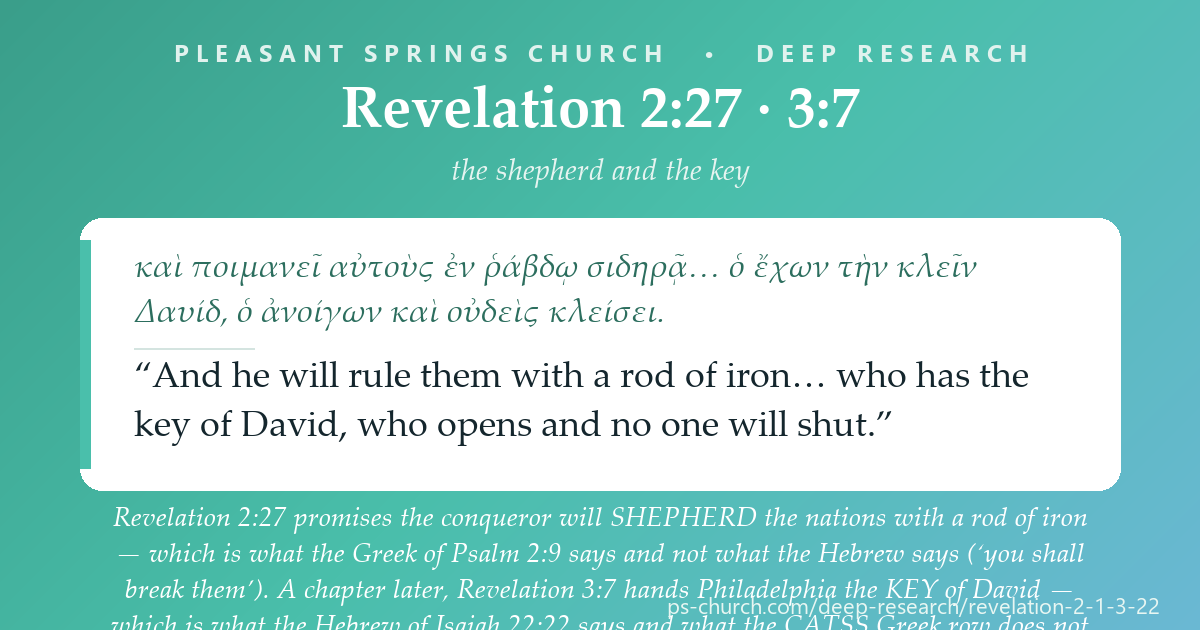
Seven messages, one template, and two verses inside it that lean in opposite directions. Revelation 2:27 promises that the conqueror will shepherd the nations with a rod of iron — which is what the Greek column of Psalm 2:9 says, and not what the Hebrew says. The Hebrew reads you shall break them. A chapter later, Revelation 3:7 hands the church at Philadelphia the key of David — which is what the Hebrew of Isaiah 22:22 says, and what the CATSS Greek row of that verse does not contain at all. Except that Swete’s Greek Isaiah, also on the shelf here, does contain it — as a second rendering set immediately after the first. Two measurements, two directions, and one honest answer about the second. Meanwhile the deepest verbatim contact anything in these two chapters makes is not with the Old Testament and not with Paul: Revelation 2:7 and Revelation 2:17 share fourteen consecutive words with each other, and of the eight rows that reach five or more against the whole rest of the Greek New Testament, seven land back inside Revelation. See the method →
Revelation 2:1–3:22 (selections)
Greek New Testament (SBLGNT / MorphGNT) · ESVBold marks a measured contiguous run, and every run on this page is printed with its tie band. A run of six with a band of one is a signal; a run of four with a band of thirteen is a formula. Both appear below.
The Shape of the Passage
Sequence — seven messages on one template, and the template turns over after the thirdThese are not seven letters. They are seven messages inside one letter. Revelation is addressed as a whole to all seven churches (1:4, 1:11), and every one of the seven messages ends by telling the hearer what the Spirit says to the churches, plural. No congregation was ever meant to read only its own paragraph.
Author
John writes; the messages are dictated. The command in every one of the seven is γράψον, write, and what follows it is τάδε λέγει, thus says. That formula is the standing opening of a prophetic oracle in the Greek Old Testament, where it stands 353 times across the files held here, most heavily in Ezekiel and Jeremiah. In the Greek New Testament it stands eight times, and seven of them are here. The writer places himself in the position of a scribe taking down a messenger-speech.
The addressee of each message is an ἄγγελος, and the page will not tell you what that is. Every message opens to the angel of the church in…. The same noun in Revelation means a heavenly being dozens of times over; it can also mean a human messenger, and 1:20 calls the seven angels the seven stars in Christ’s hand without explaining further. Guardian angel, human envoy, bishop, or the congregation personified — all four have been argued and none can be settled from the text. This page reports the word.
Audience
Seven real cities on one real road. Ephesus, Smyrna, Pergamum, Thyatira, Sardis, Philadelphia, Laodicea — taken in the order a courier leaving Ephesus would reach them, north up the coast and then inland and south. The order in the text is a delivery route, and that is an observation about geography, not about symbolism.
Churches under two pressures at once. From outside: θλῖψις and prison at Smyrna, a named martyr at Pergamum (2:13), and a city where Christ says Satan’s throne is. From inside: false apostles at Ephesus, the teaching of Balaam and the Nicolaitans at Pergamum, a prophetess the text calls Jezebel at Thyatira, deadness at Sardis, self-satisfaction at Laodicea. Five of the seven are told to repent. The two that are not are the two under the heaviest outside pressure.
Orient on the messenger formula, the seven cities, and the shape of a prophetic oracle.
Search by topic: Revelation, book of; the seven churches of Asia; Ephesus; Smyrna; Pergamum; Thyatira; Sardis; Philadelphia; Laodicea; messenger formula / ‘thus says the Lord’; prophetic oracle, forms of; angel; Nicolaitans; imperial cult in Asia.
Which articles are relevant?
- Anchor Bible Dictionary — “Revelation, Book of,” and the seven city entries; “Messenger Formula,” “Nicolaitans,” “Angel.”
- Dictionary of the Later New Testament (IVP) — “Revelation, Book of,” “Emperor Worship,” “Persecution,” “Asia Minor.”
- NIDNTT / TDNT — νικάω (nikaō, conquer), μετανοέω (metanoeō, repent), ἄγγελος (angelos).
- Commentary on the NT Use of the OT (Beale & Carson) — the Revelation chapter on 2:26–27 (Psalm 2) and 3:7 (Isaiah 22).
Settle the numbering first — and there is nothing to settle here
Revelation 2 and 3 carry the same verse numbers in the Greek and in the ESV. There is no offset anywhere in this passage, and the page states that rather than leaving it unsaid.
| ch 2 | ch 3 | whole book | |
|---|---|---|---|
| SBLGNT / MorphGNT | 29 | 22 | 405 |
| ESV | 29 | 22 | 404 |
The one-verse difference in the totals is at 12:18, and it is the only one. The SBLGNT prints and he stood on the sand of the sea as its own verse, 12:18; the ESV carries that clause at the end of 12:17 and goes straight from 12:17 to 13:1. Chapter by chapter the two columns agree everywhere else, and they agree here.
Why say so when there is no offset? Because the house rule on this shelf is that a page states its versification either way. A silent page leaves a reader wondering whether the question was asked.
The messenger formula, the seven cities, and what a run screen can and cannot see.
“Thus says” — where the formula comes from, counted
Every one of the seven messages opens with τάδε λέγει. Here is what that phrase does across the corpora held on this shelf.
| corpus | occurrences | where |
|---|---|---|
| Greek New Testament (7,927 verses) | 8 | Revelation 2:1, 2:8, 2:12, 2:18, 3:1, 3:7, 3:14 — and Acts 21:11, where Agabus says it after binding his own feet and hands with Paul’s belt |
| Greek Old Testament (64 files, 30,637 verse units) | 353 | Ezekiel 126, Jeremiah 64, Isaiah 31, 4 Kingdoms 27, 3 Kingdoms 22, Zechariah 20, Amos 14, Exodus 11, and eighteen other files |
In the Hebrew this is כֹּה אָמַר, thus said — the standing opening of a prophetic oracle, and before that the opening of a royal or diplomatic messenger-speech. What the count shows is not that Revelation is borrowing a particular verse but that it has adopted a particular FORM, and adopted it seven times running in a book that otherwise never uses it.
What is not being claimed. Nothing here says that Revelation is quoting Ezekiel, or that Ezekiel is the source of the formula, or that either writer had the other in front of him. A shared form is a shared form. Direction of influence is not asserted anywhere on this page.
The hearing-formula, and the two words that change
Seven times in these two chapters: ὁ ἔχων οὖς ἀκουσάτω. The Gospels have a saying that sounds identical in English and is not identical in Greek.
| where | the Greek | the ear | the verb |
|---|---|---|---|
| Revelation 2:7, 2:11, 2:17, 2:29, 3:6, 3:13, 3:22 | ὁ ἔχων οὖς ἀκουσάτω | singular οὖς | aorist ἀκουσάτω |
| Matthew 11:15, 13:9, 13:43 | ὁ ἔχων ὦτα ἀκουέτω | plural ὦτα | present ἀκουέτω |
| Luke 8:8, 14:35 | ὁ ἔχων ὦτα ἀκούειν ἀκουέτω | plural ὦτα | present ἀκουέτω, with an added infinitive |
| Mark 4:9, 4:23 | ὃς ἔχει / εἴ τις ἔχει … ὦτα ἀκούειν ἀκουέτω | plural ὦτα | present ἀκουέτω, and the pronoun changes too |
The four-word string ὁ ἔχων οὖς ἀκουσάτω occurs exactly seven times in the Greek New Testament, and all seven are in these two chapters. An eighth, differently worded, stands at Revelation 13:9: εἴ τις ἔχει οὖς ἀκουσάτω — and it keeps the singular ear and the aorist. Both features that separate Revelation’s form from the Gospels’ hold across the whole book.
The page does not say the Gospels and Revelation have different sources for this saying, or that one is adapting the other, or which came first. It says the wording differs in two respects and that the difference is consistent.
Seven cities, and the four things the text itself supplies about them
A great deal is written about how each message suits its city — the hot springs above Laodicea, the acropolis at Sardis, the wool trade at Thyatira. Almost none of it can be checked from the text, and none of it was checked for this page.
| city | censured? | told to repent? | what the text alone supplies |
|---|---|---|---|
| Ephesus 2:1–7 | yes (2:4) | yes (2:5) | false apostles tested; the Nicolaitans hated |
| Smyrna 2:8–11 | no | no | poverty, prison, ten days of affliction, a synagogue of Satan |
| Pergamum 2:12–17 | yes (2:14) | yes (2:16) | the throne of Satan; Antipas killed; Balaam and the Nicolaitans |
| Thyatira 2:18–29 | yes (2:20) | yes (2:21–22) | a prophetess called Jezebel; “the deep things of Satan” |
| Sardis 3:1–6 | yes (3:1–2) | yes (3:3) | a name for being alive; a few who have not soiled their garments |
| Philadelphia 3:7–13 | no | no | little power; an open door; a synagogue of Satan; the hour of trial |
| Laodicea 3:14–22 | yes (3:15–17) | yes (3:19) | lukewarm; rich and blind and naked; gold, garments, salve |
Five of seven are told to repent; the two that are not are the two the text describes as under the heaviest outside pressure. That is a pattern in the text and it is reported as one. ⚠️ No archaeology, no inscription and no ancient geographer was consulted for this page, and the city-by-city local-colour readings are named in stage 5 as material this study did not reach.
Conquering, repenting, and three words that occur once.
8 times in the Greek New Testament, 7 of them the openings of these seven messages (the eighth is Acts 21:11). 353 times across the 64 Greek Old Testament files held here — 126 in Ezekiel alone. The messenger formula, adopted whole.
The verb νικάω — not the name Nicolaitans, which shares its letters — stands 8 times in Revelation 2–3, 17 times in the whole book, 28 times in the Greek New Testament. Each of the seven messages ends with a promise to this participle — and at 3:21 the same verb is used, once, of Christ himself.
12 occurrences in Revelation, and 8 of them are in these two chapters — 2:5 (twice), 2:16, 2:21 (twice), 2:22, 3:3, 3:19. The other four (9:20, 9:21, 16:9, 16:11) are all negative: they did not repent.
Twice in the Greek New Testament — Revelation 1:15 and 2:18 — and nowhere in the 64 Greek Old Testament files held here. Its formation and its sense are both disputed; no lexicon can appeal to a wider usage, because there is none in these corpora.
Once in the Greek New Testament (3:16), and absent from the Greek Old Testament files held here. ζεστός, hot, occurs three times — all in 3:15–16 — and ἐμέσαι, vomit out, once.
As a title, once in the Greek New Testament: Revelation 3:14. The word itself is common as a response; used as a name for a person it stands here alone.
ποιμανεῖ — one verb, and the two columns of Psalm 2:9 do not agree about it
Revelation 2:27 says the conqueror will ποιμανεῖ the nations. The two columns of the verse behind it say different things.
| column | Psalm 2:9 | what it says |
|---|---|---|
| Hebrew (Masoretic) | תְּרֹעֵם בְּשֵׁבֶט בַּרְזֶל | you shall break them with a rod of iron |
| Greek (CATSS, and Swete’s text likewise) | ποιμανεῖς αὐτοὺς ἐν ῥάβδῳ σιδηρᾷ | you shall shepherd them with a rod of iron |
| Revelation 2:27 | ποιμανεῖ αὐτοὺς ἐν ῥάβδῳ σιδηρᾷ | he shall shepherd them with a rod of iron |
The measured run is five: αὐτοὺς ἐν ῥάβδῳ σιδηρᾷ ὡς, tie band one across all 30,637 Greek Old Testament verse units. It runs five and not six because the verb in front of it changes person — ποιμανεῖς to ποιμανεῖ, you to he — and it stops at ὡς because what follows also changes: the psalm has you shall shatter them like a potter’s vessel, Revelation has as clay pots are shattered, active turned passive.
The Hebrew and Greek verbs differ by one letter of the consonantal root — רעע, break, against רעה, shepherd, which in the unpointed text are written alike enough that either reading is available. ⚠️ The page states which column the New Testament wording matches and stops there. It does not say the Greek translator misread, that the Hebrew is corrupt, that John read the Septuagint, or that either reading is earlier. Direction of influence is not asserted.
What can be added is a count. The phrase ἐν ῥάβδῳ σιδηρᾷ stands twice in the 30,637 Greek Old Testament verse units held here — Psalm 2:9, and Psalms of Solomon 17:24, a witness and not Scripture — and three times in the Greek New Testament — Revelation 2:27, 12:5 and 19:15 — and nowhere else. One book of the New Testament uses the phrase, and it uses it three times.
The Psalms of Solomon reading is worth printing beside the other two, because it goes the third way. Psalms of Solomon 17:21–24 asks God to raise up their king, the son of David, and at 17:23–24 gives him Psalm 2:9’s picture entire: ὡς σκεύη κεραμέως, like a potter’s vessels, then ἐν ῥάβδῳ σιδηρᾷ συντρῖψαι πᾶσαν ὑπόστασιν αὐτῶν — with a rod of iron to SHATTER all their substance. It keeps the rod of iron and takes the Hebrew’s verb; Revelation keeps the rod of iron and takes the Greek psalm’s verb. Measured, Revelation 2:27 shares three words with Psalms of Solomon 17:24 — the rod-of-iron phrase itself — and so do Revelation 12:5 and 19:15. ⚠️ The Psalms of Solomon are a first-century-BC Jewish text, not Scripture on this shelf; they are cited here as a witness to how the phrase was being used, and no direction of influence is asserted in any direction.
Where the seven messages reach, how far, and the four places the screen goes wrong.
The whole screen, in two tables
All 51 verses of Revelation 2–3, screened against the other 7,876 verses of the Greek New Testament and against 30,637 Greek Old Testament verse units. Every run below is printed with its tie band.
| row | deepest NT partner | run | band | the shared words |
|---|---|---|---|---|
| Rev 2:17 | Revelation 19:12 | 6 | 1 | γεγραμμένον ὃ οὐδεὶς οἶδεν εἰ μὴ |
| Rev 2:18 | Revelation 1:15 | 6 | 1 | καὶ οἱ πόδες αὐτοῦ ὅμοιοι χαλκολιβάνῳ |
| Rev 3:12 | Revelation 21:2, 21:10 | 6 | 2 | ἐκ τοῦ οὐρανοῦ ἀπὸ τοῦ θεοῦ |
| Rev 2:8 | Revelation 1:17, 22:13 | 5 | 2 | ὁ πρῶτος καὶ ὁ ἔσχατος |
| Rev 2:27 | Revelation 19:15 | 5 | 1 | ποιμανεῖ αὐτοὺς ἐν ῥάβδῳ σιδηρᾷ |
| Rev 3:1 | Revelation 4:5, 5:6 | 5 | 2 | τὰ ἑπτὰ πνεύματα τοῦ θεοῦ |
| Rev 3:10 | Revelation 8:13, 11:10, 13:14 | 5 | 3 | τοὺς κατοικοῦντας ἐπὶ τῆς γῆς |
| Rev 2:19 | Philemon 5 — the one exception | 5 | 1 | τὴν ἀγάπην καὶ τὴν πίστιν |
Eight rows reach five or more against the entire rest of the Greek New Testament. Seven of the eight land back inside Revelation. Across all 51 rows: 41 reach three, 22 reach four, 8 reach five, 3 reach six. The passage’s deepest verbatim contact with the New Testament is with the book it is already in.
And here is the eighth row, printed against the page’s own thesis. Revelation 2:19 and Philemon 5 share five consecutive words, τὴν ἀγάπην καὶ τὴν πίστιν, the love and the faith, with a tie band of one — the same depth and the same band as Revelation 2:17 against Revelation 19:12. They are not the same kind of thing at all. One is a rare clause about an unreadable name; the other is a stock pair of nouns any two Greek writers could produce independently. A run and a band are two numbers, and two numbers are not an argument. Every deep run on this page has to be looked at, and this row is here so that the others are not read as more than they are.
Where the passage reaches into the Greek Old Testament
| row | deepest Greek OT partner | run | band | what it is |
|---|---|---|---|---|
| Rev 3:12 | Ezekiel 20:39 | 6 | 1 | Five function words around one noun — μου καὶ τὸ ὄνομά μου τό. The deepest run in the table and the emptiest. |
| Rev 2:27 | Psalm 2:9 | 5 | 1 | A real use of a real verse, and the one place in the passage where the New Testament wording follows the Greek column against the Hebrew. |
| Rev 2:7 | Ezekiel 31:8 | 5 | 1 | ἐν τῷ παραδείσῳ τοῦ θεοῦ — not Genesis. The phrase stands nowhere else in the Greek Old Testament. |
| Rev 3:10 | Old Greek Daniel 3:1, Numbers 33:55 | 5 | 2 | τοὺς κατοικοῦντας ἐπὶ τῆς γῆς — a description, not a citation. |
| Rev 2:19 | Isaiah 64:3 (ESV 64:4), Psalm 89:16 (MT/ESV 90:16) | 5 | 2 | σου καὶ τὰ ἔργα σου — a formula. |
| Rev 2:13 | Judith 8:33 (a witness, not Scripture) | 5 | 1 | μου καὶ ἐν ταῖς ἡμέραις — a run of five, a band of one, and nothing at all in it. Four of these five words are function words, and Judith is not a book anybody claims Revelation is using. |
| Rev 2:23 | 1 Maccabees 1:38 (a witness, not Scripture), 3 Kingdoms 17:15, Ezekiel 16:45 and 8 others | 4 | 11 | καὶ τὰ τέκνα αὐτῆς, and her children — a band of eleven is what a formula looks like. |
Read that table top to bottom and the reason the tie band is printed becomes obvious. The deepest run in it (6) is worthless, the Judith row (5, band 1) is worthless too, and the last row (4, band 11) is worse. The one row in the table that anybody would call a use of the Old Testament sits at 5, and what marks it out is not its depth but its band of one plus the fact that the surrounding sentence tracks the psalm clause for clause.
The key of David — and which Greek Isaiah you are holding
Revelation 3:7 is paired with Isaiah 22:22 in nearly every commentary, and the measurement of that pairing depends entirely on which Greek edition is on the desk.
| text | Isaiah 22:22 reads | run against Rev 3:7 |
|---|---|---|
| Hebrew (Masoretic) | וְנָתַתִּי מַפְתֵּחַ בֵּית דָּוִד עַל שִׁכְמוֹ — the key of the house of David on his shoulder; he shall open and none shut, and shut and none open | not comparable — different language |
| CATSS Greek (Rahlfs’ text) | καὶ δώσω τὴν δόξαν Δαυιδ αὐτῷ καὶ ἄρξει καὶ οὐκ ἔσται ὁ ἀντιλέγων — the GLORY of David, and no key, and no opening or shutting | 1 (καί) |
| Swete’s Greek (also on disk here) | the same short clause followed by a second rendering: καὶ δώσω τὴν κλεῖδα οἴκου Δαυεὶδ ἐπὶ τοῦ ὤμου αὐτοῦ, καὶ ἀνοίξει… — the key IS there, and so is the open-and-shut pair | 2 (ὁ ἀνοίγων) |
Three things follow, and the third is the one that matters for how this shelf should be read.
One. Revelation 3:7 has what the Hebrew has: a key, and a shutting nobody can open. On content it plainly stands with the Hebrew of Isaiah 22:22 rather than with the short CATSS row.
Two. It does not copy either Greek text. Against Swete, with the key clause present, the longest shared run is still only two words. Revelation writes κλεῖν where Swete has κλεῖδα, and οὐδεὶς κλείσει where Swete has οὐκ ἔσται ὁ ἀποκλείσων. A verse can carry a text’s content and almost none of its words, and a run screen will not see it.
Three, and this one is a warning about method. Had this page consulted only the CATSS file — the file that every other Greek measurement on this shelf runs over — it would have printed a striking and false claim: the Greek Isaiah has no key. ⚠️ That claim is false, and it was caught by opening a second Greek edition before publishing. The honest statement is narrower and duller: the CATSS row for Isaiah 22:22 does not contain the key clause; Swete’s does; and no apparatus was consulted here to say which is closer to anything. The house formula on this shelf is “the CATSS Greek row reads…” precisely because of cases like this one.
Two verses that say a well-known thing in none of its words
The screen’s hardest limit is not that it finds too little. It is that silence and absence look identical.
| the pairing | run | what it means |
|---|---|---|
| Hebrews 12:6 vs Greek Proverbs 3:12 | 11 | The entire verse, word for word. A quotation, and the screen sees it. |
| Revelation 3:19 vs Greek Proverbs 3:12 | 0 | The same thought, none of the same word forms. Revelation writes ὅσους ἐὰν φιλῶ where the Proverb has ὃν ἀγαπᾷ κύριος, and παιδεύω for παιδεύει. |
| Revelation 3:14 vs Greek Proverbs 8:22 | 0 | ἡ ἀρχὴ τῆς κτίσεως against ἔκτισέν με ἀρχὴν: same two roots, no shared form. |
⚠️ What a zero means here. These are single-pair runs over word FORMS, so 0 means the two verses share no identical word form — not that they share no vocabulary, and certainly not that they are unrelated. Revelation 3:14 and Proverbs 8:22 both use the ἀρχ- and κτισ- roots; the forms differ, and forms are all this method counts.
Set the Hebrews row beside the Revelation row and the whole method is on display in two lines. Two New Testament writers use the same Greek proverb. One copies eleven consecutive words of it; the other keeps not one. A screen built to find verbatim contact finds the first and is completely blind to the second — and on this page it is the second that is the more interesting fact about Revelation.
What this page could not check, and where it is weakest.
The limits, named
The single most important limit on this page is the one it nearly published a false claim over. Every Greek Old Testament measurement on this shelf runs over the CATSS files. On Isaiah 22:22 the CATSS row is short and has no key in it. Swete has the key. The page reports both, but the general problem stands and is not solved: a “this phrase occurs nowhere in the Greek Old Testament” statement on this shelf is a statement about the CATSS files, and a different Greek edition may contain the phrase. No critical apparatus — not Ziegler, not Brooke–McLean, not the Göttingen editions — was consulted for this page.
⚠️ And the corpus itself moved while this study was being written, which is worth reporting rather than hiding. The first pass of every Greek Old Testament measurement here ran over 44 CATSS files, 23,061 verse units. Partway through, the rest of the Greek Old Testament landed on this shelf, and the second pass ran over 64 files, 30,637 verse units. Four printed figures moved, and they are given here in their corrected form: the τάδε λέγει count went from 335 to 353 (Exodus alone supplies eleven of the new ones); ἐν ῥάβδῳ σιδηρᾷ went from one occurrence to two, the new one being Psalms of Solomon 17:24 (a witness on this shelf, not Scripture); Revelation 3:10’s Greek Old Testament band went from one to two (Numbers 33:55 joined Daniel); and Revelation 2:13’s deepest Greek Old Testament run went from 4 to 5, on a meaningless string in Judith (also a witness, not Scripture) — which is why the row is reported and then discarded rather than promoted. Every one of those changes came from books that had simply not been on the disk before.
⚠️ Two figures were re-run on the larger corpus and did NOT move, which is worth printing for the same reason the four that moved are. καὶ τὸ ὄνομα τῆς πόλεως still stands once in the Greek Old Testament, at Ezekiel 48:35, over 30,637 units instead of 23,061. And Revelation 2:27’s run against Psalm 2:9 is still five at a tie band of one — the Psalms of Solomon parallel shares the phrase but not the sequence, so it does not enter the band. A larger corpus can only lengthen runs and widen bands; when it does neither, the original figure is confirmed rather than merely unrefuted.
The moral is the one this page keeps repeating: nowhere in the Greek Old Testament means nowhere in the files held here on the day it was run, and the day and the file count belong on the page.
The Greek New Testament side has the same shape of limit, and it is not small for this book. The measurements were run over the SBLGNT as digitised by MorphGNT. Revelation has a heavier textual tradition than almost any other New Testament book — a small number of manuscripts, a long Byzantine line, and the Textus Receptus behind the King James at several of the verses on this page. No variant apparatus was consulted. Readers working from a King James will find wording in Revelation 2–3 that this page’s Greek column does not have.
The theological questions the passage is usually fought over are all outside what was measured, and the page says so at each one. Whether 3:10’s τηρήσω ἐκ means removal from the hour or preservation through it. Whether 3:5’s I will not blot his name out of the book of life implies that a name can be blotted out. Whether 3:14’s ἀρχὴ τῆς κτίσεως is a genitive of source or of partition. None of these is a question a run screen can answer, and this page answers none of them.
The historical-preterist reading of the seven cities was not tested at all. The local-colour readings — Laodicea’s aqueduct water, Sardis’ twice-taken acropolis, Thyatira’s trade guilds, Philadelphia’s earthquakes — are widespread, often persuasive, and rest on archaeology, inscriptions and Strabo. No archaeological report, no inscription and no classical geographer was consulted here. Where the table in stage 2 gives city detail, it is detail the text itself supplies.
What was not consulted at all
No Greek New Testament critical apparatus. No Greek Old Testament critical apparatus. No Targum, Syriac, Vulgate, Aquila, Symmachus or Theodotion. No Qumran material — and for Psalm 2 that is a live gap, since 4QFlorilegium cites the psalm and was not looked at. No papyri, no inscriptions, no numismatics for the seven cities. No patristic commentary — Victorinus, Oecumenius and Andrew of Caesarea are the earliest, and none was read.
One structural claim rests on the verse divisions, which are medieval. The three-and-four split reported in the structure diagram is a statement about where the hearing-formula sits relative to the promise. The order of the two elements is in the text and is not in doubt. The observation that in messages four to seven the formula occupies a verse of its own depends on a versification nobody in the first century had. The page states the order as the finding and the verse-numbering as decoration.
And the plainest limit of all. A contiguous-run screen finds verbatim contact. It does not find allusion, echo, imagery, or theology. On this passage that limit is not marginal — it is most of the story. The white stone, the hidden manna, the morning star, the open door, the pillar, the crown, the lukewarm mouthful: not one of these was found by measurement, and this page has nothing quantitative to say about any of them.
Reading list
- G. K. Beale, The Book of Revelation (NIGTC) — the fullest treatment of the Old Testament in Revelation.
- David E. Aune, Revelation 1–5 (Word Biblical Commentary 52A) — on the form of the seven messages as royal or imperial edicts.
- Craig R. Koester, Revelation (Anchor Yale Bible 38A).
- Colin J. Hemer, The Letters to the Seven Churches of Asia in their Local Setting — the standard case for the local-colour readings this page did not test.
- Richard Bauckham, The Climax of Prophecy.
- None of these were consulted for the measurements on this page, which were run on the text files named in the footer.
A book that quotes itself, and seven messages that end in the same place.
What the measurement leaves you holding
The seven messages talk to themselves more than they talk to anything else. Of the eight rows in Revelation 2–3 that reach five consecutive shared words or more against the whole rest of the Greek New Testament, seven land back inside Revelation — in chapters 1, 4, 5, 8, 11, 13, 19, 21 and 22. The eighth lands in Philemon and means nothing. Whatever else this book is, it is internally wired: the feet of bronze in 2:18 are the feet of bronze in 1:15; the rod of iron in 2:27 is the rod of iron in 19:15; the city coming down out of heaven in 3:12 is the city coming down out of heaven in 21:2. What a church is promised in chapter 3 is shown to it in chapter 21.
And every one of the seven ends in the same two places. A promise τῷ νικῶντι, to the one conquering, and a sentence telling whoever has an ear to hear what the Spirit says to the churches — plural, in a message addressed to one. Smyrna’s letter was read in Laodicea. The church with nothing against it heard what was said to the church with nothing for it, and both were told to listen.
The last promise is the one that says most. Six times the conqueror is promised something — the tree, escape from the second death, the manna and the stone, the nations, the white garment, the pillar and the names. The seventh time he is given a seat, and the sentence explains the terms: as I also conquered and sat down with my Father on his throne. It is the only place in the seven where the verb that names the hearer is used of the speaker.
Revelation 3:20–21 · to share
Greek New Testament + ESVEvery Deep Research page traces its passage across the whole sweep — the Old Testament, the Second-Temple world between the testaments (historical witnesses, not Scripture), and the New Testament. Follow the thread:
Pleasant Springs Church — Deep Research
Research method after Michael S. Heiser’s Bible Research Method (examine dictionaries → ancient literature → important words → textual connections → academic publications → share), with the Pleasant Springs “Author & Audience” foundation. Scripture set in the Hebrew, the Greek editions named on each page and the ESV (Old Testament), and the Greek New Testament and the ESV (New Testament), per the practice of Pleasant Springs Church. Revelation 2–3 research grounded in Beale (NIGTC), Aune (WBC 52A), Koester (Anchor Yale) and Bauckham, with Hemer named as the standard case for the local-setting readings this page did not test. Text: Greek New Testament from the SBL edition as digitised by MorphGNT; Greek Old Testament from Rahlfs’ Septuaginta as digitized by CATSS, with Swete’s The Old Testament in Greek consulted at Isaiah 22:22 and Psalm 2:9; Hebrew from the Masoretic text as printed in Sefaria’s Miqra according to the Masorah. No critical apparatus was consulted on any side. ⚠️ VERSE NUMBERING — no offset in this passage. Revelation 2 runs to 29 verses and Revelation 3 to 22 in the SBLGNT and in the ESValike, so every reference on this page carries one number. The book as a whole is not offset-free: the SBLGNT prints 12:18 as a verse of its own where the ESV carries the clause at the end of 12:17, giving 405 Greek verses against 404 English ones. That is the only difference, and it is nine chapters away from this passage. ⚠️ The Greek measurement, in full. Greek against Greek. MorphGNT field 6, the normalised word (the column that already resolves elision and the movable nu); CATSS FORM column (cols 0–24), beta-code transliterated first. Both sides lowercased, accents and breathings dropped, final sigma folded, then filtered to Greek letters — the same filter applied to both corpora. Contiguous runs of whole word FORMS, never lemmas and never roots. Corpus: the 51 SBLGNT rows of Revelation 2–3 against the other 7,876 verses of the Greek New Testament and against 30,637 verse units across 64 CATSS files. Exhaustive and deterministic; nothing sampled, so no seed applies. A run reported as 0 on this page is a single-pair run and means the two verses share no identical word form — they may still share roots and vocabulary, as Revelation 3:14 and Proverbs 8:22 plainly do. ⚠️ The Greek Old Testament corpus grew while this page was being written, and every figure here is the SECOND pass. The first pass ran over 44 CATSS files (23,061 verse units); the rest of the Greek Old Testament arrived mid-study and the published figures were re-derived over 64 files, 30,637 verse units, on 30 August 2026. Four numbers moved and stage 5 names all four: the τάδε λέγει count (335 → 353), the occurrences of ἐν ῥάβδῳ σιδηρᾷ (1 → 2, the new one Psalms of Solomon 17:24), Revelation 3:10’s Greek Old Testament tie band (1 → 2) and Revelation 2:13’s deepest Greek Old Testament run (4 → 5, in Judith). “Nowhere in the Greek Old Testament” on this shelf always means “nowhere in the files held here on the day it was run.” ⚠️ Isaiah 22:22 was nearly published wrong, and the correction is on the page. The CATSS row for Isaiah 22:22 carries only the short rendering — I will give the glory of David to him — with no key and no open-and-shut pair. Swete’s Greek Isaiah carries that clause AND a second rendering with the key and the opening and the shutting. A claim that “the Greek Isaiah has no key” would have been false, and stage 4 prints both texts rather than the claim. The standing caution for this shelf is exactly this: these pages say “the CATSS Greek row reads…” and never say “the Septuagint reads…”. ⚠️ Direction of influence is never asserted. Nothing here says that Revelation quotes Psalm 2, that John read a Greek Bible or a Hebrew one, that the Greek translator of Psalm 2:9 misread his source, that the Hebrew of Psalm 2:9 is corrupt, that the seven messages derive their formula from Ezekiel, or that Revelation and the Gospels stand in any relation over the hearing-formula. The page reports which wording matches which column, with counts, and stops. ⚠️ The structure diagram is a sequence, not a chiasm. It is built from two features of the text: the fixed template of each message, and the point at which the hearing-formula and the promise change places, after the third. No concentric pairing is claimed, because none is there. Typology is handled per the house position: what the text says, what the New Testament itself draws, and what we see from this side of the cross — with the seeing left to the reader.
Scripture quotations marked ESV are from the ESV® Bible (The Holy Bible, English Standard Version®), © 2001 by Crossway, a publishing ministry of Good News Publishers. ESV Text Edition: 2016. Used by permission. All rights reserved. The ESV text may not be quoted in any publication made available to the public by a Creative Commons license, and the ESV may not be translated in whole or in part into any other language. www.esv.org
|
Did this study bless you today? 💚 Give to Support PS Church100% of gifts go to the General Fund — thank you. |