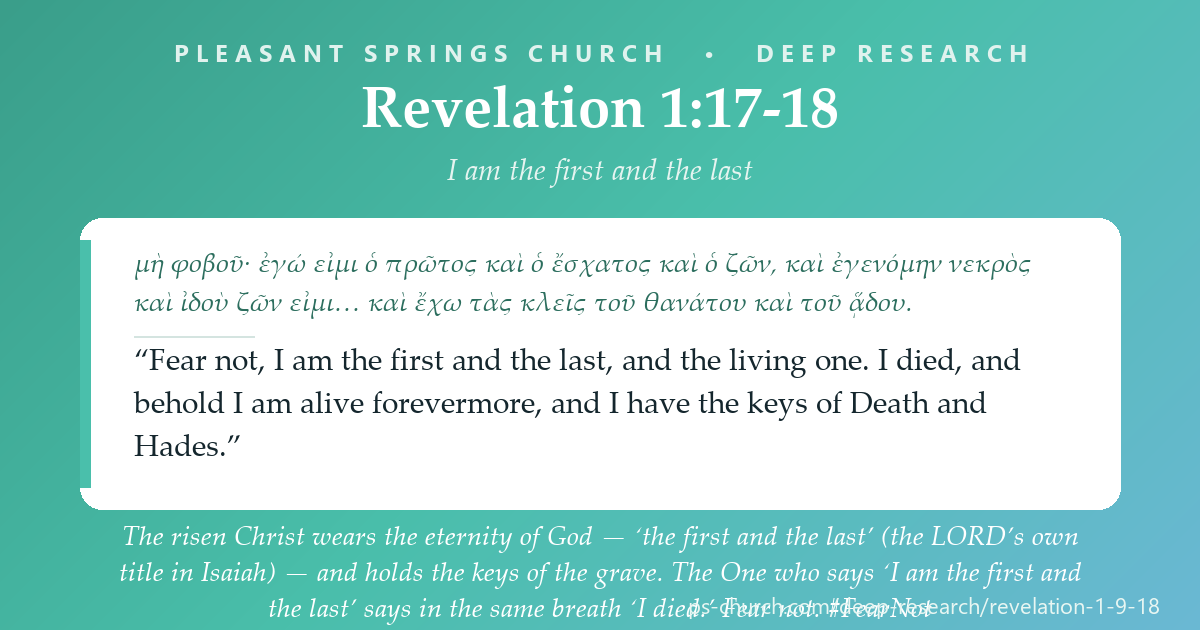
Revelation opens not with a timeline but with a Person. Exiled on Patmos, John turns and sees the glorified Christ walking among the lampstands — his churches. Hair white like wool (the Ancient of Days), eyes like fire, voice like many waters, face like the sun. John falls as though dead. Then the hand and the voice: “Fear not, I am the first and the last” — the Lord’s own title in Isaiah — “and the living one. I died, and behold I am alive forevermore, and I have the keys of Death and Hades.” This study opens the Apocalypse with Revelation 1:9–18 — who reigns. See the method →
Revelation 1:12–14, 16–18
Greek NT · ESVThe Shape of the Passage
Type-sceneRevelation is an apocalypse — an unveiling — given to comfort persecuted churches with the sight of who really reigns. Before a single seal is opened, John sees the risen Christ in glory, and the vision reframes everything: the Lamb who was slain is the Lord of eternity, present among his churches, holding the keys of death.
Author
John writes as “your brother and partner in the tribulation and the kingdom and the patient endurance that are in Jesus” (1:9) — three things held under one preposition: suffering, reign, and endurance are all present realities “in Jesus.” Exiled to the island of Patmos for the word of God, “in the Spirit on the Lord’s day” (the earliest Christian use of that phrase for the day of resurrection), he hears a trumpet-voice and turns — and sees the glorified Christ walking among seven golden lampstands. The description is not free invention; it is a mosaic of the Old Testament’s theophanies. The long robe and golden sash are the garb of the high priest (Exod 28); the white hair is lifted straight from Daniel’s vision of the Ancient of Days (Dan 7:9); the eyes like fire and feet like bronze come from Daniel 10; the voice like many waters is the voice of God’s glory returning to the temple (Ezek 43:2). John is showing us, image by image, that the man Jesus wears the attributes of God.
The Ancient of Days and the Son of Man — in one figure. This is the vision’s deepest claim. In Daniel 7 there are two figures: the Ancient of Days (God), enthroned with hair “white like wool,” and “one like a son of man” who comes to him and receives everlasting dominion. Revelation takes the white hair of the Ancient of Days and puts it on the head of the Son of Man. The two are not confused — but the Son of Man is clothed in the eternity of God. And then he speaks the unspeakable: “I am the first and the last” (1:17) — the self-designation the Lord reserves for himself alone in Isaiah: “I am the first and I am the last; besides me there is no god” (Isa 44:6; 48:12). The risen Jesus claims the divine Name and identity as his own.
Audience
Seven churches in Roman Asia (1:11) — some faithful under pressure, some compromising, all living in the shadow of an empire that demanded worship of Caesar as “lord and god.” To them the vision says: the true Lord is not on a throne in Rome but walking among the lampstands — present with his churches, holding their “stars” in his right hand. The sharp sword is not in Caesar’s hand but proceeds from Christ’s mouth: his word is the weapon that judges and saves. Whatever the churches face, the one who reigns is with them.
‘Fear not’ — the crucified holds the keys. John’s response to the vision is the right one: he “fell at his feet as though dead” (1:17), the ancient posture before God (Ezek 1:28; Dan 8:17). But the glorious hand that could destroy instead lifts: “Fear not.” And the comfort is precisely the gospel: “the living one. I died, and behold I am alive forevermore, and I have the keys of Death and Hades.” The one who wears God’s eternity is the same one who died — and having died and risen, he now holds the keys of the grave. Death is no longer the jailer; the risen Christ is, and he opens. For a church facing martyrdom, there is no greater comfort: the Lord of life has been through death and come out the other side holding its keys.
Orient on apocalypse, the Son of Man, theophany, and the churches.
Search by topic: apocalyptic / Revelation, Son of Man, theophany, Ancient of Days, Hades, the seven churches.
Which articles are relevant?
- Anchor Bible Dictionary — “Revelation, Book of,” “Son of Man,” “Apocalypticism,” “Hades.”
- Dictionary of the Later NT — “Christology,” “Visions,” “Persecution,” “Emperor Worship.”
- NIDNTT / TDNT — ἀποκάλυψις (apokalypsis, unveiling), υἱὸς ἀνθρώπου (huios anthrōpou, son of man), ᾅδης (hadēs, Hades).
Bibliography surfaced:
- G. K. Beale (NIGTC), Grant Osborne (BECNT), Robert Mounce (NICNT), David Aune (WBC), Craig Koester (Anchor) on Revelation.
- Richard Bauckham, The Theology of the Book of Revelation and The Climax of Prophecy; G. B. Caird on the imagery.
- Beale & McDonough, “Revelation,” in Commentary on the NT Use of the OT.
The Son of Man, the divine self-titles, and the keys of the grave.
Read the Daniel-7 Son of Man, the Isaiah “first and last,” and the “keys of Death and Hades” against their Old Testament backdrop — and against Caesar.
Which parallels shed light on religion and worldview?
Daniel’s Son of Man, unveiled. In the Gospels Jesus called himself “the Son of Man” — a title drawn from Daniel 7, where “one like a son of man” comes on the clouds to the Ancient of Days and receives “dominion and glory and a kingdom, that all peoples… should serve him” (Dan 7:13–14). On earth the claim was veiled; here it is unveiled in blinding glory. But Revelation does something startling with Daniel’s two figures. In Daniel, the white hair belongs to the Ancient of Days, God himself; the Son of Man is the one who approaches him. Revelation gives the Son of Man the Ancient of Days’ own white hair (1:14) — not to blur the persons of the Godhead, but to say that the Son shares the eternity and glory of God. The man who walked the roads of Galilee is robed in the attributes of the eternal God.
‘I am the first and the last.’ The clearest deity-claim comes in Christ’s own words. In Isaiah, the Lord insists on his uniqueness against all idols with a signature self-title: “I am the first and I am the last; besides me there is no god” (Isa 44:6; cf. 41:4; 48:12). It is a claim no creature could make — to bracket all of time and reality, to be the origin and the goal. On Patmos the risen Jesus says it of himself: “I am the first and the last” (1:17), sealing it at the book’s end with “I am the Alpha and the Omega… the beginning and the end” (22:13). The One on the throne says “I am the Alpha and the Omega” (1:8); the risen Christ says the same — two persons, one divine identity. This is why John can fall down before Jesus in worship (1:17), while later he is twice forbidden to worship an angel (19:10; 22:8–9). Worship refused to the highest creature is rightly given to the Son.
The keys of Death and Hades. To “hold the keys” is to hold authority. In Jewish thought the keys of the grave and of life belonged to God alone. The risen Christ declares he holds “the keys of Death and Hades” (1:18) — sovereign authority over the realm of the dead. And he holds them by right of conquest: “I died, and behold I am alive forevermore.” He did not avoid death; he entered it, and came out the other side its master. (Hades here is the grave, the realm of the dead — not the lake of fire; Death and Hades will themselves be thrown into that lake at the end, 20:14.) For churches facing the executioner, this is the heart of the comfort: the keys of your grave hang on the belt of the one who loves you and already walked out of his own.
- Daniel 7:9–14; 10:5–6 — the Ancient of Days with hair “white like wool” and the “son of man” given everlasting dominion; the man with eyes like fire and feet like bronze: the vision’s primary source.
- Isaiah 44:6; 48:12; 41:4 — “I am the first and I am the last; besides me there is no god”: the Lord’s self-title, claimed by Jesus (1:17; 22:13).
- Ezekiel 1:24; 43:2; Exodus 28 — the voice like many waters (God’s glory); the high priest’s robe and sash: the divine and priestly imagery on the Son of Man.
The opening vision of Revelation is doing something very deliberate and very daring. John could have described the risen Jesus in any number of ways, but he chose to describe him almost entirely in words the Old Testament reserves for God. The white hair is God’s in Daniel; the voice like many waters is God’s in Ezekiel; the face like the sun is the glory of God; and the title ‘the first and the last’ is one the God of Israel guards jealously against every idol in Isaiah — it is practically a definition of what it means to be the one true God, to stand at the beginning and the end of all things. John takes that definition and lays it on Jesus. And yet he has not stopped being a monotheist; there is still one throne, one God. What he has grasped — what the whole book will unfold — is that Jesus belongs on the God side of the line between God and creation. He is not the highest of the creatures who worship God; he is the one whom the creatures, and even the angels, worship. This is not a lower Christology dressed up in borrowed robes; it is as high as Christology can go. But notice how it is anchored. The figure who wears God’s eternity says, in the same breath, ‘I died.’ The eternal one entered our death. That is the mystery Revelation asks its bleeding, frightened churches to hold onto: the Lord of all time, the first and the last, is the crucified Jesus who loves them — and he holds the keys of the very death they are being asked to face.
The vocabulary of the Son of Man, the divine title, and the keys.
Watch the Danielic “son of man,” the Ancient-of-Days hair, the word-sword, the Isaiah “first and last,” and the keys of the grave.
“One like a son of man” — a deliberate echo of Daniel 7:13 (the accusative after homoion is one of Revelation’s pointed grammatical roughnesses). The veiled Gospel title of Jesus, now unveiled in glory; the one given everlasting dominion (Dan 7:14) stands among his churches.
“Hairs white like wool” — lifted from the Ancient of Days (Dan 7:9). In Daniel the white hair is God’s; here it crowns the Son of Man — the Son clothed in the eternity of God, without confusing the divine persons.
“A sharp two-edged sword” — a large broadsword, proceeding from his mouth: the weapon is his word (Isa 11:4; 49:2; Heb 4:12; Rev 19:15). Christ conquers and judges by speech, not steel — a pointed contrast to the sword of Rome.
“The first and the last” — the Lord’s exclusive self-title in Isaiah (44:6; 48:12), spoken now by the risen Jesus. Paired at the book’s close with “the Alpha and the Omega… the beginning and the end” (22:13): a divine self-designation claimed by Christ.
“The living one… I died” — “the living one” is a title of God (Josh 3:10; Ps 42:2, LXX 41:3), yet here it is qualified by “I died.” Only the incarnate Christ can say both: the eternal Living One who entered death and rose, alive forevermore.
“The keys of Death and Hades” — sovereign authority over the grave and the realm of the dead, held by God alone, now held by the risen Christ by right of conquest. Hades = the realm of the dead (not the final lake of fire, into which Death and Hades are cast, 20:14).
How the rest of Revelation and the NT fill out the vision:
- Revelation 1:8; 22:13; 2:8 — “I am the Alpha and the Omega” (the One on the throne and the risen Christ); “the first and the last, who died and came to life”: the divine self-title framing the book.
- Daniel 7:13–14; Mark 14:62; Matthew 28:18 — the Son of Man given everlasting dominion; Jesus’ own claim before the council; “all authority… given to me” (see the Great Commission).
- Hebrews 1:1–4; Philippians 2:9–11; Colossians 1:15–20 — the radiance of God’s glory seated on high; the exalted Son given the name above every name; the image in whom all things hold together (see Hebrews 1, Philippians 2).
- Revelation 5:6–14; 19:10; 22:8–9 — the Lamb who shares the throne and the worship; the angel who refuses worship: the deity of Christ within monotheism (see the Lamb).
From Daniel's Son of Man to the Lamb who shares the throne.
Trace the glorified Christ from the Old Testament theophanies through the Gospels to the throne-room of Revelation.
Which cross-references matter?
- Daniel 7:9–14; 10:5–6 — the Ancient of Days and the Son of Man; the man with fiery eyes and bronze feet: the vision’s primary source (see Daniel).
- Isaiah 44:6; 48:12; Revelation 22:13 — “I am the first and the last”: the Lord’s self-title claimed by Jesus, framing the book.
- Ezekiel 1:24–28; 43:2 — the voice like many waters and the glory that fells the prophet: the theophany behind John’s falling as dead.
- Hebrews 1:1–4; Colossians 1:15–20; Philippians 2:9–11 — the NT’s high Christology: the enthroned, glorified Son (see Hebrews 1, Colossians 1).
- Revelation 5; 21:1–22:5 — the slain Lamb on the throne; the new creation where God and the Lamb dwell with their people: where the vision is going (see the Lamb).
It matters enormously where John sees the risen Christ standing. He does not see him seated on a distant throne, remote from the struggles of the seven churches; he sees him walking in the midst of the lampstands — and we are told plainly that the lampstands are the churches (1:20). The first thing Revelation wants persecuted, frightened, compromised congregations to know is not a schedule of end-time events but a Presence: the glorified Lord is here, among us, now. The same figure whose eyes blaze like fire and whose face shines like the sun at full strength is the one who holds the churches’ stars in his hand and paces among their lamps. This changes how we read everything that follows. The letters to the seven churches in chapters 2 and 3 are not the memos of an absentee landlord; they are the words of the One who is present, who knows their works, who walks their aisles. And the visions of judgment and salvation that fill the rest of the book are not a cold unrolling of fate; they are the outworking of the purposes of the Lamb who loves them and stands among them. Whatever an empire could do to the body, it could not touch this: their Lord was with them, he held the keys of the death they feared, and he had already walked out of his own grave. Revelation begins here, with Christ among the lampstands, because everything else in the book is meant to be read in the light of his face.
The scholarship on Revelation 1:9-18.
The commentators on the inaugural vision; the studies of the Son-of-Man Christology, the OT allusions, and Revelation’s Greek.
Commentaries & studies:
- G. K. Beale (NIGTC), Grant R. Osborne (BECNT), Robert H. Mounce (NICNT), David E. Aune (WBC), Craig R. Koester (Anchor), Stephen Smalley on Revelation.
- Richard Bauckham, The Theology of the Book of Revelation and The Climax of Prophecy; G. B. Caird on symbol-with-referent.
- G. K. Beale & Sean McDonough, “Revelation,” in Commentary on the NT Use of the OT.
Interpretation notes worth keeping:
- Deity of Christ. The Ancient-of-Days hair (1:14), the Isaiah “first and last” self-title (1:17), “the living one” title, and the keys of Death and Hades together identify Jesus with the God of Israel — not a demigod (against Arianism/subordinationism), and without collapsing the divine persons (Daniel keeps them distinct).
- Symbol with a real referent. The imagery (sword, fire, stars, keys) is not photographic and not empty poetry — each picture points to a real reality (the word that judges, penetrating knowledge, sovereign authority). Revelation even decodes its own symbols (1:20).
- Son of Man. The Danielic title Jesus used veiled in the Gospels is unveiled here in glory — the one given everlasting dominion (Dan 7:14) stands among his churches.
- Hades, not hell. “The keys of Death and Hades” = authority over the grave/realm of the dead, not the lake of fire (into which Death and Hades are later cast, 20:14).
- Grammar preserved. Revelation’s deliberate solecisms (e.g. the accusative after homoion, 1:13) are original features, not errors; NA28 prints them as transmitted.
From the terror of the vision to the hand that lifts — fear not.
Name what you learned, why it matters, and one concrete response.
What should we carry away — and do?
- Jesus wears the eternity of God. The Ancient-of-Days hair, the “first and last,” the keys of the grave — the man who died is the Lord of all time. Revelation opens by showing you who reigns before it shows you what happens.
- He is present among his churches. Christ walks in the midst of the lampstands. Whatever your congregation faces, the glorified Lord is not distant — he is here, holding your star in his hand.
- The crucified holds the keys. “I died, and behold I am alive forevermore, and I have the keys of Death and Hades.” The Lord of the grave loves you and already walked out of his own.
Step in response: when fear rises — of death, of the future, of what an unbelieving world can do — hear the hand and the voice. Christ lays his right hand on the fallen John and says “Fear not.” Bring your fear to the one who holds the keys of the very thing you dread, and let his “I am the first and the last” be larger than it. Then live this week as a church that knows its Lord is standing in the room.
Revelation 1:17–18 · to share
Greek NT + ESVEvery Deep Research page traces its passage across the whole sweep — the Old Testament, the Second-Temple world between the testaments (historical witnesses, not Scripture), and the New Testament. Follow the thread:
Pleasant Springs Church — Deep Research
Research method after Michael S. Heiser’s Bible Research Method (examine dictionaries → ancient literature → important words → textual connections → academic publications → share), with the Pleasant Springs “Author & Audience” foundation. Scripture set in the Hebrew, the Greek editions named on each page and the ESV (Old Testament), and the Greek New Testament and the ESV (New Testament), per the practice of Pleasant Springs Church. Revelation 1:9–18 research grounded in Beale, Osborne, Mounce, Aune, and Koester, with Bauckham on the worship-Christology and Caird on the imagery; the vision read as the deity of Christ within monotheism — the Ancient-of-Days hair (Dan 7:9), the Isaiah “first and last” self-title (Isa 44:6; 48:12), “the living one,” and the keys of Death and Hades identifying Jesus with the God of Israel (against Arianism/subordinationism) without confusing the divine persons (Daniel keeps them distinct); the apocalyptic imagery as symbol-with-a-real-referent (Revelation decodes its own symbols, 1:20), neither wooden literalism nor empty metaphor; Hades as the realm of the dead (cast into the lake of fire at 20:14), not the final hell; Revelation’s deliberate Greek solecisms preserved as in NA28.
Scripture quotations marked ESV are from the ESV® Bible (The Holy Bible, English Standard Version®), © 2001 by Crossway, a publishing ministry of Good News Publishers. ESV Text Edition: 2016. Used by permission. All rights reserved. The ESV text may not be quoted in any publication made available to the public by a Creative Commons license, and the ESV may not be translated in whole or in part into any other language. www.esv.org
|
Did this study bless you today? 💚 Give to Support PS Church100% of gifts go to the General Fund — thank you. |