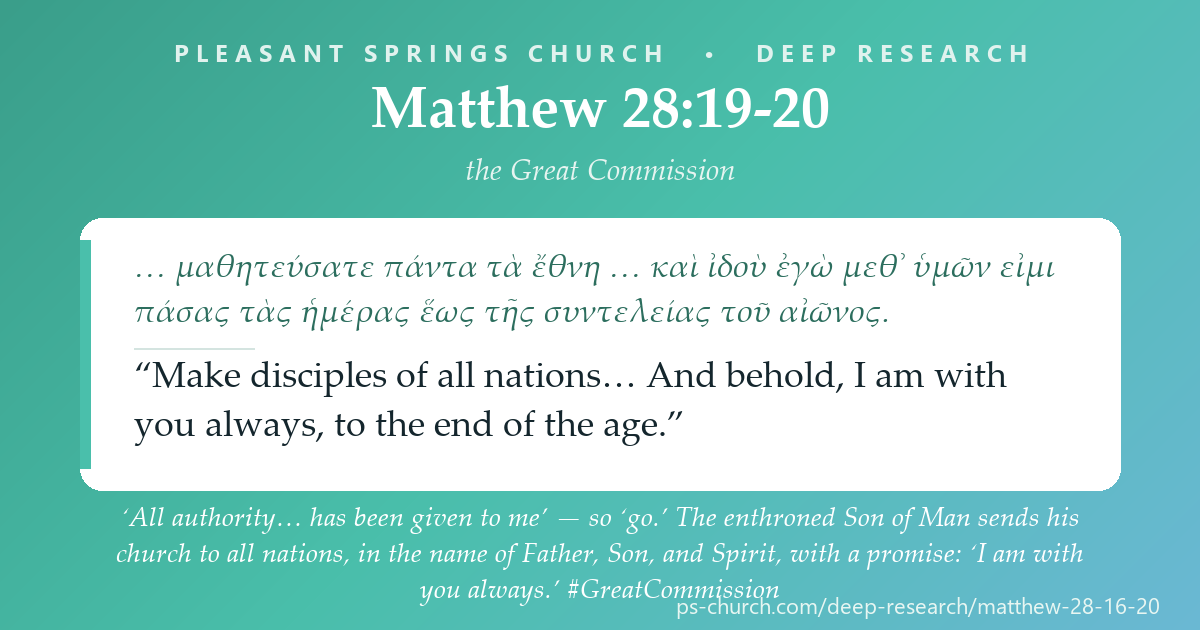
On a mountain in Galilee the risen Jesus meets the eleven — “they worshiped him, but some doubted” — and speaks the words that launch the church. “All authority in heaven and on earth has been given to me” — the enthroned Son of Man of Daniel 7. On that authority: “make disciples of all nations,” baptizing in the one name of the Father, the Son, and the Holy Spirit, and teaching obedience. And a promise to frame the whole Gospel: “I am with you always.” This study works Matthew 28:16–20 — the Great Commission — a Christology before it is a to-do list. See the method →
Matthew 28:17–20
Greek NT · ESVThe Shape of the Passage
Type-sceneMatthew ends where he began — with God present in Jesus. On a Galilean mountain the risen Christ claims all authority, sends his people to all nations, names the Triune God over their baptism, and promises his presence to the end of the age.
Author
Matthew shapes the whole ending around Daniel 7. “All authority in heaven and on earth has been given to me” deliberately echoes the vision of “one like a son of man” to whom “was given dominion and glory and a kingdom, that all peoples… should serve him” (Dan 7:13–14) — the Greek even matches (“edothē… exousia,” “panta ta ethnē”). The risen Jesus is that enthroned Son of Man. This is not the Son becoming divine by promotion; it is the public investiture, in his risen humanity, of the universal dominion that vindicates who he always was.
One command, one name, one promise. The Greek has a single main verb — “make disciples” (mathēteusate) — served by three participles: going, baptizing, teaching. The mission is not mere decision-making but disciple-making: nations brought in (baptism) and formed in obedience (teaching). And the baptism is “in the name” — onoma is singular — “of the Father and of the Son and of the Holy Spirit”: one divine name, three distinct persons, each with the article. It is among the clearest Trinitarian sentences in the New Testament.
Audience
The eleven — and, through them, the church of every age. Matthew does not hide their frailty: “they worshiped him, but some doubted” (28:17). The word for “doubted” (edistasan) is Peter’s wavering as he sank (14:31) — honest hesitation, not settled unbelief, and it stands right beside their worship. The risen Christ commissions the very people who wavered. That the evangelist left the detail in is a mark of the account’s truthfulness.
All nations, and the presence to reach them. The mission that was once limited to “the lost sheep of the house of Israel” (10:6) now reaches “all nations” — the fulfillment of God’s promise that in Abraham’s offspring “all the nations of the earth shall be blessed” (Gen 22:18). And the commission ends not with a task but with a Person: “I am with you always, to the end of the age.” Matthew opened by naming Jesus “Immanuel… God with us” (1:23); he closes with Jesus’ own promise of that presence. The God who is with us sends us, and goes with us.
Orient on the Son of Man, discipleship, baptism, the Trinity, and the divine presence.
Search by topic: Son of Man, kingdom / authority, disciple / discipleship, baptism, Trinity, presence of God (Immanuel).
Which articles are relevant?
- Anchor Bible Dictionary — “Son of Man,” “Disciple,” “Baptism,” “Trinity,” “Mission.”
- Dictionary of Jesus and the Gospels — “Commissioning,” “Son of Man,” “Baptism,” “God (Trinity).”
- NIDNTT / TDNT — ἐξουσία (exousia, authority), μαθητεύω (mathēteuō, make disciples), ὄνομα (onoma, name).
Bibliography surfaced:
- R. T. France (NICNT), W. D. Davies & Dale Allison (ICC), Donald Hagner (WBC), John Nolland (NIGTC), Craig Blomberg (NAC) on Matthew.
- B. B. Warfield on Matthew 28:19 as a Trinitarian text; G. R. Beasley-Murray, Baptism in the New Testament.
- Beale & Carson, Commentary on the NT Use of the OT (Matthew).
The enthroned Son of Man, the one Name of the Triune God, and the promised presence.
Read the Daniel-7 enthronement behind “all authority,” the singular “name” of the three persons, and the Immanuel promise that frames Matthew.
Which parallels shed light on religion and worldview?
The enthroned Son of Man. “All authority in heaven and on earth has been given to me” is Daniel 7 come true. Daniel saw “one like a son of man” come to the Ancient of Days and receive “dominion and glory and a kingdom, that all peoples, nations, and languages should serve him” (Dan 7:13–14; see the Son of Man). Jesus had already claimed this title before the Sanhedrin (Matt 26:64); now, risen, he claims its enthronement. The passive “has been given” points to the Father who exalts him (cf. Phil 2:9–11, “every knee… in heaven and on earth and under the earth”). This is the risen Son’s mediatorial, universal reign — the vindication of his deity, not the acquisition of a status he lacked.
One name, three persons. Baptism is “in the name of the Father and of the Son and of the Holy Spirit.” The word “name” (onoma) is singular — one divine name shared by three, each marked off by its own article (“the Father and the Son and the Holy Spirit”). This is not three names of one person (modalism), nor three gods (tritheism), but the one God in three co-equal, co-eternal persons — the truth the church would later confess at Nicaea and Constantinople, already assumed here. To be baptized “into the name” (eis to onoma) is to be transferred into the ownership and allegiance of the Triune God, made his own.
Immanuel, to the end. Matthew’s Gospel opens with an angel naming the child “Immanuel (which means, God with us)” (1:23) and closes with Jesus’ own word, “I am with you always, to the end of the age” — an inclusio around the whole book. The promise draws on the old covenant refrain “I am with you” spoken to Jacob, Moses, Joshua, and the returning exiles (Gen 28:15; Exod 3:12; Josh 1:9; Hag 2:4). What God once promised his servants, the risen Christ now promises his church — because he is himself God with us. The mission is possible because the One who sends also comes along.
- Daniel 7:13–14 — the Son of Man given dominion over “all peoples, nations, and languages”: the enthronement behind “all authority” (see the Son of Man).
- Genesis 12:3; 22:18; Isaiah 49:6 — in Abraham’s offspring “all the nations… blessed”; the Servant a “light for the nations”: the mission to all peoples (see the call of Abram).
- Genesis 28:15; Exodus 3:12; Joshua 1:9; Isaiah 41:10; Haggai 2:4 — the Lord’s “I am with you” to his servants: the covenant-presence promise behind Matt 28:20.
The Great Commission is often read as a missions text and little more, but Matthew has loaded its few lines with the highest theology in his Gospel. It opens with a claim to universal sovereignty — “all authority in heaven and on earth” — drawn straight from Daniel’s vision of the Son of Man enthroned before the Ancient of Days. The risen Jesus is not merely alive; he is reigning, and the mission goes out under his cosmic lordship, which is why it can dare to aim at “all nations.” It runs through the most explicit Trinitarian formula in the Gospels — one “name,” three persons — which the church rightly heard as the seed of Nicene faith: not the philosophy of the councils read back into Jesus’ mouth, but the raw material the councils were faithfully guarding. And it closes with a promise of divine presence that only God could make — “I am with you always” — sealing the Gospel’s opening claim that this Jesus is “God with us.” So the commission is not first a burden laid on the church but a disclosure of who Christ is: the enthroned, Triune-named, ever-present Lord, whose authority makes the task possible and whose presence makes it bearable. “Go” is grounded in “all authority” and cushioned by “I am with you.” The Great Commission is a Christology before it is a to-do list.
The vocabulary of authority, disciple-making, the one Name, and the presence.
Watch the Daniel-7 “given authority,” the single imperative with three participles, the singular “name,” and the Immanuel promise.
“All authority has been given” — the passive verbally echoes Daniel 7:14 LXX (edothē autō exousia). The enthroned Son of Man’s universal, mediatorial reign: the vindication of the risen Son’s deity, not an adoptionist acquisition of it.
“Make disciples” — the one main imperative of the commission; the participles going, baptizing, teaching are subordinate to it. The goal is not decisions but disciples: incorporated by baptism, formed by teaching.
“All the nations” — the same phrase as Daniel 7:14 LXX. The mission widens from “the lost sheep of the house of Israel” (10:6) to all peoples, fulfilling the Abrahamic blessing (Gen 22:18).
“Into the name” — onoma is singular, governing all three persons (each with its own article). One divine name, three persons: a foundational NT Trinitarian text. Eis (“into”) marks transfer into the ownership and reality of the Triune God — not modalism, not tritheism.
“They doubted / wavered” — the same verb as Peter sinking (14:31): honest hesitation beside genuine worship, not settled unbelief. Its inclusion is a mark of authentic testimony; the risen Christ commissions the very ones who wavered.
“I am with you” — the Immanuel inclusio with Matt 1:23 (“God with us”). Echoes the OT covenant “I am with you” (Gen 28:15; Exod 3:12; Josh 1:9); what God promised his servants, the risen Christ promises his church “to the end of the age.”
How the New Testament fills out the Commission:
- Daniel 7:13–14; Philippians 2:9–11; Ephesians 1:20–22 — the Son of Man given dominion; “every knee… in heaven and on earth and under the earth”; seated far above all rule: the enthroned Lord behind “all authority.”
- Acts 1:8; Luke 24:47; John 20:21 — witnesses “to the end of the earth”; repentance to “all nations”; “as the Father has sent me… I am sending you”: the fourfold commission.
- 2 Corinthians 13:14; 1 Corinthians 12:4–6; Ephesians 4:4–6 — the triadic Father-Son-Spirit pattern that coheres with the baptismal “name.”
- Matthew 1:23; 18:20 — “God with us”; “where two or three are gathered… there am I”: the presence promise that frames the Gospel.
From the Son of Man and the Abrahamic blessing to the church's commission.
Trace the enthroned Son of Man, the all-nations promise, and the “I am with you” through the canon into the Great Commission.
Which cross-references matter?
- Daniel 7:13–14; Matthew 26:64; 24:30 — the Son of Man given all dominion; Jesus’ own claim before the Sanhedrin: the enthronement now realized (see the Son of Man).
- Genesis 12:3; 22:18; Isaiah 49:6 — “all the nations… blessed”; the Servant a light to the nations: the mission’s scope (see the call of Abram).
- Matthew 3:13–17 — the baptism, where Father, Son, and Spirit appear together: the Trinitarian tableau behind the baptismal name (see the baptism of Jesus).
- Genesis 28:15; Exodus 3:12; Joshua 1:9; Haggai 2:4 — the covenant “I am with you”: the presence the risen Christ now promises.
- Matthew 1:23; John 20:1–18; Acts 2 — Immanuel; the risen Lord; the Spirit poured out to empower the mission (see the empty tomb).
The single most striking word in the baptismal formula is the smallest: “name,” in the singular. Jesus does not say “in the names of the Father and of the Son and of the Holy Spirit,” as if listing three separate authorities, nor does he collapse them into one undifferentiated deity. He says “in the name” — one name — “of the Father and of the Son and of the Holy Spirit” — three persons, each distinguished by the repeated article. In one short phrase the whole doctrine of the Trinity is present in seed: the unity of the divine name and the distinction of the three who bear it. The church did not invent this at Nicaea; it received it here, on a Galilean mountain, from the risen Lord, and spent three centuries learning to guard it against every distortion — against those who would make the three mere masks of one (and so lose the Son who prays to the Father), and against those who would make them three gods (and so lose the one God of Israel). To be baptized into this name is to be claimed by the one God who is Father, Son, and Spirit — the deepest thing that can be said about a Christian, said over every one of them at the font.
The scholarship on Matthew 28:16-20.
The commentators on the Great Commission; the studies of the Daniel-7 background, the Trinitarian formula, and the presence motif.
Commentaries & studies:
- R. T. France (NICNT), W. D. Davies & Dale C. Allison (ICC), Donald A. Hagner (WBC), John Nolland (NIGTC), Craig L. Blomberg (NAC), Ulrich Luz (Hermeneia) on Matthew.
- B. B. Warfield, “The Biblical Doctrine of the Trinity”; G. R. Beasley-Murray, Baptism in the New Testament.
- Bruce Metzger and modern editors on the security of the 28:19 baptismal formula.
Interpretation notes worth keeping:
- Daniel 7 enthronement. “All authority… given” echoes Dan 7:14 (“edothē… exousia,” “panta ta ethnē”) — the risen Son of Man’s mediatorial reign, the vindication of his deity, not adoptionism.
- One imperative, three participles. The command is “make disciples”; going, baptizing, and teaching are how. Disciple-making, not mere decision-making.
- A Trinitarian text. The singular “name” of the three persons (each with the article) assumes the triune God — not modalism, not tritheism. The formula is present in all Greek manuscripts; the alleged shorter “in my name” (from a few citations in Eusebius) has no manuscript support.
- Universal scope. “All nations” grounds a real, God-willed offer of salvation to all peoples; on the church’s Molinist / eternal-security frame, the free offer and God’s securing grace stand together — neither hyper-particularism nor universalism.
- Immanuel inclusio. “I am with you always” (28:20) answers “God with us” (1:23), framing the Gospel; the doubt of 28:17 (edistasan) is honest wavering, not disqualifying.
From a Galilean mountain to the ends of the earth.
Name what you learned, why it matters, and one concrete response.
What should we carry away — and do?
- The mission rests on his authority, not ours. “All authority… has been given to me” comes before “go.” We are sent under the reign of the enthroned Christ — the task is his before it is ours.
- Make disciples, not just converts. The command is disciple-making — baptizing and teaching obedience to all Christ commanded. A life formed, not just a decision made.
- You are not sent alone. The commission ends with a promise, not a warning: “I am with you always.” The Immanuel who came at Christmas is the Immanuel who goes with you now.
Step in response: take one concrete step into the commission this week — pray for a nation or a neighbor, invest in discipling one person, or take your own next step of obedience and baptism — and do it leaning on the two bookends of the command: “all authority” ahead of you, “I am with you always” beside you.
Matthew 28:19–20 · to share
Greek NT + ESVEvery Deep Research page traces its passage across the whole sweep — the Old Testament, the Second-Temple world between the testaments (historical witnesses, not Scripture), and the New Testament. Follow the thread:
Pleasant Springs Church — Deep Research
Research method after Michael S. Heiser’s Bible Research Method (examine dictionaries → ancient literature → important words → textual connections → academic publications → share), with the Pleasant Springs “Author & Audience” foundation. Scripture set in the Hebrew, the Greek editions named on each page and the ESV (Old Testament), and the Greek New Testament and the ESV (New Testament), per the practice of Pleasant Springs Church. Matthew 28:16–20 research grounded in France, Davies & Allison, Hagner, Nolland, and Blomberg, with Warfield and Beasley-Murray on the Trinitarian baptismal formula and Beale & Carson on the Daniel-7 background; “all authority” read as the risen Son of Man’s mediatorial enthronement (not adoptionism); the singular “name” of three persons held as classical Trinitarianism (not modalism or tritheism); the 28:19 formula noted as secure in all Greek manuscripts; the Immanuel inclusio with Matt 1:23.
Scripture quotations marked ESV are from the ESV® Bible (The Holy Bible, English Standard Version®), © 2001 by Crossway, a publishing ministry of Good News Publishers. ESV Text Edition: 2016. Used by permission. All rights reserved. The ESV text may not be quoted in any publication made available to the public by a Creative Commons license, and the ESV may not be translated in whole or in part into any other language. www.esv.org
|
Did this study bless you today? 💚 Give to Support PS Church100% of gifts go to the General Fund — thank you. |