“I have seen the Lord.” It is the first day of the week, still dark, and the stone is gone. The grave-cloths lie in order — no thief’s work — and the beloved disciple “saw and believed.” Weeping, Mary mistakes the risen Jesus for the gardener, until he speaks her name: “Mary” — “Rabboni!” The last Adam has come to a garden on day one of the new creation, and the Shepherd calls his own by name. This study works John 20:1–18 — the empty tomb — from the Scriptures that foretold the rising to the first Easter announcement. See the method →
John 20:1, 8, 16–18
Greek NT · ESVThe Shape of the Passage
ConcentricOn the first Easter morning, John tells the resurrection through an empty tomb, orderly grave-cloths, and a garden meeting between the risen Christ and a weeping woman. Every detail preaches: the tomb is empty, the body is raised, and the first word of the new creation is a name.
Author
John writes the resurrection with an eyewitness’s eye and a theologian’s craft. It is “the first day of the week” — and the Greek says literally “day one” (tē mia), echoing the “day one” of creation (Gen 1:5): the resurrection begins a new creation. The tomb is in a garden (19:41), and Mary supposes Jesus is the gardener — a mistake full of truth, for the last Adam has come to a garden to undo what the first Adam lost. The grave-cloths lie undisturbed, the face-cloth folded by itself: not the chaos of a robbery but the calm of a body that simply rose. On that evidence alone the beloved disciple “saw and believed” (20:8) — even though “as yet they did not understand the Scripture, that he must rise from the dead” (20:9).
The Shepherd calls his own by name. Mary does not recognize the risen Jesus by sight; she knows him when he speaks her name, “Mary” (20:16) — the promise of John 10 come true: “he calls his own sheep by name… and the sheep follow him, for they know his voice.” Then he reorders the relationship: “do not cling to me.” The Greek is a present imperative — “stop holding on” — not a rule against touch (moments later the women hold his feet, Matt 28:9, and Thomas is invited to touch, 20:27) but a redirection: she must not try to hold him in the old way, for the resurrection is moving toward the ascension and a new mode of his presence by the Spirit.
Audience
Mary Magdalene — the first witness of the risen Lord, and, in the church’s memory, “the apostle to the apostles.” That the first herald of the resurrection is a woman, whose testimony counted for little in that world, is a mark of the account’s honesty: no one inventing a legend would have written it so. Through her, John invites every reader to the same discovery — and the same announcement: “I have seen the Lord.”
My Father and your Father. The risen Jesus calls the disciples “my brothers” for the first time, and sends word: “I am ascending to my Father and your Father, to my God and your God” (20:17). He does not flatly say “our Father,” as if his sonship and ours were the same. His is by nature and eternal; ours is by grace and adoption, made ours through him (Rom 8:29; Gal 4:4–7). And “my God,” spoken from his true humanity, takes nothing from his deity — for the same chapter ends with Thomas at his feet: “My Lord and my God!” (20:28).
Orient on the resurrection, the empty tomb, Mary Magdalene, and the ascension.
Search by topic: resurrection, empty tomb, burial customs / grave-cloths, Mary Magdalene, ascension.
Which articles are relevant?
- Anchor Bible Dictionary — “Resurrection,” “Burial,” “Mary Magdalene,” “Ascension.”
- Dictionary of Jesus and the Gospels — “Resurrection,” “Empty Tomb,” “Death of Jesus,” “Women.”
- NIDNTT / TDNT — ἀνίστημι / ἀνάστασις (anistēmi / anastasis, rise / resurrection), ὀθόνια (othonia, linen cloths), ἀναβαίνω (anabainō, ascend).
Bibliography surfaced:
- D. A. Carson (Pillar), Craig Keener (2 vols.), Raymond Brown (Anchor Yale), Andreas Köstenberger (BECNT), George Beasley-Murray (WBC) on John.
- N. T. Wright, The Resurrection of the Son of God; Richard Bauckham on Mary Magdalene as named eyewitness.
- Beale & Carson, Commentary on the NT Use of the OT (John).
The new creation in a garden, and the reality of the risen body.
Read the new-creation and garden echoes John has built in, weigh the resurrection body, then hear the Scriptures that said he must rise.
Which parallels shed light on religion and worldview?
Day one, in a garden. John’s time-marker is loaded: “on the first day of the week” is literally “on day one,” the phrase the Greek Old Testament uses for the first day of creation (Gen 1:5). And the setting is a garden (19:41), where Mary takes Jesus for the gardener (20:15). The echoes of Eden are deliberate: the first Adam fell in a garden and was driven out; the last Adam rises in a garden and calls a weeper by name. The resurrection is the start of the new creation, and its first morning dawns while it is “still dark.”
A real, risen body. The tomb is empty and the grave-cloths remain, lying in order with the face-cloth folded “in a place by itself” — the calm evidence of a body that vacated its wrappings, not a robbery. The risen Jesus is the same Jesus, recognizable and touchable (the women hold his feet, Matt 28:9; Thomas is invited to touch, 20:27; later he eats, Luke 24:42–43), yet gloriously changed — Mary knows him only when he speaks her name. This is neither a resuscitated corpse nor a ghost, but a real body transformed. The Second-Temple hope of bodily resurrection (2 Macc 7, “the King of the universe will raise us up”; 4Q521, the Messiah who “makes the dead live” — witnesses, not Scripture) is here fulfilled in one man, ahead of all the rest.
‘The Scripture, that he must rise.’ John admits the disciples “did not yet understand the Scripture, that he must rise from the dead” (20:9). The resurrection was foretold — “you will not… let your holy one see corruption” (Ps 16:10, preached at Pentecost, Acts 2:27); “on the third day he will raise us up” (Hos 6:2); the Servant who, after his offering, “shall see and be satisfied” (Isa 53:10–11); the sign of Jonah’s three days (Jonah 1:17; Matt 12:40). The empty tomb sends them back to the Scriptures to learn what they had missed.
- Genesis 1:5; 2:8, 15 — “day one”; the Lord God plants a garden and puts the man in it: the new-creation and Eden echoes (see the garden of Eden).
- Psalm 16:10; Hosea 6:2; Isaiah 53:10–11; Jonah 1:17 — the Lord’s Holy One not left to corruption; “on the third day”; the Servant who lives; the sign of Jonah: the resurrection foretold (see the sign of Jonah).
- 2 Maccabees 7; 4Q521 — Second-Temple resurrection hope and the Messiah who “makes the dead live” (witnesses, not Scripture).
The little detail of the grave-cloths is doing more work than it seems. Grave-robbers do not unwrap a body and leave the linen behind, still less roll the face-cloth and set it apart; a stolen corpse leaves chaos, or leaves wrapped. What the beloved disciple saw was order — the wrappings lying as if the body had simply passed out of them — and on that evidence, before any appearance and before he understood the Scripture, “he saw and believed” (20:8). John is showing us the birth of resurrection faith, and its shape: a mind confronted with evidence it cannot explain away, drawn to a conclusion it had not dared to expect. But John also tells us what that first faith still lacked — understanding of “the Scripture, that he must rise” (20:9). Faith in the risen Christ and understanding of the Scriptures grow together; the empty tomb sends the disciples back to Moses and the Prophets to see what was there all along. And then, lest we think resurrection is only a matter of evidence and exegesis, John gives us Mary in the garden, who believes not because she reasons but because the risen Lord speaks her name. Both are true: the tomb is really empty, and the Shepherd really calls. He is risen — and he knows you by name.
The vocabulary of the empty tomb, recognition, and the ascending Lord.
Watch “day one,” the orderly grave-cloths, the present-imperative “stop clinging,” and the two distinct fatherhoods.
“On the first day of the week” — literally “on day one” (mia, a Semitism for “first”). Echoes the “day one” of creation (Gen 1:5): the resurrection inaugurates the new creation. The first day becomes the Lord’s Day (Rev 1:10).
The “linen cloths” and the “face-cloth” — lying in order, the face-cloth folded “in a place by itself.” The calm arrangement is evidential: no thief unwraps a body and leaves the cloths. Same head-cloth as at Lazarus’ tomb (11:44).
“He saw and believed” — the first resurrection faith in the Gospel: physical sight of the empty, orderly tomb yielding belief, before any appearance and before understanding the Scripture (20:9).
“Do not cling to me” — a present imperative with mē: “stop holding on,” forbidding a continuing action, not a ban on touch (cf. Matt 28:9; John 20:27). Mary must let go of the old form of presence: the ascension is reordering the relationship.
“My Father and your Father” — two relations held distinct, not merged into a flat “our Father.” The Son’s sonship is by nature and eternal; the disciples’ is by grace and adoption through him (Rom 8:29). The resurrection makes them his “brothers.”
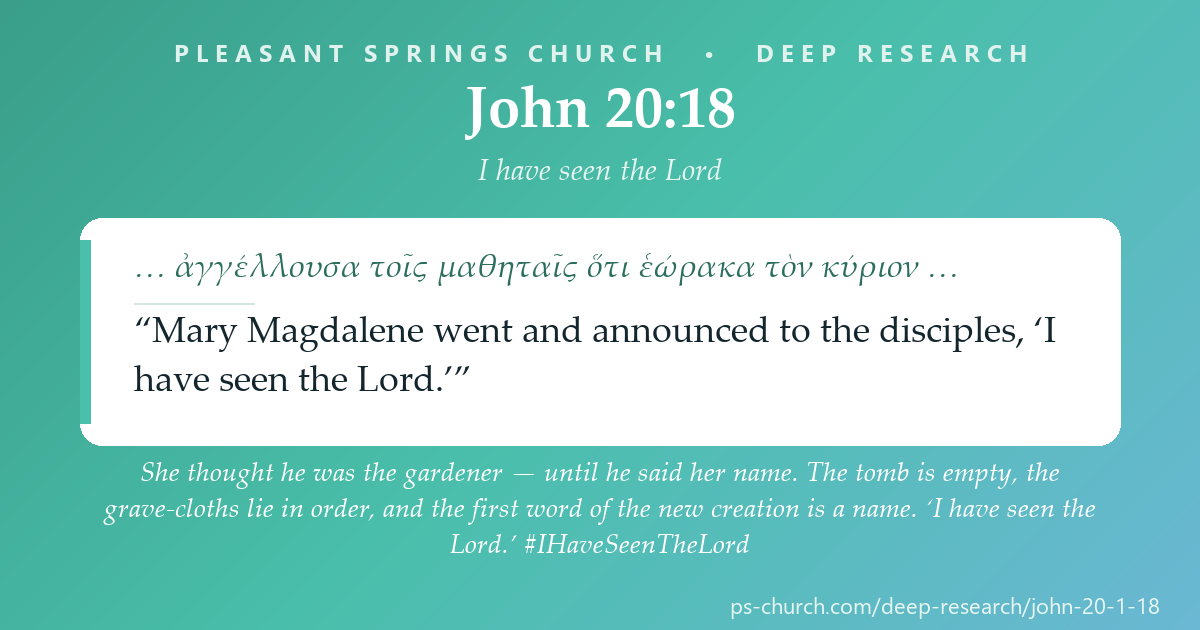
“I have seen the Lord” — perfect tense, an abiding reality. Mary is the first witness and announcer (angellousa) of the risen Lord; her kyrios anticipates the chapter’s climax, Thomas’ “My Lord and my God” (20:28).
How the New Testament fills out the resurrection morning:
- 1 Corinthians 15:3–8, 20 — “raised on the third day in accordance with the Scriptures”; “the firstfruits of those who have fallen asleep”: the risen Christ as the guarantee of our resurrection.
- Matthew 28:1–10; Luke 24:1–12 — the parallel accounts; the women hold his feet and worship (28:9); Peter runs and sees the linen cloths (24:12): the same empty tomb (see the Great Commission).
- John 10:3–4; 20:27–28 — “he calls his own by name… they know his voice”; Thomas invited to touch, then “My Lord and my God”: the Shepherd’s voice and the risen body’s reality.
- Romans 8:15–17, 29; Galatians 4:4–7 — adoption; “the firstborn among many brothers”: the derived sonship behind “my Father and your Father.”
From the first garden to the empty tomb in the garden.
Trace the resurrection from the Scriptures that foretold it, through the garden of the new creation, to the first announcement.
Which cross-references matter?
- Genesis 1–3; Song of Solomon 3:1–4 — “day one” and the garden; the bride who seeks, finds, and would hold her beloved: the new-creation and garden echoes (see Eden).
- Psalm 16:10; Hosea 6:2; Isaiah 53:10–11; Jonah 1:17 — “the Scripture, that he must rise”: the resurrection foretold (see Jonah, the Servant).
- Ezekiel 37:1–14; John 11:25–26 — the graves opened; “I am the resurrection and the life”: the promise now realized in Jesus’ own rising (see the dry bones, the resurrection and the life).
- John 19:16–30; 1 Corinthians 15:20–23 — the finished work of the cross; Christ the firstfruits: the death now vindicated by the empty tomb (see It is finished).
- John 20:19–29; Revelation 1:17–18 — the risen Lord among his disciples; “I died, and behold I am alive forevermore”: the living Christ.
The empty tomb and the personal appearances belong together, and the church has always needed both. An empty tomb by itself proves only an absence; an appearance by itself might be dismissed as a vision or a grief-born dream. John gives us both, and insists on the physicality of each: the grave-cloths that a robber would not have left, and a risen Jesus who can be recognized, held, and (elsewhere) touched and fed. This is the heart of the Christian claim, and it is stubbornly bodily. The resurrection is not the survival of Jesus’ soul, nor the disciples’ faith rising while his corpse stayed put, nor a symbol of spring or of hope in the abstract. It is the God-wrought raising of the crucified body of Jesus into a new, deathless, glorified life — the first piece of the new creation, planted in a garden on day one. And because it really happened to him, it is the promise of what will happen to all who are his: the firstfruits guarantee the harvest. Mary’s report is not a pious feeling but a fact she can announce: “I have seen the Lord.” The tomb is empty because he is risen — and because he is risen, so shall we be.
The scholarship on John 20:1-18.
The commentators on John 20; the studies of the resurrection, the grave-cloths, and the “do not cling” crux.
Commentaries & studies:
- D. A. Carson (Pillar), Craig S. Keener (2 vols.), Raymond E. Brown (Anchor Yale), Andreas J. Köstenberger (BECNT), George R. Beasley-Murray (WBC), J. Ramsey Michaels (NICNT) on John.
- N. T. Wright, The Resurrection of the Son of God; Richard Bauckham, Gospel Women and Jesus and the Eyewitnesses.
- Bruce Metzger on the John 20:16 spelling and gloss.
Interpretation notes worth keeping:
- Real, bodily, transformed. Affirm a physical resurrection — empty tomb, orderly cloths, a recognizable and touchable body — that is nonetheless glorified (unrecognized until he speaks her name). Guard against both crude resuscitation and “the disciples’ faith arose” reductions.
- “Do not cling” = stop clinging. The present imperative forbids a continuing action, not touch as such (cf. Matt 28:9; John 20:27). Mary must release the old form of fellowship because the ascension inaugurates a new mode of presence.
- Two fatherhoods, held distinct. “My Father and your Father, my God and your God” — his sonship by nature, ours by adoption through him; “my God” from his true humanity does not deny the deity confessed in 20:28.
- New-creation reading, not allegory. The “day one” and garden/gardener echoes are patterns the Evangelist built into the narrative — fulfillment and typology, handled along the canon’s own trajectory, not free-association.
- Mary’s witness. The first witness being a woman is a mark of authenticity, not embarrassment; the account bears the fingerprints of eyewitness testimony (20:18).
From a weeping woman in the dark to the first Easter announcement.
Name what you learned, why it matters, and one concrete response.
What should we carry away — and do?
- He knows you by name. Mary did not recognize the risen Jesus by sight; she knew him when he said “Mary.” The Shepherd calls his own by name — and he calls yours.
- The tomb is really empty. The orderly grave-cloths, the eyewitness reports, the risen body seen and held — this is not a symbol of hope but the ground of it. He is risen indeed.
- His Father is now your Father. The risen Christ calls his disciples “my brothers” and shares his Father with them by grace. In him, God is your Father and your God.
Step in response: take Mary’s place this week — bring your grief to the risen Lord, listen for him to call your name in his word, and then do what she did: go and announce it. “I have seen the Lord” is not a private comfort but the first Christian testimony; carry it to someone still weeping in the dark.
John 20:18 · to share
Greek NT + ESVEvery Deep Research page traces its passage across the whole sweep — the Old Testament, the Second-Temple world between the testaments (historical witnesses, not Scripture), and the New Testament. Follow the thread:
Pleasant Springs Church — Deep Research
Research method after Michael S. Heiser’s Bible Research Method (examine dictionaries → ancient literature → important words → textual connections → academic publications → share), with the Pleasant Springs “Author & Audience” foundation. Scripture set in the Hebrew, the Greek editions named on each page and the ESV (Old Testament), and the Greek New Testament and the ESV (New Testament), per the practice of Pleasant Springs Church. John 20:1–18 research grounded in Carson, Keener, Brown, Köstenberger, and Beasley-Murray, with N. T. Wright on the bodily resurrection and Bauckham on Mary Magdalene as named eyewitness; the “day one” / garden echoes read as new-creation fulfillment; “do not cling” as a present-imperative “stop clinging”; the two fatherhoods (nature vs. adoption) held distinct; the bodily-yet-transformed resurrection affirmed against docetism and reductionism.
Scripture quotations marked ESV are from the ESV® Bible (The Holy Bible, English Standard Version®), © 2001 by Crossway, a publishing ministry of Good News Publishers. ESV Text Edition: 2016. Used by permission. All rights reserved. The ESV text may not be quoted in any publication made available to the public by a Creative Commons license, and the ESV may not be translated in whole or in part into any other language. www.esv.org
|
Did this study bless you today? 💚 Give to Support PS Church100% of gifts go to the General Fund — thank you. |