And the Lord appointed a great fish to swallow up Jonah.” The thing that looks like the end is God’s rescue: from the belly of the fish the drowning prophet prays a psalm of thanksgiving that ends in a creed — “Salvation belongs to the Lord.” Centuries later Jesus made Jonah’s three days in the deep the one sign he would give a sign-seeking world: the sign of his own death and resurrection. This study works Jonah 1:17–2:10 from the belly of Sheol to the empty tomb. See the method →
Jonah 1:17–2:10 (English) = MT/LXX 2:1–11
Hebrew · LXX · ESVThe Shape of the Passage
InclusioJonah is a prophet sent to Nineveh (the Assyrian capital) who flees the other way, is thrown into the sea, and is swallowed by a fish God appoints. Chapter 2 is his prayer from inside it — a thanksgiving psalm before he is delivered onto dry land.
Author
The book tells of Jonah son of Amittai (2 Kings 14:25), sent to preach to Nineveh and fleeing by sea toward Tarshish. When a storm exposes his flight, he is thrown overboard — and “the Lord appointed a great fish to swallow up Jonah.” The verb appointed (manah) is one of the book’s keys: God appoints the fish (1:17), a plant (4:6), a worm (4:7), and a wind (4:8) — the fish is not Jonah’s punishment but his rescue, a strange grace in the deep.
A prayer of thanksgiving. From the belly of the fish Jonah prays — not a desperate plea but a thanksgiving psalm woven from the Psalter (Pss 18, 42, 69, 120, 130). He speaks of his drowning as already past (“you brought up my life from the pit”), looks toward God’s “holy temple,” and lands on the confession that sums up the whole book: “Salvation belongs to the Lord.”
Audience
Israel — a people prone, like Jonah, to want God’s mercy for themselves and judgment for their enemies. The book gently exposes that heart: the God who spares a runaway prophet in the sea will also spare a repentant pagan city on land. Salvation, from first to last, belongs to the Lord — his to give where he wills.
How Jesus read it. Asked for a sign, Jesus pointed to Jonah — twice, and in two ways. In Matthew, “as Jonah was three days and three nights in the belly of the great fish, so will the Son of Man be… in the heart of the earth” (12:40): Jonah’s deliverance from the deep is a sign of the resurrection. In Luke, Jonah is a sign to Nineveh as a preacher of repentance (11:30). The church reads Jonah as Jesus did — a real sign pointing to himself.
Orient on the fish, Sheol, thanksgiving psalms, and the sign of Jonah.
Search by topic: Jonah, great fish, Sheol, thanksgiving psalm, sign of Jonah, resurrection.
Which articles are relevant?
- Anchor Bible Dictionary — “Jonah,” “Sheol,” “Nineveh,” “Sign.”
- Dictionary of the OT: Prophets — “Jonah, Book of,” “Death and the Afterlife,” “Psalms in the Prophets.”
- NIDOTTE / TDOT — מָנָה (mānâ, appoint), דָּג (dāḡ, fish), שְׁאוֹל (šəʾôl, Sheol), תּוֹדָה (tôḏâ, thanksgiving), יְשׁוּעָה (yəšûʿâ, salvation).
Bibliography surfaced:
- Jack M. Sasson (Anchor Yale Bible), Douglas Stuart (WBC, Hosea–Jonah), Leslie C. Allen (NICOT), James Limburg (OTL) on Jonah.
- Studies of the “sign of Jonah” and its two Gospel construals (Matthew vs Luke).
- Beale & Carson, Commentary on the NT Use of the OT (Matthew; Luke).
The appointed fish, the belly of Sheol, and the sign Jesus gave.
Read the fish as grace, the prayer as thanksgiving, and the “three days” as Jesus read it.
Which parallels shed light on religion and worldview?
A great sea-creature. The Hebrew says only “a great fish” (dag gadol) — never a species; the popular “whale” is a later guess. The Greek renders it κῆτος, a great sea-creature or sea-monster — the word for the deep’s most fearsome inhabitant, now made God’s obedient servant. (A small feature: the Hebrew even shifts the fish’s gender between verses, which later Jewish storytellers spun into a two-fish legend; it carries no doctrinal weight.) In the ancient world the sea and its monsters were chaos itself; here the Lord simply “appoints” the monster to carry his prophet to safety.
The belly of Sheol. Jonah prays from “the belly of Sheol” — Sheol, the grave, the realm of the dead (Greek Ἀδης). He is describing near-death and descent in the Psalter’s own language, not the place of final torment; the point is that from the very gates of death God heard him. His prayer is a thanksgiving (todah) — he speaks of rescue as already granted, looking toward “your holy temple,” because deliverance is as sure as God’s word. It ends in the book’s creed: Salvation belongs to the Lord. (Here the Hebrew and Greek part ways: the Hebrew is a bare, verbless confession — yeshuatah la-YHWH — while the Greek, σωτηρίου τῷ κυρίῳ, ties the “deliverance” to the thank-offering just vowed; the punchy creed is sharpest in the Hebrew.)
- Psalms 18:4–6; 42:7; 69:1–2; 120:1; 130:1–2 — the psalms of the drowning and the delivered from which Jonah’s prayer is woven.
- 1 Samuel 30:12–13; Esther 4:16–5:1; Hosea 6:2 — “three days” as an inclusive Hebrew span (parts of three days), the idiom behind Jonah’s and Jesus’ words (see Hosea 6).
- 3 Maccabees 6:8; Josephus, Antiquities 9.213 (Second-Temple witnesses, not Scripture) — retellings using κῆτος of Jonah’s fish: the same Greek word Matthew uses.
- Genesis 1:21; Job 7:12; Psalm 74:13–14 · LXX 73:13–14 — the “great sea-creatures” that are God’s creatures, not his rivals (see Genesis 1:20-25).
When his opponents demanded a sign, Jesus gave them only one: “An evil and adulterous generation seeks for a sign, but no sign will be given to it except the sign of the prophet Jonah. For just as Jonah was three days and three nights in the belly of the great fish, so will the Son of Man be three days and three nights in the heart of the earth” (Matt 12:39–40). Matthew tells us plainly what the sign is: Jonah’s swallowing and deliverance foreshadow the burial and rising of Jesus. Notice the word for the fish — κῆτος — is the Septuagint’s word, the verbal thread tying Jonah 2:1 to the empty tomb. Luke reports the same saying but draws out a second sense: “as Jonah became a sign to the people of Nineveh, so will the Son of Man be to this generation” (11:30) — Jonah as the preacher whose word called a pagan city to repent. The two construals are complementary, not contradictory: Jonah is a sign both in his rescue from death (Matthew) and in his summons to repentance (Luke). A note on the “three days and three nights”: in Hebrew reckoning this idiom means a span touching parts of three days (as Esther’s fast, “three days, night or day,” ends on the third day) — so it fits the Friday-to-Sunday timeline rather than demanding a rigid seventy-two hours. The sign held out to a sign-seeking world is the resurrection: as the deep could not keep Jonah, the grave could not keep Christ.
The vocabulary of the appointed fish, the grave, and salvation.
Watch “appointed” and “salvation belongs to the Lord” — the book’s two hinges.
“Appointed, ordained” — a Jonah keyword: God appoints the fish (1:17), the plant (4:6), the worm (4:7), the wind (4:8). The fish is grace, not punishment — a rescue God provides.
“Great fish” — the Hebrew names no species. The Greek renders it κῆτος (great sea-creature); “whale” is a later guess. The word Matthew reuses of the sign (Matt 12:40).
“Sheol” — the grave, the realm of the dead (Greek Ἀδης); Psalter language for near-death, not the place of final torment. From its “belly” God heard him.
“Thanksgiving” — marks the whole prayer as a thanksgiving psalm: deliverance spoken of as already granted, because God’s rescue is sure.
“Salvation belongs to the Lord” — the theological climax of the book: salvation is the Lord’s to give, in the sea and in the city alike.
How the New Testament reuses Jonah:
- Matthew 12:39–41 — the sign of Jonah: three days “in the heart of the earth” (the resurrection), plus Nineveh’s repentance witnessing against unbelief.
- Luke 11:29–32 — the sign of Jonah as the preacher-sign to Nineveh; “something greater than Jonah is here.”
- 1 Corinthians 15:3–4 — “raised on the third day in accordance with the Scriptures”: the “third day” pattern Jonah’s sign feeds (with Hosea 6:2).
- Romans 10:7; Ephesians 4:9 — Christ’s descent and ascent: the Son who went down into the deep and was brought up.
From the belly of the fish to the empty tomb.
Trace the descent-and-rescue from the Psalter through Jonah into the death and resurrection of Christ.
Which cross-references matter?
- Jonah 2:2–9; Psalms 18; 69; 130 — the prayer and its Psalter sources: the cry from the depths and the sure deliverance.
- Jonah 3–4 — Nineveh’s repentance and Jonah’s anger: God’s mercy to the nations, the point of the whole book.
- Matthew 12:38–41; Luke 11:29–32 — the two construals of the sign: resurrection and repentance.
- 1 Corinthians 15:3–4; Acts 2:24–32 — raised on the third day; “it was not possible for him to be held” by death (see Psalm 22).
- Genesis 1:21; Psalm 107:23–30 — the God who made the sea-creatures and stills the storm (see Mark 4).
Jonah 2 is not the prayer we expect. A man sinking in the sea, swallowed by a monster, prays not a frantic get me out but a thanksgiving — speaking of his rescue as already accomplished (“you brought up my life from the pit”) and vowing the offerings of a delivered man. It is faith praying past the water. That shape is exactly why the sign fits Christ. Jonah goes down into the deep and Sheol’s belly and is brought up on the third day; the Son of Man goes down into death and the heart of the earth and is raised. The parallel is not perfect — Jonah is a rebel rescued, Jesus the obedient one who dies for rebels — and the New Testament keeps the difference: Jonah is a type, a shadow cast forward, and Jesus is “something greater than Jonah.” The book’s creed becomes the gospel: Salvation belongs to the Lord — his to give in the sea, in the city, and at the empty tomb.
The scholarship on Jonah 2 and the sign of Jonah.
The commentators on Jonah; the studies of the two Gospel construals of the sign.
Commentaries & studies:
- Jack M. Sasson (Anchor Yale Bible), Douglas Stuart (WBC, Hosea–Jonah), Leslie C. Allen (NICOT, Joel, Obadiah, Jonah, Micah), James Limburg (OTL) on Jonah.
- Studies of the “sign of Jonah” in Matthew and Luke and the inclusive “three days” idiom.
- G. K. Beale & D. A. Carson, eds., Commentary on the New Testament Use of the Old Testament.
Interpretation notes worth keeping:
- Versification. English 1:17 = Hebrew/Greek 2:1; English 2:1–10 = MT/LXX 2:2–11. A reader checking BHS or a Rahlfs LXX should look one verse higher within chapter 2 (and beware online LXX pages that silently renumber to match English).
- The fish is grace. God “appoints” the fish as rescue, not punishment; the Hebrew names no species (“whale” is later), and the gender-shift is a feature to note, not a text to fix.
- Two construals of the sign. Matthew = resurrection (three days in the earth); Luke = repentance (Jonah the preacher-sign). Hold both; don’t harmonize one away.
- “Three days and three nights.” A Semitic inclusive idiom (parts of three days), consistent with Friday-to-Sunday; not a demand for a literal seventy-two hours.
From the belly of the fish to your own rescue.
Name what you learned, why it matters, and one concrete response.
What should we carry away — and do?
- God appoints your deep. The very thing that looks like the end — the swallowing dark — can be the fish God appointed to carry you to shore. Grace sometimes arrives disguised as the depths.
- Pray thanksgiving in the belly. Jonah gave thanks before he was out. Faith can praise the God of rescue from inside the trouble, because his salvation is sure.
- The sign is the resurrection. To a world demanding proof, Jesus points to an empty tomb. As the deep could not keep Jonah, the grave could not keep Christ — or those who are his.
Step in response: from wherever you feel swallowed this week, pray Jonah’s kind of prayer — thanksgiving before the rescue is visible — and rest your whole case on the creed that anchors the book: “Salvation belongs to the Lord.” Then, like Jonah sent again to Nineveh, carry that mercy to someone you would rather avoid.
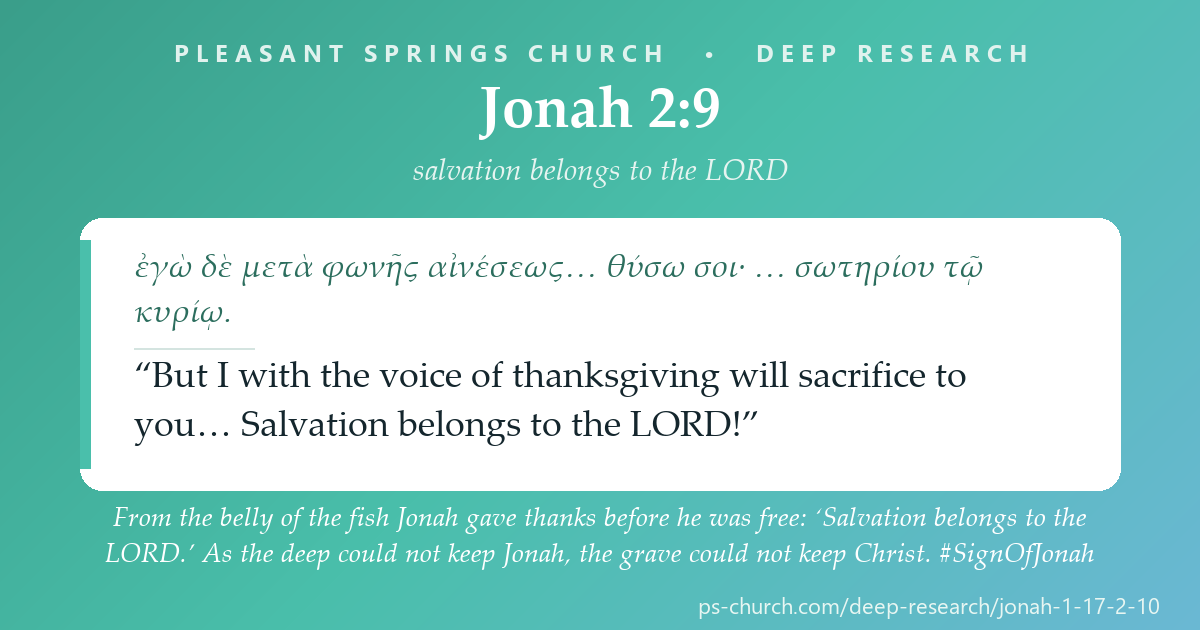
Jonah 2:9 · to share
ESVEvery Deep Research page traces its passage across the whole sweep — the Old Testament, the Second-Temple world between the testaments (historical witnesses, not Scripture), and the New Testament. Follow the thread:
Pleasant Springs Church — Deep Research
Research method after Michael S. Heiser’s Bible Research Method (examine dictionaries → ancient literature → important words → textual connections → academic publications → share), with the Pleasant Springs “Author & Audience” foundation. Scripture set in the Hebrew, the Greek editions named on each page and the ESV (Old Testament), and the Greek New Testament and the ESV (New Testament), per the practice of Pleasant Springs Church. Jonah 1:17–2:10 research grounded in Sasson, Stuart, Allen, and Limburg, with Beale & Carson on the sign of Jonah in the Gospels; 3 Maccabees and Josephus as Second-Temple witnesses to the κῆτος tradition.
Scripture quotations marked ESV are from the ESV® Bible (The Holy Bible, English Standard Version®), © 2001 by Crossway, a publishing ministry of Good News Publishers. ESV Text Edition: 2016. Used by permission. All rights reserved. The ESV text may not be quoted in any publication made available to the public by a Creative Commons license, and the ESV may not be translated in whole or in part into any other language. www.esv.org
|
Did this study bless you today? 💚 Give to Support PS Church100% of gifts go to the General Fund — thank you. |