Israel’s great imperial neighbors told a version of the same story: the world was made when a god killed the dragon of the sea. Then Genesis reaches day five — and spends its holiest verb, the one used only of God’s own creating, on the sea-dragons themselves: he made them, and they were good. This study follows the swarming waters and the tamed monster from Day Four all the way to the dragon’s last day in Revelation. See the method →
Genesis 1:20–25
Hebrew · LXX · ESVThe Shape of the Passage
Parallel panelsSame Author and audience as Genesis 1:1 — and on day five the polemic takes on the most fearsome god of all: the dragon of the sea.
Author
The Torah of Moses reaches the days of filling: day five stocks the sea and sky (v.20–23), day six begins with the land animals (v.24–25). Two touches stand out. First, the verb בָּרָא (“create,” used of God alone) has slept since 1:1 — and the Author wakes it precisely for the תַּנִּינִם, the great sea-dragons (v.21). Second, the first blessing in the Bible falls here (v.22): “Be fruitful and multiply.”
Why spend “create” on sea-monsters? In the myths of Israel’s great imperial neighbors, the sea-dragon is the primeval enemy the gods must overpower. Genesis spends the word reserved for God’s own creative making on the dragon itself — and then files it under “good.” The monster is not a rival deity; it is a fish God made and enjoys.
Audience
Israel knew the dragon by many names — Canaan’s Lotan, the twisting serpent Baal fights; Babylon’s Tiamat, the sea split to make the sky; the Bible’s own poetic Leviathan and Rahab. Their neighbors trembled before chaos incarnate.
How they heard it. Genesis 1:21 is a quiet act of demolition: the terror of the nations is a day-five creature, made, blessed, and pronounced good like the herring beside it. For a people prone to fear the powers of the deep, the message was liberation — and a promise, because the poets would go on to sing that the Lord had already crushed the dragon’s heads (Ps 74:13–14), a victory the New Testament carries to its end (Rev 20:2).
Orient on the sea-monster, the “kinds,” and the first blessing.
Search by topic: Leviathan, Rahab, dragon, sea, chaos, creation of animals, blessing.
Which articles are relevant?
- Anchor Bible Dictionary — “Leviathan,” “Rahab (Dragon),” “Dragon,” “Sea,” “Cosmogony.”
- Dictionary of Deities and Demons in the Bible (DDD) — “Leviathan,” “Tannin,” “Rahab,” “Sea.”
- Dictionary of the OT: Pentateuch — “Creation,” “Cosmology,” “Animals.”
Bibliography surfaced:
- John Day, God’s Conflict with the Dragon and the Sea (Cambridge) — the standard study of the biblical chaos-dragon motif.
- Mary Wakeman, God’s Battle with the Monster; David Tsumura, Creation and Destruction — the case against reading combat into Genesis 1 itself.
- Wenham, Genesis 1–15 (WBC); Nahum Sarna, Genesis (JPS).
The dragon in the myths — and in the Second-Temple imagination.
Set day five beside the chaos-combat myths, then follow the sea-dragon into the Second-Temple texts that paired Leviathan and Behemoth and saved them for the end.
Which parallels shed light on religion and worldview?
The chaos-combat myths. In the Babylonian Enuma Elish, Marduk defeats the sea-goddess Tiamat (a dragon) and literally builds the cosmos from her corpse. In the Ugaritic Baal Cycle, Baal defeats Yam (“Sea”) and the dragon Lotan (Hebrew Leviathan), “the twisting serpent… with seven heads” — there to win his kingship. In both, the dragon is the enemy a god must overpower. Genesis 1:21 knows this imagery and, on a widely held reading, calmly declines it: no combat, no corpse — God simply makes the sea-creatures, and they are good.
- Baal Cycle (Ugarit, KTU 1.5) — Lotan/Litan “the fleeing serpent… the twisting serpent, the mighty one with seven heads” — almost word-for-word the description Isaiah 27:1 will apply to Leviathan.
- 1 Enoch 60:7–9 (Pseudepigrapha — a Second-Temple witness, not Scripture) — Leviathan (female, in the sea-depths) and Behemoth (male, in the desert) are separated to await the judgment.
- 4 Ezra 6:49–52 (2 Esdras; Apocrypha — likewise not Scripture) — reads Genesis 1: on day five God created Behemoth and Leviathan, kept in reserve “to be eaten by whom you wish, and when.”
- 2 Baruch 29:4 (Pseudepigrapha) — Behemoth and Leviathan become food at the Messiah’s banquet: the tamed monster served at the feast.
- Jubilees 2:11–12 (Pseudepigrapha) — retells day five, counting the sea-creatures and birds among the week’s twenty-two works.
The neighbors’ dragon is a god who must be slain; the Second-Temple imagination kept the dragon dangerous but under God’s lock, a beast reserved for the end. Genesis 1 is more radical than either: the dragon never was a rival — it is a day-five creature, blessed and called good. When Israel’s poets do reach for the old combat language (Ps 74:13–14; 89:10; Isa 51:9), they use it chiefly for the Lord’s historical victories — not as a rival account of how the world was made. The dragon’s whole biblical career runs from ‘good creature’ here, by way of the serpent of Eden, to ‘defeated enemy’ at the sea’s last retirement (Rev 21:1).
The vocabulary of teeming, tamed abundance.
Watch the God-only verb בָּרָא spent on the dragon, and the first blessing spoken over creatures.
“Swarm / swarming things” — teeming abundance. The sea God’s neighbors feared is, in Genesis, joyfully overcrowded with life.
“Sea-dragons / great sea-creatures” (LXX κήτη). The mythic chaos-monster — here simply created and called good. The single most pointed demotion in the chapter.
“Created” — the God-only verb, dormant since 1:1. Reserved in this chapter for three things: the cosmos (1:1), the sea-dragons (1:21), and humanity (1:27).
“And he blessed” — the Bible’s first blessing, spoken over fish and birds: “be fruitful and multiply.” Blessing begins as the power to bring forth life.
“Kind” — with the prefix לְ and varying suffix (לְמִינֵהֶם / לְמִינָהּ / לְמִינֵהוּ), “according to its/their kind”: the ordered fruitfulness of day three, now filling the animate world.
“Living creature/soul” — the animals share this term with humanity (2:7). Genesis grants the beasts real, God-given life before ever crowning the human.
How the New Testament reuses day five:
- Revelation 12–13; 20:2 — the “great dragon… that ancient serpent” and the beast that rises “out of the sea”: the chaos-monster of the myths, unmasked as the devil — and finally bound and destroyed by the Lamb.
- Revelation 21:1 — “the sea was no more”: the dragon’s home retired, chaos abolished in the new creation (with Genesis 1:9–10).
- Colossians 1:16 — “all things… whether thrones or dominions” created through Christ: even the powers behind the dragon-symbol are made, and subject, in him.
- Matthew 12:40 — Jonah in the belly of the κῆτος (the LXX’s day-five word) becomes the sign of the Son of Man’s three days: the sea-monster made a servant of resurrection.
The dragon-thread from Genesis to Revelation.
Trace the Leviathan/Rahab texts, the blessing that echoes forward, and the dragon’s final defeat — then note where Beale & Carson picks up the thread in Revelation.
Which cross-references matter?
- Psalm 74:13–14; 89:10; Isaiah 51:9 — the Lord “broke the heads of the sea-monsters” and “crushed Rahab”: the dragon vanquished in Israel’s praise, applied to the Exodus.
- Job 41; Psalm 104:26 — Leviathan as God’s untamable pet, whom God alone can face — and who in Ps 104 merely “plays” in the sea God made for him.
- Isaiah 27:1 — “in that day the Lord… will punish Leviathan the fleeing serpent… and he will slay the dragon that is in the sea”: the eschatological end of the monster, in Ugarit’s own words.
- Genesis 1:22 → 1:28 → 8:17; 9:1 — the “be fruitful and multiply” blessing spreading from animals to humanity to the post-flood world.
- Revelation 12:9; 13:1; 20:2, 10; 21:1 — the whole dragon-thread’s destination: the ancient serpent bound, thrown down, and the sea itself gone.
The commentary’s Revelation chapters trace John’s dragon and sea-beast back through Daniel 7 and the Leviathan/chaos tradition that begins with the תַּנִּינִם of Genesis 1:21. What Genesis quietly demoted — the sea-dragon as mere creature — the prophets re-armed as an image of the nations and the powers, and Revelation finally slays. The reassurance is total: the scariest thing in the ancient imagination was, from day five, on a leash held by its Maker.
The scholarship on the dragon and the “kinds.”
John Day for the dragon motif; Tsumura for the caution against over-reading combat into Genesis 1; the standard commentaries for the exegesis.
Commentaries & studies:
- John Day, God’s Conflict with the Dragon and the Sea: Echoes of a Canaanite Myth in the Old Testament (Cambridge).
- David Tsumura, Creation and Destruction: A Reappraisal of the Chaoskampf Theory — argues Genesis 1 is not a demythologized combat.
- Wenham (WBC), Westermann, Sarna (JPS), Hamilton (NICOT), Mathews (NAC).
Interpretation notes worth keeping:
- Is Genesis 1 anti-myth or just non-myth? Day (yes, deliberate polemic) and Tsumura (no, simply a different genre) frame the debate. Either way the result is the same: the dragon is a creature, and the poetic combat-texts locate the Lord’s victory in history, not cosmogony.
- The three uses of בָּרָא (1:1, 1:21, 1:27) give the chapter its architecture: cosmos, the largest creatures, and the image-bearer — God’s special verb bracketing the whole and marking its peaks.
- “According to its kind” concerns ordered reproduction and stable categories, not a modern taxonomy; the point is faithfulness, not a biology lecture.
From the tamed dragon to your own fears.
Name what you learned, why it matters, and one concrete response.
What should we carry away — and do?
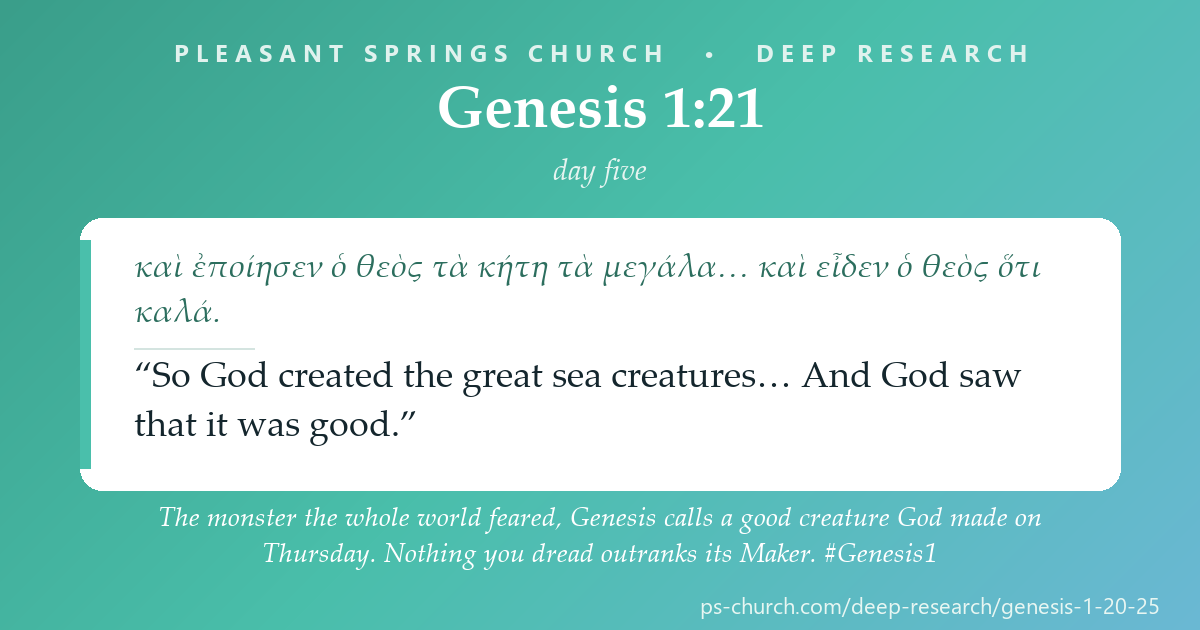
- Your worst fear is a day-five creature. The thing the whole ancient world worshiped in terror, Genesis files under “and God saw that it was good.” Nothing you dread outranks its Maker.
- Blessing is the power to bring forth life. The Bible’s first blessing (v.22) is fruitfulness — God delights to fill empty places, seas and skies and lives, with more life.
- The dragon’s story ends. From good creature (Gen 1:21) to bound enemy (Rev 20:2) to a sea that is “no more” (Rev 21:1): whatever chaos still snaps at you is on a countdown held by the Lamb.
Step in response: name the “dragon” you fear most this week, and set it consciously under Genesis 1:21 — a made thing, under its Maker — and under Revelation 20:2, an enemy already sentenced.
Genesis 1:21 · to share
LXX + ESVEvery Deep Research page traces its passage across the whole sweep — the Old Testament, the Second-Temple world between the testaments (historical witnesses, not Scripture), and the New Testament. Follow the thread:
Pleasant Springs Church — Deep Research
Research method after Michael S. Heiser’s Bible Research Method (examine dictionaries → ancient literature → important words → textual connections → academic publications → share), with the Pleasant Springs “Author & Audience” foundation. Scripture set in the Hebrew, the Greek editions named on each page and the ESV (Old Testament), and the Greek New Testament and the ESV (New Testament), per the practice of Pleasant Springs Church. Genesis 1:20–25 research grounded in Day, Tsumura, Wenham, Sarna, and Hamilton; ancient parallels from the Baal Cycle and Enuma Elish; Second-Temple dragon material per 1 Enoch 60, 4 Ezra 6, 2 Baruch 29, and Jubilees 2 (all read as witnesses, not Scripture).
Scripture quotations marked ESV are from the ESV® Bible (The Holy Bible, English Standard Version®), © 2001 by Crossway, a publishing ministry of Good News Publishers. ESV Text Edition: 2016. Used by permission. All rights reserved. The ESV text may not be quoted in any publication made available to the public by a Creative Commons license, and the ESV may not be translated in whole or in part into any other language. www.esv.org
|
Did this study bless you today? 💚 Give to Support PS Church100% of gifts go to the General Fund — thank you. |