The book called 2 Esdras
in the English Apocrypha is called the Fourth Book of Esdras in the Latin Bible, and is
neither of the books the Septuagint calls 1 and 2 Esdras. Scholarship finds three writings
inside it: a Christian frame (chapters 1–2), a Jewish apocalypse (3–14), and a second Christian
frame (15–16). This page measured that division instead of repeating it, and it is visible in
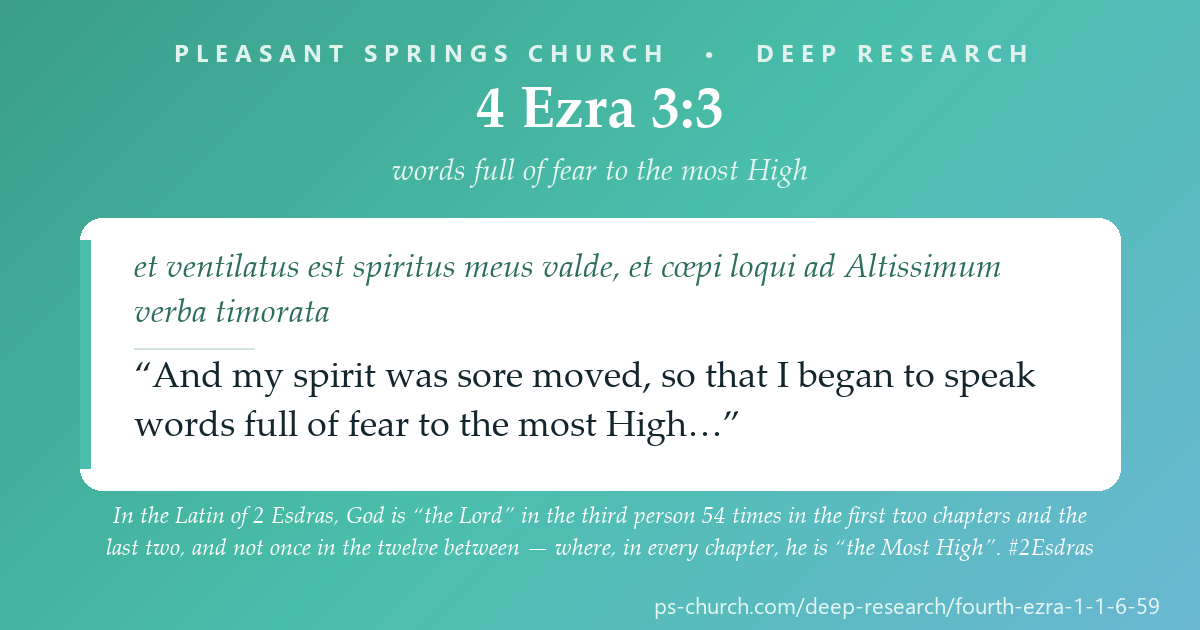
two words. In the Latin, God is the Lord in the third person — Dominus,
Domini, Domino, Dominum — fifty-four times in chapters 1–2 and 15–16, and not
once in the twelve chapters between, where in every chapter he is the Most High, Altissimus
and its cases (there Domine, ‘O Lord’, survives only as a form of address). Two
manuscripts in the 1895 critical edition title the parts at the same two seams. Along the way: the Latin Bible’s one hen, in Matthew
23:37, has a twin in 4 Ezra 1:30 and none in Luke; the seer is never called Salathiel in either text printed
here; and the deepest New Testament contacts tie at five words, one a scene and one an accident.
There is no Greek of this book on this shelf and no ESV; every measurement is Latin against
Latin, and every negative is scoped to the 35,809 Vulgate verses searched. It is not Scripture for
us, and nothing taught here rests on it.
See the method →
First of three studies: 1–6 (this page)
→ 7–10
→ 11–16.
Three writings bound as one book. Chapters 3–14 are a Jewish apocalypse, commonly dated to the decades after the Romans destroyed the Temple in AD 70; chapters 1–2 and 15–16 are commonly treated as later Christian additions and called 5 Ezra and 6 Ezra (the division is the scholarship’s — Metzger, Stone and Bergren are named in Stage 1 — and this page measures it in Stage 3 rather than assuming it). The book is in no one’s Hebrew Bible and is not in the Roman Catholic canon: the 1598 Vatican print sets it in an appendix, ‘extra fcilicet fe- riem Canonicorum Librorum’ [gloss, ours: outside, that is, the series of the canonical books], and gives its reason: ‘fepofiti funt, neprorfus interirent’ [gloss, ours: they have been set apart, lest they perish altogether], since such books [gloss, ours: are sometimes cited by some holy Fathers and are found in some Latin Bibles, manuscript and printed]. (The Latin is the OCR of the scan, which reads the long s as f.) The KJV of 1611 printed it among the Apocrypha (the 1769 text on this disk includes it). It is not Scripture for us. Pleasant Springs reads chapters 3–14 as a Second-Temple Jewish witness to how faithful people argued with God after the fall of Jerusalem, and chapters 1–2 as an early Christian writing — both read critically, gratefully for the light they throw on the world of the New Testament, and tested by the canon.
⚠️ What this page can and cannot measure — read this first.
HELD: the Latin of the whole book in the Clementine appendix (872 verses); the 70 verses of 7:36–105 in Bensly–James 1895; the KJV Apocrypha (874 verses) and the Revised Version (944); the OCR of the 1598 print, of the 1895 Revised Version and of Bensly–James 1895; the Clementine Vulgate of the 73 books of the Roman Catholic canon (35,809 verses: 27,858 in 46 Old Testament books including Tobit, Judith, Wisdom, Sirach, Baruch and 1–2 Maccabees; 7,951 in the 27 of the New); the Greek New Testament (SBLGNT, 7,927 verses).
NOT HELD: any Greek of this book (commonly described as lost apart from quotations and a small papyrus fragment of chapter 15 reported among the Oxyrhynchus papyri — see Stage 5; none of it is on this disk); the Syriac, Ethiopic, Armenian, Georgian and Arabic versions; a clean critical Latin of chapters 1–6; the Old Latin of the Gospels.
CONSEQUENCE: every measurement on this page is Latin against Latin. The Latin of 4 Ezra and the Latin of the Vulgate are two different translations made by different hands from different originals, so a shared run of Latin words measures shared Latin wording — not a source, and not a reading of one book by the other. English-against-English (KJV against KJV) is not used at all: it would measure the habits of the 1611 translators. And no Greek run is possible, because there is no Greek 4 Ezra to run.
4 Ezra (2 Esdras) 1:1–6:59 — twelve verses, two witnesses
Latin: Clementine appendix (Rome, 1598) · English: KJV Apocrypha (1769 standard text, public domain)The book calls itself the second. The print this Latin is taken from — the Vatican Clementine of 1598 — heads the page with the fourth book of Esdras (the scan’s OCR reads the spaced capitals as ‘L I B E R E S D R AE’ and ‘Q_V A R T V s’), and the first sentence under that heading is Liber Esdræ prophetæ secundus, the second book of Ezra the prophet. The KJV’s first verse carries the same sentence in English: The second book of the prophet Esdras. Stage 2 sets out every name the book goes by.
Tied for the deepest Latin contact in chapters 1–6 (with 1:4, the prophets’ formula, band 22): eight consecutive words, shared with one verse of the 35,809 in the Clementine Vulgate — Jeremiah 34:13 (tie band 1). The six-word core de terra Ægypti, de domo servitutis stands in nine verses of the Latin pool screened here; with eos before it, in two — Jeremiah 34:13 and this verse. And from Jeremiah’s side the answer is different: Jeremiah 34:13’s own deepest Latin partner is Jeremiah 11:4, at eleven words. One band of 1, and it only runs one way.
The page’s Gospel finding (Stage 4). In the 35,809 verses of the Clementine Vulgate the word gallina — hen — stands once, at Matthew 23:37. Luke 13:34, which has the same bird in Greek (ὄρνις), reads avis nidum suum sub pennis, a bird, her nest under her feathers. This verse has the hen, and four consecutive words of Matthew’s Latin. With Luke’s Latin it shares one word. The speaker here is the one the text names at 1:28, Dominus omnipotens, the Lord Almighty; in Matthew it is Jesus.
The one verse of the 290 that shares no two consecutive words with any verse of the Clementine Vulgate. Widow, fatherless, poor, orphan, naked: the content is the Bible’s own — Isaiah 1:17 has judicate pupillo, defendite viduam — and the screen cannot see it, because the order and the verb forms differ and the screen measures wording. It is printed here so that a low number is not mistaken for a low view of the poor.
Five consecutive Latin words shared with Revelation 7:14, and with no other verse of the Vulgate (band 1); and Revelation 7:14’s own deepest partner, in the whole Latin pool, is this verse (band 1). In both, a seer is told who a white-clad multitude is — in 4 Ezra after he asks the angel (2:44), in Revelation after an elder asks him (7:13) — and the answer begins these are they who… The run is made of ordinary words; Stage 4 prints, beside it, the accident that measures exactly the same.
The identification is the text’s own: the young man who crowns the multitude is filius Dei — KJV: ‘It is the Son of God, whom they have confessed in the world’. The text names him no further, and the page adds nothing to it. In the Clementine Vulgate the two words stand in 32 verses: one in Wisdom 2:18, the other 31 in the New Testament.
No Salathiel. Neither text on this page names the seer here: the Clementine of 1598 and the KJV of 1769 begin chapter 3 without a name (the 1598 print, checked on its page image, has none either). The name is in the 1895 editions: the Revised Version reads I Salathiel (the same is Esdras), and Bensly’s critical Latin (OCR) ‘Anno tricesimo ruinae ciuitatis eram in Babilone, ego Salathihel qui et Ezras,’. The only Salathiel in the two columns printed here is someone else — see 5:16.
The first ‘Most High’ in the book. Altissimum here; from this verse to the end of chapter 14 the title stands in every chapter, and the Lord in the third person (Dominus and its cases) stands in none. Two chapters earlier it was the other way round. That seam is this page’s thesis: see The Shape of the Passage.
The evil heart. Cor enim malignum — and at 3:20, 3:26 and 4:4 the noun and adjective stand side by side. In the 35,809 verses of the Clementine Vulgate, no form of cor stands next to any form of malignus. The Vulgate’s nearest include cor pravum (Psalm 100:4 in the Vulgate’s numbering, 101:4 in the English; and Proverbs 11:20, Sirach 36:22) and cor malum (Hebrews 3:12). What the text says about Adam is reported in Stage 3; what it means is a question for theology, not for a word count.
The accident. Five Latin words, Et dixit ad me : Vade, shared with one verse of the Vulgate — Acts 22:21, where the Lord sends Paul to the nations — and Acts 22:21’s deepest partner in the whole Latin pool is this verse. Band 1 both ways, exactly like 2:45 and Revelation 7:14. Here an angel is telling a man to go and weigh fire. Stage 4 sets the two side by side.
Here is the Salathiel of the 1598 Latin and the 1769 English: not the seer, but ‘the captain of the people’ who comes to him. The 1895 editions name this man differently — the Revised Version Phaltiel, and Bensly’s index (OCR) ‘Phaltiel dux populi v. 16 (al. Salathihel)’. Which man bears the name is decided by which edition is open.
Where these six chapters stop: the question. The world was made for Israel; why does Israel not possess it? The verse before it, nos autem populus tuus, shares those four words with one verse of the Vulgate, Psalm 78:13 in its numbering (79:13 in the English) — the last verse of the psalm that opens Deus, venerunt gentes in hæreditatem tuam. Band 1 from this side; from the psalm’s side its deepest run is four words, and 19 other verses reach four too (all of them on in generationem et generationem). The answer begins in chapter 7, the next study.
On the columns. The Latin is the Clementine appendix as transcribed on Latin Wikisource (CC BY-SA; a transcription of a public-domain print, credited here), held with its provenance; where this page checks it against the scan of the 1598 print it says so. The English is the King James Apocrypha, standardised text of 1769, public domain, read from the verse-per-line file on this disk and printed with its own spelling. Italic English that renders a Latin word or phrase, or paraphrases the text, is this page’s own plain rendering (it sometimes coincides with the KJV’s wording); the KJV itself is quoted in roman type, read from the file, and named as the KJV. No ESV of this book exists to print. The Revised Version of 1895 is quoted only for single readings, each checked against the OCR of an 1895 print.
Versification — stated, as on every page here, and here it is a third state: no Masoretic text, no Greek, and no ESV of this book, so the usual Hebrew/Greek/English offset does not exist. What exists is four witnesses, counted from their files:
• Latin, Clementine appendix (1598). 872 verses in 16 chapters; chapters 1–6: 40 · 48 · 36 · 52 · 55 · 59 = 290. It has no 7:36–105.
• English, KJV Apocrypha (1769). 874 verses; chapters 1–6: 40 · 48 · 36 · 52 · 56 · 59 = 291. Chapter 7 has 70 verses: it too lacks the seventy verses now numbered 7:36–105, so KJV 7:36 = modern 7:106 (next study).
• English, Revised Version (1895). 944 verses, modern numbering; chapters 1–6 have the KJV’s counts, and chapter 7 has 140.
• Latin, Bensly–James (1895). Held clean only for 7:36–105 (70 verses); the rest of that edition is on disk as OCR and is quoted here only as OCR.
The map inside chapters 1–6, found by reading the texts side by side (content, not labels):
(1) Clementine 5:55 = KJV 5:55 + 5:56 = RV 5:55 + 5:56. The Latin verse ends with the request that the KJV numbers 5:56: Et dixi, Rogo Domine, si inveni gratiam ante oculos tuos = Then said I, Lord, I beseech thee, if I have found favour in thy sight. The 1598 print has no 5:56 either (checked on its page image).
(2) RV 1:12/1:13 and 4:42/4:43. The RV opens 1:13 with Thus saith the Lord; the KJV closes 1:12 with it, and so does the Latin, Hæc dicit Dominus. At 4:42/4:43 it is the other way round: the RV file ends 4:42 with from the beginning, where the KJV opens 4:43 with From the beginning and the Latin with Ab initio. The 1895 print (OCR) sets its margin number 43 on the line ‘43 from the beginning. Then shall it be’, so the print does not settle which division it has. Elsewhere in chapters 1–6 the RV divides where the KJV does.
(3) 3:15–19: three texts, three divisions. The transcription closes 3:15 with Et dedisti ei Isaac, et Isaac dedisti Jacob et Esau; the KJV opens 3:16 with it (And unto him thou gavest Isaac). The 1598 print, read from its page image (Internet Archive scan bub_gb_bPXlOFEn6NYC, leaf n1199, page 17 of the fourth book), divides differently from both, and all three agree again at 3:20:
| Words (Latin, as transcribed) | 1598 print (page image) | Wikisource transcription | KJV 1769 |
|---|---|---|---|
| et disposuisti ei testamentum æternum… | 15 | 15 | 15 |
| Et dedisti ei Isaac… | 16 | 15 (cont.) | 16 |
| Et segregasti tibi Jacob… | 17 | 16 | 16 (cont.) |
| Et factum est cum educeres… | 18 | 17 | 17 |
| Et inclinasti cælos… | 19 | 18 | 18 |
| et transiit gloria tua… | 19 (cont.) | 19 | 19 |
| Et non abstulisti… | 20 | 20 | 20 |
Every other verse division of chapters 1–6 was read against the page images of the 1598 print (leaves n1197–n1204 of that scan) and agrees with the transcription, and all twelve codex verses carry the same numbers in both. One place the scan leaves unclear: at 1:23/24 the margin number 24 stands beside a clear verse mark before Transferam me, one line below a fainter mark before Quid tibi faciam Jacob, where the transcription, the KJV and the RV all begin 1:24. The page does not settle it. Apart from (1)–(3), every verse label in chapters 1–6 carries the same content in the Latin and the English.
The Shape of the Passage
Sequence · a frame, then dialogue cycles · the seam is measuredThe two inner cycles are parallel, and two of the parallels are counted: the seven-day fast stands at 5:13, 5:20, 6:31 and 6:35, and horum majora, ‘greater things than these’, at 5:13 and 6:31 and nowhere else in the book. The labels complaint, dialogue and signs are a reading of the content and are offered as no more than that.
This is NOT a chiasm, and the seam is not a centre. It is the join between two kinds of writing. A word count cannot say whether the join is between authors or only between genres — an oracle says saith the Lord, a dialogue with an angel would not — and Stage 5 says so again.
⚠️ Where this page sits. 4 Ezra (2 Esdras) is filed with the Apocrypha. It is in no Hebrew Bible, it is outside the Roman Catholic canon (the 1598 print says so of itself), and it was printed among the Apocrypha in the KJV. Nothing taught at Pleasant Springs rests on it.
Author
Anonymous, three times over. The voice is Ezra’s throughout — Ego Esdras in chapter 2, the seer in Babylon from chapter 3 — and the book is not Ezra’s. Chapters 3–14 are commonly dated to around AD 100: the thirtieth year after the ruin of the city (3:1) is commonly read as standing for thirty years after AD 70, with Babylon standing for Rome. Chapters 1–2 and 15–16 are commonly treated as Christian compositions added later (Stage 1 names where to check this).
The original language is not held here and is not known from this disk. The account usually given is a Semitic original, a Greek translation now lost, and from the Greek the Latin, Syriac, Ethiopic and other versions. This page can check none of that; it measures the Latin it has.
Two kinds of voice, measured. In chapters 1–2 God speaks in oracles — dicit Dominus in 18 verses. In chapters 3–6 a man argues with an angel and with Altissimum, and the formula never occurs.
Audience
For chapters 3–14: people who had watched Jerusalem fall. The seer’s first words are a lament, and his first argument is a comparison: Numquid meliora faciunt, qui habitant Babylonem — are their deeds any better that inhabit Babylon? The question the cycles keep returning to is why God’s people suffer at the hands of nations that keep his law worse — and chapter 6 ends on it.
For chapters 1–2: a community that calls itself the people to come. God gives Israel’s houses populo venienti, and Ezra turns to gentes. The page reports this as the frame’s own claim; it is the stance of chapters 1–2 and not of 3–14, where the seer pleads for Israel against the nations. Bound as one book, the two stances sit side by side, and the reader meets the second only after the first.
Orient on the book, on its three parts, and on why its name is a trap.
Search by topic: 2 Esdras; 4 Ezra; 5 Ezra; 6 Ezra; Esdras, books of; apocalyptic; Uriel; the missing fragment of 4 Ezra; Old Latin; Clementine Vulgate.
Which articles are relevant?
- Anchor Bible Dictionary — the entries on 2 Esdras / 4 Ezra, on the books of Esdras as a group, and on apocalyptic literature. An article that does not distinguish the Septuagint’s Esdras books from the Latin Bible’s is not usable for this book.
- Eerdmans Dictionary of Early Judaism — the entries on 4 Ezra and on Second-Temple apocalypses.
- Dictionary of New Testament Background (IVP) — on the Esdras literature and on apocalyptic.
- Any article on 5 Ezra and 6 Ezra — the Christian frame is usually treated separately from the apocalypse, and a reader of chapters 1–2 needs that treatment, not the one on 3–14.
Bibliography surfaced:
- Bruce M. Metzger, “The Fourth Book of Ezra,” in James H. Charlesworth (ed.), The Old Testament Pseudepigrapha, vol. 1 (1983) — translation and introduction.
- Michael E. Stone, Fourth Ezra (Hermeneia, 1990) — the standard commentary on chapters 3–14.
- Theodore A. Bergren, Fifth Ezra: The Text, Origin and Early History (1990), and Sixth Ezra: The Text and Origin (1998) — on chapters 1–2 and 15–16.
- Jacob M. Myers, I and II Esdras (Anchor Bible 42, 1974).
- R. L. Bensly, The Missing Fragment of the Latin Translation of the Fourth Book of Ezra (Cambridge, 1875) — held here in five library scans (OCR).
- R. L. Bensly, The Fourth Book of Ezra: the Latin version edited from the MSS, with an introduction by M. R. James (Texts and Studies III.2, Cambridge, 1895) — held here as OCR, and as a clean transcription of 7:36–105 only.
- G. H. Box, The Ezra-Apocalypse (1912) — held here as OCR (the next study quotes it); for this page it was read only for its report of the Greek papyrus fragment (Stage 5).
- Bruno Violet, Die Esra-Apokalypse (1910) — named, not held.
A name that differs from Bible to Bible, three books in one binding, and seventy verses that went missing.
This stage carries the naming problem in full, because nothing else on the page can be read correctly without it.
Which book is this? The names, once and in full:
Four numbered ‘Esdras’ books, and the numbers mean different things in different Bibles. This page calls the book 4 Ezra (2 Esdras): 4 Ezra is the Latin Bible’s number and the scholarly name; 2 Esdras is the English Apocrypha’s. The Septuagint’s 1 Esdras is the Vulgate’s 3 Esdras and the English 1 Esdras — a separate book on this shelf — and the Septuagint’s 2 Esdras is Ezra–Nehemiah, which is why this shelf’s Greek file of that name can never stand in for this book.
| Where | ‘1 Esdras’ | ‘2 Esdras’ | ‘3 Esdras’ | ‘4 Esdras’ |
|---|---|---|---|---|
| Septuagint (on this shelf: the CATSS files) | a Greek parallel account of the return (1 Esdras) | Ezra–Nehemiah | — | — |
| Clementine Vulgate (1592/1598) | Ezra | Nehemiah | the Greek parallel account (appendix) | this book (appendix) |
| English Apocrypha (KJV 1611, 1769) | the Greek parallel account | this book | — | — |
| Scholarship | chapters 3–14 = 4 Ezra; 1–2 = 5 Ezra; 15–16 = 6 Ezra | |||
Read from the files: the Latin Wikisource index of the Clementine lists Liber I Esdræ and Liber II Esdræ (sive Nehemiæ) among the canonical books; the 1598 print heads this book with the fourth Esdras; its own first sentence calls it the second (see the codex at 1:1).
The three-book frame — and the manuscripts that mark it:
The division into 5 Ezra, 4 Ezra and 6 Ezra is the scholarship’s, and the page measured two things against it.
First, the vocabulary. The seam in the Latin, printed under The Shape of the Passage: God in the third person 54 times in chapters 1–2 and 15–16 and never in 3–14; the Most High in every chapter of 3–14 and never in the frame. The KJV mirrors it: the Lord 26 times in chapters 1–2, 22 times in 15–16 (one of them, 16:11, opening its sentence), 0 times in 3–14; most High or Highest 0, 51, 0. And the seventy verses the 1598 print lacks follow the same rule: in Bensly’s text of 7:36–105, a form of Altissimus stands in 14 verses, and the one dominus (7:104) is a master with his servant.
Second, the titles. Bensly’s apparatus (read from the OCR of the 1895 edition on this disk) records the titles of the two manuscripts it calls S and A. In S: before chapter 1, ‘Incipit liber Ezrae secundus’; after chapter 2, ‘Explicit liber Ezrae secundus’; before chapter 3, ‘Incipit liber Ezrae quartus’; and before chapter 15, ‘Incipit liber quintus Ezrae’. A numbers the first part differently, ‘Incipit tertius’ [gloss, ours: the third begins], then has ‘Incipit quartus’ before chapter 3 and an incipit of the fifth before chapter 15. The manuscript titles and the vocabulary break at the same two places, whatever number each manuscript gives the parts. The OCR sometimes renders the siglum S as ‘8’ or ‘§’; the edition’s introduction identifies S as ‘the Codex Sangermanensis’.
Seventy missing verses:
The 1598 Latin and the 1769 English both lack the passage now numbered 7:36–105. It was recovered from Latin manuscripts in the 1870s and published by R. L. Bensly in 1875 (his The Missing Fragment is on this disk). Its subject is what happens after death: the pit of torment and the place of rest, seven ways of grief for the wicked and seven orders of rest for the righteous, and — at its end — whether the righteous may pray for the ungodly on the day of judgement, which the text answers no (7:102–105). The next study prints it, from the Revised Version of 1895 and Bensly–James, and sets out the numbering it forces on the rest of chapter 7.
Which parallels shed light on the world of the text?
- The destruction of Jerusalem in AD 70. The thirtieth year of 3:1 is commonly read as a cipher for about AD 100; Babylon in 3:1–2 and 3:28–31 as Rome. Reported, not tested here.
- 2 Baruch, another apocalypse of the same decades, commonly paired with 4 Ezra. Not held here.
- Zechariah’s interpreting angel. In 4 Ezra 5:15 Uriel is angelus, qui loquebatur in me, the angel that talked with me — the phrase the Vulgate uses of Zechariah’s angel (Stage 4 counts it).
- Revelation 7:9–17 beside 4 Ezra 2:42–48: a multitude no one could number, white garments, palms, and the question who they are (asked by the seer in 4 Ezra 2:44, by an elder in Revelation 7:13). Measured in Stage 4, and the run is five words.
- Isaiah 40:15–17 beside 4 Ezra 6:56–57: the nations as a drop from a vessel, reputed as nothing. In the Latin the two share two consecutive words at most — the seer reports what God has said, in wording that is not the Vulgate’s.
Measured across the files held here:
• The seer at 3:1. Clementine 1598 and KJV 1769: no name. RV 1895: I Salathiel (the same is Esdras). Bensly 1895 (OCR): ‘ego Salathihel qui et Ezras,’.
• The captain at 5:16. Clementine and KJV: Salathiel. RV Phaltiel; Bensly (OCR) ‘Phaltiel’.
• The archangel at 4:36. Clementine Jeremiel archangelus and RV Jeremiel the archangel; KJV Uriel the archangel; Bensly (OCR) ‘Hieremihel’.
• The land creature at 6:49 and 6:51. Clementine Henoch and KJV Enoch; RV Behemoth; Bensly’s text (OCR) ‘Behemoth’, with his apparatus recording ‘Enoch SA’.
So a reader quoting ‘Salathiel, who is Ezra’ or ‘Behemoth and Leviathan’ from 4 Ezra is quoting a critical text — on this disk, the editions of 1895 — not the 1598 Latin, and a reader of the KJV will find neither. This page prints the 1598 and 1769 texts and says so on every line.
The Lord, the Most High, a hen, an evil heart — and a name that moves.
Counts are over the Clementine Latin of 4 Ezra (872 verses; no 7:36–105 unless said), the Clementine Vulgate (35,809 verses) and the SBLGNT (7,927 verses). Words are counted after the page’s declared Latin normalisation (Stage 4), and every count says whether it is in verses or in words.
54 occurrences in the Clementine Latin of the book: 11 in chapter 1, 20 in chapter 2, 9 in chapter 15, 14 in chapter 16 — and 0 in chapters 3–14. All 54 are the divine Lord; none is a human master. In 3–14 the noun lives on only in address, Domine (33 times) and Dominator; the verb dominari, to rule, is another word.
51 occurrences in 50 verses, every one in chapters 3–14, at least one in each of those twelve chapters; 0 in 1–2 and 15–16. First at 3:3; every one is the title, written with a capital in the transcription. In the Clementine Vulgate, words from the stem altissim- occur 89 times — not all of them the title: Luke 2:14’s in altissimis is in the highest, and Deuteronomy 3:5’s walls are muris altissimis. Of the 89, 38 are in Sirach; then the Psalms (17), Daniel (7), Wisdom and Luke (6 each).
In 9 verses of chapter 1, 9 of chapter 2, 8 of chapter 15 and 4 of chapter 16; in no verse of 3–14. In the Clementine Vulgate the pair occurs 710 times, and 402 of them are Jeremiah (246) and Ezekiel (156). The frame speaks the prophets’ formula; the apocalypse never does.
Once in the 35,809 verses of the Clementine Vulgate: Matthew 23:37. The stem gallin- occurs once more, in Isaiah 22:17’s gallus gallinaceus, a cock. The Greek New Testament has the bird twice — ὄρνις at Matthew 23:37 and ὄρνις at Luke 13:34 — and the Vulgate gives Luke avis. 4 Ezra 1:30 is the hen’s only other appearance in the Latin pool.
Noun and adjective side by side at 3:20, 3:26 (corde maligno) and 4:4, and with one word between at 3:21. In the Clementine Vulgate, no form of cor stands next to any form of malignus in any of 35,809 verses. Words from the stem malign- occur eight times in the whole of 4 Ezra, six of them in 3:20–4:4.
In the Clementine and the KJV: once, at 5:16, as the captain of the people. In the RV and Bensly’s 1895 text: at 3:1, as the seer’s other name — and the captain at 5:16 is Phaltiel. See the box at the end of Stage 2.
What the text says about Adam and the heart — reported, not interpreted:
3:21: Cor enim malignum bajulans primus Adam transgressus et victus est — KJV 1769: For the first Adam bearing a wicked heart transgressed, and was overcome; and so be all they that are born of him. 3:22 (KJV): Thus infirmity was made permanent … so that the good departed away, and the evil abode still. 4:30 (KJV): the grain of evil seed hath been sown in the heart of Adam from the beginning.
The text says the first man bore an evil heart and that those born of him are likewise; it does not here say how the condition passes or what remedies it. Readings of these verses as a doctrine of inherited sin, or as something different from Paul’s in Romans 5, are the commentators’; this page reports the wording and leaves the doctrine to them and to Scripture. One measurement belongs here: 4:30’s seminatum est in corde shares four words with Matthew 13:19 in the Vulgate, the parable of the sower — where what is sown in the heart is the word, and the evil one takes it away (Stage 4).
Counted here, not assumed:
- The seven-day fasts. A form of jejunare with septem stands at 5:13, 5:20, 6:31 and 6:35 (and at 9:23, in the next study, where the seven days are expressly not a fast: sed non jejunabis in eis). Horum majora at 5:13 and 6:31 only.
- One of everything (5:23–27). vineam unicam, lilium unum, rivum unum, columbam unam, ovem unam, populum unum — the seer’s complaint is built as a list of choices, and the last is Israel.
- A KJV reading to know about. At 5:13 the KJV file reads fast even days where the Latin has jejunaveris septem diebus and the RV fast seven days (checked against the 1895 print). Whether ‘even’ is the 1769 print’s or the transcription’s, this disk cannot tell.
- The six days of creation (6:38–54) are counted off in order — die secundo, tertia die, Quarta autem die, Quinto autem die, Sexto autem die — and end with Adam and with Israel (6:54).
Latin against Latin: two runs of eight, a tie at five, and a hen.
The screen. Each of the 290 Clementine verses of chapters 1–6 against all 35,809 verses of the Clementine Vulgate (73 books), for the longest run of consecutive identical word forms. Declared Latin normalisation: lower case; æ and œ written ae and oe; accents and diaeresis dropped (the Wikisource text writes quàm, the Vulgate file quam); j written i and v written u; punctuation removed. Nothing else is folded: not spelling variants (nuncia/nuntia, quotidie/cotidie), not the enclitic -que, not inflection. Tie band = how many Vulgate verses reach the same depth. Reverse band = the partner verse screened back against the whole Latin pool (the Vulgate plus all 872 verses of 4 Ezra, 36,681 verses, less the partner itself), or, for a New Testament partner, against the Old Testament side of that pool. A row that shares no two consecutive words still scores 1 if it shares a word, so 0 would mean no shared word at all — and no row scores 0.
The distribution — all 290 verses, three ways:
Against the whole Vulgate (35,809 verses): all 290 share a word; 289 reach two, 205 reach three, 85 reach four, 15 reach five, 3 reach six, the same 2 reach seven and eight, and nothing reaches nine.
Against the Old Testament books (27,858 verses): 289 reach two, 193 three, 80 four, 13 five, 3 six, 2 eight.
Against the New Testament (7,951 verses): 278 reach two, 134 three, 41 four, 2 reach five, and nothing reaches six; 12 reach only one.
Chapters 1–2 (88 verses) against the Vulgate New Testament: 81 reach two, 32 three, 6 four, 1 five. Chapters 3–6 (202 verses): 197 two, 102 three, 35 four, 1 five. Most of the second group’s fours are two narrative openings: 23 of its 35 get there only on et dixit ad me (whose one New Testament occurrence in the Vulgate is Acts 22:21) or on et factum est and one more word. Set those aside and the rates are 6 of 88 and 12 of 202 — the same, near enough. The frame scholarship calls Christian does not, on this screen, use more of the Latin New Testament’s wording than the Jewish chapters do. That is a statement about two Latin translations, not about the authors.
The deep end — all fifteen verses that reach five, with bands both ways:
References are in the Vulgate’s numbering. Band = how many Vulgate verses reach the same depth from 4 Ezra’s side. From the partner’s side = the partner verse screened against the whole Latin pool; one way means it has a deeper partner elsewhere.
| 4 Ezra | Shared words (Clementine) | Run | Vulgate partner(s) | Band | From the partner’s side |
|---|---|---|---|---|---|
| 1:3 | in regno Artaxerxis regis Persarum | 5 | Ezra 7:1 | 1 | 4 Ezra 1:3 alone (5, band 1) |
| 1:4 | Et factum est verbum Domini ad me, dicens | 8 | 22 verses: Ezekiel 13, Jeremiah 7, Zechariah 2 | 22 | from each of the 22: a tie at 8 with the other 21 and 4 Ezra 1:4 (band 22) |
| 1:7 | eduxi eos de terra Ægypti de domo servitutis | 8 | Jeremiah 34:13 | 1 | Jeremiah 11:4 (11, band 1): one way |
| 1:11 | Omnes gentes a facie eorum | 5 | 1 Maccabees 5:43 | 1 | 5, band 3: 1 Maccabees 7:44, 11:51 and 4 Ezra 1:11 |
| 1:29 | mihi in populum, et ego | 5 | 8 verses: Jeremiah 11:4, 24:7, 30:22, 32:38; Ezekiel 11:20, 14:11, 36:28; Zechariah 8:8 | 8 | each of the 8 has a deeper partner among the prophets (10–11 words): one way |
| 1:30 | Projiciam vos a facie mea | 5 | Jeremiah 7:15 | 1 | 4 Ezra 1:30 alone (5, band 1) |
| 1:31 | avertam faciem meam a vobis | 5 | Jeremiah 3:12 | 1 | Jeremiah 23:23 (6, band 1): one way |
| 1:39 | Abraham, Isaac, et Jacob, et | 5 | Numbers 32:11, Deuteronomy 6:10, Baruch 2:34 | 3 | Baruch 2:34: 5, band 5, this verse among them; Numbers 32:11: 5, band 14, this verse among them; Deuteronomy 6:10: 7, band 3, all Deuteronomy |
| 2:45 | dixit mihi : Hi sunt qui | 5 | Revelation 7:14 | 1 | 4 Ezra 2:45 alone (5, band 1) |
| 4:5 | Et dixit ad me : Vade | 5 | Acts 22:21 | 1 | 4 Ezra 4:5 alone (5, band 1) |
| 4:44 | gratiam ante oculos tuos : et | 5 | Ruth 2:10 | 1 | 5, band 2: 4 Ezra 4:44 and 4 Ezra 12:7 |
| 5:15 | angelus, qui loquebatur in me, et | 6 | Zechariah 4:1, 4:5, 5:5 | 3 | each of the three has a deeper partner inside Zechariah (7, 10 and 9 words): one way |
| 5:21 | Et factum est post dies | 5 | Jeremiah 13:6 | 1 | 5, band 3, all three in 4 Ezra: 5:21, 9:27, 13:1 |
| 6:30 | et dixit ad me hæc | 5 | Ezekiel 46:24, Zechariah 1:19, 5:3 | 3 | each of the three has a deeper partner (6, 11 and 6 words): one way |
| 6:35 | Et factum est post hæc | 5 | Judith 16:22 | 1 | 4 Ezra 6:35 alone (5, band 1) |
Five of the fifteen are band 1 in both directions, the strongest result this screen can return. They are a regnal date (1:3 with Ezra 7:1); Jeremiah’s temple sermon (1:30 with Jeremiah 7:15); a seer told who the white-robed multitude are (2:45 with Revelation 7:14); an angel’s Go (4:5 with Acts 22:21); and a narrative join, Et factum est post hæc, and it came to pass after these things (6:35 with Judith 16:22), five words that stand in no other verse of the pool. Band 1 both ways does not tell a scene from a formula. The other ten: formulas by their bands (1:4, 1:29, 1:39, 5:15, 6:30); band 1 from 4 Ezra’s side with a deeper partner on the other (1:7, 1:31); or band 1 from 4 Ezra’s side with a tie on the other — with two more verses of 1 Maccabees (1:11), or with other verses of 4 Ezra itself (4:44, 5:21).
Two runs of eight — a formula and a sentence:
1:4 → 22 verses of the Vulgate, run of eight. Et factum est verbum Domini ad me, dicens — the word of the Lord came to me, saying — is the prophets’ formula: in the Latin pool it stands in Ezekiel 13 times, Jeremiah 7, Zechariah 2, and here. A run of eight with a band of 22 is a formula, and the page says so beside the number.
1:7 → Jeremiah 34:13, run of eight, band 1. The sentence is printed in the codex. Uniqueness completes at eos: the six words after it stand in nine verses of the pool, the seven in two. And Jeremiah 34:13 answers with Jeremiah 11:4, at eleven — so this is a band of 1 in one direction only.
The hen, in five texts:
| Witness | The image | Run with 4 Ezra 1:30 (Clementine) |
|---|---|---|
| 4 Ezra 1:30, Clementine appendix | ut gallina pullos suos sub alas suas | — |
| Matthew 23:37, Vulgate | quemadmodum gallina congregat pullos suos sub alas | 4 (pullos suos sub alas), band 1 among the 7,951 NT verses |
| Luke 13:34, Vulgate | quemadmodum avis nidum suum sub pennis | 1 (sub) |
| Matthew 23:37, SBLGNT | ὃν τρόπον ὄρνις ἐπισυνάγει τὰ νοσσία αὐτῆς ὑπὸ τὰς πτέρυγας | — (no Greek 4 Ezra) |
| Luke 13:34, SBLGNT | ὃν τρόπον ὄρνις τὴν ἑαυτῆς νοσσιὰν ὑπὸ τὰς πτέρυγας | — |
In Greek, Matthew and Luke have the same bird under the same wings. In the Vulgate they part: Matthew’s bird is a hen with her chicks under her wings, Luke’s is a bird with her nest under her feathers. 4 Ezra 1:30’s Latin is Matthew’s kind: the hen, and four consecutive words.
Both ways. Among the 7,951 New Testament verses, 1:30’s deepest partner is Matthew 23:37 alone (4, band 1). From Matthew’s side, against the whole Latin pool its deepest partner is Luke 13:34 at nine words (the shared lament Jerusalem, Jerusalem…, band 1); against the Old Testament side of the pool — everything that is not New Testament — its deepest partner is 4 Ezra 1:30 and nothing else (4, band 1). And 1:30’s deepest partner in the whole Vulgate is not Matthew at all: it is Jeremiah 7:15, projiciam vos a facie mea, five words, band 1 both ways. The one verse shares wording with Jeremiah’s temple sermon and with Matthew’s lament, and 1:32–33 go on alternating: pueros meos, prophetas (cf. Jeremiah 7:25 servos meos prophetas), then Domus vestra deserta, three words that stand in the Vulgate only at Matthew 23:38 and Luke 13:35. The sending and killing of the prophets in 1:32 shares two words with Matthew 23:34 (ad vos).
⚠️ Depth is not rarity. Those three words are not 1:33’s deepest contact; they tie with it. Against the whole Vulgate the verse’s longest run is three words and 416 verses reach it — 413 of them on Hæc dicit Dominus. Against the New Testament the band is 3: Matthew 23:38, Luke 13:35, and 2 Corinthians 6:18 on dicit Dominus omnipotens. From Matthew 23:38’s side its deepest partner in the whole Latin pool is Luke 13:35 (six words); outside the New Testament, its only three-word partner is 4 Ezra 1:33 (band 1). A screen that reports only the band of a row’s maximum would have hidden the one rare phrase in it.
⚠️ And the manuscripts move the number. Bensly’s apparatus (OCR) reads ‘pullos] CM, filios SA’: the manuscripts he calls S and A have filios, sons, where his text (‘collegi ut gallina pullos suos sub alas’) and the Clementine have pullos, chicks — and with filios the run with Matthew’s Latin falls from four to three. M. R. James’s introduction to the same edition sets the verse beside Cyprian’s Latin of Matthew 23:37, ‘colligere filios suos, sicut gallina pullos sub alas.”’, and concludes (OCR) ‘Hence it is clear that the jfilios of SA is in accordance with an Old Latin tradition, and should be retained in the text.’. The hen is in every form of the verse; the four-word run rests on pullos, the reading of C and M, which S and A lack.
⚠️ The counter-example the hen’s next verse supplies:
1:31 → Jeremiah 3:12, run of five, band 1. 4 Ezra: avertam faciem meam a vobis, I will turn my face from you. Jeremiah: et non avertam faciem meam a vobis, and I will NOT turn my face from you. The five shared words say opposite things, because the word before them differs. A run measures wording; it does not read.
From Jeremiah 3:12’s side the band runs one way: its deepest partner in the whole Latin pool is Jeremiah 23:23, at six (band 1).
The New Testament ceiling: a tie at five, one scene and one accident
Only two verses of the 290 reach five against the Vulgate New Testament, and they tie.
2:45 → Revelation 7:14, five words, band 1 — and Revelation 7:14’s deepest partner in the whole Latin pool is 2:45 (band 1). Et dixit mihi : Hi sunt, qui [gloss, ours: and he said to me, These are they who]. The scenes are alike: a multitude, white garments, the question who they are, and the answer — though in 4 Ezra the seer asks the angel (2:44), while in Revelation an elder asks the seer, who replies Domine mi, tu scis [gloss, ours: my lord, you know] (7:14). But look at what was measured. The shared five are dixit mihi hi sunt qui; hi sunt qui alone stands in 14 verses of the pool. Set the scenes side by side — 2:42–48 against Revelation 7:9–17, 63 pairs — and only three pairs reach three: this one, 2:45 with 7:13 (dixit mihi hi; from Revelation 7:13’s side its deepest partners are 4 Kings 3:11 and Revelation 7:14, at four), and 2:42 with 7:9, turbam magnam, quam against turbam magnam, quam (band 1 among New Testament verses, 10 in the whole Vulgate; from Revelation 7:9’s side its deepest partner is Revelation 11:9, at five). The crowns, the palms, the Son of God: none of them in shared wording.
4:5 → Acts 22:21, five words, band 1 — and Acts 22:21’s deepest partner in the whole Latin pool is 4:5 (band 1). Et dixit ad me : Vade, quoniam ego in nationes longe mittam te [gloss, ours: and he said to me, Go, for I will send you far away to the nations]. In 4 Ezra an angel tells a man to go and weigh the fire. This one is an accident: et dixit ad me stands in 43 Old Testament verses, 26 verses of 4 Ezra, and one verse of the New Testament — this one — and the fifth word, vade, ‘go’, stands in 182 verses of the Vulgate.
Same depth, same band, both directions. One of the two sets a seer and a white-robed multitude beside Revelation’s; the other sets an angel’s errand beside Paul’s commission, and nothing but the wording joins them. The number does not tell them apart. A reader does.
Where the screen expected contact and found little:
- The history from Adam (3:4–27) against Genesis–4 Kings (10,249 verses). All 24 verses reach two, 15 reach three, 9 reach four, nothing reaches five — and of the fours, the only one in Genesis is 3:5 with Genesis 2:7, vitæ, et factus est. That four is 3:5’s deepest contact in the whole Vulgate (band 1), and from Genesis 2:7’s side 3:5 is its only four-word partner in the whole Latin pool (band 1): band 1 both ways, at the breath of life given to Adam. Otherwise the retelling is in its own words.
- The signs (5:1–13) against Matthew 24, Mark 13 and Luke 21 (126 verses). Ten of thirteen reach two, one reaches three (5:6 with Luke 21:23, super terram et — three common words that 5:6 shares with seven New Testament verses, and Luke 21:23’s own deepest partners are Mark 13:17 and Matthew 24:19, at eight), and nothing reaches four. The second set of signs (6:18–28): four of eleven reach two, nothing reaches three. The two share a subject — signs in the sun and moon, a trumpet, friend turned against friend, the end of the age — and not the Latin wording. They do not share every sign: in 4 Ezra 5:4 relucescet subito sol noctu [gloss, ours: the sun shall suddenly shine again by night], where Matthew 24:29 has sol obscurabitur [gloss, ours: the sun shall be darkened]; and the Synoptic word for earthquakes, terræmotus (Matthew 24:7, Luke 21:11), stands in neither range of 4 Ezra.
- The angel who talked with me (5:15) → Zechariah 4:1, 4:5 and 5:5, six words, band 3 — all three Zechariah. The five-word core stands in six verses of Zechariah and in 4 Ezra 5:15. From Zechariah’s side each of the three has a deeper partner inside Zechariah (7, 10 and 9 words), so the band runs one way. Zechariah 4:1, as the ESV gives it: “And the angel who talked with me came again and woke me, like a man who is awakened out of his sleep.” (ESV).
- The last plea of chapter 6 → Psalm 78:13 (Vulgate), four words, band 1 from 6:58’s side and band 20 from the psalm’s.
- The evil seed (4:30) → Matthew 13:19, four words, band 1 (seminatum est in corde). From Matthew’s side, the whole pool gives a band of 2 (4 Ezra 4:30 and Mark 4:15); the Old Testament side gives 4 Ezra 4:30 alone.
- The people to come (1:35–37). 1:35 shares three words with Romans 10:20 (qui me non, band 1; from Romans’ side the band is 2, 4 Ezra 1:35 and 2:9); 1:36 three with Matthew 13:17, Luke 10:24 and John 20:29 (non viderunt et, band 3; from their side Matthew 13:17 and Luke 10:24 are each other’s deepest partner, at eleven, and John 20:29’s deepest is three, band 10). Believing without seeing is the idea of John 20:29; the wording reaches three.
It settles that, in Latin, 4 Ezra 1–6 has no long verbatim contact with the Vulgate New Testament: the ceiling is five words, reached twice. It does not settle anything about the lost Greek, which this page cannot see, nor about allusion, which no run engine can see. 2:20 shares no two consecutive words with the Vulgate and is as biblical in content as any verse here; 1:31 shares five and says the opposite. Direction of influence is not measurable on this disk, and is nowhere asserted.
What this page could not check, what it found wrong in its own sources, and where it is weakest.
This is the section that makes the shelf trustworthy. For a book held only in translation, it is long on purpose.
⚠️ What this page could NOT check:
- Any Greek, Hebrew or Aramaic of this book. The Greek is commonly described as lost, apart from quotations and a small papyrus fragment of chapter 15 (15:57–59 on the usual account). G. H. Box’s introduction of 1912, held here as OCR, reports ‘A specimen of the Greek translation of part of the additional chapters’ found in 1909 among the Oxyrhynchus papyri; the verse numbers are illegible in the OCR. None of it is on this disk. Every claim on this page about a Semitic or Greek original is reported from scholarship and labelled as such.
- The other ancient versions — Syriac, Ethiopic, Armenian, Georgian, Arabic. Not held. The names in the box at the end of Stage 2 cannot be weighed against these versions here; this page can compare only the Latin and English editions it holds.
- A clean critical Latin of chapters 1–6. Bensly–James 1895 is held as OCR, mixed with its apparatus, and is quoted here only where the OCR line reads cleanly; it was not checked against page images for any verse in this range.
- The two Latin forms of chapters 1–2. M. R. James’s introduction to the 1895 edition (OCR) says these chapters, and 15–16, ‘exist in two recensions, which differ from each other materially’: a ‘French’ text in the manuscripts S and A, and a ‘Spanish’ one in C, M and L, which the edition prints separately as an appendix. This page prints only the Clementine’s text and measured only it; the Spanish form was not screened.
- The Old Latin of the Gospels. Not held. The Cyprian quotation in Stage 4 is James’s, read from OCR.
- The commentaries. Metzger, Stone, Bergren, Myers, Box and Violet are named in Stage 1 as where to check this page; none of them was read for it, apart from the one passage of Box’s introduction on the Greek fragment (above). Every dating and authorship statement on this page is attributed for that reason.
- Any liturgical afterlife of chapters 1–2. Not investigated: no liturgical text is held and no commentary was read; this page measured only that requiem æternitatis (2:34) and lux perpetua (2:35) stand in no verse of the Clementine Vulgate.
⚠️ Found in the sources while building this page — reported, not silently fixed:
- The transcription is not the print at 3:15–19. Read against the page image of the 1598 print, the Wikisource transcription’s 3:15, 3:16, 3:17, 3:18 and 3:19 each carry different words from the print’s verses of those numbers (Versification, above); the KJV agrees with the print at 3:15 and where 3:16 begins, and with the transcription at 3:17–19. Everywhere else in chapters 1–6 the transcription’s verse numbers are the print’s. Its wording was not collated with the page images; only its verse divisions were.
- The KJV file at 5:13 reads fast even days (Stage 3).
- The seer’s name and three others differ from edition to edition (Stage 2). A shelf page that cited ‘4 Ezra 6:49–52, Behemoth and Leviathan’ from the KJV would be citing a word the KJV does not have.
- The transcription’s documented slip at 7:28 (cum bis for cum his) is in the next study’s range and is reported there.
⚠️ Where this page is weakest:
- Latin against Latin is a measurement of translations. The Latin of 4 Ezra is commonly held to have been made from a lost Greek; the Vulgate’s from Hebrew and Greek, by other hands. A shared run says the two Latin texts share wording, and nothing about which original read what.
- The Clementine is a late printed text. It is what the 1598 Roman Bible printed, from the manuscripts its editors had; it is not the critical text. At 3:1 the critical text differs (Salathiel), and at 1:30 two of its manuscripts read filios and its own introduction argues for that reading, which would move a number this page prints (Stage 4).
- The seam is a word count, not an authorship proof. Chapters 1–2 and 15–16 are oracles and 3–14 are dialogue; an oracle formula is absent from a dialogue for reasons of genre alone. The measurement agrees with the scholarly division; it does not establish it.
- The structure’s labels are a reading. The seam and the fast-and-greater-things markers are counted; the names of the parts are not.
- The English column is quotation. The KJV of this book is, on the usual account (not checked here), made from a Latin text; it is not an independent witness, and English runs were deliberately not computed.
- Wikisource is a transcription. Its wording was checked against the 1598 scan at a few places by the agent that acquired it, not verse by verse; its verse divisions in chapters 1–6 were checked here against the page images, and differ from the print at 3:15–19. This page relied on it for every Latin number, and its orthography (j, æ, accents) is the transcription’s, not the 1598 type’s.
Commentaries & studies:
- Metzger (OTP 1, 1983); Stone (Hermeneia, 1990); Bergren (Fifth Ezra, 1990; Sixth Ezra, 1998); Myers (AB 42, 1974); Violet (1910) — named, not read for this page. Box (1912) — held as OCR, read here only for the Greek fragment.
- Bensly 1875 and Bensly–James 1895 — held as scans and OCR; the second is quoted here.
- Latin Wikisource, Vulgata Clementina / Liber Quartus Esdrae — the transcription the Latin column is read from (CC BY-SA, credited).
A book with three names, three parts, and one question it will not let go of.
Name what you learned, why it matters, and one concrete response.
What should we carry away — and do?
- Ask which book, and which edition. ‘2 Esdras’ is a different book in the Septuagint and in the English Apocrypha, and the seer is Salathiel in one edition and unnamed in another. Before repeating what an ancient book says, find out which copy said it.
- A seam can be counted. Scholars divided this book into three on many grounds; two Latin words divide it at the same places. The measurement agrees with the division; it does not prove it — and knowing the difference is the point.
- The hen is a reminder of what translation does. One Greek bird is a hen in Matthew’s Latin and a bird in Luke’s, and the Latin of 4 Ezra has the hen. Every Bible you read was worded, word by word, by someone.
- The question of chapter 6 is an honest one. If the world was made for us, why do we not possess it? The seer asks it of the Most High without pretending; Scripture’s own laments do the same, and its answer is the canon’s, not this book’s.
- One concrete response. The one verse in these chapters that shares no two consecutive words with the Latin Bible is as biblical in substance as any of them: Do right to the widow, judge for the fatherless, give to the poor, defend the orphan, clothe the naked (KJV 1769, 2:20). Do one of those five this week.
4 Ezra 3:3 · to share
Latin: Clementine appendix (1598) · English: KJV Apocrypha (1769)Every Deep Research page traces its passage across the whole sweep — the Old Testament, the Second-Temple world between the testaments (historical witnesses, not Scripture), and the New Testament. Follow the thread:
Pleasant Springs Church — Deep Research
Research method after Michael S. Heiser’s Bible Research Method (examine dictionaries → ancient literature → important words → textual connections → academic publications → share), with the Pleasant Springs “Author & Audience” foundation. Scripture set in the Hebrew, the Greek editions named on each page and the ESV (Old Testament), and the Greek New Testament and the ESV (New Testament), per the practice of Pleasant Springs Church. ⚠️ Status: 4 Ezra (2 Esdras) is not part of the Protestant canon, nor of the Roman Catholic; it is absent from the Hebrew Bible and was printed among the Apocrypha in the KJV. This study is filed under Apocrypha and nothing taught at Pleasant Springs rests on it. Latin: the Clementine Vulgate appendix, Liber Quartus Esdræ (Rome: Typographia Vaticana, 1598), as transcribed on Latin Wikisource (CC BY-SA; credited), with the OCR of the 1598 scan (Internet Archive) used for checks; R. L. Bensly and M. R. James, The Fourth Book of Ezra (Cambridge, 1895), quoted from the OCR of the Internet Archive scan and labelled as OCR. Comparison Latin: the Clementine Vulgate of the 73 books of the Roman Catholic canon (public domain), all 35,809 verses screened. English: the King James Apocrypha, standardised 1769 text, public domain, read from the verse-per-line file on this disk (874 verses) and printed verbatim; single readings from the Revised Version Apocrypha (1895), public domain, each checked against the OCR of an 1895 print. There is no ESV of this book; the ESV appears once, for Zechariah 4:1. Greek: the SBLGNT via MorphGNT, for two New Testament verses only. ⚠️ NOT HELD: any Greek, Hebrew or Aramaic of 4 Ezra; the Syriac, Ethiopic and other versions; a clean critical Latin of chapters 1–6. Direction of influence is nowhere asserted.
Scripture quotations marked ESV are from the ESV® Bible (The Holy Bible, English Standard Version®), © 2001 by Crossway, a publishing ministry of Good News Publishers. ESV Text Edition: 2016. Used by permission. All rights reserved. The ESV text may not be quoted in any publication made available to the public by a Creative Commons license, and the ESV may not be translated in whole or in part into any other language. www.esv.org
|
Did this study bless you today? 💚 Give to Support PS Church100% of gifts go to the General Fund — thank you. |