A man stands in the gate of the temple and tells the people going in that the building will not save them. Three chapters later he is laughing at gods made of wood that have to be carried because they cannot walk. Run all ninety-nine Greek rows of Jeremiah 7–10 against the 7,927 verses of the Greek New Testament and the result is not the one anybody would guess. The two deepest runs are tied at six, both into Hebrews 8:8 — and Hebrews 8:8 is quoting Jeremiah 31:31, which is in a different chapter of a different page. It matches these two verses more closely than it matches the verse it is quoting. Meanwhile a den of robbers, quoted by Jesus in Matthew, Mark and Luke, measures three — and the three shared words come from the Isaiah half of the quotation. And seven of these 107 verses are missing from the Greek column altogether, four of them inside the idol satire, including the one the New Testament most sounds like. This page prints the spikes, the silences and the counter-examples together, because none of them is honest on its own. See the method →
Jeremiah 7:1–10:25 — sixteen rows from all four chapters (⚠ there IS an offset here, and it is one verse wide: Hebrew and Greek 8:23 is ESV 9:1, and Hebrew and Greek 9:1–25 is ESV 9:2–26. Chapters 7 and 10 agree in all three. Every row below prints all three numbers)
Hebrew (Masoretic) · Greek (CATSS/Rahlfs) · ESVJer 7:27/28, so neither has a row of its own. Greek 10:9 stands between 10:4 and 10:5 rather than after 10:8. Screened against all 7,927 verses of the Greek New Testament the ninety-nine rows fall out like this: 98 reach two, 76 reach three, 22 reach four, 8 reach five, 2 reach six, and nothing reaches seven. The two sixes are tied — Jeremiah 7:32 and Jeremiah 9:24 (ESV 9:25), both into Hebrews 8:8, tie band one apiece — and Hebrews 8:8 is quoting Jeremiah 31:31, which is not in this passage. Against those two sixes the page prints the quotations everyone expects to be deep and that are not: the den of robbers measures THREE in all three Gospels, Paul on boasting measures TWO, and Stephen on the uncircumcised heart measures ONE. Every figure was measured on 31 August 2026.The Shape of the Passage
Sequence — thirty scribal sections across four chapters, and they get shorterNothing on this page bears on the composition history of the book of Jeremiah. How the book reached the two shapes it has — a longer Hebrew one and a Greek one about an eighth shorter, with the oracles against the nations in a different place — is a real and old question, and it is not answerable from the files on this disk. What follows reports who the text says is speaking, who it says is listening, and where the two ancient columns differ. It stops there.
Author
The passage names its speaker in its first line, and the Greek column does not have that line. Hebrew 7:1 reads the word that came to Jeremiah from the Lord. The CATSS file has no row for it; Greek chapter 7 begins at 7:2 with the imperative ἀκούσατε, hear. The same eight-word Hebrew heading stands at 11:1, 18:1 and 30:1, tie band three, so what is missing from the Greek here is a formula the Hebrew book uses four times.
The speaker changes at least seven times in these four chapters and the changes are marked unevenly. 7:3–15 is quoted divine speech introduced by כֹּה־אָמַר יְהוָה. 7:16 is the Lord addressing Jeremiah in the second person singular — as for you, do not pray. 8:18–23 is a first-person lament that never says whose it is: my joy is gone, oh that my head were waters. Hebrew 9:1 (ESV 9:2) is the same voice wishing for a lodging place in the desert; Hebrew 9:2 (ESV 9:3) is divine speech again by the end of the verse. 10:23–25 is prayer addressed to the Lord. Not one of these transitions is announced before it happens. The reader finds out who was speaking from the formula that closes the unit, and sometimes not even then.
What the Greek column adds, and what it does not. The CATSS files for Jeremiah carry 1,298 rows against the Masoretic 1,364 verses. In these four chapters the Hebrew has 34, 23, 25 and 25 verses and the Greek has 32, 21, 25 and 21 rows. Chapter 9 is the only one of the four where the two columns hold the same number of units. The Greek is used here as a witness to a second ancient text, never as evidence about who wrote the Hebrew one, and no reading on this page is called a correction, a mistake, an expansion or a change.
The two columns disagree at 7:1, 7:4, 7:18, 7:27–28, 8:11–12, 8:20, 10:5, 10:6–10 and 10:17. Every one of those is printed above or named in stage 4, and the page adjudicates none of them.
Audience
The addressee is a crowd standing in a doorway. 7:2 puts Jeremiah in the gate of the temple and tells him to speak to כׇּל־יְהוּדָה, all Judah, specifically those who enter these gates to worship the Lord. The audience is not the nation in general; it is the people who came to church that day. The Greek narrows it differently: πᾶσα ἡ Ἰουδαία, all Judaea — the territory rather than the tribe.
Then the audience changes and the page can measure the moment. At 10:1 the address is no longer to Judah but to בֵּית יִשְׂרָאֵל, the house of Israel. At 10:11 it changes again and so does the language: the verse is Aramaic and it is a line to be said to them — to the nations, in the international language of the sixth century. The one verse in the book that is not in Hebrew is also the one verse addressed past Israel to somebody else. That much is on the page; what it means is a reading, and this page leaves the reading to you.
How it has been carried. Jeremiah 7:11 is the most quoted verse in these four chapters because Jesus quoted it in the temple, and every English reader knows it as a den of thieves. Jeremiah 8:22 gave the spiritual its title. Jeremiah 9:23–24 (Hebrew 9:22–23) is Paul’s, twice. Jeremiah 10:1–5 is read every December as a word about Christmas trees, which is a reading the Hebrew does not support and which this page will not repeat. What the measurement adds is an order almost nobody would predict: a formula about coming days at six, the den of robbers at three, Paul at two, Stephen at one.
Before anything is measured, find out what the words in the passage are already known to mean, and where the reference works and the two ancient columns disagree with each other.
A dictionary gives the range of a word and the consensus about a place. It does not tell you what this text does with either, and it will not tell you that the Greek column renders the same Hebrew phrase two different ways inside one book. Stage 1 collects the questions; stages 3 and 4 test them against the files.
What is a מְעָרַת פָּרִצִים, and how rare is the Greek for it?
The lexica give פָּרִיץ as a violent man, a bandit, a housebreaker — from the root פרץ, to break through. מְעָרָה is a cave. So: a bandits’ cave, the place robbers go home to, not the place they rob. That distinction is worth keeping, because the English den of thieves has often been preached as though the temple were where the stealing happened.
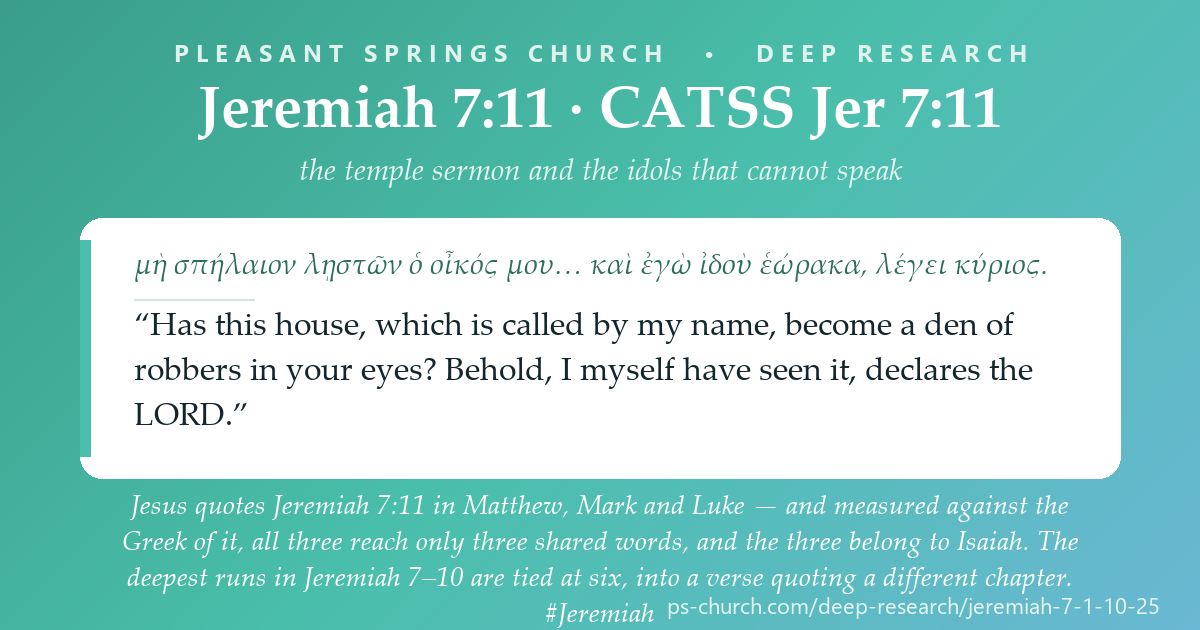
The Greek is where the measurement gets interesting. The two words σπήλαιον λῇστῶν stand in exactly one of the 30,348 Greek Old Testament units screened here — Jeremiah 7:11 — and in exactly three of the 7,927 verses of the Greek New Testament: Matthew 21:13, Mark 11:17 and Luke 19:46. Four verses in the whole Greek Bible. By comparison the noun σπήλαιον on its own occurs fifty-five times in the Greek Old Testament files — mostly the cave of Machpelah in Genesis and David’s hiding places in Samuel — and λῃστ- occurs in fifteen New Testament verses. It is the pairing that is unique, not either word.
Who is the “queen of heaven” of 7:18 — and why does the Greek call her an army?
מְלֶכֶת הַשָּׁמַיִם stands in five verses of the whole Hebrew Bible, always with the preposition — לִמְלֶכֶת הַשָּׁמַיִם — and all five are in Jeremiah: 7:18, 44:17, 44:18, 44:19 and 44:25. The bare consonantal form מלכת stands in thirteen other verses of the Masoretic corpus, and it is not one word in them but several: going at 1 Samuel 30:21 and four more places, you reigned at 2 Samuel 16:8, reigning at 2 Kings 11:3 and 2 Chronicles 22:12, and the queen of Sheba at 1 Kings 10:4 and 10:10 and 2 Chronicles 9:3 and 9:9. The screen reads consonants and not vowels, so those last four are the same four letters as the queen of heaven, pointed differently. Every reference work identifies her with a goddess — Ishtar and Astarte are the usual candidates — and every reference work also notes that the consonants can be pointed as מְלֶאכֶת, the work of heaven, meaning the stars.
The Greek column has taken that second road once and the first road four times, inside one book, and this page can print the count. At Greek Jeremiah 7:18 the phrase is τῇ στρατιᾷ τοῦ οὐρανοῦ, the host of heaven. At Greek Jeremiah 51:17, 51:18, 51:19 and 51:25 — which are Hebrew and ESV 44:17, 44:18, 44:19 and 44:25 — it is τῇ βασιλίσσῃ τοῦ οὐρανοῦ, the queen of heaven. Four to one. The page reports the split. It does not say which is the translator’s first thought and which his second, because the files cannot tell it.
What is Topheth, and is it Gehenna?
הַתֹּפֶת is a place in גֵּיא בֶן־הִנֹּם, the Valley of the Son of Hinnom, on the south side of Jerusalem, where children were burned. The Hebrew name stands in five verses: 2 Kings 23:10, Jeremiah 7:31, 7:32, 19:6 and 19:13.
The Greek column does not render the name; it spells it out. Ταφεθ stands in three verses of the Greek files held here — 2 Kings 23:10, Jeremiah 7:31 and Jeremiah 7:32 (twice in that one verse). At Greek Jeremiah 19:6 the same Hebrew word has become διάπτωσις, a falling to pieces, and the valley itself is πολυάνδριον, a place of many men — a mass grave. One Hebrew word, three Greek treatments, in one book.
And Gehenna is not here. The word γέεννα stands in twelve verses of the Greek New Testament — Matthew 5:22, 5:29, 5:30, 10:28, 18:9, 23:15, 23:33; Mark 9:43, 9:45, 9:47; Luke 12:5; James 3:6 — and in not one of the 30,348 Greek Old Testament units screened here. The valley that gave the word its name is named twice in this passage, and it is named φάραγξ υἱοῦ Ἑννομ both times. The road from this valley to that word runs through literature this page does not hold and did not consult.
What did the world around this text look like, and what can actually be checked from the corpora on this disk rather than asserted from memory?
This stage is where a page is most tempted to repeat what it has read. The rule here is narrow: anything stated as a fact is either measured from a file held locally, or it is flagged as not verifiable from local corpora and left as a question.
Shiloh — why does the sermon go there twice?
7:12 and 7:14 send the crowd to look at Shiloh, where the tent had stood and where the ark was lost. The argument is architectural: God let the first house go, so the presence of a building is not the presence of God.
Measured: Σηλωμ stands twenty-two times across twenty-one rows of the Greek Old Testament files held here (1 Samuel 1:24 carries it twice). Ten of the twenty-two are in 1 Samuel and 1 Kings — the sanctuary and its fall. Six are the personal name Shelah and have nothing to do with the place: five in Genesis 38 and 46, one at 1 Chronicles 4:21. Four are in Jeremiah: 7:12, 7:14, and 33:6 and 33:9 (which are Hebrew and ESV 26:6 and 26:9, where Jeremiah is put on trial for saying this house will be like Shiloh). One is Judges 18:31 and one is Psalm 77:60 (ESV 78:60), he forsook the dwelling at Shiloh.
Not verifiable from local corpora: the archaeology of Khirbet Seilun, the destruction layer and its date. Nothing on this disk speaks to it and this page makes no claim about it.
The cakes of 7:18 — what is χαυῶνας?
It is not a Greek word. It is the Hebrew כַּוָּנִים written in Greek letters and given a Greek accusative plural ending — a transliteration, not a translation. Measured: χαυών stands in exactly two verses of the 30,348 Greek Old Testament units screened here — Jeremiah 7:18 and Jeremiah 51:19 — which are precisely the two verses where the Hebrew has כַּוָּנִים.
Where a text transliterates, it is carrying a word it is not rendering. The domestic detail is the point of the Hebrew line: children fetch the wood, fathers light the fire, women knead the dough. It is a family, working together, on a task. That is what the sermon objects to — not a foreign cult in a corner but a household craft.
Not verifiable from local corpora: what a כַּוָּן looked like. Baked-clay moulds of a female figure are regularly cited in the commentaries; no such artefact is on this disk and this page does not describe one.
Why is one verse of Jeremiah in Aramaic?
Jeremiah 10:11 is Aramaic and the rest of the book is not — the standard identification, which this page has not tested against an Aramaic lexicon. כִּדְנָה תֵּאמְרוּן לְהוֹם — thus you shall say to them — and then a sentence about gods who did not make heaven and earth, in the language a Judean would have used to say it to a Babylonian. The Masoretes fenced it off: it stands alone in a section of its own — between the open marker {פ} that closes 10:10 and the closed marker {ס} that closes 10:11.
Measured on the Hebrew screen it reaches two, tie band one, and the single match is a homograph accident: לא עבדו is Aramaic here for they did not make and Hebrew at Malachi 3:18 for who did not serve him. The screen reads consonants. It does not know what language it is looking at. A page that reported that hit without checking would have printed a parallel that does not exist, and this page prints the near miss on purpose.
Not verifiable from local corpora: whether this line is a proverb, a gloss, a marginal note that migrated into the text, or an Aramaic sentence Jeremiah composed. The Elephantine papyri and the Aramaic of Daniel and Ezra are the comparanda everyone reaches for; the Aramaic sections of Daniel and Ezra ARE on this disk inside the Masoretic file, but no dialect comparison was run and none is claimed here.
What kind of writing is Jeremiah 10:1–16?
It is a satire on manufacture. Every line is about a process: a tree is cut from the forest, a craftsman works it, silver and gold are hammered on, nails and hammers fasten it so it will not totter, blue and purple are put on it, and then somebody has to carry it because it cannot walk.
Measured: the Greek row for 10:5 begins at the Hebrew’s fifth word, so the scarecrow and the clause and they cannot speak are both absent from the Greek line. וְלֹא יְדַבֵּרוּ stands in four verses of the Hebrew Bible — Jeremiah 10:5, Zephaniah 3:13, Psalm 115:5 and Psalm 135:16 — and three of the four are held in both columns. This one is not.
The Greek word for the idols in this chapter is worth a count. εἴδωλον appears in three verses of the whole Greek Jeremiah (9:13, 14:22, 16:19) and in none of chapter 10; γλυπτ-, carved thing, in five (8:19, 10:14, 27:38, 28:17, 28:52); and μάταιος, worthless, in six (2:5, 8:19, 10:3, 10:15, 23:16, 28:18). The satire calls them worthless things and carved things, and almost never idols.
Six words and phrases, each with a count that can be re-run, and each with the place where the two ancient columns part company.
A word study on this shelf is a count over a named corpus, never an impression. Where the Hebrew and the Greek do not carry the same word, both are given and neither is called the right one.
Fourteen occurrences in the Masoretic corpus, and three of the fourteen are inside Jeremiah 7:4. The threefold chant occurs nowhere else in the Hebrew Bible. The CATSS Greek of the verse says ναὸς κυρίου twice, not three times.
The Greek pair σπήλαιον λῇστῶν stands in one Greek Old Testament verse and three New Testament verses — four in the whole Greek Bible. On the Hebrew side, פָּרִצִים spelled this way occurs in four verses, and in three of them it is the place-name Perazim (2 Samuel 5:20, Isaiah 28:21, 1 Chronicles 14:11).
Two verses in the Hebrew Bible, both in Jeremiah: 7:18 and 44:19. The Greek column carries it in Greek letters rather than rendering it. χαυῶνας stands in exactly those two places in the Greek files held here and nowhere else, which makes it one of the clearest transliterations in the Greek Jeremiah.
Fifteen verses in the whole Hebrew Bible. Five of the fifteen are in Jeremiah 8 (8:11, 8:19, 8:21, 8:22, 8:23) and a sixth at 9:6 (ESV 9:7); five more are in Lamentations. The Greek chapter, lacking 8:11, carries four of the five. It is the only tender phrase in four chapters of indictment.
Four verses: Jeremiah 10:5, Zephaniah 3:13, Psalm 115:5, Psalm 135:16. This page takes its name from the clause and then has to report that the Greek column does not carry it here — the CATSS row for 10:5 begins after it.
Exactly two verses in the Hebrew Bible: Jeremiah 9:25 (ESV 9:26) and Ezekiel 44:7. The Greek here is ἀπερίτμητοι καρδίας; Stephen at Acts 7:51 says καρδίαις, dative plural, and the pair therefore measures one.
Which single word carries the most weight in these four chapters?
שֶׁקֶר — a lie. It is the word for the deceptive words of 7:4 and 7:8, for the false swearing of 7:9, for the lying pen of the scribes at 8:8, for the lying tongue of 9:2 and 9:4 (ESV 9:3 and 9:5), and for the metal-worker’s cast image at 10:14, where שֶׁקֶר נִסְכּוֹ means his molten image is a lie.
The Greek scatters it: λόγοις ψευδέσιν at 7:4 and 7:8, ψευδῆ at 9:4 (ESV 9:5) and 10:14, and at 8:8 something else entirely — the Hebrew’s lying pen of the scribes becomes σχοῖνος ψευδὴς γραμματεῦσιν, a false measuring-line for the scribes. A pen in one column, a surveyor’s cord in the other. This page prints both and adjudicates neither.
Every figure below was produced by the same engine: contiguous runs of whole word forms, exhaustive, deterministic, with the tie band beside every run.
The screen finds verbatim contact. It does not find allusion. A run of six with a band of one is a signal; a run of five with a band of four is a formula; and a real quotation can measure one. All three appear below, and the page names which is which.
The finding: the two deepest runs are tied at six, and neither is a quotation of this passage.
Jeremiah 7:32 and Jeremiah 9:24 (ESV 9:25) both reach six consecutive Greek word forms with Hebrews 8:8, tie band one apiece. The six are ἰδοὺ ἡμέραι ἔρχονται λέγει κύριος καί. Band one means neither verse reaches six with any other New Testament verse.
And Hebrews 8:8 is quoting Jeremiah 31:31. In the Greek Jeremiah that verse is numbered 38:31, and it reads ἰδοὺ ἡμέραι ἔρχονται φησὶν κύριος — says in a different verb. Hebrews reads λέγει, so the run against the verse it is actually quoting stops dead at three. Against seven other rows of Greek Jeremiah that read λέγει κύριος καί — 7:32, 9:24, 16:14, 19:6, 23:5, 23:7 and 28:52 — it reaches six.
So the opening clause of the New Testament’s longest Old Testament quotation matches seven verses it is not quoting more closely than the verse it is. And the rest of that quotation is not close at all — it is identical. Hebrews 8:9, 8:10 and 8:11 reach twenty-three, thirteen and twenty-three consecutive word forms with Greek Jeremiah 38:32, 38:33 and 38:34, band one apiece, and those are the three deepest runs in the whole 1,298-row Greek Jeremiah. Only the first line of the quotation drifts, and it drifts onto this page. The page reports the arithmetic and does not say which text acted on which.
The den of robbers: three, and the three are Isaiah’s.
Matthew 21:13, Mark 11:17 and Luke 19:46 each measure THREE against the CATSS Greek of Jeremiah 7:11, and the three words are ὁ οἶκός μου. Those three words are the opening of the Isaiah 56:7 half of the saying: my house shall be called a house of prayer.
The Jeremiah half is σπήλαιον λῇστῶν, two words, and in the Greek Jeremiah those two words stand at the front of the verse while in the gospel sentence they stand at the end. A contiguous run cannot jump the gap between them. The measurement therefore reports the Isaiah phrase and not the Jeremiah phrase, on a quotation of Jeremiah.
This is the clearest case on the shelf of a number failing to see a citation that is obviously there. The right response is not to inflate the number. It is to say what the two words are worth on their own: they occur in four verses of the entire Greek Bible, and three of the four are the Gospels quoting the fourth.
What the four fives in chapter 7 actually are.
Four rows of Jeremiah 7 reach five with Acts 15:17, tie band one each: 7:10, 7:11, 7:14 and 7:30. The five are ἐπικέκληται τὸ ὄνομά μου ἐπί — upon whom my name has been called.
Acts 15:17 is not quoting Jeremiah. It is James at the Jerusalem council quoting Amos 9:12 — and Greek Amos 9:12 carries the same five words. Measured: the phrase stands in five Greek Old Testament verses (Amos 9:12 and those four in Jeremiah 7) and in exactly one New Testament verse. In Hebrew the corresponding נִקְרָא־שְׁמִי עָלָיו stands in six verses, all six in Jeremiah: 7:10, 7:11, 7:14, 7:30, 32:34 and 34:15. The Hebrew phrase is a Jeremiah signature; the Greek phrase is shared with Amos; and the New Testament verse that carries it is reading Amos. Four fives that look like contact with the temple sermon, and are not.
A New Testament contact that exists only in Greek: 7:18 and Acts 7:42.
Jeremiah 7:18 reaches four with Acts 7:42, tie band one — τῇ στρατιᾷ τοῦ οὐρανοῦ, the host of heaven, in Stephen’s speech.
The Hebrew of Jeremiah 7:18 does not say host of heaven. It says queen of heaven. The phrase τῇ στρατιᾷ τοῦ οὐρανοῦ stands in five Greek Old Testament verses — 2 Chronicles 33:3, 33:5, Jeremiah 7:18, Jeremiah 19:13 and Zephaniah 1:5 — and in exactly one New Testament verse, Acts 7:42. Had the Greek Jeremiah here read queen, as the same book does four times in chapter 51, the run would be zero. A run created by a rendering is still a run, and it is still worth printing — but only with the rendering printed beside it.
The Hebrew side: where these chapters are shared, and where they are alone.
Deepest: Jeremiah 7:16 → Jeremiah 11:14, eleven consecutive Hebrew words, tie band one — the ban on intercession, twice. Jeremiah 9:8 (ESV 9:9) → Jeremiah 5:29, ten, band one — nine with the section markers stripped. Jeremiah 10:12 → Jeremiah 51:15, nine, band one. Jeremiah 7:32 → 16:14 and 19:6, nine, band two. Jeremiah 7:1 → 11:1, 18:1, 30:1, eight, band three. Jeremiah 7:34 → 16:9, 25:10, 33:11, eight, band three. Jeremiah 8:11 → 6:14, eight, band one. Jeremiah 8:2 → 25:33, eight, band one. Jeremiah 7:23 → Leviticus 26:12, seven, band one — the covenant formula, and the only run of seven or more in these chapters that leaves the book of Jeremiah.
The doublet at 10:12–16. These five verses stand again at Jeremiah 51:15–19. In Hebrew the five pairs measure nine, six, seven, seven and four. In Greek — where the second member is numbered 28:15–19, not 51:15–19 — the same five pairs measure five, thirteen, nine, three and ten — and the ranking is nearly inverted: the Hebrew’s deepest pair is the Greek’s second shallowest. Two Greek renderings of the same Hebrew, in one book, differing where the Hebrew does not.
Zero. Four verses in these chapters share no two consecutive words with any other verse in the 23,204-unit Masoretic corpus: 8:20, 10:8, 10:17 and 10:20. The Hebrew-side screen runs with the unigram fallback OFF, so 0 means no adjacent pair, not no words. One of the four, 10:8, is also one of the four verses the Greek column does not carry.
The counter-examples this page prints against itself.
Revelation 18:23 and Jeremiah 7:34. Both say the voice of bridegroom and bride. Measured, the pair reaches two. Revelation 18:23’s deepest contact anywhere in the 1,298-row Greek Jeremiah is four, at Jeremiah 9:23 (ESV 9:24), and it is four words of connective tissue. The nearest thing to a real contact is three, at Greek Jeremiah 40:11 (= ESV 33:11).
Revelation 15:4 and Jeremiah 10:7. Revelation asks who shall not fear, Lord? and Jeremiah 10:7 asks who would not fear you, King of the nations? The Greek column has no row for Jeremiah 10:7, so there is nothing to measure. Revelation 15:4’s deepest contact in the whole Greek Jeremiah is four, and it lands on 9:25 (ESV 9:26), a verse about circumcision.
Paul on boasting. 1 Corinthians 1:31 says as it is written and measures two against Greek Jeremiah 9:23 (ESV 9:24). 2 Corinthians 10:17 measures one. 1 Corinthians marks its sentence as a quotation and 2 Corinthians does not; neither is visible to a contiguous-run screen.
Stephen on the uncircumcised heart. Acts 7:51 measures one against Jeremiah 9:25 (ESV 9:26), because Stephen’s καρδίαις is not the Greek Jeremiah’s καρδίας.
And the formula that looks like a link. Jeremiah 10:11 reaches five with Luke 16:17, Acts 4:24, Acts 14:15 and Revelation 14:7 — τὸν οὐρανὸν καὶ τὴν γῆν. Tie band four. Four New Testament verses at the same depth is what a stock phrase looks like on this screen, and it is printed here so that the band-one sixes above are not read as more than they are.
What this page could not check, what it deliberately did not do, and where it is weakest.
This is the section that makes the shelf usable. Everything above is reproducible from files on one disk; that is a strength and a boundary. The boundary is named here in full.
The single largest gap: no manuscript evidence of any kind was consulted.
This passage is one of the places where the textual evidence matters most, and this page has none of it. Seven of the 107 verses are absent from the Greek column, four of them in a ten-verse stretch. The scrolls from Qumran Cave 4 — 4QJera, 4QJerb, 4QJerc, 4QJerd — are the evidence that bears directly on whether a shorter Hebrew Jeremiah existed. None of them was collated. No photograph, transcription or apparatus was opened. Nor was Ziegler’s Göttingen edition of the Greek Jeremiah, nor BHS, nor BHQ.
Everything this page says about the shorter Greek is therefore a report on one digitised file and nothing more. The CATSS files are a transcription of Rahlfs’ Septuaginta. Where this page says the Greek column has no row for 10:7, that is a statement about Jer1.mlxx on this disk. It is not a statement about the Septuagint, about any manuscript, or about what the translator had in front of him.
A claim that was drafted and withdrawn.
The draft of this page said that Jeremiah 10:17 shares no two consecutive words with anything, in either language. That is false and it has been cut.
What is true, and what the page now says: on the Hebrew screen 10:17 reaches 0 against the 23,204-unit Masoretic corpus, and on the Greek screen it reaches 1 with a tie band of 3,300 against the 7,927-verse Greek New Testament — the only one of the ninety-nine rows in this passage that does not reach two there. But screened against the whole 30,348-unit Greek Old Testament it reaches three, tie band one, at Ezekiel 26:11 (τὴν ὑπόστασίν σου). The wider claim was appealing and the narrower one is correct, and the difference is the corpus the screen was pointed at. Every zero and every one on this page carries the corpus it was measured against, for exactly this reason.
What was not consulted, by name.
- Commentaries not opened for this page: Holladay (Hermeneia), Lundbom (Anchor Yale), McKane (ICC), Carroll (OTL), Thompson (NICOT), Craigie, Kelley and Drinkard (WBC), Brueggemann, Fretheim, Allen (OTL), Stulman, Miller (NIB), Jones (NCB), Keown/Scalise/Smothers (WBC).
- On the two editions of Jeremiah: Janzen’s Studies in the Text of Jeremiah, Tov’s work on the two literary editions, Bogaert, Stipp, Piovanelli, Shead. This is the literature that would decide the question this page keeps refusing to answer, and none of it was read for this page.
- On the Greek Jeremiah specifically: Ziegler’s Göttingen Ieremias, Thackeray on the two translators of Greek Jeremiah, Tov’s The Septuagint Translation of Jeremiah and Baruch. The doublet measurement in stage 4 — 10:12–16 against 51:15–19 in both columns — touches that question directly and stops short of it deliberately.
- On Jeremiah 10:11: nothing on the Aramaic of the verse, its dialect, or its relation to the Elephantine corpus was consulted. The verse is reported as Aramaic, fenced by section markers, and measured. Nothing else is claimed about it.
- On the temple sermon and Jeremiah 26: the relation between Jeremiah 7 and Jeremiah 26 — the same sermon and its consequences — is one of the standard questions in the literature. This page measures the Shiloh vocabulary they share and does not discuss the relation.
- Archaeology: Shiloh, the Hinnom valley, the Ketef Hinnom burials. No site report, photograph or excavation record is on this disk.
Method limits inside the measurement itself.
The conflated row. The CATSS file carries Hebrew 7:27 and 7:28 as one row labelled Jer 7:27/28. Every Greek figure for those two verses is therefore a figure for the pair, not for either one, and no separate number exists for them.
Section markers are counted as words. The Masoretic file held here prints {ס} and {פ} inside the verse text, and the frozen normaliser tokenises them — at the end of thirty of this passage’s 107 verses, and of 3,447 verses across the whole Masoretic corpus. Two figures on this page do include a marker, and here is the whole difference. Jeremiah 9:8 (ESV 9:9) against Jeremiah 5:29 reads TEN with the markers counted and NINE with them stripped; Jeremiah 8:23 (ESV 9:1) against Lamentations reads THREE at tie band two with them counted and TWO at tie band fifty-three with them stripped. The screen was run both ways and no other figure on this page changes. normalize.py was not edited.
Runs are word forms, never lemmas. Two forms of the same word do not match. That is why Stephen’s καρδίαις measures one against καρδίας, and why the word order of 1 Corinthians 1:31 holds its run against Jeremiah 9:23 to two. The number is not a judgement about whether a text is being quoted.
The English column was not verified against a held ESV text. There is no ESV file for Jeremiah on this disk and no Crossway API key in this project. The ESV above was typed and its verse alignment rests on verse counts, chapter openings. The Hebrew and Greek columns were pulled programmatically from the corpus files.
Where this page is weakest.
Three places, named plainly.
1. The structure diagram is a Hebrew-side artefact. It is built from one edition’s section markers. The Greek files carry none, so the shape shown is not a shape either ancient reader of the Greek would have seen. And six of the sixteen rungs group two or more scribal sections for legibility.
2. The six-word runs into Hebrews 8:8 are formulaic by construction. ἰδοὺ ἡμέραι ἔρχονται stands in twenty Greek Old Testament verses, thirteen of them in Jeremiah. The band of one is a fact about the New Testament, where the phrase occurs once. It is not evidence that Hebrews had Jeremiah 7 or 9 in view, and the page does not suggest it.
3. The passage is quoted selectively. Sixteen rows out of 107 verses. The rows were chosen because they carry a measurement, which means the chapters’ long stretches of ordinary indictment — most of 8:1–10, most of 9:9–21 — are represented by their screen figures and not by their text. A reader who wants the argument of the sermon should read all four chapters; this page is about what can be counted in them.
Three things worth carrying out of four dark chapters, and one question the measurement cannot close.
The last stage of the method is not a summary. It is the handing over: here is what was found, here is what it does not settle, and the settling is yours.
The building is not the guarantee.
The sermon’s first move is to take a chant away from the people who are chanting it. The temple of the Lord, the temple of the Lord, the temple of the Lord — three times in Hebrew, twice in Greek, and nowhere else in the Bible — and the answer is: go and look at Shiloh.
The argument is not that the building is worthless. It is that the building has a history, and the history includes a time God let it go. What the sermon asks for instead is in 7:5–6, and it is not liturgical: justice between a man and his neighbour, the sojourner, the fatherless and the widow not oppressed, innocent blood not shed.
The gods that have to be carried.
Jeremiah 10 is funny, and it is worth saying so. The tree is cut down, the craftsman works it, the silver and gold go on, and then somebody nails it to the floor so it will not fall over. The joke is in the direction of the verbs: everything is done TO the god, and nothing is done BY it.
Against that stands 10:12–16, and it is the same list of verbs pointed the other way: he made the earth, he established the world, he stretched out the heavens. The measurement of that unit is one of this page’s clean results — those five verses stand again at Jeremiah 51:15–19 at nine, six, seven, seven and four consecutive Hebrew words. Somebody thought it was worth saying twice.
The number is not the connection.
The deepest thing these four chapters do in the Greek New Testament is share six words of a stock formula with a verse that is quoting a different chapter. The most important thing they do — supply Jesus with a phrase for what the temple had become — measures three, and the three belong to Isaiah.
That is not a defect in the tool. It is the tool doing exactly what it does: counting adjacent identical word forms. What it cannot do is recognise a quotation, and this page has been careful to keep the counting and the recognising apart. The numbers above are checkable by anyone with the same files. The reading of them is not, and it is not being smuggled in.
The question this page cannot close.
Why are seven of these 107 verses missing from the Greek, and why are four of the seven inside ten verses of the idol satire?
There are two families of answer — the translator’s Hebrew was shorter, or the translator abridged — and choosing between them requires the Qumran evidence and the critical editions named in stage 5, none of which was consulted. This page can tell you exactly which verses are absent and exactly how the surviving ones are ordered. It cannot tell you why, and it is not going to guess. What it will say is that the absent verses are not random: 10:6, 10:7 and 10:10 are the three lines in the satire that praise the Lord directly, and 10:8 is one of only four verses in these chapters that share no adjacent word-pair with anything in the Hebrew Bible. That is a pattern. Whether it is a meaningful one is the question, and it is open.
Every Deep Research page traces its passage across the whole sweep — the Old Testament, the Second-Temple world between the testaments (historical witnesses, not Scripture), and the New Testament. Follow the thread:
Pleasant Springs Church — Deep Research
Research method after Michael S. Heiser’s Bible Research Method (examine dictionaries → ancient literature → important words → textual connections → academic publications → share), with the Pleasant Springs “Author & Audience” foundation. Scripture set in the Hebrew, the Greek editions named on each page and the ESV (Old Testament), and the Greek New Testament and the ESV (New Testament), per the practice of Pleasant Springs Church. Jeremiah research grounded in the standard commentary tradition — Holladay (Hermeneia), Lundbom (Anchor Yale), McKane (ICC), Carroll (OTL), Thompson (NICOT), Allen (OTL), Brueggemann and Fretheim — and, on the two editions of the book, in Janzen, Tov, Bogaert and Stipp. Stage 5 states plainly that none of it was opened for this page and names what that costs. Text: Hebrew from the Masoretic text as printed in the edition consulted — Sefaria’s Miqra according to the Masorah; no critical apparatus was consulted for the Hebrew and no Dead Sea Scroll was collated, the Cave 4 Jeremiah scrolls included. Greek from Rahlfs’ Septuaginta as digitized by CATSS (Jer1.mlxx and Jer2.mlxx); Greek New Testament from the SBL edition as digitized by MorphGNT. The standing caution for this shelf applies: these pages say “the CATSS Greek text reads…” and never call a Greek reading early or late, and never say which text acted on which. ⚠️ Verse numbering — there IS an offset here and it is one verse wide. Hebrew and CATSS Jeremiah 8:23 is ESV 9:1; Hebrew and CATSS 9:1–25 is ESV 9:2–26. Chapters 7 and 10 agree in all three columns, verse for verse. Every row in the codex prints all three numbers, and every reference in the prose gives both wherever they differ. Beyond this passage the offset is far larger and this page states it rather than using it: the Greek Jeremiah relocates the oracles against the nations, so Hebrew and ESV 31:31–34 is Greek 38:31–34, Hebrew 44:17–25 is Greek 51:17–25, Hebrew 51:15–19 is Greek 28:15–19, Hebrew 26:6–9 is Greek 33:6–9, and Hebrew 33:11 is Greek 40:11. All five of those correspondences are used on this page and all five are printed with both numbers. The correspondences were derived from the files on this disk by python -m dr_tools versify Jeremiah --derive, not copied from a printed table, and versify.py still marks Jeremiah PROVISIONAL, which is the honest label for it. ⚠️ The Greek column runs eight rows short of the Hebrew: 99 against 107. Seven verses are absent from the Greek file — 7:1, 8:11, 8:12, 10:6, 10:7, 10:8 and 10:10 — and 7:27 and 7:28 share one conflated row labelled Jer 7:27/28; Greek 10:9 stands between 10:4 and 10:5. Where a row is absent this page prints the absence in the Greek column and does not estimate what would have been there. ⚠️ The ESV column was NOT verified against a held ESV text. No ESV file for Jeremiah exists on this disk and no Crossway API key exists in this project; the English was typed and its verse alignment rests on verse counts and chapter openings. The Hebrew and Greek columns were pulled programmatically from the corpus files. ⚠️ Every cross-corpus run figure on this page was measured on 31 August 2026 and applies MorphGNT’s own spelling equivalences — οὐ/οὐκ/οὐχ, ἐκ/ἐξ and the movable nu — so that a shared run is not cut at a word the two editions merely spell differently. Figures published on this shelf before 30 August 2026 are lower for that reason; nothing was copied from a sibling page and every number above was re-measured. ⚠️ A run of zero means different things on the two screens. The Hebrew-side screen runs with the unigram fallback OFF, so max = 0 at Jeremiah 8:20, 10:8, 10:17 and 10:20 means those verses share no adjacent word pair with any other verse in the Masoretic corpus — not that they share no words. The Greek-side screen runs with the fallback ON, so the 1 reported for Jeremiah 10:17 against the Greek New Testament means it shares isolated words with 3,300 verses and an adjacent pair with none. ⚠️ The Masoretic text held here counts the scribal section markers as words. {ס} and {פ} stand inside the verse text of the Sefaria file and the frozen normaliser tokenises them — at the end of thirty of this passage’s 107 verses, and of 3,447 verses across the whole Masoretic corpus. Two figures on this page include a marker — the ten at Jeremiah 9:8 and the three at Jeremiah 8:23 — and stage 5 prints both of them with the markers and without. normalize.py is frozen and was not edited. ⚠️ Greek Old Testament figures are scoped to the 64 CATSS files held here, 30,637 verse units, screened to 30,348 with the Odes excluded — the Odes are second copies of passages already in the corpus, and two of them are New Testament text (Ode 9 is Luke 1 and Ode 13 is Luke 2), so screening them would inflate every tie band and manufacture false parallels. ⚠️ One claim was withdrawn while this page was built and it is named in stage 5. Typology is handled per the house position: what the text says, what the New Testament itself draws, and what we see from this side of the cross — with the seeing left to the reader.
Scripture quotations marked ESV are from the ESV® Bible (The Holy Bible, English Standard Version®), © 2001 by Crossway, a publishing ministry of Good News Publishers. ESV Text Edition: 2016. Used by permission. All rights reserved. The ESV text may not be quoted in any publication made available to the public by a Creative Commons license, and the ESV may not be translated in whole or in part into any other language. www.esv.org
|
Did this study bless you today? 💚 Give to Support PS Church100% of gifts go to the General Fund — thank you. |