Five chapters, one hundred and ten verses, and the darkest stretch of an already dark book: a covenant lawsuit, a rotted linen belt, a drought, and two blocks of the most bitter prayer in the Bible. Run the whole thing against the 7,927 verses of the Greek New Testament and the deepest contact is six. Run it against the 23,204 verse units of the Hebrew Bible and two verses reach eleven — and both of them land inside Jeremiah. Jeremiah 11:14 shares eleven consecutive Hebrew words with Jeremiah 7:16, tie band one, and eleven consecutive Greek words with the same verse. Jeremiah 15:20 gives back eight words of Jeremiah 1:19. The four-word phrase pray for this people stands in exactly three verses of the Hebrew Bible and two of them are here. These chapters are where the book turns and quotes itself — and what it keeps repeating is the order to stop praying. Meanwhile the verse everyone brings to this passage, the lamb led to the slaughter at 11:19, shares one word with Isaiah 53:7 in Hebrew and one word with it in Greek. See the method →
Jeremiah 11:1–15:21 — sixteen rows across all five chapters (the chapter and verse numbers agree in the Hebrew, the Greek and the ESV throughout this passage, with one measured exception: there is no Jeremiah 11:7 in the CATSS Greek at all. See the footer.)
Hebrew (Masoretic) · Greek (CATSS/Rahlfs) · ESVnormalize.py was not edited.The Shape of the Passage
Sequence — seven units, with one measured refrain sounding three timesNothing on this page settles how the book of Jeremiah reached the shape it has. That the book grew in stages, that Baruch is named as its scribe at 36:4, and that the Greek edition is about an eighth shorter than the Hebrew and arranges part of it differently, are all real and old questions. What follows reports what the text says about who is speaking and who is listening, and what the two ancient columns measurably do. It stops there.
Author
The passage opens with a superscription and it is a formula. הַדָּבָר אֲשֶׁר הָיָה אֶל־יִרְמְיָהוּ מֵאֵת יְהוָה לֵאמֹר — the word that came to Jeremiah from the Lord — stands word for word in exactly four verses of the Hebrew Bible: Jeremiah 7:1, 11:1, 18:1 and 30:1. All four open a prose sermon. The eight-word run at 11:1 has a tie band of three and every one of the three is in this book.
The speaker changes constantly and the passage does not always say when. 11:1–17 is God speaking through the prophet to Judah. At 11:18 the voice turns and it is Jeremiah speaking to God, and it stays there through 12:4. At 12:5 God answers. At 12:7 God laments in the first person over his own house. Chapter 13 is a narrated sign-act in the prophet’s voice. 14:2–9 is a communal lament in the first person plural — we, not I. 14:11 is God again; 14:13 is the prophet objecting; 15:10 is the prophet crying woe over his own birth; 15:19 is God answering him. About nine changes of speaker in 110 verses, and only about half of them are announced.
What the Greek column adds, and what it does not. The CATSS file gives 109 rows against the Masoretic 110 for these five chapters, and the entire difference is one verse: there is no row numbered Jeremiah 11:7 in the Greek file at all, and the row numbered 11:8 is three words long — καὶ οὐκ ἐποίησαν, and they did not do them — where the Hebrew 11:7 and 11:8 together run to forty-one tokens. The numbering realigns at 11:9 and chapters 12, 13, 14 and 15 hold seventeen, twenty-seven, twenty-two and twenty-one units in both corpora. Whether the shorter Greek reflects a shorter Hebrew or an abbreviating translator is a manuscript question, and no manuscript evidence was consulted for this page.
The Greek is used here as a witness to a second ancient text, never as evidence about who wrote the Hebrew one. On this page the two columns disagree at 11:8, 11:19, 12:1, 12:5, 13:1, 14:4, 15:16 and 15:20. Every one of those is printed above, and none of them is called a correction, a mistake or a change.
Audience
The addressee is Judah, and then it is the prophet, and the switch is the passage. Chapters 11 and 13 address a people: masculine plural imperatives, שִׁמְעוּ, hear. Chapters 12 and 15 address one man: God speaking to Jeremiah in the singular. Chapter 14 does both inside twenty-two verses — a communal we have sinned against you at 14:7 and 14:20, and a private do not pray for the welfare of this people at 14:11.
And the thing being taken away is intercession. This is the measured centre of the page. The four-word sequence pray for this people stands in three verses of the Hebrew Bible and two of them are here. In the world these chapters come from the prophet’s ordinary job description included standing between God and the people: Abraham does it at Genesis 18, Moses at Exodus 32, Amos at Amos 7:2, Samuel at 1 Samuel 12:23 — far be it from me that I should sin against the Lord by ceasing to pray for you. Jeremiah 15:1 names Moses and Samuel by name and says it would not work now.
How it has been carried. 11:19 has been read as a prophecy of Christ since the second century, on the strength of the lamb and of the Greek let us cast wood into his bread. 13:23 — can the Ethiopian change his skin — has had a long and sometimes ugly life in English. 15:16, your words were found and I ate them, is a favourite of preachers on Scripture. What this page adds is only the measurement, and the measurement ranks these three in an order nobody would predict: 11:19 shares one word with Isaiah 53:7, 13:23 measures two in a band of 260, and 15:16 is a verse whose Greek column does not contain the famous clause at all.
Before anything is measured, find out what the words in the passage are already known to mean, and where the reference works leave a question open.
A dictionary gives the range of a word and the consensus about a place. It does not tell you what this text does with either. Stage 1 collects the questions; stages 3 and 4 test them against the files.
What is an אֵזוֹר?
A belt, sash or waistcloth — the standard lexica give a band worn round the loins, and the reference works divide over whether Jeremiah 13 means an undergarment (so the rotting is intimate) or an outer sash of office. The distribution settles less than the debate assumes and more than a dictionary entry shows.
The word stands in fifteen places in the Hebrew Bible, and eight of the fifteen are in Jeremiah 13 — 13:1, 13:2, 13:4, 13:6, 13:7 twice, 13:10 and 13:11. The other seven: 2 Kings 1:8 twice (Elijah, a belt of leather about his waist), Isaiah 5:27, Isaiah 11:5 twice (righteousness shall be the belt of his waist), Ezekiel 23:15 and Job 12:18.
Fifteen is a count of the consonantal form אזור, which is how every count on this page is made. The second of the two at 2 Kings 1:8 is not the noun: it is אָזוּר, girded, the passive participle, spelled with the same consonants. The lexica therefore count the noun אֵזוֹר fourteen times, and eight of those fourteen are still in Jeremiah 13.
So more than half the occurrences of the word are one chapter’s sign-act. The chapter is not using a common object; it is very nearly the reason the word is in the Hebrew Bible at all.
Sword, famine and pestilence — is that a standing formula?
The reference works call it Jeremiah’s triad, and the count is exact. The three-word Hebrew sequence בַּחֶרֶב וּבָרָעָב וּבַדֶּבֶר stands in exactly four verses of the whole Hebrew Bible, and all four are in Jeremiah — 14:12, 21:9, 27:8 and 32:36.
In Greek it is rarer still. ἐν μαχαίρᾳ καὶ ἐν λιμῷ καὶ ἐν θανάτῳ stands in exactly one verse of the 30,348-unit Greek Old Testament screened here, which is Jeremiah 14:12. Its last five words, ἐν λιμῷ καὶ ἐν θανάτῳ, stand in two Greek Old Testament verses (Jeremiah 14:12 and Greek Jeremiah 51:13) and in exactly one verse of the Greek New Testament: Revelation 6:8.
The third item is worth watching across the columns. Hebrew דֶּבֶר is plague; Greek θάνατος is simply death; the ESV usually writes pestilence. The same three-way split recurs at 15:2, and Revelation 6:8 names its rider ὁ θάνατος.
What are כְּלָיוֹת, and why do they get tested?
Kidneys. In Hebrew idiom the kidneys are the seat of the innermost self, the way the heart is the seat of thought and will — so kidneys and heart is a merism for the whole hidden person. English versions render it heart and mind, which gets the sense and loses the anatomy.
The pair is scarcer than the idiom’s fame suggests. כְּלָיוֹת וָלֵב stands in exactly two verses of the Hebrew Bible, Jeremiah 11:20 and Jeremiah 20:12; νεφροὺς καὶ καρδίας stands in exactly the same two verses of the Greek screen; and νεφροὺς καὶ καρδίας stands in exactly one verse of the Greek New Testament, Revelation 2:23. (The two nouns share a verse in six places — Jeremiah 11:20, 17:10 and 20:12, and Psalms 7:10 (= ESV 7:9), 26:2 and 73:21. In three of the six they stand adjacent but reversed or suffixed; in Jeremiah 17:10 they are three words apart. The exact adjacent pair in these forms stands in two verses, and that is what the screen above measures.)
Who were Moses and Samuel to an audience hearing 15:1?
Not simply two great men. They are the two figures the Hebrew Bible shows successfully turning God back from destroying Israel. Moses at Exodus 32:11–14 and Numbers 14:13–20; Samuel at 1 Samuel 7:9 and again at 12:23, where he says that to stop praying for the people would itself be a sin.
The dictionaries will tell you both men are called intercessors. What they do not tell you is what 15:1 does with that: it names the two strongest precedents available and cancels them. The verse is not saying prayer is useless in general. It is saying the two cases everyone would cite would not work here.
Put the passage next to the world it came out of — and be exact about which of those witnesses are on this disk and which are not.
Everything named in this stage as a measurement was run against files held locally. Everything named as background reading was NOT collated here, and is labelled as such where it appears.
A covenant lawsuit was a recognisable genre.
Jeremiah 11 opens the way a treaty document opens: hear the terms, cursed is the man who does not obey, remember the day I brought you out of the iron furnace. The pattern — historical prologue, stipulations, curses for breach — is the pattern of the ancient Near Eastern vassal treaty, and its closest biblical relative is Deuteronomy.
The screen sees the relationship, though not as deeply as the genre argument would suggest. Jeremiah 11:6 shares five consecutive Hebrew words with Deuteronomy 29:8 (= ESV 29:9), tie band one — את דברי הברית הזאת ועשיתם — and 11:2 shares four with the same verse, with 2 Kings 23:3 (the covenant renewal under Josiah) and with Jeremiah 18:11, tie band three. Those are the two measurable Deuteronomic contacts in the whole unit, and neither is deep. The genre similarity is real; it is not a verbatim similarity, and this page does not pretend the screen found it.
The Hittite and Assyrian treaty texts themselves — the Sefire inscriptions, the vassal treaties of Esarhaddon — were NOT read in critical editions for this page. They are named because that is where this argument lives, not as citations for anything above.
A linen belt buried in a riverbank.
The sign-act at 13:1–11 is a piece of prophetic street theatre: buy an expensive linen waistcloth, wear it, bury it in a rock cleft by the river, dig it up later and hold up the rotted thing. Linen is priestly cloth. Water is the one thing the prophet is told to keep it away from, and then it is buried in wet ground.
The word the Greek translator reached for is the interesting part. περίζωμα stands in ten verses of the 30,348-unit screen. Seven are this chapter. One is Genesis 3:7 — they sewed fig leaves together and made themselves περιζώματα. The remaining two are Proverbs 31:24 and Ruth 3:15. That is a fact about a Greek translator’s vocabulary and nothing more; no direction of influence is asserted and none is measurable here.
Drought was a covenant sanction, not just weather.
14:1–6 is one of the most physical passages in the book: cisterns come back empty, the ground is cracked, the doe abandons her newborn because there is no grass, the wild donkeys stand on the bare heights panting like jackals. In Deuteronomy 28:23–24 a sky like bronze is a named consequence of covenant breach, so an audience hearing this would not have heard a weather report.
And the measurement puts one specific drought behind it. Jeremiah 14:4 shares five consecutive Hebrew words with 1 Kings 17:7, tie band one: כי לא היה גשם בארץ, because there was no rain in the land — the verse that dries up the brook Cherith in the Elijah cycle. Which text is prior is not decidable from these files. What is measurable is that the sentence stands in those two verses and in a band of one.
What was NOT consulted.
4QJera, 4QJerb, 4QJerc and 4QJerd were not collated for this page. They are the single most relevant ancient witnesses to the question the footer raises — why the Greek Jeremiah is shorter — because some of them are short like the Greek and some long like the Masoretic text. None of them is on this disk. Any claim here about what “the Hebrew reads” means the Masoretic text as printed in the edition consulted, and nothing more.
Also not consulted: the Targum of Jeremiah, the Peshitta, the Vulgate, the Ziegler Göttingen Jeremiah, any critical apparatus for either language, and the ancient Near Eastern treaty corpus named above. Where this page needed one of those to settle a question, it left the question open and said so.
Six words, each one counted across the corpora held here rather than described.
Every count below is a form-level count over the files named in the footer: the Masoretic corpus (23,204 verse units), the 64 CATSS Greek files (30,637 units, screened to 30,348 with the Odes excluded) and the Greek New Testament (7,927 verses). Forms, never lemmas.
Thirteen verb forms in these 110 verses, and eight of the thirteen are in chapter 11 (11:2, 3, 4, 6, 7, 8, 11, 14). One in chapter 12 (12:17), three in chapter 13 (13:11, 15, 17), one in chapter 14 (14:12) and none at all in chapter 15. The word for listening runs out before the passage does.
Fifteen occurrences in the Hebrew Bible; eight of the fifteen are in Jeremiah 13. Its Greek partner περίζωμα stands in ten verses of the 30,348-unit screen, seven of them the same chapter — and one of the other three is Genesis 3:7.
With לֵב beside it, the pair stands in exactly two verses of the Hebrew Bible: Jeremiah 11:20 and 20:12. The Greek νεφροὺς καὶ καρδίας stands in exactly those two verses of the Greek screen and in exactly one of the Greek New Testament, Revelation 2:23.
The third item of Jeremiah’s triad. The Greek renders it θάνατος, death, and the ESV renders it pestilence; at 15:2 the Hebrew word is מָוֶת, death, and the ESV still writes pestilence. Three columns, three different words, in both verses.
Ten verses of the 30,348-unit Greek screen: Jeremiah 13 seven times, Genesis 3:7, Proverbs 31:24 and Ruth 3:15. It does not occur once in the Greek New Testament.
The verb the Greek Jeremiah puts where the Hebrew has וְאַל־תִּשָּׂא… רִנָּה וּתְפִלָּה, do not lift up a cry and a prayer. The Greek prohibition at 11:14 and at 7:16 is word-for-word identical for eleven words — the same verse pair, and the same depth, as the deepest Hebrew run in the passage. It is not the deepest Greek self-contact here: screened against the rest of CATSS Jeremiah, 11:13 shares thirteen consecutive Greek words with Jeremiah 2:28, tie band one, where the same pair measures six in Hebrew.
The word that runs out.
A verb of the root שָׁמַע stands thirteen times in these five chapters, and the distribution is not flat.
| chapter | verses | shamaʿ verbs |
|---|---|---|
| 11 | 23 | 8 |
| 12 | 17 | 1 |
| 13 | 27 | 3 |
| 14 | 22 | 1 |
| 15 | 21 | 0 |
Chapter 11 is a sermon whose imperative is hear; by chapter 15 the word has gone. Whether that is design or accident cannot be settled by a word count, and this page does not settle it. It reports the distribution and leaves the reading to you.
Counted on the pointed Masoretic text with maqqef treated as a word separator, over verbal forms only. Proper names built from the same consonants — יִשְׁמָעֵאל, שְׁמַעְיָהוּ — do not occur in these five chapters, so no filtering was needed here; they DO occur elsewhere in Jeremiah and would wreck the same count run book-wide. שְׁמוּאֵל, Samuel, at 15:1 does not contain the root.
The measurements. Every run below is a run of whole word FORMS, with its tie band beside it, and every one of them was measured on 31 August 2026.
Two screens. The Hebrew screen runs the passage against the 23,204-unit Masoretic corpus with the unigram fallback OFF, so a reported 0 means no two consecutive words anywhere. The Greek screen runs the CATSS text against all 7,927 verses of the Greek New Testament with the fallback ON, so a reported 1 means isolated shared words and no adjacent pair. The tie band is how many other verses reach the same depth: a band of 1 means the run lands on exactly one verse, a band of 300 means it is a formula.
The whole passage against the Greek New Testament.
109 CATSS rows — Jeremiah 11 to 15 — against 7,927 verses.
| depth | rows |
|---|---|
| 1 | 1 |
| 2 | 28 |
| 3 | 50 |
| 4 | 26 |
| 5 | 3 |
| 6 | 1 |
Nothing reaches seven. For comparison: on the sibling Isaiah page one verse reaches twenty-three. This passage has no spike at all against the New Testament. Its whole distribution sits between one and six.
The four rows that reach five or six:
- Jeremiah 14:12 → Revelation 6:8 — run 6, band 1. καὶ ἐν λιμῷ καὶ ἐν θανάτῳ.
- Jeremiah 13:22 → Romans 10:6 — run 5, band 1. εἴπῃς ἐν τῇ καρδίᾳ σου. See the counter-example below; this one is not what it looks like.
- Jeremiah 15:13 → Matthew 2:16 — run 5, band 1. καὶ ἐν πᾶσιν τοῖς ὁρίοις, and in all the region. A band of one and completely meaningless: Matthew is counting the boundaries of Bethlehem and Jeremiah the borders of Judah.
- Jeremiah 15:3 → Matthew 8:20, Luke 8:5, Luke 9:58 and two more — run 5, band 5. καὶ τὰ πετεινὰ τοῦ οὐρανοῦ, the birds of the air. A formula, printed here so the two band-one fives above are not read as the same kind of thing.
The deepest New Testament contact: Jeremiah 14:12 and the fourth horseman.
Six consecutive Greek word forms. Tie band one.
…ἐν μαχαίρᾳ καὶ ἐν λιμῷ καὶ ἐν θανάτῳ
Jeremiah 14:12, CATSS
…ἀποκτεῖναι ἐν ῥομφαίᾳ καὶ ἐν λιμῷ καὶ ἐν θανάτῳ καὶ ὑπὸ τῶν θηρίων τῆς γῆς
Revelation 6:8, SBLGNT
The run stops one word short of seven for a single reason: the two texts do not use the same word for the sword. The Greek Jeremiah has ἐν μαχαίρᾳ, Revelation has ἐν ῥομφαίᾳ. Everything after that is identical for six words.
Now the counter-example, and it is the one the cross-reference lists would give you. Revelation 6:8’s four judgments — sword, famine, death and the wild beasts of the earth — are usually traced to Ezekiel 14:21, which lists the same four. Measured, Ezekiel 14:21 against Revelation 6:8 is a pair run of ONE: the Greek Ezekiel has ῥομφαίαν καὶ λιμὸν καὶ θηρία πονηρὰ καὶ θάνατον in the accusative and without the repeated ἐν, so not one adjacent pair survives. Jeremiah 15:3, one chapter further on, lists four εἴδη including τὰ θηρία τῆς γῆς and measures two against Revelation 6:8.
What that does and does not license. It does not license “Revelation quotes Jeremiah.” A verbatim screen measures surface, and surface can be produced by a shared idiom, a shared translator’s habit, or a quotation. What it does show is that the standard cross-reference for this verse shares no two adjacent Greek words with it, and a verse hardly anyone lists shares six. The page prints both figures and asserts no direction.
The counter-example that matters most: the lamb led to the slaughter.
This is the part of the page that keeps everything else honest. Jeremiah 11:19 is why many readers open these chapters at all: I was like a gentle lamb led to the slaughter. It is read beside Isaiah 53:7 in nearly every commentary and hymn and lectionary that touches it.
| pair | run | shared |
|---|---|---|
| Jeremiah 11:19 → Isaiah 53:7 (Hebrew) | 1 | יובל |
| Jeremiah 11:19 → Isaiah 53:7 (Greek) | 1 | ὡς |
| Jeremiah 11:19 → Acts 8:32 | 1 | δέ |
| Isaiah 53:7 → Acts 8:32 | 10 | ὡς πρόβατον ἐπὶ σφαγὴν ἤχθη καὶ ὡς ἀμνὸς ἐναντίον τοῦ |
The two lamb verses share one word in Hebrew and one word in Greek. Isaiah has כַּשֶּׂה, one of a flock — a lamb or a kid, not marked for sex — and πρόβατον/ἀμνός; Jeremiah has כְּכֶבֶשׂ אַלּוּף, a tame male lamb, and ἀρνίον ἄκακον. Isaiah is led לַטֶּבַח; Jeremiah לִטְבוֹחַ. Even the words that mean the same thing are different words.
And the Ethiopian eunuch in Acts 8 is reading the passage that measures ten, not the one that measures one. The connection between Jeremiah 11:19 and Isaiah 53 may be entirely real as an image and as a theology. It is not verbatim, and this page will not pretend the screen found it.
A second counter-example: Romans 10:6 does not belong to Jeremiah 13:22.
The table above lists Jeremiah 13:22 → Romans 10:6 at five words with a tie band of one, which on this shelf is normally a signal. Measure the alternatives and the tool itself finds a better candidate one word deeper.
| pair | run | shared |
|---|---|---|
| Deuteronomy 9:4 → Romans 10:6 | 6 | μὴ εἴπῃς ἐν τῇ καρδίᾳ σου |
| Jeremiah 13:22 → Romans 10:6 | 5 | εἴπῃς ἐν τῇ καρδίᾳ σου |
| Deuteronomy 30:12 → Romans 10:6 | 3 | εἰς τὸν οὐρανόν |
The five-word sequence εἴπῃς ἐν τῇ καρδίᾳ σου stands in four verses of the 30,348-unit Greek screen — Deuteronomy 8:17, 9:4, 18:21 and Jeremiah 13:22 — and with the negative in front, μὴ εἴπῃς ἐν τῇ καρδίᾳ σου, in two, both of them Deuteronomy. Paul writes the negative. The Greek Jeremiah writes καὶ ἐὰν εἴπῃς, a conditional.
So a band of one is not automatically a signal. Here it means only that the particular five-word string happens to occur once in Jeremiah, in a passage about skirts lifted over a face, while the six-word string Paul actually wrote occurs twice in Deuteronomy in a passage about not congratulating yourself. The page prints the whole table and draws no conclusion beyond that.
The Hebrew screen, and the finding this page is built on.
110 Masoretic rows against roughly 23,180 non-source verse units each.
| depth | rows |
|---|---|
| 0 | 7 |
| 2 | 36 |
| 3 | 25 |
| 4 | 12 |
| 5 | 15 |
| 6 | 9 |
| 7 | 2 |
| 8 | 2 |
| 11 | 2 |
The four deepest rows in the passage all land inside the book of Jeremiah.
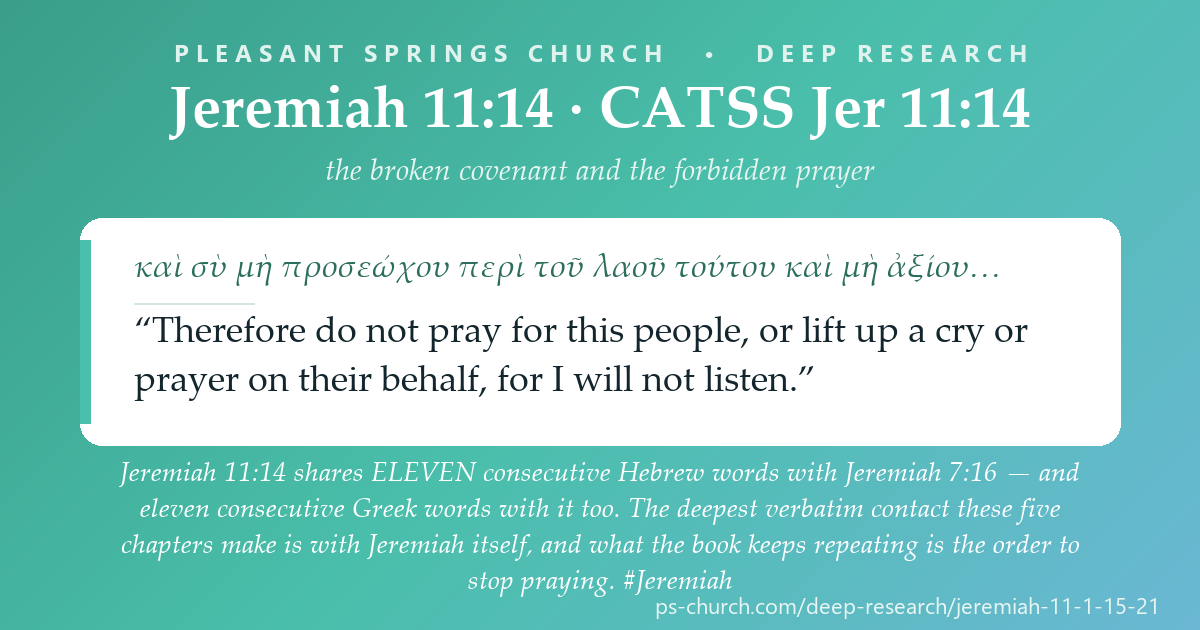
- 11:14 → Jeremiah 7:16 — eleven words, band 1. ואתה אל תתפלל בעד העם הזה ואל תשא בעדם רנה ותפלה. Eleven words in Greek too, against the same verse: καὶ σὺ μὴ προσεύχου περὶ τοῦ λαοῦ τούτου καὶ μὴ ἀξίου. This is the deepest Hebrew run in the passage. In Greek it is not the deepest self-contact: screened against the rest of CATSS Jeremiah, 11:13 shares thirteen consecutive Greek words with Jeremiah 2:28, tie band one, where the same pair measures six in Hebrew.
- 11:20 → Jeremiah 20:12 — eleven tokens, of which ten are words, band 1. כליות ולב אראה נקמתך מהם כי אליך גליתי את ריבי. The eleventh token is the closed-section marker {ס}, which stands inside both verses in the Masoretic file and which the frozen normaliser counts as a word. The page reports ten. In Greek the same pair measures eight.
- 15:20 → Jeremiah 1:19 — eight words, band 1. ונלחמו אליך ולא יוכלו לך כי אתך אני. In Greek the same pair measures ten. The last oracle of the passage gives back the last line of the call narrative.
- 11:1 → Jeremiah 7:1, 18:1 and 30:1 — eight words, band 3. The prose-sermon superscription, and all three other verses are in this book.
And the seven zeros: 11:15, 11:18, 13:22, 13:24, 14:2, 15:12 and 15:21 share no two consecutive words with any verse in the Masoretic corpus outside their own chapter. 11:15 is one of the most textually difficult verses in the book; 11:18 is the first line of the first complaint; 15:21 is the last verse of the passage.
Is the self-quotation unusual? The honest answer is: less than it looks.
A claim was tested here and had to be narrowed. The first draft of this page said that these chapters are unusually self-referential. So the same screen was run over four control passages of similar size, asking a simple question of each row: does its deepest partner sit inside its own book?
| passage | verses | zeros | deepest partner in the same book |
|---|---|---|---|
| Ezekiel 1–5 | 99 | 7 | 73 of 92 — 79.3% |
| Jeremiah 30–33 | 134 | 4 | 101 of 130 — 77.7% |
| Jeremiah 11–15 | 110 | 7 | 75 of 103 — 72.8% |
| Jeremiah 1–5 | 143 | 9 | 92 of 134 — 68.7% |
| Isaiah 1–5 | 115 | 24 | 52 of 91 — 57.1% |
72.8% is high, and it is not distinctive. Ezekiel 1–5 is higher, and so is another part of Jeremiah. Heavy internal repetition is a characteristic of Jeremiah and Ezekiel as books, not of these five chapters in particular, and the sentence that survives the measurement is narrower than the one that was drafted before it.
What IS distinctive is the depth, not the rate. Two rows at eleven with a tie band of one apiece, in a passage whose whole New Testament distribution tops out at six, is a lopsided shape however common self-quotation is in this book.
The negative results.
Jeremiah 12:15 does not measurably touch Acts 15:16. The Greek Jeremiah reads μετὰ τὸ ἐκβαλεῖν με αὐτοὺς ἐπιστρέψω, after I have driven them out I will return, and James at the Jerusalem council opens his citation μετὰ ταῦτα ἀναστρέψω, after this I will return. This verse is a standing cross-reference for that clause. The pair run is one.
Jeremiah 15:12 measures one, in a tie band of 5,335. The whole Greek verse is six words — εἰ γνωσθήσεται σίδηρος καὶ περιβόλαιον χαλκοῦν — and its only New Testament contact is the single word γνωσθήσεται, which stands in thousands of verses in company with something. This is the shallowest row on the page and it is printed so that the six at 14:12 has something to be measured against.
Jeremiah 13:23 — the Ethiopian and the leopard — measures two in a band of 260. The single most quoted line in these five chapters is, on this screen, indistinguishable from noise. A proverb is memorable for what it says. The screen cannot see that at all.
Jeremiah 14 has twenty-two verses — the right number for an acrostic — and it is not one. Screened verse-initial against the twenty-two-letter Hebrew alphabet, four of its twenty-two initials fall on the letter their position would require and eighteen do not; eighteen of the twenty-two letters never appear in the right place at all. Chapter 15, twenty-one verses, matches in three positions and misses in eighteen. Named because Lamentations sits next to Jeremiah on this shelf and Lamentations 5 is exactly this shape — the right number of verses and no acrostic. Nobody has claimed one here; the screen was run so that the negative could be printed rather than assumed.
What the specialists have argued about this passage — and, at length, what this page could not check, did not consult, and is weakest on.
This stage is where the page states its limits. If a claim above is not supported by a file on this disk, it is named here. A page that only lists its findings is not trustworthy.
The live scholarly questions this page does not settle.
Why the Greek Jeremiah is shorter, and what that means. The Greek edition runs roughly an eighth shorter than the Masoretic text and arranges the oracles against the nations in a different place. In this passage the difference is exactly one verse — there is no Greek 11:7 and the Greek 11:8 is three words — and the obvious question is whether the translator abbreviated or whether he was working from a shorter Hebrew. The Qumran Jeremiah scrolls are the evidence that bears on it and they are not on this disk. Nothing on this page decides it.
Where the “confessions of Jeremiah” begin and end, and whether they are one composition. Two of the traditional five or six sit in this passage (11:18–12:6 and 15:10–21) and the delimitation is argued. The structure diagram above follows the Masoretic section markers where they and the subject matter agree; that is a scribal convention, not a compositional argument, and it must not be read as one.
The relationship between chapter 11 and Deuteronomy. Whether Jeremiah 11 reflects Josiah’s reform, whether it is Deuteronomistic editing, or whether the resemblance is generic, is one of the oldest arguments in the field. The screen offers two data points — five words with Deuteronomy 29:8 (= ESV 29:9), four with the same verse and 2 Kings 23:3 — and neither is deep enough to decide anything.
Whether Revelation 6:8 is using Jeremiah 14:12. The six-word run with a band of one is a real measurement. It is not an argument about literary dependence, and this page does not make one.
What was NOT consulted. Named, one by one.
- The Qumran Jeremiah manuscripts (4QJera-d). Not on this disk, not collated. This is the most important single omission on the page, because they bear directly on the one textual question the passage actually raises.
- Any critical apparatus, for either language. No BHS or BHQ, no Ziegler Göttingen Jeremiah. The Greek used here is Rahlfs as digitized by CATSS — a single edition, treated as a witness and never as the Septuagint.
- The Targum of Jeremiah, the Peshitta, the Old Latin and the Vulgate. None held, none consulted.
- Commentaries. None was open while this page was written. The names in the footer describe where the standing research on Jeremiah lives; they are not citations for any sentence above.
- The patristic reading of 11:19. That Justin and Tertullian read the Greek let us cast wood into his bread as the cross is named in a translation note as reception history. No patristic text was read in a critical edition for this page and nothing above rests on it.
- The ancient Near Eastern treaty corpus. Sefire, the vassal treaties of Esarhaddon, the Hittite material. Genuinely relevant to stage 2 and not read here.
- The Odes. Excluded from every Greek screen on this page, which is why the Greek Old Testament figure is 30,348 and not 30,637. Two of the fourteen Odes are New Testament text (Luke 1 and Luke 2) and ten more are second copies of passages already in the corpus; leaving them in would inflate every tie band that touched one.
Where this page is weakest.
1. The ESV column was not verified against a held ESV text. There is no ESV file for Jeremiah on this disk and no Crossway API key in this project. The English above was typed; its verse alignment rests on verse counts and chapter openings. The Hebrew and Greek columns were pulled programmatically from the corpus files and are reliable in a way the English column is not.
2. One reported run includes a scribal marker, and it is the second-deepest number on the page. Jeremiah 11:20 against Jeremiah 20:12 measures eleven tokens, and the eleventh is {ס}, the closed-section marker, which stands inside the verse text of the Sefaria file and which the frozen normaliser tokenises. The page reports ten everywhere it matters and says eleven only where it also says why. The other three deep runs — 11:14, 15:20, 11:1 — were checked and contain no markers. normalize.py is frozen and was not edited.
3. The whole method is form-level. Every run counts identical word FORMS. Jeremiah 11:19 measures one against Isaiah 53:7 partly because לַטֶּבַח is not לִטְבוֹחַ and πρόβατον is not ἀρνίον. On a lemma screen — matching dictionary words rather than inflected forms — that pair would score higher. The form-level screen was chosen because it is unambiguous and reproducible, not because it is a good model of how allusion works. Readers who want the ones on this page to mean “there is no relationship here” are reading them wrongly, and the page says so in three places on purpose.
4. One claim was withdrawn while this page was built. An earlier draft said these five chapters are unusually self-referential. Running four control passages showed that to be false as stated — Ezekiel 1–5 and Jeremiah 30–33 both score higher — and the sentence was replaced with the narrower claim that survived: the rate is ordinary for this book, the DEPTH is not.
5. The pair runs in stage 4 carry no tie bands. A pair run has no band by construction. The Ezekiel 14:21, Acts 8:32 and Deuteronomy 9:4 figures are therefore weaker evidence than the banded screen results and should not be weighed the same.
6. The structure diagram is one edition’s section markers plus a judgement. The thirty-four markers in these five chapters are exactly as the Sefaria Miqra according to the Masorah text prints them; the grouping of thirty-four markers into seven units is this page’s, guided by subject matter. A different grouping is defensible. Nothing in stage 4 depends on the diagram.
Where the standing research on this passage lives.
Named so a reader can go further. None of these was open while this page was written and no sentence above depends on any of them.
- Lundbom, Jeremiah 1–20 (Anchor Yale) — the rhetorical-criticism reading these chapters are usually approached through.
- Holladay, Jeremiah 1 (Hermeneia).
- McKane, Jeremiah I–XXV (ICC).
- Carroll, Jeremiah (Old Testament Library) — the sceptical reading of the confessions.
- Brueggemann, A Commentary on Jeremiah: Exile and Homecoming.
- Tov, The Septuagint Translation of Jeremiah and Baruch, and Ziegler’s Göttingen Ieremias — on the shorter Greek edition.
- Tov and Ulrich in Discoveries in the Judaean Desert XV — the Qumran Jeremiah scrolls, the edition that would settle the question this page had to leave open.
- On Revelation 6 and its Old Testament background: Beale (NIGTC), Aune (WBC).
What the 110 verses turned out to be about, once the numbers were in.
Therefore do not pray for this people, or lift up a cry or prayer on their behalf, for I will not listen when they call to me in the time of their trouble.Jeremiah 11:14
The page did not end up where it started.
It began as a page about the lamb. Jeremiah 11:19 is the reason most readers ever open these chapters, and it is the verse a Christian reader expects to be the deep one. It shares one word with Isaiah 53:7 in Hebrew and one word with it in Greek, and one word with the Acts passage that quotes Isaiah 53:7 at ten.
Then the Hebrew screen ran and pointed the other way. Not outward into the New Testament but backward into Jeremiah: eleven words shared with chapter 7, ten with chapter 20, eight with chapter 1. The deepest verbatim contact this passage makes with anything is with the book it is already in.
And the New Testament’s deepest touch was a verse nobody names. Not the lamb but the triad: sword, famine and pestilence, six consecutive Greek words shared with the fourth horseman, tie band one — while the standard cross-reference for that horseman shares no two adjacent words with it at all.
The one sentence worth carrying away.
These chapters keep repeating one order, and the repetition is measurable. The four-word phrase pray for this people stands in three verses of the Hebrew Bible — 7:16, 11:14, 14:11 — and every one of them forbids it. At 15:1 the same refusal is aimed at Moses and Samuel, the two men the Hebrew Bible shows successfully turning God back from destroying Israel. The book is not describing a God who cannot be moved. It is describing a moment in which the ordinary channel is closed and the prophet is told so three times.
And then the passage ends by giving the prophet his own commission back. 15:20 is eight consecutive Hebrew words of 1:19 and ten consecutive Greek words of it: they will fight against you, but they shall not prevail over you, for I am with you. The man who has just cried woe over his own birth and asked whether God will be to him like a deceitful brook is answered with the sentence he was called with. Nothing new is offered. The first promise is simply repeated.
Where the measurement stops and reading begins.
Everything above the line is countable: eleven, ten, eight, six, one, a band of 260, a band of 5,335. Below the line is a reading, and it is offered as one.
A book whose deepest verbatim contact is with itself is a book that has already said what it has to say and is now saying it again to people who did not hear it the first time. That is what chapter 11 is: chapter 7 again. That is what 15:20 is: chapter 1 again. The prophet is not given new words. He is given the old ones back, and told to stand there.
The count is exact. The reading is yours.
Every Deep Research page traces its passage across the whole sweep — the Old Testament, the Second-Temple world between the testaments (historical witnesses, not Scripture), and the New Testament. Follow the thread:
Pleasant Springs Church — Deep Research
Research method after Michael S. Heiser’s Bible Research Method (examine dictionaries → ancient literature → important words → textual connections → academic publications → share), with the Pleasant Springs “Author & Audience” foundation. Scripture set in the Hebrew, the Greek editions named on each page and the ESV (Old Testament), and the Greek New Testament and the ESV (New Testament), per the practice of Pleasant Springs Church. Jeremiah research grounded in Lundbom (Anchor Yale), Holladay (Hermeneia), McKane (ICC), Carroll (OTL) and Brueggemann; on the shorter Greek edition in Tov and Ziegler; on Revelation 6 in Beale and Aune. Text: Hebrew from the Masoretic text as printed in the edition consulted — Sefaria’s Miqra according to the Masorah; no critical apparatus was consulted for the Hebrew and no Dead Sea Scroll was collated, the Qumran Jeremiah manuscripts included. Greek from Rahlfs’ Septuaginta as digitized by CATSS; Greek New Testament from the SBL edition as digitized by MorphGNT. The standing caution for this shelf applies: these pages say “the CATSS Greek text reads…” and never call a Greek reading early or late, and never say which text acted on which. ⚠️ Verse numbering — and Jeremiah is the hardest book on the shelf for this. The two corpora were aligned by measuring the files on this disk, not by copying a printed table. Within Jeremiah 1–24 the Masoretic and CATSS texts carry the same chapter numbers and disagree on the verse count of exactly six chapters — 2, 7, 8, 10, 11 and 17. From chapter 25 to chapter 52 they disagree on every single chapter, because the Greek edition puts the oracles against the nations in a different place; that region is entirely outside this passage and this page did not derive the mapping for it. This passage sits in the first region and touches one of the six. Masoretic Jeremiah 11–15 holds 23, 17, 27, 22 and 21 verses; the CATSS file holds 22, 17, 27, 22 and 21. The whole difference is that there is no row numbered Jeremiah 11:7 in the Greek file at all, and the row numbered 11:8 is three words — καὶ οὐκ ἐποίησαν — against forty-one Hebrew tokens at 11:7–8 together. The numbering realigns at 11:9, so every reference on this page after that point means the same verse in every column. Three cross-references on this page carry an offset and are printed with it: Greek Jeremiah 51:13 is Masoretic Jeremiah 44:13; and outside Jeremiah, two Hebrew references are numbered Masoretically where the ESV numbers one higher — Deuteronomy 29:8 is ESV 29:9 (the Masoretic Deuteronomy 28 holds sixty-nine verses), and Psalms 7:10 is ESV 7:9 (the Masoretic Psalm 7 counts its superscription as verse 1). ⚠️ The ESV column was NOT verified against a held ESV text. No ESV file for Jeremiah exists on this disk and no Crossway API key exists in this project; the English was typed and its verse alignment rests on verse counts and chapter openings. The Hebrew and Greek columns were pulled programmatically from the corpus files. ⚠️ Every cross-corpus run figure on this page was measured on 31 August 2026 and applies MorphGNT’s own spelling equivalences — οὐ/οὐκ/οὐχ, ἐκ/ἐξ and the movable nu — so that a shared run is not cut at a word the two editions merely spell differently. Figures published on this shelf before 30 August 2026 are lower for that reason; nothing was copied from a sibling page and every number above was re-measured. ⚠️ A run of zero on the Hebrew screen means NO TWO CONSECUTIVE WORDS. The Hebrew-side screen runs with the unigram fallback off, so max = 0 at Jeremiah 11:15, 11:18, 13:22, 13:24, 14:2, 15:12 and 15:21 means those verses share no adjacent word pair with any verse outside their own chapter — not that they share no words. The Greek-side screen runs with the fallback ON, so the 1 reported for Jeremiah 11:19 against Acts 8:32 means they share isolated words and no adjacent pair at all. ⚠️ The Masoretic text held here counts the scribal section markers as words, and on this page one reported run ends on one. {ס} and {פ} stand inside the verse text of the Sefaria file and the frozen normaliser tokenises them. Jeremiah 11:20 against Jeremiah 20:12 measures eleven TOKENS and ten WORDS, because both verses end with {ס}; the page reports ten. The three other deep Hebrew runs — 11:14, 15:20 and 11:1 — were checked and cross no markers. normalize.py is frozen and was not edited. ⚠️ Greek Old Testament figures are scoped to the 64 CATSS files held here, 30,637 verse units, screened to 30,348 with the Odes excluded. Two of the Odes are New Testament text and ten more are second copies of passages already in the corpus, so leaving them in would inflate any tie band that touched one. ⚠️ One claim was withdrawn while this page was built and it is named in stages 4 and 5. Typology is handled per the house position: what the text says, what the New Testament itself draws, and what we see from this side of the cross — with the seeing left to the reader.
Scripture quotations marked ESV are from the ESV® Bible (The Holy Bible, English Standard Version®), © 2001 by Crossway, a publishing ministry of Good News Publishers. ESV Text Edition: 2016. Used by permission. All rights reserved. The ESV text may not be quoted in any publication made available to the public by a Creative Commons license, and the ESV may not be translated in whole or in part into any other language. www.esv.org
|
Did this study bless you today? 💚 Give to Support PS Church100% of gifts go to the General Fund — thank you. |