Five chapters in which a prophet is
mostly not talking. He is forbidden to marry, forbidden to go to a funeral, forbidden to go to a wedding.
He is sent down to a workshop to watch a man turn a spoiled pot back into wet clay. He is sent out to buy
a fired flask, carry it to the rubbish valley below the city, and break it in front of the elders. And he
spends a night bent into a wooden frame in the Benjamin Gate, and comes out of it with a new name for his
gaoler and a curse on the day he was born.
This study measures rather than asserts. Screened against the Greek New Testament, these five chapters
yield two runs of six and nothing deeper — and both of them land on the same verse,
Hebrews 8:8, the sentence that introduces the longest Old Testament quotation in the New
Testament. Hebrews 8:8 is quoting a different chapter — and quoting it
unmistakably: the next four verses of Hebrews match their Jeremiah verses at 23, 13, 23 and 14
consecutive Greek words. The header verse does not. Against the Greek of the verse it
actually introduces, Jeremiah 38:31, it reaches three. Against these two verses it is not
quoting, it reaches six. One Greek word makes the difference, and Stage 3 counts where
that word stands in the whole book: 74 of 78 in one half, 23 of 26 in the other. Along the way: four Hebrew
verses the Greek does not have at all; a Hebrew nickname that binds two verses of chapter 20 together and
is rendered six different ways in Greek; fourteen of the fifteen deepest Hebrew runs staying inside the
book of Jeremiah, and the one that does not; and three counter-examples printed against the page’s
own findings, starting with the one New Testament verse that says the word “Jeremiah” out
loud and measures almost nothing.
See the method →
Jeremiah 16:1–20:18 (selections)
Hebrew · Greek (CATSS / Rahlfs) · ESVEvery row here was chosen by a measurement, not by a theme. 16:14 and 19:6 are the two deepest Greek rows on the page and they are tied. 17:1 is printed because the Greek does not have it. 17:9 and 17:12 are printed because they are zero rows in the Hebrew. 18:6 is printed because the New Testament sentence everyone expects to sit on it does not. 20:10 is printed because it is the one deep Hebrew run in these chapters that leaves the book of Jeremiah. Where the two columns say different things, both are printed and neither is corrected.
The Shape of the Passage
Sequence — four public acts with three private prayers set into themThese five chapters sit in the first half of the book, before the Babylonian armies arrive and while there is still something to be argued about. Behind them stands the call in chapter 1, whose Greek supplies two of the words the passage ends on. In front of them, at 31:31–34, stands the new-covenant oracle that Hebrews quotes at length — and the header of that quotation is what this page’s deepest measurement turns out to touch.
Author
He is a man who is made to perform. In five chapters he is told what he may not do (marry, mourn, feast), sent to watch a craftsman work, sent to buy an object and destroy it in public, and then held overnight in a wooden frame. There is remarkably little preaching here and a great deal of doing. Whatever else the book is, this stretch of it is a record of a body being used as an argument.
And he keeps the record of what it cost. Three times in these chapters the narrative stops and a first-person prayer begins — 17:14–18, 18:18–23, 20:7–13 — and the third of them says to God you have deceived me and I was deceived. The Hebrew verb there, פִּתִּיתַנִי, occurs in that form in exactly one verse of the Hebrew Bible. He did not reach for a stock word.
He also repeats himself, and the measurement can see it. Fifteen verses in these chapters reach six or more consecutive Hebrew words shared with somewhere else, and fourteen of the fifteen land inside the book of Jeremiah — 16:14 with 23:7 at ten words, 19:6 with 7:32 at nine, 20:12 with 11:20 at ten, 18:1 with 7:1, 11:1 and 30:1 at eight. This is a book that says the same sentences more than once, and it does not hide it.
Audience
People who could walk to the sites. The Valley of the Son of Hinnom is a real ravine on the south side of Jerusalem; the Potsherd Gate opened onto it; the potter’s house was a working shop somebody could find. When Jeremiah broke a flask there in front of “the elders of the people and the elders of the priests,” the audience did not need the symbol explained. They needed to be willing to accept it.
People who had a settled answer ready. The reply is printed at 18:12: “That is in vain! We will follow our own plans.” And again at 18:18, where the argument is not that Jeremiah is wrong but that he is unnecessary — the law will not perish from the priest, nor counsel from the wise, nor the word from the prophet. The objection is institutional. We already have channels; you are not one of them.
And later, people reading it in Greek in a very different city. The Greek Jeremiah held here is about an eighth shorter than the Hebrew and orders the book differently; in these five chapters the difference is concentrated in one place, 17:1–4, which the Greek does not have. It also loses, wholly, the Hebrew nickname that ties 20:3 to 20:10. A Greek-reading congregation met a slightly different Jeremiah, and this page prints both without ranking them.
Orient on prophetic sign-acts, on the potter and his wheel, on Topheth and the Valley of Hinnom, on the stocks, and on the group of first-person passages usually called Jeremiah’s confessions.
Search by topic: sign-act (prophetic symbolic action); celibacy in the Old Testament; mourning customs / marzeah; potter, pottery, potter’s wheel (ʾobnayim); clay; Topheth; Hinnom, Valley of; Gehenna; Molech; child sacrifice; Potsherd Gate; stocks (mahpeket); Benjamin Gate; Pashhur; confessions of Jeremiah; Septuagint of Jeremiah; Jeremiah, Book of (text and versions).
Which articles are relevant?
- Anchor Bible Dictionary — “Jeremiah, Book of” (esp. the section on the Greek text), “Prophetic Symbolic Actions,” “Potter, Pottery,” “Hinnom, Valley of,” “Topheth,” “Molech,” “Gehenna,” “Pashhur,” “Stocks.”
- Dictionary of the Old Testament: Prophets (IVP) — “Sign Acts,” “Lament, Laments,” “Confessions of Jeremiah,” “Text and Textual Criticism” (which is where the two editions of Jeremiah are handled).
- The New Interpreter’s Dictionary of the Bible — “Jeremiah, Book of,” §§ on chapters 11–20; “Clay”; “Wheel, Potter’s.”
- Where the dictionaries disagree, and the page says so rather than choosing: whether Jeremiah’s celibacy is literal or a literary device; whether the confessions are Jeremiah’s own words or a later editorial frame; whether the shorter Greek Jeremiah reflects an earlier Hebrew edition or a translator’s abridgement; and whether “Topheth” names a place, an installation, or a rite. None of the four is decidable from any corpus held here.
The one thing to fix before reading further:
The potter’s house is not a lesson about God’s absolute freedom to do whatever he likes. Read 18:7–10 before 18:6. The sign is explicitly two-directional: if God has spoken about uprooting a nation and it turns, he relents; if he has spoken about building a nation and it does evil, he relents from the good. The clay in this chapter answers back, and the text says the answer changes the outcome. That is why 18:12 — “we will follow our own plans” — is the hinge of the chapter, and why the flask of chapter 19, which is bought already fired and broken past mending, is a harder sign than the wet clay of chapter 18. The two sign-acts are deliberately not the same sign.
The potter’s wheel and gods who work in clay; a Hebrew letter from Jeremiah’s own decade complaining that someone is weakening the soldiers’ hands; and what the Second-Temple world remembered about Jeremiah himself.
Ancient texts are witnesses to the world around Scripture. They are never levelled with it. Everything quoted below was read at first hand from the editions named — Pritchard’s ANET for the cuneiform and the Hebrew ostraca, the CATSS Greek files on this disk for Sirach and 2 Maccabees.
Gods who work in clay — checked at first hand:
The image of a deity forming humanity out of clay is older than Israel and was common property across the ancient Near East. Two examples, read from Pritchard:
“Aruru washed her hands, Pinched off clay and cast it on the steppe. [On the step]pe she created valiant Enkidu.”The Epic of Gilgamesh, Tablet I — Pritchard, ANET, p. 74
“Let one god be slain, And let the gods be purified by immersion In his flesh and his blood. Let Nintu mix clay, God and man, Let them together be smeared with clay.”Creation of Man by the Mother Goddess — Pritchard, ANET, pp. 99–100
What Jeremiah 18 does with the image is not what those texts do with it. In the Akkadian material the clay is the raw material of the human race at the beginning. In Jeremiah 18 the clay is a nation already made, already spoiled, and already in the middle of its history — and the point of the sign is that the potter starts over on the same lump. The Hebrew text also declines to leave the potter unaccountable: 18:7–10 makes the reworking conditional on what the clay does. The page reports the parallel and the difference, and does not assert that anyone borrowed from anyone.
A letter from Jeremiah’s own decade — checked at first hand:
The Lachish Ostraca are twenty-one inscribed potsherds — the first eighteen found in the burnt guardroom of the Lachish gate in 1935, three more added in 1938 — dated by Pritchard’s editors to “immediately before the beginning of the Chaldean siege of Lachish, perhaps in the autumn of 589 (or 588) B.C.” They are, in that edition’s words, “the only known corpus of documents in classical Hebrew prose.” Ostracon VI is an officer’s complaint about letters coming out of Jerusalem:
“And behold the words of the pr[inces] are not good, (but) to weaken our hands [and to sla]cken the hands of the m[en] who are informed about them [ … And now] my lord, wilt thou not write to them, saying, ‘Why do ye thus [even] in Jerusalem?’”Lachish Ostracon VI — Pritchard, ANET, p. 322
That is the charge of Jeremiah 18:18 in the mouth of somebody who is not in the Bible. An officer in the field, in the last months before the siege, is asking headquarters to shut somebody up because his words are weakening the soldiers’ hands. The page does not claim the ostracon is about Jeremiah. It does not name him; the same volume’s Ostracon III mentions an unnamed “prophet” and a Coniah son of Elnathan going down to Egypt, and the identifications are contested. What the ostracon establishes is the social fact: in Jerusalem in that decade, saying the wrong thing in public was a military problem, and the people whose hands were being weakened wrote letters about it.
What the Second-Temple world remembered about Jeremiah:
Two witnesses, both read at first hand from the Greek files on this disk, and both historical witnesses rather than Scripture on the Pleasant Springs canon.
Ben Sira, about 180 BC, in his roll-call of Israel’s ancestors, does not praise Jeremiah for his oracles. He praises him for what was done to him: ἐν χειρὶ Ιερεμιου · ἐκάκωσαν γὰρ αὐτόν, καὶ αὐτὸς ἐν μήτρᾳ ἡγιάσθη προφήτης — “by the hand of Jeremiah — for they mistreated him, and he himself was consecrated a prophet in the womb” (Sirach 49:7). Ben Sira is compressing Jeremiah 1:5 — and the verbatim contact between his sentence and the Greek of Jeremiah 1:5 measures one word. A writer can know a text intimately and share almost nothing measurable with it. This page prints that number precisely because it limits what its own six-word runs are allowed to prove.
2 Maccabees makes him a figure in a dream on the eve of a battle. Onias points him out to Judas: Ιερεμιας ὁ τοῦ θεοῦ προφήτης, “Jeremiah, the prophet of God” — “the one who prays much for the people and for the holy city” (2 Maccabees 15:14), and he hands Judas a golden sword. Four centuries after the stocks, the man whose prayers in chapter 20 are the bitterest in the Old Testament is remembered chiefly as an intercessor.
What the stocks were:
The Hebrew מַהְפֶּכֶת at 20:2 is from the root “to twist, overturn”; the usual reconstruction is a wooden frame that held the neck and limbs in a bent position, so that the punishment is not confinement but sustained distortion of the body. The Greek renders it something else entirely: καταρράκτης, which in ordinary Greek means a portcullis, a trapdoor, or a waterfall — here evidently an underground cell. Neither reconstruction can be checked against an object from a corpus held here, and the page says so rather than picking the more vivid one.
Six words and phrases, each with a number attached, and each number produced by an exhaustive search rather than a lexicon entry.
Counts on the Hebrew side are exhaustive over the 23,204 verse units of the Masoretic corpus held here, on consonantal word forms with the qere read. Counts on the Greek side are exhaustive over 30,348 verse units — the 30,637 units of the 64 CATSS files on disk, less the Odes — and over all 7,927 verses of the Greek New Testament.
168 occurrences in Masoretic Jeremiah, spread over 38 of its 52 chapters — eight of them in these five. One Hebrew formula carries the whole book. The Greek does not. See the count below.
Three verses in the Hebrew Bible — 1 Kings 14:3, Jeremiah 19:1 and 19:10. The Greek word that answers it, βῖκος, stands in two of the 30,348 Greek Old Testament verse units screened and in none of the 7,927 Greek New Testament verses. A rare object, rendered by a rare word.
Six verses in the Hebrew Bible: Jeremiah 6:25, 20:3, 20:10, 46:5, 49:29 — and Psalm 31:14. Five of the six are Jeremiah’s. What the Greek does with it is the surprise: see below.
In that exact form, one verse in the Hebrew Bible: Jeremiah 20:7. The root is used of seducing a girl (Exodus 22:16) and of luring a man to his death (Judges 16:5). The Greek renders it ἠπάτησάς με, “you deceived me,” and does not soften it.
17 occurrences in the Greek Old Testament files held here, four of them inside five verses of Jeremiah 18 (vv. 2, 3 and 6 twice). Three occurrences in the Greek New Testament: Matthew 27:7, Matthew 27:10 and Romans 9:21. Stage 4 measures what that does and does not amount to.
One occurrence in the 30,348 Greek Old Testament verse units screened: Jeremiah 20:3, where it is the name the Greek gives Pashhur. The word-family is not rare in the New Testament — μετοικεσία stands four times in Matthew 1, for the deportation to Babylon.
The count this page turns on: how Greek Jeremiah says “says the Lord”
The Hebrew of Jeremiah has one postpositive formula, נְאֻם־יְהוָה, and uses it 168 times across the book. The Greek held here has two, and it does not mix them. Counted exhaustively over the CATSS Jeremiah files on this disk:
| Greek formula | total | chapters 1–29 | chapters 30–52 |
|---|---|---|---|
| λέγει κύριος (postpositive) | 78 | 74 | 4 |
| τάδε / οὕτως λέγει κύριος | 69 | 66 | 3 |
| φησὶν κύριος | 26 | 3 | 23 |
Ninety-five per cent of the postpositive λέγει κύριος stands before Greek chapter 30; eighty-eight per cent of φησὶν κύριος stands after it. Jeremiah 16–20 is deep inside the first zone: seven postpositive λέγει κύριος, ten τάδε λέγει κύριος, and no φησὶν κύριος at all.
What this page claims and what it does not. It claims the distribution, which is a count. Scholarship has a standing explanation for it — that Greek Jeremiah is the work of two hands, or of one hand revised, with a seam near the middle of the book — and this page neither endorses nor rejects it, because the corpora held here cannot distinguish two translators from one translator who changed his habit from a later reviser who touched half a book. The count is the finding. The explanation is somebody else’s work.
Six occurrences, six different Greek phrases
מָגוֹר מִסָּבִיב is Jeremiah’s own phrase — five of its six occurrences are his — and it is what he renames Pashhur in 20:3 and what he hears the whisperers saying in 20:10. In the Hebrew that repetition is the joke and the wound at once. In the Greek held here it disappears, because no two of the six are rendered the same way:
| Hebrew reference | Greek reference | rendering |
|---|---|---|
| Jeremiah 6:25 | Jer 6:25 | παροικεῖ κυκλόθεν — dwells round about |
| Jeremiah 20:3 | Jer 20:3 | μέτοικον — an exile (no “round about” at all) |
| Jeremiah 20:10 | Jer 20:10 | συναθροιζομένων κυκλόθεν — of those gathering round about |
| Jeremiah 46:5 | Jer 26:5 | περιεχόμενοι κυκλόθεν — hemmed in round about |
| Jeremiah 49:29 | Jer 30:24 | ἀπώλειαν κυκλόθεν — destruction round about |
| Psalm 31:14 | Ps 30:14 | παροικούντων κυκλόθεν — of those sojourning round about |
Two of the six share a verb-root (παροικ-); no two share a phrase. The consequence is measurable. In Hebrew, Jeremiah 20:10 and Psalm 31:14 share six consecutive words. In Greek, Jeremiah 20:10 and Psalm 30:14 share four — ὅτι ἤκουσα ψόγον πολλῶν — and the terror-phrase itself is not among them. A reader of the Greek Jeremiah has no way of hearing Pashhur’s new name in the mouths of the whisperers seven verses later. The page does not say the translator was wrong; it says the two texts do different things, and prints both.
One more count, because it runs through the whole passage:
The potter word יוֹצֵר stands nine times in Jeremiah 18–19 — 18:2, 18:3, 18:4 twice, 18:6 twice, 18:11, 19:1 and 19:11. The seventh of those nine is not a potter. At 18:11 it is God: “Behold, I am shaping disaster against you” — the participle of the same verb. The Greek keeps the link exactly: πλάσσω appears six times in Greek Jeremiah, and three of the six are the call (“before I formed you,” 1:5), the potter’s house (“I am moulding evil,” 18:11) and the flask (“a moulded earthen flask,” 19:1). The man who was formed in the womb is sent to buy something moulded and break it.
Two screens, run on this disk this week, with every run reported beside its tie band — and three counter-examples printed against the page’s own findings.
Runs are contiguous whole word forms, never lemmas and never roots. The Hebrew screen ran each of the 104 Masoretic verses of Jeremiah 16–20 against every other verse of the 23,204-unit corpus, minus its own chapter. The Greek screen ran each of the 100 CATSS verse units of Jeremiah 16–20 against all 7,927 verses of the SBLGNT, with MorphGNT’s own spelling equivalences applied (ou / ouk / ouch, ek / ex, the movable nu). Figures here are higher than any run figure published on this shelf before 30 August 2026 and were re-measured, not copied.
The Greek screen: where the depth actually is
Across the 100 CATSS rows against 7,927 New Testament verses: 99 reach two, 79 reach three, 30 reach four, 6 reach five, 2 reach six, and nothing reaches seven. The whole top of the table is short:
| row | run | tie band | New Testament verse | shared words |
|---|---|---|---|---|
| Jeremiah 16:14 | 6 | 1 | Hebrews 8:8 | ἰδοὺ ἡμέραι ἔρχονται λέγει κύριος καί |
| Jeremiah 19:6 | 6 | 1 | Hebrews 8:8 | ἰδοὺ ἡμέραι ἔρχονται λέγει κύριος καί |
| Jeremiah 17:21 | 5 | 1 | Luke 4:16 | ἐν τῇ ἡμέρᾳ τῶν σαββάτων |
| Jeremiah 17:22 | 5 | 1 | Luke 4:16 | ἐν τῇ ἡμέρᾳ τῶν σαββάτων |
| Jeremiah 17:24 | 5 | 1 | Luke 4:16 | ἐν τῇ ἡμέρᾳ τῶν σαββάτων |
| Jeremiah 17:27 | 5 | 1 | Luke 4:16 | ἐν τῇ ἡμέρᾳ τῶν σαββάτων |
| Jeremiah 17:12 | 1 | 401 | — | ἡμῶν (the shallowest row on the page) |
Take the four fives off the table first. “On the sabbath day” is a formula: it stands in seven verse units of the Greek Old Testament screened here — 1 Maccabees 2:32, Ezekiel 46:4 and 46:12, and these four verses of Jeremiah 17 — and in exactly one verse of the Greek New Testament, Luke 4:16, where Jesus goes into the Nazareth synagogue. It is a beautiful coincidence and it is a coincidence. Jeremiah 17:19–27 is a sabbath oracle; Luke 4:16 is a sabbath narrative; both use the ordinary Greek phrase for “on the sabbath day.” Nothing follows from it and the page claims nothing from it.
The finding: two runs of six that lead somewhere else
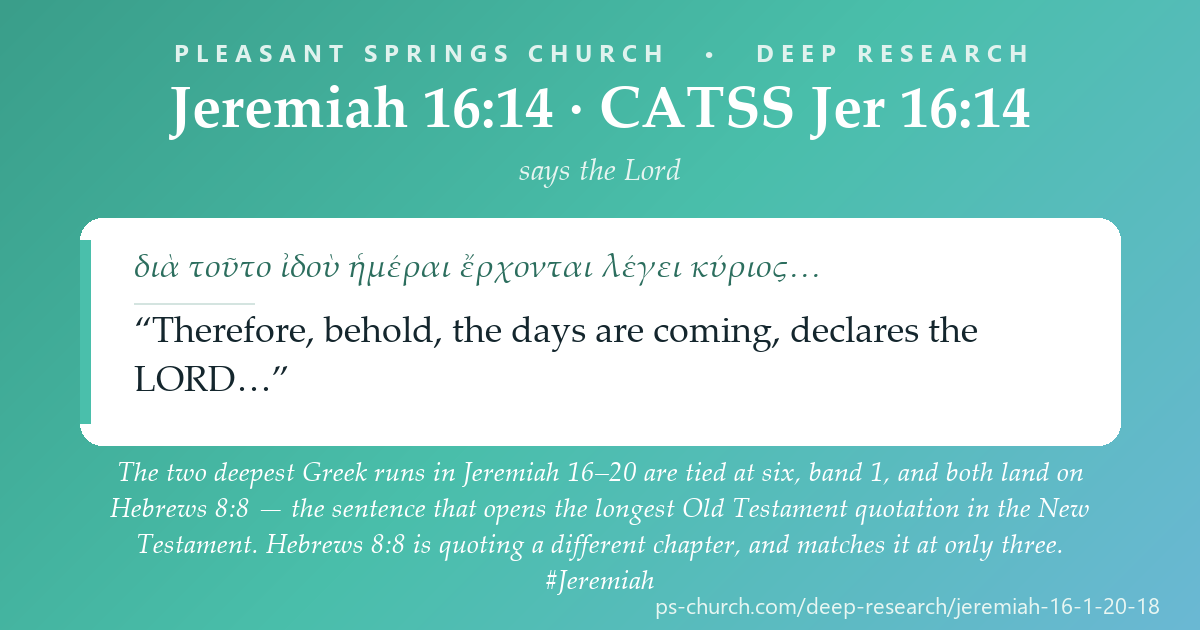
Hebrews 8:8 is not an ordinary New Testament verse. It is the sentence that introduces the longest Old Testament quotation anywhere in the New Testament — the new covenant oracle of Jeremiah 31:31–34, which is Jeremiah 38:31–34 in the Greek numbering, and which this shelf studies on its own page at Jeremiah 31:31–34. Hebrews quotes it at length and names it as a quotation. And the quotation is not in doubt. Measured verse by verse against the Greek Jeremiah held here:
| Hebrews | Greek Jeremiah | run |
|---|---|---|
| Hebrews 8:8 | Jeremiah 38:31 | 3 |
| Hebrews 8:9 | Jeremiah 38:32 | 23 |
| Hebrews 8:10 | Jeremiah 38:33 | 13 |
| Hebrews 8:11 | Jeremiah 38:34 | 23 |
| Hebrews 8:12 | Jeremiah 38:34 | 14 |
Twenty-three consecutive words twice over. Nobody could look at those figures and wonder whether Hebrews is quoting Jeremiah. And that is exactly what makes the first row strange. Every verse of the quotation matches its Jeremiah verse at thirteen words or more — except the opening one, which matches at three. So the interesting question is not whether Hebrews 8:8 touches Jeremiah. It is which Jeremiah verse it touches most:
| compared with Hebrews 8:8 | run | shared words |
|---|---|---|
| Greek Jeremiah 38:31 — the verse Hebrews is quoting | 3 | ἰδοὺ ἡμέραι ἔρχονται |
| Greek Jeremiah 16:14 — which Hebrews is not quoting | 6 | ἰδοὺ ἡμέραι ἔρχονται λέγει κύριος καί |
| Greek Jeremiah 19:6 — which Hebrews is not quoting | 6 | ἰδοὺ ἡμέραι ἔρχονται λέγει κύριος καί |
The verse being quoted matches at half the depth of two verses that are not — and at one-eighth the depth of the verse immediately after it. And the reason is one word. In the CATSS text of Rahlfs’s Septuaginta, Jeremiah 38:31 reads ἰδοὺ ἡμέραι ἔρχονται φησὶν κύριος. Jeremiah 16:14 and 19:6 read ἰδοὺ ἡμέραι ἔρχονται λέγει κύριος. Hebrews 8:8 reads λέγει. Hebrews agrees with the half of Greek Jeremiah it is not quoting, and differs by one word from the half it is.
What this page will not say. It will not say that Hebrews had a different Greek Jeremiah, or that Rahlfs’s text is wrong here, or that the author of Hebrews smoothed the formula, or that the two Greek halves prove two translators. Each of those is a claim about history that a word count cannot reach, and Stage 5 lists the editions and manuscripts that would be needed and are not held. It will least of all say that Hebrews has cited the wrong chapter. Hebrews 8:9 and 8:11 reproduce their Jeremiah verses at twenty-three consecutive words each; the identification is beyond argument, and the one-word difference falls in the header formula, which is the part of any quotation most likely to be given in a writer’s own habitual wording. What the page says is the measurement: on the Greek text held here, the deepest verbatim contact between Jeremiah 16–20 and the New Testament is a six-word formula, tie band 1 on the New Testament side, standing in a sentence whose declared subject is a different chapter of the same book.
And the formula is a formula. Those six Greek words occur in ten of the 30,348 Greek Old Testament verse units screened — Amos 8:11, Amos 9:13, Isaiah 39:6, and seven verses of Jeremiah (7:32, 9:24, 16:14, 19:6, 23:5, 23:7, 28:52). On the Old Testament side it is common; on the New Testament side ἰδοὺ ἡμέραι ἔρχονται stands in exactly one verse. Both numbers belong on the page and neither is allowed to hide the other.
The Hebrew screen: a book that quotes itself
Across the 104 Masoretic rows: 3 are zero rows, 34 stop at two, 28 at three, 14 at four, 10 at five, 4 at six, 4 at seven, 4 at eight, and one each at nine, ten and eleven. The fifteen rows that reach six or more are these:
| row | run | band | matches |
|---|---|---|---|
| Jeremiah 20:12 | 11 (10 — see below) | 1 | Jeremiah 11:20 |
| Jeremiah 16:14 | 10 | 1 | Jeremiah 23:7 |
| Jeremiah 19:6 | 9 | 1 | Jeremiah 7:32 |
| Jeremiah 16:9 | 8 | 3 | Jeremiah 7:34, 25:10, 33:11 |
| Jeremiah 16:15 | 8 | 1 | Jeremiah 23:7 |
| Jeremiah 18:1 | 8 | 3 | Jeremiah 7:1, 11:1, 30:1 |
| Jeremiah 19:15 | 8 | 1 | Jeremiah 39:16 |
| Jeremiah 16:4 | 7 | 3 | Jeremiah 8:2, 25:33, 34:20 |
| Jeremiah 17:23 | 7 | 1 | Jeremiah 7:26 |
| Jeremiah 19:3 | 7 | 6 | Jeremiah 9:14, 16:9, 39:16, 43:10, 44:11, 50:18 |
| Jeremiah 19:8 | 7 | 1 | Jeremiah 49:17 |
| Jeremiah 19:4 | 6 | 1 | Jeremiah 44:3 |
| Jeremiah 19:7 | 6 | 2 | Jeremiah 16:4, 34:20 |
| Jeremiah 19:11 | 6 | 2 | Jeremiah 25:28, 43:10 |
| Jeremiah 20:10 | 6 | 1 | Psalm 31:14 — the only match outside Jeremiah |
Fourteen of fifteen stay inside the book. Every tied partner of every row above, including the six partners of 19:3 and the three of 16:9, is a verse of Jeremiah — except the last row. Jeremiah 20:10 and Psalm 31:14 share six consecutive consonantal words, tie band 1: nothing else in the Hebrew Bible carries that sequence. The page reports the contact and declines to say which way it runs, whether either writer knew the other, or whether both were using something already current. It notes only what is on the page: the phrase is Jeremiah’s five times over and the psalm’s once, and in the Greek the link is not there to be heard.
⚠️ One number on that table is inflated and the page will not quietly take the better version. The Hebrew normaliser used here treats the Masoretic section markers ס and פ as word tokens. Jeremiah 20:12 and Jeremiah 11:20 both end with the same clause and the same section marker, so the screen counts eleven. The honest figure is ten — the same depth as 16:14 — and the tie band is 1 either way. Both figures are printed here; the table above says eleven because that is what the tool returned, and this paragraph says ten because that is what the text has.
Three counter-examples, printed against this page’s own findings
1. Matthew 27:9 names Jeremiah, and the measurement finds almost nothing. “Then was fulfilled what had been spoken by the prophet Jeremiah” — and what follows is thirty pieces of silver and a potter’s field. Chapters 18, 19 and 32 of Jeremiah are the chapters with potters and fields in them. Screened against Matthew 27:9 and 27:10, no verse of Greek Jeremiah 18 or 19, nor of Greek Jeremiah 39 — the Greek numbering of Masoretic 32 — reaches even three consecutive words. Zechariah 11:13, the verse commentators usually point to instead, reaches two with Matthew 27:9 (καὶ ἔλαβον) and two with 27:10 (εἰς τόν). The only lexical thread is κεραμεύς, and that word stands in fourteen Greek Old Testament verses (seventeen occurrences) of the 30,348 screened. The one place in the New Testament that says the word ‘Jeremiah’ over a quotation is the place where this method measures least. That is a real limit of the method and the page prints it at full strength.
2. Romans 9:21 is not sitting on Jeremiah 18:6. “Has the potter no right over the clay?” is the sentence every reader expects to find anchored in the potter’s house. Measured: Romans 9:21 against Jeremiah 18:6 — two words (ὁ κεραμεύς). Romans 9:20, the sentence immediately before it, against Isaiah 29:16 — six words (μὴ ἐρεῖ τὸ πλάσμα τῷ πλάσαντι). The verbatim contact in that paragraph of Romans is with Isaiah, not with Jeremiah. An image can be shared without a text being quoted, and this page’s method cannot see the difference — so it says so.
3. The three zero rows are exactly average. Jeremiah 17:9, 17:12 and 18:22 share no two consecutive words with any other verse in the Hebrew Bible. That is 3 rows out of 104, or 2.9%. Screened chapter by chapter across the whole book, Jeremiah has 41 zero rows out of 1,364 verses — 3.0%. These five chapters are not unusually original; they are precisely as original as the rest of Jeremiah, and a page that printed “three verses unique in the whole Hebrew Bible” without that baseline would be selling the reader a number.
Where to go next, what this page could not check, and where it is weakest.
Consult the technical literature last, so that it corrects the reading rather than supplying it. This section is also where the page states its own limits, because a shelf that only reports what it found is not trustworthy.
Where the real work on this passage is:
- Commentaries. William Holladay, Jeremiah 1 (Hermeneia, 1986) — the standard technical treatment of chapters 1–25. William McKane, Jeremiah I–XXV (ICC, 1986) — the most cautious on the Greek. Jack Lundbom, Jeremiah 1–20 (Anchor Yale, 1999) — the fullest on the rhetoric of exactly this stretch. Leslie Allen, Jeremiah (OTL, 2008). Georg Fischer, Jeremia 1–25 (HThKAT, 2005), which argues the opposite of the usual line on the Greek.
- On the two editions of Jeremiah. H. St J. Thackeray’s 1903 article proposing a seam in the Greek book; Emanuel Tov, The Septuagint Translation of Jeremiah and Baruch (1976), and his Textual Criticism of the Hebrew Bible; Hermann-Josef Stipp on the Masoretic Sondergut; Albert Pietersma and Marc Saunders in NETS. The count in Stage 3 is offered as data these works interpret, not as a verdict on them.
- Ancient Near Eastern comparisons. James Pritchard, ANET (3rd ed.) — the Gilgamesh and mother-goddess passages at pp. 74 and 99–100 and the Lachish Ostraca at pp. 321–322 were read at first hand from that volume for this page.
- Topheth and the valley. The archaeological and epigraphic literature on the Hinnom valley, including the Ketef Hinnom silver amulets, which are seventh-century and come from that valley. They were not examined for this page and nothing here rests on them.
What this page could not check — stated plainly
No Qumran text is held here, and that is the single most important gap. The decisive witnesses for the shorter Greek Jeremiah are the Hebrew scrolls 4QJerb and 4QJerd, which are reported to preserve a short Hebrew text agreeing with the Greek against the Masoretic Text. The page prints Jeremiah 17:1 with an empty Greek column and cannot say whether a Hebrew manuscript ever lacked those four verses. Anyone wanting that answer must go to the Qumran editions; this page has not.
The Greek here is Rahlfs, not Ziegler. Every Greek figure on this page is a figure about the CATSS digitisation of Rahlfs’s Septuaginta. No Göttingen apparatus is held, so no variant is known to this page and nothing is claimed from one. In particular, the φησίν at Jeremiah 38:31 that carries the whole central finding is Rahlfs’s reading, and the page’s central measurement would have to be re-run against Ziegler before anyone built anything on it.
The Greek New Testament here is the SBLGNT via MorphGNT. The λέγει in Hebrews 8:8 is that edition’s text. No New Testament apparatus was consulted.
The seam is a distribution, not a history. Stage 3 counts where λέγει κύριος and φησὶν κύριος stand. It cannot distinguish two translators from one translator whose habit changed, from a reviser who worked over part of the book, from a Greek text assembled from two scrolls. The page does not choose, and a reader who leaves it believing ‘two translators’ has read more than is written.
No Akkadian or Hebrew epigraphic corpus is held. The Gilgamesh, mother-goddess and Lachish passages in Stage 2 were read in Pritchard’s English translations, not in the original languages, and were not screened against anything. The Lachish comparison is a historical observation, not a measurement, and the ostracon does not name Jeremiah.
No commentary was consulted at first hand. The works listed above are named as where a reader should go. No claim on this page rests on any of them.
The ESV column was typed from the printed 2016 text edition, because no ESV API key has ever been issued to this site. Any transcription error is ours.
Matthew 27:9 is not solved here. The page measures the contact and reports that it is negligible. Why Matthew names Jeremiah is a question this method cannot answer and this page does not pretend to.
Where the page is weakest. The Hebrews 8:8 finding is a finding about editions, and editions can move. If Ziegler reads λέγει at Jeremiah 38:31, the surprise shrinks to nothing and only the formula count survives. That is the sentence a critic should press first, and the page would rather write it itself.
A man who was the sermon, a pot that could be remade and a flask that could not, and a prayer that does not get an answer.
Name what you learned, why it matters, and one concrete response.
What should we carry away — and do?
- The wet clay and the fired flask are two different signs, and the order matters. Chapter 18 is a lump still on the wheel: spoiled, and remade on the spot, with 18:7–10 saying outright that God relents when a nation turns. Chapter 19 is a flask already fired, bought finished, and smashed “so that it can never be mended.” Between the two chapters stands 18:12: ‘We will follow our own plans.’ The text puts the hardening between the two signs, not before them.
- The objection to Jeremiah was not that he was wrong. It was 18:18 — we have priests for instruction, wise men for counsel, prophets for the word; we are covered. The most effective way to ignore a message is to point at the institution that should have delivered it. That is a live temptation in any church with a working structure.
- Chapter 20 is in the Bible. A prophet says to God you enticed me and I was enticed, curses the day he was born, and asks why he ever left the womb — and none of it is edited out, corrected, or answered. Verse 13 praises God; verse 14 curses the day; the chapter ends on the curse. Scripture keeps the praise and the curse in that order and does not resolve them. Anyone who has been told that faith means not saying such things should read Jeremiah 20 twice.
- One concrete response. Write down, in one sentence, the thing you would say to God if you were sure it would not be held against you. Then pray it, out loud, in those words. Jeremiah 20:7 is already in the canon; you are not going to shock anyone. If you can, tell one other Christian this week that you did it.
Jeremiah 20:9 · to share
Hebrew + Greek (CATSS / Rahlfs) + ESVEvery Deep Research page traces its passage across the whole sweep — the Old Testament, the Second-Temple world between the testaments (historical witnesses, not Scripture), and the New Testament. Follow the thread:
Pleasant Springs Church — Deep Research
Research method after Michael S. Heiser’s Bible Research Method (examine dictionaries → ancient literature → important words → textual connections → academic publications → share), with the Pleasant Springs “Author & Audience” foundation. Scripture set in the Hebrew, the Greek editions named on each page and the ESV (Old Testament), and the Greek New Testament and the ESV (New Testament), per the practice of Pleasant Springs Church. Jeremiah 16–20 research grounded in Holladay (Hermeneia), McKane (ICC), Lundbom (Anchor Yale), Allen (OTL) and Fischer (HThKAT), with Tov, Stipp and Pietersma on the Greek Jeremiah and Pritchard’s ANET for the Akkadian creation-from-clay texts and the Lachish Ostraca. Book name: in the Septuagint this book is Ieremias, Ἰερεμίας; the Hebrew titles it יִרְמְיָהוּ. Text & numbering: Hebrew from the Masoretic Text (Sefaria, Miqra according to the Masorah), cantillation retained and the qere read — the one ketiv/qere in the printed rows is at 17:8 and is flagged there; Greek from the CATSS digitisation of Rahlfs’s Septuaginta, printed without editorial punctuation and with proper names unaccented; English ESV. ⚠️ THE VERSIFICATION OFFSET, DERIVED FROM THE FILES ON THIS DISK RATHER THAN COPIED FROM A TABLE. Jeremiah is the hardest book on the shelf for numbering — the Greek book is about an eighth shorter than the Hebrew and puts the oracles against the nations in a different place — but that reordering begins at MT 25:15 / LXX 32, well outside this passage. Inside Jeremiah 16–20 the chapter numbers agree exactly, and so do the verse numbers, with one exception. Verse counts measured on disk: Masoretic 21 / 27 / 23 / 15 / 18; CATSS 21 / 23 / 23 / 15 / 18. The whole of the difference is in chapter 17, where the Greek file begins at verse 5 and runs to verse 27: MT 17:1–4 has no Greek counterpart here at all. Everywhere else in these five chapters, Hebrew verse n is Greek verse n and English verse n — except that 16:1–2 are divided differently, the Hebrew putting the messenger formula in verse 1 and the Greek putting the marriage command there. Counted, not assumed. Measurements. The Hebrew screen ran all 104 Masoretic verses of Jeremiah 16–20 against the whole 23,204-verse corpus held here, minus the source chapter; runs are contiguous whole consonantal word forms, never lemmas and never roots, with the qere read, cantillation and vowel points removed, final letters folded and maqqef treated as a word separator. ⚠️ The normaliser also treats the Masoretic section markers ס and פ as tokens, which inflates one figure on this page by one word: Jeremiah 20:12 against 11:20 is returned as 11 and is really 10, and Stage 4 prints both rather than quietly taking the better number. On that screen a row of 0 means the verse shares no two consecutive words with any other verse in the Hebrew Bible; three of these 104 are such rows — 17:9, 17:12 and 18:22 — and the page prints Jeremiah’s own book-wide rate of 41 in 1,364 beside them, because 3 in 104 is the same rate and not a better one. The Greek New Testament screen ran all 100 CATSS verse units of Jeremiah 16–20 against all 7,927 verses of the SBLGNT via MorphGNT, with the edition’s own spelling equivalences applied (ou / ouk / ouch, ek / ex, the movable nu), so figures here are higher than any run figure published on this shelf before 30 August 2026 and were re-measured rather than copied from a sibling page. On that screen a 0 would mean “shares no word at all”; the lowest row here is Jeremiah 17:12 at 1, tie band 401. Phrase and word counts on the Greek side were exhaustive over 30,348 verse units — the 30,637 units of the 64 CATSS files held, less the Odes, which are excluded from run screens because two of them are New Testament text (Ode 9 is Luke 1, Ode 13 is Luke 2) and ten more are second copies of Exodus 15, Deuteronomy 32, 1 Samuel 2, Habakkuk 3, Isaiah 5, Isaiah 26, Isaiah 38, Jonah 2 and Daniel 3. Every run on this page is reported with its tie band, the four runs of five are printed as a sabbath formula before the two runs of six are discussed, and the six-word formula behind the central finding is printed with its ten Greek Old Testament occurrences. ⚠️ Direction of influence is never asserted. The page says that Hebrews 8:8 matches Jeremiah 16:14 and 19:6 at six and the verse it is quoting at three; it does not say that Hebrews used a different Greek Jeremiah, that Rahlfs is wrong, that a translator erred, or that the λέγει / φησίν distribution proves two translators. MT/LXX divergences inside the passage are disclosed rather than smoothed: 16:1–2 (a different verse division), 17:1–4 (absent from the Greek), 17:9 (crooked against deep), 18:4 (the clay absent), 18:18 (the negative absent), 19:6 (Topheth and Hinnom rendered rather than transliterated), 19:11 (the Topheth burial clause absent) and 20:3 (Terror on Every Side against μέτοικος). Limits are stated in Stage 5 and are load-bearing: no Qumran text is held, so 4QJerb and 4QJerd — the decisive witnesses at 17:1–4 — could not be checked; the Greek is Rahlfs and not Ziegler, so the φησίν that carries the central finding is one edition’s reading and nothing is claimed from an apparatus; the Greek New Testament is the SBLGNT and no New Testament apparatus was consulted; no Akkadian or Hebrew epigraphic corpus is held, so the Gilgamesh, mother-goddess and Lachish material is read in Pritchard’s English and is historical rather than measured, and the Lachish ostracon does not name Jeremiah; Sirach and 2 Maccabees are used as historical witnesses, never levelled with Scripture; the commentaries named were not consulted at first hand and no claim rests on them; Matthew 27:9’s attribution is measured and not solved; and the ESV column was typed from the printed 2016 text edition because no ESV API key has ever been issued to this site. The literary structure is labelled a sequence of four public acts with three first-person prayers set into them, not a chiasm, and the frame between 16:1–4 and 20:14–18 is labelled thematic and not verbal, with the measurement printed: 16:2 and 20:15 share one word, 16:2 and 20:18 share none. The catchword that binds the sequence is counted, not asserted: “this place” stands 64 times in the Hebrew Bible, 30 in Jeremiah, and 9 in these five chapters, distributed 3 / 0 / 0 / 6 / 0. Typology is handled per the house position: what the text says, what the New Testament itself draws, and what we see from this side of the cross — with the seeing left to the reader.
Scripture quotations marked ESV are from the ESV® Bible (The Holy Bible, English Standard Version®), © 2001 by Crossway, a publishing ministry of Good News Publishers. ESV Text Edition: 2016. Used by permission. All rights reserved. The ESV text may not be quoted in any publication made available to the public by a Creative Commons license, and the ESV may not be translated in whole or in part into any other language. www.esv.org
|
Did this study bless you today? 💚 Give to Support PS Church100% of gifts go to the General Fund — thank you. |