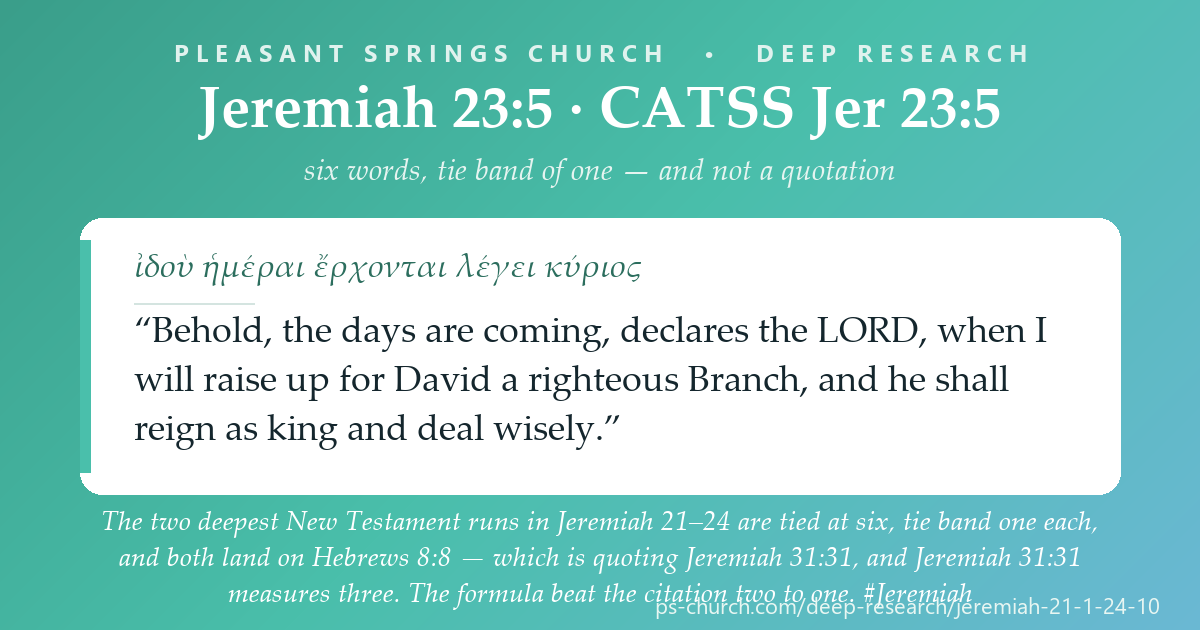
Four chapters, ninety-four verses, and the point where the book of Jeremiah stops arguing with Judah and starts sorting it: a king's delegation turned away, four named kings judged in a row, one promise of a righteous Branch, thirty-two verses against the prophets, and two baskets of figs. Screened against all 7,927 verses of the Greek New Testament, the two deepest runs in the passage are tied at six with a tie band of one each — and they land on the same verse. Jeremiah 23:5 and Jeremiah 23:7 both reach ἰδοὺ ἡμέραι ἔρχονται λέγει κύριος καί in Hebrews 8:8. Hebrews 8:8 is not quoting either of them. It is quoting Jeremiah 31:31 — and Jeremiah 31:31, in the Greek Jeremiah on this disk, measures three against Hebrews 8:8, because it reads φησὶν κύριος where Hebrews reads λέγει κύριος. The formula beat the citation two to one. Run the same chapters against the Hebrew Bible and the numbers double: Jeremiah 23:20 shares twelve consecutive words with Jeremiah 30:24, tie band one — and the same two verses share three words in Greek. See the method →
Jeremiah 21:1–24:10 — sixteen rows across all four chapters (the chapter and verse numbers agree in the Hebrew, the Greek and the ESV throughout this passage — 14, 30, 40 and 10 verses in both corpora, with no offset anywhere. One thing the numbers hide: in the Greek file the rows numbered 23:7 and 23:8 stand after 23:40. See the footer.)
Hebrew (Masoretic) · Greek (CATSS/Rahlfs) · ESVThe Shape of the Passage
Sequence — eight units, inside one measured envelopeNothing on this page settles how the book of Jeremiah reached the shape it has. That the book grew in stages, that Baruch is named as its scribe at 36:4, and that the Greek edition is about an eighth shorter than the Hebrew and arranges part of it differently, are all real and old questions. What follows reports what the text says about who is speaking and who is listening, and what the two ancient columns measurably do. It stops there.
Author
The passage opens with the book’s standard heading and then breaks it. הַדָּבָר אֲשֶׁר־הָיָה אֶל־יִרְמְיָהוּ מֵאֵת יְהוָה stands word for word in exactly ten verses of the Hebrew Bible, all of them in this book: 7:1, 11:1, 18:1, 21:1, 30:1, 32:1, 34:1, 34:8, 35:1 and 40:1. Four of them — 7:1, 11:1, 18:1 and 30:1 — continue into לֵאמֹר, saying, and go straight to the oracle. 21:1 does not. It names King Zedekiah, two named messengers and both their fathers first. The seven-word run has a tie band of nine and every one of the nine is in Jeremiah.
Four kings are named in these chapters and one is not. Shallum (22:11, the Jehoahaz of 2 Kings 23:31), Jehoiakim (22:18), Coniah / Jeconiah (22:24, 22:28, 24:1 — the Jehoiachin of 2 Kings 24) and Zedekiah (21:1, 21:7, 24:8). Josiah is named only as a father. The one king the passage promises is the one it refuses to name: 23:5 says only a righteous Branch for David, and 23:6 gives a name that is a sentence about God rather than a name for a man.
What the Greek column adds, and what it does not. For once in Jeremiah the two files agree on the count: fourteen, thirty, forty and ten verses in the Masoretic text and fourteen, thirty, forty and ten in CATSS. But the Greek is a shorter text inside the rows. 22:30 does not carry Thus says the Lord and a man who shall not succeed in his days; 23:6 does not carry the sentence the Lord is our righteousness and prints a proper name instead; 23:20 and its Hebrew twin at 30:24 stop being a doublet altogether. And the rows numbered 23:7 and 23:8 stand after 23:40 in the file. Whether the shorter Greek reflects a shorter Hebrew or an abbreviating translator is a manuscript question, and no manuscript evidence was consulted for this page.
The Greek is used here as a witness to a second ancient text, never as evidence about who wrote the Hebrew one. On this page the two columns disagree at 21:1, 21:12, 22:30, 23:5, 23:6, 23:20 and 24:3. Every one of those is printed above, and none of them is called a correction, a mistake or a change.
Audience
The addressee changes four times and the changes are announced. 21:1–7 answers a royal delegation. 21:8 turns to this people. 21:11 turns to the house of the king of Judah, and 21:12 addresses the dynasty by name: בֵּית דָּוִד. 23:9 turns again — concerning the prophets — and stays there for thirty-two verses. Chapter 24 has no human audience at all: it is a vision report addressed to the prophet, and the people in it are spoken about, never spoken to.
And the thing being redefined is who counts as Israel. This is the measured centre of the passage’s argument. In 597 BC Nebuchadnezzar deported the king, the officials, the craftsmen and the smiths and left a remnant behind under Zedekiah. The obvious reading of that event was that the people left in the land were the ones God had kept. Jeremiah 24 says the reverse, in a picture nobody could misunderstand: the basket of good figs is the deportees, and the bad figs are Zedekiah, his officials and the people still living in Jerusalem. The verse that says so, 24:8, is verbatim the verse that opened the passage at 21:7 — six words, tie band one, in Hebrew and in Greek.
How it has been carried. 23:5–6 is one of the most-preached messianic texts in the Old Testament, and the church has read the Lord our righteousness as a name for Christ since at least the second century. 22:30 has been argued over for as long, because Matthew 1:11–12 runs the genealogy of Jesus straight through the man whom this verse tells the scribes to write down childless. 24:7 has been read as the new covenant arriving early. What this page adds is only the measurement, and the measurement puts these three in an order nobody would predict: 23:5 is tied for the deepest New Testament run in the passage and the New Testament verse it reaches is not quoting it; 22:30 shares one word with Matthew 1:12; and 24:7 turns out to be stock exilic vocabulary shared with Ezekiel.
Before anything is measured, find out what the words in the passage are already known to mean, and where the reference works leave a question open.
A dictionary gives the range of a word and the consensus about a place. It does not tell you what this text does with either. Stage 1 collects the questions; stages 3 and 4 test them against the files.
What is a צֶמַח, and is it the same thing as Isaiah’s “shoot from the stump of Jesse”?
The lexica give צֶמַח as sprout, growth, what springs up — from צָמַח, to sprout. The reference works then group it with the other royal-plant images: Isaiah 11:1’s חֹטֶר and נֵצֶר, Isaiah 53:2’s יוֹנֵק, Ezekiel 17’s cedar sprig. The grouping is a theological one and the vocabulary does not support it.
צֶמַח stands in exactly eight verses of the whole Hebrew Bible: Leviticus 13:37, Isaiah 4:2, Jeremiah 23:5, Jeremiah 33:15, Ezekiel 16:7, Hosea 8:7, Zechariah 3:8 and Zechariah 6:12. Three of the eight are not royal at all — Leviticus 13:37 is hair growing back in a skin-disease examination, Ezekiel 16:7 is a foundling growing up, Hosea 8:7 is a crop that yields no flour. And Isaiah 11:1 is not on the list. Jeremiah 23:5 and Isaiah 11:1 share zero consecutive words; they do not share this word or any other.
So the “Branch” texts, on vocabulary alone, are five: Isaiah 4:2, Jeremiah 23:5, Jeremiah 33:15, Zechariah 3:8, Zechariah 6:12. Two of the five are in Jeremiah, and one of those two has no Greek text at all. See stage 4.
What is a חוֹתָם, and why does taking one off a hand mean anything?
A seal — a cylinder or stamp cut in stone, worn on a cord or set in a ring, pressed into clay to authenticate a document or close a jar. The dictionaries note that it was the single most personal object a man owned: it was his signature, his authority delegated, and it did not leave his person. Judah gives his to Tamar as a pledge (Genesis 38:18) precisely because nothing else would prove who he was.
So 22:24 is not a metaphor about jewellery. It is about a man being God’s own delegated authority and being removed from it. The Hebrew אֶתְּקֶנְךָּ is violent — tear you off, not take you off; the Greek ἐκσπάσω is the same, I will pull you out.
Every reference work sends you from here to Haggai 2:23, where Zerubbabel — this man’s grandson — is made the signet. The theological reversal is real; the verbatim contact is two words, and both are the formula declares the Lord. See stage 4.
Are the two baskets of figs a standard prophetic vision-form?
Yes, and the dictionaries and handbooks describe the form well: God shows the prophet an ordinary object, asks what do you see?, gets a plain answer, and then supplies a meaning that the object could not have carried on its own. Amos 7–8 has four of them; Jeremiah 1 has two; Zechariah has eight.
What no dictionary tells you is which of them this chapter actually touches. The commonplace pairing is Jeremiah 24 with Amos 8:1–2, the basket of summer fruit, because both are baskets. Measured, Jeremiah 24:3 reaches six consecutive Hebrew words and eight consecutive Greek words with Amos 7:8, the plumb line — and only three and five with Amos 8:2. The shared material is the question, not the fruit. See stage 4.
Who is Coniah, and how many names does he have?
Three, and the passage uses two of them. Coniah (כׇּנְיָהוּ) at 22:24 and 22:28; Jeconiah (יְכׇנְיָהוּ) at 24:1; and Jehoiachin (יְהוֹיָכִין) in 2 Kings 24, 2 Chronicles 36 and Jeremiah 52. The Greek column flattens all of this: CATSS reads Ιεχονιας at 22:24, 22:28 and 24:1 alike.
He reigned three months, surrendered Jerusalem in 597 BC at eighteen years old, and spent thirty-seven years in Babylonian custody. The reference works all note that he is the pivot of the whole royal question in this book: 22:30 says write him down childless, 24:1 makes his deportation the moment the good figs left, and Matthew 1:11–12 runs the line of Jesus through him. Stage 2 has what the Babylonian tablets say about him.
Is מַשָּׂא in 23:33–40 a burden or an oracle?
Both, and the passage is a sustained pun on the fact. מַשָּׂא is what is lifted — a load carried on the back, and also an utterance lifted up, the technical heading of a prophetic oracle (the oracle concerning Babylon, Isaiah 13:1). Jeremiah 23:33–40 uses it eight times and turns it over: you are the burden, and I will cast you off.
The Greek column cannot do the pun and does not try. CATSS reads λῆμμα throughout — a thing taken — which carries the “oracle” sense and drops the “load” sense entirely. This is one of the places where a page that quoted only the Greek would not know there was a joke. It is also why this shelf prints both columns.
Read the passage in the world it came out of — the Babylonian records of the very deportation it describes, the Judean letters written while the siege was closing, and the ordinary furniture of an eighth-century palace.
This stage is where a page is most tempted to overclaim. Everything below is either quoted from a published edition and named as such, or measured on the files held here and marked. Nothing is inferred from a photograph of an artefact this project has not seen.
The Babylonian Chronicle records the event of Jeremiah 24:1.
The chronicle series for Nebuchadnezzar’s early years records the campaign against Judah, the capture of the city and the removal of its king in his seventh year — the deportation of 597 BC. The Old Testament and the Babylonian record describe the same week from two sides. Jeremiah 24:1 is that week from the third side: from inside the temple courtyard, after the ships had sailed, looking at fruit.
Cited from the published translation in Pritchard’s Ancient Near Eastern Texts, which is held in this project as a scanned volume. The cuneiform was not read for this page and the tablet was not collated. Nothing in the measured sections of this study depends on it.
Ration tablets from Babylon name the man of Jeremiah 22:30.
Administrative tablets from Nebuchadnezzar’s palace storerooms, published by Weidner, list oil rations issued to captives, and among them Ya’u-kinu, king of the land of Yahudu, together with an allowance for his sons. Jeremiah 22:30 tells the scribes to write this man down עֲרִירִי, childless. A Babylonian storekeeper, at roughly the same time, was writing down his children’s rations.
The two records are not in contradiction and the passage itself shows why: the second half of 22:30 states the sentence exactly — none of his offspring shall succeed in sitting on the throne of David. It is a dynastic verdict, not a biological one, and the Hebrew word does the harder work of sounding like the second while meaning the first. The CATSS Greek does not have childless at all; it has ἐκκήρυκτον, proscribed, which is the dynastic verdict and nothing else.
Cited from the published edition, at second hand. The tablets were not examined for this page.
The Lachish ostraca: letters written while these chapters were being spoken.
Eighteen inscribed potsherds found in the guardroom of the Lachish gate, most of them military correspondence from the last months before 586 BC. One of them reports watching for fire-signals because we cannot see Azekah — the two towns Jeremiah 34:7 names as the last still holding out. Another complains that an official is weakening the hands of the people, which is the exact charge Jeremiah’s enemies bring against him at 38:4.
This is the closest thing there is to hearing the other side of Jeremiah 21 in its own handwriting. 21:4 says God will turn back the weapons in their hands; 21:9 says whoever goes out and surrenders to the Chaldeans shall live. The ostraca are what the officers who had to hear that were writing to each other.
Cited from the published translations in ANET. No epigraphic work was done for this page and the readings of the damaged lines are contested in the literature. Note also that the “weakening the hands” parallel is a parallel of situation, not a measured verbatim run: the ostraca are not in any corpus this project can screen.
A palace panelled in cedar and painted vermilion — 22:13–17.
The oracle against Jehoiakim is unusually specific about building: spacious upper rooms, cut out windows, panelled with cedar and painted with vermilion, and workmen not paid. Cedar came from Lebanon by sea and by cart and was the most expensive structural timber in the region; red ochre pigment on interior panelling is attested in Iron Age palace contexts across the Levant.
The passage then turns that vocabulary into the sentence. 22:23 addresses Jerusalem as you who dwell in Lebanon, nested among the cedars — the timber has become the city’s name — and 22:7 says the destroyers will cut down your choicest cedars and cast them into the fire. 22:23 is also the one verse in these four chapters that shares no two consecutive words with any other verse in the Hebrew Bible.
Two baskets set down in front of the temple — what is that gesture?
The Hebrew is מוּעָדִים לִפְנֵי הֵיכַל יְהוָה, set / appointed before the temple of the Lord. Deuteronomy 26 describes the firstfruits rite: the worshipper puts the basket down in front of the altar and recites the history of the nation over it. Jeremiah 24 opens on the posture of an offering and then has God do the inspecting.
Whether the two baskets in the vision are firstfruits baskets is not something this page can settle, and the vocabulary does not settle it either: Deuteronomy 26 uses טֶנֶא, Jeremiah 24:1 uses דּוּדָאֵי — which in its four other verses means mandrakes — Jeremiah 24:2 uses דּוּד, a pot or pail, and the Greek of both verses uses κάλαθος, which stands in exactly two verses of the whole 30,348-unit Greek screen and both of them are here. The gesture may be shared. The words are not.
Four words carry this passage, and three of them behave differently in the two columns.
A word study here means the distribution measured on the files held on this disk: 23,204 Masoretic verse units, 30,348 screened Greek Old Testament verse units, 7,927 Greek New Testament verses. Where a count is of the corpus rather than of the Septuagint entire, the text says so.
Eight verses in the whole Hebrew Bible. Leviticus 13:37, Isaiah 4:2, Jeremiah 23:5, Jeremiah 33:15, Ezekiel 16:7, Hosea 8:7, Zechariah 3:8, Zechariah 6:12. Isaiah 11:1 is not one of them.
What CATSS puts where the Hebrew has צֶמַח, in exactly four verses: Jeremiah 23:5, Ezekiel 16:7, Zechariah 3:8 and Zechariah 6:12 — and in three of the four it is a title for a person, Ezekiel 16:7 being the growth of a field. Eleven verses of the Greek New Testament carry the word; only Luke 1:78 uses it of a person.
The most personal object a man owned. 22:24 makes Coniah the seal on God’s right hand and then tears it off; Haggai 2:23 makes his grandson the seal and keeps it. The two verses share two words.
Seven occurrences in five verses of the Hebrew Bible — Genesis 30:14, 30:15, 30:16, Song of Songs 7:14 and Jeremiah 24:1. Only the last is not mandrakes.
Stands in two verses of the entire 30,348-unit Greek screen — Jeremiah 24:1 and 24:2 — and zero verses of the Greek New Testament.
Eight times in 23:33–40, and the point is that it means both. The Greek λῆμμα carries only one of the two senses, so the pun exists in one column and not the other.
“The way of life and the way of death” — a phrase that occurs once.
דֶּרֶךְ הַחַיִּים, the way of life, stands in exactly one verse of the 23,204-unit Masoretic corpus. דֶּרֶךְ הַמָּוֶת, the way of death, stands in exactly one verse. They are the same verse: Jeremiah 21:8.
This is worth being precise about, because the two-ways idea is everywhere and the two-ways wording is not. Deuteronomy 30:15 sets life and good against death and evil and shares two words with this verse. Proverbs has the plural construct דַּרְכֵי־מָוֶת, ways of death, at 14:12 and 16:25, and those two words stand in exactly those two verses and nowhere else. The Didache opens there are two ways, one of life and one of death, and Matthew 7:13–14 has the two gates. The Greek of Jeremiah 21:8 and the Greek of Matthew 7:13 share one word, καί.
What that measurement means: this verse is the sharpest formulation of the two-ways teaching in the Hebrew Bible, and no later text on this disk reproduces its words. The tradition is real. The verbatim contact is not there to be found.
Why does the Greek call the Branch a sunrise?
Because צֶמַח and ἀνατολή are the same idea from two directions. The Hebrew noun is built on to sprout: what comes up out of the ground. The Greek noun is built on ἀνατέλλω: what comes up over the horizon. Both are ‘the rising’. Neither is a translation error, and neither is a picture of the other.
The distribution makes the choice look deliberate rather than accidental: the four places the Greek Old Testament held here puts a form of ἀνατολή where the Hebrew has צֶמַח are Jeremiah 23:5, Ezekiel 16:7, Zechariah 3:8 and Zechariah 6:12, and in three of the four it is a title for a person — the exception is Ezekiel 16:7, where ἡ ἀνατολὴ τοῦ ἀγροῦ is the growth of a field. Three of those four are among the five ‘Branch’ verses in Hebrew. Of the other two, Jeremiah 33:15 has no Greek text at all in this file (see stage 4), and Isaiah 4:2 carries no ἀνατολ- word at all: CATSS reads ἐπιλάμψει ὁ θεός, God will shine out. The word ἀνατολ- itself is common — 193 occurrences in 179 verses of the 30,348-unit screen — and almost all of them mean ‘east’. The four above are the ones this page counted.
And then the run screen refuses to close the circle. Luke 1:78 calls Christ ἀνατολὴ ἐξ ὕψους, the sunrise from on high — the one place in the Greek New Testament where the word is a person. Jeremiah 23:5 and Luke 1:78 share zero consecutive words. They share a noun and nothing else. That is what a shared tradition looks like on this instrument, and it is not the same thing as a quotation.
Ιωσεδεκ — a name that appears eighteen times and means somebody else seventeen of them.
Where the Hebrew of 23:6 has the sentence יְהוָה צִדְקֵנוּ — two words, standing in exactly two verses of the Hebrew Bible, 23:6 and 33:16 — the CATSS Greek has a single word, Ιωσεδεκ.
Screened across the 30,348 screened Greek verse units of the 30,637 held here, that string occurs in eighteen verses. Five are in Haggai (1:1, 1:12, 1:14, 2:2, 2:4), one in Zechariah (6:11), ten in the two Esdras books, one in Sirach (49:12) — and every one of those seventeen is the patronymic of Joshua the high priest, Ἰησοῦς ὁ τοῦ Ιωσεδεκ. Jeremiah 23:6 is the eighteenth, and the only one that is not.
Here is the part the page will state and refuse to explain. Zechariah 6:11 crowns Joshua son of Ιωσεδεκ; Zechariah 6:12, the next verse, says behold a man, Ἀνατολή is his name. The two Greek words that stand in Jeremiah 23:5–6 — Ἀνατολή and Ιωσεδεκ — are the two names of Zechariah 6:11–12, in that order. The run screen finds almost nothing between the verses: Jeremiah 23:5 and Zechariah 6:12 share two words (λέγει κύριος), and Jeremiah 23:6 and Zechariah 6:11 share the name as an isolated word and no adjacent pair at all. Which text acted on which, or whether either did, is not decidable from these files, and this page does not decide it.
עֲרִירִי against ἐκκήρυκτος — two different sentences on one man.
The Hebrew of 22:30 is כִּתְבוּ אֶת־הָאִישׁ הַזֶּה עֲרִירִי, write this man down childless. The word is used of Abram before Ishmael (Genesis 15:2) and of the penalty in Leviticus 20:20–21.
The CATSS Greek reads γράψον τὸν ἄνδρα τοῦτον ἐκκήρυκτον ἄνθρωπον — write this man down a proscribed man. ἐκκήρυκτος is not a word about children; it is a word about being cried out of the city by a herald. And the Greek row does not contain Thus says the Lord or a man who shall not succeed in his days at all.
The two columns arrive at the same practical verdict — no descendant of his will sit on David’s throne — by two different words, one biological and one legal. The page prints both. It does not say which is the original, and it does not use the Greek to soften the Hebrew.
Now measure. Every run below is the longest contiguous sequence of identical word forms between two verses, with the number of other verses that reach the same depth printed beside it.
The screen finds verbatim contact. It does not find allusion, and the difference is the whole point of this stage: on this page the deepest New Testament run is an accident of formula, and the strongest theological connection in the passage measures two.
THE FINDING — the two deepest New Testament runs are tied at six, and neither is a quotation.
Screened against all 7,927 verses of the Greek New Testament, the ninety-four CATSS rows of Jeremiah 21–24 distribute like this: 92 reach two, 78 reach three, 30 reach four, 6 reach five, and 2 reach six. Nothing reaches seven.
The two sixes are tied, tie band one apiece, and both land on the same New Testament verse.
Jeremiah 23:5 → Hebrews 8:8: six. ἰδοὺ ἡμέραι ἔρχονται λέγει κύριος καί.
Jeremiah 23:7 → Hebrews 8:8: six. The same six words.
Hebrews 8:8–12 is the longest Old Testament quotation in the New Testament, and what it quotes is Jeremiah 31:31–34 — the new covenant. In the Greek Jeremiah held here that passage is numbered 38:31–34. Measure the actual citation and it is overwhelming, except at the one verse that matters for this page:
Greek Jeremiah 38:31 → Hebrews 8:8 — three: ἰδοὺ ἡμέραι ἔρχονται
Greek Jeremiah 38:32 → Hebrews 8:9 — twenty-three
Greek Jeremiah 38:33 → Hebrews 8:10 — thirteen
Greek Jeremiah 38:34 → Hebrews 8:11 — twenty-three
The verse Hebrews is quoting scores three. Two verses Hebrews is not quoting score six each. The reason is one word: CATSS reads φησὶν κύριος at 38:31, and Hebrews reads λέγει κύριος — which is exactly what stands at Jeremiah 23:5 and 23:7.
This is the page’s own counter-example and it is printed first on purpose. A run of six with a tie band of one looks like a signal. Here it is a formula meeting a formula, and the citation it appears to be is happening two chapters away in a verse that measures half as deep. Nobody should read Jeremiah 23:5 as a source for Hebrews 8:8 on the strength of a number this page itself produced.
How common is “behold, the days are coming”? Exactly this common.
הִנֵּה יָמִים בָּאִים stands in twenty-one verses of the 23,204-unit Masoretic corpus: 1 Samuel 2:31, 2 Kings 20:17, Isaiah 39:6, Amos 4:2, 8:11, 9:13, and fifteen in Jeremiah — 7:32, 9:24, 16:14, 19:6, 23:5, 23:7, 30:3, 31:27, 31:31, 31:38, 33:14, 48:12, 49:2, 51:47, 51:52.
ἰδοὺ ἡμέραι ἔρχονται stands in twenty verses of the 30,348-unit Greek screen and in exactly one verse of the Greek New Testament: Hebrews 8:8.
So the phrase is Jeremiah’s house style — three quarters of its Hebrew occurrences are in this book — and the New Testament uses it once, inside a quotation of Jeremiah. The tie band of one on the six-word run is real: no other New Testament verse comes close. It is also, on inspection, meaningless as evidence of contact with chapter 23. A tie band of one is not the same thing as a quotation, and this is the clearest example of that on the shelf.
The deepest run in the passage is Hebrew, it is twelve words, and the Greek does not have it.
Screened against the 23,204 verse units of the Masoretic corpus, Jeremiah 23:20 shares TWELVE consecutive words with Jeremiah 30:24, tie band one — אף יהוה עד עשתו ועד הקימו מזמות לבו באחרית הימים תתבוננו בה. No third verse in the Hebrew Bible reaches it. The preceding verses pair too: 23:19 and 30:23 share five, tie band one.
In the CATSS Greek the same two rows share three words. Greek Jeremiah 23:20 and Greek Jeremiah 37:24 — which is Masoretic 30:24 — are two different sentences that happen to share καρδίας αὐτοῦ ἐπ’. Where the Hebrew has the anger of the Lord will not turn back twice in the same words, the Greek has καὶ οὐκέτι ἀποστρέψει ὁ θυμὸς κυρίου in one place and οὐ μὴ ἀποστραφῇ ὀργὴ θυμοῦ κυρίου in the other.
Twelve against three is the largest column gap on this page. The page states it and stops: it does not say the translator was careless, it does not say the Greek reflects a different Hebrew, and it does not say which text is prior. Those are manuscript questions and no manuscript evidence was consulted here.
Where the Greek goes deeper than the Hebrew: 23:7–8 and 16:14–15.
The same oracle stands twice in Jeremiah — the new exodus that will make the old one obsolete as an oath formula. Measured:
Hebrew 23:7 → Hebrew 16:14 — ten, tie band one
Hebrew 23:8 → Hebrew 16:15 — six, tie band one
Greek 23:7 → Greek 16:14 — thirteen
Greek 23:8 → Greek 16:15 — ten
This is one of very few places on this shelf where a doublet measures deeper in Greek than in Hebrew, and the reason is visible in one word. Both Hebrew rows open לָכֵן הִנֵּה יָמִים בָּאִים נְאֻם יְהֹוָה, but 16:14 then reads וְלֹא יֵאָמֵר, it shall no longer be said, where 23:7 reads וְלֹא יֹאמְרוּ, they shall no longer say — so the Hebrew run cannot begin until after it. The Greek rows read οὐκ ἐροῦσιν in both places, and nothing cuts the Greek run until ὅς stands against ὁ near the end.
And in the CATSS file these two rows are not where the numbering says. They stand after the row numbered 23:40, at the end of the chapter. The chapter has forty rows in both corpora; the order of two of them differs. That is a fact about the file on this disk, reported without a theory attached.
The envelope: 21:7 and 24:8, six words, both columns.
Jeremiah 21:7 → Jeremiah 24:8: six consecutive Hebrew words, tie band one — אתן את צדקיהו מלך יהודה ואת, I will give Zedekiah king of Judah and. The same pair measures six in Greek — τὸν Σεδεκιαν βασιλέα Ιουδα καὶ τοὺς.
Fourteen Hebrew rows in this passage reach six or more. 21:7 and 24:8 are the only two of the fourteen whose deepest partner is the other one. The remaining twelve all point outside these four chapters — to Jeremiah 4:4, 7:1, 7:6, 16:14, 16:15, 29:17, 30:24, 32:36, 33:4 and 33:14, and to Deuteronomy 29:24, 1 Kings 11:31, 2 Kings 21:12 and Amos 7:8.
That is the whole basis for treating 21:1–24:10 as a unit on this page, and it is a thin basis and the page says so. Two verses at either end, verbatim, in both languages. It is not a chiasm and nothing mirrors around a centre. See the structure diagram.
Four connections everybody makes that the screen does not support.
Jeremiah 22:24 and Haggai 2:23 — the signet reversed. Two shared words in Hebrew (נאם יהוה) and two in Greek (λέγει κύριος). Both are the messenger formula. The theological reversal is one of the finest things in the prophets; the verbatim contact is nil.
Jeremiah 22:30 and Matthew 1:11–12 — the Jeconiah curse. One shared word with Matthew 1:12 — τόν — and one with Matthew 1:11. Matthew names the man; he does not touch this verse.
Jeremiah 23:1–4 and John 10 — the shepherd. Jeremiah 23:1 reaches three into the Greek New Testament, tie band two, and the phrase is τὰ πρόβατα τῆς. Against Ezekiel 34:2 the Hebrew shares one word. The shepherd tradition is enormous and almost none of it is verbatim.
Jeremiah 23:29 and Hebrews 4:12 — the word like fire, like a hammer. One shared word: καί. Jeremiah 23:29’s own deepest Hebrew reach is two with a tie band of 240. Two of the most quoted sentences about Scripture in either Testament, and they do not touch.
The doublet that exists in one column only: 23:5–6 and 33:15–16.
In Hebrew, the righteous-Branch oracle stands twice. Jeremiah 23:5 shares six consecutive words with Jeremiah 33:14, tie band one (הנה ימים באים נאם יהוה והקמתי); 23:5 and 33:15 share four (ועשה משפט וצדקה בארץ); 23:6 and 33:16 share two, and יהוה צדקנו stands in those two verses and nowhere else.
In the Greek file the second copy does not exist. The rows that answer Masoretic Jeremiah 33 are numbered chapter 40 in CATSS and there are thirteen of them, against the Hebrew’s twenty-six. Masoretic 33:14–26 — including the whole Branch oracle and the covenant with David and with Levi — has no counterpart in the Greek Jeremiah held here at all.
So: the “Branch” is a doublet in the Hebrew Bible and a single oracle in the Greek. A page that read only one column would not know that, which is why this shelf prints two. Nothing here says which text is older, and no manuscript evidence — Qumran included — was consulted.
Jeremiah 24:3 and Amos: the right parallel is not the one with the basket in it.
The commonplace pairing for the two baskets of figs is the basket of summer fruit in Amos 8:1–2. Measured, the closer verse is the plumb line one chapter earlier:
Hebrew 24:3 → Amos 7:8 — six, tie band one
Greek 24:3 → Amos 7:8 — eight
Hebrew 24:3 → Amos 8:2 — three
Greek 24:3 → Amos 8:2 — five
What is shared is the question — ויאמר יהוה אלי מה אתה ראה, καὶ εἶπεν κύριος πρός με τί σὺ ὁρᾷς — and the vision form that goes with it. The baskets themselves share nothing. Amos has כְּלוּב and ἄγγος; Jeremiah has דּוּד and κάλαθος.
This is what the instrument is for. Two visions that look alike to a reader share a container and not a word; two visions that look different share eight consecutive Greek words. Neither fact settles who read whom, and the page does not raise the question.
One zero, and exactly what it means.
Jeremiah 22:23 shares no two consecutive words with any other verse in the Hebrew Bible. It is the only row in these ninety-four that does.
Read the scope before reading anything into it. The Hebrew-side screen on this shelf runs with the unigram fallback off, which means a reported zero is no adjacent word pair shared with any of the other 23,174 verse units — not no words shared. 22:23 shares plenty of individual words: בַּלְּבָנוֹן, בָּאֲרָזִים, חֲבָלִים. What it never shares is a phrase.
The Greek-side screen runs with the fallback ON, so every zero reported for a Greek row on this shelf would mean “shares no word at all”, which is why there are none here: the shallowest Greek row in this passage reaches one. Two screens, two meanings of zero, and a page that reports one without naming the convention is misleading its reader.
What the specialists argue about in these four chapters, and — the part that matters — what this page could not check.
This is the section that makes the shelf usable. Everything above is either quoted from a file on this disk or measured on one. Everything that is neither is named here.
WHAT THIS PAGE COULD NOT CHECK — read this before citing anything above.
No critical apparatus was consulted for the Hebrew. The Masoretic text used is Sefaria’s digitization of Miqra according to the Masorah. No variant readings were collated from BHS or BHQ, and no Dead Sea Scroll was examined — the Qumran Jeremiah manuscripts included. This matters here more than on most pages, because 4QJerb and 4QJerd are the principal evidence in the argument about the short Greek edition, and this page has not seen them.
No ESV file exists on this disk for Jeremiah and no Crossway API key exists in this project. The English column above was typed. Its verse alignment rests on verse counts and chapter openings, not on a held text. The Hebrew and Greek columns were pulled programmatically from the corpus files and can be re-derived by anyone with the repository.
The Greek is Rahlfs as digitized by CATSS, and that is one edition. Ziegler’s Göttingen Jeremiah was not consulted. Where this page says “the rows numbered 23:7 and 23:8 stand after 23:40”, that is a statement about the file on this disk. It is not a statement about what any manuscript does, and the placement of these verses is itself an editorial decision in every printed Septuagint.
Stage 2 is the weakest section on this page and it should be read that way. The Babylonian Chronicle, the Weidner ration tablets and the Lachish ostraca are cited from published translations at second hand. No cuneiform was read, no ostracon was collated, no photograph was examined. None of the measured claims on this page depends on any of them.
The commentaries named at the foot of this page were not quoted. They frame the questions; every number above came from the files.
The argument this page is standing next to and not joining: the two editions of Jeremiah.
Greek Jeremiah is roughly an eighth shorter than the Hebrew and puts the oracles against the nations in a different place. Since the Qumran finds the dominant position — Tov, Janzen and others — has been that the short Greek reflects a genuinely shorter Hebrew edition, and that the Masoretic text represents a later, expanded one. Others — Lundbom prominently — argue that much of the difference is translational, and that haplography accounts for a large share of the shorter readings.
This page takes no side, and its house rule is why. The shelf never asserts direction of influence and never calls a reading early or late. What it can do is show you the difference at the level of the sentence, which it does at 22:30, 23:6, 23:20 and 33:14–26.
Where the difference is measurable, this page measured it. Where deciding it would require a manuscript, this page stopped.
Is Jeremiah 21:1–24:10 a unit? The literature is not agreed and neither is this page.
Most treatments call 21:11–23:8 a “royal collection” and 23:9–40 a separate “prophet collection”, with 21:1–10 a later prose insertion that pulls a Zedekiah episode forward out of its chronological place (it belongs with chapters 37–38) and chapter 24 a fourth thing again. Some outlines end the block at 23:8; some run it to 24:10; some start it at 21:11.
What this page has that an outline does not is a measurement, and it points the other way. 21:7 and 24:8 share six consecutive words in Hebrew with a tie band of one, and six consecutive words in Greek. Of the fourteen Hebrew rows in these chapters that reach six or more, those two are the only ones whose deepest partner is inside the passage; the other twelve all point outside it.
That is one envelope, and one envelope is not a structure. The page prints the shape as a sequence with a measured frame and refuses to call it a chiasm, because nothing mirrors around a centre. If a commentary tells you otherwise, ask it which verses and count the words.
Things a specialist would raise that this page cannot answer.
Is Ιωσεδεκ at 23:6 a translator’s decision or a Vorlage reading? The page reports the distribution — eighteen occurrences, seventeen of them one man — and does not answer the question. It would take manuscript evidence.
Does the Greek order of 23:7–8 reflect anything, or is it an artefact of the edition? Not answerable from one digitized edition.
Is 21:1–10 the same event as 37:3–10? Two Zedekiah delegations, two similar answers, different names in the delegation at 37:3. The page notes that 21:9 and 38:2 share five consecutive Hebrew words with a tie band of one, and leaves the historical question alone.
Why does 22:23 share no phrase with anything? The page has no explanation and offers none. It is a fact about the corpus, not a fact about the author.
- Lundbom, Jeremiah 21–36 (Anchor Yale Bible) — the fullest recent commentary on this exact block, and the standing argument against the short-edition consensus.
- Holladay, Jeremiah 1 (Hermeneia) — on the royal collection and the placement of 21:1–10.
- McKane, Jeremiah I–XXV (ICC) — the “rolling corpus” account of how these chapters grew.
- Carroll, Jeremiah (OTL), and Brueggemann, A Commentary on Jeremiah — for the theology of the two baskets.
- Tov, The Text-Critical Use of the Septuagint in Biblical Research, and Janzen, Studies in the Text of Jeremiah — the case for the short edition.
- Ziegler, Ieremias (Septuaginta: Vetus Testamentum Graecum, Göttingen) — the critical Greek edition, NOT consulted for this page.
- Pritchard (ed.), Ancient Near Eastern Texts Relating to the Old Testament — the Babylonian Chronicle and the Lachish ostraca, cited at second hand.
- Beale and Carson (eds.), Commentary on the New Testament Use of the Old Testament — on Hebrews 8 and Jeremiah 31.
The measurements are done and printed. What you make of them is the part this page cannot do for you.
Everything above can be re-derived from the files. Bring what you find — including where you think this page is wrong.
Sit with the counter-example first.
The number this page is proudest of is the one it spent a section undermining. Two runs of six, tie band one each, both to Hebrews 8:8 — and Hebrews 8:8 is quoting a chapter that scores three.
If you take one habit from this shelf, take that one. A deep run with a narrow band is where you start looking, not where you stop.
Then sit with the baskets.
Chapter 24 says the people God kept are the ones who lost. The exiles — the king in prison, the officials deported, the craftsmen and the smiths shipped to Babylon — are the good figs. The ones still in Jerusalem, still in the temple, still with a king on the throne, are the basket that cannot be eaten.
And then 24:7: I will give them a heart to know that I am the Lord, and they shall be my people and I will be their God, for they shall return to me with their whole heart. The promise is not made to the people who kept the building. It is made to the people who lost everything.
A question worth arguing about.
The Hebrew of 23:6 gives the coming king a name that is a sentence about God: the Lord is our righteousness. The Greek gives him a name that belongs, in every other one of its eighteen occurrences, to the father of a high priest.
Two ancient readers, two decisions, and this page will not tell you which one to prefer. The count is exact. The reading is yours.
Every Deep Research page traces its passage across the whole sweep — the Old Testament, the Second-Temple world between the testaments (historical witnesses, not Scripture), and the New Testament. Follow the thread:
Pleasant Springs Church — Deep Research
Research method after Michael S. Heiser’s Bible Research Method (examine dictionaries → ancient literature → important words → textual connections → academic publications → share), with the Pleasant Springs “Author & Audience” foundation. Scripture set in the Hebrew, the Greek editions named on each page and the ESV (Old Testament), and the Greek New Testament and the ESV (New Testament), per the practice of Pleasant Springs Church. Jeremiah research grounded in Lundbom (Anchor Yale), Holladay (Hermeneia), McKane (ICC), Carroll (OTL) and Brueggemann; on the two editions in Tov and Janzen; on Hebrews 8 in Beale and Carson. Text: Hebrew from the Masoretic text as printed in the edition consulted — Sefaria’s Miqra according to the Masorah; no critical apparatus was consulted for the Hebrew and no Dead Sea Scroll was collated, the Qumran Jeremiah manuscripts included. Greek from Rahlfs’ Septuaginta as digitized by CATSS; Greek New Testament from the SBL edition as digitized by MorphGNT. The standing caution for this shelf applies: these pages say “the CATSS Greek text reads…” and never call a Greek reading early or late, and never say which text acted on which. ⚠️ Verse numbering — Jeremiah is the hardest book on the shelf for this, and this passage is the easy part of it. The two corpora were aligned by measuring the files on this disk, not by copying a printed table. Masoretic Jeremiah 21, 22, 23 and 24 hold 14, 30, 40 and 10 verses; the CATSS file holds 14, 30, 40 and 10. There is no offset anywhere in this passage: every reference on this page means the same verse in the Hebrew, the Greek and the ESV. That is unusual for this book. Within Jeremiah 1–24 the two corpora disagree on the verse count of six chapters — 2, 7, 8, 10, 11 and 17 — and from chapter 25 to chapter 52 they disagree on every single chapter, because the Greek edition puts the oracles against the nations in a different place. Three things the agreeing numbers hide, all measured on the file. (1) In the CATSS file the rows numbered Jeremiah 23:7 and 23:8 do not stand between 23:6 and 23:9; they stand after 23:40, at the end of the chapter. The count agrees; the order does not. (2) Two cross-references on this page carry the book’s large offset and are printed with it: Greek Jeremiah 38:31–34 is Masoretic Jeremiah 31:31–34, and Greek Jeremiah 37:23–24 is Masoretic Jeremiah 30:23–24. (3) Masoretic Jeremiah 33:14–26 has no counterpart in the Greek file at all: the Greek chapter that answers Masoretic 33 is numbered 40 and holds thirteen rows against the Hebrew’s twenty-six, so the second copy of the righteous-Branch oracle exists in the Hebrew column only. ⚠️ The ESV column was NOT verified against a held ESV text. No ESV file for Jeremiah exists on this disk and no Crossway API key exists in this project; the English was typed and its verse alignment rests on verse counts and chapter openings. The Hebrew and Greek columns were pulled programmatically from the corpus files. ⚠️ Every cross-corpus run figure on this page was measured on 31 August 2026 and applies MorphGNT’s own spelling equivalences — οὐ/οὐκ/οὐχ, ἐκ/ἐξ and the movable nu — so that a shared run is not cut at a word the two editions merely spell differently. Figures published on this shelf before 30 August 2026 are lower for that reason; nothing was copied from a sibling page and every number above was re-measured. ⚠️ A run of zero on the Hebrew screen means NO TWO CONSECUTIVE WORDS. The Hebrew-side screen runs with the unigram fallback off, so max = 0 at Jeremiah 22:23 — the only zero in these ninety-four verses — means that verse shares no adjacent word pair with any of the other 23,203 Masoretic verse units, not that it shares no words. The Greek-side screen runs with the fallback ON, so a 1 reported for a Greek row means the two verses share isolated words and no adjacent pair at all — which is what the 1 for Jeremiah 22:30 against Matthew 1:12 means. ⚠️ The Masoretic text held here counts the scribal section markers as words, and four rows on this page were checked for it. {ס} and {פ} stand inside the verse text of the Sefaria file and the frozen normaliser tokenises them. The reported maxima for Jeremiah 21:3, 22:19, 23:1 and 23:4 each END on a marker and are therefore one token longer than the shared word run; none of those four is reported as a finding on this page. The fourteen rows that reach six or more — including the twelve at 23:20, the tens at 21:12 and 23:7 and the sixes at 21:7 and 24:8 — were each checked and cross no markers. normalize.py is frozen and was not edited. ⚠️ Greek Old Testament figures are scoped to the 64 CATSS files held here, 30,637 verse units, screened to 30,348 with the Odes excluded. Two of the Odes are New Testament text — Ode 9 is Luke 1 and Ode 13 is Luke 2 — and ten more are second copies of Exodus 15, Deuteronomy 32, 1 Samuel 2, Habakkuk 3, Isaiah 26, Jonah 2, Daniel 3, Isaiah 5 and Isaiah 38, so leaving them in would inflate any tie band that touched one. ⚠️ The deepest New Testament run on this page is not a quotation and the page says so in three places. Typology is handled per the house position: what the text says, what the New Testament itself draws, and what we see from this side of the cross — with the seeing left to the reader.
Scripture quotations marked ESV are from the ESV® Bible (The Holy Bible, English Standard Version®), © 2001 by Crossway, a publishing ministry of Good News Publishers. ESV Text Edition: 2016. Used by permission. All rights reserved. The ESV text may not be quoted in any publication made available to the public by a Creative Commons license, and the ESV may not be translated in whole or in part into any other language. www.esv.org
|
Did this study bless you today? 💚 Give to Support PS Church100% of gifts go to the General Fund — thank you. |