Two men stand in the house of the
Lord with the same title. Both open with Thus says the
Lord of hosts, the God of Israel. Both perform a sign
with the same wooden object. One says two years; the other says seventy. The Hebrew text calls
both of them the same thing. It calls Hananiah הַנָּבִיא, and nine
verses later it puts both men in one sentence with that word attached to each.
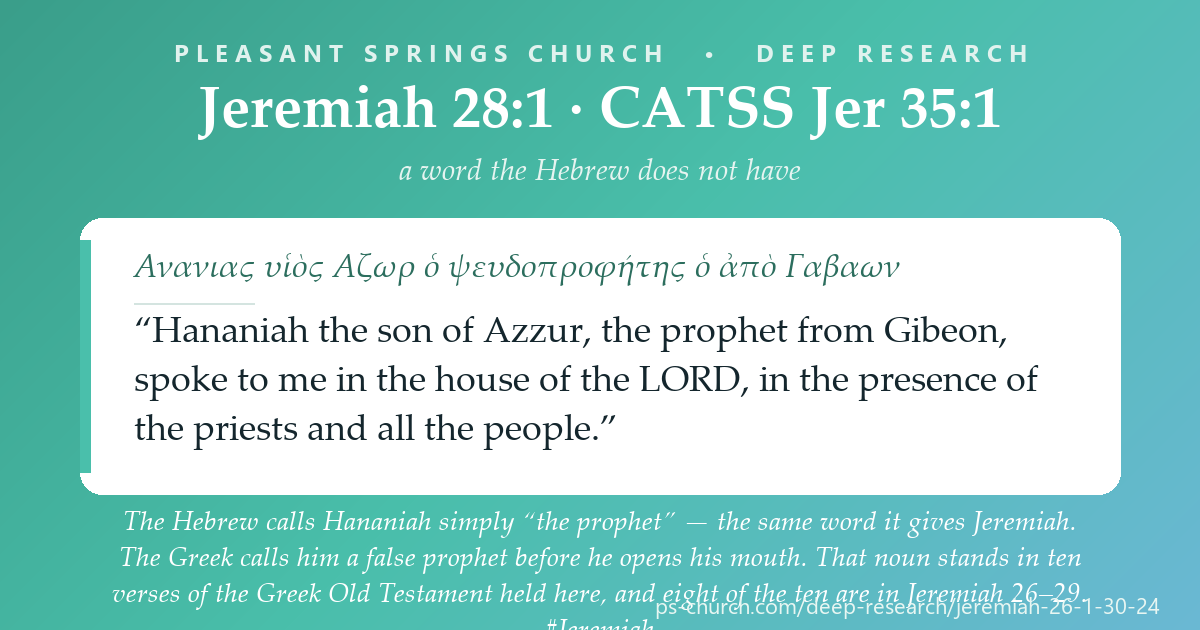
The Greek text does not. In the first line of its chapter, before Hananiah has said
anything, it calls him ὁ ψευδοπροφήτης — a false prophet. And that noun,
screened exhaustively, stands in ten of the 30,348 Greek Old Testament verse units held
here — eight of them inside these five chapters, with the Hebrew reading the
ordinary word for a prophet underneath every one. The Greek New Testament uses the same noun eleven
times. The run screen cannot see any of this: measured against all 7,927 verses of the
Greek New Testament, these chapters top out at five words, twice, and both are coincidences — one
of them a stock phrase plus the word and. Along the way: one prophet quoting another by name,
and the quotation missing by two single letters in Hebrew while running six words twice in Greek;
fourteen Hebrew verses with no Greek counterpart at all; Nebuchadnezzar named seven times here in Hebrew
and once in Greek; and four counter-examples printed against the page’s own findings, starting with
Daniel 9:2, which says outright that it is reading Jeremiah — and whose deepest
contact with the whole book of Jeremiah turns out to be a chapter heading, in four verses it is not
talking about, while the words it is quoting measure two.
See the method →
Jeremiah 26:1–30:24 (selections)
Hebrew · Greek (CATSS / Rahlfs) · ESVEvery row here was chosen by a measurement. 26:8 and 28:1 are printed because of one Greek noun. 26:18 is printed because it is a quotation and the quotation does not match. 27:1 and 30:10 and 30:22 are printed because the Greek does not have them. 27:16 and 29:9 are printed because they are the two deepest Greek rows on the page and both are coincidences. 30:24 is printed because it is the deepest Hebrew row. Where the two columns say different things, both are printed and neither is corrected.
The Shape of the Passage
Sequence — four dated confrontations in prose, then one undated poemThese five chapters sit between the sign-acts of 16–20 and the new-covenant oracle of 31:31–34. They are the most heavily dated stretch of the book — four scenes, four regnal dates — and the last of them, chapter 30, has no date at all.
Author
He is on trial, and the record is written as a court record. Chapter 26 names the charge, the accusers, the venue (the New Gate of the house of the Lord), the defence, the precedent cited, and the man who kept him alive: Ahikam the son of Shaphan. That family runs through the whole book — Shaphan is named in eleven verses of Masoretic Jeremiah, and his sons and grandsons are the officials who hide the scroll (36:10–12), get Jeremiah out of the cistern, and finally govern what is left of Judah (39:14, 40:5). The prophet in this book survives because of a civil service family.
He is also, in these chapters, a man arguing with people who have exactly his job. Hananiah of Gibeon uses Jeremiah’s own opening formula — Thus says the Lord of hosts, the God of Israel — and the Hebrew gives him the same title, הַנָּבִיא. The text does not make him easy to spot. In 28:10 the two men stand in one sentence with the same word attached to each of them. That is why chapter 28 carries nineteen occurrences of the root in seventeen verses, and it is why the noun standing in the Greek column — a word the Hebrew has no equivalent for — is such a large difference.
And he writes letters. Chapter 29 is a document with a postal history: it is sent by the hand of two named envoys travelling to Babylon on royal business (29:3), it provokes a reply from Babylon addressed to a named temple official (29:24–28), and Jeremiah answers the reply. Jeremiah 29:24 is the one verse in these five chapters that shares no two consecutive words with any other verse in the Hebrew Bible. It is the address line of a letter.
Audience
Two audiences at once, six hundred miles apart. One is in Jerusalem in the years after 597: a court, a temple establishment, and five foreign embassies looking for a coalition. The other is already in Babylon — the deportation of 597 had taken the king, the queen mother, the officials, the craftsmen and the smiths (29:2). Chapter 29 is written to people who have lost and are being told to settle down; chapters 27 and 28 are written to people who have not lost yet and are being told they will.
They had a rival message and it was the better-sounding one. Hananiah's announcement is two years and the vessels come home; Jeremiah's is seventy years and build houses. Nothing in the text suggests the audience could tell them apart by any external mark. Both men used the formula; both spoke in the house of the Lord; both performed a sign-act with the same object. The only test the chapter offers — 28:9, wait and see whether it happens — is useless to anyone who has to decide today.
And later, people reading it in Greek, for whom the question had already been settled. The Greek book held here is arranged differently, is missing fourteen of the 119 Hebrew verses of these five chapters, names Nebuchadnezzar once where the Hebrew names him seven times, and — the change that matters most — tells its reader in the first line of chapter 35 that Hananiah is a false prophet. A Greek-reading congregation met a Jeremiah in which the argument had already been won, and this page prints both without ranking them.
Orient on prophetic conflict and the criteria for true prophecy, on the yoke as a political symbol, on the deportation of 597 and the community it created, and on the two editions of the book of Jeremiah.
Search by topic: prophecy, false; prophetic conflict; true and false prophets; criteria of prophecy; sign-act (prophetic symbolic action); yoke; Micah of Moresheth; Uriah son of Shemaiah; Shaphan, family of; Ahikam; Hananiah; Shemaiah the Nehelamite; Gibeon; New Gate; letter, letters in the ancient Near East; Golah, the exilic community; Jehoiachin; seventy years; Book of Consolation (Jeremiah 30–31); Septuagint of Jeremiah; Jeremiah, Book of (text and versions).
Which articles are relevant?
- Anchor Bible Dictionary — “Jeremiah, Book of” (especially the section on the Greek text), “Prophecy, False,” “Prophetic Symbolic Actions,” “Hananiah,” “Shaphan,” “Jehoiachin,” “Exile, Babylonian,” “Seventy Years.”
- Dictionary of the Old Testament: Prophets (IVP) — “Prophecy and Society,” “Prophecy, False,” “Sign Acts,” “Intertextuality and Innerbiblical Exegesis,” “Text and Textual Criticism.”
- The New Interpreter’s Dictionary of the Bible — “Jeremiah, Book of,” §§ on chapters 26–36; “Yoke”; “Letter.”
- Where the dictionaries disagree, and the page says so rather than choosing: whether the quotation of Micah at 26:18 is Jeremiah’s or a later editor’s; whether chapters 26–29 come from Baruch, from a Deuteronomistic editor, or from Jeremiah; whether the “seventy years” is a round number, a Babylonian topos, or a calculation; whether the shorter Greek Jeremiah reflects an earlier Hebrew edition or the translator’s abridgement; and whether ψευδοπροφήτης is a translator’s coinage or an existing Greek word put to a new use. None of the five is decidable from any corpus held here.
The one thing to fix before reading further:
Nothing in chapters 26–29 lets you identify a false prophet at the moment he is speaking. Read 28:1–11 slowly. Hananiah uses the standard messenger formula, speaks in the temple, performs a sign-act, and is called הַנָּבִיא by the narrator. Jeremiah’s first reply is Amen! May the Lord do so (28:6) — he does not have a rebuttal ready. He leaves. The word that answers Hananiah comes later (28:12), “after the prophet Hananiah had broken the yoke-bars.”
The only two tests the passage offers both work backwards. 28:9 says you will know when it happens; 29:9 says the mark of the false prophet is that God did not send him — which is true and unobservable. This is the problem the Greek column settles with a noun. Where the Hebrew leaves the reader in the room with two men holding the same title, the Greek labels one of them before he speaks. It is a real gain in clarity and a real loss of the situation, and this page does not pretend the two texts are doing the same thing.
A Babylonian ration list that names the exiled king these chapters were written around, and a Hebrew letter from Jeremiah’s own decade in which a warning is carried by a prophet and an officer goes down to Egypt.
Ancient texts are witnesses to the world around Scripture. They are never levelled with it. Everything quoted below was read at first hand from the edition named — Pritchard’s ANET, third edition — and nothing in this stage is a measurement.
The exiles of Jeremiah 29, on a Babylonian ration list — checked at first hand:
Jeremiah 29:1–2 dates its letter after Jeconiah the king, the queen mother, the eunuchs, the officials and the craftsmen had gone from Jerusalem. Administrative tablets excavated from a vaulted building near the Ishtar Gate in Babylon list rations of oil issued to foreign dependants of the crown. Among them:
“10 (sila) to Ia-ku-u-ki-nu, the son of the king of Ia-ku-du (i.e. Judah); 2½ sila for the 5 sons of the king of Judah (Ia-ku-du) through Qana’a …”Babylon 28186, reverse ii 13–18 — Pritchard, ANET, p. 308
“… [Ia]-’-kin, king of Ia[…]; 2½ sila (oil) to [… so]ns of the king of Judah (Ia-a-hu-du); 4 sila to 8 men from Judah (a’ne Ia-a-hu-da-a-a) …”Babylon 28178, obverse ii 38–40 — Pritchard, ANET, p. 308
That is the addressee list of Jeremiah 29 as a Babylonian quartermaster saw it. A deposed king, his sons, and a group of men from Judah, drawing rations in a foreign capital. The letter tells them to build houses, plant gardens, marry off their children and pray for the place. What the page claims is only that the community existed and was administratively visible. The tablets say nothing about Jeremiah, nothing about a letter, and nothing about seventy years, and the page does not use them to argue anything about the biblical text.
A letter from Jeremiah’s own decade — checked at first hand:
The Lachish Ostraca are inscribed potsherds found in the burnt guardroom of the Lachish gate, from the last months before the Babylonian siege. Ostracon III is a field officer’s report to his commander, and two of its sentences touch this passage directly:
“And it hath been reported to thy servant, saying, ‘The commander of the host, Coniah son of Elnathan, hath come down in order to go into Egypt…’ And as for the letter of Tobiah, servant of the king, which came to Shallum son of Jaddua through the prophet, saying, ‘Beware!’, thy servant hath sent it to my lord.”Lachish Ostracon III — Pritchard, ANET, p. 322
Both mechanisms of these chapters are in that one potsherd. A senior officer travelling down to Egypt on the king’s business — which is what Jeremiah 26:22 describes, when Jehoiakim sends Elnathan the son of Achbor and others to Egypt to extradite the prophet Uriah. And a written warning passing through a prophet to a named official — which is the machinery of Jeremiah 29 in both directions.
The page does not identify anybody. Coniah son of Elnathan is not Elnathan son of Achbor; the names run in the same families and the identifications are contested and unprovable. What the ostracon establishes is the social fact: in Judah in that decade, prophets carried official correspondence, and men were sent to Egypt to fetch people back.
What a yoke on the neck meant:
The image in chapters 27 and 28 is not agricultural sentiment. Submission to an overlord is described as a yoke across the Near East and across the Old Testament — and the closest biblical parallel is a political negotiation, not a farm. When Israel comes to Rehoboam at Shechem the demand is lighten the hard service of your father and his heavy yoke, and the answer is my father laid on you a heavy yoke; I will add to your yoke (1 Kings 12:4–14). Counted on this disk, nine of the 23 occurrences of κλοιός in the Greek Old Testament held here stand in that one chapter of 3 Kingdoms.
What Jeremiah adds is the physical object. He wears it. Hananiah takes it off him and breaks it in front of the crowd — a counter-sign-act, performed on the other man’s equipment — and the reply is a yoke that cannot be broken. There is no record here of anyone disputing that a sign-act was a legitimate way to argue. The dispute is entirely about which sign is true.
What the later tradition did with these chapters:
The seventy years of 29:10 became a number that later writers counted with. 2 Chronicles 36:21 names Jeremiah and uses it; Ezra 1:1 names Jeremiah and uses it; Daniel 9:2 names Jeremiah, says he was reading him, and uses it. All three are Scripture on the Pleasant Springs canon, not outside witnesses — and all three are printed in Stage 4 as counter-examples against this page’s own method, because the run screen finds almost nothing in any of them.
The Second-Temple memory of Jeremiah himself runs in the same direction as chapter 26: he is remembered for what was done to him. Ben Sira’s roll-call says ἐκάκωσαν γὰρ αὐτόν, “for they mistreated him” (Sirach 49:7), and 2 Maccabees 15:14 makes him an intercessor who prays much for the people and for the holy city. Both are read here as historical witnesses to what a later generation remembered, never levelled with Scripture.
Six words, each with an exhaustive count attached, and one of them the reason this page exists.
Counts on the Hebrew side are exhaustive over the 23,204 verse units of the Masoretic corpus held here, on consonantal word forms with the qere read. Counts on the Greek side are exhaustive over 30,348 verse units — the 30,637 units of the 64 CATSS files on disk, less the Odes, which are excluded because two of them are New Testament text (Ode 9 is Luke 1, Ode 13 is Luke 2) and ten more are second copies of Exodus 15, Deuteronomy 32, 1 Samuel 2, Habakkuk 3, Isaiah 5, Isaiah 26, Isaiah 38, Jonah 2 and Daniel 3 — and over all 7,927 verses of the Greek New Testament.
Ten occurrences in the 30,348 Greek Old Testament verse units held here. Eight of the ten are in these five chapters. The Hebrew Bible has no such noun. Counted in full below.
The root נבא, in every form, stands 134 times in Masoretic Jeremiah and 51 times in these five chapters — and 0 times in chapter 30. Nineteen of the 51 are in chapter 28 alone, where two men hold the title at once.
In the singular, nine verses of Masoretic Jeremiah — and they divide three ways: Nebuchadnezzar 25:9, 27:6, 43:10; Jacob 30:10, 46:27, 46:28; David 33:21, 33:22, 33:26. Three men, three verses each. The Greek held here does not distribute it that way.
23 occurrences in the 30,348 Greek Old Testament verse units, five of them in Jeremiah (34:2; 35:10; 35:12; 35:13 twice) — and none at all in the 7,927 verses of the Greek New Testament. It is what Hananiah breaks.
68 occurrences in the Greek Old Testament held here, ten of them in Jeremiah — and six in the Greek New Testament: Matthew 11:29, Matthew 11:30, Acts 15:10, Galatians 5:1, 1 Timothy 6:1, Revelation 6:5. This is the yoke-word that survives.
The word the argument is fought over. Hananiah prophesies לְשָׁלוֹם (28:9); Jeremiah tells the exiles to seek the שָׁלוֹם of the city because in its שָׁלוֹם they will have שָׁלוֹם (29:7); and God’s plans are מַחְשְׁבוֹת שָׁלוֹם (29:11). Every one of those five is rendered with εἰρήνη — including the one at 29:11, which survives in a sentence that has otherwise been rebuilt.
The count this page turns on: a noun the Hebrew does not have
A screen of every word form beginning ψευδοπροφητ- across the whole Greek Old Testament held here returns ten verses, and no more:
| Greek reference | Hebrew reference | what the Hebrew says there |
|---|---|---|
| Jer 6:13 | Jeremiah 6:13 | וּמִנָּבִיא — “and from prophet” |
| Jer 33:7 | Jeremiah 26:7 | וְהַנְּבִאִים — “and the prophets” |
| Jer 33:8 | Jeremiah 26:8 | וְהַנְּבִיאִים — “and the prophets” |
| Jer 33:11 | Jeremiah 26:11 | וְהַנְּבִאִים — “and the prophets” |
| Jer 33:16 | Jeremiah 26:16 | וְאֶל־הַנְּבִיאִים — “and to the prophets” |
| Jer 34:9 | Jeremiah 27:9 | אֶל־נְבִיאֵיכֶם — “to your prophets” |
| Jer 35:1 | Jeremiah 28:1 | הַנָּבִיא — “the prophet” (of Hananiah) |
| Jer 36:1 | Jeremiah 29:1 | וְאֶל־הַנְּבִיאִים — “and to the prophets” |
| Jer 36:8 | Jeremiah 29:8 | נְבִיאֵיכֶם — “your prophets” |
| Zech 13:2 | Zechariah 13:2 | אֶת־הַנְּבִיאִים — “the prophets” |
Eight of the ten are in the five chapters this page studies, and none at all is in the fifth of them. In every single case the Hebrew underneath reads the ordinary word for a prophet — the same word it uses of Jeremiah, of Micah and of Uriah. The judgement is carried by the Greek noun and by nothing in the Hebrew.
And the same noun stands eleven times in the Greek New Testament: Matthew 7:15, 24:11 and 24:24; Mark 13:22; Luke 6:26; Acts 13:6; 2 Peter 2:1; 1 John 4:1; and Revelation 16:13, 19:20 and 20:10. Eleven New Testament uses of a word whose Old Testament home, on this disk, is overwhelmingly Jeremiah 26–29.
⚠️ What this page claims and what it does not. It claims the two counts — ten and eleven — and the fact that no Hebrew noun corresponds. It does not claim that the Septuagint of Jeremiah coined the word, because the corpora held here cannot establish that: no classical Greek corpus, no papyri and no Second-Temple Greek outside the files on this disk were searched. It does not claim that the New Testament writers took the word from Jeremiah, because a shared noun is not verbatim contact and this page’s method cannot tell a borrowing from a common vocabulary. What it claims is the distribution, which is a count. Stage 5 names what would have to be checked to say more.
Three men called “my servant,” and then one
The Hebrew Jeremiah uses the singular עַבְדִּי of exactly three people, three verses each. The Greek held here uses δοῦλός μου or παῖς μου in exactly two verse units of the whole book, and both are Jacob. Verse by verse:
| Hebrew | of whom | the Greek held here |
|---|---|---|
| Jeremiah 25:9 | Nebuchadnezzar | LXX 25:9 — neither the name nor the epithet: “I will take the family from the north” |
| Jeremiah 27:6 | Nebuchadnezzar | LXX 34:6 — the name stands, the epithet does not |
| Jeremiah 43:10 | Nebuchadnezzar | LXX 50:10 — the name stands, the epithet does not |
| Jeremiah 30:10 | Jacob | LXX 37 has no verse 10 |
| Jeremiah 46:27 | Jacob | LXX 26:27 — δοῦλός μου Ιακωβ |
| Jeremiah 46:28 | Jacob | LXX 26:28 — παῖς μου Ιακωβ |
| Jeremiah 33:21 | David | LXX 40 stops at verse 13 |
| Jeremiah 33:22 | David | LXX 40 stops at verse 13 |
| Jeremiah 33:26 | David | LXX 40 stops at verse 13 |
Two of the nine Hebrew verses are inside this passage, and neither survives as “my servant” in the Greek. The Hebrew of these chapters hands the title to the king of Babylon at 27:6 and takes it back for Jacob at 30:10; the Greek does neither. The page reports the arrangement of each text and asserts nothing about which came first, which of the two is an abridgement, or whether anybody found “Nebuchadnezzar my servant” difficult. Those are questions about history; this is a count.
Two more counts, because they run through the whole passage:
Nebuchadnezzar. The Masoretic Jeremiah names him 35 times, in both of the book’s spellings, out of 76 occurrences in the 23,204-verse Masoretic corpus held here. Seven of the 35 are in these five chapters — 27:6, 27:8, 27:20, 28:3, 29:1, 29:3, 29:21. CATSS Jeremiah names him 14 times in the whole book and once inside LXX 33–37, at 34:6. Seven to one.
Seventy years. The Hebrew phrase שִׁבְעִים שָׁנָה stands 13 times in 12 verses of the Hebrew Bible; three of the twelve are Jeremiah’s (25:11, 25:12, 29:10) and the rest are Genesis 5:12, Genesis 11:26, Isaiah 23:15 (twice in the one verse), Isaiah 23:17, Zechariah 1:12, Zechariah 7:5, Psalm 90:10, Daniel 9:2 and 2 Chronicles 36:21. All three of Jeremiah’s survive into the Greek — LXX 25:11, 25:12 and 36:10 — which matters, because the seventy years is the one thing in these chapters that later Scripture quotes back.
Two screens, run on this disk this week, with every run reported beside its tie band — and four counter-examples printed against the page’s own findings.
Runs are contiguous whole word forms, never lemmas and never roots. The Hebrew screen ran each of the 119 Masoretic verses of Jeremiah 26–30 against every other verse of the 23,204-unit corpus, minus its own chapter. The Greek screen ran each of the 105 CATSS verse units of LXX Jeremiah 33–37 against all 7,927 verses of the SBLGNT, with MorphGNT’s own spelling equivalences applied (ou / ouk / ouch, ek / ex, the movable nu). Figures here are higher than any run figure published on this shelf before 30 August 2026 and were re-measured, not copied.
The Greek screen: the depth is shallow, and that is normal for this book
Across the 105 CATSS rows against 7,927 New Testament verses: all 105 reach one, 103 reach two, 74 reach three, 27 reach four, 2 reach five, and nothing reaches six. The whole top of the table is two rows long:
| row | run | tie band | New Testament verse | shared words |
|---|---|---|---|---|
| LXX Jer 34:16 (Hebrew 27:16) | 5 | 1 | Acts 4:10 | ὑμῖν καὶ παντὶ τῷ λαῷ |
| LXX Jer 36:9 (Hebrew 29:9) | 5 | 1 | Mark 9:39 | ἐπὶ τῷ ὀνόματί μου καί |
| LXX Jer 33:1 (Hebrew 26:1) | 4 | 1 | Matthew 28:15 | ὁ λόγος οὗτος παρά |
| LXX Jer 33:5 (Hebrew 26:5) | 4 | 1 | Matthew 23:34 | ἐγὼ ἀποστέλλω πρὸς ὑμᾶς |
| LXX Jer 35:1 (Hebrew 28:1) | 4 | 17 | Mark 4:4, Luke 5:12 … | καὶ ἐγένετο ἐν τῷ (a formula) |
| LXX Jer 36:14 (Hebrew 29:14) | 1 | 5,329 | — | καί (the shallowest row on the page) |
Before anything is made of the two fives, here is the baseline. Screened chapter by chapter against the New Testament, 40 of the 52 chapters of Greek Jeremiah top out at five or lower. These five chapters are not unusually silent; they are ordinary. What is not ordinary in this book is the other end: Jeremiah 38 (Hebrew 31) reaches 23 twice, against Hebrews 8:9 and 8:11, because Hebrews is quoting it at length. A page that printed ‘the deepest run in Jeremiah 26–30 is only five’ without that comparison would be selling the reader a number.
The two runs of five, and why the page calls both of them coincidences
Acts 4:10. Peter, on trial before the high-priestly family, says let it be known to all of you and to all the people of Israel. Jeremiah 27:16 is a prophet addressing the priests and all the people. The situations rhyme almost too well — and the shared material is ὑμῖν καὶ παντὶ τῷ λαῷ, an ordinary way of addressing a crowd. It stands in one New Testament verse and one Greek Old Testament verse, so the tie band on both sides is 1. A tie band of 1 means the string is rare. It does not mean the string is a citation.
Mark 9:39, and this one is sharper. Greek Jeremiah 36:9 says the prophets prophesy unjust things to you ἐπὶ τῷ ὀνόματί μου and I did not send them. Mark 9:39 has Jesus say do not stop him, for no one who does a mighty work ἐπὶ τῷ ὀνόματί μου and will be able soon afterward to speak evil of me. The same five Greek words are doing opposite work: one is a reason to stop people speaking in God’s name, the other a reason not to.
⚠️ And here is the deflation, printed at full strength. The tie band of 1 is produced by a conjunction. Measured across the whole Greek New Testament:
| phrase | New Testament verses |
|---|---|
| ἐπὶ τῷ ὀνόματί μου | 7 — Matthew 18:5, Matthew 24:5, Mark 9:37, Mark 9:39, Mark 13:6, Luke 9:48, Luke 21:8 |
| ἐπὶ τῷ ὀνόματί μου καί | 1 — Mark 9:39 |
Four of the five words are a stock phrase; the fifth is and. Two of the seven verses that carry the four-word phrase — Matthew 24:5 and Mark 13:6 — are warnings about people who will come in Jesus’ name and lead many astray, which is Jeremiah’s subject exactly. That connection is real and it is thematic. The run screen cannot see it, and the run screen’s answer — Mark 9:39 — is not it.
The finding: one prophet quotes another by name, and the quotation is not word-perfect
Jeremiah 26:18 is the passage’s hinge and, so far as the standard literature goes, the clearest case anywhere in the Hebrew Bible of one writing prophet being quoted by name inside another prophetic book. The page cannot prove that negative by measurement — no screen held here can establish that nothing else in the canon does it — and says so. What it can do is measure the quotation. The result is that it is not verbatim, and that it breaks in different places in the two languages.
| word | Micah 3:12 | Jeremiah 26:18 |
|---|---|---|
| 1–3 | צִיּוֹן שָׂדֶה תֵחָרֵשׁ — identical (a run of 3) | |
| 4 | וירושלם — no yod | וירושלים — with yod |
| 5 | עיין — final nun | עיים — final mem |
| 6–10 | תִּהְיֶה וְהַר הַבַּיִת לְבָמוֹת יָעַר — identical (a run of 5) | |
Words 4 and 5 are printed unpointed, because the difference is in the consonants and the vowel-points would hide it. Both are read as the qere; neither is a ketiv/qere.
Eight of the ten words are identical; two differ by a single letter each; the longest unbroken run is five. On the Hebrew screen Jeremiah 26:18 therefore comes in at 5 with a tie band of 7 — and six of those seven partners are not Micah at all but verses carrying the messenger formula לֵאמֹר כֹּה אָמַר יְהֹוָה צְבָאוֹת (Jeremiah 27:4, Jeremiah 39:16, Zechariah 1:4, 1:14, 1:17, 6:12). The one explicit quotation in the passage does not even stand alone at the top of its own row.
And in Greek the quotation is deeper than in Hebrew. Seventeen words are quoted on each side; fourteen are identical; three differ, and none of the three is a spelling — they are lexical choices:
| LXX Micah 3:12 | LXX Jeremiah 33:18 | |
|---|---|---|
| run of 6 | Σιων ὡς ἀγρὸς ἀροτριαθήσεται καὶ Ιερουσαλημ | |
| the break | ὡς ὀπωροφυλάκιον — like a watchman’s hut | εἰς ἄβατον — into a trackless waste |
| run of 6 | ἔσται καὶ τὸ ὄρος τοῦ οἴκου | |
| the break | ὡς | εἰς |
| run of 2 | ἄλσος δρυμοῦ | |
Five in Hebrew, six twice in Greek. That is a real reversal and it is worth stating carefully. It does not mean the Greek is a better witness, and it does not mean anything about priority. It means that the two Hebrew texts differ by two letters and the two Greek texts differ by two words, and the run engine measures letters, not sense. A reader who wants to know whether Jeremiah is quoting Micah should look at the sense, where the answer is obvious; the measurement is here to show how little a measurement can settle.
The Hebrew screen: a book quoting itself, and one verse that quotes nothing
Across the 119 Masoretic rows: 1 is a zero row, 17 stop at two, 37 at three, 25 at four, 18 at five, 9 at six, 7 at seven, 4 at eight, and one reaches twelve. The rows that reach seven or more:
| row | run | band | matches |
|---|---|---|---|
| Jeremiah 30:24 | 12 | 1 | Jeremiah 23:20 |
| Jeremiah 27:21 | 8 | 1 | Jeremiah 28:14 (inside this passage) |
| Jeremiah 28:14 | 8 | 1 | Jeremiah 27:21 (inside this passage) |
| Jeremiah 30:1 | 8 | 3 | Jeremiah 7:1, 11:1, 18:1 |
| Jeremiah 30:11 | 8 | 1 | Jeremiah 46:28 (the doublet) |
| Jeremiah 26:1 | 7 | 1 | Jeremiah 36:1 |
| Jeremiah 27:4 | 7 | 1 | Jeremiah 39:16 |
| Jeremiah 28:2 | 7 | 2 | Jeremiah 29:25, 44:25 |
| Jeremiah 29:8 | 7 | 6 | Jeremiah 16:9, 27:21, 28:14, 32:15, 42:18, 51:33 (a formula) |
| Jeremiah 29:17 | 7 | 1 | Jeremiah 24:10 |
| Jeremiah 29:25 | 7 | 2 | Jeremiah 28:2, 44:25 |
| Jeremiah 30:22 | 7 | 2 | Jeremiah 11:4 and Ezekiel 36:28 — the only match outside Jeremiah |
Every deep partner but one is a verse of Jeremiah. The exception is Ezekiel 36:28, which shares seven consecutive Hebrew words with Jeremiah 30:22 — the covenant formula, and you shall be my people and I will be your God. The two prophets were contemporaries; the page reports the contact and declines to say which way it runs, whether either man knew the other, or whether both were using a formula already current. It notes only what the measurement adds: the Greek held here does not have Jeremiah 30:22 at all, so a reader of the Greek Jeremiah cannot make the connection from this verse.
The one zero row is Jeremiah 29:24 — “To Shemaiah of Nehelam you shall say” — which shares no two consecutive words with any other verse in the Hebrew Bible. (On this screen a 0 means exactly that; it may still share individual words.) And one zero row in 119 is below Jeremiah’s own rate, not above it: screened chapter by chapter across the whole book, Jeremiah has 41 zero rows in 1,364 verses, 3.0%, against 0.8% here. These are not unusually original chapters. They are unusually repetitive ones, and the page prints the baseline so that its single zero row cannot be mistaken for a finding.
Four counter-examples, printed against this page’s own findings
1. Daniel 9:2 says outright that it is reading Jeremiah, and the run screen sends it to the wrong verses. “I, Daniel, perceived in the books the number of years that, according to the word of the Lord to Jeremiah the prophet, must pass before the end of the desolations of Jerusalem, namely, seventy years.” It names the prophet. It names the source. It is doing the thing every intertextual argument wants to find. Screened against every verse of Masoretic Jeremiah:
| the verse that names Jeremiah | run | band | where the screen sends it |
|---|---|---|---|
| Daniel 9:2 | 5 | 4 | Jeremiah 14:1, 46:1, 47:1, 49:34 — אשר היה דבר יהוה אל, a chapter heading |
| Daniel 9:2, against 25:11 / 25:12 / 29:10 | 2 | — | שבעים שנה — and ἑβδομήκοντα ἔτη in both Greek Daniels |
| 2 Chronicles 36:21 | 2 | 66 | דבר יהוה — and nothing deeper anywhere in the book |
| Ezra 1:1 | 4 | 1 | Jeremiah 51:11 — העיר יהוה את רוח, a verse about the kings of the Medes |
Daniel’s deepest contact with the whole book of Jeremiah is a chapter heading he is not quoting, in four verses he is not talking about. The two words that carry what he actually says he is doing come in at two.
2. 2 Chronicles 36:21 and Ezra 1:1 name Jeremiah too, and fare no better. Chronicles reaches two and its band is sixty-six. Ezra reaches four, band 1, on a verse about Media.
Three explicit, self-declared, named uses of Jeremiah, and this page’s method scores all three at or near the level of noise — and points one of them somewhere else entirely. That is the most important paragraph in Stage 4. Nothing on this page’s tables should be read as measuring use; they measure wording, which is a different thing.
3. Deuteronomy 18:22 is not sitting under Jeremiah 28:9. The test of a prophet — wait and see whether the word comes to pass — is unmistakably the same rule in both places. Measured: one consecutive Hebrew word (הַנָּבִיא) and two consecutive Greek words (ὁ προφήτης). The same goes for Jeremiah 29:13 and Deuteronomy 4:29, you will seek me and find me when you seek me with all your heart: one word in Hebrew, two in Greek.
4. The yoke of Acts 15:10 is not this yoke, measurably. At the Jerusalem council Peter asks why they should place a yoke on the neck of the disciples — and Greek Jeremiah 35:14 says God has placed an iron yoke upon the neck of all these nations. The run is three (ἐπὶ τὸν τράχηλον). Against Matthew 11:29, “take my yoke upon you,” it is one; against Matthew 11:30, “my yoke is easy,” it is zero — not one word in common. (On the Greek screen a 0 means no shared word at all, which is the strong sense.) Two texts can share an image, a body part and a piece of farm equipment and share almost no words. The page prints that here so that its own runs of five are not read as more than they are.
Where to go next, what this page could not check, and where it is weakest.
Consult the technical literature last, so that it corrects the reading rather than supplying it. This section is also where the page states its own limits, because a shelf that only reports what it found is not trustworthy.
Where the real work on this passage is:
- Commentaries. William McKane, Jeremiah II (XXVI–LII) (ICC, 1996) — the most cautious on the Greek. Jack Lundbom, Jeremiah 21–36 (Anchor Yale, 2004). William Holladay, Jeremiah 2 (Hermeneia, 1989). Leslie Allen, Jeremiah (OTL, 2008). Georg Fischer, Jeremia 26–52 (HThKAT, 2005), which argues the opposite of the usual line on the Greek.
- On the two editions of Jeremiah. Emanuel Tov, The Septuagint Translation of Jeremiah and Baruch (1976) and Textual Criticism of the Hebrew Bible; Hermann-Josef Stipp, Das masoretische Sondergut des Jeremiabuches; Albert Pietersma and Marc Saunders in NETS; Andrew Shead on the two forms of chapter 32. The counts in Stage 3 are offered as data these works interpret, not as a verdict on them.
- On prophetic conflict. The standard monographs on true and false prophecy — among them James Crenshaw, Prophetic Conflict, and Thomas Overholt, The Threat of Falsehood — and the specialist literature on Jeremiah 27–29 and its Greek text. None was consulted at first hand for this page.
- Ancient Near Eastern comparisons. James Pritchard, ANET (3rd ed.) — the Babylonian ration tablets at p. 308 and the Lachish Ostraca at pp. 321–322 were read at first hand from that volume for this page.
What this page could not check — stated plainly
The central claim about ψευδοπροφήτης is a claim about one corpus, and the corpus is small. The page counts ten occurrences in the 30,348 Greek Old Testament verse units held here. It did not search classical Greek, the documentary papyri, Philo, Josephus, or any Second-Temple Greek outside the CATSS files on this disk. It therefore cannot say that the translator coined the word, that the word was new, or that the New Testament writers got it from Jeremiah. A reader who leaves this page believing the Septuagint invented the word has read more than is written. That is the sentence a critic should press first.
No Qumran text is held here. The decisive witnesses for the shorter Greek Jeremiah are the Hebrew scrolls 4QJerb and 4QJerd, reported to preserve a short Hebrew text agreeing with the Greek against the Masoretic Text. The page prints Jeremiah 27:1, 30:10 and 30:22 with an empty Greek column and cannot say whether a Hebrew manuscript ever lacked them.
The Greek here is Rahlfs, not Ziegler. Every Greek figure on this page is a figure about the CATSS digitisation of Rahlfs’s Septuaginta. No Göttingen apparatus is held, so no variant is known to this page and nothing is claimed from one. In particular the fourteen absent verses, and the reading ψευδοπροφήτης in each of its eight places here, are Rahlfs’s text.
The Greek New Testament here is the SBLGNT via MorphGNT, and no New Testament apparatus was consulted.
“The only prophet quoted by name” is not measured. Stage 4 says that Jeremiah 26:18 is, in the standard literature, the clearest such case in the Hebrew Bible. No screen held here can prove that negative, and the page does not claim to have proved it. What is measured is the quotation itself.
The word-counts are counts of forms, not of meanings. The Hebrew figure of 134 for the root נבא counts every word form containing that consonant sequence, verb and noun together; the Greek figure of 98 counts every form containing the stem προφητ-, including augmented aorists and the compound with ψευδο-. They are comparable to each other only loosely, and the load-bearing part of the finding is the zero at the end of both, which no definition of the stem changes.
Direction of influence is nowhere asserted. Not for Micah and Jeremiah, not for Jeremiah and Ezekiel 36:28, not for the Septuagint and the New Testament, and not between the two editions of Jeremiah. The page reports arrangements and counts.
No Akkadian or Hebrew epigraphic corpus is held. The Babylonian ration tablets and the Lachish ostracon in Stage 2 were read in Pritchard’s English translations, not in the original languages, and were not screened against anything. The ostracon does not name Jeremiah, and Coniah son of Elnathan is not identified here with Elnathan son of Achbor.
No commentary was consulted at first hand. The works listed above are named as where a reader should go. No claim on this page rests on any of them.
The ESV column was typed from the printed 2016 text edition, because no ESV API key has ever been issued to this site. Any transcription error is ours. Where the ESV itself departs from the Masoretic Text — at 27:1, where it prints “Zedekiah” with a footnote at that word naming Jehoiakim — the page says so in the row rather than quietly printing three columns that disagree.
Where the page is weakest. Its headline is a count of a noun, and a count of a noun in one digitised edition of one corpus is a fragile thing to build on. If a wider Greek corpus turned up ψευδοπροφήτης in quantity outside Jeremiah, the distribution would still hold — eight of ten is eight of ten — but the sense that something is being done in these chapters would weaken considerably. The page would rather write that sentence itself than have it written about it.
Two men with the same title, the same formula and opposite messages — and a letter that tells the losing side to plant gardens.
Name what you learned, why it matters, and one concrete response.
What should we carry away — and do?
- The text does not give you a way to tell them apart in the moment. Hananiah used the formula, stood in the temple, and performed a sign. Jeremiah’s first answer was “Amen!” and then he walked away with nothing to say (28:6–11). The word that answered Hananiah came afterwards. Anyone who thinks discernment is a skill you deploy on the spot should read Jeremiah 28 twice.
- The Greek reader was told and the Hebrew reader was not. This page’s central measurement is that the Greek column settles the question with a noun the Hebrew does not have. That is a real gain in clarity and a real loss of the difficulty. Be careful of any teaching that hands you the labels already attached — and be equally careful of pretending the labels never turn out to be right. Hananiah did die in the seventh month.
- The letter is the strangest thing in these chapters. To people who have just lost everything, God says: build houses, plant gardens, have children, and pray for Babylon. Not endure Babylon — seek its welfare, because in its welfare you will have welfare (29:7). Jeremiah 29:11 is addressed to those people, in that situation, about seventy years, and it is not a promise that this year will go well.
- One concrete response. Name one place you live, work or worship that you have been treating as somewhere to survive rather than somewhere to seek the welfare of. This week, do one specific thing for its good — and pray for it by name. That is Jeremiah 29:7, and it was written to people with far better reasons than yours to refuse.
Jeremiah 29:7 · to share
Hebrew + Greek (CATSS / Rahlfs) + ESVEvery Deep Research page traces its passage across the whole sweep — the Old Testament, the Second-Temple world between the testaments (historical witnesses, not Scripture), and the New Testament. Follow the thread:
Pleasant Springs Church — Deep Research
Research method after Michael S. Heiser’s Bible Research Method (examine dictionaries → ancient literature → important words → textual connections → academic publications → share), with the Pleasant Springs “Author & Audience” foundation. Scripture set in the Hebrew, the Greek editions named on each page and the ESV (Old Testament), and the Greek New Testament and the ESV (New Testament), per the practice of Pleasant Springs Church. Jeremiah 26–30 research grounded in McKane (ICC), Lundbom (Anchor Yale), Holladay (Hermeneia), Allen (OTL) and Fischer (HThKAT), with Tov, Stipp and Pietersma on the Greek Jeremiah, and Pritchard’s ANET for the Babylonian ration tablets and the Lachish Ostraca. Book name: in the Septuagint this book is Ieremias, Ἰερεμίας; the Hebrew titles it יִרְמְיָהוּ. Text & numbering: Hebrew from the Masoretic Text (Sefaria, Miqra according to the Masorah), cantillation retained and the qere read — two ketiv/qere stand in the printed rows, at 26:18 (מיכיה / מִיכָה) and 28:1 (בשנת / בַּשָּׁנָה), and both are flagged in place; Greek from the CATSS digitisation of Rahlfs’s Septuaginta, printed without editorial punctuation and with proper names unaccented; English ESV. ⚠️ THE VERSIFICATION OFFSET, DERIVED FROM THE FILES ON THIS DISK RATHER THAN COPIED FROM A TABLE. Jeremiah is the hardest book on the shelf for numbering, and unlike the earlier Jeremiah studies on this shelf THIS PASSAGE LIES INSIDE THE DISPLACED ZONE. The Greek book puts the oracles against the nations in the middle, and everything after MT 25:13 is renumbered. Inside this passage the shift is a constant +7: Hebrew 26 is Greek 33, Hebrew 27 is Greek 34, Hebrew 28 is Greek 35, Hebrew 29 is Greek 36, Hebrew 30 is Greek 37. Verse numbers within each chapter are unchanged, because the CATSS files label the displaced chapters with the Hebrew verse numbers — which is what makes the gaps directly visible. Verse counts measured on disk: Masoretic 24 / 22 / 17 / 32 / 24 = 119; CATSS 24 / 17 / 17 / 27 / 20 = 105. FOURTEEN HEBREW VERSES HAVE NO GREEK COUNTERPART HELD HERE: 27:1, 27:7, 27:13, 27:17, 27:21; 29:16–20; and 30:10, 30:11, 30:15, 30:22. The ESV follows the Hebrew numbering throughout. Counted, not assumed. Measurements. The Hebrew screen ran all 119 Masoretic verses of Jeremiah 26–30 against the whole 23,204-verse corpus held here, minus the source chapter; runs are contiguous whole consonantal word forms, never lemmas and never roots, with the qere read, cantillation and vowel points removed, final letter-forms folded and maqqef treated as a word separator. ⚠️ The normaliser also treats the Masoretic section markers ס and פ as tokens, which can inflate a run by one where two verses end at the same kind of break; the deepest figure on this page, Jeremiah 30:24 against 23:20 at twelve, was checked word by word and carries no marker inside the run. On that screen a row of 0 means the verse shares no two consecutive words with any other verse in the Hebrew Bible; one of these 119 is such a row — 29:24 — and the page prints Jeremiah’s own book-wide rate of 41 in 1,364 beside it, because 1 in 119 is a LOWER rate and not a higher one. The Greek New Testament screen ran all 105 CATSS verse units of LXX Jeremiah 33–37 against all 7,927 verses of the SBLGNT via MorphGNT, with the edition’s own spelling equivalences applied (ou / ouk / ouch, ek / ex, the movable nu), so figures here are higher than any run figure published on this shelf before 30 August 2026 and were re-measured rather than copied from a sibling page. On that screen a 0 would mean “shares no word at all”; the lowest row here is LXX 36:14 at 1, tie band 5,329. Phrase and word counts on the Greek side were exhaustive over 30,348 verse units — the 30,637 units of the 64 CATSS files held, less the Odes, which are excluded from run screens because two of them are New Testament text (Ode 9 is Luke 1, Ode 13 is Luke 2) and ten more are second copies of Exodus 15, Deuteronomy 32, 1 Samuel 2, Habakkuk 3, Isaiah 5, Isaiah 26, Isaiah 38, Jonah 2 and Daniel 3. Every run on this page is reported with its tie band, the two runs of five are printed as coincidences before anything is made of them, the tie band of 1 on Mark 9:39 is deflated in place by printing the seven New Testament verses that carry the same phrase without its final conjunction, and the whole-book baseline is printed so that a shallow maximum is not mistaken for a finding: 40 of the 52 chapters of Greek Jeremiah top out at five or lower against the New Testament. ⚠️ Direction of influence is never asserted. Not between Micah 3:12 and Jeremiah 26:18, not between Jeremiah 30:22 and Ezekiel 36:28, not between the Septuagint and the New Testament over ψευδοπροφήτης, and not between the two editions of Jeremiah. MT/LXX divergences inside the passage are disclosed rather than smoothed: 26:1 (a shorter heading), 26:8 and 28:1 (ψευδοπροφήτης for נָבִיא), 26:18 (the Micah quotation breaking in different places), 27:1 (absent from the Greek, and the ESV printing “Zedekiah” against the Masoretic “Jehoiakim”), 27:6 (“my servant” absent, and the lands singular), 27:16 (the addressees reordered), 28:13 (bars against collars), 29:7 (city against land), 29:11 (a substantially shorter Greek sentence ending ταῦτα where the Hebrew ends “a future and a hope”), 30:10 and 30:22 (absent from the Greek), and 30:24 (a doublet audible in Hebrew and not in Greek). Limits are stated in Stage 5 and are load-bearing: the ψευδοπροφήτης count is a count of one corpus and no classical Greek, papyri, Philo or Josephus were searched, so no claim is made that the word was coined or borrowed; no Qumran text is held, so 4QJerb and 4QJerd could not be checked against the fourteen absent verses; the Greek is Rahlfs and not Ziegler and no apparatus is held; the Greek New Testament is the SBLGNT and no New Testament apparatus was consulted; the claim that Jeremiah 26:18 is the clearest named quotation of one prophet by another is taken from the standard literature and is NOT measured here, because no screen held here can prove that negative; the stem counts behind the structure diagram count word forms and not meanings; the Babylonian tablets and the Lachish ostracon were read in Pritchard’s English, are historical rather than measured, and identify nobody; the commentaries named were not consulted at first hand and no claim rests on them; and the ESV column was typed from the printed 2016 text edition because no ESV API key has ever been issued to this site. The literary structure is labelled a sequence of four dated prose confrontations followed by one undated poem, not a chiasm, and the break is supported by a count taken independently in both languages: the Hebrew root נבא stands 51 times in these chapters, distributed 10 / 11 / 19 / 11 / 0, and the Greek stem προφητ- 34 times, distributed 10 / 10 / 7 / 7 / 0. The page explicitly declines to claim that the fall to zero was designed. Typology is handled per the house position: what the text says, what the New Testament itself draws, and what we see from this side of the cross — with the seeing left to the reader.
Scripture quotations marked ESV are from the ESV® Bible (The Holy Bible, English Standard Version®), © 2001 by Crossway, a publishing ministry of Good News Publishers. ESV Text Edition: 2016. Used by permission. All rights reserved. The ESV text may not be quoted in any publication made available to the public by a Creative Commons license, and the ESV may not be translated in whole or in part into any other language. www.esv.org
|
Did this study bless you today? 💚 Give to Support PS Church100% of gifts go to the General Fund — thank you. |