Six chapters that open and close in the
same prison yard. Between the two ends: a promise spoken through the bars, a general emancipation sworn
in the temple and cancelled as soon as the siege lifted, a clan of teetotal nomads offered wine in a
temple chamber, a scroll dictated and written and read aloud three times and then cut up with a
scribe’s knife and burned column by column — and a prophet let down on ropes into a cistern
with no water in it, and hauled back out by a foreign eunuch with a store-room full of old
rags.
This study measures rather than asserts. Screened against the Greek New Testament, these six chapters
yield two runs of six and nothing deeper, and the two are tied with a tie band of one
each. The first lands on Hebrews 8:12, the last line of the longest Old Testament
quotation in the New Testament. Hebrews 8:12 is quoting a different chapter, and matches it at fourteen.
But the clause it shares with this passage —
ἵλεως ἔσομαι ταῖς ἀδικίαις αὐτῶν, “I will be merciful toward their
iniquities” — stands in exactly two verses of the 30,348 Greek Old Testament verse
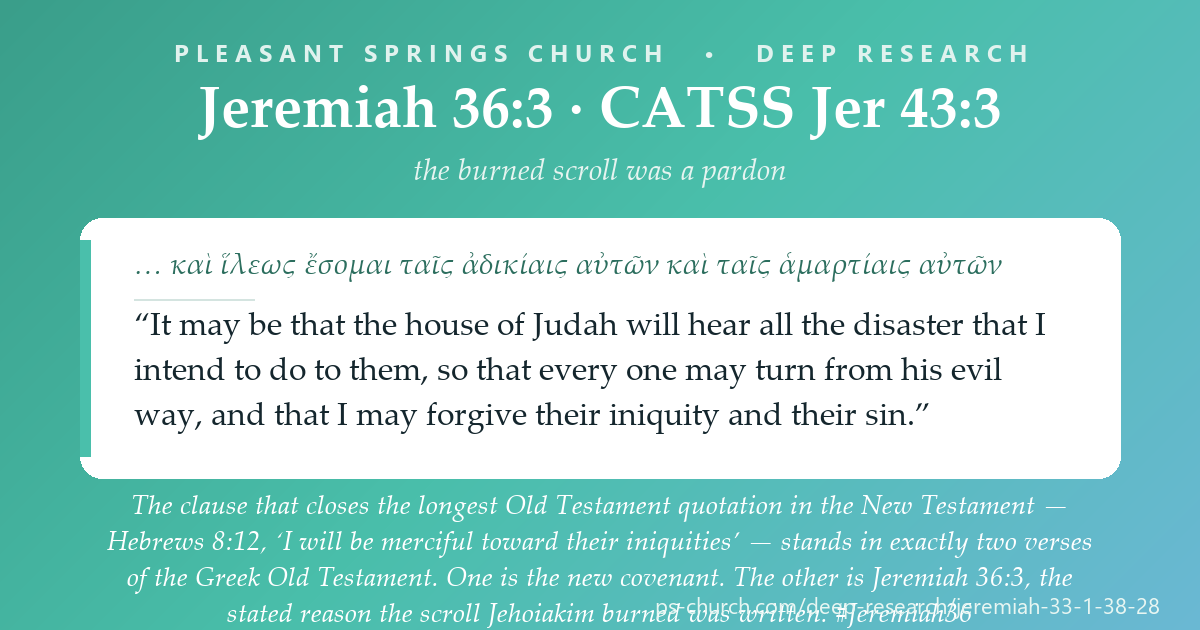
units screened here: the new covenant, and Jeremiah 36:3, the stated reason the burned
scroll was written. In Hebrew those two verses share two words. The second six lands on
Revelation 6:8, and it is capped by a word the Greek does not have. Along the way:
thirteen Hebrew verses the Greek does not carry at all; a phrase that occurs nine times in the Bible and
never outside this book; and four counter-examples printed against the page’s own findings,
starting with the fact that its 148 Hebrew rows contain no zeros.
See the method →
Jeremiah 33:1–38:28 (selections)
Hebrew · Greek (CATSS / Rahlfs) · ESVEvery row here was chosen by a measurement, not by a theme. 33:1 and 38:28 are printed because they are the two ends of a phrase that occurs nowhere outside this book. 33:15–16 is printed because the Greek does not have it. 36:2–3 and 38:2 are the two deepest Greek rows on the page and they are tied at six. 34:11 is printed because the Greek is half the length. 36:23 is printed because it carries a word that stands nowhere else in the Greek Old Testament. Where the two columns say different things, both are printed and neither is corrected.
The Shape of the Passage
Inclusio — one prison yard around a sequence that is out of date orderThese six chapters are the last dark stretch in the middle of the book. In front of them stands the new-covenant oracle at 31:31–34, whose closing line is the sentence this page’s central measurement runs into. Behind them stands the potter’s house and the night in the stocks at 16:1–20:18. What changes here is the genre: for the first time the book is mostly narrative, and mostly about writing.
Author
These chapters know how a book gets made, because they are about one being made. Chapter 36 names the writing surface, the dictation, the reading, the audience, the storage room, the blade, the brazier, and the second copy. The Hebrew word for the scroll, מְגִלָּה, stands fourteen times in the book of Jeremiah, and all fourteen are in this one chapter. The Greek word that answers it, χαρτίον with its by-form χάρτης, stands fourteen times between them in the Greek Old Testament held here — and all fourteen are in this one chapter. No other chapter in either corpus is this interested in stationery.
And the author is not the man holding the pen. Baruch son of Neriah writes; Jeremiah dictates; Jehudi reads; the king burns. Four men handle the same words and only one of them composed them. Whatever theory anyone holds about how the book of Jeremiah reached its present shape, chapter 36 is the book’s own account of being edited, and its last clause is “and many similar words were added to them.”
He repeats himself, and the screen can see it. Twenty-one verses in these six chapters reach six or more consecutive Hebrew words shared with somewhere else, and nineteen of the twenty-one land only inside the book of Jeremiah — 34:2 with 32:3 at eleven, 33:11 with 25:10 at nine, 34:20 with 16:4 at seven. The two that leave the book are 33:4 and 34:13, and both leave it by way of a messenger formula.
Audience
People inside a city with the siege lines up. Jeremiah 34:7 names the last two fortified towns still holding: Lachish and Azekah. A soldier writing from a guard post in that same decade says he is watching for the fire-signals of Lachish because he can no longer see Azekah. The audience for chapter 38 is a population being told that leaving the city is the only way to survive it — which is exactly why four officials call the sentence treason and get permission to drop the man who said it down a shaft.
People with slaves, in a city short of food. The emancipation of chapter 34 was sworn in the temple under oath and reversed as soon as the Babylonians pulled back to meet the Egyptian army. The text does not say the motive. It says what was done, and it says what God calls it: the profaning of his name. The audience is a class of people who found a religious act cheap while it was expensive to keep.
And later, people reading it in Greek in another country. The Greek Jeremiah held here is about an eighth shorter than the Hebrew and puts the oracles against the nations in a different place; inside this passage the reordering has already happened, so every chapter number is shifted by seven, and the biggest single difference is that thirteen verses of chapter 33 are simply not there. A Greek-reading congregation met a Jeremiah with no righteous Branch in chapter 33, and this page prints both texts without ranking them.
Orient on scribes and scroll-making, on debt-slavery and the Jubilee, on the Rechabites, on Judah’s last two kings, on cisterns, and on the two editions of the book of Jeremiah.
Search by topic: scribe (sopher); writing and writing materials; scroll, book; Baruch son of Neriah; seal impressions (bullae); Jehoiakim; Jehoiachin / Coniah; Zedekiah; manumission; slavery, Hebrew slaves; Jubilee; Sabbatical year; Rechabites; Jonadab son of Rechab; Nazirite; cistern; Lachish; Azekah; Ebed-melech; Cush, Cushites; eunuch; court of the guard; Septuagint of Jeremiah; Jeremiah, Book of (text and versions).
Which articles are relevant?
- Anchor Bible Dictionary — “Jeremiah, Book of” (especially the section on the two editions), “Scribe,” “Writing and Writing Materials,” “Baruch, Son of Neriah,” “Slavery (Old Testament),” “Jubilee, Year of,” “Rechabites,” “Lachish,” “Azekah,” “Cistern,” “Ebed-melech,” “Eunuch,” “Zedekiah,” “Jehoiakim.”
- Dictionary of the Old Testament: Prophets (IVP) — “Baruch,” “Writing and Prophecy,” “Social Justice,” “Text and Textual Criticism,” which is where the shorter Greek Jeremiah is handled.
- The New Interpreter’s Dictionary of the Bible — “Jeremiah, Book of,” §§ on chapters 26–45; “Scroll”; “Ostracon”; “Prison.”
- Where the dictionaries disagree, and the page says so rather than choosing: whether the shorter Greek Jeremiah reflects an earlier Hebrew edition or a translator’s abridgement; whether Jeremiah 33:14–26 is a late Hebrew addition or an early Greek loss; whether the Rechabites were a guild of metalworkers, a nomadic clan, or a religious order; whether the manumission of chapter 34 was a Sabbatical-year observance, a Jubilee, or an emergency wartime measure with no legal precedent at all. None of the four is decidable from any corpus held here.
The one thing to fix before reading further:
Chapter 36 is not a story about a king who did not like a sermon. Read 36:3 before 36:23. The scroll is written for a stated purpose, and the purpose is the last clause of verse 3: that I may forgive their iniquity and their sin. The document Jehoiakim shreds is, on the text’s own account, an offer of pardon issued in writing. That is why this page prints 36:2–3 as one row rather than starting at the fire.
And chapter 34 is not a story about a king who broke a promise to God. It is a story about a city that swore in the temple to free its slaves and then re-enslaved them the moment the pressure lifted — and the sentence in 34:17 is built out of the very word they would not say. The two chapters are the same shape: a release offered, and cancelled.
A potsherd from a burning guardroom that names the same two towns Jeremiah 34:7 names; a Babylonian ration list that names the king Jeremiah 37:1 says Zedekiah replaced; and what the Second-Temple world did with Baruch and his scroll.
Ancient texts are witnesses to the world around Scripture. They are never levelled with it. Everything quoted below was read at first hand from the editions named — Pritchard’s ANET for the Hebrew ostraca and the Babylonian tablets, the CATSS Greek files on this disk for Baruch and 2 Maccabees.
Lachish and Azekah — checked at first hand:
The Lachish Ostraca are twenty-one inscribed potsherds — eighteen found in 1935 and three more in 1938 — from the burnt gate-tower of Lachish. Pritchard’s editors place them “immediately before the beginning of the Chaldean siege of Lachish, perhaps in the autumn of 589 (or 588) B.C.,” and describe them as “the only known corpus of documents in classical Hebrew prose.” Ostracon IV ends like this:
“And let (my lord) know that we are watching for the signals of Lachish, according to all the indications which my lord hath given, for we cannot see Azekah.”Lachish Ostracon IV — Pritchard, ANET, p. 322
And Jeremiah 34:7 reads: “… against Jerusalem and against all the cities of Judah that were left, Lachish and Azekah, for these were the only fortified cities of Judah that remained.”
Two documents, the same two towns, the same decade, and one of them written by somebody watching the fire-signals go out. The page claims exactly that and no more. It does not claim the ostracon refers to the biblical verse, or that either writer knew the other. What it establishes is that Jeremiah 34:7 is describing a real military situation in the terms the soldiers themselves used, and that the situation was already bad enough that Azekah had gone dark.
The scribal world of chapter 36 — checked at first hand:
Chapter 36 turns on somebody being able to write to dictation and somebody else being able to read aloud. Ostracon III, from the same guardroom, shows what that skill was worth and how touchy people were about it:
“And as for what my lord said, ‘Dost thou not understand?—call a scribe!’, as Yahweh liveth no one hath ever undertaken to call a scribe for me … And as for the letter of Tobiah, servant of the king, which came to Shallum son of Jaddua through the prophet, saying, ‘Beware!’, thy servant hath sent it to my lord.”Lachish Ostracon III — Pritchard, ANET, p. 322
An officer who can read is insulted by the suggestion that he needs a scribe, and in the same letter he forwards a warning that came ‘through the prophet.’ The prophet is not named and the identifications in the scholarly literature are contested; this page does not propose one. What the ostracon shows is a world in which written messages from prophets circulated through military channels and were passed upward — which is precisely the mechanism of Jeremiah 36:11–20, where a scroll read in the temple reaches the secretary’s chamber and then the king within a single afternoon.
And one line from the same collection lands on Jeremiah 38:4 more exactly than on anything else in the book. Ostracon VI complains that letters coming out of Jerusalem are “not good, (but) to weaken our hands [and to sla]cken the hands of the m[en] who are informed about them” (ANET, p. 322) — and the charge four officials bring against Jeremiah in 38:4 is that הוּא־מְרַפֵּא אֶת־יְדֵי אַנְשֵׁי הַמִּלְחָמָה, he is slackening the hands of the men of war. The same idiom, the same decade, the same complaint, and neither document names the other. This shelf prints the same ostracon on the Jeremiah 16–20 page against 18:18, and says so here rather than presenting it as new; the point is that the phrase was ordinary military language, which is exactly why it is not evidence of contact.
The king Jeremiah 37:1 says Zedekiah replaced — checked at first hand:
Jeremiah 37:1 begins: “Zedekiah the son of Josiah, whom Nebuchadnezzar king of Babylon made king in the land of Judah, reigned instead of Coniah the son of Jehoiakim.” Coniah is Jehoiachin, deported in 597. Administrative tablets excavated at Babylon list oil deliveries to prisoners and dependants of the royal household, identified by name and nationality:
“10 (sila of oil) to … [Ia]-’-kin, king of Ia[…] … 2½ sila (oil) to [… so]ns of the king of Judah (Ia-a-hu-du); 4 sila to 8 men from Judah … 10 (sila) to Ia-ku-u-ki-nu, the son of the king of Ia-ku-du (i.e. Judah); 2½ sila for the 5 sons of the king of Judah”Babylon tablets 28178 and 28186 — Pritchard, ANET, p. 308
The deposed king of Judah drawing rations in Babylon, by name, on a Babylonian oil ledger. The Greek of Jeremiah 44:1 (MT 37:1) does not have Coniah at all — it reads that Zedekiah reigned ἀντὶ Ιωακιμ, in place of Jehoiakim. The two texts name different predecessors and the page prints both without choosing. The tablet settles nothing about which reading is original; it establishes that the man in the Hebrew reading was a real prisoner with a food allowance.
What the Second-Temple world did with Baruch and his scroll:
Two witnesses, both read at first hand from the Greek files on this disk, and both historical witnesses rather than Scripture on the Pleasant Springs canon.
The book of Baruch opens by re-running Jeremiah 36 with a different ending. “And these are the words of the book which Baruch son of Neriah … wrote in Babylon … And Baruch read the words of this book in the ears of Jechoniah son of Joakim king of Judah and in the ears of all the people who came to the book … and in the ears of all the people from the least to the greatest … And they wept and fasted and prayed before the Lord” (Baruch 1:1–5). Same scribe, same act, same audience of ‘all the people’ — and this time they weep and fast instead of burning it. The verbatim contact between Baruch 1:3 and the Greek of Jeremiah 43:10 (MT 36:10) measures five consecutive words, ἐν ὠσὶ παντὸς τοῦ λαοῦ, “in the ears of all the people.” The page reports the five and asserts nothing about who used whom.
2 Maccabees remembers Jeremiah as the man who hid the tent, the ark and the altar of incense in a cave on Nebo, and it ends the story with a word this page has been counting: the place will stay unknown ἕως ἂν συναγάγῃ ὁ θεὸς ἐπισυναγωγὴν τοῦ λαοῦ καὶ ἵλεως γένηται — “until God gathers the gathering of the people and becomes merciful” (2 Maccabees 2:7). More than four centuries after the cistern, the prophet of the burned scroll is remembered as the man who put things away until God should be merciful.
What a cistern was, and what this page cannot show you:
A Judean cistern of this period is normally cut down through the limestone as a narrow neck opening into a bell-shaped chamber, and plastered so it will hold winter runoff. That shape explains both halves of 38:6: a man can be lowered through the neck on ropes and cannot climb back out of the belly, and the silt that settles at the bottom of a dry one is deep. No cistern, no archaeological report and no excavation photograph is held in any corpus on this disk. The description above is standard in the literature and is offered as background, not as a measurement, and Stage 5 lists it among the things this page could not check.
Six words and phrases, each with a number attached, and each number produced by an exhaustive search rather than a lexicon entry.
Counts on the Hebrew side are exhaustive over the 23,204 verse units of the Masoretic corpus held here, on consonantal word forms with the qere read. Counts on the Greek side are exhaustive over 30,348 verse units — the 30,637 units of the 64 CATSS files on disk, less the Odes — and over all 7,927 verses of the Greek New Testament.
22 occurrences in the Hebrew Bible, and fourteen of them are in Jeremiah 36 — vv. 2, 4, 6, 14 (twice), 20, 21, 23, 25, 27, 28 (twice), 29, 32. The other eight are Ezekiel 2:9 and 3:1–3, Zechariah 5:1–2, Psalm 40:7 (MT 40:8) and Ezra 6:2. One chapter owns nearly two-thirds of the word. (Four further forms that a bare consonantal search returns — 2 Samuel 15:12, Proverbs 11:13, Proverbs 27:5, Job 12:22 — are the unrelated root “to uncover” and a place-name, and are excluded by hand.)
Forms of χαρτ- stand 15 times in the whole 30,348-unit Greek Old Testament screened here, and 14 of the 15 are in Greek Jeremiah 43 (MT 36); the fifteenth is χαρτηρίαν at 3 Maccabees 4:20. In the Greek New Testament the word stands once: 2 John 12, “I would rather not use paper and ink.”
In the sense “release”, seven occurrences: Leviticus 25:10, Isaiah 61:1, Ezekiel 46:17, and Jeremiah 34:8, 34:15, 34:17 twice. Four of the seven are in Jeremiah 34. (A homonym meaning “swallow” stands at Psalm 84:3 and Proverbs 26:2, and “flowing” myrrh at Exodus 30:23; those three are excluded. The Psalm is 84:3 in English and 84:4 in the Hebrew.)
49 occurrences in the Greek Old Testament files held here, heavily concentrated in Leviticus 25 and 27 and Deuteronomy 15 — the Jubilee and the sabbatical remission. (Four of the 49, at 2 Samuel 22:16, Joel 1:20, Joel 4:18 and Lamentations 3:48, are the same noun in its other sense, a channel of water.) Four of the 49 are in Greek Jeremiah 41 (MT 34). In the Greek New Testament the noun stands 17 times in 16 verses and means forgiveness in fifteen of them; the two exceptions are both in Luke 4:18, reading Isaiah 61:1 and Isaiah 58:6 aloud, where it is release.
λάκκος stands 97 times in the Greek Old Testament files held here: eight for Joseph’s pit (Genesis 37 and 40:15), twenty for the lions’ den of Daniel 6 across the two Greek Daniels and sixteen more for the second lions’ den in Bel and the Dragon, and seven in Greek Jeremiah 45 (MT 38). It does not occur once in the 7,927 verses of the Greek New Testament.
Two occurrences in the 30,348 Greek Old Testament verse units screened, and both are in the same verse — Jeremiah 45:6 (MT 38:6), where it renders טִיט. One occurrence in the Greek New Testament: 2 Peter 2:22, the washed sow returning to wallow in it. Three occurrences in two corpora, and the page claims no link between them.
The count this page turns on: where ἵλεως ἔσομαι ταῖς ἀδικίαις αὐτῶν stands
Hebrews 8 quotes Jeremiah at greater length than any other Old Testament passage is quoted anywhere in the New Testament. Its last line, Hebrews 8:12, is ὅτι ἵλεως ἔσομαι ταῖς ἀδικίαις αὐτῶν, καὶ τῶν ἁμαρτιῶν αὐτῶν οὐ μὴ μνησθῶ ἔτι. Searched exhaustively over the 30,348 Greek Old Testament verse units screened here, the sequence ἵλεως ἔσομαι ταῖς ἀδικίαις αὐτῶν stands in exactly two verses:
| Greek verse | Hebrew verse | run against Hebrews 8:12 | what the verse is |
|---|---|---|---|
| Jeremiah 38:34 | MT 31:34 | 14 | the last line of the new covenant — the verse Hebrews is quoting |
| Jeremiah 43:3 | MT 36:3 | 6 (tie band 1) | the stated reason the scroll was written — the scroll Jehoiakim burned |
Widen the search to ἵλεως ἔσομαι alone and it returns five verses in the whole Greek Old Testament held: 2 Chronicles 7:14, Jeremiah 5:1, Jeremiah 27:20 (MT 50:20), and those two. Narrow it by one more word and there are two.
And in Hebrew the two verses barely touch. Jeremiah 36:3 against Jeremiah 31:34 measures two consecutive words, לַעֲוֺנָם וּלְחַטָּאתָם, “their iniquity and their sin” — because 31:34 reads אֶסְלַח and 36:3 reads וְסָלַחְתִּי, two different forms of one verb, and a run of whole word forms breaks between them. The Greek renders both with the same three words and the run runs. The Greek makes audible a connection the Hebrew forms conceal. The page states that and stops: it does not say the translator saw the link, that the link was intended, or that anyone quoting Hebrews 8:12 had chapter 36 anywhere in mind.
The release that was proclaimed, cancelled, and re-issued as a sentence
דְּרוֹר is a legal word with one home: Leviticus 25:10, the Jubilee — “proclaim liberty throughout the land to all its inhabitants.” The Greek renders it ἄφεσις there and in every other “release” verse. Here is the whole distribution of the Hebrew word, with what the Greek does at each:
| verse | Greek | what is released |
|---|---|---|
| Leviticus 25:10 | ἄφεσις | land, debts and persons, every fiftieth year |
| Isaiah 61:1 | ἄφεσις | captives — the verse read aloud in Nazareth, Luke 4:18 |
| Ezekiel 46:17 | ἄφεσις | a gift of land returning to the prince |
| Jeremiah 34:8 | ἄφεσις | slaves — proclaimed under oath in the temple |
| Jeremiah 34:15 | ἄφεσις | the same, described as “right in my eyes” |
| Jeremiah 34:17 | ἄφεσις | “you did not proclaim it” |
| Jeremiah 34:17 | ἄφεσις | “behold, I proclaim to you a release — to the sword, to the plague, to the famine” |
Four of the seven are in one chapter, and the fourth of the four is the word turned inside out. In the Greek New Testament ἄφεσις stands seventeen times in sixteen verses, and means the forgiveness of sins in every case but the two in the Nazareth reading. Jeremiah 34 is therefore the one chapter in either Testament where an ἄφεσις is granted, withdrawn, and then handed back as a sentence. The page reports the distribution; it does not claim that any New Testament writer is playing on this chapter.
One more count, because it holds the six chapters together:
The phrase בַּחֲצַר הַמַּטָּרָה, “in the court of the guard,” stands in nine places in the 23,204-unit Masoretic corpus, and all nine are in Jeremiah: 32:2, 32:12, 33:1, 37:21 (twice), 38:6, 38:13, 38:28 and 39:15. The noun מַטָּרָה occurs elsewhere only as a target to shoot at (1 Samuel 20:20, Job 16:12, Lamentations 3:12) and as a gate of the post-exilic wall (Nehemiah 3:25, 12:39). The prison yard is a Jeremiah location and nothing else in the Hebrew Bible happens there.
Six of the nine are inside this passage — 33:1, 37:21 twice, 38:6, 38:13 and 38:28 — and three of them are the passage’s first verse, its cistern, and its last verse. The cistern of 38:6 is itself in the court of the guard — the shaft he is dropped into is in the yard he is already confined to, which is why chapter 38 can end with him back where chapter 33 began without anyone unlocking a door. The Greek keeps all three: ἐν τῇ αὐλῇ τῆς φυλακῆς, five consecutive words shared between the opening and closing verses of the passage.
Two screens, run on this disk this week, with every run reported beside its tie band — and four counter-examples printed against the page’s own findings.
Runs are contiguous whole word forms, never lemmas and never roots. The Hebrew screen ran each of the 148 Masoretic verses of Jeremiah 33–38 against every other verse of the 23,204-unit corpus, minus its own chapter. The Greek screen ran each of the 135 CATSS verse units of Jeremiah 40–45 — which is the same passage — against all 7,927 verses of the SBLGNT, with MorphGNT’s own spelling equivalences applied (ou / ouk / ouch, ek / ex, the movable nu). Figures here are higher than any run figure published on this shelf before 30 August 2026 and were re-measured, not copied.
The Greek screen: two sixes, and they are tied
Across the 135 CATSS rows against 7,927 New Testament verses: all 135 reach two, 110 reach three, 32 reach four, 3 reach five, 2 reach six, and nothing reaches seven. The whole top of the table is short:
| row (LXX / MT) | run | tie band | New Testament verse | shared words |
|---|---|---|---|---|
| Jer 43:3 / MT 36:3 | 6 | 1 | Hebrews 8:12 | ἵλεως ἔσομαι ταῖς ἀδικίαις αὐτῶν καί |
| Jer 45:2 / MT 38:2 | 6 | 1 | Revelation 6:8 | ἐν ῥομφαίᾳ καὶ ἐν λιμῷ καί |
| Jer 45:11 / MT 38:11 | 5 | 1 | Acts 9:17 | καὶ εἰσῆλθεν εἰς τὴν οἰκίαν |
| Jer 40:10 / MT 33:10 | 4 | 1 | Acts 7:7 | ἐν τῷ τόπῳ τούτῳ |
| Jer 43:12 / MT 36:12 | 4 | 7 | seven Gospel and Acts verses | εἰς τὸν οἶκον τοῦ |
| Jer 43:11 / MT 36:11 | 2 | 215 | Mark 6:14 and 214 others | καὶ ἤκουσεν (the shallowest row on the page) |
Take the five off the table first. Jeremiah 45:11 is Ebed-melech going into the palace to fetch rags; Acts 9:17 is Ananias going into the house where Saul is blind. “And he went into the house” is a sentence any narrative in Greek will produce. It has a tie band of 1 and it is still an accident. A band of 1 tells you the phrase is rare; it does not tell you the contact is meaningful. This page prints the five before the sixes so that nobody reads the band as proof.
Six into Hebrews 8:12 — what it is, and what it is not
What it is. Hebrews 8:8–12 quotes Jeremiah 31:31–34 at length and signals the quotation. Its closing line, Hebrews 8:12, matches the Greek of Jeremiah 38:34 (MT 31:34) at fourteen consecutive words. Nobody needs a screen to see that. What the screen adds is that the same clause — ἵλεως ἔσομαι ταῖς ἀδικίαις αὐτῶν — also stands, in exactly one other place in the 30,348 Greek Old Testament verse units held here, at Jeremiah 43:3, which is MT 36:3, which is the sentence that says why the scroll was written. The pardon that closes the new covenant and the pardon the burned scroll was issued to offer are the same Greek sentence.
What it is not. It is not a claim that Hebrews has chapter 36 in view; the quotation is marked, continuous, and plainly from chapter 31. It is not a claim about direction: nothing here says the translator of chapter 36 borrowed from chapter 31, or the reverse, or that one hand harmonised them. And it is not visible in Hebrew at all — there the two verses reach two words. The finding is a finding about the Greek, and Stage 5 says what would overturn it.
Six into Revelation 6:8 — and the counter-example that caps it
Four named officials hear this sentence (38:1) and two verses later ask the king for the prophet’s life on the strength of it: “Let this man be put to death, for he is weakening the hands of the soldiers who are left in this city” (38:4). In Greek the same verse shares six consecutive words with the fourth horseman:
| text | |
|---|---|
| Jer 45:2 (MT 38:2) | … ἀποθανεῖται ἐν ῥομφαίᾳ καὶ ἐν λιμῷ καὶ ὁ ἐκπορευόμενος … |
| Revelation 6:8 | … ἀποκτεῖναι ἐν ῥομφαίᾳ καὶ ἐν λιμῷ καὶ ἐν θανάτῳ … |
The run stops on a word the Greek Jeremiah does not have. The Hebrew of 38:2 has the full triad בַּחֶרֶב בָּרָעָב וּבַדָּבֶר — sword, famine, plague — which stands in seven verses of the Hebrew Bible, six of them Jeremiah’s (27:13, 29:18, 38:2, 42:17, 42:22, 44:13) and one Ezekiel’s (6:11). The Greek of 45:2 has only sword and famine. Revelation 6:8 goes on καὶ ἐν θανάτῳ, which is the standing Greek rendering of the missing word.
And here is the counter-example, printed against this page’s own finding. The full six-word sequence ἐν ῥομφαίᾳ καὶ ἐν λιμῷ καί stands in exactly two of the 30,348 Greek Old Testament verse units screened: Jeremiah 45:2, which is on this page, and Jeremiah 51:13 (MT 44:13), which is not. And Jeremiah 51:13 does have the third term. Measured against Revelation 6:8 it reaches eight. The deepest run this passage makes into the New Testament is beaten, in the same book, by a verse thirteen chapters further on. Anyone tempted to build something on the six should build it on the eight first, and then notice that the eight is a stock curse formula and build nothing on either.
The Hebrew screen: 148 rows, and not one of them is a zero
Across the 148 Masoretic verses of Jeremiah 33–38, each screened against the whole corpus minus its own chapter: 22 rows reach two, 50 reach three, 33 reach four, 22 reach five, 11 reach six, 8 reach seven, one reaches nine, and one reaches eleven. None reaches zero.
| row | run | tie band | best match | shared (consonantal) |
|---|---|---|---|---|
| Jeremiah 34:2 | 11 | 1 | Jeremiah 32:3 | כה אמר יהוה הנני נתן את העיר הזאת ביד מלך בבל |
| Jeremiah 33:11 | 9 | 1 | Jeremiah 25:10 | קול ששון וקול שמחה קול חתן וקול כלה קול |
| Jeremiah 34:20 | 7 | 1 | Jeremiah 16:4 | והיתה נבלתם למאכל לעוף השמים ולבהמת הארץ |
| Jeremiah 35:1 | 7 | 9 | Jeremiah 7:1 and eight others | הדבר אשר היה אל ירמיהו מאת יהוה |
| Jeremiah 35:17 · 38:17 | 7 | 2 | each other, and Jeremiah 44:7 | כה אמר יהוה אלהי צבאות אלהי ישראל |
| Jeremiah 36:3 | 6 | 1 | Jeremiah 26:3 | הרעה אשר אנכי חשב לעשות להם |
Read the zero line carefully, because it is the strongest thing on this page and it is a negative. On this screen a row of 0 would mean that the verse shares no two consecutive words with any other verse in the Hebrew Bible. Across the whole book of Jeremiah, screened the same way, 41 of 1,364 verses are such rows — 1:5, 2:21, 5:16, 17:9, 17:12, 18:22 and thirty-five others. At that rate you would expect four or five zeros in 148 verses. There are none. These six chapters are the most thoroughly formulaic stretch in Jeremiah: everything in them is said somewhere else too, and 19 of the 21 rows that reach six or more are matched only inside this book.
Four counter-examples, printed against this page
1. The most famous contrast in chapter 36 is not verbal at all. The standing contrast drawn on 36:24 — “Yet neither the king nor any of his servants who heard all these words was afraid, nor did they tear their garments” — is with 2 Kings 22:11, where Josiah, this king’s father, hears the book and tears his clothes. Measured, Jeremiah 36:24 and 2 Kings 22:11 share one word, the object marker אֵת. The contrast is real and it is thematic; it is not a verbal echo, and this page will not print it as one.
2. Jeremiah 33:15–16 is not a verbatim repeat of 23:5–6. The two Branch oracles are routinely treated as the same text twice. Measured: 33:15 against 23:5 reaches four, and 33:16 against 23:6 reaches two. 33:14 against 23:5 reaches six, tie band 1 — but that six is הנה ימים באים נאם יהוה והקמתי, a formula, not a Branch.
3. A rare word shared is not a link. βόρβορος stands twice in the Greek Old Testament screened, both in Jeremiah 45:6, and once in the Greek New Testament, 2 Peter 2:22. That is a co-occurrence of a rare noun and nothing more. 2 Peter is quoting a proverb about a pig; Jeremiah 38:6 is describing silt at the bottom of a dry shaft. The page prints the count because it is interesting and refuses the inference because it is not warranted.
4. And the same discipline applied to the one that is hardest to resist. Jeremiah 38:7 is the only verse in the 23,204-unit Masoretic corpus that calls one man both הַכּוּשִׁי and סָרִיס — a Cushite and a eunuch. Acts 8:27 is the only verse in the 7,927-verse Greek New Testament that calls one man both Αἰθίοψ and εὐνοῦχος. Two verses, one in each Testament, and each unique in its corpus. The verbatim contact between them is nil, and the Greek of Jeremiah 45:7 does not even carry the word for eunuch — it reads only Αβδεμελεχ ὁ Αἰθίοψ. So a reader of the Greek Jeremiah cannot see the pairing at all. The page reports two counts and draws no line between them. What the Hebrew does say, plainly, is that the one person in six chapters who acts to save the prophet is a foreign eunuch, and a eunuch could not have entered the assembly (Deuteronomy 23:1, MT 23:2), and that 39:16–18 promises him his life.
Where to go next, what this page did not consult, and where it is weakest.
This stage exists to mark the boundary of the method. Everything above was measured on corpora held on one disk. Everything below is either a pointer to work not done here or an admission of a limit.
Where a reader should go next
- Commentaries. William Holladay, Jeremiah 2 (Hermeneia); William McKane, Jeremiah II (ICC); Jack Lundbom, Jeremiah 21–36 and Jeremiah 37–52 (Anchor Yale); Leslie Allen, Jeremiah (OTL); Georg Fischer, Jeremia (HThKAT).
- The two editions of Jeremiah. Emanuel Tov, Textual Criticism of the Hebrew Bible, on the shorter Greek Jeremiah and the Qumran evidence; Hermann-Josef Stipp on the Masoretic surplus; Albert Pietersma and Marc Saunders in NETS on the Greek Ieremias. Jeremiah 33:14–26 is one of the standard test cases in this whole literature and this page prints it with an empty Greek column without joining the argument.
- The manumission of chapter 34. The comparative material on ancient Near Eastern debt-release edicts — the mīšarum proclamations of Old Babylonian kings and the Edict of Ammiṣaduqa — is where this chapter is usually set. None of it was consulted for this page and no claim here rests on it.
- The Lachish letters. Torczyner’s The Lachish Letters (1938) and the bibliography Pritchard prints at ANET p. 322. The reading of Ostracon III’s “the prophet” is contested and this page does not adopt any identification.
- Baruch and the bullae. The seal impressions read as “Berekhyahu son of Neriyahu the scribe” are unprovenanced and their authenticity is disputed in print. They were not examined for this page and nothing here rests on them.
What this page could not check — stated plainly
No Qumran text is held here, and that is the single most important gap. The status of the shorter Greek Jeremiah turns on the Hebrew scrolls from Cave 4, which are reported to preserve a short Hebrew text agreeing with the Greek against the Masoretic Text. This page prints Jeremiah 33:15–16 with an empty Greek column and cannot say whether any Hebrew manuscript ever lacked those verses. Anyone wanting that answer must go to the Qumran editions; this page has not.
The Greek here is Rahlfs, not Ziegler. Every Greek figure on this page is a figure about the CATSS digitisation of Rahlfs’s Septuaginta. No Göttingen apparatus is held, so no variant is known to this page and nothing is claimed from one. In particular, the absence of καὶ ἐν θανάτῳ at Jeremiah 45:2, which is what caps the Revelation 6:8 run at six, is one edition’s reading, and the finding would have to be re-run against Ziegler before anyone built on it.
The Greek New Testament here is the SBLGNT via MorphGNT. Hebrews 8:12 and Revelation 6:8 are that edition’s text. No New Testament apparatus was consulted, and Revelation in particular has a textual history this page has not touched.
The date disagreement at 36:9 is reported and not solved. The Hebrew dates the fast at which the scroll was read to the fifth year of Jehoiakim; the Greek of 43:9 reads ἐν τῷ ἔτει τῷ ὀγδόῳ, the eighth year. The page prints the difference and cannot adjudicate it. The same goes for 37:1, where the Hebrew has Zedekiah succeed Coniah and the Greek has him succeed Jehoiakim, and for 36:32, where the Hebrew has Jeremiah take the second scroll and the Greek has Baruch take it.
No Akkadian or Hebrew epigraphic corpus is held. The Lachish ostraca and the Babylon ration tablets in Stage 2 were read in Pritchard’s English translations, not in the original languages, and were not screened against anything. Those comparisons are historical observations, not measurements, and neither ostracon names Jeremiah.
No archaeological report was consulted. The description of a bell-shaped plastered cistern in Stage 2 is standard background from the literature and was not verified against any excavation report held here.
Baruch and 2 Maccabees are used as historical witnesses, never levelled with Scripture. The five-word contact between Baruch 1:3 and Greek Jeremiah 43:10 is a measurement; everything said about what Baruch 1 is doing with Jeremiah 36 is an observation about content and asserts no direction.
No commentary was consulted at first hand. The works listed above are named as where a reader should go. No claim on this page rests on any of them.
The ESV column was typed from the printed 2016 text edition, because no ESV API key has ever been issued to this site. Any transcription error is ours.
Where the page is weakest. The Hebrews 8:12 finding is a finding about one Greek edition and about a five-word window. Widen it backwards by one word and it collapses to a single verse either way — LXX 38:34 has ὅτι in front of the clause and LXX 43:3 has καί. Forwards the two hold together for exactly one more word, καί, which is where the run of six stops, and part at the word after it (τῶν against ταῖς). The pair is a six-word window and no wider. Narrow the corpus to the books CATSS holds and the “30,348” becomes an argument about which files are on this disk rather than about the Septuagint. The honest form of the claim is: in the Greek Old Testament text held here, that clause stands twice, and one of the two is the burned scroll’s stated purpose. Everything beyond that sentence is the reader’s, and a critic should press exactly there first.
A pardon issued in writing and cut up with a penknife; a release sworn and revoked; and a man pulled out of the mud with old rags under his arms.
Name what you learned, why it matters, and one concrete response.
What should we carry away — and do?
- The scroll was an offer, not a threat. Jeremiah 36:3 states the reason it was written: so that every one may turn from his evil way, and that I may forgive their iniquity and their sin. The document Jehoiakim shredded three columns at a time was a written pardon. And when it was rewritten it came back longer. Nothing was lost by burning it except the years between.
- Chapter 34 is about the cheapness of a religious act done under pressure. The emancipation was sworn in the temple, in the house that bears God’s name, and reversed when the siege lifted. The word they would not say is the word they got back as a sentence. Any commitment made only while the army is at the wall should be examined before the army leaves.
- The Rechabites are not held up as better believers. They are held up as people who kept one instruction from one dead ancestor for two hundred years without a single revelation to help them. The comparison is deliberately unfair, and that is the point: God has been speaking “persistently” — the Hebrew is rising early and speaking — and it has not produced what Jonadab produced with one sentence.
- The rescue is done by the wrong person, with the wrong materials. Not a priest, not an official, not a prophet: a foreign eunuch from the palace staff, with thirty men, a store-room full of worn-out rags and some rope — and the detail the text keeps is that he told Jeremiah to put the rags under his armpits so the ropes would not cut him. Somebody thought about the pain of the man he was rescuing.
- One concrete response. Find the thing you promised God when you were frightened and have quietly taken back now that you are not. Write it on paper. Either do it this week or tell one other Christian, out loud, that you are not going to. Jeremiah 34 is what the second option looks like when nobody says it out loud.
Jeremiah 38:13 · to share
Hebrew + Greek (CATSS / Rahlfs) + ESVEvery Deep Research page traces its passage across the whole sweep — the Old Testament, the Second-Temple world between the testaments (historical witnesses, not Scripture), and the New Testament. Follow the thread:
Pleasant Springs Church — Deep Research
Research method after Michael S. Heiser’s Bible Research Method (examine dictionaries → ancient literature → important words → textual connections → academic publications → share), with the Pleasant Springs “Author & Audience” foundation. Scripture set in the Hebrew, the Greek editions named on each page and the ESV (Old Testament), and the Greek New Testament and the ESV (New Testament), per the practice of Pleasant Springs Church. Jeremiah 33–38 research grounded in Holladay (Hermeneia), McKane (ICC), Lundbom (Anchor Yale), Allen (OTL) and Fischer (HThKAT), with Tov, Stipp and Pietersma on the Greek Jeremiah and Pritchard’s ANET for the Lachish Ostraca and the Babylon ration tablets. Book name: in the Septuagint this book is Ieremias, Ἰερεμίας; the Hebrew titles it יִרְמְיָהוּ. Text & numbering: Hebrew from the Masoretic Text (Sefaria, Miqra according to the Masorah), vowel-pointed with cantillation not shown and the qere read; Greek from the CATSS digitisation of Rahlfs’s Septuaginta, printed without editorial punctuation and with proper names unaccented; English ESV. ⚠️ THE VERSIFICATION OFFSET, DERIVED FROM THE FILES ON THIS DISK RATHER THAN COPIED FROM A TABLE. Jeremiah is the hardest book on the shelf for numbering, and this passage sits on the far side of the break: the Greek book moves the oracles against the nations to the middle, beginning at MT 25:15 / LXX 32, so from LXX 33 onward every chapter number is shifted. THROUGHOUT THIS PASSAGE THE OFFSET IS EXACTLY +7 AND THE VERSE NUMBERS AGREE. MT 33 = LXX 40, MT 34 = LXX 41, MT 35 = LXX 42, MT 36 = LXX 43, MT 37 = LXX 44, MT 38 = LXX 45. Verse counts measured on disk: Masoretic 26 / 22 / 19 / 32 / 21 / 28; CATSS 13 / 22 / 19 / 32 / 21 / 28. The whole of the difference is in chapter 33, where the Greek file runs from verse 1 to verse 13 and stops: MT 33:14–26 has no Greek counterpart here at all. Everywhere else in these six chapters, Hebrew verse n is Greek verse (n) of the chapter seven higher, and English verse n. Counted, not assumed. Measurements. The Hebrew screen ran all 148 Masoretic verses of Jeremiah 33–38 against the whole 23,204-verse corpus held here, minus the source chapter; runs are contiguous whole consonantal word forms, never lemmas and never roots, with the qere read, cantillation and vowel points removed, final letters folded and maqqef treated as a word separator. On that screen a row of 0 would mean the verse shares no two consecutive words with any other verse in the Hebrew Bible; none of these 148 is such a row, and the page prints Jeremiah’s own book-wide rate of 41 in 1,364, screened identically, beside that zero so that the absence can be judged rather than admired. The Greek New Testament screen ran all 135 CATSS verse units of Jeremiah 40–45 against all 7,927 verses of the SBLGNT via MorphGNT, with the edition’s own spelling equivalences applied (ou / ouk / ouch, ek / ex, the movable nu), so figures here are higher than any run figure published on this shelf before 30 August 2026 and were re-measured rather than copied from a sibling page. On that screen a 0 would mean “shares no word at all”; the lowest row here is Jeremiah 43:11 at 2, tie band 215. Phrase and word counts on the Greek side were exhaustive over 30,348 verse units — the 30,637 units of the 64 CATSS files held, less the Odes, which are excluded from run screens because two of them are New Testament text (Ode 9 is Luke 1, Ode 13 is Luke 2) and ten more are second copies of Exodus 15, Deuteronomy 32, 1 Samuel 2, Habakkuk 3, Isaiah 5, Isaiah 26, Isaiah 38, Jonah 2 and Daniel 3. Every run on this page is reported with its tie band, the run of five into Acts 9:17 is printed as an accident before the two sixes are discussed, and the deeper run the same formula makes from outside the passage — Jeremiah 51:13 into Revelation 6:8 at eight — is printed against this page’s own six. ⚠️ Direction of influence is never asserted. The page says that the clause behind Hebrews 8:12 stands in two Greek Old Testament verses and that one of them is the burned scroll’s stated purpose; it does not say that Hebrews had chapter 36 in view, that one Greek chapter was assimilated to another, that a translator erred, or that the Ebed-melech and Acts 8:27 counts are connected. MT/LXX divergences inside the passage are disclosed rather than smoothed: 33:14–26 (absent from the Greek), 33:11 (the restoration worded differently from the removal verses, so the Greek reversal is inaudible), 34:11 (fourteen Hebrew words against seven Greek), 34:17 (plague rendered θάνατος), 35:14 (a passive in Hebrew, the sons as subject in Greek), 36:2 (Israel in Hebrew, Jerusalem in Greek), 36:9 (fifth year in Hebrew, eighth in Greek), 36:24 (“were not afraid” against “did not seek”), 36:32 (Jeremiah takes the scroll in Hebrew, Baruch in Greek), 37:1 (Coniah in Hebrew, Jehoiakim in Greek), 38:2 (the Greek lacks “and by plague”), 38:7 (the Greek lacks “a eunuch”), 38:12 (the Greek lacks Ebed-melech’s name and the rags) and 38:28 (the Greek lacks the trailing Hebrew clause). Limits are stated in Stage 5 and are load-bearing: no Qumran text is held, so the decisive witnesses at 33:14–26 could not be checked; the Greek is Rahlfs and not Ziegler, so the missing καὶ ἐν θανάτῳ that caps the Revelation run is one edition’s reading; the Greek New Testament is the SBLGNT and no New Testament apparatus was consulted; no Akkadian or Hebrew epigraphic corpus is held, so the Lachish and Babylon material is read in Pritchard’s English and is historical rather than measured, and neither ostracon names Jeremiah; no archaeological report was consulted for the cistern; Baruch and 2 Maccabees are used as historical witnesses, never levelled with Scripture; the commentaries named were not consulted at first hand and no claim rests on them; the date disagreement at 36:9 is reported and not solved; and the ESV column was typed from the printed 2016 text edition because no ESV API key has ever been issued to this site. The literary structure is labelled an inclusio around a sequence, not a chiasm, and the inclusio is the one symmetry claimed, with the measurement printed: בַּחֲצַר הַמַּטָּרָה stands in nine places in the Hebrew Bible, in eight verses and in no book but Jeremiah, and 33:1 and 38:28 are two of them; in Greek the same two verses share five consecutive words. What organises the middle is dating, and the date lines are the text’s own: Zedekiah at 33:1, 34:2 and 34:8; Jehoiakim at 35:1 and 36:1; Zedekiah again at 37:1. Typology is handled per the house position: what the text says, what the New Testament itself draws, and what we see from this side of the cross — with the seeing left to the reader.
Scripture quotations marked ESV are from the ESV® Bible (The Holy Bible, English Standard Version®), © 2001 by Crossway, a publishing ministry of Good News Publishers. ESV Text Edition: 2016. Used by permission. All rights reserved. The ESV text may not be quoted in any publication made available to the public by a Creative Commons license, and the ESV may not be translated in whole or in part into any other language. www.esv.org
|
Did this study bless you today? 💚 Give to Support PS Church100% of gifts go to the General Fund — thank you. |