Six chapters in which the prophet is
right about everything and it changes nothing. The wall is breached in ten Hebrew words. The king is
caught in the plain of Jericho, made to watch his sons die, and then blinded. The governor the Babylonians
appoint is warned that he will be murdered, does not believe it, and is murdered at dinner. The survivors
ask Jeremiah to pray, swear to obey the answer “whether it is good or bad,”
wait ten days for it, hear it, call it a lie, and carry him down into Egypt with them.
This study measures rather than asserts, and the measurement that shapes it is a
negative. Screened against every other verse in the Hebrew Bible,
not one of these 117 verses is a zero row — not one shares fewer than two
consecutive words with somewhere else. Jeremiah’s own book-wide rate is 41 zero rows in 1,364
verses, which predicts three or four here. There are none. These are the least verbally
original chapters in the book, and the reason is countable: 30 of the 32 rows that reach into
2 Kings 25 or Jeremiah 52 stand in chapters 39–41, and 13 of the 19 rows that
reach back into the temple sermon of Jeremiah 7 stand in chapter 44 alone. The passage changes
its vocabulary at the exact verse where the people take their oath. Along the way: the deepest Hebrew run
on the page, eleven words shared with 2 Kings 25:25; ten Hebrew verses the Greek does not have at all; a
goddess the Greek calls a queen in chapter 44 and a host in chapter 7 while keeping her cakes in both;
and eight consecutive Greek words that run from a threat spoken to refugees in Egypt
into the fourth horseman of Revelation 6:8 — printed beside a five-word run into
Luke 2 that means nothing at all, so that neither is read as more than it is.
See the method →
Jeremiah 39:1–44:30 (selections)
Hebrew · Greek (CATSS / Rahlfs) · ESVEvery row here was chosen by a measurement, not by a theme. 39:7 is printed because the Greek does not have it. 41:1 is printed because it is the deepest Hebrew row in the passage and its partner is in another book. 44:13 is printed because it is the deepest Greek row and its partner is the fourth horseman. 44:17 and 44:19 are printed because the Greek keeps one rare word from Jeremiah 7 and loses the other. 44:29 is printed against 44:13, because a five-word run into Luke 2 that means nothing is the best available warning about an eight-word run into Revelation 6. Where the two columns say different things, both are printed and neither is corrected.
The Shape of the Passage
Sequence — two movements with a measured hinge at 42:1–6These six chapters close the story of the book. Behind them stand the temple sermon of Jeremiah 7, whose vocabulary chapter 44 uses more than any other chapter uses it, and the sign-acts of Jeremiah 16–20, of which 43:8–13 is the last. In front of them, on this shelf, stands Revelation 6, where the deepest Greek run in this passage turns up again.
Author
Whoever wrote this down was not trying to make Jeremiah look good. He is right about everything and it changes nothing. He tells them to stay; they go. He is put in a convoy and taken to a country he spent forty years warning them about. The book gives him no vindication scene and no death notice. His last recorded words are an oracle against a Pharaoh, delivered to people who have just told him to his face that he is lying.
And the writing is unusually unoriginal, which is measurable. Across all 117 Masoretic verses of these six chapters, not one is a zero row: every single verse shares at least two consecutive words with some other verse of the Hebrew Bible. Jeremiah’s own book-wide rate is 41 zero rows in 1,364 verses — 3.0 per cent — which would have predicted three or four here. There are none. That is not a flaw. It is what happens when a writer is telling a story that two other biblical books also tell, in vocabulary he has already used himself for forty years.
He is also honest about the parts that make his own side look worse. The Babylonian captain of the guard quotes Israel’s God correctly (40:2–3) and gives the prophet a free choice. The governor who is murdered had been warned and would not believe it. The men who swore the oath at 42:6 are the same men who break it at 43:2, and the text names them.
Audience
Two groups of people who were both wrong about where safety was. One went to Babylon in chains and was told to build houses and plant gardens. One walked to Egypt as free people and was told they would die there. The book that both groups eventually read puts the second group’s story last.
And a much later audience: Jews living in Egypt who could read. There was a Judean military colony at Elephantine in the fifth century with its own temple, and there was a large Greek-speaking Jewish population at Alexandria from the third century on. Jeremiah 44 is a chapter about Judeans in Egypt worshipping a goddess and arguing that it worked. Whoever copied and translated this book in Egypt was copying a chapter about himself.
The women of chapter 44 are the only audience in the book that answers back at length. Their argument is empirical and their theology is not stupid: while we made offerings to the queen of heaven we had plenty of food; since we stopped, we have been consumed by sword and famine. And it is legally careful — 44:19 points out that the husbands knew, which under Numbers 30 makes the vow binding. The text lets them finish.
Orient on the fall of Jerusalem in 586, on Gedaliah and the province of Judah under Babylon, on Tahpanhes and the Judean settlements in Egypt, on the queen of heaven, and on the two editions of the book of Jeremiah.
Search by topic: Jerusalem, fall of; Zedekiah; Nebuchadnezzar II; Nebuzaradan; Gedaliah; Mizpah; Ishmael son of Nethaniah; Johanan son of Kareah; Ammon; Tahpanhes (Daphnae); Migdol; Memphis (Noph); Pathros; Elephantine; Hophra / Apries; queen of heaven; Astarte / Ishtar; Baruch son of Neriah; the Deuteronomistic History; Jeremiah, Book of (text and versions).
Which articles are relevant?
- Anchor Bible Dictionary — “Jeremiah, Book of” (especially the section on the Greek text), “Gedaliah,” “Mizpah,” “Tahpanhes,” “Elephantine,” “Hophra,” “Queen of Heaven,” “Baruch.”
- Dictionary of the Old Testament: Prophets (IVP) — “Exile,” “Jeremiah: Book of,” “Israelite History,” “Text and Textual Criticism,” which is where the shorter Greek Jeremiah is handled.
- The New Interpreter’s Dictionary of the Bible — “Gedaliah,” “Egypt, Jews in,” “Queen of Heaven,” “Ammon, Ammonites.”
- Where the dictionaries disagree, and the page says so rather than choosing: whether Gedaliah was murdered in 586 or some years later; whether the “queen of heaven” is Ishtar, Astarte, a syncretism of both, or a title rather than a name; whether chapters 39–44 are a single composition or a narrative source expanded by a Deuteronomistic editor; and whether the shorter Greek Jeremiah reflects an earlier Hebrew edition or a translator’s abridgement. None of the four is decidable from any corpus held here.
The one thing to fix before reading further:
The people in chapter 42 are not asking a rhetorical question and they are not villains. They had just watched the Babylonian-appointed governor murdered by a man of the royal house, and they had every reason to expect a reprisal column marching south. Going to Egypt was the sensible thing to do. Egypt was two weeks’ walk away, it had grain, and there were Judeans there already. What the chapter is about is not stupidity; it is about what happens when you ask for guidance you have already decided not to take — and 41:17 says plainly that they were camped “intending to go to Egypt” before they asked. Read 42:1–6 and 41:17 together, in that order, and the ten days of waiting in 42:7 become the most uncomfortable verse in the passage.
A Hebrew letter written in Jeremiah’s own decade about an officer going down to Egypt; and three Second-Temple books that could not agree on where Jeremiah and Baruch ended up.
Ancient texts are witnesses to the world around Scripture. They are never levelled with it. Everything quoted below was read at first hand from the editions named — Pritchard’s ANET for the Hebrew ostraca, and the CATSS Greek files on this disk for Baruch, the Letter of Jeremiah and 2 Maccabees.
A Hebrew letter from Jeremiah’s own decade — read at first hand:
The Lachish Ostraca are inscribed potsherds found in the burnt guardroom of the Lachish gate, dated by Pritchard’s editors to “immediately before the beginning of the Chaldean siege of Lachish, perhaps in the autumn of 589 (or 588) B.C.” They are, in that edition’s words, “the only known corpus of documents in classical Hebrew prose.” Two of them belong beside this passage.
“And it hath been reported to thy servant, saying, ‘The commander of the host, Coniah son of Elnathan, hath come down in order to go into Egypt; and unto Hodaviah son of Ahijah and his men hath he sent to obtain … from him.’”Lachish Ostracon III — Pritchard, ANET, p. 322
“And let (my lord) know that we are watching for the signals of Lachish, according to all the indications which my lord hath given, for we cannot see Azekah.”Lachish Ostracon IV — Pritchard, ANET, p. 322
Ostracon III is the traffic of Jeremiah 42–43 in the mouth of somebody who is not in the Bible. A senior officer, in the last months before the siege, is going down to Egypt. That road was open, it was used, and it was used by the military. The page does not claim the ostracon refers to anyone in Jeremiah. The name Coniah son of Elnathan is not in the biblical text and the identification is contested. What it establishes is the social fact: going to Egypt was an ordinary option that ordinary commanders took.
Ostracon IV is the last minutes of Jeremiah 39:1. Jeremiah 34:7 says that the Babylonian army was fighting against Jerusalem “and against all the cities of Judah that were left, Lachish and Azekah, for these were the only fortified cities of Judah that remained.” A man in a signal post writes that he can no longer see Azekah. That is a fortress chain going dark, in real time, in Hebrew.
Where did Baruch end up? Two Second-Temple books, read at first hand:
Jeremiah 43:6–7 says Baruch went to Egypt. The Greek of 50:6–7 on this disk names him in the convoy list: … καὶ Ιερεμιαν τὸν προφήτην καὶ Βαρουχ υἱὸν Νηριου … καὶ εἰσῆλθον εἰς Ταφνας — “and Jeremiah the prophet and Baruch son of Neriah … and they came into Tahpanhes.”
The book of Baruch opens by putting him somewhere else.
“And these are the words of the book which Baruch son of Neriah … wrote in Babylon, in the fifth year, on the seventh of the month, at the time when the Chaldeans took Jerusalem and burned it with fire.”Baruch 1:1–2, read from the CATSS Greek text held here
Both cannot be geography. The page does not adjudicate and does not need to: Baruch is a historical witness on the Pleasant Springs canon and Jeremiah is Scripture. What the juxtaposition shows is that within two or three centuries the question “what happened to Jeremiah’s secretary” had at least two answers in circulation, and the one that got written into a book put him with the exiles who obeyed rather than with the refugees who did not.
The Letter of Jeremiah does the same thing in the opposite direction, opening διὰ τὰς ἁμαρτίας ἃς ἡμαρτήκατε ἐναντίον τοῦ θεοῦ ἀχθήσεσθε εἰς Βαβυλῶνα αἰχμάλωτοι — “because of the sins you have committed before God you will be led away to Babylon as captives” — and then spending sixty-odd verses proving that foreign gods cannot save. That is chapter 44’s argument, addressed to the other exile.
What the Second Temple did with Jeremiah after the fall:
2 Maccabees gives him an afterlife the book of Jeremiah does not. Read at first hand from the Greek on this disk:
“And Jeremiah came and found a cave-dwelling, and he brought in there the tent and the ark and the altar of incense, and he blocked up the door. And some of those who followed came up to mark the way, and they could not find it … ‘The place shall be unknown until God gathers the congregation of the people together and becomes merciful.’”2 Maccabees 2:5–7, CATSS Greek text
Nothing of this is in Jeremiah 39–44, and that is the point. The canonical chapters end with the prophet losing an argument in a foreign country. Two centuries later he is remembered as the man who saved the furniture of the temple and hid it where nobody could find it. The tradition softened what the book leaves hard. The page reports the two pictures and does not harmonise them.
The queen of heaven and the cakes:
Jeremiah 7:18 describes an assembly line: children gather wood, fathers light the fire, women knead dough “to make cakes for the queen of heaven.” Chapter 44 shows the same practice still running, in Egypt, forty years later, defended out loud. Who she was is not settled and this page does not settle it. The usual candidates are Ishtar (whose Akkadian titles include sharrat shame, queen of heaven), the West Semitic Astarte, and a local fusion. No Akkadian or Ugaritic corpus is held here, so no title was checked at first hand, and Stage 5 says so. What can be measured is what the Greek translator did with the Hebrew phrase, and he did two different things in the same book — see Stage 3.
Six words and phrases, each with a number attached, and each number produced by an exhaustive search rather than a lexicon entry.
Counts on the Hebrew side are exhaustive over the 23,204 verse units of the Masoretic corpus held here, on consonantal word forms with the qere read. Counts on the Greek side are exhaustive over 30,348 verse units — the 30,637 units of the 64 CATSS files on disk, less the Odes — and over all 7,927 verses of the Greek New Testament.
Six verses in the entire Hebrew Bible, and all six stand in these chapters — 40:15, 42:15, 42:19, 43:5, 44:12, 44:28. It is not used before 40:15 and never again after 44:28. The phrase is this passage’s name for its own subject.
Five verses in the Hebrew Bible: Jeremiah 7:18 and 44:17, 18, 19, 25. Four of the five are in this passage and the fifth is the temple sermon. The Greek does not render the two places alike — see the count below.
Two verses in the Hebrew Bible: Jeremiah 7:18 and 44:19, and nowhere else. The Greek does not translate it; it transliterates, χαυῶνας, which stands in exactly those two of the 30,348 Greek Old Testament verse units screened and in none of the Greek New Testament.
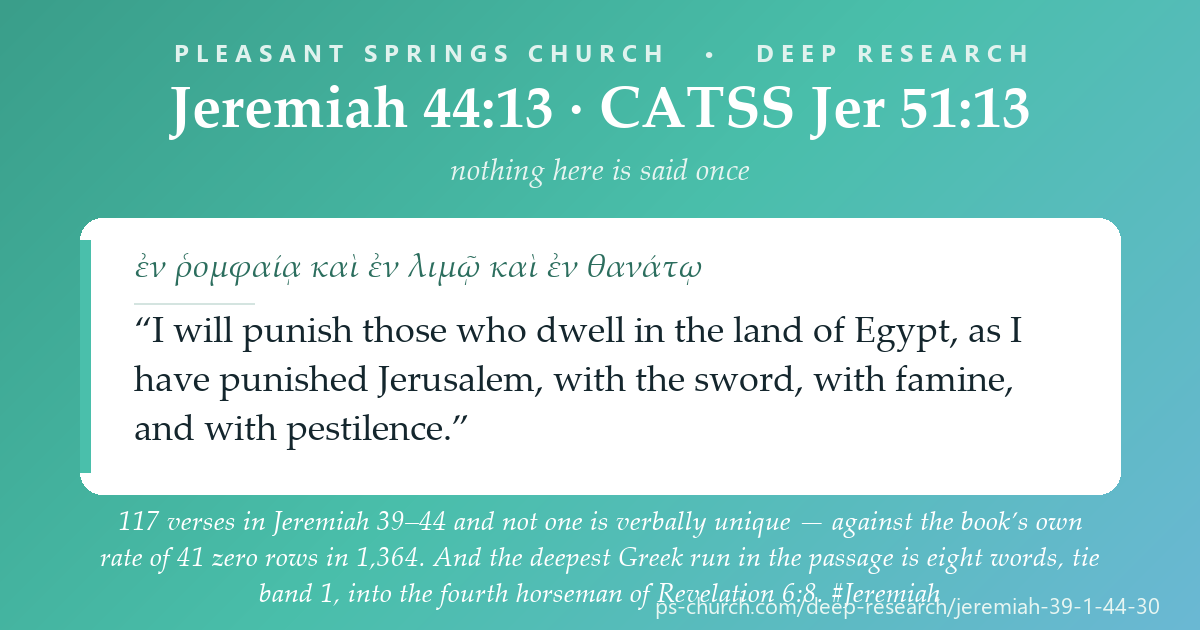
All three together in 24 verses of the Hebrew Bible: 15 in Jeremiah, 7 in Ezekiel, one in 1 Chronicles and one in 2 Chronicles. Three of the 24 stand here — 42:17, 42:22 and 44:13. Only one of the three carries the eight-word Greek form that Revelation 6:8 also has.
Seven of the 30,348 Greek Old Testament verse units screened and none of the 7,927 Greek New Testament verses. Three of the seven are Jeremiah’s: 45:2, 46:18 and 51:35 — MT 38:2, 39:18 and 45:5. The other four are Sirach. It is what the Greek says instead of your life as plunder.
One occurrence in the 30,348 Greek Old Testament verse units screened here, at Jeremiah 51:30 = MT 44:30. The Hebrew חׇפְרַע likewise stands in exactly one verse. The last proper name Jeremiah speaks in his own book is one the Bible uses once.
The count this page turns on: what the Greek did with the queen of heaven
The Hebrew phrase is identical in both places. Jeremiah 7:18 reads לַעֲשׂוֹת כַּוָּנִים לִמְלֶכֶת הַשָּׁמַיִם; Jeremiah 44:17 reads לְקַטֵּר לִמְלֶכֶת הַשָּׁמַיִם. Same consonants, same pointing. The Greek held here does not render them the same way, and the difference is not subtle:
| Hebrew verse | Greek verse | what the Greek reads | meaning |
|---|---|---|---|
| Jeremiah 7:18 | Jer 7:18 | τῇ στρατιᾷ τοῦ οὐρανοῦ | to the host of heaven |
| Jeremiah 44:17 | Jer 51:17 | τῇ βασιλίσσῃ τοῦ οὐρανοῦ | to the queen of heaven |
| Jeremiah 44:18 | Jer 51:18 | τῇ βασιλίσσῃ τοῦ οὐρανοῦ | to the queen of heaven |
| Jeremiah 44:19 | Jer 51:19 | τῇ βασιλίσσῃ τοῦ οὐρανοῦ | to the queen of heaven |
| Jeremiah 44:25 | Jer 51:25 | τῇ βασιλίσσῃ τοῦ οὐρανοῦ | to the queen of heaven |
βασίλισσα τοῦ οὐρανοῦ stands in four of the 30,348 Greek Old Testament verse units screened here, and all four are Greek Jeremiah 51 — that is, Hebrew Jeremiah 44. It does not stand at Greek Jeremiah 7:18. The unpointed Hebrew consonants מלכת can be read as queen or as מְלֶאכֶת, work / array / host, and the Greek of chapter 7 evidently took it the second way while the Greek of chapter 44 took it the first.
The consequence is measurable and it runs the other way from what you would expect. In Hebrew, chapter 44 is quoting the temple sermon back at itself; a reader of the Hebrew hears 7:18 under 44:17 immediately. In the Greek that link is cut at one end and left standing at the other, because the rare word for the cakes survives the crossing in both places: χαυῶνας stands at Greek 7:18 and at Greek 51:19 and nowhere else in the corpus. So a Greek reader can still hear the baking of chapter 7 in chapter 44 — and cannot hear the goddess. The page reports what the two texts do and does not say that either translator was wrong.
One more count, because the whole passage points at it:
מִצְרַיִם, Egypt, stands in 582 verses of the Hebrew Bible, 54 of them in Jeremiah. Twenty-three of those 54 — well over a third — stand in these six chapters, and they are distributed 0 / 0 / 1 / 6 / 5 / 11 across chapters 39 to 44. The word is absent from the two chapters about the fall of Jerusalem and dense in the last chapter of the book’s narrative. That gradient is the plot: the further the survivors get from the ruins, the more the text says the name of the place they are going. The single occurrence in chapter 41 is 41:17 — the camp near Bethlehem, “intending to go to Egypt” — and it stands four verses before they ask God what to do.
Two screens, run on this disk this week, with every run reported beside its tie band — and three counter-examples printed against the page’s own findings.
Runs are contiguous whole word forms, never lemmas and never roots. The Hebrew screen ran each of the 117 Masoretic verses of Jeremiah 39–44 against every other verse of the 23,204-unit corpus, minus its own chapter. The Greek screen ran each of the 107 CATSS verse units of Jeremiah 46:1–51:30 — which is what these six Hebrew chapters are in Greek numbering — against all 7,927 verses of the SBLGNT, with MorphGNT’s own spelling equivalences applied (ou / ouk / ouch, ek / ex, the movable nu). Figures here are higher than any run figure published on this shelf before 30 August 2026 and were re-measured, not copied.
The Hebrew screen: the finding this page exists for
Across the 117 Masoretic rows, screened against every other verse in the Hebrew Bible with single words not counted: 7 stop at two, 41 at three, 30 at four, 9 at five, 14 at six, 11 at seven, 3 at eight, one at nine and one at eleven — and nothing at all stops at zero.
That last clause is the finding. On this screen a zero means the verse shares no two consecutive words with any other verse in the Hebrew Bible — the strong, printable result that gave the Obadiah page its two unique verses. Jeremiah 39–44 has none. Not one verse in these six chapters is verbally unique.
And the page prints its own baseline, because a number without one is a sales pitch. Screened chapter by chapter across the whole book, Jeremiah has 41 zero rows in 1,364 verses — 3.0 per cent. At that rate a stretch of 117 verses should contain about three or four. It contains none. These six chapters are the least verbally original stretch of the book, and the reason is countable rather than mysterious: the story they tell is told twice more in the Bible, and the sermon they end with was preached in chapter 7.
The sixteen deepest Hebrew rows — every row in the passage reaching seven or more:
| row | run | band | matches |
|---|---|---|---|
| Jeremiah 41:1 | 11 | 1 | 2 Kings 25:25 |
| Jeremiah 39:9 | 9 | 2 | 2 Kings 25:11, Jeremiah 52:15 |
| Jeremiah 39:5 | 8 | 1 | Jeremiah 52:9 |
| Jeremiah 39:16 | 8 | 1 | Jeremiah 19:15 |
| Jeremiah 44:11 | 8 | 2 | Jeremiah 9:14, 50:18 |
| Jeremiah 40:1 | 7 | 9 | Jeremiah 7:1, 11:1, 18:1, 21:1, 30:1, 32:1, 34:1, 34:8 … |
| Jeremiah 40:9 | 7 | 1 | 2 Kings 25:24 |
| Jeremiah 40:11 | 7 | 1 | 2 Kings 25:22 |
| Jeremiah 41:10 | 7 | 1 | Jeremiah 43:6 |
| Jeremiah 41:16 | 7 | 1 | Jeremiah 43:5 |
| Jeremiah 42:18 | 7 | 6 | Jeremiah 16:9, 27:21, 28:14, 29:8, 32:15, 51:33 |
| Jeremiah 43:5 | 7 | 1 | Jeremiah 41:16 |
| Jeremiah 43:6 | 7 | 1 | Jeremiah 41:10 |
| Jeremiah 43:10 | 7 | 7 | Jeremiah 9:14, 16:9, 19:3, 19:15, 39:16, 44:11, 50:18 |
| Jeremiah 44:7 | 7 | 2 | Jeremiah 35:17, 38:17 |
| Jeremiah 44:25 | 7 | 2 | Jeremiah 28:2, 29:25 |
Read the band column, not the run column. Jeremiah 43:10 reaches seven with a band of seven — that is the book’s stock oracle opening, and it means nothing on its own. Jeremiah 41:1 reaches eleven with a band of one, and the eleven words are a date, three personal names and a description of lineage. The two numbers are not the same kind of object and the page will not let them sit side by side unlabelled.
Where the language comes from, and where it changes
Because none of these rows is unique, the interesting question is not whether the language is shared but with what. Counted over all 117 rows, by which verses appear among a row’s deepest partners:
| chapter | rows | rows touching 2 Kings 25 or Jeremiah 52 | rows touching Jeremiah 7 |
|---|---|---|---|
| Jeremiah 39 | 18 | 12 | 0 |
| Jeremiah 40 | 16 | 9 | 2 |
| Jeremiah 41 | 18 | 9 | 0 |
| Jeremiah 42 | 22 | 1 | 3 |
| Jeremiah 43 | 13 | 0 | 1 |
| Jeremiah 44 | 30 | 1 | 13 |
| total | 117 | 32 | 19 |
Thirty of the thirty-two rows that touch the Kings narrative stand in chapters 39, 40 and 41. Thirteen of the nineteen rows that touch the temple sermon stand in chapter 44. The two distributions barely overlap, and the changeover falls at chapter 42 — at the oath. That is why the structure diagram above calls 42:1–6 a hinge and not a middle: it is where the text stops sounding like 2 Kings and starts sounding like Jeremiah 7.
What this page does not say. It does not say that Jeremiah copied Kings, or that Kings copied Jeremiah, or that both drew on a common source, or that an editor assembled chapters 39–41 out of the Kings account. Each of those is a claim about history that a word count cannot reach. There is a large scholarly literature on exactly that question and Stage 5 names it. The count is the finding.
The Greek screen: one run of eight, then a cliff
Across the 107 CATSS rows against 7,927 New Testament verses: 106 reach two, 94 reach three, 30 reach four, 8 reach five, 1 reaches eight, and nothing reaches nine. Nothing at all reaches six or seven. The distribution has a hole in it, and the whole top of the table is this:
| row (Greek / English) | run | band | New Testament verse | shared words |
|---|---|---|---|---|
| Jer 51:13 / 44:13 | 8 | 1 | Revelation 6:8 | ἐν ῥομφαίᾳ καὶ ἐν λιμῷ καὶ ἐν θανάτῳ |
| Jer 49:22 / 42:22 | 5 | 1 | Revelation 6:8 | ἐν ῥομφαίᾳ καὶ ἐν λιμῷ |
| Jer 51:12 / 44:12 | 5 | 1 | Revelation 6:8 | ἐν ῥομφαίᾳ καὶ ἐν λιμῷ |
| Jer 51:18 / 44:18 | 5 | 1 | Revelation 6:8 | ἐν ῥομφαίᾳ καὶ ἐν λιμῷ |
| Jer 51:27 / 44:27 | 5 | 1 | Revelation 6:8 | ἐν ῥομφαίᾳ καὶ ἐν λιμῷ |
| Jer 51:21 / 44:21 | 5 | 1 | Acts 7:23 | ἀνέβη ἐπὶ τὴν καρδίαν αὐτοῦ |
| Jer 51:29 / 44:29 | 5 | 1 | Luke 2:12 | καὶ τοῦτο ὑμῖν τὸ σημεῖον |
| Jer 51:8 / 44:8 | 5 | 1 | Acts 7:41 | ἐν τοῖς ἔργοις τῶν χειρῶν |
| Jer 48:14 / 41:14 | 1 | 5,325 | — | ιωαναν (the shallowest row on the page) |
Four of the seven rows that stop at five are the same phrase landing on the same verse. ἐν ῥομφαίᾳ καὶ ἐν λιμῷ is a Jeremianic formula — it stands in seven of the 30,348 Greek Old Testament verse units screened, six of them in Jeremiah and one in Lamentations — and in exactly one New Testament verse. So the run of eight is not a bolt from nowhere; it is the top of a family that this passage uses over and over. Both facts belong on the page and neither is allowed to hide the other.
The eight words, and the verse that everyone names instead
Revelation 6:8 is the fourth seal: a pale horse, its rider named Death, given authority over a quarter of the earth ἀποκτεῖναι ἐν ῥομφαίᾳ καὶ ἐν λιμῷ καὶ ἐν θανάτῳ καὶ ὑπὸ τῶν θηρίων τῆς γῆς — to kill with sword and with famine and with pestilence and by the wild beasts of the earth. The verse commentaries almost always name behind it is Ezekiel 14:21, which has the same four judgements: sword, famine, evil beasts, pestilence. Measured, the two comparisons are not close:
| comparison | longest shared run | the words |
|---|---|---|
| Revelation 6:8 vs Greek Jeremiah 51:13 (= Jeremiah 44:13) | 8 (tie band 1) | ἐν ῥομφαίᾳ καὶ ἐν λιμῷ καὶ ἐν θανάτῳ |
| Revelation 6:8 vs Greek Ezekiel 14:21 (the four judgements) | 1 | καί — and nothing else in sequence |
| Revelation 6:8 vs the deepest verses in the whole of Greek Ezekiel | 4 (tie band 10) | καὶ εἶδον καὶ ἰδού (the vision formula, not the plague list — ten Ezekiel verses tie at four) |
Ezekiel 14:21 has the whole set — ῥομφαίαν καὶ λιμὸν καὶ θηρία πονηρὰ καὶ θάνατον — but in the accusative and without the repeated ἐν, so not one two-word sequence survives the comparison. Screened against all 30,348 Greek Old Testament verse units screened here, the single deepest verbatim contact Revelation 6:8 makes anywhere is with Jeremiah 44:13, at eight words and a tie band of one; the runners-up reach six. This shelf measured the same thing from the Revelation side first, on the page for Revelation 6:1–8:13, and the two pages agree to the word.
What this page will not say. It will not say that John quoted Jeremiah. Revelation carries no citation formula anywhere — not once in twenty-two chapters — so there is no textual signal to appeal to, and the shelf’s rule is that direction of influence is never asserted without one. It will not say the phrase was rare in the air John breathed: it was Jeremiah’s stock threat, used five times in this passage alone. What the page says is the measurement: the deepest verbatim contact between Jeremiah 39–44 and the New Testament is eight consecutive Greek words, tie band 1, and they are a sentence spoken to refugees in Egypt about what was going to happen to them there.
Three counter-examples, printed against this page’s own findings
1. Luke 2:12 is the control. Jeremiah 44:29 opens with five Greek words that are also the first five Greek words of the angel’s sentence to the shepherds — καὶ τοῦτο ὑμῖν τὸ σημεῖον, “and this shall be the sign to you.” Run of five, tie band 1, the deepest contact that verse makes with the entire New Testament. In Jeremiah the sign is that God will punish; in Luke it is a baby in a feeding trough. Nobody should build anything on it, and the fact that nobody should is the reason it is printed here. If a five with a band of one can be an accident, an eight with a band of one is a bigger number and not a different kind of thing.
2. Two more fives that are idiom, not contact. Jeremiah 44:21 reaches five with Acts 7:23 — ἀνέβη ἐπὶ τὴν καρδίαν αὐτοῦ, “it came up on his heart,” a Semitic idiom for remembering, used of God in Jeremiah and of Moses in Acts. Jeremiah 44:8 reaches five with Acts 7:41 — ἐν τοῖς ἔργοις τῶν χειρῶν, “in the works of their hands,” the ordinary Greek for idols. Both are Stephen’s speech, and neither is quoting Jeremiah. Three of the eight deepest New Testament contacts this passage makes are coincidences, and the page says so before it says anything else.
3. The Greek is missing the material that would test the Hebrew finding hardest. The Hebrew block that is most duplicated elsewhere — 39:4–13, which reaches nine with 2 Kings 25:11 and eight with Jeremiah 52:9 — is precisely the block the Greek Jeremiah on this disk does not have. That is a fact about two texts and it is easy to build a story on. The page refuses to. It does not say the Greek is earlier, that the Hebrew block was imported from Kings, that a scribe filled a gap, or that Rahlfs’s text is defective here. No Qumran witness and no Göttingen apparatus is held; the two observations are printed next to each other and left there.
Where to go next, what this page could not check, and where it is weakest.
Consult the technical literature last, so that it corrects the reading rather than supplying it. This section is also where the page states its own limits, because a shelf that only reports what it found is not trustworthy.
Where the real work on this passage is:
- Commentaries. William Holladay, Jeremiah 2 (Hermeneia, 1989) — the standard technical treatment of chapters 26–52. William McKane, Jeremiah XXVI–LII (ICC, 1996). Jack Lundbom, Jeremiah 37–52 (Anchor Yale, 2004), the fullest on exactly these chapters. Leslie Allen, Jeremiah (OTL, 2008). Georg Fischer, Jeremia 26–52 (HThKAT, 2005), which argues the opposite of the usual line on the Greek.
- On chapters 37–45 as a unit. The old proposal that these chapters are a “Baruch narrative” or passion narrative goes back to Bernhard Duhm and Sigmund Mowinckel; Christopher Seitz, Theology in Conflict (1989), and Kathleen O’Connor have argued the case differently since. The distribution counted in Stage 4 is offered as data these works interpret, not as a verdict on them.
- On the relationship with 2 Kings 24–25 and Jeremiah 52. This is a standing question in the literature on the Deuteronomistic History and on the composition of Jeremiah; see the commentaries above and the discussion in Emanuel Tov, Textual Criticism of the Hebrew Bible. Nothing on this page adjudicates it.
- On the two editions of Jeremiah. Emanuel Tov, The Septuagint Translation of Jeremiah and Baruch (1976); Hermann-Josef Stipp on the Masoretic Sondergut; Albert Pietersma and Marc Saunders in NETS; and the Qumran editions of 4QJerb and 4QJerd.
- On Judeans in Egypt. Bezalel Porten, Archives from Elephantine (1968) and the Porten–Yardeni Textbook of Aramaic Documents from Ancient Egypt. Neither was consulted for this page and nothing here rests on them.
- Ancient Near Eastern comparisons. James Pritchard, ANET (3rd ed.) — the Lachish Ostraca at pp. 321–322 were read at first hand from the copy held here for this page.
What this page could not check — stated plainly
No Qumran text is held here, and for this passage that gap is load-bearing. The decisive witnesses for the shorter Greek Jeremiah are 4QJerb and 4QJerd, reported to preserve a short Hebrew text agreeing with the Greek against the Masoretic Text. This page prints Jeremiah 39:7 with an empty Greek column and cannot say whether any Hebrew manuscript ever lacked 39:4–13. Anyone wanting that answer must go to the Qumran editions; this page has not.
The Greek here is Rahlfs, not Ziegler. Every Greek figure on this page is a figure about the CATSS digitisation of Rahlfs’s Septuaginta. No Göttingen apparatus is held, so no variant is known to this page and nothing is claimed from one. The eight-word run at Jeremiah 51:13 is Rahlfs’s reading, and if Ziegler differs by so much as a preposition the central Greek measurement changes.
The Greek New Testament here is the SBLGNT via MorphGNT. No New Testament apparatus was consulted, and Revelation is a book with a busy one.
The Kings comparison is a word count, not a source theory. Stage 4 counts which rows have 2 Kings 25 or Jeremiah 52 among their deepest partners. It cannot distinguish Jeremiah drawing on Kings from Kings drawing on Jeremiah, from both drawing on an archival account, from an editor harmonising the two later. A reader who leaves this page believing any one of those has read more than is written.
The Elephantine papyri were not read at first hand. They are the obvious external control on Jeremiah 44 — a real Judean community in Egypt, with a real temple, and documents naming a goddess alongside Yahweh — and they sit at ANET pp. 491–492 and 633. The copy of Pritchard held here stops at printed page 326, so those pages could not be opened, and no Aramaic corpus is on this disk. Everything this page says about Judeans in Egypt outside the biblical text is therefore background, not evidence.
The Babylonian Chronicle was not read at first hand either, for the same reason — it stands at ANET p. 563, past the end of the copy held. The dates in Jeremiah 39:1–2 are printed as the Hebrew gives them and are not checked against a cuneiform tablet here.
No Akkadian or Ugaritic corpus is held, so the identification of the queen of heaven with Ishtar or Astarte was not tested against any divine title at first hand. Stage 2 names the candidates and stops.
Herodotus on Apries was not consulted. The Greek historian’s account of Apries being deposed by Amasis and later killed is the usual external note on Jeremiah 44:30. No copy of Herodotus is held on this disk and the page makes no claim about the fulfilment of that oracle.
No commentary was consulted at first hand. The works listed above are named as where a reader should go. No claim on this page rests on any of them.
The ESV column was typed from the printed 2016 text edition, because no ESV API key has ever been issued to this site. Any transcription error is ours.
Where the page is weakest. The Hebrew finding — nought zero rows in 117 — is robust, because a zero row is a property of the corpus and the corpus is fixed. The Greek finding is fragile in exactly the way edition-dependent findings always are. It rests on one verse of one edition of one book, and on the shelf’s decision to screen 30,348 verse units rather than the whole Septuagint, which is larger than what is held here. A critic should press the Ziegler question first, and the page would rather write that sentence itself.
An oath kept for ten days, a promise given to a foreigner, and a chapter in which the people win the argument.
Name what you learned, why it matters, and one concrete response.
What should we carry away — and do?
- They asked God for guidance after they had packed. Jeremiah 41:17 says the company was already camped near Bethlehem “intending to go to Egypt.” Four verses later they ask Jeremiah to pray and swear to obey the answer “whether it is good or bad.” Ten days later the answer comes and they call it a lie. The oath was sincere and it was also decoration. Anyone who has ever asked for advice they had no intention of taking should read Jeremiah 42 slowly.
- The one unconditional promise in these chapters goes to a foreigner and a court eunuch. Ebed-melech the Ethiopian is told he will live “because you have put your trust in me” — the only person in the passage of whom that is said. He had done exactly one thing: pulled a prophet out of a cistern when nobody else would. The book keeps his name and does not keep the names of most of the officials.
- Chapter 44 is the hardest chapter to answer because the people are arguing from evidence. When we made offerings to the queen of heaven we had bread; since we stopped, we have had sword and famine. That is a real argument and it is empirically true of the years they are describing. The prophet does not deny the data; he reverses the reading of it. Christians who expect faith to be validated by outcomes should notice that this passage puts that expectation in the mouths of the people who are wrong.
- One concrete response. Think of one decision you are currently praying about. Write down, honestly, what you have already decided. Then either tell God that, or change the decision. Do not do both. If you can, say the sentence out loud to one other Christian this week — that is the step Jeremiah 42 shows nobody taking.
Jeremiah 42:6 · to share
Hebrew + Greek (CATSS / Rahlfs) + ESVEvery Deep Research page traces its passage across the whole sweep — the Old Testament, the Second-Temple world between the testaments (historical witnesses, not Scripture), and the New Testament. Follow the thread:
Pleasant Springs Church — Deep Research
Research method after Michael S. Heiser’s Bible Research Method (examine dictionaries → ancient literature → important words → textual connections → academic publications → share), with the Pleasant Springs “Author & Audience” foundation. Scripture set in the Hebrew, the Greek editions named on each page and the ESV (Old Testament), and the Greek New Testament and the ESV (New Testament), per the practice of Pleasant Springs Church. Jeremiah 39–44 research grounded in Holladay (Hermeneia), McKane (ICC), Lundbom (Anchor Yale), Allen (OTL) and Fischer (HThKAT), with Tov, Stipp and Pietersma on the Greek Jeremiah, Seitz and O’Connor on chapters 37–45, and Pritchard’s ANET for the Lachish Ostraca. Book name: in the Septuagint this book is Ieremias, Ἰερεμίας; the Hebrew titles it יִרְמְיָהוּ. Text & numbering: Hebrew from the Masoretic Text (Sefaria, Miqra according to the Masorah), cantillation retained and the qere read — two ketiv/qere stand in the printed rows, at 42:6 and 43:10, and both are flagged there; Greek from the CATSS digitisation of Rahlfs’s Septuaginta, printed without editorial punctuation and with proper names unaccented; English ESV. ⚠️ THE VERSIFICATION OFFSET, DERIVED FROM THE FILES ON THIS DISK RATHER THAN COPIED FROM A TABLE. Jeremiah is the hardest book on the shelf for numbering, and this passage sits on the far side of the break. The Greek book puts the Oracles Against the Nations in the middle rather than at the end, so from MT 26 onward the chapter numbers run +7: Hebrew 39 is Greek 46, Hebrew 40 is Greek 47, Hebrew 41 is Greek 48, Hebrew 42 is Greek 49, Hebrew 43 is Greek 50 and Hebrew 44 is Greek 51. Verse counts measured on disk: Masoretic 18 / 16 / 18 / 22 / 13 / 30; CATSS 8 / 16 / 18 / 22 / 13 / 30, plus five more verse units in Greek 51 which are Hebrew chapter 45, the Baruch oracle, joined onto the end of the same Greek chapter. Inside chapters 40–44 the verse numbers then agree one-for-one, Hebrew verse n being Greek verse n and English verse n, with the single exception of 40:4–5, which the two texts divide in different places. The whole of the remaining difference is in chapter 39: CATSS 46 carries verses 1, 2, 3, 14, 15, 16, 17 and 18 and nothing between — MT 39:4–13 has no Greek counterpart here at all, and the Greek keeps the Hebrew numbering across the gap. Counted, not assumed. Measurements. The Hebrew screen ran all 117 Masoretic verses of Jeremiah 39–44 against the whole 23,204-verse corpus held here, minus the source chapter; runs are contiguous whole consonantal word forms, never lemmas and never roots, with the qere read, cantillation and vowel points removed, final letters folded and maqqef treated as a word separator. On that screen a row of 0 would mean the verse shares no two consecutive words with any other verse in the Hebrew Bible — and none of these 117 rows is a zero row, against Jeremiah’s own book-wide rate of 41 in 1,364, which is the baseline the page prints beside its own number. The Greek New Testament screen ran all 107 CATSS verse units of Jeremiah 46:1–51:30 against all 7,927 verses of the SBLGNT via MorphGNT, with the edition’s own spelling equivalences applied (ou / ouk / ouch, ek / ex, the movable nu), so figures here are higher than any run figure published on this shelf before 30 August 2026 and were re-measured rather than copied from a sibling page. On that screen a 0 would mean “shares no word at all”; the lowest row here is Greek Jeremiah 48:14 at 1, tie band 5,325. Phrase and word counts on the Greek side were exhaustive over 30,348 verse units — the 30,637 units of the 64 CATSS files held, less the Odes, which are excluded from run screens because two of them are New Testament text (Ode 9 is Luke 1, Ode 13 is Luke 2) and ten more are second copies of Exodus 15, Deuteronomy 32, 1 Samuel 2, Habakkuk 3, Isaiah 5, Isaiah 26, Isaiah 38, Jonah 2 and Daniel 3. Every run on this page is reported with its tie band, the eight-word run into Revelation 6:8 is printed together with the five-word Jeremianic formula it sits on top of and with the seven Greek Old Testament verses that carry that formula, and the three runs of five that are pure coincidence are printed before the run of eight is discussed. ⚠️ Direction of influence is never asserted. The page says that Revelation 6:8 matches Greek Jeremiah 51:13 at eight and Greek Ezekiel 14:21 at one; it does not say that John quoted Jeremiah, and it notes that Revelation carries no citation formula anywhere. It says that 32 rows touch 2 Kings 25 or Jeremiah 52; it does not say which book drew on which, or that an editor assembled anything. MT/LXX divergences inside the passage are disclosed rather than smoothed: 39:4–13 (absent from the Greek), 40:4–5 (a different verse division, the freedom clause standing in the Greek’s next verse), 41:5 (Shiloh against Σαλημ, and מִנְחָה transliterated as μαναα), 42:9 (a much shorter Greek), 43:2 (the Greek drops “the presumptuous men”), 43:10 (no “my servant,” and a royal canopy rendered as weapons), and 44:17 against 7:18 (the queen of heaven against the host of heaven, from identical Hebrew consonants). Limits are stated in Stage 5 and are load-bearing: no Qumran text is held, so 4QJerb and 4QJerd — the decisive witnesses at 39:4–13 — could not be checked; the Greek is Rahlfs and not Ziegler, so the eight-word run is one edition’s reading; the Greek New Testament is the SBLGNT and no apparatus was consulted; the copy of Pritchard held here stops at printed page 326, so the Elephantine papyri (pp. 491–492) and the Babylonian Chronicle (p. 563) could NOT be read at first hand and nothing rests on them; no Akkadian or Ugaritic corpus is held, so the identification of the queen of heaven was not tested; Herodotus on Apries is not held and no claim is made about the fulfilment of 44:30; Baruch, the Letter of Jeremiah and 2 Maccabees are used as historical witnesses, never levelled with Scripture; the commentaries named were not consulted at first hand and no claim rests on them; and the ESV column was typed from the printed 2016 text edition because no ESV API key has ever been issued to this site. The literary structure is labelled a sequence in two movements with a hinge, not a chiasm, and the absence of a verbal frame between 39:2 and 44:30 is stated rather than papered over; the hinge itself is the one structural claim the page makes, and it is a count, printed in Stage 4. The catchword that binds the sequence is counted, not asserted: “the remnant of Judah” stands in six verses of the Hebrew Bible and all six are in these chapters. Typology is handled per the house position: what the text says, what the New Testament itself draws, and what we see from this side of the cross — with the seeing left to the reader.
Scripture quotations marked ESV are from the ESV® Bible (The Holy Bible, English Standard Version®), © 2001 by Crossway, a publishing ministry of Good News Publishers. ESV Text Edition: 2016. Used by permission. All rights reserved. The ESV text may not be quoted in any publication made available to the public by a Creative Commons license, and the ESV may not be translated in whole or in part into any other language. www.esv.org
|
Did this study bless you today? 💚 Give to Support PS Church100% of gifts go to the General Fund — thank you. |