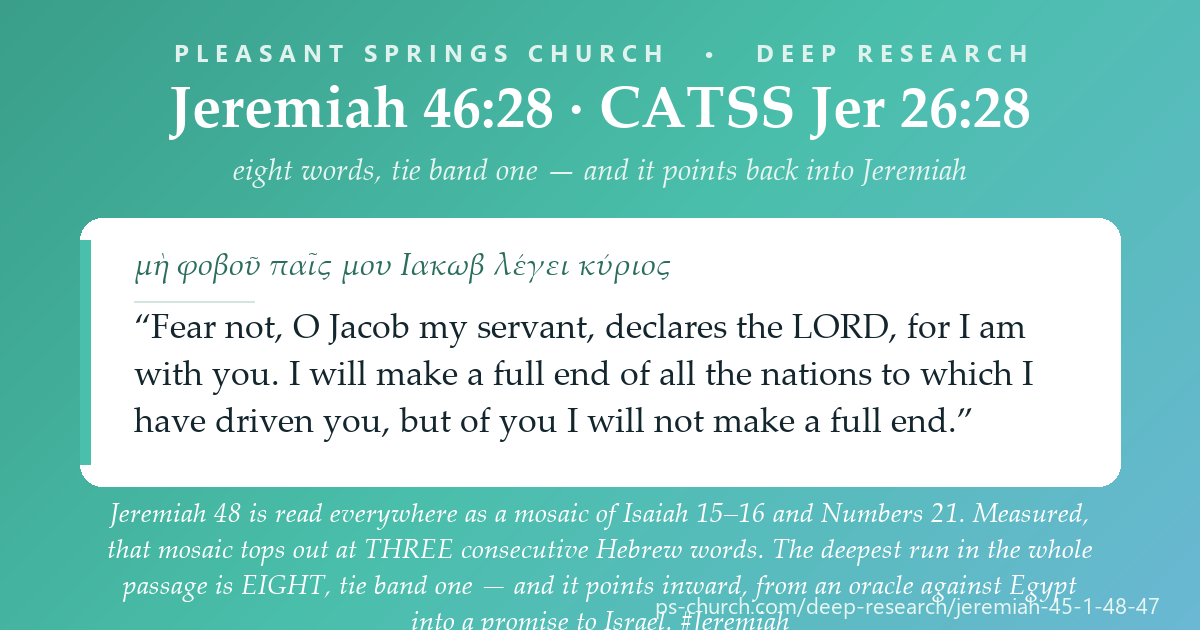
Four chapters, eighty-seven verses: a private word to the scribe who wrote the book, and then poems against Egypt, against Philistia and against Moab. These are the chapters where borrowing is asserted most often and measured least. Jeremiah 48 is read everywhere as a mosaic of Isaiah 15–16 and the Heshbon ballad of Numbers 21. Screened word by word, that mosaic tops out at THREE consecutive Hebrew words — 48:34 with Isaiah 15:5, 48:29 with Isaiah 16:6, 48:32 with Isaiah 16:9, 48:46 with Numbers 21:29. Nothing reaches four. The two deepest runs in the whole passage are EIGHT apiece, tie band one apiece, and both point inward into Jeremiah: 47:1 into the heading at 49:34, and 46:28 into 30:11 — “of you I will not make a full end”, the promise to Jacob, standing at the end of an oracle against Pharaoh. And the Greek book does not have the other half of that doublet. The CATSS file carries no Jeremiah 37:10 and no 37:11. It also carries no 46:26, no 48:45, no 48:46 and no 48:47 — which means three of the four restoration promises the Hebrew Jeremiah makes to foreign nations are simply not in the Greek. See the method →
Jeremiah 45:1–48:47 — sixteen rows across all four chapters (⚠️ the chapter numbers do NOT agree. In the Greek these four chapters are numbered 51:31–35, 26, 29 and 31, and they do not stand in this order. Four of the sixteen rows have no Greek counterpart at all. The Greek reference is printed on every row and the whole alignment is set out in the footer.)
Hebrew (Masoretic) · Greek (CATSS/Rahlfs) · ESVThe Shape of the Passage
Sequence — nine units by the scribal section markers, and no chiasmNothing on this page settles how the book of Jeremiah reached the shape it has, and these four chapters are where that question bites hardest. The Greek edition of Jeremiah is about an eighth shorter than the Hebrew and puts the oracles against the nations in a different place, and this passage sits astride the join. What follows reports what the text says about who is speaking and who is listening, and what the two ancient columns measurably do. It stops there.
Author
The passage opens by naming the man who wrote the book down. 45:1 is the only place in Scripture where a prophetic book turns aside to give its own scribe an oracle. Baruch son of Neriah has just written the scroll of chapter 36 from Jeremiah’s dictation; the scroll has been cut up and burned by the king; and the word that comes to him is not about Judah at all. It is about his own ambition and his own survival. The date given — בשנה הרבעית ליהויקים בן יאשיהו מלך יהודה — is seven consecutive words shared with 25:1 and 36:1, tie band two, and with nothing else in the Bible.
Then three headings, and two of them are the same heading. אשר היה דבר יהוה אל ירמיהו הנביא opens 46:1 (the nations), 47:1 (the Philistines) and 49:34 (Elam). Those three verses are the only three in the Hebrew Bible that begin that way. Between 46:1 and 47:1 the shared run is seven words; between 47:1 and 49:34 it is eight, tie band one — the deepest run in the passage that is not the Jacob oracle. The book is signing its oracles against the nations with a formula it uses nowhere else.
What the Greek column adds, and what it takes away. The two files do not agree on the chapter numbers anywhere here, and they differ in verse count in two of the four: 5, 28, 7 and 47 Hebrew verses against 5, 26, 7 and 44 Greek ones. Five Hebrew verses in this passage have no Greek counterpart: 46:1, 46:26, 48:45, 48:46 and 48:47. Three of those five are the sentences a reader remembers — Egypt restored, the Heshbon ballad, Moab pardoned. And the Greek puts Baruch last. In the Hebrew book the scribe’s oracle stands before the nations; in the Greek it stands after them, at 51:31–35, the last words of the prophecies before the historical appendix in chapter 52. The same five verses close two different books in two different ways.
The Greek is used here as a witness to a second ancient text, never as evidence about who wrote the Hebrew one. On this page the two columns disagree at 45:1 (placement), 46:1, 46:10, 46:17, 46:26, 47:1, 48:11, 48:43 and 48:45–47. Every one of those is printed above, and none of them is called a correction, a mistake or a change.
Audience
Nobody in these chapters is listening. That is the strangest thing about oracles against the nations and it should be said plainly. Egypt did not receive chapter 46. Ashkelon did not receive chapter 47. Moab, whose capital was already a Babylonian problem, did not receive chapter 48. These are poems about foreign nations delivered to Judeans, and the question they answer is not “what will happen to Moab” but “is the God who is letting Babylon destroy us the God of Babylon too”.
Which is why the promise to Jacob is sitting where it is. 46:27–28 is not an interruption. It is the point of the Egypt oracle, and the measurement says so: it is the deepest-running pair of verses in the whole passage, eight and six consecutive words, tie band one apiece, lifted verbatim from the Book of Consolation at 30:10–11. The audience is told that the same sentence God says over restored Israel is the sentence he says at the end of a poem about Pharaoh drowning in the Euphrates. I will make a full end of all the nations… but of you I will not make a full end.
And the audience is told, four times, that judgement is not the last word for the nations either. Egypt is restored at 46:26; Moab at 48:47; Ammon at 49:6; Elam at 49:39. Three of those four verses are missing from the Greek file. A reader of the Greek Jeremiah meets one foreign pardon; a reader of the Hebrew meets four. That is not a small difference in tone, and this page prints it without deciding which book is the older one.
How it has been carried. 45:5 — do you seek great things for yourself? Seek them not — has been read to novices and ordinands for fifteen centuries, and it is the one line in these chapters most people know. 48:11, the wine on its lees, became a standing image for a comfortable soul. What this page adds is only the measurement, and the measurement is mostly deflationary: the Numbers quotation runs to three words, the Isaiah 15–16 material to three, and the passage’s deepest reach into the New Testament is four, shared with a verse about a strong man’s furniture.
Before anything is measured, find out what the words and the places in the passage are already known to mean, and where the reference works leave a question open.
A dictionary gives the range of a word and the consensus about a place. It does not tell you what this text does with either. Use it to frame the question, then go and count.
What is an “oracle against the nations”, and why is there a block of them?
Four of the prophetic books carry a large block of poems addressed to foreign peoples: Isaiah 13–23, Jeremiah 46–51, Ezekiel 25–32, and Amos 1–2 in miniature. The dictionaries agree on the form — a heading naming the nation, a summons or a taunt, a description of the disaster, sometimes a closing turn — and disagree about the setting. The commonest suggestions are a war ritual, a royal court oracle before battle, and a liturgical setting in the temple.
What the files show, rather than the dictionaries. The formula that heads two of these three oracles — אשר היה דבר יהוה אל ירמיהו הנביא — is not the book’s ordinary heading. Jeremiah’s usual opening is הדבר אשר היה אל ירמיהו מאת יהוה, which stands in ten verses. This other one stands in three, and all three head foreign oracles: 46:1, 47:1, 49:34. The book marks the block with a title of its own.
Who was Baruch son of Neriah?
The scribe named at 32:12, 36:4–32, 43:3–6 and 45:1–5. He writes Jeremiah’s dictated scroll, reads it in the temple when Jeremiah cannot go, rewrites it after Jehoiakim burns it, is accused of manipulating the prophet, and is taken down to Egypt with the refugee company. A bulla — a clay seal impression — reading belonging to Berekhyahu son of Neriyahu the scribe has circulated since 1975 and is widely reproduced.
The page’s position on that bulla: it is unprovenanced, it came through the antiquities market rather than an excavation, and its authenticity is disputed by specialists. No claim on this page rests on it, and no photograph or laboratory report was examined here.
Chemosh, and what “the people of Chemosh” means.
The national god of Moab, known from the Bible and from the Mesha Stele, the ninth-century Moabite inscription in which King Mesha credits Chemosh with victory over Israel in language strikingly close to Israel’s own. In the Hebrew Bible the name occurs in eight verses: Numbers 21:29, Judges 11:24, 1 Kings 11:7, 1 Kings 11:33, 2 Kings 23:13, and Jeremiah 48:7, 48:13 and 48:46. Three of the eight are in this one chapter.
A count that looks like a coincidence and is not quite one. The screened Greek Old Testament also carries Χαμως in eight verses — but not the same eight. It gains one, because Judges is held in two recensions and Judges 11:24 is therefore counted twice; and it loses one, because Masoretic Jeremiah 48:46 has no Greek counterpart. Two eights, arrived at by different routes. The page prints the route.
Carchemish, 605 BC, and why the date matters twice.
Carchemish is on the upper Euphrates, on the modern Turkish–Syrian border. In 605 BC the Babylonian crown prince Nebuchadnezzar destroyed the Egyptian army there and then pursued it to Hamath. It is the battle that ended Egyptian power in the Levant and began the Babylonian period — and it is the event 46:2 names.
The date is the passage’s hinge. The fourth year of Jehoiakim is the date of the Egypt oracle at 46:2, of the word to Baruch at 45:1, of the scroll at 36:1 and of the seventy-years oracle at 25:1. Those four verses share the same date, and three of them — 25:1, 36:1 and 45:1 — share the same seven-word formula, which appears nowhere else in the Bible; 46:2 dates the year in slightly different words, בשנת הרביעית. Whatever else these chapters are, they are anchored to one year.
Where do the reference works stop being useful here?
On the relationship between the two editions. Every dictionary article on Jeremiah says the Greek is shorter and arranged differently. Almost none of them will tell you which verses are missing from the chapter you are reading. That is a question you have to answer against a file, and this page did: five Hebrew verses in this passage have no Greek counterpart, and they are 46:1, 46:26, 48:45, 48:46 and 48:47.
And on the borrowings. The reference works will tell you Jeremiah 48 draws on Isaiah 15–16. They will not tell you that the deepest verbatim contact between the two is three consecutive words. That number is not in any dictionary. It is in the text.
What the world outside the Bible says about these nations, these battles and these gods — and how much weight any of it can carry here.
Ancient sources set a scene. They do not settle a text. Everything in this section is cited from published translations at second hand, and none of the measured claims on this page depends on any of it.
The Babylonian Chronicle on Carchemish.
The cuneiform chronicle series covering Nebuchadnezzar’s early reign records the defeat of the Egyptian army at Carchemish in the twenty-first year of Nabopolassar, the pursuit into the district of Hamath, and the accession of Nebuchadnezzar later that year on his father’s death. It is one of the very few places where a prophetic oracle and a Babylonian administrative record are describing the same afternoon.
What that does and does not license. It makes 46:2 datable. It says nothing about when the poem in 46:3–12 was composed, and this page does not use it that way. Cited from Pritchard’s Ancient Near Eastern Texts and the standard published translations; no cuneiform was read for this page.
The Mesha Stele, and reading Jeremiah 48 beside it.
The Moabite Stone, found at Dhiban in 1868, is King Mesha’s own account of throwing off Israelite control. It names Chemosh repeatedly, credits him with the anger that let Israel oppress Moab and with the deliverance that ended it, and uses herem language for the devotion of captured towns. Several of the towns Jeremiah 48 lists — Nebo, Kiriathaim, Dibon, Aroer, Beth-meon, Bezer, Jahaz, Horonaim — appear on the stele.
The honest use of that overlap. It shows the town list is a real Moabite geography and not a poetic invention. It does not show that Jeremiah 48 knew the stele, and no measurement here could establish that, because the two are in different languages and the run engine does not cross that gap.
Herodotus on Pharaoh Neco, and the problem with him.
Herodotus II.158–159 has Neco building a canal toward the Red Sea, defeating the Syrians at “Magdolos” and taking “Kadytis”, a great city of Syria. Kadytis has often been identified with Gaza, which would give an outside witness to 47:1, “before Pharaoh struck down Gaza”.
Three cautions the page prints rather than suppresses. The identification of Kadytis with Gaza is contested. Herodotus is writing more than a century later and is not a reliable chronicler of Egyptian campaigns. And the clause in question is one of the things the Greek Jeremiah does not have: CATSS 29:1 reads three words, ἐπὶ τοὺς ἀλλοφύλους, with no Pharaoh and no Gaza in it. A synchronism that rests on a clause present in one column only is a weak synchronism.
Wine on the lees — what the image assumed about winemaking.
New wine was left standing on its sediment for a time, which gave it body and colour, and then racked off from one jar into another to separate it before it spoiled. Wine left too long on its lees goes thick and eventually turns. Isaiah 25:6 uses the same technology as a picture of richness; Zephaniah 1:12 uses it, as here, as a picture of complacency.
What the Hebrew of 48:11 does with it is exact. Moab has not been הוּרַק מִכְּלִי אֶל־כֶּלִי, poured from vessel to vessel — a phrase that occurs in one verse of the Bible — so his taste stayed and his scent did not change. Deportation is being described as decanting, and the next verse sends the pourers. The CATSS Greek does not carry the lees; see the translation note on that row.
What this section cannot do.
It cannot date a poem. The Babylonian Chronicle dates a battle. The stele dates a king. Neither dates a line of Hebrew verse, and this page does not pretend otherwise.
And it cannot be checked here. Everything above is second-hand: no tablet was collated, no stele was examined, no photograph was consulted. Stage 2 is the weakest section on this page and it is meant to be read that way.
Six words and phrases, each one counted across the whole corpus rather than described.
Every count below is exhaustive over a named corpus — 23,204 Masoretic verse units, 30,348 screened Greek Old Testament units, 7,927 Greek New Testament verses — and the corpus is named because a count without one means nothing.
Twenty-eight verses of the Hebrew Bible carry this form — twenty-nine occurrences, Ezekiel 8:6 having it twice — and four of the twenty-eight are in Jeremiah. The construction at 45:5 — ואתה תבקש לך גדלות — occurs in exactly one. The CATSS Greek reads μεγάλα, which is ordinary. The uniqueness is in the Hebrew phrasing, not in the vocabulary.
Sixty-one verses of the 30,348-unit screened Greek Old Testament, fifty-two of them in Isaiah — and exactly one in Jeremiah, at 26:10, which is Masoretic 46:10. The Hebrew יהוה צבאות stands in seventy-two verses of Jeremiah; the Greek translates it every other time. It also stands twice in the Greek New Testament: Romans 9:29 and James 5:4.
The Greek of 46:17 for שאון העביר המועד. One occurrence in the whole screened Greek Old Testament. Three hard Hebrew words standing in the Greek column in Greek letters — and the page does not call that a mistake, because the same file does the same thing with σαβαωθ seven verses earlier.
One verse in the Hebrew Bible: Jeremiah 48:11. The whole Moab oracle turns on it — the nation that was never decanted, so its taste stayed. 48:12 answers it with צֹעִים, tippers or pourers — a form that occurs in ONE verse of the Hebrew Bible — and so does נִבְלֵיהֶם, their jars, in the same sentence.
Two verses in the Hebrew Bible: Isaiah 24:17 and Jeremiah 48:43. Lamentations 3:47 has the first two words and not the third. The Greek keeps the three things and loses the sound — and Greek Jeremiah moves the snare to the front, so the five-word Hebrew doublet measures three in Greek.
How the Greek Old Testament almost always says Philistines: 278 verses. The transliteration Φυλιστιιμ stands in twenty-three, and none of them is in Jeremiah. Greek Jeremiah 29:1, the whole of Masoretic 47:1, is three words: ἐπὶ τοὺς ἀλλοφύλους.
Nebuchadnezzar has two spellings and Jeremiah uses both.
נְבוּכַדְרֶאצַּר, with a resh, stands in thirty-three verses of the Hebrew Bible — twenty-nine of them in Jeremiah and four in Ezekiel. נְבוּכַדְנֶאצַּר, with a nun, stands in twelve — six of them in Jeremiah, and the rest in 2 Kings, 2 Chronicles and Daniel. The form with the resh is closer to the Akkadian Nabu-kudurri-usur; the form with the nun is the one English inherited.
All three occurrences in this passage — 46:2, 46:13 and 46:26 — take the resh. The Greek has one form throughout, Ναβουχοδονοσορ, in fourteen verses of Greek Jeremiah. A page that reported “Jeremiah spells the king’s name this way” without the count would be reporting three-quarters of the truth.
A word about what these counts are and are not.
They are counts of FORMS, not of lemmas. Nothing here is stemmed and nothing is matched by root. When this page says כמוש occurs in eight verses, it means eight verses contain a word whose consonants include that string, prefixes and all.
And they are counts over a named corpus. The Greek Old Testament figure is 30,348 screened verse units from the 64 CATSS files held here — 30,637 held, with the Odes excluded from screening because two of them are Luke and ten of them are second copies of passages already in the corpus. “Once in the Septuagint” on this page means once in those 30,348 units, and nothing wider.
The measurement itself: every verse of this passage against the Hebrew Bible, and every Greek verse of it against the whole Greek New Testament.
Contiguous runs of whole word forms, exhaustive and deterministic, with the tie band beside every figure. The screen finds verbatim contact. It does not find allusion, and several of the strongest readings below score low precisely because allusion is what they are.
THE HEADLINE: the two deepest runs are eight, and both point into Jeremiah.
Screened against the 23,117 Masoretic verse units outside the passage, the eighty-seven Hebrew rows top out at eight, twice, with a tie band of one each:
Jeremiah 46:28 → Jeremiah 30:11. לא אעשה כלה ויסרתיך למשפט ונקה לא אנקך — of you I will not make a full end; I will discipline you in just measure, and I will by no means leave you unpunished. The verse before it, 46:27, reaches six with 30:10, also tie band one. Two consecutive verses of an oracle against Egypt are verbatim two consecutive verses of the Book of Consolation.
Jeremiah 47:1 → Jeremiah 49:34. אשר היה דבר יהוה אל ירמיהו הנביא אל — the foreign-oracle heading, running one word further than it does at 46:1.
Neither of these is a quotation of an older book. Both are the book of Jeremiah repeating itself. That is what the distribution says all the way down: eight rows in this passage reach six or more, they have fifty partner verses between them at their reported maxima, and every single one of the fifty is in Jeremiah. Not one of the deep runs in these four chapters reaches out of the book.
AND THE COUNTER-EXAMPLE, printed first rather than last: Isaiah 15–16.
Jeremiah 48 and Isaiah 15–16 are the same subject, many of the same towns, and in places the same sentences in paraphrase. Commentaries treat the relationship as settled. Screened verse against verse, the deepest contact between Jeremiah 48 and Isaiah 15 is THREE consecutive words, and the deepest between Jeremiah 48 and Isaiah 16 is THREE.
Every pair that reaches three: 48:34 → Isaiah 15:5 (עגלת שלשיה כי); 48:29 → Isaiah 16:6 (שמענו גאון מואב); 48:32 → Isaiah 16:9 (על קיצך ועל). Nothing in the chapter reaches four with either Isaiah chapter.
The page is not saying the relationship is not there. It is saying that whatever the relationship is, it is not verbatim, and a run screen cannot see it. Compare that three with the eight at 46:28 and you have the shape of this whole passage: the borrowings people name measure low, and the repetitions nobody names measure high.
The Heshbon ballad: Numbers 21:28–29 at Jeremiah 48:45–46.
The clearest Torah quotation in the chapter, and it measures as follows. 48:46 → Numbers 21:29, THREE consecutive words, tie band one: אוי לך מואב, which stands in exactly two verses of the Hebrew Bible. 48:45 → Numbers 21:28, TWO consecutive words, tie band seven: כי אש, shared with Deuteronomy 32:22 and five others.
Both of those Jeremiah verses are missing from the Greek file. The CATSS Moab chapter ends at 31:44, which is Masoretic 48:44.
A reader who knows both texts hears the ballad immediately. The screen hears three words. Both are true, and a page that printed only one of them would be lying by selection.
Isaiah 24:17–18 at Jeremiah 48:43–44 — where a real one shows up.
This is the pair that does measure. 48:43 → Isaiah 24:17: FIVE consecutive words, tie band one — פחד ופחת ופח עליך יושב. 48:44 → Isaiah 24:18: FOUR, tie band two — הפחד יפל אל הפחת, the other partner being Jeremiah 23:12.
And the Greek destroys it. Greek Isaiah 24:17 reads φόβος καὶ βόθυνος καὶ παγίς; Greek Jeremiah 31:43 reads παγὶς καὶ φόβος καὶ βόθυνος. Same three nouns, the snare moved from last place to first, and the measured run between the two Greek verses drops to three.
This page will not say which Hebrew text is older or who moved the snare. It reports that a five-word Hebrew contact is a three-word Greek one, and that the difference is one noun’s position.
The New Testament: eighty-two Greek rows, and nothing reaches five.
Screened against all 7,927 verses of the Greek New Testament: 77 of the 82 rows reach two, 33 reach three, 5 reach four, and none reaches five.
The five fours, with their bands: 46:18 (Greek 26:18), band 2 — ζῶ ἐγώ λέγει κύριος with Romans 14:11 and λέγει κύριος ὁ θεός with Revelation 1:8. 46:23 (26:23), band 1 — Revelation 1:8 again. 47:2 (29:2), band 2 — 1 Corinthians 10:26 and Revelation 17:2. 47:4 (29:4), band 3 — ἐν τῇ ἡμέρᾳ τῇ with Luke 1:59, Ephesians 6:13 and Hebrews 4:4. 48:12 (31:12), band 2 — καὶ τὰ σκεύη αὐτοῦ with Matthew 12:29 and Luke 17:31.
Not one of the five is a New Testament writer using Jeremiah. Romans 14:11 is quoting Isaiah 45:23. 1 Corinthians 10:26 is quoting Psalm 24:1 — and Greek Psalm 23:1 measures SIX against 1 Corinthians 10:26 where Greek Jeremiah 29:2 measures four, so on this page, unusually, the citation outscores the accident. Matthew 12:29 is about a strong man’s furniture. Revelation 1:8 is quoting nobody.
Put that beside the neighbouring page and the difference is the finding.
Jeremiah 21–24 was re-measured on the same day, against the same New Testament corpus, with the same spelling equivalences. Its 94 Greek rows give 92 at two, 78 at three, 30 at four, 6 at five and 2 at six. These 82 rows give 77, 33, 5, 0 and 0.
Thirty-two per cent of the royal-collection rows reach four; six per cent of these do. The oracles against Egypt, Philistia and Moab are, by this measurement, among the least verbally present passages in the Old Testament so far as the New Testament’s vocabulary is concerned.
The honest explanation is mostly boring: proper nouns. Nebo, Kiriathaim, Dibon, Ashkelon, Migdol, Tahpanhes and Chemosh do not appear in the New Testament, and a run screen counts them like any other word. But the size of the gap is real, and it is printed rather than smoothed.
Six verses that share no phrase with anything, and where they are.
46:4, 48:4, 48:6, 48:16, 48:28 and 48:39 each reach ZERO on the Hebrew screen — which here, with the unigram fallback off, means no two consecutive words shared with any other verse in the Hebrew Bible. They all share individual words. What they do not share is a phrase.
Five of the six are in the Moab oracle. Harness the horses (46:4); Moab is destroyed, her little ones cry out (48:4); flee, be like a juniper in the desert (48:6); the calamity of Moab is near (48:16); leave the cities and nest in the rock like a dove (48:28); how it is broken, how they wail (48:39).
The chapter most often called a patchwork contains five of the six verses in this passage that are stitched to nothing at all. The page reports that and does not build an argument on it: six zeros in eighty-seven verses is a small sample and could fall out by itself.
Two screens, two meanings of zero, and this page uses both. The Hebrew-side screen runs with the unigram fallback OFF, so a 0 means “no two consecutive words shared” — that is the six-zero finding above. The Greek-side screen runs with the fallback ON, so a 1 means “shares isolated words and no adjacent pair”, and a 0 would mean “shares no word at all”. There are no Greek zeros here; the shallowest Greek rows in the passage reach one, and they are Greek 26:14, 31:3, 31:4, 31:20 and 31:35. Masoretic 47:1, whose entire Greek text is three words, reaches two with a tie band of thirty.
What the specialists argue about in these four chapters, and — the part that matters — what this page could not check.
This is the section that makes the shelf usable. Everything above is either quoted from a file on this disk or measured on one. Everything that is neither is named here.
WHAT THIS PAGE COULD NOT CHECK — read this before citing anything above.
No critical apparatus was consulted for the Hebrew. The Masoretic text used is Sefaria’s digitization of Miqra according to the Masorah. No variant readings were collated from BHS or BHQ, and no Dead Sea Scroll was examined. This matters more here than on most pages: 4QJerb and 4QJerd are the principal evidence in the whole argument about the short Greek edition, and this page has not seen them. Every statement above of the form “the Greek does not have this verse” is a statement about one digitized edition on one disk, and nothing more.
No ESV file exists on this disk for Jeremiah and no Crossway API key exists in this project. The English column above was typed. Its verse alignment rests on verse counts and chapter openings, not on a held text. The Hebrew and Greek columns were pulled programmatically from the corpus files and can be re-derived by anyone with the repository.
The Greek is Rahlfs as digitized by CATSS, and that is one edition. Ziegler’s Göttingen Ieremias was not consulted. Where a printed Septuagint supplies a verse number this file lacks, the two will disagree with each other and not necessarily with any manuscript. Anyone checking the “missing verses” claims above against a different edition may get a different answer, and should.
The alignment of Masoretic and Greek chapters here was DERIVED, not copied. Here is how, and where it could be wrong.
Jeremiah is the hardest versification problem on this shelf. The mapping used above was fixed by reading the CATSS file itself — matching proper nouns, dates and opening formulae verse by verse — and then checked against the verse counts:
Masoretic 45:1–5 = Greek 51:31–35 (5 and 5; Greek 51 carries Masoretic 44:1–30 in its verses 1–30). Masoretic 46:2–28 = Greek 26:2–28 (27 Hebrew verses, 26 Greek: there is no 26:1 and no 26:26). Masoretic 47:1–7 = Greek 29:1–7 (7 and 7). Masoretic 48:1–44 = Greek 31:1–44 (44 and 44; Masoretic 48:45–47 have no counterpart).
Where this could be wrong. The verse-for-verse identity within each block was spot-checked at the boundaries and at several midpoints, not verified for every one of the eighty-two rows. If the CATSS file has a local displacement in the middle of Greek 31 that this page did not catch, some verse numbers in the Moab block could be off by one. The block boundaries and the missing verses are secure; individual mid-block numbers are asserted with less confidence than anything else on this page.
The argument this page is standing next to and not joining: the two editions.
Greek Jeremiah is roughly an eighth shorter than the Hebrew and moves the oracles against the nations from the end of the book into the middle of chapter 25. Since the Qumran finds the dominant position — Tov, Janzen and others — has been that the short Greek reflects a genuinely shorter Hebrew edition, and that the Masoretic text represents a later, expanded one. Others — Lundbom prominently — argue that much of the difference is translational and that haplography accounts for a large share of the shorter readings.
This passage is unusually good evidence for whichever side you already favour, and that is exactly why this page takes neither. Three of the four foreign restoration promises are absent from the Greek, which looks like a pattern; but three short verses could also be three separate accidents, and the fourth promise survives. The shelf never asserts direction of influence and never calls a reading early or late.
Where the difference is measurable, this page measured it. Where deciding it would require a manuscript, this page stopped.
Is Jeremiah 45 part of this passage at all?
In the Hebrew book it stands immediately before the oracles against the nations and immediately after the Egypt-diaspora oracle of chapter 44, and most outlines treat it as the closing colophon of the “Baruch narrative” rather than as the opening of the foreign oracles. In the Greek book the same five verses stand at the very end of the prophecies, after Moab, immediately before the historical appendix.
Both arrangements make sense and they make different sense. The Hebrew has the scribe told to expect nothing great just before God begins dismantling the great powers. The Greek has the same words as the last thing the book says before it turns to the fall of Jerusalem.
This page groups it with 46–48 because the study scope did, and says so. The grouping is editorial, not measured; nothing above depends on it.
Things a specialist would raise that this page cannot answer.
Is Σαων-εσβι-εμωηδ at 26:17 a transliteration of a Hebrew text the translator could not construe, or evidence of a different Hebrew text? The page reports that it occurs once in the corpus and stops.
Why does the Greek Moab oracle swap the snare to the front of the triad? Unanswerable from one digitized edition. It could be the translator, the Vorlage, or a copyist.
Are Jeremiah 48 and Isaiah 15–16 both drawing on a third, older Moab oracle? That is the standard proposal, and a run screen cannot test it: the hypothesis specifically predicts the low verbatim contact this page measured.
Does the absence of 46:26, 48:45–47 and 49:6 from the Greek reflect an editorial theology? The page prints the pattern and refuses the explanation.
Where this page is weakest.
One. The mid-block verse alignment in Greek 31, as set out above.
Two. The ESV column is typed, not held. It is the only column on this page that was not machine-read from a file.
Three. Stage 2 is entirely second-hand and none of it can be checked here.
Four. The six-zero finding rests on six rows out of eighty-seven. It is reported as an observation, not as evidence of anything.
Five. The comparison with Jeremiah 21–24 is one comparison. The claim that this passage is unusually shallow toward the New Testament is supported against that one neighbour and against the general run of this shelf, not against a systematic survey of every Old Testament passage.
- Lundbom, Jeremiah 37–52 (Anchor Yale Bible) — the fullest recent commentary on these chapters, and the standing argument against the short-edition consensus.
- Holladay, Jeremiah 2 (Hermeneia) — on the foreign-nation collection and the placement of chapter 45.
- McKane, Jeremiah XXVI–LII (ICC) — the “rolling corpus” account, and the fullest philological treatment of the Moab town list.
- Carroll, Jeremiah (OTL), and Brueggemann, A Commentary on Jeremiah — for the theology of the oracles against the nations.
- Tov, The Text-Critical Use of the Septuagint in Biblical Research, and Janzen, Studies in the Text of Jeremiah — the case for the short edition.
- Ziegler, Ieremias (Septuaginta: Vetus Testamentum Graecum, Göttingen) — the critical Greek edition, NOT consulted for this page.
- Pritchard (ed.), Ancient Near Eastern Texts Relating to the Old Testament — the Babylonian Chronicle and the Mesha Stele, cited at second hand.
- The published literature on the “Baruch” bullae — the unprovenanced seal impressions, cited here only to say that nothing on this page rests on them.
The measurements are done and printed. What you make of them is the part this page cannot do for you.
Everything above can be re-derived from the files. Bring what you find — including where you think this page is wrong.
Sit with the counter-example first.
The best-known literary claim about these chapters — that Jeremiah 48 rewrites Isaiah 15–16 — measures three consecutive words at its deepest. The best-known quotation — the Heshbon ballad from Numbers 21 — measures three. Meanwhile the deepest run in the passage is eight words nobody talks about, from an oracle against Egypt into a promise to Israel four chapters earlier.
If you take one habit from this shelf, take that one. What everyone cites and what actually repeats are two different lists, and only one of them can be counted.
Then sit with where the promise is.
Read 46:1–26 and it is unrelieved: Egypt harnessing horses she will not ride, the virgin daughter of Egypt going to Gilead for a balm that will not heal, Pharaoh renamed Noisy one who lets the hour go by, the sword drinking its fill by the Euphrates.
Then, without a heading: But fear not, O Jacob my servant, nor be dismayed, O Israel… I will make a full end of all the nations to which I have driven you, but of you I will not make a full end.
Those are the deepest-measured words in these four chapters, and they are not new words. They are lifted verbatim out of Jeremiah 30. The comfort at the end of the Egypt oracle is quoted comfort — something already said, said again, in a place where nobody would look for it.
A question worth arguing about.
The Hebrew Jeremiah ends its Moab oracle with a pardon: Yet I will restore the fortunes of Moab in the latter days. The Greek Jeremiah does not have that verse. It also does not have Egypt’s pardon or Ammon’s. Read only the Greek and the oracles against the nations are almost unbroken judgement; read the Hebrew and there are four doors left open.
The page will not tell you which is the older book. But it is worth asking what you would preach differently from each, and whether you had ever noticed that the question was there.
What to bring.
If you have Ziegler, or a BHQ apparatus, or a photograph of 4QJerb, you can check three things this page explicitly could not: whether another Greek edition has 26:26, whether the Moab block really is verse-for-verse through Greek 31, and whether any Hebrew witness lacks 48:45–47.
Send corrections. A page that names its weak points is asking to be checked at them.
Every Deep Research page traces its passage across the whole sweep — the Old Testament, the Second-Temple world between the testaments (historical witnesses, not Scripture), and the New Testament. Follow the thread:
Pleasant Springs Church — Deep Research
Research method after Michael S. Heiser’s Bible Research Method (examine dictionaries → ancient literature → important words → textual connections → academic publications → share), with the Pleasant Springs “Author & Audience” foundation. Scripture set in the Hebrew, the Greek editions named on each page and the ESV (Old Testament), and the Greek New Testament and the ESV (New Testament), per the practice of Pleasant Springs Church. Jeremiah research grounded in Lundbom (Anchor Yale), Holladay (Hermeneia), McKane (ICC), Carroll (OTL) and Brueggemann; on the two editions in Tov and Janzen. Text: Hebrew from the Masoretic text as printed in the edition consulted — Sefaria’s Miqra according to the Masorah; no critical apparatus was consulted for the Hebrew and no Dead Sea Scroll was collated, the Qumran Jeremiah manuscripts included. Greek from Rahlfs’ Septuaginta as digitized by CATSS; Greek New Testament from the SBL edition as digitized by MorphGNT. The standing caution for this shelf applies: these pages say “the CATSS Greek text reads…” and never call a Greek reading early or late, and never say which text acted on which. ⚠️ Verse numbering — there is an offset here and it is the largest on the shelf. Jeremiah is the hardest book on this shelf for versification, and this passage is the hard part of it. The two corpora were aligned by measuring the files on this disk — matching proper nouns, dates and opening formulae — not by copying a printed table. Masoretic Jeremiah 45, 46, 47 and 48 hold 5, 28, 7 and 47 verses. Their counterparts in the CATSS file are numbered 51:31–35, 26, 29 and 31, and hold 5, 26, 7 and 44. (1) Masoretic 45:1–5 is Greek 51:31–35 — the Baruch oracle stands AFTER the Moab oracle in the Greek book, not before the Egypt one, and is the last thing in the prophecies before chapter 52. (2) Masoretic 46:2–28 is Greek 26:2–28, and the file has no 26:1 and no 26:26. (3) Masoretic 47:1–7 is Greek 29:1–7, verse for verse. (4) Masoretic 48:1–44 is Greek 31:1–44, verse for verse; Masoretic 48:45, 48:46 and 48:47 have no Greek counterpart. (5) Two cross-references on this page carry the offset and are printed with it: Masoretic 30:10–11 would be Greek 37:10–11, and the file has neither verse; Masoretic 49:6 would be Greek 30:22, and the file does not have that verse either. The mid-block verse identities were spot-checked at boundaries and midpoints, not verified for all eighty-two rows — see Stage 5. ⚠️ The ESV column was NOT verified against a held ESV text. No ESV file for Jeremiah exists on this disk and no Crossway API key exists in this project; the English was typed and its verse alignment rests on verse counts and chapter openings. The Hebrew and Greek columns were pulled programmatically from the corpus files. ⚠️ Every cross-corpus run figure on this page was measured on 31 August 2026 and applies MorphGNT’s own spelling equivalences — οὐ/οὐκ/οὐχ, ἐκ/ἐξ and the movable nu — so that a shared run is not cut at a word the two editions merely spell differently. Figures published on this shelf before 30 August 2026 are lower for that reason; nothing was copied from a sibling page, and the Jeremiah 21–24 comparison figures quoted above were re-measured here rather than read off that page. ⚠️ A run of zero on the Hebrew screen means NO TWO CONSECUTIVE WORDS. The Hebrew-side screen runs with the unigram fallback off, so max = 0 at 46:4, 48:4, 48:6, 48:16, 48:28 and 48:39 means those verses share no adjacent word pair with any of the other 23,117 Masoretic verse units; they do share individual words. The Greek-side screen runs with the fallback ON, so a 1 reported for a Greek row means the two verses share isolated words and no adjacent pair at all. The Hebrew screen was run twice, once reading every ketiv and once reading every qere; the two passes agree on all six zeros and on both eights, and differ on one row only, which moves between two and three and is not reported as a finding. ⚠️ The Masoretic text held here counts the scribal section markers as words, and every row on this page was checked for it. {ס} and {פ} stand inside the verse text of the Sefaria file and the frozen normaliser tokenises them. Of the eighty-seven rows, exactly one has a reported maximum that ends on a marker — 46:19, whose two-word run against Jeremiah 9:10 is יושב plus a marker — and it is not reported as a finding on this page. All eight rows reaching six or more, including both eights, were checked individually and cross no markers. normalize.py is frozen and was not edited. ⚠️ Greek Old Testament figures are scoped to the 64 CATSS files held here, 30,637 verse units, screened to 30,348 with the Odes excluded. Two of the Odes are New Testament text — Ode 9 is Luke 1 and Ode 13 is Luke 2 — and ten more are second copies of Exodus 15, Deuteronomy 32, 1 Samuel 2, Habakkuk 3, Isaiah 26, Jonah 2, Daniel 3, Isaiah 5 and Isaiah 38, so leaving them in would inflate any tie band that touched one. ⚠️ Every “the Greek does not have this verse” statement on this page is a statement about ONE digitized edition. Ziegler’s critical text was not consulted, and a printed Septuagint may number these chapters differently again. Typology is handled per the house position: what the text says, what the New Testament itself draws, and what we see from this side of the cross — with the seeing left to the reader.
Scripture quotations marked ESV are from the ESV® Bible (The Holy Bible, English Standard Version®), © 2001 by Crossway, a publishing ministry of Good News Publishers. ESV Text Edition: 2016. Used by permission. All rights reserved. The ESV text may not be quoted in any publication made available to the public by a Creative Commons license, and the ESV may not be translated in whole or in part into any other language. www.esv.org
|
Did this study bless you today? 💚 Give to Support PS Church100% of gifts go to the General Fund — thank you. |