The last four chapters of Jeremiah, one hundred and eighty-three verses: five short oracles against Ammon, Edom, Damascus, Kedar and Elam; two long chapters against Babylon; a scroll tied to a stone and sunk in the Euphrates; the burning of Jerusalem; and, at the very end, a king let out of prison and given supper. The measurement that decided what this page is about is one run. Jeremiah 50:42 shares thirteen consecutive Hebrew words with Jeremiah 6:23, tie band one — cruel and without mercy; their voice roars like the sea; they ride on horses, arrayed as a man for battle against you, O daughter of… — and there the run stops. In chapter 6 the next word is Zion. In chapter 50 it is Babylon. The sentence God spoke over his own city is the sentence he speaks over the city that burned it, word for word, and the only thing that changes is the name. Everything else on this page is measured against that: the fours and fives that Revelation 18 actually shares with these chapters, the seventeen words chapter 52 shares with 2 Kings, and the one Greek row that reaches six into the New Testament. See the method →
Jeremiah 49:1–52:34 — sixteen rows across all four chapters (⚠️ the Greek chapter numbers in this table are NOT the English ones. Greek Jeremiah puts the oracles against the nations in a different place and a different order, so Masoretic 49 is scattered across Greek 25 and 30, Masoretic 50 is Greek 27, Masoretic 51 is Greek 28, and only chapter 52 keeps its number. The correspondence was derived by reading the files, not by copying a table — see the footer.)
Hebrew (Masoretic) · Greek (CATSS/Rahlfs) · ESVThe Shape of the Passage
Sequence — eleven units, and the same eleven in a different Greek orderNothing on this page settles how the book of Jeremiah reached the shape it has, and this passage is where that question is sharpest. The Greek edition is about an eighth shorter than the Hebrew, and here it also puts the oracles against the nations in a different place in the book and in a different order among themselves. Both arrangements are ancient. This page reports what each column contains and where, and says nothing about which came first.
Author
The passage contains the only sentence in the Hebrew Bible that tells you where a prophetic book ends. Jeremiah 51:64 closes: עַד־הֵנָּה דִּבְרֵי יִרְמְיָהוּ, thus far are the words of Jeremiah. The three-word sequence עד הנה דברי stands in exactly one verse of the 23,204-unit Masoretic corpus. And then there are thirty-four more verses.
Chapter 52 does not claim to be Jeremiah’s and the measurement shows whose it is. Twenty-nine of its thirty-four verses find their deepest partner in the whole Hebrew Bible in 2 Kings, and the runs are enormous: seventeen at 52:1, fourteen at 52:13, thirteen at 52:17, twelve at 52:7, eleven at 52:25, ten at 52:6. Jeremiah is not named once in the chapter except as the father of Zedekiah’s mother. The prophet whose book this is appears in his own last chapter only as somebody’s grandfather — and the Hamutal of 52:1 is a different Jeremiah, from Libnah.
Seraiah, and the one moment the book names its own delivery. 51:59–64 has Jeremiah write the Babylon oracle on a single scroll and hand it to Seraiah son of Neriah — the brother, on the face of it, of Baruch son of Neriah, the scribe of 36:4. The instruction is to read it out in Babylon, tie a stone to it and throw it into the Euphrates. The book’s own account of how this oracle travelled ends with the manuscript at the bottom of a river.
Audience
Five of the six audiences named in these chapters cannot read Hebrew. Ammon, Edom, Damascus, Kedar and Elam are addressed in the second person — flee, turn back, dwell in the depths, O inhabitants of Dedan — in a language they do not speak, in a scroll they will never see. The oracles against the nations are overheard speech. The people meant to hear them are the people holding the scroll.
And the sixth audience is the one that has already lost. Jeremiah 51:45 — go out of the midst of her, my people — is spoken to Judahites living inside Babylon. So is 51:6. So is 50:8. The Babylon chapters are addressed to exiles who are being told that the city they now live in is finished, and to get out. Two of those three verses can be measured in the Greek file on this disk and one cannot, because 51:45 is not in it.
Sixty-five of the passage’s 183 Hebrew verses name Babylon. Two in chapter 49, nineteen in chapter 50, thirty-one in chapter 51 and thirteen in chapter 52. In the Greek, 61 of the 173 rows carry Βαβυλών. Whatever else these four chapters are about, they are about one city, and they say its name once every three verses.
Before anything is measured, find out what the names in the passage are already known to mean, and where the reference works leave a question open.
A dictionary gives the range of a word and the consensus about a place. It does not tell you what this text does with either. Stage 1 collects the questions; stages 3 and 4 test them against the files.
Six nations, and what a dictionary can tell you about each.
Ammon (49:1–6) — east of the Jordan, capital Rabbah, national god Milcom, which the Hebrew of 49:1 and 49:3 writes מַלְכָּם, a form that can also simply mean their king. The CATSS Greek reads Μελχομ and treats it as the name. The ESV prints Milcom. The consonants alone will not settle it.
Edom (49:7–22) — Esau’s country, and the one nation here with a whole other book about it. Teman, Dedan and Bozrah are its towns. The Greek renders the country Ἰδουμαία, which occurs in seven rows of CATSS Jeremiah.
Damascus (49:23–27) — with Hamath and Arpad, the Aramean north; the “house of Hazael” in 49:27 is the dynasty of 2 Kings 8–13.
Kedar and the kingdoms of Hazor (49:28–33) — north Arabian tent-dwellers. This is not the Hazor of Joshua 11. The word is חָצוֹר, an unwalled settlement, and where the Hebrew column has a name the CATSS Greek column has a common noun: ἡ αὐλή, the courtyard. The page prints both and says nothing about what either did to the other.
Elam (49:34–39) — east of Babylon, capital Susa; the Greek writes Αιλαμ. Its bow is broken in 49:35 and its throne is set up by God in 49:38.
Babylon (50–51) — and here a dictionary hands you three further entries: Bel, the title of Marduk; Merodach, the Hebrew spelling of Marduk; and Sheshach, which every dictionary will tell you is a cipher for Babel. Stage 3 checks that claim against the alphabet rather than repeating it.
Two names in chapter 52 a dictionary gets right and a concordance gets better.
Nebuzaradan, נְבוּזַרְאֲדָן, captain of the guard — literally chief of the slaughterers, רַב־טַבָּחִים. He burns the house in 52:13 and counts the deportees in 52:30.
Evil-merodach, אֱוִיל מְרֹדַךְ, the son of Nebuchadnezzar who releases Jehoiachin. A concordance shows what a dictionary entry hides: the second half of his name is the same consonantal form as the god put to shame in 50:2, and that form stands in exactly four verses of the Hebrew Bible — 2 Kings 25:27, Isaiah 39:1, Jeremiah 50:2 and Jeremiah 52:31.
What Stage 1 could not settle, and stages 3 and 4 had to measure. Whether מלכם in 49:1 is a god or a common noun; whether ששך and לב קמי really are alphabet ciphers; whether Revelation 18 shares words with Jeremiah 50–51 or only shares subject matter; and whether chapter 52 is closer to 2 Kings than to the rest of Jeremiah. Three of those four were answerable from the files. The first was not.
Babylon was a real city with real records, and Jehoiachin’s rations are one of the very few points where a biblical text and a cuneiform archive describe the same man.
This stage names what the ancient world holds and states plainly which of it was consulted for this page and which was not. Nothing below was collated from a tablet, a photograph or a critical edition; the sources are named so a reader can go further than the page did.
The Jehoiachin ration tablets.
Administrative tablets excavated at Babylon and published by Ernst Weidner in 1939 list rations of oil and barley issued to Ya’u-kinu, king of the land of Yahudu, and to his sons. They are usually dated to the 590s BC, well before the release described in Jeremiah 52:31.
What that means for this page is limited and worth stating exactly. The tablets show a captive Judahite king being fed at royal expense in Babylon, which is what Jeremiah 52:34 describes as a permanent arrangement after his release. They do not corroborate the release, they are not dated to the same reign, and no tablet, photograph or transliteration was examined for this page; the description here is second-hand from the standard literature.
The Babylonian Chronicle and the two sieges.
The chronicle series (BM 21946 for the 597 BC capture of Jerusalem) is the external record most often set beside Jeremiah 52 and 2 Kings 24–25. It names the month, the capture of the city, the appointment of a king of Nebuchadnezzar’s choosing and the tribute carried to Babylon.
Jeremiah 52 counts three deportations — the seventh year, the eighteenth, the twenty-third — where 2 Kings counts differently and where the Greek Jeremiah has no verses at all. Reconciling those three witnesses is a chronology problem, it is genuinely disputed, and this page does not attempt it. What this page reports is which texts carry the numbers: the Hebrew of Jeremiah does, the Greek of Jeremiah does not, and 2 Kings does not.
Atbash, and where else it turns up.
The substitution behind Sheshach and Leb-kamai — first letter for last, second for second-last — is called atbash from the first four letters it pairs. It is a scribal device, not a magical one, and it is the sort of thing that turns up in later Jewish exegesis and in the Qumran material.
What this page can say about it is exactly one thing, and it was measured: run the twenty-two letters in reverse over בבל and you get ששך; run them over כשדים and you get לבקמי. That is arithmetic on an alphabet, and it checks out. Why a scribe would encipher a name he spells out plainly four words later in the same verse is a question about ancient scribal culture that this page raises and does not answer.
The city itself, and one caution about Herodotus.
Jeremiah 51:58 says the broad wall of Babylon shall be levelled and her high gates burned. The classical descriptions of Babylon’s walls — Herodotus I.178–186 above all — are the passages usually quoted beside it.
Herodotus wrote roughly a century after the fall, never certainly saw the city, and his measurements are not trusted by Assyriologists. He is named here as something a reader may want to consult, not as evidence for anything on this page. The archaeological reports of Koldewey’s excavations are the better door, and none of them was consulted here either.
- Weidner, E. F. “Jojachin, König von Juda, in babylonischen Keilschrifttexten”, in Mélanges syriens offerts à M. René Dussaud II (1939) — the ration tablets. Not examined for this page.
- Grayson, A. K. Assyrian and Babylonian Chronicles (1975) — the chronicle series including the 597 BC entry. Not examined.
- Pritchard, J. B. (ed.) Ancient Near Eastern Texts Relating to the Old Testament, 3rd ed. — the standard English gateway to both of the above.
- Herodotus, Histories I.178–186 — the walls and gates of Babylon. Named as a classical description, not as corroboration.
Six words carry this passage, and four of them were checked by exhaustive count against the whole corpus rather than by looking them up.
Every count below is a machine count over a named corpus: 23,204 Masoretic verse units, 30,348 screened Greek Old Testament verse units (the 64 CATSS files less the Odes) and 7,927 Greek New Testament verses. A count is only ever a count of what is held here.
Two verses in the whole Hebrew Bible: Jeremiah 25:26 and 51:41. Atbash for בבל, verified by running the twenty-two letters in reverse. Zero occurrences of Σεσαχ in all 64 CATSS files.
One verse in the whole Hebrew Bible: Jeremiah 51:1. Atbash for כשדים, Chaldeans. The CATSS row reads Χαλδαίους with no cipher.
Four verses: 2 Kings 25:27, Isaiah 39:1, Jeremiah 50:2, Jeremiah 52:31. Two of the four are the first oracle and the last paragraph of this passage. The Greek spells them Μαρωδαχ and Ουλαιμαραδαχ — one occurrence each, and not the same form.
Five verses: Isaiah 47:1, Jeremiah 50:42, Jeremiah 51:33, Zechariah 2:11, Psalm 137:8. Against בת ציון, daughter of Zion, in twenty-three. One of the twenty-three is Jeremiah 6:23 — the verse 50:42 shares thirteen words with.
Ten verses in the 30,348-unit Greek Old Testament screen; exactly ONE in the 7,927-verse Greek New Testament, and that one is Hebrews 8:8. One of the ten is Greek Jeremiah 28:52, Masoretic 51:52.
Greek Jeremiah 27:29 (Masoretic 50:29) and Revelation 18:6. Four words, tie band one — and the deepest verbatim contact this whole passage has with Revelation 18.
The formula that beat the citation, measured across the whole Greek Old Testament.
The Hebrew phrase הנה ימים באים stands in 21 verses of the Hebrew Bible, and fifteen of them are in Jeremiah. Three are in this passage: 49:2, 51:47 and 51:52. 51:47 is one of the four verses of chapter 51 that the Greek file does not have, so in the Greek this chapter says it once where the Hebrew says it twice.
In Greek the phrase splits in two, and the split is the finding. ἰδοὺ ἡμέραι ἔρχονται occurs in twenty verses of the Greek Old Testament held here. Only ten of those twenty continue λέγει κύριος. The rest — including Greek Jeremiah 38:31, which is Masoretic Jeremiah 31:31, the new covenant itself — read φησὶν κύριος instead.
So the arithmetic comes out like this. Hebrews 8:8 is quoting Jeremiah 31:31. Hebrews 8:8 reads λέγει κύριος. The Greek Jeremiah verse it is quoting reads φησὶν κύριος. And the verse in these four chapters that does read λέγει κύριος — 51:52, about smashing Babylon’s idols — therefore measures six against Hebrews 8:8 with a tie band of one, deeper than the verse Hebrews is actually citing. This is not a discovery about Hebrews. It is a demonstration of what a verbatim run screen can and cannot see.
One count on this page is a consonantal count and cannot be trusted as a word count, and the page says so rather than hiding it. The form בל stands 64 times in the Masoretic corpus, spread over 54 verses — a count of occurrences and a count of verses are not the same number, and this page prints both. In sixty of the sixty-four it is בַּל, the poetic negative — it shall not be moved; one more, Daniel 6:15, is the Aramaic בָּל, mind. Only three are the god: Isaiah 46:1, Jeremiah 50:2 and Jeremiah 51:44. The screen cannot tell them apart, because it works on consonants and not on vowels or meaning. The separation above was made by reading the sixty-four occurrences, and it is a reading, not a measurement.
Five connections were screened: chapter 52 against 2 Kings, chapter 51 against chapter 10, chapter 50 against chapter 6, chapter 49 against Obadiah, and the whole passage against Revelation.
Every run below is a contiguous run of whole word forms, never lemmas, with its tie band. The Hebrew screen runs against the 23,021 Masoretic verse units outside these four chapters — the passage is held out of its own target — with the unigram fallback OFF, so a zero means no adjacent word pair anywhere outside Jeremiah 49–52. The Greek screen runs against all 7,927 Greek New Testament verses with the fallback ON, so a one there means isolated shared words and no adjacent pair at all.
Jeremiah 52 against 2 Kings — the deepest parallel on this page.
| Jeremiah | deepest partner | run | band |
|---|---|---|---|
| 52:1 | 2 Kings 24:18 | 17 | 1 |
| 52:13 | 2 Kings 25:9 | 14 | 1 |
| 52:17 | 2 Kings 25:13 | 13 | 1 |
| 52:7 | 2 Kings 25:4 | 12 | 1 |
| 52:25 | 2 Kings 25:19 | 11 | 1 |
| 52:6 | 2 Kings 25:3 | 10 | 1 |
| 52:5 | 2 Kings 25:2 | 9 | 1 |
| 52:9 | 2 Kings 25:6 | 9 | 1 |
| 52:19 | 2 Kings 25:15 | 9 | 1 |
| 52:15 | 2 Kings 25:11 · Jeremiah 39:9 | 9 | 2 |
| 52:28–30 | nothing in 2 Kings | 3, 3, 4 | 2, 1, 1 |
Twenty-nine of the thirty-four verses find their deepest partner in 2 Kings. The five that do not are 52:10 (deepest against Jeremiah 39:6), 52:21 (against 1 Kings 7:15, the description of the pillars) and the three deportation counts. This is the clearest instance on the whole shelf of one biblical book carrying another book’s text. It says nothing whatever about which direction the copying went, and no page here will say.
Jeremiah 51:15–19 against Jeremiah 10:12–16 — a doublet inside one book.
| Jeremiah | partner | run | shared |
|---|---|---|---|
| 51:15 | 10:12 | 9 | עשה ארץ בכחו מכין תבל בחכמתו ובתבונתו נטה שמים |
| 51:16 | 10:13 | 6 | ברקים למטר עשה ויוצא רוח מאצרתיו |
| 51:17 | 10:14 | 7 | מפסל כי שקר נסכו ולא רוח בם |
| 51:18 | 10:15 | 7 | הבל המה מעשה תעתעים בעת פקדתם יאבדו |
| 51:19 | 10:16 | 4 | כי יוצר הכל הוא |
Five consecutive verses, each one deepest against its own opposite number, in order. That is what a doublet looks like when you measure it instead of asserting it. The hymn that mocked idols in chapter 10 is set down again in the middle of the Babylon oracle, and the Babylon oracle does not adapt it — it repeats it.
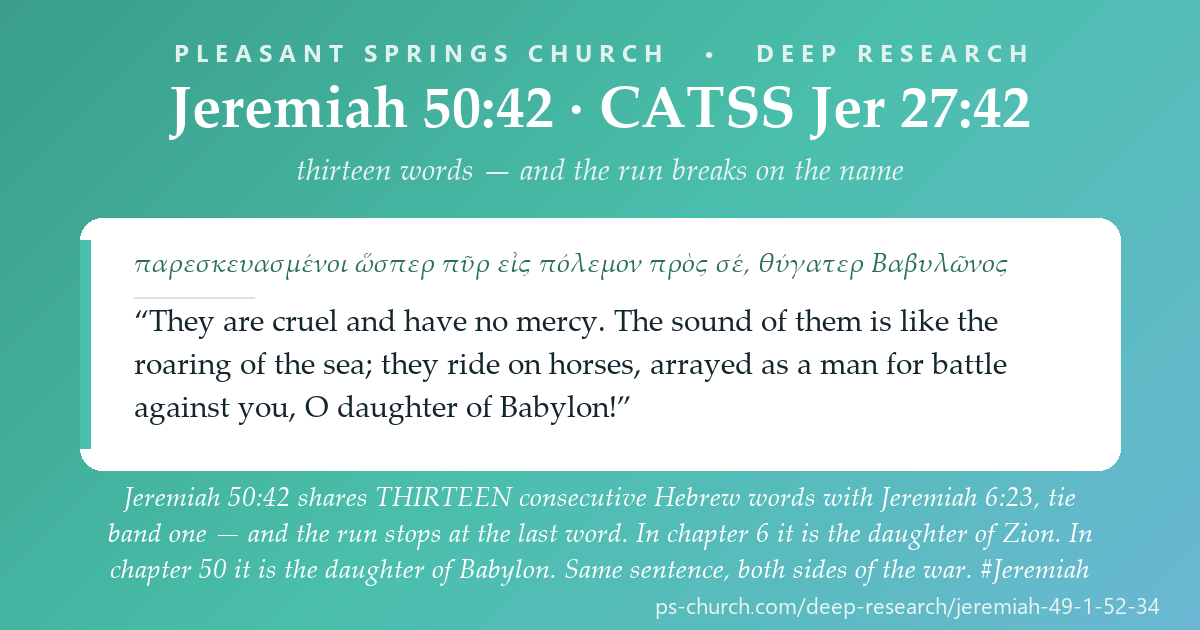
Jeremiah 50:42 against Jeremiah 6:23 — the run that breaks on the name.
… וְלֹא יְרַחֵמוּ קוֹלָם כַּיָּם יֶהֱמֶה וְעַל־סוּסִים יִרְכָּבוּ עָרוּךְ כְּאִישׁ לַמִּלְחָמָה עָלַיִךְ בַּתthe thirteen words Jeremiah 6:23 and Jeremiah 50:42 share, tie band one
Nineteen word forms in each verse. Thirteen of them are the same thirteen, in the same order, and no third verse in the Hebrew Bible reaches them.
The run begins at ולא ירחמו, five words in, because the two verses spell וכידון / וכידן differently and 6:23 has הוא where 50:42 has המה. It ends at בת. The fourteenth word is Zion in one verse and Babylon in the other, and it is the last word of both.
In Greek the pair does not survive as a run, because the CATSS rows for the two verses are separately translated: 27:42 ends πρὸς σέ θύγατερ Βαβυλῶνος, and its opposite number is a different sentence. The reversal is a Hebrew-column finding and the page says so.
Jeremiah 49 against Obadiah — the same seam, measured from the other side.
The Obadiah study on this shelf measured Obadiah against Jeremiah 49 and found that the overlap does not fade, it stops. This page measures the same seam from the Jeremiah side and finds it in the same place.
| Jeremiah | Obadiah | run | shared |
|---|---|---|---|
| 49:9 | Obadiah 5 | 4 | אם בצרים באו לך |
| 49:14 | Obadiah 1 | 4 | מאת יהוה וציר בגוים |
| 49:15 | Obadiah 2 | 5 | הנה קטן נתתיך בגוים בזוי |
| 49:16 | Obadiah 4 | 5 | קנך משם אורידך נאם יהוה |
| 49:26 | Obadiah 8 | 4 | ביום ההוא נאם יהוה |
| 49:8 | — | 0 | and 0 against everything outside Jeremiah 49–52; three, band one, against Jeremiah 49:30 |
Five verses of Jeremiah 49 reach three or more with Obadiah; twenty-three of the thirty-nine reach two or more, and fourteen of those eighteen twos are נאם יהוה or כה אמר. Four of the five deep ones are 49:9, 14, 15 and 16 — one verse, then a gap of four, then three in a row. The fifth, 49:26, is a stock day-formula. And 49:8, which sits immediately before the first of them, shares no adjacent word pair with anything outside these four chapters — inside them it reaches three with 49:30. Nothing here says which book is prior, whether either writer saw the other, or whether both drew on something older.
The whole passage against Revelation — the page’s own counter-example.
All 173 Greek rows of Jeremiah 49–52 were screened against all 405 verses of Revelation. Nothing reaches five.
| Greek Jeremiah | = Masoretic | Revelation | run | band |
|---|---|---|---|---|
| 27:29 | 50:29 | 18:6 κατὰ τὰ ἔργα αὐτῆς | 4 | 1 |
| 27:20 | 50:20 | 9:6 | 4 | 1 |
| 27:31 | 50:31 | 11:18 | 4 | 1 |
| 27:38 | 50:38 | 9:19 | 4 | 1 |
| 27:7 | 50:7 | 11:12 | 4 | 1 |
| 28:16 | 51:16 | 4:1, 4:2, 5:13, 11:19, 12:3 | 4 | 5 |
| 28:8 | 51:8 | 18:2 ἔπεσεν Βαβυλών | 2 | — |
| 28:7 | 51:7 | 17:4 ποτήριον χρυσοῦν | 2 | — |
| 28:9 | 51:9 | 18:5 | 1 | — |
| 28:63 | 51:63 | 18:21 the stone and the sea | 1 | — |
| no row | 51:45 | 18:4 come out of her, my people | unmeasurable | — |
Read the last four rows of that table against the first. The four connections a reader of Revelation 18 would name first — fallen, fallen is Babylon, the golden cup, the sins heaped to heaven, the millstone thrown into the sea — measure two, two, one and one. The one that measures four is a phrase nobody quotes. And the deepest connection of all, come out of her, my people, cannot be measured at all, because its Hebrew verse is one of the four the Greek file does not have.
The honest statement is this. Revelation 18 and Jeremiah 50–51 share a subject, a set of images and a rhetorical shape. What they do not share, in the texts held here, is very much wording. A run screen finds verbatim contact. It does not find allusion, and on this passage the difference between the two is the whole story.
Four figures printed so that the deep ones are not read as more than they are.
Jeremiah 51:33 reaches seven consecutive Hebrew words with a tie band of SIX. The seven words are כי כה אמר יהוה צבאות אלהי ישראל and the six partners are Jeremiah 16:9, 27:21, 28:14, 29:8, 32:15 and 42:18. A seven with a band of six is a formula. A five with a band of one is a signal. Both are on this page.
Jeremiah 49:1 reaches three with a tie band of 280. Two hundred and eighty verses of the Hebrew Bible tie it. That is what כה אמר יהוה costs.
Greek Jeremiah 52:9 reaches five with Luke 19:35, tie band one. καὶ ἤγαγον αὐτὸν πρὸς τόν — and they brought him to… In Jeremiah, Zedekiah is brought to the king of Babylon at Riblah. In Luke, the disciples bring the colt to Jesus. Five consecutive words, tie band one, and nobody is quoting anybody.
Greek Jeremiah 30:12 reaches five with Jude 7, tie band one — Σοδομα καὶ Γομορρα καὶ αἱ. That one at least is a shared formula about the same two cities; 27:40, Masoretic 50:40, reaches four with the same verse. The page prints it as a four and a five, not as a dependency.
Where the argument actually is, and — more usefully — where this page is thin, what it did not consult, and what it could not check.
This section exists to keep the page honest. Everything measured above is reproducible from two directories of text files. Everything below is either somebody else’s work or an admission.
The live scholarly argument this passage sits inside.
Two editions. The Greek Jeremiah is roughly an eighth shorter than the Hebrew and arranges the oracles against the nations differently. The Qumran material (4QJerb, 4QJerd) is usually read as supporting a Hebrew Vorlage close to the Greek. Emanuel Tov and J. Gerald Janzen are the standard names; the argument has been running since the 1970s and is not settled. No Qumran manuscript was collated for this page and no critical apparatus was opened.
Whether Jeremiah wrote chapters 50–51. A long tradition of critical scholarship holds that the Babylon oracles are later than the prophet, partly because 51:59–64 describes a scroll that is then destroyed. Others take the colophon at 51:64 as the whole point. This page has no view. It reports that the colophon stands in exactly one verse of the Hebrew Bible and that the Greek row stops before it.
Whether chapter 52 came from Kings or Kings from it or both from a third source. The measurement here is very strong — seventeen words, fourteen, thirteen, twelve, eleven, all tie band one — and it is completely silent on direction. A run screen cannot tell you who copied whom, and this page will not pretend otherwise.
What this page did not check, stated plainly.
1. No manuscript evidence of any kind. The Hebrew is Sefaria’s Miqra according to the Masorah as it stands; the Greek is Rahlfs as digitized by CATSS. No apparatus, no variant, no Scroll, no Syriac, no Targum, no Vulgate. Where the two columns differ this page prints both and declines to adjudicate, and that is not modesty, it is the limit of the evidence on this disk.
2. The ESV column was not verified against a held ESV text. There is no ESV file for Jeremiah on this disk and no Crossway API key in this project. The English was typed, and its verse alignment rests on verse counts and chapter openings. The Hebrew and Greek columns were pulled programmatically from the corpus files and are exactly what those files contain.
3. The Greek chapter correspondences were derived by content, not by measurement. Nothing on this shelf compares Hebrew to Greek for run depth, because a translation does not share word forms. The mapping used throughout this page — Masoretic 49:1–6 = Greek 30:17–21, 49:7–22 = 30:1–16, 49:23–27 = 30:29–33, 49:28–33 = 30:23–28, 49:34–39 = 25:14–20, 50 = 27, 51 = 28, 52 = 52 — was established by matching proper nouns and verse counts across the two columns, by eye. Once the eleven Hebrew verses with no Greek row are set aside and 25:14 is counted as a heading, the counts line up block by block; the raw counts do not — Masoretic 51 is 64 verses against 60 Greek rows, and Masoretic 52 is 34 against 28. That is a good check; it is not a proof.
4. One reported Hebrew maximum on this page is inflated by a scribal marker. The Masoretic file counts the section markers {ס} and {פ} as words, and the frozen normaliser tokenises them. Jeremiah 52:30’s reported five with 1 Chronicles 12:27 ends on a marker and is really four, and the codex row says so. The runs this page actually argues from — the seventeen at 52:1, the fourteen at 52:13, the thirteen at 50:42 and 52:17, the twelve, the eleven, the nine at 51:15 and the fives against Obadiah — were each checked and cross no markers. normalize.py is frozen and was not edited.
5. Nothing was checked against the Second-Temple Greek literature. 1 Maccabees, Sirach, Baruch and the Epistle of Jeremiah are on this disk. The Epistle of Jeremiah in particular is a whole Greek text about Babylonian idols, and no run screen was pointed at it for this page. It is inside the 30,348-unit Greek Old Testament corpus the word counts above were taken over, and nowhere else on this page. That is a real gap and a good next piece of work.
6. The chronology of 52:28–30 was not reconciled with anything. The three counts, their years and their relation to 2 Kings 24–25 and to the Babylonian Chronicle are a genuine problem. This page reports only which texts carry the verses.
Where this page is weakest.
The Revelation section is the strongest part of the page and also the easiest to misread. “Revelation 18 shares at most four consecutive words with Jeremiah 50–51” is true, measured, and would be badly misused if it were taken to mean John was not using Jeremiah. He may have been quoting from memory, from a different Greek text, from the Hebrew, or reworking freely — all of which produce low runs. The measurement constrains one thing only: it was not verbatim transcription of the Greek text held here.
The Merodach observation is a distribution, not an intention. Four verses in the Hebrew Bible carry the form and two of them frame this passage. That is a genuine and checkable fact. Whether anybody put them there for that reason is not something a word count can reach.
And the headline run has a soft edge worth naming. Jeremiah 6:23 and 50:42 share thirteen words and differ in three places: one spelling (וכידון against וכידן), one pronoun (הוא against המה) and the name at the end. Folding the spelling alone would NOT lengthen the run: measured, it stays at thirteen, because the pronoun still breaks it. Fold both and it is eighteen. Reported as measured, not as rounded.
- Lundbom, Jack R. Jeremiah 37–52 (Anchor Yale Bible 21C).
- Holladay, William L. Jeremiah 2 (Hermeneia) — chapters 26–52.
- McKane, William. Jeremiah II (ICC) — chapters 26–52.
- Carroll, Robert P. Jeremiah (OTL).
- Tov, Emanuel. Textual Criticism of the Hebrew Bible, and his essays on the two editions of Jeremiah.
- Janzen, J. Gerald. Studies in the Text of Jeremiah (1973).
- Beale, G. K. and Carson, D. A. (eds.) Commentary on the New Testament Use of the Old Testament — for Revelation 18 and Hebrews 8.
- Aune, David E. Revelation 17–22 (WBC) — on the Babylon material.
What the measurements leave you holding.
The sentence that works both ways.
Chapter 6 of this book describes an army coming for Jerusalem: cruel and without mercy, their voice roars like the sea, they ride on horses, arrayed as a man for battle against you, O daughter of Zion.
Chapter 50 describes an army coming for Babylon. It is the same sentence. Thirteen consecutive words, tie band one, and the run breaks on the last word of both verses.
Whatever else that means, it means the language of judgement in this book is not the language of favouritism. The same God, the same words, the same cavalry — and the only thing that changes is which city is standing at the end.
The last four verses of a very long book.
Jeremiah preached for forty years, was beaten, put in the stocks, thrown down a cistern, and carried to Egypt against his will. His book ends with none of that. It ends with a king he never much approved of being let out of a Babylonian prison, given a change of clothes and a seat at a table.
52:34 is six consecutive Hebrew words of 2 Kings 25:30, tie band one. Even the ending stands in two books at once, and this page does not say which had it first. And it is still an ending: after fifty-one chapters of sinking, the last thing the book does is lift somebody’s head.
A question worth arguing about.
Jeremiah 51:45 says go out of the midst of her, my people. Revelation 18:4 says come out of her, my people. Everyone hears the connection.
And the Greek Jeremiah on this disk does not contain the verse, so the measurement has nothing to say about it at all. What do you do with a connection you can hear and cannot count? This page’s answer is to print both facts and let you decide which one is doing the work.
Every Deep Research page traces its passage across the whole sweep — the Old Testament, the Second-Temple world between the testaments (historical witnesses, not Scripture), and the New Testament. Follow the thread:
Pleasant Springs Church — Deep Research
Research method after Michael S. Heiser’s Bible Research Method (examine dictionaries → ancient literature → important words → textual connections → academic publications → share), with the Pleasant Springs “Author & Audience” foundation. Scripture set in the Hebrew, the Greek editions named on each page and the ESV (Old Testament), and the Greek New Testament and the ESV (New Testament), per the practice of Pleasant Springs Church. Jeremiah research grounded in Lundbom (Anchor Yale), Holladay (Hermeneia), McKane (ICC) and Carroll (OTL); on the two editions in Tov and Janzen; on Revelation 18 in Aune and in Beale and Carson. Text: Hebrew from the Masoretic text as printed in the edition consulted — Sefaria’s Miqra according to the Masorah; no critical apparatus was consulted for the Hebrew and no Dead Sea Scroll was collated, the Qumran Jeremiah manuscripts included. Greek from Rahlfs’ Septuaginta as digitized by CATSS; Greek New Testament from the SBL edition as digitized by MorphGNT. The standing caution for this shelf applies: these pages say “the CATSS Greek text reads…” and never call a Greek reading early or late, and never say which text acted on which. ⚠️ Verse numbering — this is the hardest offset on the shelf and this passage is the worst of it. The two corpora were aligned by reading the files on this disk, not by copying a printed table. Masoretic Jeremiah 49, 50, 51 and 52 hold 39, 46, 64 and 34 verses. The Greek material stands at CATSS Jeremiah 25:14–20 and 30 (for Masoretic 49), 27 (for 50), 28 (for 51) and 52 (for 52), holding 7, 32, 46, 60 and 28 rows. Within Masoretic 49 the individual nations are reordered as well as renumbered: 49:1–6 = Greek 30:17–21, 49:7–22 = 30:1–16, 49:23–27 = 30:29–33, 49:28–33 = 30:23–28, 49:34–39 = 25:14–20. Chapter 52 is the only chapter in this passage that keeps its number, and even there the rows are not the same rows. Eleven Hebrew verses in these four chapters have no Greek row at all: 49:6; 51:45, 46, 47, 48; and 52:2, 3, 15, 28, 29, 30. One Greek row, 25:14, has no single Hebrew verse behind it — it is a heading. Every reference on this page prints the Greek number beside the English one wherever they differ, which here is everywhere. ⚠️ The ESV column was NOT verified against a held ESV text. No ESV file for Jeremiah exists on this disk and no Crossway API key exists in this project; the English was typed and its verse alignment rests on verse counts and chapter openings. The Hebrew and Greek columns were pulled programmatically from the corpus files. ⚠️ Every cross-corpus run figure on this page was measured on 31 August 2026 and applies MorphGNT’s own spelling equivalences — οὐ/οὐκ/οὐχ, ἐκ/ἐξ and the movable nu — so that a shared run is not cut at a word the two editions merely spell differently. Figures published on this shelf before 30 August 2026 are lower for that reason; nothing was copied from a sibling page and every number above was re-measured. ⚠️ A run of zero on the Hebrew screen means NO TWO CONSECUTIVE WORDS. The Hebrew-side screen runs with the unigram fallback off AND with the whole passage held out of its own target, so max = 0 at 49:8, 49:11, 49:24, 50:2, 50:8, 50:11, 50:12 and 51:38 means those verses share no adjacent word pair with any of the 23,021 Masoretic verse units OUTSIDE Jeremiah 49–52 — not that they share no words, and not that they share nothing inside the passage. Screened against the whole corpus only four of the eight stay at zero: 49:11, 49:24, 50:11 and 51:38. The Greek-side screen runs with the fallback ON, so a 1 reported for a Greek row means the two verses share isolated words and no adjacent pair at all — which is what the 1 for Greek Jeremiah 28:6 against Revelation 18:4 means, and the word is ἐκ. ⚠️ One reported Hebrew maximum on this page is inflated by a scribal marker and is corrected in place. The Masoretic file counts {ס} and {פ} as words. Jeremiah 52:30’s reported five ends on one and is really four; the codex row says so. Every run this page argues from was checked and crosses no marker. normalize.py is frozen and was not edited. ⚠️ Greek Old Testament figures are scoped to the 64 CATSS files held here, 30,637 verse units, screened to 30,348 with the Odes excluded. Two of the Odes are New Testament text — Ode 9 is Luke 1 and Ode 13 is Luke 2 — and ten more are second copies of Exodus 15, Deuteronomy 32, 1 Samuel 2, Habakkuk 3, Isaiah 26, Jonah 2, Daniel 3, Isaiah 5 and Isaiah 38, so leaving them in would inflate any tie band that touched one. ⚠️ The deepest New Testament run on this page is not a quotation, and the passage’s clearest New Testament connection cannot be measured at all. The page says both, in three places each. Typology is handled per the house position: what the text says, what the New Testament itself draws, and what we see from this side of the cross — with the seeing left to the reader.
Scripture quotations marked ESV are from the ESV® Bible (The Holy Bible, English Standard Version®), © 2001 by Crossway, a publishing ministry of Good News Publishers. ESV Text Edition: 2016. Used by permission. All rights reserved. The ESV text may not be quoted in any publication made available to the public by a Creative Commons license, and the ESV may not be translated in whole or in part into any other language. www.esv.org
|
Did this study bless you today? 💚 Give to Support PS Church100% of gifts go to the General Fund — thank you. |