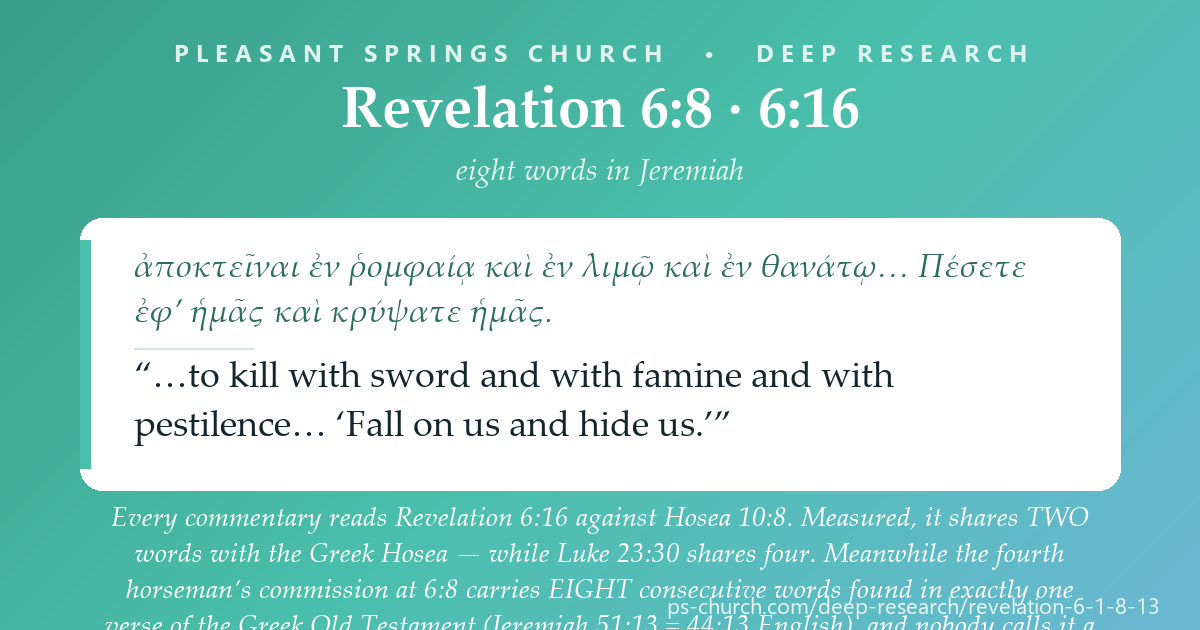
Every commentary reads Revelation 6:16 — fall on us and hide us — against Hosea 10:8. Measured against the Greek text, it shares two words with Hosea. The verse that does reach Hosea is Luke 23:30, at four words with a tie band of one across 30,348 verse units. Meanwhile the deepest Old Testament contact anywhere in these three chapters belongs to a verse nobody calls a quotation: the fourth horseman’s commission at 6:8 carries eight consecutive words that stand in exactly one verse of the Greek Old Testament — Jeremiah 51:13, which is Jeremiah 44:13 in an English Bible — and in exactly one verse of the Greek New Testament, which is this one. Depth is not citation, and citation is not always deep. This study works the seven seals, the two visions between the sixth and the seventh, and the first four trumpets — and prints its own counter-examples. See the method →
Revelation 6:1–8:13 (selections)
Greek NT (SBLGNT via MorphGNT) · ESV⚠️ But the verses this page measures Revelation AGAINST are numbered differently, and one of them badly. The deepest finding on this page cites Greek Jeremiah 51:13. Greek Jeremiah is renumbered wholesale — the oracles against the nations sit in a different place — and that verse is Jeremiah 44:13 in a Hebrew or English Bible. Likewise Greek Psalm 41:2 is Psalm 42:1 in English, and 2 Chronicles 2:14 in the Greek and the Hebrew is 2 Chronicles 2:15 in English. Both numbers are given every time this page names one of them.
⚠️ One place in Revelation where the numbering does part, outside this study. The file measured here gives Revelation 405 verses to the ESV’s 404: it numbers a clause 12:18 that English Bibles print at the end of 12:17. Chapters 6, 7 and 8 are unaffected.
The Shape of the Passage
Sequence — four, then two, then a pause, then the seventhRevelation 6–8 is not a new vision. It is the scroll of chapter 5 being opened. Chapter 4 put God on the throne, chapter 5 found the one worthy to take the sealed scroll, and chapter 6 begins to break the seals. Everything that follows in this passage is what happens when the slain Lamb opens what was sealed — which is why the first thing the four horsemen share is not their colour but a passive verb.
Author
John writes in verbs of receiving. Count the aorist passive of δίδωμι — ἐδόθη, it was given — across the book: 23 times in Revelation, and eight of them fall in these three chapters. A crown is given to the first rider (6:2); to the second it is given to take peace from the earth, and a great sword is given him (6:4, twice); authority over a fourth of the earth is given (6:8); a white robe is given to each martyr (6:11); permission to harm is given to the four angels (7:2); seven trumpets are given out (8:2); much incense is given to the angel at the altar (8:3).
Nobody in this passage takes anything. The same passive covers the crown, the sword, the martyr’s robe and the incense of the prayers. John never says who does the giving, and the reticence is the point: the horsemen ride on a licence, and the licence is issued from the throne room the reader has just been shown. This is a grammatical observation, and it is not by itself a doctrine of providence — but it is what the text does, eight times in 47 verses.
And John counts. Seven seals, four horsemen, four winds, four corners, 144,000, twelve tribes of twelve thousand, seven trumpets, three woes, and a third of everything — τὸ τρίτον twelve times in chapter 8 alone against sixteen in the whole book. A third is not most. The trumpets are restrained in a way the bowls of chapter 16 will not be.
Audience
Seven churches, and at least two of them had already buried someone. The letters of chapters 2–3 name Antipas, killed at Pergamum, and warn Smyrna of prison and death. The fifth seal is written for congregations that have a grave to visit: the souls under the altar are not an abstraction to them, and neither is the question they ask.
“How long?” is a liturgical question, not a rhetorical one. It is the question of Psalm 13, Psalm 74, Psalm 79, Habakkuk 1, Zechariah 1 — and the answer given here is unusual. It is not soon and it is not never. It is a little longer, until the number is complete, with a robe handed over in the meantime. The passage does not tell the churches that suffering is short. It tells them it is counted.
Two portraits of one people, or two peoples? The sealed 144,000 are heard and are “from every tribe of the sons of Israel”; the multitude is seen and is “from every nation.” Readers have taken these as the same company described twice, as the church and ethnic Israel, and as martyrs and the whole redeemed. This page does not decide it. What it can show is the literary move: John hears one thing and sees another, exactly as he does at 5:5–6, where what he hears is Lion and what he sees is Lamb — and there the two are one.
Orient on seals, horsemen, the sealing of the servants, and the trumpets.
Search by topic: Revelation, Book of; seal, sealing; horse, horseman; Death and Hades; martyr; altar; tribes of Israel, lists of; tribulation; trumpet; wormwood; woe oracles.
Which articles are relevant?
- Anchor Bible Dictionary — “Revelation, Book of,” “Seal,” “Hades,” “Tribes of Israel,” “Trumpet,” “Apocalypticism.”
- Dictionary of the Later NT and Its Developments (IVP) — “Revelation, Book of,” “Martyrdom,” “Persecution,” “Apocalyptic, Apocalypticism.”
- NIDNTT / TDNT — σφραγίς, θλῖψις, ῥομφαία against μάχαιρα, δεσπότης.
- Commentary on the NT Use of the OT (Beale & McDonough on Revelation) — the standard catalogue of this passage’s alleged Old Testament sources, against which the measurements in stage 4 can be read.
Settle the numbering first — and here there is nothing to settle
Revelation 6, 7 and 8 carry the same verse numbers in the Greek file this page measures and in the ESV.
| ch 6 | ch 7 | ch 8 | whole book | |
|---|---|---|---|---|
| SBLGNT (MorphGNT) | 17 | 17 | 13 | 405 |
| ESV | 17 | 17 | 13 | 404 |
The one verse of difference is at 12:18, outside this study: the Greek file numbers as its own verse a clause (and he stood on the sand of the sea) that English Bibles print at the end of 12:17. Nothing in chapters 6–8 moves.
The offsets that do matter on this page are on the other side of the measurement. Greek Jeremiah is numbered quite differently from Hebrew Jeremiah, and this page’s headline finding cites it: Greek Jeremiah 51:13 = Jeremiah 44:13 in a Hebrew or English Bible. Greek Psalm 41:2 = Psalm 42:1 English. Greek and Hebrew 2 Chronicles 2:14 = 2 Chronicles 2:15 English. Both numbers appear every time.
Four riders, a price list, a tribe that is missing, and a half hour.
The four horsemen, and where their four agents come from
The fourth seal names four ways to die: sword, famine, pestilence, and wild beasts of the earth. That set of four is Ezekiel’s. The wording of three of them is Jeremiah’s. The measurement can tell the two apart.
| comparison | longest shared run | tie band | the words |
|---|---|---|---|
| Rev 6:8 vs Greek Jeremiah 51:13 (= Jer 44:13 English) | 8 | 1 | ἐν ῥομφαίᾳ καὶ ἐν λιμῷ καὶ ἐν θανάτῳ |
| Rev 6:8 vs Greek Ezekiel 14:21 (the four judgments) | 1 | — | καί — and nothing else in sequence |
Ezekiel 14:21 has the whole set — ῥομφαίαν καὶ λιμὸν καὶ θηρία πονηρὰ καὶ θάνατον, sword and famine and evil beasts and death — but in the accusative and without the repeated ἐν, so not one two-word sequence survives the comparison. Revelation 6:8 has Ezekiel’s list and Jeremiah’s grammar. The page reports that and asserts nothing about how it happened.
How rare is the eight-word phrase? Here is the whole gradient.
| the phrase, truncated | verses in the Greek OT | where |
|---|---|---|
| ἐν ῥομφαίᾳ καὶ ἐν λιμῷ καὶ ἐν θανάτῳ (8) | 1 | Jer 51:13 |
| first 6 words | 2 | Jer 45:2 (= Jer 38:2 English), Jer 51:13 |
| first 5 words | 7 | six in Jeremiah, one in Lamentations |
| first 4 words | 12 | Jeremiah, Lamentations, Ezekiel, 1 Samuel, Daniel, Ezra–Nehemiah, Baruch |
| first 3 words | 22 | spread across the historical books and the prophets |
So it is a Jeremianic formula that thins out fast, and only one row in 30,348 carries all eight. In the Greek New Testament the same eight words — and even the first three of them — stand in Revelation 6:8 and nowhere else.
The price list of the third seal
A denarius was about a day’s wage; a χοῖνιξ was roughly a day’s grain ration for one man. So the third seal prices a day’s bread at a day’s pay for wheat, or three days’ worth of the cheaper barley. It is famine pricing without famine language: a man can eat, or a man can feed his household, but not both.
And then the voice protects the luxuries: do not harm the oil and the wine. Which is the strangest clause in the seal, and the page will not pretend to settle it. It has been read as the deep-rooted olive and vine surviving a drought that kills the shallow-rooted grain; as a rich man’s table untouched while the poor queue; and as an edict of Domitian on vineyards. None of those can be checked from the corpora held here, and the page names them as readings, not findings.
The measurement offers one thing, and it is a warning. This row’s deepest Old Testament run is six words, tie band one: καὶ τὸ ἔλαιον καὶ τὸν οἶνον, at 2 Chronicles 2:14 (2:15 in English) — Hiram writing back to Solomon about payment for the Lebanon woodcutters, the wheat and the barley, the oil and the wine. Wheat, barley, oil and wine in that order is simply how the ancient world listed staples. Six shared words with a band of one, and no relationship at all. Print it beside the eight-word run at 6:8 and the difference between a signal and an accident stops being a matter of opinion.
The tribe list — what is actually in it
Revelation 7:5–8 names twelve tribes. Read straight off the Greek, in order:
| # | tribe | # | tribe |
|---|---|---|---|
| 1 | Judah (not Reuben) | 7 | Simeon |
| 2 | Reuben | 8 | Levi (counted, as it is not in the land allotments) |
| 3 | Gad | 9 | Issachar |
| 4 | Asher | 10 | Zebulun |
| 5 | Naphtali | 11 | Joseph |
| 6 | Manasseh | 12 | Benjamin |
Dan is absent. Ephraim is absent. Manasseh and Joseph both stand as tribes in their own right. Levi is counted. Judah is first. Those five facts are readable off Revelation 7 itself and none of them is disputed. That the Manasseh-and-Joseph pairing is unlike the Old Testament twelve-tribe lists — where Joseph either stands for both his sons or gives way to Ephraim and Manasseh — is a claim about the Old Testament rather than a reading of this passage, and it has not been screened here.
What the page will not do is explain the omission. Dan’s absence has been tied to the idolatry at Dan in Judges 18 and 1 Kings 12, to a patristic tradition that the antichrist would come from Dan, and to simple scribal loss. None of that can be measured from the corpora held here, and one of the three would explain the Ephraim omission and the other two would not. The page reports the list. It does not supply a motive.
What the measurement does turn up is small and pleasant. The phrase ἐκ φυλῆς Ἀσήρ, of the tribe of Asher, occurs in the Greek New Testament in exactly one other verse: Luke 2:36, of Anna the prophetess in the temple. And ἐκ φυλῆς Βενιαμίν occurs in exactly one other: Acts 13:21, of Saul the son of Kish.
Half an hour of silence
The seventh seal is the loudest thing in the book and it opens onto silence. ἡμιώριον occurs once in the Greek New Testament and not once in the 30,348 verse units of Greek Old Testament held here.
Readers have connected the silence to the hush in the temple while the incense was offered, and to be silent, all flesh, before the Lord in Zechariah 2:13 and Habakkuk 2:20 and Zephaniah 1:7. Measured, none of those three reaches this row: Revelation 8:1’s deepest Greek Old Testament run is three words — ἐν τῷ οὐρανῷ — with a tie band of twenty-five, which is to say, a formula. The thematic connection may well be right; there is no verbatim contact to support it, and the page says both halves of that.
Structurally the silence does something plain: it is the seam. The seventh seal contains the seven trumpets, so the scroll does not finish being opened — it opens into the next cycle. The half hour is the space between the last seal and the first trumpet.
Two swords, a green horse, a passive verb eight times, and a plant name the Septuagint never uses.
23 times in Revelation counting the two plurals, eight of them in these three chapters — 6:2, 6:4 (twice), 6:8, 6:11, 7:2, 8:2 (plural), 8:3. The crown, the sword, the authority, the martyr’s robe, the licence to harm, the trumpets and the incense all arrive the same way. Nobody in this passage takes anything.
The fourth horse. The word means green, and it stands four times in the Greek New Testament — two of them in this passage: 6:8 of the horse, and 8:7 of the green grass that is burned up. The others are Mark 6:39 (green grass) and Revelation 9:4. The ESV renders it pale here and green everywhere else — one Greek word, two English words, and the seam falls between the horse and the grass.
The fourth rider kills ἐν ῥομφαίᾳ — but the second rider two verses earlier was given a μάχαιρα μεγάλη. Two different swords in seven verses. ῥομφαία occurs 7 times in the Greek New Testament, six of them in Revelation and the seventh in Luke 2:35, the sword through Mary’s soul. In Revelation it is always the sword that comes out of the mouth of the Son of Man (1:16, 2:12, 2:16, 19:15, 19:21) — except here.
Revelation 6:10, how the martyrs address God. The only occurrence in Revelation, out of ten in the Greek New Testament, where it usually means a slave-owner (1 Timothy 6:1–2, Titus 2:9, 1 Peter 2:18). The souls under the altar do not address a judge. They address the owner of the house, about the blood of his own servants.
Revelation 8:1. Once in the Greek New Testament; zero times in 30,348 verse units of Greek Old Testament. The only measured duration in the seals.
Revelation 8:11, twice. Zero occurrences in the Greek Old Testament held here. The Hebrew לַעֲנָה stands 8 times in the Hebrew Bible, and the Greek columns at those places read χολή (gall), πικρία (bitterness), ὀδύνη (pain), ἀνάγκη (distress) — never this word.
Wormwood, checked place by place
The image of wormwood is thoroughly Old Testament. The word is not.
| verse (English numbering) | what the Greek row has |
|---|---|
| Jeremiah 9:15 (Greek 9:14) | ἀνάγκας… ὕδωρ χολῆς — hardships… water of gall |
| Jeremiah 23:15 | ὀδύνην… ὕδωρ πικρόν — pain… bitter water |
| Lamentations 3:15 | πικρίας… χολῆς |
| Lamentations 3:19 | πικρίας καὶ χολῆς |
| Amos 6:12 | εἰς πικρίαν |
| Proverbs 5:4 | πικρότερον χολῆς — more bitter than gall |
| Deuteronomy 29:18 (Greek 29:17) | ἐν χολῇ καὶ πικρίᾳ |
| Amos 5:7 | — the Greek row here does not carry a matching noun |
So a reader working only from the Greek columns would never meet ἄψινθος before Revelation 8:11. What John does is use the ordinary Greek name of the plant, and then make it a proper name — ὁ Ἄψινθος, with the article, as the name of a star. Direction of influence is not asserted: the page does not say John rejected the Septuagint’s renderings, only that his word is not one of them.
Two swords, and the one that is missing
Revelation has a signature sword and does not use it for the second horseman. Five of the book’s six occurrences of ῥομφαία are the sword from the mouth of Christ. The sixth is 6:8, in the fourth rider’s licence — and there it stands inside the eight words shared with Greek Jeremiah, where the Greek Old Testament regularly renders the Hebrew חֶרֶב with ῥομφαία.
The second horseman gets μάχαιρα μεγάλη instead — the shorter blade, the ordinary word for a soldier’s or a butcher’s knife, and the word Revelation uses again only at 13:10 and 13:14. The page notes the two words and does not build on the difference; Greek writers of this period use the two with considerable overlap, and one verse is not enough to prove a distinction.
Every measurement on this page, including the ones that go against it.
The Hosea 10:8 question, measured three ways
Revelation 6:16 and Luke 23:30 both echo Hosea 10:8. Only one of them measures as a use of the Greek Hosea.
| comparison | run | tie band | the shared words |
|---|---|---|---|
| Greek Hosea 10:8 vs Luke 23:30 | 4 | 1 | ἡμᾶς καὶ τοῖς βουνοῖς |
| Greek Hosea 10:8 vs Revelation 6:16 | 2 | — | τοῖς ὄρεσιν |
| Luke 23:30 vs Revelation 6:16 | 4 | — | πέσετε ἐφ’ ἡμᾶς καί |
| Revelation 6:16 vs the whole Greek Old Testament | 5 | 1 | τοῦ καθημένου ἐπὶ τοῦ θρόνου — Exodus 12:29 |
Read the three rows themselves and the arithmetic stops being surprising.
Greek Hosea 10:8 has the mountains told to cover and the hills told to fall. Luke 23:30 has both nouns and both verbs, with the two imperatives the other way round — mountains fall, hills cover — and the four words it shares run straight across the swap. Revelation 6:16 has no hills at all, puts rocks beside the mountains instead, and where Hosea and Luke both say καλύψατε, cover, Revelation says κρύψατε, hide.
So: two words, a different verb, and a missing noun. That is a common picture, not a common text. And the picture is a common one — the same terror stands in Isaiah 2:10, 2:19 and 2:21, and Revelation’s previous verse reaches Isaiah 2:19 at six. Nothing here says Revelation is quoting Luke, or Hosea, or Isaiah, and nothing says which way any borrowing would run. The page reports numbers.
And the deepest run this verse has is meaningless. Five words with a tie band of one, and the one verse in 30,348 that carries them is Exodus 12:29, where τοῦ καθημένου ἐπὶ τοῦ θρόνου, who sat on the throne, describes Pharaoh on the night the firstborn died. This page prints that against itself. A run of five with a band of one sounds decisive until you read what it landed on.
The nine words the white rider shares with the rider of chapter 19
Revelation 6:2 and Revelation 19:11 share nine consecutive words, and no other pair of verses in the Greek New Testament shares them.
6:2 … καὶ ἰδοὺ ἵππος λευκός, καὶ ὁ καθήμενος ἐπ’ αὐτὸν ἔχων τόξον
19:11 … καὶ ἰδοὺ ἵππος λευκός, καὶ ὁ καθήμενος ἐπ’ αὐτὸν πιστὸς καλούμενος
Whether the first horseman is Christ or a counterfeit of him is one of the oldest arguments about this book. The measurement does not settle it, and this page is going to say so plainly rather than let a nine-word run do work it cannot do.
Both readings survive the number. If the two riders are the same, the nine words are the reason. If they are not, the nine words are exactly what a deliberate counterfeit would look like — and the tenth word is where the two part: a bow against a name. A run measures contact, not identity. Notice also that the first horseman is described almost entirely in the same passive as the other three: a crown was given to him.
Where Revelation 6–8 reaches the Greek Old Testament
All 47 rows against 30,348 verse units of Greek Old Testament. The distribution first, so the deep rows can be read in proportion.
| run | rows reaching it |
|---|---|
| 8 | 1 of 47 |
| 7 | 1 of 47 |
| 6 | 4 of 47 |
| 5 | 13 of 47 |
| 4 | 28 of 47 |
| 3 | 45 of 47 |
| 2 | 47 of 47 |
And the rows that reach five or more, every one of them, with the band:
| row | deepest Greek OT partner | run | band | the shared words |
|---|---|---|---|---|
| 6:8 | Jer 51:13 (= 44:13 Eng) | 8 | 1 | ἐν ῥομφαίᾳ καὶ ἐν λιμῷ καὶ ἐν θανάτῳ |
| 6:6 | 2 Chr 2:14 (= 2:15 Eng) | 6 | 1 | καὶ τὸ ἔλαιον καὶ τὸν οἶνον — a coincidence |
| 6:15 | Isa 2:19 and Ps 2:2 | 6 | 2 | εἰς τὰ σπήλαια καὶ εἰς τάς / οἱ βασιλεῖς τῆς γῆς καὶ οἱ |
| 7:12 | 4 Maccabees 18:24 | 6 | 1 | εἰς τοὺς αἰῶνας τῶν αἰώνων ἀμήν — a doxology formula, and not in a canonical book |
| 6:11 | Ezra 5:3 (2 Esdras) | 5 | 1 | καὶ οἱ σύνδουλοι αὐτῶν καί — Persian officials |
| 6:16 | Exod 12:29 | 5 | 1 | τοῦ καθημένου ἐπὶ τοῦ θρόνου — of Pharaoh |
| 7:2 | Haggai 2:6, 2:21 and 2 others | 5 | 4 | τὴν γῆν καὶ τὴν θάλασσαν |
| 7:11 | Judith 5:8 | 5 | 1 | αὐτῶν καὶ προσεκύνησαν τῷ θεῷ — not a canonical book |
| 7:15 | Ps 41:4 (= Ps 42:3 Eng) and Lev 15:6 | 5 | 2 | ἡμέρας καὶ νυκτὸς ἐν τῷ / καὶ ὁ καθήμενος ἐπὶ τοῦ — two different runs |
| 8:3 | Num 4:11 | 5 | 1 | ἐπὶ τὸ θυσιαστήριον τὸ χρυσοῦν |
| 8:8 | Jonah 1:4 | 5 | 1 | εἰς τὴν θάλασσαν καὶ ἐγένετο — a coincidence |
| 8:10 | Ps 41:2 (= Ps 42:1 Eng) | 5 | 1 | ἐπὶ τὰς πηγὰς τῶν ὑδάτων — the deer panting; a coincidence |
| 8:13 | Dan 3:1 (OG) and Num 33:55 | 5 | 2 | τοὺς κατοικοῦντας ἐπὶ τῆς γῆς |
Four of these thirteen are certainly accidents and the page says which. Solomon’s supply list (6:6), the storm that hit Jonah’s ship (8:8), the Persian governor’s colleagues (6:11) and the deer panting for the water-springs (8:10) have nothing to do with the seals or the trumpets. Every one of them has a tie band of one — the same band as the Jeremiah run at 6:8. A tie band of one tells you a phrase is rare. It does not tell you a text is being used. Two of the thirteen (7:11, 7:12) land in books this shelf does not treat as Scripture.
Where Revelation 6–8 reaches the rest of the New Testament
The same 47 rows against the other 7,880 verses of the Greek New Testament. Almost everything deep is Revelation talking to itself.
| row | deepest NT partner | run | band | the shared words |
|---|---|---|---|---|
| 6:2 | Rev 19:11 | 9 | 1 | καὶ ἰδοὺ ἵππος λευκὸς καὶ ὁ καθήμενος ἐπ’ αὐτόν |
| 7:10 | Rev 5:13 | 8 | 1 | τῷ καθημένῳ ἐπὶ τῷ θρόνῳ καὶ τῷ ἀρνίῳ |
| 7:11 | Rev 11:16 | 8 | 1 | ἐπὶ τὰ πρόσωπα αὐτῶν καὶ προσεκύνησαν τῷ θεῷ |
| 8:6 | Rev 15:6 | 7 | 1 | οἱ ἑπτὰ ἄγγελοι οἱ ἔχοντες τὰς ἑπτά |
| 6:15 | Acts 4:26 | 6 | 1 | οἱ βασιλεῖς τῆς γῆς καὶ οἱ — and Acts 4:26 is quoting Psalm 2:2 |
| 7:17 | Rev 21:4 | 6 | 1 | πᾶν δάκρυον ἐκ τῶν ὀφθαλμῶν αὐτῶν |
| 6:9 | Rev 1:9 and Rev 20:4 | 6 | 2 | διὰ τὸν λόγον τοῦ θεοῦ καί |
| 6:16 | Rev 4:10 | 6 | 1 | τοῦ καθημένου ἐπὶ τοῦ θρόνου καί |
| 7:12 | Gal 1:5, Php 4:20, 1 Ti 1:17 and 4 more | 6 | 7 | εἰς τοὺς αἰῶνας τῶν αἰώνων ἀμήν — a band of seven, which is what a formula looks like |
The one that goes outside the book is the instructive one. Revelation 6:15 and Acts 4:26 share six consecutive words with a tie band of one, and there is no contact between them whatever. Acts 4:26 is a quotation of Psalm 2:2; Revelation 6:15 reaches the same six words because it too stands on Psalm 2:2. Two verses can share a long, rare, exact run because they are both looking at a third text. That single row is the best short argument on this page for why a run is evidence of contact and not of dependence.
Compare the last row, too. The doxology at 7:12 reaches six words in seven different New Testament verses. Same run, band of seven instead of one, and it means nothing at all — it is how Greek-speaking Christians ended a prayer.
What was not consulted, what could not be checked, and where this page is weakest.
The limits of the measurement itself
The screen finds verbatim contact. It does not find allusion, and on this passage that gap is unusually wide. Revelation 6:12–14 reads like Isaiah 34:4 and Joel 2:31 to any reader — sun black as sackcloth, moon like blood, stars falling, the sky rolled up like a scroll. Measured, 6:13 reaches Isaiah 34:4 at one word and 6:14 at two. The pictures are shared; the sentences are not. A page that reported only the runs would have to say Revelation 6:12–14 has no Old Testament background, and that would be false.
So this page has been careful to run the measurement in both directions. Where a famous connection measures low (Hosea 10:8, Isaiah 34:4) it says so and does not delete the connection. Where an unfamous one measures high (Jeremiah 51:13, 2 Chronicles 2:14) it says so and does not manufacture a connection. Neither number decides anything by itself.
A specific weakness, named. The headline finding — eight words, band of one — is a strong result about the Greek Old Testament as this shelf holds it. It is not a demonstration that Revelation used Greek Jeremiah. The phrase sword, famine and pestilence is a Jeremianic commonplace in Hebrew as well; the eight-word Greek form could be reached by a writer who knew the formula in either language, and the page cannot distinguish those. Direction of influence is never asserted here.
What could not be checked at all
No critical apparatus was consulted, for either testament. This matters more on Revelation than on most books, and the page has three known exposures. (1) At 8:1 the file measured here reads ὅταν where many editions read ὅτε, and the editor flags the word. (2) At 6:1 the living creature says Ἔρχου alone; older English Bibles read come and see, from a longer Greek text. (3) At 8:13 the creature crying in mid-heaven is an ἀετός, an eagle; a body of manuscripts reads ἀγγέλου, angel, which is where the King James “angel flying” comes from. The page reports the file it measures and does not adjudicate any of the three.
No Latin, Syriac or Coptic witnesses. No papyri. No Second Temple apocalyptic sources — 4 Ezra, 2 Baruch and 1 Enoch are the obvious comparanda for a seal-opening vision, a fixed number of the righteous and a delay until the count is full, and none of them was consulted. No Roman-period evidence on grain prices, on Domitian’s vine edict, or on the Parthian mounted archer sometimes read behind the first horseman.
The measurement corpus is not a canon, and the page has flagged where that bites. The 30,348 verse units include the deuterocanonical books and the Psalms of Solomon. Two of this passage’s thirteen deepest rows land in 4 Maccabees and Judith, and both are labelled in the table above. A hit in those files is a fact about Greek, not about Scripture.
⚠️ THE CORPUS THIS PAGE IS MEASURED AGAINST GOT SMALLER ON 31 AUGUST 2026, AND NOT ONE NUMBER ON THIS PAGE MOVED. THE PAGE PRINTS THE HISTORY RATHER THAN SWAPPING THE FIGURE IN SILENCE. The Odes — the fourteen liturgical canticles bound after the Greek Psalter, which arrived with the last twenty CATSS files — have been taken out of everything this shelf calls “the Greek Old Testament” for screening purposes. They are still held on the disk. They are no longer screened. Two reasons, either of which would be enough: Ode 9 is Luke 1 (the Magnificat and the Benedictus) and Ode 13 is Luke 2 (the Nunc Dimittis), so a screen that includes them can report a Gospel’s deepest Old Testament contact when what it has found is Luke matching Luke; and ten more of the canticles are second copies of passages already in the corpus (Ode 1 = Exodus 15, 2 = Deuteronomy 32, 3 = 1 Samuel 2, 4 = Habakkuk 3, 5 = Isaiah 26, 6 = Jonah 2, 7 and 8 = Daniel (Th) 3, 10 = Isaiah 5, 11 = Isaiah 38), so any tie band touching one of them was doubled. HELD is 30,637 verse units in 64 files; SCREENED is 30,348. The difference is exactly the 289 Odes units, and every screening figure on this page now names the second number.
⚠️ And here is the whole effect of that on this page, which is almost nothing — which is worth printing too. Re-run over 30,348 units, every run and every tie band published above is unchanged: 6:8 is still eight at Jeremiah 51:13 in a band of one, 6:6 still six at 2 Chronicles 2:14, 6:15 still six across Isaiah 2:19 and Psalm 2:2, 7:12 still six at 4 Maccabees 18:24, 6:16 still five at Exodus 12:29, 8:3 still five at Numbers 4:11, and the whole distribution table — 1, 1, 4, 13, 28, 45, 47 — stands exactly as printed. Not one hit on this page was in Ode 9 or Ode 13, so nothing here was Luke measured against itself. Three tie bands narrowed, and none of the three is a figure this page prints: 6:10’s band of 258 is now 253, 6:12’s 18 is now 17, 7:10’s 26 is now 25. A page whose findings survive a corpus getting smaller is a page whose findings were not resting on the corpus’s edges, and that is the only thing this correction has to report.
A note on the corpus, dated. The Greek Old Testament on this shelf went from 44 CATSS files to 64 — the complete upstream lxxmorph set — on 30 August 2026, hours before this page was written. Four of this page’s findings come from files that were not here the day before: Exodus 12:29 at 6:16, Numbers 4:11 at 8:3, Judith 5:8 at 7:11 and 4 Maccabees 18:24 at 7:12. Any figure on any Deep Research page that counts occurrences “across the Greek Old Testament held here” is a figure about a corpus of a particular size on a particular date, and this one names both.
Where the page is weakest on the substance
It does not tell you who the first horseman is. Nine words with chapter 19 is the strongest datum anyone can put on that table, and it cuts both ways. The page prints it and stops.
It does not tell you who the 144,000 are, or whether they are the great multitude. It shows the hear/see structure and the absence of Dan, and leaves the identification to the reader and the church.
It does not periodise the seals. Whether these are first-century events, a recurring pattern of history, or a strictly future sequence is the central question readers bring to Revelation 6, and nothing in a run screen touches it. Pleasant Springs holds a historic premillennial position; this page does not argue it and does not assume it, and a reader from another position will find nothing here that has been decided against them by measurement.
Reading list
- G. K. Beale, The Book of Revelation (NIGTC) — the fullest treatment of the Old Testament in Revelation.
- David E. Aune, Revelation (Word Biblical Commentary, 3 vols.).
- Craig R. Koester, Revelation (Anchor Yale Bible 38A).
- Richard Bauckham, The Climax of Prophecy — on the seals, the trumpets and the interludes as a structure.
- Beale & McDonough, “Revelation,” in Commentary on the New Testament Use of the Old Testament.
- None of these were consulted for the measurements on this page, which were run on the text files named in the footer. Where this page disagrees with a commentary it is disagreeing about a number, not about a judgement.
Three questions, and the one that is answered with a crowd.
Who is able to stand?
There are three questions in these three chapters. The martyrs ask the first from underneath the altar — how long? The kings and the generals and the slaves ask the second from inside the caves — who can stand? The third is the elder’s, and it is the only one answered in words: who are these, clothed in white robes?
The second question is answered too, but not with a sentence. The verb of 6:17 is σταθῆναι, from ἵστημι. It stands 21 times in Revelation, and after 6:17 the next five occurrences are 7:1, 7:9, 7:11, 8:2 and 8:3 — every one inside this passage, and nothing further until chapter 10. Four angels standing at the corners of the earth. A multitude no one could number standing before the throne. All the angels standing around it. Seven angels who stand before God. Another angel who stood at the altar.
The kings ask who can stand, and the book answers by showing five sets of people who are standing — and one of them is a crowd out of every nation, in white, holding palms. They are not standing because they escaped anything. The elder says they came out of the great tribulation, and that their robes are white because they were washed in blood. The answer to “who can stand” is not “the strong.”
The half hour
Two chapters of thunder, hoofbeats, earthquake, a great multitude crying out with a loud voice, myriads of angels. Then the seventh seal, the last one, the one the whole book has been waiting for — and silence in heaven for about half an hour.
Then the seven angels are given seven trumpets, and an angel comes with a golden censer and stands at the altar — the same altar the souls were under at 6:9 — and the smoke of the incense goes up with the prayers of all the saints. And then he fills the censer with fire from that altar and throws it down.
What goes up from the altar is the prayers. What comes down from the altar is the answer. “How long?” was asked at 6:10 and is not replied to. Two chapters later it comes back as thunder and lightning and an earthquake. The half hour of silence sits between the question and the answer, and it is the only measured length of time in the whole sequence.
One of nine Revelation studies on this shelf. It follows 1:9–18, 2:1–3:22 and 5:1–14, and is followed by 9:1–11:19, 12:1–14:20, 15:1–18:24, 19:1–20:15 and 21:1–22:5. And the tear that God wipes away at 7:17 is wiped away again, in six of the same words, at 21:4 — the first time in the middle of the trouble, the second time after it is over.
Every Deep Research page traces its passage across the whole sweep — the Old Testament, the Second-Temple world between the testaments (historical witnesses, not Scripture), and the New Testament. Follow the thread:
Pleasant Springs Church — Deep Research
Research method after Michael S. Heiser’s Bible Research Method (examine dictionaries → ancient literature → important words → textual connections → academic publications → share), with the Pleasant Springs “Author & Audience” foundation. Scripture set in the Hebrew, the Greek editions named on each page and the ESV (Old Testament), and the Greek New Testament and the ESV (New Testament), per the practice of Pleasant Springs Church. Revelation 6:1–8:13 research grounded in Beale (NIGTC), Aune (WBC), Koester (Anchor Yale) and Bauckham (The Climax of Prophecy), with Beale & McDonough on the New Testament use of the Old. Text: Greek New Testament from the SBL edition as digitized by MorphGNT; English from the ESV. ⚠️ VERSE NUMBERING — no offset in this passage, and the page checked. The MorphGNT file and the ESV both give Revelation 6, 7 and 8 seventeen, seventeen and thirteen verses. The one place the book’s numbering parts is outside this study: the Greek file has 405 verses to the ESV’s 404, numbering as 12:18 a clause English Bibles print at the end of 12:17. The offsets that do matter here are on the Old Testament side of the measurement — Greek Jeremiah 51:13 = Jeremiah 44:13 in Hebrew and English; Greek Psalm 41:2 = Psalm 42:1; Greek and Hebrew 2 Chronicles 2:14 = 2 Chronicles 2:15 English. Both numbers are given every time. ⚠️ The measurement, in full. Greek against Greek. MorphGNT field 6, the normalised word form (the column that already resolves elision and the movable nu), against the CATSS FORM column (cols 0–24) beta-code transliterated first. Both sides lowercased, accents and breathings dropped, final sigma folded, then filtered to Greek letters — the same filter applied to both corpora. Word forms, never lemmas; contiguous runs only, so a reordering scores zero. Corpus: the 47 rows of Revelation 6:1–8:13 against 30,348 verse units — the 64 CATSS files less the Odes and against the other 7,880 verses of the Greek New Testament. Exhaustive and deterministic; nothing sampled, so no seed applies. Every run on this page is printed with its tie band. ⚠️ The corpus grew the day this page was written, and it is dated. The Greek Old Testament on this shelf went from 44 CATSS files to the complete upstream set of 64 on 30 August 2026. Four findings here come from files added that day — Exodus 12:29, Numbers 4:11, Judith 5:8, 4 Maccabees 18:24. The 64 files include the deuterocanonical books and the Psalms of Solomon; a hit in those is a fact about Greek and not about Scripture, and the two rows on this page that land there are labelled as such. ⚠️ And then the corpus got smaller, on 31 August 2026. The Odes, the Greek Psalter’s fourteen-canticle appendix, were dropped out of every screen on this shelf: Ode 9 is Luke 1 and Ode 13 is Luke 2, and ten of the other canticles are second copies of Exodus 15, Deuteronomy 32, 1 Samuel 2, Habakkuk 3, Isaiah 26, Jonah 2, Daniel 3, Isaiah 5 and Isaiah 38. The files are still held; they are no longer screened. HELD 30,637 in 64 files; SCREENED 30,348. Every figure on this page was re-run over the smaller corpus and none of them moved — no hit on this page was ever in Ode 9 or Ode 13. Stage 5 prints the three unpublished tie bands that did narrow. ⚠️ No critical apparatus was consulted, and three readings are exposed. 8:1 ὅταν against ὅτε; 6:1 Ἔρχου against the longer come and see; 8:13 ἀετοῦ, eagle, against ἀγγέλου, angel. The page reports the file it measures and adjudicates none of them. ⚠️ Direction of influence is never asserted. Nothing here says Revelation quotes Jeremiah, that Revelation is reading Luke or Luke Revelation, that John rejected a Septuagint rendering of wormwood, or that the rider of 6:2 is or is not the rider of 19:11. Four of the thirteen deepest Old Testament runs on this page are printed as coincidences on purpose. Typology is handled per the house position: what the text says, what the New Testament itself draws, and what we see from this side of the cross — with the seeing left to the reader.
Scripture quotations marked ESV are from the ESV® Bible (The Holy Bible, English Standard Version®), © 2001 by Crossway, a publishing ministry of Good News Publishers. ESV Text Edition: 2016. Used by permission. All rights reserved. The ESV text may not be quoted in any publication made available to the public by a Creative Commons license, and the ESV may not be translated in whole or in part into any other language. www.esv.org
|
Did this study bless you today? 💚 Give to Support PS Church100% of gifts go to the General Fund — thank you. |