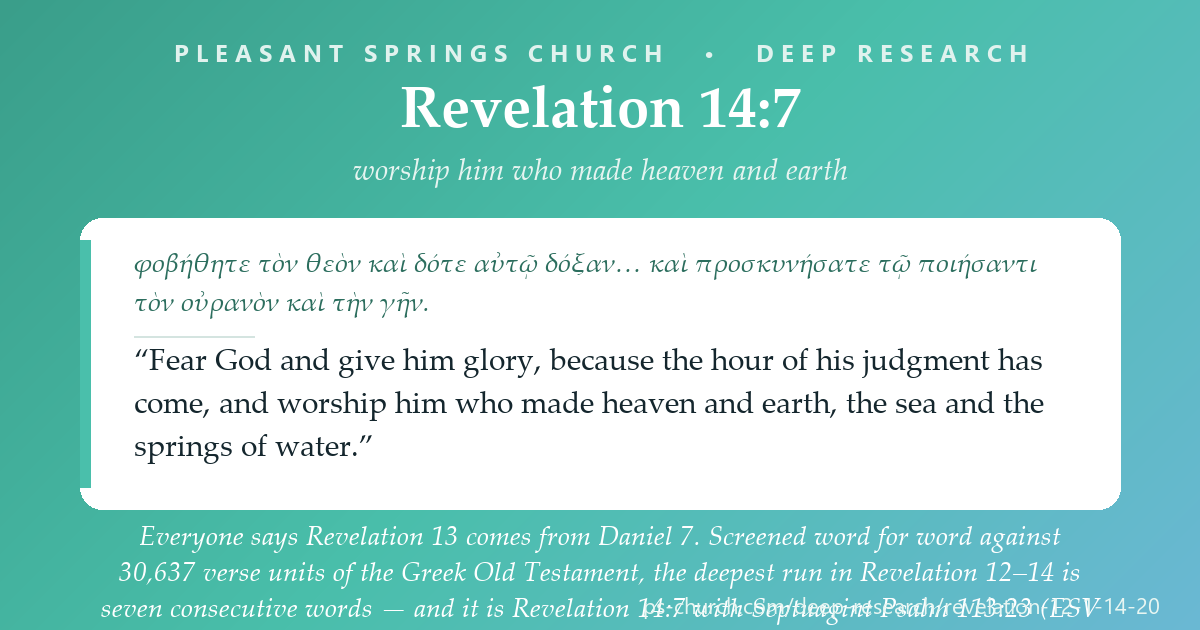
Everybody knows where Revelation 13 comes from. The beast out of the sea with ten horns and seven heads, a leopard with a bear’s feet and a lion’s mouth, a mouth speaking great things for forty-two months — that is Daniel 7, and no commentary fails to say so. So we measured it. All 56 verses of Revelation 12–14 in the Greek, screened word form against word form across 30,637 verse units of the Greek Old Testament held here and all 7,927 verses of the Greek New Testament. The deepest Old Testament run in the passage is seven consecutive words, tie band one — and it is not in Daniel. It is Revelation 14:7 with Septuagint Psalm 113:23, the verse the ESV numbers Psalm 115:15: him who made heaven and earth. Daniel 7 does turn up — at five, and at four, and at four — and when it does, the two Greek Daniels on this disk disagree, and Revelation lands nearer a different one of them in three clauses of the same paragraph. Meanwhile Isaiah 21:9 measures two, and the two words are not the ones about Babylon. Joel 3:13 measures two at its best, and one, one and zero in the three harvest verses. Daniel 7:13, the son of man on the cloud, measures two. The measurement finds verbatim contact. It does not find allusion, and the difference is the whole point of this page. See the method →
Revelation 12:1–14:20 (selections)
Greek New Testament (SBLGNT, via MorphGNT) · ESVThe offset also reaches this page from the other side, three times. The seven-word run at 14:7 is with Septuagint Psalm 113:23 = ESV Psalm 115:15. The one place in the Greek Old Testament that reads ἔπεσεν Βαβυλών is Jeremiah 28:8 = ESV Jeremiah 51:8. The harvest prophecy behind 14:14–20 is Joel 4:13 in both the Hebrew and the Greek, and Joel 3:13 in English. A page that cited these by English number alone would send the reader to three wrong verses.
The Shape of the Passage
Two frames and a sequence — and deliberately not a chiasmThe book names its writer four times and never calls him an apostle. Ἰωάννης at 1:1, 1:4, 1:9 and 22:8 — a servant, a brother, a fellow-sharer in the tribulation, on Patmos. Everything past that is inference, and this page keeps the inference away from the count.
Author
A man who writes Greek like nobody else in the New Testament. Revelation 14:14 says ὅμοιον υἱὸν ἀνθρώπου — ὅμοιος takes a dative, and this is an accusative. The same three words stand at 1:13 and nowhere else in the Greek New Testament. Both Greek Daniels write the phrase differently, so the wording is not borrowed from either of them.
He never quotes with a formula. There is no as it is written anywhere in Revelation, and no that it might be fulfilled. The book is saturated with Old Testament language and introduces none of it as citation — which is exactly why a page like this one can only measure contact and must refuse to call it quotation.
What the counting shows about his vocabulary. δράκων 13 times in the New Testament, all 13 his. ἀρνίον 30 times, 29 his. θηρίον 46 times, 39 his. χάραγμα 8 times, 7 his. He is not short of words; he is running a private lexicon.
Audience
Seven named congregations in the Roman province of Asia. Ephesus, Smyrna, Pergamum, Thyatira, Sardis, Philadelphia, Laodicea (1:11). Real cities on a real postal circuit, and the same seven letters that stand behind the study of chapters 2–3.
These chapters are addressed to people who can be refused a market stall. 13:17 — no one can buy or sell unless he has the mark. That is not a battlefield; it is a commercial one. And 13:10 and 14:12 both answer it with the same word, ὑπομονή — endurance, staying put. The two calls to endure bracket the chapter about the mark.
They are told they are going to lose. 13:7 says the beast is allowed νικῆσαι — to conquer — the saints, and 12:11 says the saints conquered by the blood of the Lamb and by the word of their testimony, for they loved not their lives even unto death. νικάω stands 28 times in the Greek New Testament and 17 times in Revelation. The book uses the same verb for both sides and means opposite things by it.
Orient on apocalyptic, on the imperial cult in Asia, and on the two Greek Daniels — before touching a single number.
Search by topic: Revelation, Book of; apocalyptic literature; Daniel, Greek versions of; Theodotion; imperial cult; Nero; gematria; combat myth; Michael; the mark of the beast.
Which articles are relevant?
- Anchor Bible Dictionary — “Revelation, Book of,” “Apocalypticism,” “Emperor Worship,” “Nero,” “Theodotion.”
- Dictionary of the Later New Testament & Its Developments (IVP) — “Revelation, Book of,” “Beasts, Dragon, Sea, Conflict Motif,” “Roman Emperors,” “Persecution.”
- New International Dictionary of NT Theology & Exegesis — ἀρνίον, θηρίον, δράκων, χάραγμα, ὑπομονή, νικάω.
- Commentary on the New Testament Use of the Old Testament, ed. G. K. Beale and D. A. Carson (Baker, 2007) — the Revelation chapter, which is where the Daniel 7 and Joel 3 questions are argued at length.
- The Old Greek and Theodotion Daniel — any introduction to the Septuagint will explain that Daniel survives in two very different Greek forms and that the church transmitted the Theodotionic one. That question is the hinge of Stage 4 and the limit of Stage 5.
- None of these were consulted for the measurements below. The measurements were run on the text files named in the footer.
Settle the numbering first — and on this page there is genuinely something to settle
Every page on this shelf states its versification offset, including the pages where the answer is that there is none. On most New Testament pages the answer is stronger than that — there is no second column to be offset from. Not here.
| ch 12 | ch 13 | ch 14 | these three | whole book | |
|---|---|---|---|---|---|
| SBLGNT (MorphGNT) | 18 | 18 | 20 | 56 | 405 |
| ESV | 17 | 18 | 20 | 55 | 404 |
The SBLGNT row was counted off disk; the ESV row is the printed edition’s shape, because no ESV Revelation file is held here — its 17 / 18 / 20 and its 404 were checked against a digitised public-domain English text that is on disk and was consulted for verse numbering only. The one clause that separates them is καὶ ἐστάθη ἐπὶ τὴν ἄμμον τῆς θαλάσσης — and he stood on the sand of the sea. SBLGNT gives it verse 18 of chapter 12; the ESV tucks it into 12:17; the King James and its descendants put it at the head of 13:1 and read and I stood. One clause, three verse numbers and two subjects.
And three Old Testament verses on this page carry an offset of their own. The deepest run in the passage is with Psalm 113:23 in the Greek and Psalm 115:15 in the ESV — the Septuagint joins Hebrew Psalms 114 and 115 into one. The only Greek Old Testament verse reading ἔπεσεν Βαβυλών is Jeremiah 28:8 in the Greek and Jeremiah 51:8 in the ESV — Greek Jeremiah stands the oracles against the nations in a different place and numbers the whole second half of the book differently. And the harvest text is Joel 4:13 in the Hebrew and in the Greek, Joel 3:13 in English — here it is the English that moved.
A seven-headed sea-serpent older than Daniel, a province full of temples to a living man, and a number game that was already a joke on a Pompeii wall.
The seven-headed serpent is older than the Bible, and it is on this disk
Revelation 12:3 gives the dragon seven heads, and no Greek Old Testament verse held here supplies them. Measured whole-corpus, the verse reaches four with a tie band of eight, and the four words are ἐν τῷ οὐρανῷ καί — the sign formula, not the heads. The seven-heads clause on its own reaches three, tie band 39, and one of the 39 is Theodotion Daniel 7:7 with καὶ κέρατα δέκα — the horns, not the heads. The motif, however, is attested in the Ugaritic Baal cycle, which Pritchard prints in translation.
If thou smite Lotan, the serpent slant, / destroy the serpent tortuous, / Shalyat of the seven heads…The Baal cycle, as translated in Ancient Near Eastern Texts (Pritchard, 3rd ed.), 138; the same passage, in the first person, at 137
Pritchard’s own footnote identifies Lotan with the Leviathan of Isaiah 27:1. That is an ancient witness, not Scripture, and this page treats it as one. The Bible has its own multi-headed sea creature and says who broke it: Psalm 73:14 in the Greek numbering — ESV Psalm 74:14 — you crushed the heads of the dragon. That verse supplies Revelation 12:3’s two shared words, τὰς κεφαλάς, and nothing more.
⚠️ What was not checked. The Ugaritic itself was not read; only Pritchard’s English. No Akkadian, no Egyptian, no Hittite text was consulted for this page. The Greek myth most often set beside Revelation 12 — Leto pursued by the serpent Python while pregnant with Apollo, and the parallel Egyptian tale of Isis, Set and Horus — is reported here from general reference and was not verified against any primary text on this disk.
A province where the emperor had temples, and the letters went to seven of its cities
Asia was the first Roman province to build a temple to a living emperor. Pergamum, one of the seven cities of Revelation 1:11, took the provincial temple of Rome and Augustus in 29 BC; Smyrna won a second in AD 26; Ephesus a third under the Flavians. Refusing the cult was not a private conviction in such a city; it was visible, and it was expensive.
That is the ordinary background against which Revelation 13:17 — no one can buy or sell unless he has the mark — is usually read, and it makes sense of the verse. ⚠️ It is also entirely outside what this page can measure. No inscription, no coin legend, no provincial decree is on this disk. The dates above come from standard reference works, not from a text file, and the page flags them rather than letting them sit next to the counted numbers as if they were the same kind of statement.
Gematria, and why the page will do the arithmetic but not the identification
Letters were numbers in both Greek and Hebrew, and playing with the sum was a known game. A graffito from Pompeii, buried in AD 79, reads (in the standard reading) I love her whose number is 545. Whoever wrote it expected to be understood and expected not to be identified. That is exactly the posture of Revelation 13:18: let the one who has understanding calculate.
The arithmetic that is usually offered. Written in Hebrew letters, Neron Caesar as נרון קסר sums to 50 + 200 + 6 + 50 + 100 + 60 + 200 = 666. Drop the final nun — the Latin spelling Nero rather than the Greek Neron — and the same name sums to 616, which is the number a minority of manuscripts print at this verse.
⚠️ Three warnings, and the page means all three. (1) The arithmetic above is arithmetic; anyone can check it. The Hebrew spelling it depends on is a reconstruction and does not occur in the Masoretic corpus held here — the search returns nothing. (2) The 616 reading is NOT VERIFIABLE FROM LOCAL CORPORA. MorphGNT holds a single running text and no apparatus; no papyrus and no majuscule is on this disk. The SBLGNT prints ἑξακόσιοι ἑξήκοντα ἕξ, spelled out in words. (3) Gematria will produce a match for a great many names if you are allowed to choose the language and the spelling. The page prints the sum and declines the identification.
Six words counted across all 7,927 verses of the Greek New Testament. Four of them are almost private to this book.
13 occurrences in the Greek New Testament, and all 13 are in Revelation. Eight fall in chapter 12 alone; three more in chapter 13; then 16:13 and 20:2. No Gospel, no letter, no Acts. It is the one creature in the New Testament that exists only in this book.
46 in the New Testament, 39 of them in Revelation. The other seven are literal animals — Mark 1:13, Acts 11:6, Acts 28:4, Acts 28:5, Titus 1:12, Hebrews 12:20, James 3:7. Outside this book the word never once means an empire.
30 in the New Testament, 29 in Revelation. The one remaining is John 21:15 — Luke 10:3 is a different word, ἀρήν. It is a diminutive. The book that has the only dragon also has the only lamb, and the lamb is the smaller word.
8 in the New Testament, 7 in Revelation (13:16, 13:17, 14:9, 14:11, 16:2, 19:20, 20:4). The eighth is Acts 17:29, where Paul tells Athens that God is not like a χάραγμα of human art and imagination. The word is what you do to a coin.
23 in the New Testament, 10 in Revelation — and all ten are the beast’s image (13:14, 13:15 three times, 14:9, 14:11, 15:2, 16:2, 19:20, 20:4). Elsewhere in the New Testament the same noun is the image of God, of the Creator, of his Son (Romans 8:29; 1 Corinthians 15:49; 2 Corinthians 3:18; Colossians 3:10). One word, two directions.
32 in the New Testament, 7 in Revelation — and two of the seven are the sentences that bracket the mark of the beast, 13:10 and 14:12. What the book asks of a congregation that can be shut out of the market is not resistance. It is remaining.
One more word, and it is the shape of chapter 13
ἐδόθη — it was given — stands 21 times in Revelation, and six of the 21 are in this one chapter. 13:5 twice, 13:7 twice, 13:14, 13:15. A mouth was given it; authority was given it; making war was given it; signs were given it; breath for the image was given it. The beast of Revelation 13 seizes nothing. Everything it holds is handed over, in a passive with no stated agent, in a book that has spent twelve chapters saying who sits on the throne.
The count is of the exact form ἐδόθη across the 27 MorphGNT files. Other forms of δίδωμι are not included, so the real density is higher than 21.
The measurement itself: 56 Greek verses against 30,637 verse units of the Greek Old Testament and 7,871 other verses of the Greek New Testament.
Greek against Greek. MorphGNT field 6, the normalised word column (the one that has already resolved elision and the movable nu); CATSS FORM column, beta-code transliterated first. Both sides lowercased, accents and breathings dropped, final sigma folded, then filtered to Greek letters — the same filter on both corpora. Contiguous runs of whole word FORMS, never lemmas. The tie band — how many target verses reach the same maximum — is printed beside every run below. Exhaustive and deterministic; nothing sampled, so no seed applies.
First, the shape of the whole result
Against the Greek Old Testament (30,637 verse units, 64 CATSS files): across the 56 rows, all 56 reach two, 55 reach three, 38 reach four, 17 reach five, 5 reach six, 1 reaches seven, and nothing reaches eight.
Against the rest of the Greek New Testament (7,871 verses): all 56 reach three, 37 reach four, 14 reach five, 6 reach six, 3 reach seven, 1 reaches eight, and nothing reaches nine.
⚠️ Read those two lines together and the headline is already there. The single deepest contact this passage has with the Old Testament is seven words. The single deepest contact it has with the New Testament is eight — with itself. The commentary tradition calls Revelation 12–14 the most allusion-dense stretch of the New Testament; that is not something this page measured, and it is not what the distribution says. What the distribution does say is narrower and harder: these 56 verses quote nothing.
The five runs that reach six or seven against the Greek Old Testament
| Revelation | nearest Greek OT verse | run | tie band | the shared words |
|---|---|---|---|---|
| 14:7 | Psalm 113:23 (ESV 115:15) | 7 | 1 | τῷ ποιήσαντι τὸν οὐρανὸν καὶ τὴν γῆν |
| 12:10 | Psalms of Solomon 17:3 | 6 | 1 | καὶ ἡ βασιλεία τοῦ θεοῦ ἡμῶν |
| 12:14 | Daniel 12:7 (Old Greek) | 6 | 1 | καιρὸν καὶ καιροὺς καὶ ἥμισυ καιροῦ |
| 13:8 | Numbers 14:14 | 6 | 1 | πάντες οἱ κατοικοῦντες ἐπὶ τῆς γῆς |
| 14:6 | Jeremiah 32:29 (ESV 25:29) | 6 | 1 | ἐπὶ τοὺς καθημένους ἐπὶ τῆς γῆς |
Two of those five are worth something and three are formulas with a lucky alignment, and the page says which is which. 12:14 is the one everybody would have predicted — a time, times and half a time is Daniel’s phrase and nobody else’s. 14:7 is the one nobody predicted. The other three — the kingdom of our God, all who dwell on the earth, those who sit on the earth — are common liturgical and prophetic furniture that happen to line up for six words. A tie band of one is not by itself evidence of contact; it can also mean the formula is slightly unusual.
★ The headline: seven words, and the counter-example printed beside it
Revelation 14:7 shares seven consecutive words with Septuagint Psalm 113:23 (ESV Psalm 115:15), and no other verse in 30,637 reaches seven with it.
Greek Psalm 113:23: εὐλογημένοι ὑμεῖς τῷ κυρίῳ τῷ ποιήσαντι τὸν οὐρανὸν καὶ τὴν γῆν. Revelation 14:7: προσκυνήσατε τῷ ποιήσαντι τὸν οὐρανὸν καὶ τὴν γῆν καὶ θάλασσαν καὶ πηγὰς ὑδάτων.
⚠️ Now the counter-example, on the same page and in the same paragraph, because a run of seven can be made to look like more than it is. Drop the first word and the remaining six, τὸν οὐρανὸν καὶ τὴν γῆν καί, have a tie band of ten across the Greek Old Testament — Exodus 20:11, Exodus 31:17, Haggai 2:6, Haggai 2:21, Daniel 4:37, Judith 7:28, 2 Maccabees 7:28, Bel and the Dragon 1:5 in both Greek forms, and Greek Esther 4:17c — and a tie band of two across the New Testament, Acts 4:24 and Acts 14:15. The seventh word is a case ending. The phrase τῷ ποιήσαντι occurs eight times in the Greek Old Testament held here (Isaiah 17:7 and 29:16, Psalms 113:23, 135:5, 135:7 and 149:2, Baruch 3:35, Wisdom 16:24), and Psalm 113:23 is the only one that follows it with heaven and earth. Three of the other seven are followed by a pronoun — the one who made him / them, at Baruch 3:35, Isaiah 17:7 and Psalm 149:2; Psalm 135:5 has the heavens in the plural, 135:7 has the great lights, and Isaiah 29:16 and Wisdom 16:24 give the participle no object at all. The dative in the two verses that matter arrives for different reasons: in the psalm it follows τῷ κυρίῳ, and in Revelation it is there because προσκυνήσατε takes a dative. That is worth knowing before anyone calls the seventh word evidence.
So what does the page claim? Only this: measured across everything held here, the deepest verbatim contact in Revelation 12–14 with the Greek Old Testament is not with any of the three chapters everyone names, but with a psalm of praise — and the angel with the eternal gospel is telling the whole earth to worship the Creator in words that a psalm had already used. Whether the writer had that psalm in front of him, this page does not know and does not say.
The two Greek Daniels, and why Revelation 13 will not sit still
Daniel survives in two very different Greek forms and both are on this disk. The Old Greek and the Theodotionic text are held as separate CATSS files. On five rows in this passage they give measurably different answers, and Revelation does not land on the same side twice in a row.
| Revelation | the clause | Old Greek | Theodotion | nearer |
|---|---|---|---|---|
| 12:4 | τῶν ἀστέρων τοῦ οὐρανοῦ καί (8:10) | 5 | 3 | Old Greek |
| 12:14 | καιρὸν καὶ καιροὺς καὶ ἥμισυ καιροῦ (12:7) | 6 | 3 | Old Greek |
| 13:5a | στόμα λαλοῦν μεγάλα καί (7:8) | 4 | 3 | Old Greek |
| 13:7a | πόλεμον μετὰ τῶν ἁγίων καί (7:21) | 1 | 5 | Theodotion |
| 13:7b | καὶ ἐδόθη αὐτῷ ἐξουσία (7:14) | 4 | 1 | Old Greek |
Where the numbers come from. Old Greek Daniel 7:21 reads πόλεμον συνιστάμενον πρὸς τοὺς ἁγίους; Theodotion reads ἐποίει πόλεμον μετὰ τῶν ἁγίων καὶ ἴσχυσεν, which is Revelation’s wording for five words. In the other direction, Old Greek 7:14 reads καὶ ἐδόθη αὐτῷ ἐξουσία while Theodotion recasts it as καὶ αὐτῷ ἐδόθη ἡ ἀρχή. Both of those clauses are inside Revelation 13:7. Theodotion 12:7 has εἰς καιρὸν καιρῶν where the Old Greek has εἰς καιρὸν καὶ καιρούς — a genitive instead of a conjunction, and the run falls from six to three.
⚠️ What must NOT be concluded from that table, and this page will not conclude it. Nothing here says Revelation used Theodotion, or that Theodotion used Revelation, or that either used the Old Greek. The historical Theodotion is conventionally dated to the second century, after Revelation, which is exactly why the standard discussion invokes a proto-Theodotionic or kaige text older than the man — and nothing on this disk can date, or test, or refute that hypothesis. What the measurement establishes is narrower and sturdier: the two Greek Daniels held here disagree at these five places, and Revelation’s wording is nearer the Old Greek at four of them and nearer Theodotion at one. That is the whole finding.
⚠️ The counter-examples — the allusions everybody names, measured
These are printed so that the runs above are not read as more than they are, and so that the reader can see how little verbatim contact a real allusion can have.
| Revelation | the source everyone names | run | what is actually shared |
|---|---|---|---|
| 12:2 a woman in labour | Isaiah 66:7 / Micah 4:10 / Isaiah 26:17 | 1 | καί — and nothing else |
| 12:3 seven heads | Psalm 73:14 (ESV 74:14) | 2 | τὰς κεφαλάς; Isaiah 27:1 reaches 1 |
| 12:5 rod of iron | Psalm 2:9 | 3 | ἐν ῥάβδῳ σιδηρᾷ — the verb differs in form |
| 13:1–2 the beast | Daniel 7:3 / 7:4–6 | 3 / 2 | ἐκ τῆς θαλάσσης; then ἄρκου καί |
| 14:8 fallen, fallen | Isaiah 21:9 | 2 | πάντα τά — not the Babylon clause |
| 14:10 the cup of wrath | Psalm 74:9 (ESV 75:8) / Isaiah 51:17 | 1 / 2 | καί; τοῦ θυμοῦ |
| 14:14 one like a son of man | Daniel 7:13, both Greek forms | 2 | καὶ ἰδού |
| 14:15, 14:18, 14:19, 14:20 the harvest | Joel 4:13 (ESV Joel 3:13) | 1, 1, 0, 2 | at 14:19, no word form at all; at 14:20, ἡ ληνός |
⚠️ What that zero means, exactly. This shelf runs two conventions and they mean different things. In the whole-corpus screens above, a lone shared word still scores 1, so a zero would mean shares no word at all and is almost unheard of. In the named-pair comparisons in this table there is no fallback: Revelation 14:19 and Septuagint Joel 4:13 have not one word form in common. Joel writes δρέπανα and ληνός; Revelation writes δρέπανον and ληνόν. Same nouns, different forms, and this engine counts forms.
And the sharpest counter-example of the set. Mark 4:29 — he sends in the sickle, because the harvest has come — shares two consecutive words with Greek Joel 4:13, ὅτι παρέστηκεν. That is as deep as any verse of Revelation 14 manages with the same prophecy — 14:20 also reaches two, ἡ ληνός, and nothing in the chapter reaches three. Mark holds the New Testament’s only occurrence of δρέπανον outside this chapter, and no list of Revelation’s harvest sources mentions him. If a Gospel nobody lists ties the deepest measured contact the Apocalypse has with Joel, then the measurement is telling us what it always tells us: it finds verbatim contact, and allusion is a different thing.
The deepest run in the passage is with Revelation itself
Against all 7,871 other verses of the Greek New Testament, the deepest run in these three chapters is eight consecutive words, tie band one — Revelation 14:8 with Revelation 18:3.
ἐκ τοῦ οἴνου τοῦ θυμοῦ τῆς πορνείας αὐτῆς. Then the two verses part company at the verb — 14:8 πεπότικεν, she made them drink; 18:3 πέπτωκαν in the SBLGNT, they have fallen — and then both resume with πάντα τὰ ἔθνη. The run engine stops at the verb; the eye does not.
| Revelation | nearest NT verse | run | band | shared |
|---|---|---|---|---|
| 14:8 | Revelation 18:3 | 8 | 1 | ἐκ τοῦ οἴνου τοῦ θυμοῦ τῆς πορνείας αὐτῆς |
| 13:8 | Revelation 21:27 | 7 | 1 | ἐν τῷ βιβλίῳ τῆς ζωῆς τοῦ ἀρνίου |
| 14:2 | Revelation 19:6 | 7 | 1 | ὡς φωνὴν ὑδάτων πολλῶν καὶ ὡς φωνήν |
| 12:3 | Revelation 17:3 | 6 | 1 | ἔχων κεφαλὰς ἑπτὰ καὶ κέρατα δέκα |
| 13:16 | Revelation 11:18 | 6 | 1 | τοὺς μικροὺς καὶ τοὺς μεγάλους καί |
| 14:7 | Acts 4:24 · Acts 14:15 | 6 | 2 | τὸν οὐρανὸν καὶ τὴν γῆν καί |
Five of the six deepest New Testament runs in this passage are Revelation with Revelation. The sixth is the only place these chapters reach six with a book outside themselves — and it is Acts, twice, in the two speeches where Christians name the Creator to a pagan crowd (Lystra and the Jerusalem prayer). That is the same six-word formula as the 14:7 row above, and its band of two is the reason the page keeps calling it a formula.
Two phrase searches, exhaustive, with their scope attached
| phrase | Greek OT (30,637 units) | Greek NT (7,927 verses) |
|---|---|---|
| ἔπεσεν Βαβυλών | 1 — Jeremiah 28:8 (ESV 51:8) | 2 — Revelation 14:8, 18:2 |
| πέπτωκεν Βαβυλών | 1 — Isaiah 21:9 | 0 |
| Βαβυλὼν ἡ μεγάλη | 2 — Daniel 4:30, Old Greek and Theodotion | 5 — all Revelation: 14:8, 16:19, 17:5, 18:2, 18:21 |
Isaiah 21:9 and Jeremiah 28:8 both announce Babylon’s fall, and they use different verbs. Revelation’s verb is the one Jeremiah has, not the one Isaiah has. The title Babylon the great stands twice in the Greek Old Testament and both are one verse — Nebuchadnezzar on his roof saying is this not great Babylon, which I have built. Direction of influence not asserted. Neither is it asserted that the writer meant Rome, though every commentary on the shelf says so, because that is an argument and this is a count.
SCOPE. Exhaustive over the 64 CATSS Greek files held here (30,637 verse units) and the 27 MorphGNT files (7,927 verses). A negative is a negative on the corpus searched and nothing more. Normalisation as described above; the searches are on normalised word forms, so an inflected variant of the same phrase would not be counted.
Where this page is weakest, what it could not check, and what it did not consult.
⚠️ The single biggest weakness on this page
The candidate list, not the corpus, is the weak link. The whole-corpus screens are exhaustive — every verse of Revelation 12–14 was run against every verse unit held here, and nothing was sampled. But the named-pair table in Stage 4 — Isaiah 66:7, Micah 4:10, Daniel 7:13, Joel 4:13 and the rest — is a list assembled by hand from memory of the commentary tradition. It was not taken from the Nestle-Aland margin, from the UBS index of allusions, or from Beale’s apparatus, none of which are on this disk. A verse that the tradition names and this page forgot would simply be missing from the table.
And the exhaustive screen already caught the hand-made list out once. Psalm 113:23 is not on anybody’s standard list of Revelation’s sources, and it came out on top. That is a warning about the method, not a vindication of it: if the deepest run in the passage was one the compiler would never have guessed, the compiler’s guesses are not to be trusted anywhere else on the page.
⚠️ What could not be checked at all
- The variant 616 at Revelation 13:18. NOT VERIFIABLE FROM LOCAL CORPORA. MorphGNT holds one running text and no apparatus; no papyrus, majuscule, minuscule, version or patristic citation is on this disk. The page reports the reading it has and the existence of the other, and stops.
- The date of the Theodotionic Daniel. The whole force of the Stage 4 table would change if the Theodotionic wording could be shown to be older or younger than Revelation. Nothing here can show either. The kaige / proto-Theodotion question is named and left open.
- The Aramaic of Daniel 7. Daniel 2:4b–7:28 is Aramaic, and the Masoretic corpus held here contains it — but no Aramaic-side screen was run for this page. Every Daniel number above is Greek against Greek.
- Any Second Temple apocalypse other than the Psalms of Solomon. 1 Enoch, 4 Ezra, 2 Baruch and the Sibylline Oracles are not on this disk. The Nero-redivivus legend is standardly argued from Sibylline Oracles 4 and 5, and this page could not open them.
- Roman evidence. No Suetonius, no Tacitus, no Dio, no inscription, no coin, no provincial decree. The imperial-cult dates in Stage 2 come from reference works and are flagged there as such.
- The Pompeii graffito and the Hebrew spelling behind 666. The graffito is reported from general reference and was not verified. The Hebrew consonants נרון קסר do not occur in the Masoretic corpus held here; the arithmetic is arithmetic, the spelling is a reconstruction.
- Greek Revelation textual criticism generally. The SBLGNT is an edited text. This page never says a reading is early or late; it says what the file on this disk reads.
⚠️ Where a reader should push back hardest
1. The seven-word run may be a formula wearing a signal’s clothes. The page prints the band of ten on its six-word core precisely because that is the strongest objection to its own headline, and the objection is a real one. A reader who concludes that 14:7 is simply liturgical Greek, and that the extra word is an accident of syntax, is reading the same numbers the page printed.
2. Run length is a poor instrument for a book that never quotes. Revelation reworks its sources rather than reciting them. On a writer who does that, contiguous-run length will systematically under-report exactly the relationships the commentary tradition is most confident about — and the Daniel 7:13 row, measuring two, is the clearest possible demonstration. The right conclusion is not that Daniel is absent from Revelation 13. It is that this instrument cannot see him there.
3. The structure diagram is descriptive, and someone will want more from it. Two counted brackets and a sequence is all the page will claim. Chiastic outlines of 12–14 exist in the literature and some of them are attractive. The page does not print one because the vocabulary would not carry it, not because the proposals are foolish.
Reading list
- G. K. Beale, The Book of Revelation (NIGTC, 1999) — the standard argument that Daniel is Revelation’s controlling Old Testament source.
- Richard Bauckham, The Climax of Prophecy (1993) — including the essay on the number of the beast.
- David Aune, Revelation (Word Biblical Commentary, 3 vols.) — the fullest treatment of the Greco-Roman background this page could not check.
- Steve Moyise, The Old Testament in the Book of Revelation (1995) — on the methodological problem this page keeps running into: what counts as a use.
- Craig Koester, Revelation (Anchor Yale Bible 38A, 2014).
- Timothy McLay, The Use of the Septuagint in New Testament Research (2003) — on the Old Greek / Theodotion question that Stage 4 has to leave open.
- None of these were consulted for any number on this page, which were run on the text files named in the footer.
A book with no quotations, and the one sentence in it that measured deepest.
Seven words
Revelation 12–14 is the passage everyone reaches for when they want to talk about the end: a woman clothed with the sun, a red dragon with seven heads, war in heaven, two beasts, a mark on the hand, a number, and blood to the horses’ bridles for a hundred and eighty miles. It is also a passage that never once says as it is written.
So we counted. Fifty-six verses, thirty thousand six hundred and thirty-seven verse units of Greek Old Testament, seven thousand nine hundred and twenty-seven of Greek New. And the deepest thing in it — seven consecutive words, nothing else in the corpus reaching seven — is not the beast and not the dragon and not the number. It is an angel in mid-heaven telling every nation on earth to worship him who made heaven and earth, in the words a psalm had already used to bless somebody.
Three chapters about a counterfeit, and the deepest sentence in them is about the Maker. The beast has a mouth that was given it, authority that was given it, signs that were given it — six passives in one chapter, and never once a verb where it takes anything for itself. It can stamp a mark on a hand. It cannot make a sea, or a spring of water.
And the answer the passage gives to the people who can be shut out of the market is not a strategy. It is one word, said twice, on either side of the chapter about the mark: ὧδε ἡ ὑπομονὴ τῶν ἁγίων — here is the endurance of the saints. Stay put. He made the springs of water; the one who wants your hand did not.
Every Deep Research page traces its passage across the whole sweep — the Old Testament, the Second-Temple world between the testaments (historical witnesses, not Scripture), and the New Testament. Follow the thread:
Pleasant Springs Church — Deep Research
Research method after Michael S. Heiser’s Bible Research Method (examine dictionaries → ancient literature → important words → textual connections → academic publications → share), with the Pleasant Springs “Author & Audience” foundation. Scripture set in the Hebrew, the Greek editions named on each page and the ESV (Old Testament), and the Greek New Testament and the ESV (New Testament), per the practice of Pleasant Springs Church. Revelation research grounded in Beale (NIGTC), Aune (WBC), Bauckham, Koester (Anchor Yale) and Moyise — none of which were consulted for any number on this page. Text: Greek New Testament from the SBL edition as digitized by MorphGNT; Greek Old Testament from Rahlfs’ Septuaginta as digitized by CATSS, including both the Old Greek and the Theodotionic Daniel as separate files; Hebrew from the Masoretic text as printed in Sefaria’s Miqra according to the Masorah. No critical apparatus was consulted on any side. The standing caution for this shelf applies: these pages say “the CATSS Greek row reads…” and never call a reading early or late. ⚠️ VERSE NUMBERING — Revelation is a New Testament book, so there is no Masoretic or Septuagint column; but there IS an offset on this page and it is stated rather than smoothed. Counted off disk: SBLGNT Revelation 12 / 13 / 14 = 18 / 18 / 20 = 56 verses; the ESV prints 17 / 18 / 20 = 55, because it folds καὶ ἐστάθη — and he stood on the sand of the sea — into the end of 12:17 where the SBLGNT numbers it 12:18. Whole book: 405 Greek verses, 404 English. Three cited Old Testament verses carry offsets of their own: Greek Psalm 113:23 = ESV Psalm 115:15; Greek Jeremiah 28:8 = ESV Jeremiah 51:8; Joel 4:13 in Hebrew and Greek = Joel 3:13 in English. ⚠️ The measurement, in full. Greek against Greek. MorphGNT field 6, the normalised word column (the one that already resolves elision and the movable nu); CATSS FORM column (cols 0–24), beta-code transliterated first. Both sides lowercased, accents and breathings dropped, final sigma folded, then filtered to Greek letters — the same filter applied to both corpora. Contiguous runs of whole word FORMS, never lemmas. Corpus: the 56 MorphGNT rows of Revelation 12–14 against 30,637 verse units in 64 CATSS files and against the other 7,871 verses of the Greek New Testament. Exhaustive and deterministic; nothing sampled, so no seed applies. The tie band — how many target verses reach the same maximum — is printed beside every run on this page. ⚠️ What a zero means here. The whole-corpus screens use the unigram fallback, so a lone shared word still scores 1 and a zero would mean shares no word at all. The named-pair comparisons in Stage 4 do not: the zero reported for Revelation 14:19 against Septuagint Joel 4:13 means the two verses have not one word form in common. ⚠️ What was NOT measurable. The 616 variant at 13:18; the date of the Theodotionic Daniel; the Aramaic side of Daniel 7; 1 Enoch, 4 Ezra, 2 Baruch and the Sibylline Oracles; any Roman historian, inscription or coin. The named-pair list in Stage 4 was assembled by hand and is the weakest thing on the page — Stage 5 says so at length. ⚠️ Direction of influence is never asserted. Nothing here says Revelation used the Old Greek Daniel, or the Theodotionic Daniel, or Psalm 113, or that any of them used Revelation. The page reports which wording agrees with which text held on this disk, and stops. Typology is handled per the house position: what the text says, what the New Testament itself draws, and what we see from this side of the cross — with the seeing left to the reader.
Scripture quotations marked ESV are from the ESV® Bible (The Holy Bible, English Standard Version®), © 2001 by Crossway, a publishing ministry of Good News Publishers. ESV Text Edition: 2016. Used by permission. All rights reserved. The ESV text may not be quoted in any publication made available to the public by a Creative Commons license, and the ESV may not be translated in whole or in part into any other language. www.esv.org
|
Did this study bless you today? 💚 Give to Support PS Church100% of gifts go to the General Fund — thank you. |