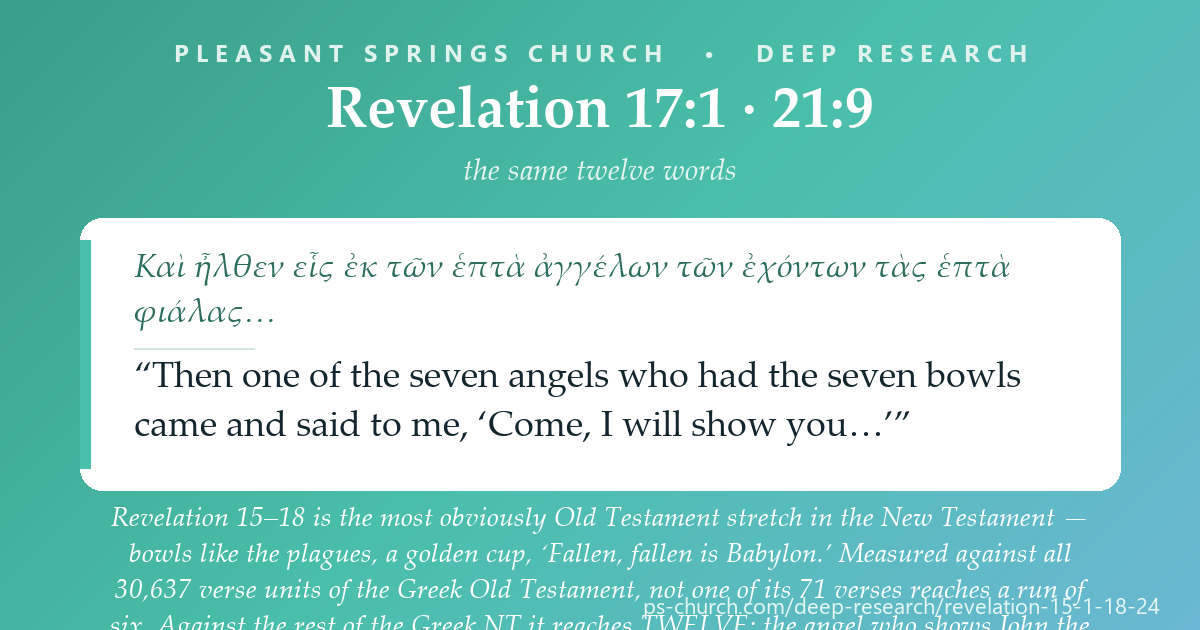
Revelation 15 to 18 is the stretch of the New Testament most obviously made out of the Old. Bowls poured like the plagues of Egypt; a river dried for kings to cross; a prostitute city with a golden cup; a merchant dirge in the shape of Ezekiel's lament over Tyre; Fallen, fallen is Babylon the great. So this page measured all seventy-one verses against every one of the 30,637 verse units of the Greek Old Testament held here, and the result was a wall. Fourteen rows reach a run of five consecutive words. Nothing reaches six. Chapters 15 through 19 are the longest stretch in Revelation where that is true. Then the same seventy-one verses were run against the rest of the Greek New Testament, and the number went to twelve — Revelation 17:1 against Revelation 21:9, tie band of one. The angel who shows John the whore and the angel who shows John the bride are introduced in the same twelve words. These chapters do not quote the prophets. They quote themselves. See the method →
Revelation 15:1–18:24 (selections)
Greek NT (SBLGNT via MorphGNT) · ESV⚠️ The verses this page measures Revelation AGAINST are numbered differently, and Jeremiah twice over. Greek Jeremiah is renumbered wholesale. The cup at 16:19 lands on Greek Jeremiah 32:15, which is Jeremiah 25:15 in a Hebrew or English Bible; the fallen-Babylon form at 18:2 lands on Greek Jeremiah 28:8 = Jeremiah 51:8; and the silenced mill at 18:22 lands on Greek Jeremiah 25:10, which is Jeremiah 25:10. Two of those three come out of the same Hebrew chapter — Jeremiah 25 — which the Greek Bible splits across chapters 25 and 32. Likewise Greek Psalm 85:9 is Psalm 86:9 in English, Greek Psalm 83:5 is 84:4, Greek Exodus 38:26 is Exodus 38:8, and Greek 3 Kingdoms 21:32 is 1 Kings 20:32. Both numbers are given every time this page names one of them.
⚠️ One place in Revelation where the numbering does part, outside this study. The file measured here gives Revelation 405 verses to the ESV’s 404: it numbers a clause 12:18 that English Bibles print at the end of 12:17. Chapters 15 to 18 are unaffected.
The Shape of the Passage
Sequence — an inclusio, seven bowls, and a dirge in three panelsRevelation is the one book of the New Testament whose author names himself four times and never calls himself an apostle. He calls himself Ἰωάννης, a servant, a brother and a fellow-sharer in tribulation, and he says where he was when he saw it. Everything beyond that is inference, and this page keeps the inference labelled.
Author
A man on an island who writes as a prophet and not as an authority. The name Ἰωάννης stands at 1:1, 1:4, 1:9 and 22:8. The identification with the son of Zebedee is early, contested from the third century, and not something this page can measure. What can be said from the text: he expects to be believed because of what he saw, not because of who he is.
He never once uses a citation formula. No as it is written, no that it might be fulfilled, no the prophet says — not in this passage and not anywhere in the book. That is a fact about the book, and it is the fact this page’s measurement runs into. Revelation is saturated with the Old Testament and quotes none of it in the way the rest of the New Testament does.
Audience
Seven named congregations in the Roman province of Asia. The book is a letter before it is anything else — 1:4 addresses seven churches by name and chapters 2 and 3 address them one at a time. The bowls and Babylon are read to the same congregations that were told about their lampstands.
And they are told to come out of a city. 18:4 stops describing and commands: Come out of her, my people. Whatever else Babylon is in this passage, it is somewhere the first readers were understood to be living, since they are told to leave it. The page reports the imperative and does not identify the city.
Orient on the bowls, on Babylon as a cipher, and on a place-name that occurs once.
Search by topic: Revelation, book of; bowls, seven; plagues of Egypt; Babylon (in the New Testament); Rome, city of; Armageddon / Har-Magedon; Megiddo; prostitute, the great; Tyre, oracles against; laments and dirges; allusion versus quotation.
Which articles are relevant?
- Anchor Bible Dictionary — “Revelation, Book of,” “Armageddon,” “Megiddo,” “Babylon (NT),” “Rome (New Testament).”
- Dictionary of the Later New Testament & Its Developments (IVP) — “Revelation, Book of,” “Babylon,” “Old Testament in Revelation,” “Roman Empire.”
- Commentary on the New Testament Use of the Old Testament (ed. Beale & Carson, Baker 2007) — Beale’s Revelation chapter, which is where the allusion lists this page is arguing with are assembled.
- NIDNTTE — φιάλη, πόρνη, θυμός and ὀργή, ἔμπορος.
Settle the numbering first — and it is the targets that move, not Revelation
Revelation 15 to 18 carries the same verse numbers in every column this page uses.
| ch 15 | ch 16 | ch 17 | ch 18 | total | |
|---|---|---|---|---|---|
| SBLGNT / MorphGNT | 8 | 21 | 18 | 24 | 71 |
| ESV | 8 | 21 | 18 | 24 | 71 |
The offsets on this page all belong to the books Revelation is being measured against. Greek Jeremiah is renumbered wholesale; the Greek Psalter runs one behind the Hebrew from Psalm 9/10 through 147; Greek Exodus 36–39 does not line up with the Hebrew of those chapters; and Greek 3 Kingdoms swaps two chapters of 1 Kings. Every citation of a Greek Old Testament verse on this page gives both numbers.
The one Revelation offset, and it is outside this study. The Greek file used here numbers 405 verses in Revelation where English Bibles number 404, because it makes a clause of 12:17 into a verse 12:18. Chapters 15–18 are identical.
A cargo list, a dirge, and a city that is never named.
The cargo of Revelation 18:12–13, item by item
Two verses list twenty-nine commodities, joined by καί, and the page counted them rather than repeating a number from a commentary.
| 18:12 — fourteen | 18:13 — fifteen |
|---|---|
| gold · silver · precious stone · pearls · fine linen · purple · silk · scarlet · every citron wood · every ivory vessel · every vessel of costliest wood · bronze · iron · marble | cinnamon · amomum · incense · myrrh · frankincense · wine · oil · fine flour · wheat · cattle · sheep · horses · carriages · bodies · souls of men |
The list ends where it ends on purpose. The twenty-eighth item is σωμάτων, bodies, which in Greek commercial usage is a way of saying slaves. The twenty-ninth is ψυχὰς ἀνθρώπων, souls of men — and it is an accusative standing straight after three genitives — horses, carriages, bodies — so that it reads less like the next entry on the manifest than like a comment on the one before it. The case alternates through the list, so this is a local break and not the only accusative in it: eleven earlier items in 18:13 are accusative as well.
What the count is and is not. Twenty-nine is the number of καί-joined nouns in the SBLGNT text of these two verses. Commentaries print 28 and 29 both, depending on whether bodies and souls of men are read as one item or two. The page shows the list so the reader can count it, and takes no view on the merchandising history of any of these goods, none of which was researched from primary sources here.
Three laments, one refrain — and the refrain can be counted
The doubled cry οὐαὶ οὐαί occurs five times in the Greek New Testament. All five are in Revelation.
| verse | who is speaking | the words |
|---|---|---|
| Rev 8:13 | an eagle in mid-heaven (twice in one verse) | woe, woe, woe to those who dwell on the earth |
| Rev 18:10 | the kings of the earth | οὐαὶ οὐαί, ἡ πόλις ἡ μεγάλη |
| Rev 18:16 | the merchants | οὐαὶ οὐαί, ἡ πόλις ἡ μεγάλη |
| Rev 18:19 | the shipmasters and sailors | οὐαὶ οὐαί, ἡ πόλις ἡ μεγάλη |
Six words, word for word identical, three times, and in no other verse of the New Testament. That is what makes 18:9–19 three panels rather than one paragraph, and it is why the structure diagram above marks them. Two of the three panels also share the phrase in one hour — 18:10 and 18:19 — and the middle one, the merchants’, has it in 18:17 instead.
The shape — kings, then traders, then seafarers, each looking on from a distance at a burning port — is the shape of the Tyre lament in Ezekiel 26–27. Measured, Revelation 18:11 shares two words with Greek Ezekiel 27:27, and 18:19 shares two with Ezekiel 27:30. The likeness is in the staging, not in the sentences, and stage 4 gives the numbers.
Why Babylon, and why the page will not name the city
The text calls her Babylon, calls the name a μυστήριον, and says she is the great city that has dominion over the kings of the earth (17:18).
Two things can be said from the text without leaving it. First, the name is presented as a name written on a forehead, not as a geographical claim — 17:5. Second, the historical Babylon was not a world power when Revelation was written by any dating anyone proposes, and the book knows it: the city it describes is a sea-trading empire with a merchant marine (18:17–19), which Babylon on the Euphrates never was.
Beyond that the page stops. The identification with Rome is the majority reading and has been since at least the second century; it is also an identification the text declines to make, and 1 Peter 5:13’s she who is at Babylon is cited on both sides of the question. This page has no way to measure it and therefore does not decide it.
The house caution about ancient sources applies in full here. No Roman historian, no inscription, no coin and no papyrus was consulted for this page. Where a commentary would put Tacitus, Suetonius or the Sibylline Oracles, this page puts nothing, because nothing was read.
A bowl that does three jobs, a name spelled five ways, and a mill that is in the Hebrew.
Twelve occurrences in the Greek New Testament and all twelve are in Revelation — 5:8, 15:7, 16:1, 16:2, 16:3, 16:4, 16:8, 16:10, 16:12, 16:17, 17:1 and 21:9. Ten of the twelve are in this study. The two that are not are the bowls that hold the prayers of the saints and the bowl in the hand of the angel who shows John the bride.
This exact four-word nominative phrase stands five times in the Greek New Testament, and all five are in this passage — 16:19, 17:18, 18:10, 18:16, 18:19. Revelation uses other cases of it elsewhere (11:8); the nominative belongs to these four chapters.
Seven occurrences in the Greek New Testament: five in John and two in Revelation, and both Revelation uses flag a name — Ἀβαδδών at 9:11 and Ἁρμαγεδών at 16:16. The book only ever uses the word when it is about to give a name its readers would not otherwise place.
Once in the Greek New Testament, and nowhere at all in the 30,637 verse units of the Greek Old Testament held here. Megiddo is named eleven times in those files and is spelled five different ways — none of them this; a twelfth verse, Isaiah 10:28, spells Migron the same way. The derivation from הַר har, mountain, plus Megiddo, is a proposal and this page labels it one.
Revelation 18:22, the sound of the mill. Jeremiah 25:10 lists the same silences — bridegroom, bride, mill, lamp — but the Greek row of that verse does not have a mill in it. Where the Hebrew reads קוֹל רֵחַיִם, the sound of millstones, the Greek reads ὀσμὴν μύρου, the scent of perfume.
Revelation 18:13, the twenty-eighth item in the cargo list, immediately followed by ψυχὰς ἀνθρώπων. The ESV renders the pair slaves, that is, human souls. The two words together are the last thing the merchants of the earth are said to have sold.
Two words for wrath, and Revelation 16:19 uses both
The passage runs on two nouns, θυμός and ὀργή, and 16:19 stacks them.
15:1 says the θυμός of God is finished; 15:7 gives the angels bowls full of the θυμός of God; 16:1 tells them to pour out the bowls of the θυμός of God. Then 16:19 hands Babylon the cup of the wine of the θυμός of the ὀργή of him — two different wrath-words in a single genitive chain, which is not a natural Greek construction and is one of the things that makes this book’s Greek what it is.
The page does not tell you what the difference between the two words is, because the difference commonly asserted — hot anger against settled anger — is a lexicon claim, and no lexicon was consulted for this page. What is measurable is that the chain occurs, and that the same chain occurs again at 19:15.
The wall at five, the twelve inside the book, and the allusions that measure nothing.
The headline: seventy-one rows against the whole Greek Old Testament
Every verse of Revelation 15–18 was measured against all 30,637 verse units of the Greek Old Testament held here — 64 files, and no Greek Old Testament book missing. Gaps INSIDE a book are another matter, and this page reports one below: Greek Jeremiah 28 runs from verse 44 straight to verse 49.
Across the 71 rows against 30,637 verse units of the Greek Old Testament: all 71 reach two, 68 reach three, 46 reach four, 14 reach five, and nothing reaches six.
That flatness is the finding, and it is easier to see against the rest of the book.
| chapter | deepest run vs the Greek OT | the row, and where it lands |
|---|---|---|
| Rev 6 | 8 | 6:8 — Greek Jeremiah 51:13 (= 44:13 English), band 1 — that study |
| Rev 20 | 8 | 20:9 — 4 Kingdoms 1:10 and 1:12 (= 2 Kings 1), band 2 |
| Rev 5, 10, 14 | 7 | 5:13, 10:6, 14:7 |
| Rev 1, 3, 4, 7, 12, 13 | 6 | six chapters reach six |
| Rev 15 | 5 | 15:4 — Greek Psalm 85:9 (= 86:9 English), band 1 |
| Rev 16 | 5 | 16:2 — 2 Kingdoms 20:10 (= 2 Samuel 20:10), band 1 |
| Rev 17 | 5 | 17:2 — Psalm 2:2, band 1 |
| Rev 18 | 5 | 18:3 — 1 Maccabees 2:18, band 1 |
Eleven of Revelation’s twenty-two chapters reach six or more. Chapters 15 through 19 all stop at five, and that is the longest stretch of consecutive chapters in the book where nothing reaches six. This study covers four of those five chapters.
What a wall at five does and does not mean. It does not mean these chapters are not built out of the Old Testament. It means they are not built out of its sentences. The run screen finds verbatim contact between word forms in sequence; it is blind to imagery, to structure, to a scene reproduced in different words. Revelation reuses all three of those constantly, and this instrument cannot see any of it.
The fourteen rows that do reach five — and how few of them mean anything
Here are all fourteen, with the tie band beside each.
| row | lands on | band | the shared words |
|---|---|---|---|
| 15:4 | Ps 85:9 (= Ps 86:9 Eng) | 1 | ἥξουσιν καὶ προσκυνήσουσιν ἐνώπιόν σου |
| 15:5 | Exod 38:26 (= 38:8), Lev 8:31, Num 14:10 | 3 | τῆς σκηνῆς τοῦ μαρτυρίου ἐν |
| 15:7 | 4 Macc 18:24, Ps 83:5 (= 84:4), Tobit 14:15 | 3 | εἰς τοὺς αἰῶνας τῶν αἰώνων |
| 16:2 | 2 Kingdoms 20:10 (= 2 Sam 20:10) | 1 | αὐτοῦ εἰς τὴν γῆν καί |
| 16:3 | Jonah 1:4 | 1 | εἰς τὴν θάλασσαν καὶ ἐγένετο |
| 16:4 | Judith 7:7, 7:17 | 2 | καὶ τὰς πηγὰς τῶν ὑδάτων |
| 16:13 | Isaiah 59:21 | 1 | καὶ ἐκ τοῦ στόματος τοῦ |
| 16:19 | Jer 32:15 (= Jer 25:15 Eng) | 1 | τὸ ποτήριον τοῦ οἴνου τοῦ |
| 17:2 | Psalm 2:2 | 1 | οἱ βασιλεῖς τῆς γῆς καί |
| 17:7 | Genesis 31:11 | 1 | καὶ εἶπεν μοι ὁ ἄγγελος |
| 17:8 | Numbers 14:14 | 1 | οἱ κατοικοῦντες ἐπὶ τῆς γῆς |
| 18:3 | 1 Maccabees 2:18 | 1 | πάντα τὰ ἔθνη καὶ οἱ |
| 18:12 | Numbers 31:22 | 1 | καὶ χαλκοῦ καὶ σιδήρου καί |
| 18:19 | Joshua 7:6, 3 Kingdoms 21:32 (= 1 Kgs 20:32) | 2 | χοῦν ἐπὶ τὰς κεφαλὰς αὐτῶν (Joshua 7:6; 3 Kingdoms 21:32 shares the last four of those, and has ropes in the first slot, not dust) |
Ten of the fourteen have a tie band of one, which normally means a signal. Read the shared words and most of them are not. And out of the mouth of the. And he said to me, the angel. And of bronze and of iron and. Into the sea, and it became. These are chains of Greek function words that happen to line up once in thirty thousand verses. A tie band of one tells you the sequence is rare; it does not tell you it is meaningful, and this page will not pretend otherwise.
Three of the fourteen do carry something. 15:4 with Psalm 86:9 (below). 16:19 with the cup of Jeremiah 25:15. And 18:19 with the dust on the heads, which is the mourning gesture of Joshua 7:6 — 1 Kings 20:32 shares four of the five words but puts ropes on the heads, not dust, and is surrender rather than grief. Three out of fourteen — and the page prints all fourteen so that the three are not read as more than they are.
Scope note about the corpus. The 30,637 verse units include books outside the Protestant canon — Maccabees, Tobit, Judith, Sirach, Wisdom, Psalms of Solomon and the rest of the CATSS files. Three of the fourteen deepest hits land in those books. They are reported because the measurement found them, and naming where they landed is part of reporting them honestly.
Revelation 15:4 and Psalm 86:9 — where the screen measures LESS than what is there
This is the clearest case on the shelf of a contiguous-run screen underselling a real connection, and it is worth more than the headline number.
| run | the words |
|---|---|
| 5 | ἥξουσιν καὶ προσκυνήσουσιν ἐνώπιόν σου — shall come and shall worship before you |
| 3 | πάντα τὰ ἔθνη — all the nations |
| 3 | τὸ ὄνομά σου — your name |
Eleven of Revelation 15:4’s twenty-seven words stand in a single verse of the Greek Psalter — and the screen reports five, because one word of the psalm sits in the middle of the sequence and Revelation does not have it. Greek Psalm 85:9 reads πάντα τὰ ἔθνη ὅσα ἐποίησας ἥξουσιν… — all the nations whom you made shall come. Remove those two words and the run would be eight.
So the number to report here is five, and the number to understand is eleven. The page reports both. This is exactly the failure mode a run screen has, and the reason the shelf’s standing rule is that the measurement finds verbatim contact and not allusion — in this direction as well as the other.
The deepest measurement on the page is Revelation against Revelation
The same 71 rows, run against the other 7,856 verses of the Greek New Testament.
Across the 71 rows: all 71 reach two, 64 reach three, 38 reach four, 20 reach five, 9 reach six, 5 reach seven, 4 reach eight, 3 reach nine, 2 reach ten, 1 reaches twelve, and nothing reaches thirteen.
| row | partner | run | band | the shared words |
|---|---|---|---|---|
| 17:1 | Rev 21:9 | 12 | 1 | καὶ ἦλθεν εἷς ἐκ τῶν ἑπτὰ ἀγγέλων τῶν ἐχόντων τὰς ἑπτὰ φιάλας |
| 16:2 | Rev 19:20 | 10 | 1 | τὸ χάραγμα τοῦ θηρίου καὶ τοὺς προσκυνοῦντας τῇ εἰκόνι αὐτοῦ |
| 16:18 | Rev 11:19 | 9 | 1 | καὶ ἐγένοντο ἀστραπαὶ καὶ φωναὶ καὶ βρονταὶ καὶ σεισμός |
| 18:3 | Rev 14:8 | 8 | 1 | ἐκ τοῦ οἴνου τοῦ θυμοῦ τῆς πορνείας αὐτῆς |
| 15:6 | Rev 8:6 | 7 | 1 | οἱ ἑπτὰ ἄγγελοι οἱ ἔχοντες τὰς ἑπτὰ |
| 18:2 | Rev 14:8 | 6 | 1 | λέγων ἔπεσεν ἔπεσεν Βαβυλὼν ἡ μεγάλη |
Every one of the six deepest has a tie band of one, and every one of the six is Revelation against Revelation. Nothing outside the book comes close. The whole New Testament apart from Revelation contributes no partner deeper than five to any of these 71 rows.
And the top one is the finding this page is named for. Revelation 17:1 and 21:9 share twelve consecutive words — and there came one of the seven angels who had the seven bowls. Then 21:9 inserts seven words that 17:1 does not have, full of the seven last plagues. Then the two rejoin for eight more: and he spoke with me saying, Come, I will show you. Twenty shared words in two blocks — out of 17:1’s thirty-one and 21:9’s thirty-three — and then one sentence ends the great prostitute and the other ends the Bride, the wife of the Lamb.
What is claimed and what is not. The claim is that the two verses share twelve consecutive word forms, that no other verse in the Greek Bible shares them, and that the sentences part at the same point. The claim is not that the whore and the bride are being compared — that is a reading, and a good one, and readings are the reader’s business. The page supplies the number.
The page's own counter-examples: four allusions nobody disputes, measured
These four are as securely identified as anything in Revelation studies. Here is what a run screen makes of them.
| the allusion | run | the shared words |
|---|---|---|
| Rev 18:2 ← Isaiah 21:9 (Fallen, fallen is Babylon) | 1 | καί |
| Rev 15:3 ← Exodus 15 (the song of Moses) | 2 | τὴν ᾠδήν — and Deuteronomy 32 gives the same two |
| Rev 18:4 ← Jeremiah 51:45 / Isaiah 52:11 (come out of her) | 3 | ὁ λαός μου, band 8 across Greek Jeremiah — and Jeremiah 51:45 is not in the Greek file at all |
| Rev 16:1–13 ← the plagues of Egypt | 1–2 | sores against Exod 9:10, sea to blood against Exod 7:20, darkness against Exod 10:22, frogs against Exod 8:2 — the deepest of the four is καὶ ἐγένετο |
⚠️ And one of the four cannot be measured at all, which is worth printing. Revelation 18:4’s come out of her, my people is referred by every allusion list to Jeremiah 51:45. Greek Jeremiah does not have that verse. Its chapter 28 — which is where the Hebrew chapter 51 sits in the Greek Bible — runs 1 to 44 and then jumps to 49. Verses 45, 46, 47 and 48 are simply absent from the file. So the run of three reported above is Revelation against the whole of Greek Jeremiah, and the specific verse the commentaries name is one this page could not screen, because in this text it does not exist.
The bowls are the plagues of Egypt done again, and they share almost nothing with Greek Exodus but the word and. The song of Moses is named as the song of Moses in the text itself — 15:3 says so — and it shares two words with either of the two songs of Moses. If the shared-run number were the test of a real connection, all four of these would fail it, and all four are real.
This is why the number is never reported alone on this shelf. Compare what the same instrument does at 16:19: five words with a tie band of one, landing on a cup of wine in Jeremiah, which is also a real connection. The screen cannot tell you which connections are real. It can tell you where the words are literally the same, and that is a smaller and more checkable thing.
One place where the Greek and the Hebrew columns differ, and Revelation has the Hebrew's item
Revelation 18:22–23 silences five things: music, the craftsman, the mill, the lamp, the bridegroom and the bride. Jeremiah 25:10 silences a list that overlaps it closely — and the two ancient columns of Jeremiah 25:10 do not agree.
| Jeremiah 25:10 | the list |
|---|---|
| Hebrew (MT) | voice of mirth · voice of gladness · voice of the bridegroom · voice of the bride · קוֹל רֵחַיִם, the sound of millstones · the light of the lamp |
| Greek (CATSS row) | φωνὴν χαρᾶς · φωνὴν εὐφροσύνης · φωνὴν νυμφίου · φωνὴν νύμφης · ὀσμὴν μύρου, the scent of perfume · φῶς λύχνου |
| Revelation 18:22–23 | harpists, musicians, flute players, trumpeters · every craftsman · φωνὴ μύλου, the sound of the mill · φῶς λύχνου · φωνὴ νυμφίου καὶ νύμφης |
Revelation 18:23 shares three consecutive words with the Greek row — καὶ φῶς λύχνου — and Revelation 18:22 shares none. The mill is the item the Greek column of Jeremiah does not have. Revelation has it, in Greek, as φωνὴ μύλου, which is a word the Greek Old Testament does use elsewhere — seven times, including at Isaiah 47:2, in the chapter Revelation 18:7 touches. Seven is the LEMMA count. Thirteen words beginning mul- stand in these files, but six of them belong to two other words — a molar tooth and a mill-house.
⚠️ What is NOT being claimed, and it matters. This page does not say that John read Hebrew, that he used a different Greek text, that the CATSS row is late or early, or that anyone was translating anything. It says: the Hebrew of Jeremiah 25:10 has a millstone in that slot, the Greek row has a scent of perfume, and Revelation 18:22 has a mill. Those are three facts about three texts. Any account of how they came to stand that way is beyond what was measured here, and the house rule on direction of influence applies without exception.
Where this page is weakest, and what was not reached.
The biggest weakness: this page measures the wrong thing for the question it is asking
The honest statement of the limit is that a contiguous-run screen is close to the worst possible instrument for Revelation, and this page is built on one.
Revelation does not quote. It never uses a citation formula, it reworks its sources into its own idiom, and it fuses several passages into one image. Every one of those habits is invisible to a screen that looks for identical word forms in sequence. So the headline — nothing reaches six — is a true measurement of a thing that was never very likely to be there.
What makes it worth printing anyway is the comparison. The same instrument, run over the same book, returns eight at Revelation 6:8 and eight at 20:9 and seven three times. The instrument is capable of finding depth in Revelation; it finds none here. That is a difference between chapters, measured the same way, and it is the only claim the page makes from the number.
And the Psalm 86:9 row shows the failure directly. Eleven of twenty-seven words in common, reported as five, because two intervening words break the sequence. A page that quoted only the maximum would have understated a real connection by more than half. It is printed here as a correction to this page’s own method, not as a footnote to it.
What could not be checked at all
No Greek critical apparatus beyond the SBLGNT sigla visible in the file — and this passage has a real variant at 15:3, αἰώνων against ἐθνῶν, which the page reports and cannot adjudicate. No manuscript was consulted for it. No Hebrew apparatus for Jeremiah 25:10 either, where the divergence reported in stage 4 is read off two printed texts and nothing more.
One verse this page wanted to measure is not in the corpus. Jeremiah 51:45 — the verse behind Revelation 18:4 in every allusion list — has no counterpart in the CATSS Greek Jeremiah: chapter 28 runs 1 to 44 and resumes at 49. Whether that reflects the Greek translator’s source, a loss in transmission, or an editorial decision in the printed edition digitized here is exactly the kind of question a critical apparatus answers and this page has none.
No Roman-period documentary sources: no Tacitus, no Suetonius, no Sibylline Oracles, no coins, no inscriptions, no papyri on the Asian grain and luxury trade. The cargo list in 18:12–13 is printed and counted, and not one item in it was researched.
No Qumran material. No Targum, Syriac, Vulgate, Aquila, Symmachus or Theodotion. No archaeology on Megiddo, which is the obvious thing to want when a page says the Greek Old Testament spells the name five ways and Revelation matches none of them.
And two questions readers will ask that this page deliberately does not answer. Who is Babylon? The text calls the name a mystery and declines to say; so does this page. When was Revelation written? The two standard datings — late Nero, or the reign of Domitian — turn on external evidence that was not consulted, and the measurements on this page do not bear on it either way.
Reading list
- G. K. Beale, The Book of Revelation (NIGTC) — the standard treatment of Revelation’s use of the Old Testament, and the source of most allusion lists.
- David E. Aune, Revelation 6–16 and Revelation 17–22 (Word Biblical Commentary 52B, 52C).
- Richard Bauckham, The Climax of Prophecy — including the essay on the cargo list of Revelation 18.
- Steve Moyise, The Old Testament in the Book of Revelation.
- None of these were consulted for the measurements on this page, which were run on the text files named in the footer. Where the page disagrees with an allusion list, it is disagreeing about what a shared-run number means, not about whether the allusion is there.
The same twelve words, and then the sentence turns.
Two angels, one sentence
An angel with an empty bowl comes to John and says: Come, I will show you. Four chapters later an angel with an empty bowl comes to John and says: Come, I will show you. Twelve words the same; then seven that only the later verse has; then eight the same again — and then the sentences end in two different places.
…δεῖξω σοι τὸ κρίμα τῆς πόρνης τῆς μεγάλης — I will show you the judgment of the great prostitute (17:1)
…δεῖξω σοι τὴν νύμφην τὴν γυναῖκα τοῦ ἀρνίου — I will show you the Bride, the wife of the Lamb (21:9)
Nothing in the shape of the sentence tells you which one you are getting. The angel is the same kind of angel, holding the same kind of bowl, using the same words, and the difference arrives only at the object of the verb. That is a measurable fact about two verses and a hundred pages of sermons could be preached off it — but the fact came first, from a screen that was looking for something else entirely.
Which is the sort of thing this shelf exists to find. The page set out to see how deeply the bowls and Babylon quote the prophets. The answer was: they do not. Not one run of six in thirty thousand verses. The instrument that returned that blank returned twelve when it was pointed at the book itself.
Chapters 15, 16, 17 and 18 join the shelf with this page; all four were dark before it. Also on Revelation: 1:9–18, 2:1–3:22, 5:1–14, 6:1–8:13, 9:1–11:19, 12:1–14:20, 19:1–20:15 and 21:1–22:5.
Every Deep Research page traces its passage across the whole sweep — the Old Testament, the Second-Temple world between the testaments (historical witnesses, not Scripture), and the New Testament. Follow the thread:
Pleasant Springs Church — Deep Research
Research method after Michael S. Heiser’s Bible Research Method (examine dictionaries → ancient literature → important words → textual connections → academic publications → share), with the Pleasant Springs “Author & Audience” foundation. Scripture set in the Hebrew, the Greek editions named on each page and the ESV (Old Testament), and the Greek New Testament and the ESV (New Testament), per the practice of Pleasant Springs Church. Revelation research grounded in Beale (NIGTC), Aune (WBC 52B–52C), Bauckham (The Climax of Prophecy) and Moyise. Text: Greek New Testament from the SBL edition as digitized by MorphGNT, apparatus sigla removed for display; Greek Old Testament from Rahlfs’ Septuaginta as digitized by CATSS; Hebrew, where it is cited, from Sefaria’s Miqra according to the Masorah. English is the ESV. ⚠️ VERSE NUMBERING — none in this passage, and the page checked. SBLGNT and the ESV both give Revelation 15, 16, 17 and 18 eight, twenty-one, eighteen and twenty-four verses: seventy-one in all, with the same numbers. The offsets on this page belong to the targets. Greek Jeremiah 32:15 = Jeremiah 25:15 English; Greek Jeremiah 28:8 = 51:8; Greek Jeremiah 25:10 = 25:10; Greek Psalm 85:9 = Psalm 86:9; Greek Psalm 83:5 = 84:4; Greek Exodus 38:26 = Exodus 38:8; Greek 3 Kingdoms 21:32 = 1 Kings 20:32; Greek 2 Kingdoms 20:10 = 2 Samuel 20:10; Greek 4 Kingdoms 1:10, 1:12 = 2 Kings 1:10, 1:12. Both numbers are given at every mention. Outside this study the Greek file numbers 405 verses in Revelation to the ESV’s 404, because it makes a verse 12:18 of a clause English Bibles print at the end of 12:17. ⚠️ The measurement, in full. Greek against Greek. MorphGNT field 6, the normalised word (the column that already resolves elision and the movable nu); CATSS FORM column (cols 0–24), beta-code transliterated first. Both sides lowercased, accents and breathings dropped, final sigma folded, then filtered to Greek letters — the same filter applied to both corpora. Contiguous runs of whole word FORMS, never lemmas. Corpus: the 71 verses of Revelation 15–18 against 30,637 verse units across 64 CATSS files, and separately against the other 7,856 verses of the Greek New Testament. Exhaustive and deterministic; nothing sampled, so no seed applies. Every run on this page is printed with its tie band. ⚠️ The corpus is wider than the Protestant canon. The 30,637 verse units include Maccabees, Tobit, Judith, Sirach, Wisdom, Baruch, the Psalms of Solomon and both Greek Daniels. Three of the fourteen deepest hits land in those books and are named where they land. ⚠️ What a run screen cannot do, stated once more because this passage is where it matters most. It finds verbatim contact between word forms in sequence. It is blind to imagery, to reworked scenes and to fused allusions, which is how Revelation actually uses the Old Testament. The page prints four undisputed allusions that measure one, two, three and two, and prints the Psalm 86:9 row where the screen reports five and eleven words are shared. ⚠️ Direction of influence is never asserted. Nothing here says Revelation quotes Jeremiah, Isaiah or the Psalter; nothing says John read Hebrew; nothing says which of Revelation 14:8, 17:1, 18:2 or 21:9 was written first; and nothing explains why the Greek row of Jeremiah 25:10 has a scent of perfume where the Hebrew has the sound of millstones. Those are facts about texts, printed as facts about texts. Typology is handled per the house position: what the text says, what the New Testament itself draws, and what we see from this side of the cross — with the seeing left to the reader.
Scripture quotations marked ESV are from the ESV® Bible (The Holy Bible, English Standard Version®), © 2001 by Crossway, a publishing ministry of Good News Publishers. ESV Text Edition: 2016. Used by permission. All rights reserved. The ESV text may not be quoted in any publication made available to the public by a Creative Commons license, and the ESV may not be translated in whole or in part into any other language. www.esv.org
|
Did this study bless you today? 💚 Give to Support PS Church100% of gifts go to the General Fund — thank you. |