Heaven says Hallelujah four times — the only four times the word appears in the Greek New Testament — and then a rider comes out of an opened sky with a sword in his mouth and no battle to describe. Then a dragon is bound, a thousand years pass in six verses, Gog and Magog come up, and a great white throne is set. We screened all 405 Greek verses of Revelation against the whole Greek Old Testament. Exactly two reach eight consecutive words, and nothing reaches nine. One of the two is Revelation 20:9 — and its match is not Ezekiel. It is Elijah. This study works Revelation 19:1–20:15 with every number and every tie band printed, including the one that cuts against the method. See the method →
Revelation 19:1–20:15 (selections)
Greek NT (SBLGNT via MorphGNT) · ESV⚠️ But the Old Testament verses this page measures Revelation AGAINST are numbered differently, and this page names both numbers every time. The deepest finding here cites 4 Kingdoms 1:10 and 1:12 in the Greek (the CATSS file is tagged
2/4Kgs) — the Greek Bible counts Samuel and Kings as four books of Kingdoms, so that verse is 2 Kings 1:10, 12 in a Hebrew or English Bible. Greek Jeremiah 51:13, named once below as this page’s control, is Jeremiah 44:13 in English — Greek Jeremiah is renumbered wholesale. Psalm 2 is Psalm 2 in every column (the Psalter’s one-behind offset does not begin until 9/10), and Ezekiel 38–39 and Genesis 10 carry the same numbers in both.⚠️ One place in Revelation where the numbering does part — outside this study. The file measured here gives Revelation 405 verses to the ESV’s 404: it numbers a clause 12:18 that English Bibles print at the end of 12:17. Chapters 19 and 20 are unaffected, and every count on this page that says “405” is a count of Greek rows.
The Shape of the Passage
Sequence — a fourfold Hallelujah, then seven times ‘And I saw’Revelation 20 has been the most fought-over chapter in the Bible for eighteen centuries. This page does not settle the fight. It measures what can be measured, prints the numbers with their tie bands, and says plainly where measurement runs out — which, on the millennium, is early.
Author
John, writing in a Greek soaked in the Old Testament and quoting none of it. Revelation is the most allusive book in the New Testament and it never once introduces a quotation. γέγραπται, “it is written,” occurs 67 times in the Greek New Testament and twice in Revelation — 13:8 and 17:8 — and neither is a citation formula: both are about a name written in the book of life. That makes it an unusually honest test case for the kind of measurement this shelf does, because there is no citation formula to lean on: either the words are shared or they are not. So we ran the screen. All 405 Greek verses of Revelation against all 30,637 verse units of the Greek Old Testament held on disk. Result: every verse reaches two consecutive shared words, 381 reach three, 239 reach four, 93 reach five, sixteen reach six, five reach seven, two reach eight, and nothing in the book reaches nine.
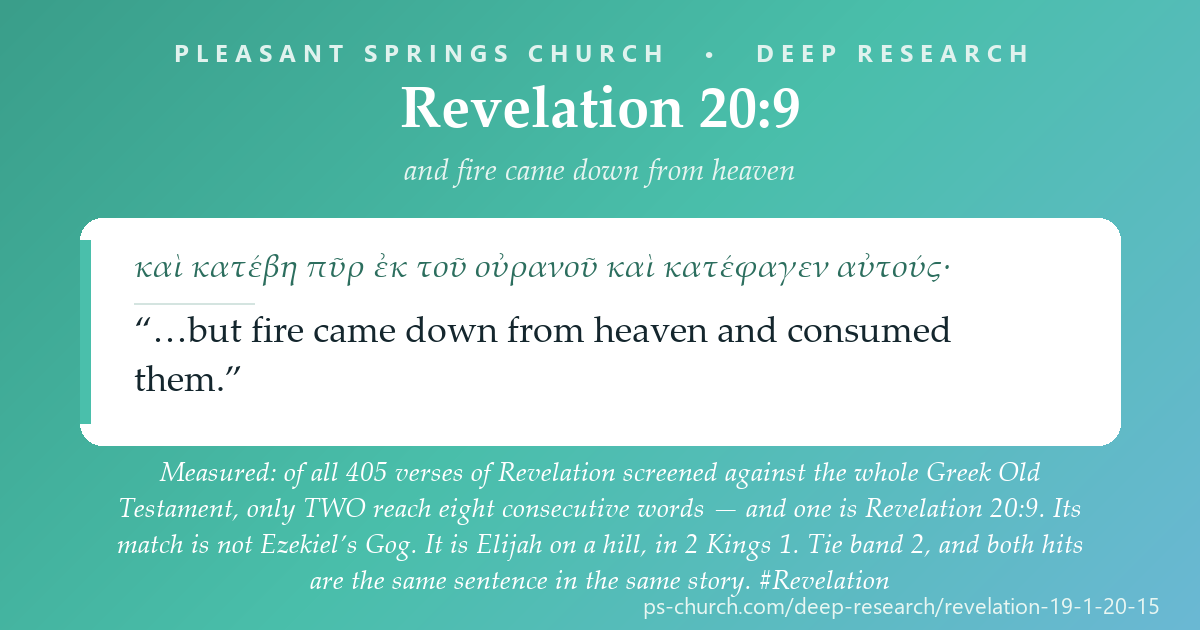
One of those two eights is in this passage — and it is not where anyone would look for it. Revelation 20:9, “and fire came down from heaven and consumed them,” runs eight consecutive words — καὶ κατέβη πῦρ ἐκ τοῦ οὐρανοῦ καὶ κατέφαγεν — identical to the Greek of 2 Kings 1:10 and 1:12 (4 Kingdoms in the Greek Bible). Tie band: 2 — and the two are the same narrated sentence in the same story, written out once after the first captain of fifty and again after the second. What Elijah himself says is in the future (καταβήσεται πῦρ, “fire shall come down”); what matches Revelation is the narrator’s report that it did. Nothing else in these thirty-six verses reaches even six against the Greek Old Testament. The chapter everyone reads for Ezekiel’s Gog has its single deepest verbal contact with a story about a prophet, a hilltop and two companies of soldiers.
What that does and does not mean. It does not mean John “quoted 2 Kings.” This shelf never asserts direction of influence, and “fire came down from heaven and consumed” is close to the only way to say that sentence in Greek. What it does mean is that the one place in these two chapters where the language locks is a vindication-by-fire scene from the Elijah cycle — and Luke 9:54 shows that first-century readers had exactly that scene ready to hand, when James and John ask whether to call fire down on a Samaritan village and are rebuked for it. The measurement points at the story; the theology is the reader’s work.
The rider is named four times and unveiled once. Faithful and True (19:11); a name written that no one knows but himself (19:12); The Word of God (19:13); King of kings and Lord of lords (19:16). His robe is already dipped in blood before the battle — the sword is in his mouth, not his hand, and the army behind him is dressed in white linen and carries nothing. Whatever else Revelation 19 is, it is not a description of a fight. The beast is captured and the war is over inside a single verse.
Audience
Churches under a state that could kill them, being told who actually reigns. The overture is a courtroom verdict turned into a hymn: Ἁλληλουϊά, four times in six verses, “for he has judged the great prostitute… and has avenged on her the blood of his servants.” Measured, those four are the only four occurrences of the word in the whole Greek New Testament. In the Greek Old Testament it stands in twenty-four verse units, twenty-one of them in the Psalter (Greek numbering), almost all as the opening word of a psalm; the other three are 3 Maccabees 7:13 and Tobit 13:18 in both of its recensions. The Bible’s hymnbook says it constantly; the New Testament says it once, here, when the verdict finally lands.
And then the hardest six verses in the Bible. “A thousand years” — χίλια ἔτη — occurs in exactly seven verses of the Greek New Testament: Revelation 20:2, 3, 4, 5, 6, 7 and 2 Peter 3:8. Six of the seven are consecutive verses of one chapter. The seventh says “with the Lord one day is as a thousand years, and a thousand years as one day.” Every millennial system Christians have ever built — premillennial, amillennial, postmillennial — is built on those six verses, read in the light of that one. That is a fact about the evidence, not a verdict about the systems, and this page prints it because a reader deserves to know how narrow the base is.
Then the assize. A great white throne — θρόνον μέγαν λευκόν, a phrase that occurs once in the Bible. Earth and sky flee. The dead stand, “great and small,” and books are opened, and one other book. Judgement is by works and rescue is by the book of life, and Revelation states both in the same breath without apology. Then the last move: Death and Hades, the two that had held everyone, are thrown into the lake of fire themselves. The jailers are jailed.
Orient on the divine warrior, the millennium, Gog and Magog, and the final judgement.
Search by topic: millennium / chiliasm, first resurrection, second death, Gog and Magog, lake of fire, book of life, divine warrior, parousia. Read at least one article by someone who disagrees with you.
Which articles are relevant?
- Anchor Bible Dictionary — “Millennium,” “Gog and Magog,” “Resurrection (Early Judaism and Christianity),” “Judgment, Last.”
- Dictionary of the Later NT & Its Developments — “Revelation, Book of,” “Millennium,” “Eschatology,” “Satan, Devil.”
- NIDNTT / TDNT — χίλιοι (chilioi), ἄβυσσος (abyssos), ποιμαίνω (poimainō), ἁλληλουϊά (hallelouia).
- Dictionary of Deities and Demons in the Bible — “Gog,” “Magog,” “Abaddon,” “Satan.”
Bibliography surfaced:
- G. K. Beale (NIGTC), David Aune (WBC, 3 vols.), Craig Koester (Anchor Yale), Grant Osborne (BECNT), Robert Mounce (NICNT) on Revelation.
- Richard Bauckham, The Climax of Prophecy and The Theology of the Book of Revelation.
- Beale & McDonough, “Revelation,” in Commentary on the NT Use of the OT; Steve Moyise, The Old Testament in the Book of Revelation.
A Roman triumph read backwards; Gog before Ezekiel; and a Greek Bible that already knew the name.
Read 19:11–21 against the imagery a first-century city actually watched go by; read 20:8 against every occurrence of the name Gog in the Greek Old Testament, not only the famous one.
Which parallels shed light on religion and worldview?
The triumph, inverted. A Roman provincial knew what a conquering general looked like: a white horse, a crowned rider, a following army, and behind them the captives and the spoil. Revelation 19 supplies every element and then breaks each one. The rider’s crowns are plural — διαδήματα πολλά, many diadems, not the single laurel of one victory. His robe is dipped in blood before the fighting starts. His weapon is a sword out of his mouth, so the conquest is by speech. His army wears white linen and carries no weapon at all and does nothing in the entire scene. And the feast at the end is not the victor’s banquet: it is the birds eating the flesh of kings. A triumph that mocks triumphs.
Gog is older, and stranger, than Ezekiel 38. Everyone reads Revelation 20:8 off Ezekiel, and Ezekiel is certainly where the name occurs most: Γωγ occurs in eleven verse units of the Greek Old Testament and nine of them are Ezekiel 38–39. But the other two are the interesting ones. Magog is a person before he is a place — a son of Japheth in the table of nations (Genesis 10:2; 1 Chronicles 1:5). And Greek Numbers 24:7 makes Balaam say that his kingdom “shall be exalted above Gog” (ὑψωθήσεται ἢ Γωγ βασιλεία αὐτοῦ) — where the Hebrew reads Agag, and reads “his king” for the Greek’s “his kingdom” (מֵאֲגַג). Both texts are on this shelf’s disk and both were checked. A reader whose Bible was Greek therefore met Gog in Balaam’s oracle, as the archetypal enemy a messianic king overtops, long before he reached Ezekiel. That is a genuine MT/LXX divergence, and the page states it without deciding which reading is older.
Fire from heaven was a known ending. The eight-word lock at 20:9 lands on Elijah, but the motif was wider: Sodom (Genesis 19:24), the fire on Carmel, the fire at the dedication of the temple, which 2 Maccabees 2:10 tells by comparing Solomon with Moses — and it is the Moses half of that comparison that carries seven of the eight words (καὶ κατέβη πῦρ ἐκ τοῦ οὐρανοῦ καί, then τὰ τῆς θυσίας ἐδαπάνησεν where Revelation has κατέφαγεν), and, in the New Testament, the beast’s counterfeit — the second beast “makes fire come down from heaven” in the sight of men (13:13). Revelation 20:9 is the real thing answering the forgery. Note what it is not: there is no battle at 20:9 either. The armies encircle the city, and the story ends in half a sentence.
- 2 Kings 1:9–14 (Greek: 4 Kingdoms) — Elijah and the captains of fifty; the clause that measures eight words against Revelation 20:9, spoken twice.
- Ezekiel 38–39 — Gog of the land of Magog, the hordes from the north, and the birds summoned to the sacrificial feast (39:17–20): the scene commentators set alongside 19:17–18 and 20:8, however little verbal overlap the screen finds (see Gog of Magog).
- Genesis 10:2; 1 Chronicles 1:5; Numbers 24:7 — Magog as a son of Japheth; and the Greek Balaam oracle that reads Gog where the Hebrew reads Agag.
- Isaiah 63:1–6; Psalm 2; Wisdom 18:15–16 — the treader of the winepress with stained garments; the rod of iron; the all-powerful Word leaping down as a stern warrior: the three streams that meet in the rider.
It is worth slowing down at the point where most readings speed up. Revelation 19 gathers every image of decisive military victory the ancient world had — the white horse, the crowned commander, the massed army, the kings of the earth drawn up in array against him — and then declines to narrate a battle. Verse 19 assembles the enemy. Verse 20 says the beast was captured. There is no clash, no casualties on the winning side, no tactics, no duration. The rider’s army has been described in detail and it does nothing at all; it is dressed for a wedding, not a war, in the fine linen that verse 8 has just told us is the righteous deeds of the saints. And the rider’s only weapon is a sword coming out of his mouth, which is to say that he conquers by saying something. Whatever a reader concludes about the timing of these chapters, the shape of the scene is a rebuke to the imagination that wants them to be an action sequence. The same holds at 20:9: the nations come up over the breadth of the earth and surround the camp of the saints, and then the sentence simply stops — fire came down and consumed them. Twice, in two chapters, John sets up a battle and refuses to give us one. The victory is not in doubt long enough to be described. That is a theological claim made by narrative form, and it is the most consistent thing in the passage.
Eight words screened against the corpora, with their counts.
Every count below was run against the MorphGNT/SBLGNT normalised column (field 6) and the CATSS Greek Old Testament on disk, not taken from a concordance note. Where a count is a count of Greek rows rather than English verses, it says so.
“Praise Yah” — a Hebrew liturgical cry carried untranslated into Greek. Measured: these four are the only four occurrences in the entire Greek New Testament. In the Greek Old Testament it stands in 24 verse units, 21 of them in the Psalter (Greek numbering) and mostly as a psalm’s opening word. The Bible’s songbook says it constantly; the New Testament saves it for the verdict.
“A thousand years.” Measured: the phrase occurs in exactly seven verses of the Greek New Testament — the six above and 2 Peter 3:8. Whether the number is a duration or a symbol of completeness (ten cubed, as twelve squared times a thousand is the sealed number at 7:4) is the whole millennial argument, and no word-count settles it.
“The abyss” — in the Greek Old Testament the primeval deep of Genesis 1:2, here a prison with a key and a seal. Measured: the word occurs in nine verses of the Greek New Testament — seven of them in Revelation (9:1, 2, 11; 11:7; 17:8; 20:1, 3; plus Luke 8:31 and Romans 10:7), and in Revelation always as the place the destroyer comes up from. At 20:3 the direction reverses: something goes down into it.
“He will shepherd” — and here is a real, checked MT/LXX divergence. Psalm 2:9 in Greek reads ποιμανεῖς αὐτοὺς ἐν ῥάβδῳ σιδηρᾷ, “you will shepherd them with a rod of iron”; the Masoretic pointing of the same consonants (תְּרֹעֵם) yields “you will break them.” Revelation’s ποιμανεῖ agrees with the Greek. The page reports the agreement; it does not claim to know which vocalisation is original.
“The lake of fire.” Measured: the phrase occurs in exactly four verses of the Greek New Testament, and all four are inside this passage. (Revelation 21:8 speaks of “the lake that burns with fire and sulfur” — a different construction.) It is not a word the New Testament uses loosely; it is a word this passage owns.
“The second death.” It occurs at 2:11, 20:6, 20:14 and 21:8 — four verses, all in Revelation, two of them here. Crucially, Revelation defines its own term at 20:14: “this is the second death, the lake of fire.” Whatever else is disputed in this chapter, the book does not leave this phrase to the reader’s imagination.
Measured: the only verse in the Greek New Testament containing either name. In the Greek Old Testament, Gog in eleven verse units (nine of them Ezekiel 38–39, plus Amos 7:1 and Numbers 24:7) and Magog in three (Genesis 10:2; 1 Chronicles 1:5; Ezekiel 38:2). In Ezekiel, Gog is a ruler of the land of Magog; here the two are a paired name for the deceived nations.
“A great white throne.” Measured: the phrase occurs once in the Greek New Testament and nowhere at all in the Greek Old Testament held here. Revelation uses θρόνος 47 times across 37 verses; only this once is the throne white. The one seated on it goes unnamed here — as he also does at 4:2–3 and 21:5 — and the scene is so absolute that the earth and the sky have to leave.
How the rest of the canon fills these out:
- Psalm 2:1–12 — the kings of the earth set themselves; “you shall shepherd/break them with a rod of iron”: the verse whose Greek wording Revelation carries three times (2:27; 12:5; 19:15), 19:15 among them.
- Isaiah 11:4; 49:2; Hebrews 4:12 — “he shall strike the earth with the rod of his mouth”; the mouth like a sharp sword; the word of God living and active: the sword that is speech.
- Daniel 7:9–14 — thrones set in place, the court sat, and the books were opened: the nearest Old Testament scene to 20:4 and 20:12 (see Daniel 7).
- Exodus 32:32–33; Greek Psalm 68:29 = English Psalm 69:28; Philippians 4:3 — the book God writes names in and can blot names out of: the “book of life” of 20:12, 15.
- 1 Corinthians 15:24–28, 54–56 — the reign until every enemy is under his feet, and death the last enemy destroyed: the closest Pauline parallel to 20:14, and the standard text for reading Revelation 20 alongside the rest of the New Testament (see 1 Corinthians 15).
The screens, the tie bands, and the counter-examples that keep them honest.
Greek against Greek. Contiguous runs of whole normalised word forms, never lemmas — the MorphGNT normalised column against the CATSS Greek Old Testament, both lowercased, accents and breathings dropped, final sigma folded. Exhaustive and deterministic. The tie band is the number of places that share the same longest run, and it is printed beside every figure below.
Screen 1 — Revelation 19:1–20:15 against the whole Greek Old Testament (36 rows × 30,637 verse units):
All 36 verses reach two consecutive shared words, 35 reach three, 23 reach four, 9 reach five, one reaches eight, and nothing reaches nine.
- Revelation 20:9 — run of 8, band 2. καὶ κατέβη πῦρ ἐκ τοῦ οὐρανοῦ καὶ κατέφαγεν, matching 4 Kingdoms 1:10 and 1:12 (English: 2 Kings 1). The band of 2 is really one locus: the narrator reports the fire falling on two successive captains of fifty, in the same words both times. Elijah’s own words are future — καταβήσεται πῦρ ἐκ τοῦ οὐρανοῦ καὶ καταφάγεταί σε — and do not match. This is the deepest verbal contact this passage has with any text in the Greek Old Testament held on this shelf’s disk. No Hebrew screen was run and none could be, the passage being Greek; the claim is about the Greek column only.
- Revelation 19:2 — run of 5, band 2. ἐν τῇ πορνείᾳ αὐτῆς καί (Ezekiel 23:17; Nahum 3:4). The vocabulary of the harlot-city is shared, not owned.
- Revelation 20:8 — run of 5, band 2. ὡς ἡ ἄμμος τῆς θαλάσσης (Hosea 2:1; Isaiah 10:22) — and note where it does not match: see the counter-example below.
- Revelation 19:6 — run of 5, band 13. κύριος ὁ θεὸς ὁ παντοκράτωρ, tied across ten verses of Amos plus Hosea, Nahum and Zechariah. A run of five with a band of thirteen is a formula, not a citation, and this page will not report it as an echo of any one of them.
- Revelation 19:15 — run of 4, band 8. The Psalm 2:9 contact (αὐτοὺς ἐν ῥάβδῳ σιδηρᾷ) is one of eight ties at four. The universally recognised citation in this passage measures shallower than the unremarked Elijah clause. Depth is not citation, and citation is not depth.
Screen 2 — the counter-example this page owes its readers:
Revelation 20:8 names Gog and Magog outright. It is the only proper-name borrowing from an Old Testament oracle in these two chapters, and Ezekiel 38–39 is where the names live. So we screened Revelation 20:8 against Ezekiel 38–39 alone — 52 verse units — and asked how many consecutive words they share.
- Revelation 20:8 vs. Ezekiel 38–39: max run 3, band 2. The three-word hits are τὰ ἔθνη τά (39:4) and τὸν Γὼγ καί (39:11) — that is, an article-noun-article string, and the name plus a conjunction.
- Revelation 19:17–18 vs. Ezekiel 39:17–20: max run 1, in every pairing. The shared items are single words, and the notable one is not a connective: Revelation 19:17 and Ezekiel 39:17 both carry συνάχθητε, “be gathered” — the summons itself, standing twice in the Ezekiel verse. The rest are εἰς, ἐπί and καί. The summons of the birds to the great supper, which every commentary on the page reads off Ezekiel 39, has no two consecutive words in common with it in Greek.
Read that carefully, because it cuts against this page’s own method. Ezekiel is unmistakably in the room: the name, the birds, the sacrificial feast, the northern hordes, the fire. And the measurement cannot see him. That is not a finding that Ezekiel is absent; it is a finding about what this screen detects. It detects verbatim contact and nothing else. Allusion, motif, structural imitation, translation from a Hebrew text rather than a Greek one, John writing from memory in his own idiom — every one of those is invisible here. A page that printed the eight-word Elijah run and quietly omitted the one-word Ezekiel result would be using measurement as decoration. So both are printed, and the second is the more important of the two.
Screen 3 — Revelation 19–20 against the rest of the Greek New Testament (36 rows × 7,891 verses):
All 36 reach three, 26 reach four, 17 reach five, 8 reach six, 4 reach seven, 3 reach nine, 2 reach ten, one reaches thirteen, and nothing reaches fourteen. Every one of the deepest hits is Revelation against itself — the book is far more self-referential than it is citational.
- Revelation 19:10 ↔ 22:9 — run of 13, band 1. καὶ λέγει μοι· ὅρα μή· σύνδουλός σού εἰμι καὶ τῶν ἀδελφῶν σου τῶν. John falls at an angel’s feet twice and is refused in almost identical words twice. The deepest verbatim run anywhere in these two chapters is a book quoting itself to say ‘do not worship me.’
- Revelation 19:11 ↔ 6:2 — run of 9, band 1. καὶ ἰδοὺ ἵππος λευκός, καὶ ὁ καθήμενος ἐπ’ αὐτόν. The first seal’s rider and the rider called Faithful and True share nine consecutive words. This page reports the number and declines to settle the question with it. Whether the first horseman is Christ, a conquering counterfeit, or neither, is decided by context (a seal opened by the Lamb, in a quartet with sword, famine and death) and not by a word-run; identical vocabulary is exactly what a deliberate contrast would also produce.
- Revelation 19:20 ↔ 16:2 — run of 10, band 1. τὸ χάραγμα τοῦ θηρίου καὶ τοὺς προσκυνοῦντας τῇ εἰκόνι αὐτοῦ — the mark and the image, described in the same ten words in the bowl sequence and in the beast’s capture.
- Revelation 20:4 ↔ 1:9 and 6:9 — run of 6, band 2. διὰ τὸν λόγον τοῦ θεοῦ καί. The souls on the thrones at 20:4 are described in the same phrase as the souls under the altar at 6:9 and as John’s own exile at 1:9 (see Revelation 1, the seals).
Screen 4 — the whole book, for scale:
All 405 Greek verses of Revelation against all 30,637 verse units of the Greek Old Testament: 381 reach three, 239 reach four, 93 reach five, 16 reach six, 5 reach seven, 2 reach eight, none reach nine. The two eights are Revelation 20:9 (4 Kingdoms 1:10, 12 — band 2) and Revelation 6:8 (Greek Jeremiah 51:13 = English Jeremiah 44:13 — band 1), the latter already published on the seals page. For a book of 405 verses built almost entirely out of Old Testament material, a ceiling of eight is low — which is itself the finding: Revelation does not quote; it re-speaks.
A reader who has followed this shelf for a while will have noticed that the numbers here are smaller than on the Old Testament pages, where a Hebrew prophet can share fourteen or eighteen consecutive words with another. That is not a defect in the screen; it is a fact about Revelation. The book is saturated with Scripture and quotes none of it. There is no ‘as it is written’ anywhere in twenty-two chapters. What John does instead is take the furniture of Daniel, Ezekiel, Isaiah, Zechariah and the Psalms and rebuild it in his own Greek, so that a reader who knows those books hears them on nearly every line while a machine that counts consecutive words hears almost nothing. The measured ceiling of eight across 405 verses is the numerical shape of that habit. And it means something for how the page should be read: on Revelation, the screen is best used the way it is used above — not to prove connections, which it mostly cannot, but to rank them honestly, to catch the places where the language does lock, and above all to keep the page from claiming more precision than the evidence carries. The eight-word Elijah run is a real and surprising datum. It is not a doctrine.
The scholarship, the four readings of the thousand years, and what this page could not check.
This is the section where the page says what it does not know. On Revelation 20 that list is long, and shortening it would be dishonest.
Commentaries & studies:
- G. K. Beale, The Book of Revelation (NIGTC); David E. Aune, Revelation (WBC, 3 vols.); Craig R. Koester, Revelation (Anchor Yale); Grant R. Osborne (BECNT); Robert H. Mounce (NICNT).
- Richard Bauckham, The Climax of Prophecy; Steve Moyise, The Old Testament in the Book of Revelation; Jan Fekkes, Isaiah and Prophetic Traditions in the Book of Revelation.
- Darrell Bock, ed., Three Views on the Millennium and Beyond; Robert Clouse, ed., The Meaning of the Millennium: Four Views — the standard place to hear each position argued by someone who holds it.
The four readings of the thousand years, stated fairly:
- Historic premillennial — the binding, the first resurrection and the reign are future and in this order; Christ returns at 19:11 and reigns on earth before the final judgement. Held by Irenaeus and Justin, and by many since; it is also Pleasant Springs’ own position, and stating that is part of being honest, not a substitute for argument.
- Amillennial — the thousand years is the present church age; the binding is the restraint of Satan from deceiving the nations (Matthew 12:29; John 12:31), and the “first resurrection” is the believer’s life with Christ after death or in regeneration. Augustine, City of God XX, and the majority Western reading for most of church history.
- Postmillennial — the reign is a coming era of gospel success within history, before Christ’s return.
- Recapitulationist (cutting across the others) — chapters 19 and 20 are not consecutive; 20:1–10 retells the same conflict from a different angle, as Revelation demonstrably does elsewhere with the seals, trumpets and bowls.
- What no measurement on this page decides between them. Word-runs cannot tell you whether two visions are sequential or recapitulated, whether a thousand is a number or a symbol, or what “they came to life” means. Anyone who tells you the Greek settles it is overselling the Greek.
What this page did NOT check, and where it is weakest:
- No Hebrew screen was run. Revelation is Greek and there is no Hebrew Vorlage to screen; but that also means this page cannot tell whether John was working from Hebrew Ezekiel rather than Greek Ezekiel, which would explain the near-zero result at 19:17–18 entirely. That gap is the single biggest limitation on this page.
- The Greek Old Testament screened is CATSS/Rahlfs. Where the Greek tradition splits — Old Greek against Theodotion in Daniel, the two Judges recensions, the shorter and longer Tobit — both texts are in the corpus and a hit may be recension-specific. No manuscript-level apparatus was consulted, and Brooke & McLean has already shown this shelf one systematic dropout in a Swete text.
- The Greek New Testament screened is SBLGNT. Textual variants in this passage were not screened: the presence or absence of ἀπὸ τοῦ θεοῦ (“from God”) beside “out of heaven” at 20:9, which the SBLGNT marks as a variant unit and on which the eight-word run depends, the disputed ἐρραντισμένον / βεβαμμένον at 19:13 (“sprinkled” vs. “dipped” — and 19:13 is a load-bearing verse here), and the ἁλληλουϊά spellings. A different base text could move a run by a word.
- No commentary was opened to produce the numbers. Every figure on this page came out of the corpora on disk. The compensating weakness is that no commentator checked them; the bibliography above is where they can be checked against.
- Second Temple parallels were named, not screened. 1 Enoch, 4 Ezra 7 and the Qumran War Scroll are cited from the secondary literature. 4 Ezra and 1 Enoch are not on this shelf’s disk in Greek, so nothing about them here is measured.
- The date of Revelation is assumed, not argued. The Domitianic date (c. AD 95) is the majority view and is what the Author & Audience section presupposes; the Neronian case exists and is not engaged here.
Interpretation notes worth keeping:
- The rider is Christ, and the text says so four ways. Faithful and True (cf. 3:14), the Word of God, King of kings and Lord of lords (cf. 17:14), and the eyes like a flame of fire that identify him with 1:14. This is not in serious dispute.
- The blood on the robe precedes the battle. Whether it is his own blood or his enemies’ is disputed; Isaiah 63:1–3, the nearest image, is the enemies’. The text does not say, and the page does not decide.
- Judgement by works and rescue by the book are both stated. 20:12–13 says the dead were judged “according to what they had done”; 20:15 says the criterion of the lake of fire is absence from the book of life. Revelation holds both without embarrassment, and so should a reader.
- Death and Hades are personified and then destroyed. 20:14 is the nearest thing in Revelation to 1 Corinthians 15:26 — and it is the clearest signal that this scene is the end, not a stage within history.
- No date-setting, and no identification of Gog with a modern nation. The text supplies neither, and the shelf will not supply what the text withholds.
What eight words, a low ceiling, and a refused worship are actually for.
Name what you learned, why it matters, and one concrete response.
What should we carry away — and do?
- The victory is never described, twice. Both battles in this passage — 19:19–21 and 20:8–9 — are set up in detail and then finished in half a sentence. The rider’s army carries nothing; his weapon is a word; the fire falls from outside the story. You are not being recruited into a fight; you are being told who wins.
- The deepest run in these two chapters is an angel saying ‘don’t.’ Thirteen consecutive words, repeated at 19:10 and 22:9: and he said to me, ‘You must not do that! I am a fellow servant with you and your brothers…’ — and in both places the sentence runs on to ‘worship God.’ In a passage about thrones and kings and reigning, the one sentence the book takes the trouble to say twice is a refusal to be worshipped.
- Certainty and humility are not opposites. The name on the robe is not in doubt. The order of the thousand years has been argued for eighteen hundred years by people who all confess that name. Hold the first with your whole weight and the second with an open hand.
Step in response: read Revelation 19:1–20:15 straight through, out loud, in one sitting — it takes about six minutes. Do not stop to adjudicate the millennium. Notice instead how often the text tells you what someone is called, and where the only long repetition in it falls. Then pick one thing in your life that is waiting on a verdict that has not come, and say the word heaven says four times at the front of this passage over it.
Revelation 20:9 · to share
Greek NT + ESVEvery Deep Research page traces its passage across the whole sweep — the Old Testament, the Second-Temple world between the testaments (historical witnesses, not Scripture), and the New Testament. Follow the thread:
Pleasant Springs Church — Deep Research
Research method after Michael S. Heiser’s Bible Research Method (examine dictionaries → ancient literature → important words → textual connections → academic publications → share), with the Pleasant Springs “Author & Audience” foundation. Scripture set in the Hebrew, the Greek editions named on each page and the ESV (Old Testament), and the Greek New Testament and the ESV (New Testament), per the practice of Pleasant Springs Church. Revelation 19:1–20:15 research grounded in Beale (NIGTC), Aune (WBC), Koester (Anchor Yale), Osborne (BECNT) and Mounce (NICNT), with Bauckham’s Climax of Prophecy and Moyise on Revelation’s use of the Old Testament, and the millennial positions taken from Clouse’s Four Views and Bock’s Three Views. All numeric findings were generated locally: the MorphGNT/SBLGNT normalised column (field 6) screened against the CATSS/Rahlfs Greek Old Testament held on disk (30,637 verse units), contiguous runs of whole word forms, lowercased with accents and breathings dropped and final sigma folded, every run reported with its tie band. Direction of influence is never asserted. The Ezekiel 38–39 counter-result (max run 3 at 20:8; max run 1 at 19:17–18) is printed alongside the eight-word 2 Kings 1 result precisely so that neither is read as more than it is: this screen finds verbatim contact and not allusion, and it cannot see a Hebrew Vorlage at all. The four millennial readings are stated as their holders state them; Pleasant Springs’ historic premillennial position is disclosed rather than assumed, and no measurement on this page adjudicates between them. Textual variants at 19:13 and 20:9 were not screened and are named as a limitation.
Scripture quotations marked ESV are from the ESV® Bible (The Holy Bible, English Standard Version®), © 2001 by Crossway, a publishing ministry of Good News Publishers. ESV Text Edition: 2016. Used by permission. All rights reserved. The ESV text may not be quoted in any publication made available to the public by a Creative Commons license, and the ESV may not be translated in whole or in part into any other language. www.esv.org
|
Did this study bless you today? 💚 Give to Support PS Church100% of gifts go to the General Fund — thank you. |