Sixteen rows in the book of Jeremiah reach six consecutive words against the Greek New Testament. Not one of them is in chapters 1–5. These five chapters are 142 of the book’s 1,298 Greek rows — eleven per cent of it — and screened against all 7,927 verses of the Greek New Testament their deepest contact is five, reached three times, every one of them a formula: a stock phrase in Acts 7:41, a date formula in Luke 4:2, and men hiding in caves in Revelation 6:15. Meanwhile the lines everybody knows measure almost nothing. Jeremiah 5:21, eyes but see not, which Mark 8:18 says back to the disciples, comes out at 2 — with a tie band of 225. Jeremiah 2:13, the broken cisterns, comes out at 3. And Jeremiah 1:5, before I formed you in the womb I knew you, is the verse in this passage that shares no two consecutive words with any other verse in the Hebrew Bible. The deepest verbatim contact in all 143 verses is Jeremiah quoting Jeremiah: ten words shared between 4:4 and 21:12, tie band one. See the method →
Jeremiah 1:1–5:31 (selections)
Hebrew (Masoretic) · Greek (CATSS, Rahlfs’ Septuaginta) · ESV⚠️ The rest of the book is a different matter, and this page will not pretend otherwise. Over the whole book the measured shapes are Masoretic 1,364 verses and CATSS 1,298 — and 34 of the 52 chapters have different verse counts in the two, because the Greek puts the Oracles Against the Nations in a different place in the book and orders the nations differently inside them. Three correspondences outside this passage were verified here by content rather than asserted from a table: Greek 38:31–34 is Hebrew 31:31–34, the New Covenant; Greek 44:16 is Hebrew 37:16; and Greek 45:6 is Hebrew 38:6, the pit with mire in it. Chapters 1–5 are the same in both, and every LXX reference on this page outside them is labelled with its Greek chapter number.
The Shape of the Passage
Sequence — a call, an indictment, a summons to turn, an invasion and a search. Not a chiasm. One bracket on this diagram was measured; the rest is a reading of the order the text stands in.These five chapters name their author in the first three words of one column and not of the other. The Hebrew heads the book the words of Jeremiah; the CATSS row heads it the word of God. Both then name the same man, the same father, the same village and the same three reigns. This page reports the difference at the top of the book and does not adjudicate it.
Author
A priest’s son from a village three miles from Jerusalem, in the territory of the tribe that lost the throne. יִרְמְיָהוּ is rendered Ιερεμιας. His father is חִלְקִיָּהוּ, Hilkiah, and the row spells him Χελκιου. Anathoth — עֲנָתוֹת and its gentilic — stands 21 times in the Masoretic corpus, and seven of those are in this book: 1:1, 11:21, 11:23, 29:27 and three times in the field-purchase of 32:7–9. An eighth is 1 Kings 2:26, where Solomon banishes the priest Abiathar to Anathoth and tells him he deserves to die. The page notes that the two facts sit beside each other in the corpus and draws no line between them.
The New Testament names him three times, and every one of the three is in Matthew. Counted over all 7,927 MorphGNT verses, every inflected form of Ἰερεμίας: three — against Ἠσαΐας 22, Ἠλίας 29 and Μωυσῆς 79. None of the three is a quotation from these five chapters, and the book’s deepest New Testament contact by far — Hebrews 8:8–12 on the new covenant — names no prophet at all. See Jeremiah 31:31–34.
Audience
Judah and Jerusalem, addressed together. The exact phrase אִישׁ יְהוּדָה וְיֹשְׁבֵי יְרוּשָׁלִָם stands in three verses of the Hebrew Bible — Jeremiah 4:4, Jeremiah 17:25 and 2 Chronicles 34:30 — and the third of those is Josiah reading the book of the covenant in their hearing. 4:3 addresses the same two in a slightly different form. The northern kingdom is addressed too, and it has been gone a century: 3:12 sends the words toward the north to מְשֻׁבָה יִשְׂרָאֵל, and 3:6–11 sets the two sisters side by side. A preacher addressing a kingdom already destroyed is a plain feature of the text.
Dated from the thirteenth year of Josiah, and the chapters do not stay there. 1:2–3 fixes a span from Josiah to the eleventh year of Zedekiah — roughly 627 to 586 BC — but 3:6 is explicitly “in the days of King Josiah” while the invasion of chapter 4 reads like something much later. This page does not date the individual oracles and does not adjudicate whether the foe from the north is Scythian, Babylonian or unnamed on purpose. Neither question can be settled from the text files measured here, and stage 5 says so.
Orient on the call, the covenant lawsuit, and the numbering problem this book is famous for.
Search by topic: Jeremiah, book of; Septuagint of Jeremiah / the short edition; 4QJerb,d; call narratives; prophetic lawsuit (רִיב); Deuteronomistic prose in Jeremiah; the foe from the north; cisterns and water supply; circumcision of the heart; Anathoth; Josiah’s reform.
Which articles are relevant?
- Anchor Bible Dictionary — “Jeremiah, Book of,” “Jeremiah (person),” “Anathoth,” “Cistern,” “Covenant Lawsuit,” “Foe from the North.”
- Dictionary of the OT: Prophets (IVP) — “Jeremiah: Book of,” “Call / Commission Narratives,” “Marriage and Divorce Imagery,” “Israel’s History (Josiah),” “Text and Textual Criticism.”
- NIDOTTE — שׁוב, מְשׁוּבָה, בּוֹר, עׇרְלָה, אֱמוּנָה, נְאֻם.
- Dictionary of NT Use of the OT (Beale & Carson) — on Hebrews 8:8–12, which is the book’s deepest New Testament contact and lies twenty-six chapters past this study.
Settle the numbering — inside this passage, and the warning for everywhere else
Jeremiah is the hardest verse-numbering problem on this shelf, and chapters 1–5 are the easy part of it.
| ch 1 | ch 2 | ch 3 | ch 4 | ch 5 | total | |
|---|---|---|---|---|---|---|
| Masoretic | 19 | 37 | 25 | 31 | 31 | 143 |
| CATSS Greek | 19 | 36 | 25 | 31 | 31 | 142 |
| ESV | 19 | 37 | 25 | 31 | 31 | 143 |
Every chapter number and every verse number in these five chapters is the same in all three columns. The single exception is that Masoretic and English 2:1 has no CATSS row. This was derived from the files on this disk, label by label, and not copied from a numbering table: the CATSS labels for Greek Jeremiah 2 run 2:2, 2:3, 2:4… through 2:37, so the Greek chapter simply has no verse numbered 2:1 and nothing after the gap is shifted.
⚠️ The ESV row of that table is the one row not derived from a file on this disk. No ESV text of Jeremiah 1–5 is held here — the English in the codex above was typed by hand from the printed edition — so the ESV verse counts are the printed English chapter divisions, which for these five chapters are the same as the Masoretic. The Masoretic and CATSS rows were measured; the ESV row was read.
⚠️ Past chapter 5, everything changes. Over the whole book the measured shapes are Masoretic 1,364 verses and CATSS 1,298, and 34 of the 52 chapters have different verse counts. The reason is not a scattering of small omissions but a structural difference: the Greek book puts the Oracles Against the Nations in the middle rather than at the end, and orders the nations inside them differently, so from roughly chapter 25 onward a Hebrew chapter number and a Greek chapter number are two different things.
Rather than reprint a correspondence table this page has not verified, three anchors were checked against the files here by content:
| Greek chapter and verse | is | checked how |
|---|---|---|
| Jer 38:31–34 | Hebrew / English 31:31–34 | the new covenant; 38:31 opens …διαθήσομαι… διαθήκην καινήν, and 38:32–34 are the rows Hebrews 8:9–11 reproduce |
| Jer 44:16 | Hebrew / English 37:16 | ἦλθεν Ιερεμιας εἰς οἰκίαν τοῦ λάκκου — the house of the pit |
| Jer 45:6 | Hebrew / English 38:6 | ἐν τῷ λάκκῳ οὐκ ἦν ὕδωρ ἀλλ’ ἢ βόρβορος — no water in the pit but mire |
| Jer 28:52 | Hebrew / English 51:52 | ἐκδικήσω ἐπὶ τὰ γλυπτὰ αὐτῆς — judgment on Babylon’s images |
The 66-verse difference between 1,364 and 1,298 understates the gap, because the Greek is also shorter inside verses that both books have. This page did not measure the word-level difference and therefore does not quote a percentage for it. What it states is the verse-unit counts it took off the disk.
A divorce law, a hewn cistern, and the corpus this page screens against.
The law behind Jeremiah 3:1, measured
Jeremiah 3:1 argues from a case in the Torah, and every commentary names Deuteronomy 24:1–4. Measured verse against verse across the whole of Jeremiah 3 and the whole of Deuteronomy 24, the deepest shared run is three words.
| Jeremiah 3 | best partner in Deuteronomy 24 | longest shared run |
|---|---|---|
| 3:1 | 24:2 | 3 — וְהָיְתָה לְאִישׁ אַחֵר |
| 3:9 · 3:16 · 3:18 | 24:4 | 2 |
| the other 21 verses of Jeremiah 3 | various | 1 |
Three words: and she becomes another man’s. That is a real verbal contact and it is a small one. Jeremiah 3:1 opens with לֵאמֹר, saying, with nothing said before it — the Hebrew reads as though a citation formula has been left standing without its citation. The page notes the oddity and does not repair it.
The technical noun for the certificate is rarer than the theme. כְּרִיתֻת, the writ of divorce, stands in exactly four verses of the Hebrew Bible: Deuteronomy 24:1, Deuteronomy 24:3, Isaiah 50:1 and Jeremiah 3:8 — and the last three of those are all God divorcing, or refusing to divorce, a people. Two of the four are the law; two are the metaphor.
A cistern is a technology, and the metaphor of 2:13 depends on knowing it
Jeremiah 2:13 sets two water sources against each other, and the contrast only works if you know which one fails. A מָקוֹר מַיִם חַיִּים — a spring of living, that is running, water — needs no maintenance. A בֹּאר is cut out of rock and plastered, and a plastered cistern that cracks holds nothing at all. The verse’s force is that the second is more work than the first and yields less.
What was checked and what was not. No archaeological report was consulted. Nothing here rests on excavation data, lime-plaster chemistry or Iron Age water management, and the paragraph above is background a reader can find in any dictionary, not a finding. What was measured is only this: the Greek column uses one noun, λάκκος, ten times in the book, and eight of the other nine are the pit Jeremiah is lowered into at Greek 44:16 and 45:6–13 — Hebrew 37:16 and 38. The Hebrew spells the two differently.
The corpus this page screened against, and why the Odes are held out
Every Greek figure on this page was run against the same screening corpus, and it is smaller than the shelf’s holdings on purpose. The Greek Old Testament here is 64 CATSS files and 30,637 verse units. A run screen sees 30,348, because the Odes are excluded. They have to be: Ode 9 is Luke 1 and Ode 13 is Luke 2, copied into a Greek Old Testament manuscript, and ten more Odes are second copies of Exodus 15, Deuteronomy 32, 1 Samuel 2, Habakkuk 3, Isaiah 26, Jonah 2, Daniel 3, Isaiah 5 and Isaiah 38. Left in, they would hand those passages a spurious perfect match with themselves and would silently double the tie band of anything touching a canticle. No Ode is a copy of anything in Jeremiah, so on this page the exclusion changes no figure — but the number the page quotes for the corpus is the screened one, 30,348, and not the held one.
The Greek New Testament side is the SBL edition via MorphGNT, 7,927 verses in 27 files. As of 30 August 2026 cross-corpus runs apply MorphGNT’s own spelling equivalences — ou / ouk / ouch, ek / ex, and the movable nu — so figures on this page are higher than anything a page written before that date reports. Every run here was re-measured; nothing was copied from a sibling page.
What could not be checked about the seventh century
Josiah’s reform, the fall of Assyria, the Scythian question and the Babylonian advance are all outside what this page can measure. No cuneiform source was consulted. No Babylonian Chronicle, no Lachish ostracon, no bulla bearing a name from this book, no excavation report from Anathoth. The identity of the “foe from the north” in chapters 4–6 is a genuinely contested question and this page does not enter it. What the text says is that the direction is north; the text does not name the nation, and neither does this page.
A root that runs twenty-five times, a hard heart Jesus quotes, and a cistern that becomes a prison.
25 occurrences in Jeremiah 1–5, and 16 of them in chapter 3 alone — imperatives (turn!), participles (turnable sons) and the noun מְשׁוּבָה, turning-away, all from the same three consonants.
The epithet of 3:6, 3:8, 3:11 and 3:12. Three of the four come across in the CATSS row as ἡ κατοικία, the dwelling; the fourth has no epithet. Unpointed, משבה and מושבה differ by one letter.
Jeremiah 4:4, and the same demand at Deuteronomy 10:16. Both come across in the Greek as σκληροκαρδία, hardness of heart — a word that stands 5 times in the 64 CATSS files and 3 times in the New Testament.
The broken cisterns of 2:13. Ten occurrences in CATSS Jeremiah; eight of the other nine are the pit Jeremiah is let down into at Greek 44:16 and 45:6–13 — Hebrew 37:16 and 38. The Hebrew spells them בֹּארֹת and הַבּוֹר.
The cisterns of 2:13 are συντετριμμένους, and at 3:22 what God heals is τὰ συντρίμματα ὑμῶν. The Greek column ties those two verses together; the Hebrew, which has נִשְׁבָּרִים and מְשׁוּבֹתֵיכֶם, does not.
Jeremiah 5:21, for the Hebrew וְאֵין לֵב. Four occurrences in the 64 CATSS files — here, Proverbs 10:13, Proverbs 17:16 and Sirach 6:20 — and none at all in the New Testament.
Jeremiah 5:1: the one man sought is doing justice, seeking אֱמוּנָה. The row has ζητῶν πίστιν — seeking pistis, the New Testament’s word for faith.
σκληροκαρδία — three words that stand in four places, and the screen cannot rank them
The Greek column of Jeremiah 4:4 contains three consecutive words that Jesus uses in Mark 10:5 — and the same three words stand in Greek Deuteronomy 10:16, identically.
| verse | the phrase | run against Mark 10:5 |
|---|---|---|
| CATSS Jeremiah 4:4 | περιτέμεσθε τὴν σκληροκαρδίαν ὑμῶν | 3 |
| CATSS Deuteronomy 10:16 | περιτεμεῖσθε τὴν σκληροκαρδίαν ὑμῶν | 3 |
| Matthew 19:8 | πρὸς τὴν σκληροκαρδίαν ὑμῶν | — |
| Mark 16:14 | σκληροκαρδίαν alone | — |
The measurement returns three in both directions and therefore cannot say which Old Testament verse Mark 10:5 is nearer. Neither can this page. What it can say is that the word is uncommon: five occurrences across the 64 CATSS files — the noun at Deuteronomy 10:16, Jeremiah 4:4 and Sirach 16:10, the adjective σκληροκάρδιος at Ezekiel 3:7 and Proverbs 17:20 — and three in the New Testament, all of them on Jesus’ lips, twice about divorce and once about unbelief.
And note what the Hebrew of Jeremiah 4:4 and Deuteronomy 10:16 actually says: circumcise the foreskin of your heart. The Greek word is not a translation of that image; it replaces the image with the idea. A reader in Greek is hearing about hardness where a reader in Hebrew is hearing about a surgical removal.
A root that will not stop turning
The three consonants שׁוב carry chapter 3 the way הוֹי carries Isaiah 5.
| chapter | occurrences of the root שׁוב |
|---|---|
| Jeremiah 1 | 0 |
| Jeremiah 2 | 3 |
| Jeremiah 3 | 16 |
| Jeremiah 4 | 4 |
| Jeremiah 5 | 2 |
| total, 1–5 | 25 |
Counted on the consonantal forms and hand-separated from the three other roots that share letters in this passage — ישׁב to dwell (7), שׁבר to break (6) and שׁבע to swear / to be sated (5) — which together account for the other 18 hits a blunt letter search returns. The separation was done by eye, verse by verse, and is the one number on this page that a machine did not produce unaided.
The Greek column carries the play, but not to the same depth. Forms of the στρέφω family — ἐπιστρέφω, ἀποστρέφω, ἀναστρέφω and their nouns — stand 20 times in CATSS Jeremiah 1–5, 8 of them in chapter 3. So the Hebrew puts nearly two-thirds of its turn-words in chapter 3 and the Greek puts under half, chiefly because three of chapter 3’s four מְשֻׁבָה epithets are not turn-words in the row at all.
The book's sixteen deep rows, none of them here; and the passage's real contacts, which are internal.
Sixteen rows in Jeremiah reach six. None is in chapters 1–5.
All 1,298 CATSS rows of Jeremiah were screened against all 7,927 verses of the Greek New Testament for this page. Sixteen rows reach six consecutive words or more. Every one of the sixteen lies outside this study.
| Greek row | = Hebrew | NT partner | run | tie band |
|---|---|---|---|---|
| Jer 38:32 | 31:32 | Hebrews 8:9 | 23 | 1 |
| Jer 38:34 | 31:34 | Hebrews 8:11 | 23 | 1 |
| Jer 38:33 | 31:33 | Hebrews 8:10 | 13 | 1 |
| Jer 51:13 | not stated | Revelation 6:8 | 8 | 1 |
| Greek 7:32 · 9:24 · 16:14 · 19:6 · 23:5 · 23:7 · 28:52 | not stated — see the numbering warning | Hebrews 8:8 | 6 | 1 each |
| Greek 14:12 · 32:29 · 38:1 · 43:3 · 45:2 | not stated | Revelation 6:8 · Revelation 14:6 · Hebrews 8:10 · 8:12 | 6 | 1 each |
| deepest row in Jeremiah 1–5: 4:29, run 5, tie band 1, Revelation 6:15 | ||||
Look at what the seven sixes are. They are all the same phrase — ἰδοὺ ἡμέραι ἔρχονται λέγει κύριος καί, behold, days are coming, says the Lord, and — standing in seven different Jeremiah rows and matching one New Testament verse, Hebrews 8:8. The tie band on the New Testament side is one, and the tie band on the Jeremiah side is seven. A run of six that seven verses of the same book can produce is a formula, and the page labels it one.
The book’s two runs of 23 are studied on their own page: Jeremiah 31:31–34, the New Covenant.
The three deepest Greek rows in this passage, and why none of them is a connection
Jeremiah 1–5 tops out at five, three times.
| row | NT partner | run | tie band | the shared words |
|---|---|---|---|---|
| Jer 4:29 | Revelation 6:15 | 5 | 1 | εἰς τὰ σπήλαια καὶ εἰς |
| Jer 1:16 | Acts 7:41 | 5 | 1 | τοῖς ἔργοις τῶν χειρῶν αὐτῶν |
| Jer 3:17 | Luke 4:2 · Acts 7:41 | 5 | 2 | ἐν ταῖς ἡμέραις ἐκείναις καί |
Two of the three are not connections in any sense, and the page says so plainly. ἐν ταῖς ἡμέραις ἐκείναις καί is a date formula; Luke 4:2 is the wilderness temptation and has nothing to do with Jeremiah 3:17. τοῖς ἔργοις τῶν χειρῶν αὐτῶν, the works of their hands, is the standard idiom for idols in both testaments. What is faintly interesting is that one New Testament verse, Acts 7:41, reaches five with two different Jeremiah rows — and Acts 7:41 is the golden calf, which is the topic of one of the two rows, 1:16. The other, 3:17, touches Acts 7:41 on the date formula alone and has nothing to do with a calf. The page prints that as an observation about vocabulary, not as an argument that Stephen is quoting Jeremiah, because the measurement cannot support the second claim.
And the third — the caves — the page corrects itself on.
| pair | run | the shared words |
|---|---|---|
| CATSS Isaiah 2:19 vs Revelation 6:15 | 6 | εἰς τὰ σπήλαια καὶ εἰς τάς |
| CATSS Jeremiah 4:29 vs Revelation 6:15 | 5 | εἰς τὰ σπήλαια καὶ εἰς |
| CATSS Isaiah 2:21 vs Revelation 6:15 | 3 | καὶ εἰς τάς |
The deepest Greek contact in Jeremiah 1–5 is beaten, inside the very same New Testament verse, by a row from another book. Isaiah 2:19 goes one word further. The page prints this beside its own headline number precisely so that the five is not read as more than it is, and asserts nothing about which Old Testament verse Revelation 6:15 has in view — or whether it has either.
Now the counter-examples — the famous lines, measured
Four lines from these chapters are quoted from pulpits every week. Here is what the same screen that produced the table above does with them.
| the line | where people hear it | run | tie band |
|---|---|---|---|
| 5:21 eyes but see not | Mark 8:18 | 2 | 225 |
| 1:5 before I formed you in the womb | Galatians 1:15 | 1 | — |
| 2:13 the fountain of living waters | John 4:14 · 7:38 | 1 | — |
| 1:8 I am with you | Acts 18:10 | 2 | — |
| 4:4 circumcise your hearts | Romans 2:29 | 1 | — |
Jeremiah 5:21 is the sharpest of these and the most useful. Screened against the whole Greek New Testament its deepest run is 2, and 225 other verses tie it there. Against Mark 8:18 in particular the shared run is 2. Yet Mark 8:18 says having eyes do you not see, and having ears do you not hear? to men in a boat, and no honest reader thinks that is a coincidence. The measurement is correct and the conclusion a reader would draw from it alone would be wrong. That is what a tie band of 225 is for: it says these two words are everywhere; stop counting and start reading.
On the Hebrew side 5:21’s nearest relatives are not in the New Testament at all. עֵינַיִם לָהֶם וְלֹא יִרְאוּ — four words, tie band 3 — stands at Psalm 115:5 and Psalm 135:16, where the eyes that do not see belong to idols. Jeremiah says of the people what the psalms say of statues. The page prints the measurement and leaves the sermon to the reader.
The real contacts in this passage are Hebrew, and they are internal
Screened against every other verse in the 23,204-verse Masoretic corpus, the deepest rows in Jeremiah 1–5 are Jeremiah against Jeremiah.
| verse | partner | run | tie band | what is shared |
|---|---|---|---|---|
| 4:4 | Jeremiah 21:12 | 10 | 1 | lest my wrath go forth like fire and burn with none to quench it, because of the evil of your deeds |
| 5:29 | Jeremiah 9:8 | 9 | 1 | declares the LORD, and shall I not avenge myself on a nation such as this? |
| 1:19 | Jeremiah 15:20 | 8 | 1 | they will fight against you and shall not prevail, for I am with you |
| 2:20 | 1 Kings 14:23 · 2 Kings 17:10 | 8 | 2 | on every high hill and under every green tree |
| 5:9 | Jeremiah 9:8 · Jeremiah 5:29 | 6 | 2 | the same refrain, one conjunction shorter |
| 1:2 | Zephaniah 1:1 | 6 | 1 | in the days of Josiah son of Amon king of Judah |
| 2:28 | Jeremiah 11:13 | 6 | 1 | as many as your cities are your gods, O Judah |
Three of the four deepest are this book repeating itself, and the fourth is a formula out of Kings. The 4:4 / 21:12 pair is the deepest single contact in the passage: ten consecutive words, and no third verse in the Hebrew Bible has them. The two verses are addressed to different people — 4:4 to the men of Judah, 21:12 to the house of David — and the threat is identical.
The 1:19 / 15:20 pair is the one worth sitting with. Eight words, tie band one. They are said to Jeremiah at his commissioning, and they are said to him again in chapter 15, immediately after he has told God you have become to me like a deceitful brook, like waters that fail. The measurement shows only that the sentence is repeated verbatim in the book and nowhere else. What that repetition is doing is a reading, and the page marks it as one.
Where the Hebrew screen sees nothing at all
Nine of the 143 verses in this passage share no two consecutive words with any other verse in the Hebrew Bible.
| chapter | verses returning 0 |
|---|---|
| Jeremiah 1 | 1:5 |
| Jeremiah 2 | 2:21 · 2:24 · 2:25 |
| Jeremiah 3 | 3:23 |
| Jeremiah 4 | none |
| Jeremiah 5 | 5:16 · 5:25 · 5:28 · 5:30 |
⚠️ What that zero means, exactly. The Hebrew screen on this shelf runs with unigram_fallback=False, so 0 means “shares no two consecutive words with any other verse” — not shares no words. Jeremiah 1:5 shares plenty of individual words with the rest of the Bible; what it does not share is any two of them side by side.
That the list opens with 1:5 is the finding. The verse most often printed on a card, read at an ordination and quoted in an argument is, measured, one of the nine most verbally isolated verses in these five chapters. Nobody in the Hebrew Bible says it the way Jeremiah 1:5 says it.
And the search for one just man, which measures nothing
Jeremiah 5:1 reads like Abraham bargaining over Sodom. It was measured against Genesis 18, verse by verse, over both chapters.
| result | |
|---|---|
| deepest run anywhere, Jeremiah 5 vs Genesis 18 | 2 — דֶּרֶךְ יְהוָה, 5:4 against Genesis 18:19 |
| Jeremiah 5:1 itself vs anything in Genesis 18 | 1, tie band 13 — five words shared singly, among them מִשְׁפָּט at Genesis 18:25 |
| Jeremiah 5:1 vs the whole Masoretic corpus | max 2, tie band 16 |
The two chapters share a shape — a city, a search, a number of righteous people, a possible pardon — and they do not share sentences. Genesis 18 counts down from fifty; Jeremiah 5 starts at one and does not find it. The resemblance is real and it is not verbal, and a run screen is the wrong instrument for it. The page prints the numbers so that the resemblance is not smuggled in as a measurement.
What this page could not check, where it is weakest, and one number on it that is partly an artefact.
A tenth word that is not a word — the page’s own correction
The Hebrew screen reported Jeremiah 5:29 and Jeremiah 9:8 sharing ten consecutive tokens. Nine of them are words. The tenth is a scribal mark.
The Masoretic edition used here — Sefaria’s Miqra according to the Masorah — prints the section markers {ס} and {פ} in the text stream. The normaliser strips the markup around them but the bare letter survives tokenisation, and both Jeremiah 5:29 and Jeremiah 9:8 end with a samekh. So the raw figure for that pair is 10 and the honest figure is 9, which is what this page prints.
| pair | raw tokens | real words |
|---|---|---|
| Jeremiah 5:29 vs 9:8 | 10 | 9 |
| Jeremiah 5:9 vs 9:8 | 7 | 6 |
| Jeremiah 4:4 vs 21:12 | 10 | 10 — no marker involved |
This matters for one reason: the 4:4 pair and the 5:29 pair both came back as ten, and only one of them is really ten. Had the page not checked, it would have printed a tie at the top of its own table. The deepest verbatim contact in Jeremiah 1–5 is 4:4 with 21:12, alone, at ten. The normaliser is frozen and is not being changed to fix this; the page reports around it. Every other Hebrew figure on this page was checked the same way.
The largest gap: Qumran, and Jeremiah is the book where it hurts most
No Dead Sea material was consulted, and for Jeremiah that is not a footnote — it is the centre of the scholarly conversation this page is standing next to.
The Hebrew and Greek books of Jeremiah differ by roughly a sixth in length and by a wholesale relocation of the Oracles Against the Nations. Cave 4 produced Hebrew fragments that are discussed in the literature as witnesses to a shorter Hebrew edition, and not one of them is held on this shelf or has been checked here. Every statement on this page about the two texts is therefore a two-column statement: the Masoretic edition as printed, and the CATSS file as digitized. There is no third column.
Findings on this page that a third witness could bear on directly:
- 2:1 — the verse with no CATSS row.
- 1:1 — the words of Jeremiah against τὸ ῥῆμα τοῦ θεοῦ.
- 1:10 — six destructive-and-constructive verbs in one column and five in the other.
- 3:6, 3:8, 3:12 — מְשֻׁבָה against ἡ κατοικία.
- 4:22 — my people against the leaders of my people.
What is claimed about all five is only this: the Masoretic column as printed in the edition used has one thing, the CATSS row as digitized has another. No claim is made about which is earlier, what either witness once read, or what produced the difference.
What else was not consulted
No Hebrew or Greek critical apparatus — not BHS, not BHQ, not the Göttingen Jeremiah, which is the edition a specialist would insist on for exactly the questions this page raises. The Greek here is Rahlfs as digitized by CATSS, one edition and not a critical reconstruction, and where this page says “the row does not have it” it means that file and no more. No Targum Jonathan, no Peshitta, no Vulgate, no Aquila, Symmachus or Theodotion. No rabbinic material and no patristic reception.
The versification correspondences outside chapters 1–5 are four verified anchors, not a table. Greek 38:31–34 = Hebrew 31:31–34, Greek 44:16 = Hebrew 37:16, Greek 45:6 = Hebrew 38:6, Greek 28:52 = Hebrew 51:52 — each checked by reading the Greek row and matching its content. Everything between and around those anchors is left unstated on this page. A printed correspondence table exists in every commentary; this page does not reproduce one it has not derived.
The word-count separations in stage 3 were made by eye. The figure of 25 for the root שׁוב required separating it from ישׁב, שׁבר and שׁבע, which a letter search cannot do. That number is a hand-checked count of 43 machine hits, and it is the one figure on this page a reader should treat as human work rather than machine output. The 43 raw hits and their references are reproducible from the tooling.
Two questions this page deliberately does not answer. Who or what the foe from the north is, and whether the Greek book’s shorter form represents an earlier Hebrew edition. Both are live in the literature; neither can be settled from the text files this page measures. A page that answered them would be repeating something it had read.
What the measurement cannot do, restated for this passage
The run screen finds verbatim contact. It does not find allusion, and Jeremiah 1–5 is a passage where almost everything worth noticing is allusion. It gave Mark 8:18 a 2 against the verse Mark is obviously echoing. It gave Galatians 1:15 a 1 against Jeremiah 1:5. It gave John 4:14 a 1 against the fountain of living waters. Every one of those low numbers is correct as a measurement and misleading as a conclusion, which is why they are printed in their own table rather than omitted.
Conversely, a high number is not automatically a citation. The seven Jeremiah rows that reach six against Hebrews 8:8 all do it on behold, days are coming, says the Lord, which is simply how this prophet starts a sentence. Where a text does not signal a citation, this page reports shared words and stops.
Reading list
- William L. Holladay, Jeremiah 1 (Hermeneia) — chapters 1–25.
- Jack R. Lundbom, Jeremiah 1–20 (Anchor Yale Bible 21A).
- Leslie C. Allen, Jeremiah (Old Testament Library).
- Robert P. Carroll, Jeremiah (Old Testament Library).
- Emanuel Tov, Textual Criticism of the Hebrew Bible — for the two editions of Jeremiah, which this page describes but does not adjudicate.
- Georg Walser, Jeremiah (Septuagint Commentary Series) — for the Greek column.
- None of these were consulted for the measurements on this page, which were run on the text files named in the footer.
A cistern that becomes a prison, and a verse nobody else knows how to say.
The word for the cistern is the word for the pit
In chapter 2 Jeremiah accuses his people of hewing out cisterns that hold no water. Thirty-six chapters later, men lower him on ropes into a cistern in the court of the guard, and there is no water in it, only mire, and he sinks in it.
In the Greek column those are the same word. Ten occurrences of λάκκος in the book; one is the accusation at 2:13 and eight are the prophet in the hole at Greek 44:16 and 45:6–13, which are Hebrew 37:16 and 38. The Hebrew does not spell them the same — בֹּארֹת in chapter 2, הַבּוֹר in chapter 38 — so a reader in Hebrew sees two related nouns and a reader in Greek sees one word used twice.
The page states the measurement and stops there. Whether the Greek column’s single word is making a point or simply doing its job is not something a word count can decide, and this page does not decide it.
And a verse that shares no two words with anything
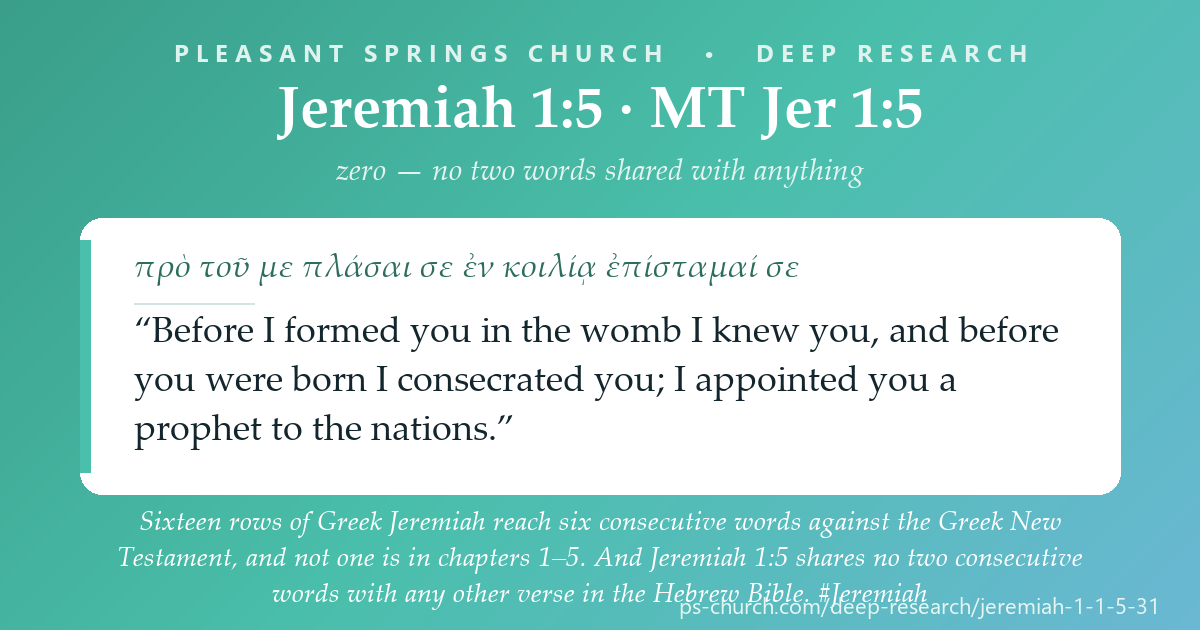
Before I formed you in the womb I knew you, and before you were born I consecrated you; I appointed you a prophet to the nations.
Screened against all 23,204 verse units of the Hebrew Bible, Jeremiah 1:5 comes back zero. No two of its words stand side by side anywhere else. Not in the psalms of formation, not in the servant songs, not in the other call narratives. The sentence Christians most often reach for when they want to say that God knew a person before there was a person is a sentence the rest of the Hebrew Bible does not know how to say.
This study closes the last dark chapters at the front of the book of Jeremiah on this shelf — 1–5, alongside the existing study at 31:31–34, the new covenant, which holds the two deepest verbatim runs in the whole book.
Every Deep Research page traces its passage across the whole sweep — the Old Testament, the Second-Temple world between the testaments (historical witnesses, not Scripture), and the New Testament. Follow the thread:
Pleasant Springs Church — Deep Research
Research method after Michael S. Heiser’s Bible Research Method (examine dictionaries → ancient literature → important words → textual connections → academic publications → share), with the Pleasant Springs “Author & Audience” foundation. Scripture set in the Hebrew, the Greek editions named on each page and the ESV (Old Testament), and the Greek New Testament and the ESV (New Testament), per the practice of Pleasant Springs Church. Jeremiah research grounded in Holladay (Hermeneia), Lundbom (Anchor Yale), Allen and Carroll (OTL). Text: Hebrew from the Masoretic text as printed in the edition consulted — Sefaria’s Miqra according to the Masorah; no critical apparatus was consulted for the Hebrew and no Qumran manuscript was consulted at all, which for Jeremiah is the largest single gap on this page and is named as such in stage 5. Greek from Rahlfs’ Septuaginta as digitized by CATSS; Greek New Testament from the SBL edition via MorphGNT. The standing caution for this shelf applies: these pages say “the CATSS Greek row reads…” and never call a Greek reading early or late. ⚠️ VERSE NUMBERING — no offset inside Jeremiah 1–5, one absent verse, and a book-wide warning. Derived from the files on this disk. Masoretic 19 / 37 / 25 / 31 / 31 = 143; CATSS 19 / 36 / 25 / 31 / 31 = 142; ESV 143 on the printed English chapter divisions and not from a file held here, because no ESV text of Jeremiah is on this disk. Every chapter and verse number agrees across all three columns except that Masoretic and English 2:1 has no CATSS row — verified label by label: the Greek chapter’s verses are numbered 2:2 through 2:37, so nothing downstream is displaced. Outside this passage Jeremiah is the hardest numbering problem in the Bible: over the whole book the measured shapes are Masoretic 1,364 verses and CATSS 1,298, with 34 of 52 chapters differing, because the Greek book places the Oracles Against the Nations in the middle rather than at the end and reorders the nations inside them. Four correspondences were verified here by content rather than copied from a table — Greek 38:31–34 = Hebrew 31:31–34, Greek 44:16 = Hebrew 37:16, Greek 45:6 = Hebrew 38:6, Greek 28:52 = Hebrew 51:52 — and nothing else about the correspondence is asserted. ⚠️ The Greek measurement, in full. Greek against Greek. CATSS FORM column (cols 0–24), beta-code transliterated first; MorphGNT field 6, the normalised word — the column that already resolves elision and the movable nu. Both sides lowercased, accents and breathings dropped, final sigma folded, then filtered to Greek letters — the same filter applied to both corpora. Word forms, never lemmas. As of 30 August 2026 cross-corpus runs apply MorphGNT’s own spelling equivalences (ou / ouk / ouch, ek / ex, the movable nu), so figures here are higher than anything a page written before that date reports; nothing on this page was copied from a sibling page and every run was re-measured. Corpus: the 1,298 CATSS rows of Jeremiah — 142 of them in chapters 1–5 — against 7,927 verses across 27 MorphGNT files. Exhaustive and deterministic; nothing sampled, so no seed applies. ⚠️ The Greek Old Testament corpus, and why the Odes are held out. The shelf holds 64 CATSS files, 30,637 verse units; a run screen sees 30,348, because the Odes are excluded. Ode 9 is Luke 1 and Ode 13 is Luke 2, copied into a Greek Old Testament manuscript, and ten more Odes are second copies of Exodus 15, Deuteronomy 32, 1 Samuel 2, Habakkuk 3, Isaiah 26, Jonah 2, Daniel 3, Isaiah 5 and Isaiah 38. No Ode duplicates anything in Jeremiah, so the exclusion changes no figure on this page — the screened number is quoted because it is the number the screen actually saw. ⚠️ What a zero means here. The Hebrew-side screen runs with unigram_fallback=False, so 0 means “shares no two consecutive words with any other verse” and not “shares no words”. Nine verses of this passage return 0, and Jeremiah 1:5 is one of them. ⚠️ One figure on this page is partly an artefact and is corrected in stage 5. The Masoretic edition prints the section markers {ס} and {פ} in the text stream and the bare letter survives tokenisation. The raw run between Jeremiah 5:29 and Jeremiah 9:8 is 10 tokens; nine are words and the tenth is a samekh, so the page prints 9. The run between Jeremiah 4:4 and 21:12 is 10 words with no marker involved. ⚠️ Direction of influence is never asserted. Nothing here says that Mark 8:18 read the Greek column or the Hebrew of Jeremiah 5:21; that Revelation 6:15 has Jeremiah 4:29 or Isaiah 2:19 in view, or either; that Mark 10:5 is nearer Jeremiah 4:4 than Deuteronomy 10:16; which of the two editions of Jeremiah is earlier; or what produced any column difference — the missing verse at 2:1, the missing sixth verb at 1:10, ἡ κατοικία at 3:6, the leaders at 4:22, or τὸ ῥῆμα τοῦ θεοῦ at 1:1. Typology is handled per the house position: what the text says, what the New Testament itself draws, and what we see from this side of the cross — with the seeing left to the reader.
Scripture quotations marked ESV are from the ESV® Bible (The Holy Bible, English Standard Version®), © 2001 by Crossway, a publishing ministry of Good News Publishers. ESV Text Edition: 2016. Used by permission. All rights reserved. The ESV text may not be quoted in any publication made available to the public by a Creative Commons license, and the ESV may not be translated in whole or in part into any other language. www.esv.org
|
Did this study bless you today? 💚 Give to Support PS Church100% of gifts go to the General Fund — thank you. |