It did not begin with a weapon but with a question: “Did God actually say?” A crafty creature in a perfect garden set out to make the woman doubt God’s word, then deny its consequence, then distrust God’s heart — and the whole race fell for a lie about a piece of fruit. This study works the anatomy of the first temptation, and follows the serpent from Eden to the moment the Lamb crushes “that ancient serpent” for good. See the method →
Genesis 3:1–7
Hebrew · LXX · ESVThe Shape of the Passage
Parallel panelsSame Author and audience as Genesis 1:1 — and the story now turns on its darkest hinge: how good creatures in a good garden came to grief.
Author
The Torah of Moses introduces the tempter with careful restraint: the serpent is “a beast of the field that the Lord God had made” (3:1) — a creature, not a rival deity. His weapon is not force but a question: “Did God actually say?” The attack is on God’s word and God’s goodness — first twisting the command (“any tree”), then flatly denying its consequence, then impugning God’s motive (“God knows…”).
The anatomy of the fall. Doubt (“did God say?”) → denial (“you will not die”) → a promise of autonomy (“you will be like God”). The woman “saw… took… ate… gave” — and the man, “with her” (v.6), ate too. The reach for godlikeness apart from God ends not in enlightenment but in shame and hiding.
Audience
Israel — a covenant people whose own story would repeat this pattern: given a good land and a clear word, tempted to doubt God’s goodness and seize what he had not given. Genesis 3 is the template for every later fall, from the golden calf to the exile.
How they heard it — and how the canon reads the serpent. Within Genesis, the serpent is simply the craftiest creature; the text does not name him. But Scripture itself later unmasks him: he is “that ancient serpent, who is the devil and Satan” (Rev 12:9; 20:2), the liar “from the beginning” (John 8:44). Second-Temple Judaism had already made the link (Wisdom 2:24). So the crafty snake of Eden is the enemy Revelation later pictures as the great dragon (Rev 12:9) — and the whole Bible is the story of his defeat.
Orient on the serpent, temptation, and the fall.
Search by topic: serpent, Satan/devil, temptation, sin, the fall, knowledge of good and evil.
Which articles are relevant?
- Anchor Bible Dictionary — “Serpent,” “Satan,” “Fall, The,” “Sin (OT).”
- Dictionary of Deities and Demons in the Bible (DDD) — “Serpent,” “Satan,” “Devil.”
- Dictionary of the OT: Pentateuch — “Fall,” “Temptation,” “Sin.”
Bibliography surfaced:
- Wenham, Genesis 1–15 (WBC); Sarna, Genesis (JPS); Hamilton (NICOT).
- Henri Blocher, Original Sin: Illuminating the Riddle; and In the Beginning.
- James Charlesworth, The Good and Evil Serpent — the serpent’s ancient symbolism.
The serpent of wisdom and immortality — and the enemy the canon unmasks.
Compare the ANE serpent symbolism, then follow the Second-Temple identification of Eden’s serpent with the devil.
Which parallels shed light on religion and worldview?
The ancient serpent. Across the ANE the serpent symbolized wisdom, immortality, and chaos at once. In Gilgamesh, a serpent steals the plant of life, robbing humanity of immortality — the reverse of Eden, where the serpent talks humanity out of the life it had. The snake was also a cult symbol of forbidden divination and healing. Genesis engages this loaded figure and strips it of mystique: the serpent is a creature, and its promise is a lie.
- Epic of Gilgamesh XI — the serpent that seizes the plant of life: the ancient link of snake and lost immortality.
- Wisdom of Solomon 2:24 (Apocrypha/Deuterocanon — a valued witness, not Scripture) — “through the devil’s envy death entered the world”: an early — and the standard — reading that links death’s entry, and Eden’s serpent, to the devil.
- Life of Adam and Eve / Apocalypse of Moses (Pseudepigrapha — likewise not Scripture) — expands the fall with Satan using the serpent as his instrument; an influential Second-Temple retelling.
- Sirach 25:24 (Apocrypha) — “from a woman sin began, and because of her we all die”: an early “blame Eve” reading — which the New Testament pointedly does not follow, laying the trespass on Adam (Rom 5:12–19).
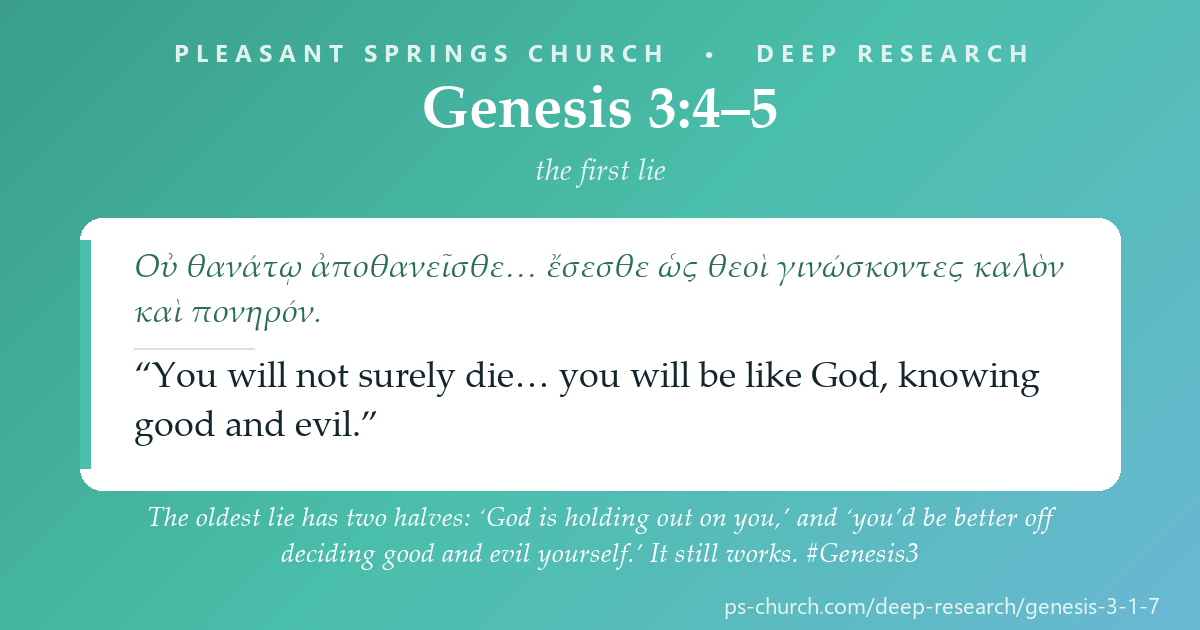
Genesis names no devil; it simply reports a crafty snake. But the Bible read as one book identifies him: Revelation calls Satan “that ancient serpent” (12:9; 20:2) — the very phrase (ὁ ὄφις ὁ ἀρχαῖος) reaching back to Eden. And in the Bible’s later imagery the serpent of the garden and the dragon merge into a single foe: “the great dragon… that ancient serpent” (Rev 12:9). The lie told in Eden — “you will not surely die… you will be like God” — is the same lie he has told ever since, and the same one the last Adam refused in his own wilderness temptation (Matt 4).
The vocabulary of the first lie.
Watch the crafty/naked pun, the weaponized question, and the exact inversion of God’s command.
“Serpent” (LXX ὄφις) — in Genesis, a crafty “beast of the field”; in the canon’s own reading, “that ancient serpent… the devil” (Rev 12:9).
“Crafty, shrewd” — a pun on “naked” (עֲרוּמִּים, 2:25). Shrewdness itself is neutral (Prov 22:3); here it is bent to deceive.
“Did God actually / really say?” — the first weaponized question. The tempter’s method is not brute denial but insinuated doubt about God’s word.
“You will not surely die” — a direct, point-for-point inversion of God’s “you shall surely die” (2:17): the negation לֹא laid over the very words of the command.
“Like God” (or “like gods/divine beings”) — the bait: autonomy, self-defined good and evil, godlikeness seized rather than received. The oldest temptation.
“They knew that they were naked” — the promised “opened eyes” delivers not glory but shame; the first fruit of the knowledge is hiding.
How the New Testament reuses the serpent and the fall:
- Revelation 12:9; 20:2 — “that ancient serpent, who is called the devil and Satan”: the canon’s own identification of Eden’s snake, merged with the dragon.
- Romans 5:12–19; 1 Corinthians 15:21–22 — sin and death entering “through one man”: Paul reads Genesis 3 as the fall of the race, undone by the last Adam.
- 2 Corinthians 11:3; 1 Timothy 2:14 — “the serpent deceived Eve by his cunning”: the deception as a live warning to the church.
- John 8:44 — the devil “a murderer from the beginning… a liar and the father of lies”: Jesus traces every lie back to Genesis 3.
The lie in Eden, and its undoing.
Trace the serpent through the canon — from crafty creature to unmasked devil to crushed enemy — and note the Beale & Carson trajectory at Revelation.
Which cross-references matter?
- Genesis 3:15 — the first gospel promise, the seed of the woman crushing the serpent’s head (the next passage in this series).
- Job 1–2; Zechariah 3:1–2 — “the satan” (the accuser) in the heavenly court: the OT’s developing portrait of the adversary.
- Matthew 4:1–11 — the last Adam meets the tempter’s “did God say” with “it is written,” and refuses the shortcut to glory: Eden reversed in the wilderness.
- Romans 16:20 — “the God of peace will soon crush Satan under your feet”: Genesis 3:15 applied to the church.
- Revelation 12:9–10; 20:2, 10 — the ancient serpent thrown down, bound, and destroyed: the lie’s final answer.
The Beale–Carson Commentary’s Revelation chapters trace John’s “ancient serpent” directly to Genesis 3, showing that Revelation reads the whole Bible as the conflict begun in Eden and won at the cross. The crafty creature who asked “did God say?” is the dragon the Lamb defeats — and the believer’s assurance is that the serpent’s head is already, in principle, crushed (Rom 16:20; Heb 2:14).
The scholarship on the serpent and the fall.
Blocher on original sin; Charlesworth on the serpent; the commentaries for the exegesis of the temptation.
Commentaries & studies:
- Henri Blocher, Original Sin: Illuminating the Riddle; Wenham (WBC), Hamilton (NICOT), von Rad, Westermann.
- James Charlesworth, The Good and Evil Serpent — the serpent’s symbolism across the ancient world.
- On the NT reception: N. T. Wright and others on Adam Christology (Rom 5; 1 Cor 15).
Interpretation notes worth keeping:
- Genesis names no devil — the identification of the serpent with Satan is the canon’s own later reading (Wis 2:24; Rev 12:9), not an imposition on the Hebrew text. Both facts should be held: the restraint of Genesis, and the clarity of the whole Bible.
- “Like God” / “like gods” (כֵּאלֹהִים) — the phrase can be read either way; the temptation is godlikeness-on-my-own-terms, autonomy in defining good and evil.
- “With her” (v.6) — the man was present and silent; Scripture lays the primary responsibility on Adam (Rom 5), correcting the “blame Eve” reading of Sirach 25:24.
From the first lie to today’s temptations.
Name what you learned, why it matters, and one concrete response.
What should we carry away — and do?
- Temptation begins with ‘Did God say?’ The first attack is on the reliability and goodness of God’s word. Knowing what God actually said — and that he is good — is the first defense (Matt 4).
- The oldest lie is autonomy. “You will be like God, deciding good and evil for yourself.” Every sin since is a variation: seizing what God meant to give, on our own terms.
- The serpent is already sentenced. The crafty snake of Eden is the dragon the Lamb defeats. We resist a defeated enemy — “the God of peace will soon crush Satan under your feet” (Rom 16:20).
Step in response: when a “did God really say?” whispers this week — about a command, or about God’s goodness — answer it out loud with what God actually said, as Jesus did: “It is written.”
Genesis 3:4–5 · to share
LXX + ESVEvery Deep Research page traces its passage across the whole sweep — the Old Testament, the Second-Temple world between the testaments (historical witnesses, not Scripture), and the New Testament. Follow the thread:
Pleasant Springs Church — Deep Research
Research method after Michael S. Heiser’s Bible Research Method (examine dictionaries → ancient literature → important words → textual connections → academic publications → share), with the Pleasant Springs “Author & Audience” foundation. Scripture set in the Hebrew, the Greek editions named on each page and the ESV (Old Testament), and the Greek New Testament and the ESV (New Testament), per the practice of Pleasant Springs Church. Genesis 3:1–7 research grounded in Blocher, Charlesworth, Wenham, Hamilton, and von Rad; ancient serpent symbolism per Gilgamesh; Second-Temple readings per Wisdom 2:24 and the Life of Adam and Eve (read as witnesses, not Scripture).
Scripture quotations marked ESV are from the ESV® Bible (The Holy Bible, English Standard Version®), © 2001 by Crossway, a publishing ministry of Good News Publishers. ESV Text Edition: 2016. Used by permission. All rights reserved. The ESV text may not be quoted in any publication made available to the public by a Creative Commons license, and the ESV may not be translated in whole or in part into any other language. www.esv.org
|
Did this study bless you today? 💚 Give to Support PS Church100% of gifts go to the General Fund — thank you. |