After a whole chapter of “good,” God says the first “not good” in the Bible — and it is about being alone. What follows is the tenderest scene in Scripture’s opening: a deep sleep, a woman built from the man’s own side, and his first recorded words — a poem of recognition. This study works the making of the woman and the “one flesh” charter from Eden to the marriage of the Lamb. See the method →
Genesis 2:18–25 (selections)
Hebrew · LXX · ESVThe Shape of the Passage
Parallel panelsSame Author and audience as Genesis 1:1 — and the garden narrative now reaches the one thing in creation God calls not good: aloneness.
Author
The Torah of Moses lands its first negative verdict: after a chapter of “good… good… very good,” God says “not good” — of solitude. The remedy is not a servant or a subordinate but a helper fit for him (עֵזֶר כְּנֶגְדּוֹ), a counterpart who stands face-to-face. God builds her not from the dust again but from the man’s own side, so that the sexes are one substance — and the man’s first recorded words are a poem of recognition.
“Bone of my bones.” The wordplay אִישׁ / אִשָּׁה (ish / ishshah, man/woman) marks them as a matched pair. Verse 24 then steps outside the story to state the enduring pattern — leave, hold fast, one flesh — the Bible’s charter for marriage.
Audience
Israel — in a world where a wife was often property and marriage a transaction. Genesis grounds marriage instead in shared nature and mutual belonging: same bone, same flesh, a helper who corresponds. The woman is neither the man’s subordinate species nor his possession but his equal counterpart, taken from his side.
How they heard it. “Naked and not ashamed” describes a world before the fall: total openness without fear, intimacy without hiding. It is the last note of Eden’s innocence — and the deliberate set-up for the shame that floods in the very next scene, when the “crafty” serpent turns the “naked” pair against their Maker.
Orient on marriage, the helper, and one flesh.
Search by topic: marriage, woman, helper (ezer), family, one flesh.
Which articles are relevant?
- Anchor Bible Dictionary — “Marriage,” “Woman,” “Family,” “Adam and Eve.”
- Dictionary of the OT: Pentateuch — “Marriage,” “Woman,” “Image of God.”
- NIDOTTE / TDOT — עֵזֶר (ʿēzer), צֵלָע (ṣēlāʿ), דָּבַק (dāḇaq), בָּשָׂר (bāśār).
Bibliography surfaced:
- Wenham, Genesis 1–15 (WBC); Sarna, Genesis (JPS); Victor Hamilton, Genesis 1–17 (NICOT).
- Richard Davidson, Flame of Yahweh: Sexuality in the Old Testament — the fullest study of Genesis 2 on marriage.
- Christopher Ash, Marriage: Sex in the Service of God.
The creation of woman and the covenant of “one flesh.”
Compare the ANE views of woman and marriage, then follow “one flesh” into the Second-Temple wedding tradition.
Which parallels shed light on religion and worldview?
A different dignity. The ANE creation myths that make humanity at all (e.g. Atrahasis) make an undifferentiated labor-force; none offers a tender account of the woman formed from the man’s side and greeted as an equal “bone of my bones.” Genesis is distinctive precisely here: marriage as covenant partnership rooted in shared nature, not a property arrangement.
- Tobit 8:6 (Apocrypha/Deuterocanon — a valued witness, not Scripture) — Tobias prays on his wedding night: “You made Adam, and for him you made his wife Eve as a helper… from the two of them the human race has sprung” — Genesis 2:18 in a Second-Temple marriage liturgy.
- Jubilees 3:1–7 (Pseudepigrapha — likewise not Scripture) — retells the making of Eve and dates it, weaving the scene into the book’s calendar and purity concerns.
- Sirach 36:24–27 (Apocrypha) — “he who acquires a wife gets his best possession, a helper fit for him” — echoing עֵזֶר כְּנֶגְדּוֹ.
- Malachi 2:14–15 — marriage as covenant, “the wife of your covenant… did he not make them one?” — Genesis 2 read against divorce.
The word עֵזֶר (“helper”) carries no hint of inferiority — it is used most often in the OT of God himself as Israel’s help (Ps 33:20; 121:2). Paired with כְּנֶגְדּוֹ (“corresponding to him,” a matching counterpart), it describes a strong ally who stands face-to-face, not beneath. Genesis’ vision of the woman is neither ancient servility nor modern autonomy but covenant partnership — two equals of one flesh. (Genesis 2 establishes the woman’s equal worth and mutual belonging; the distinct question of roles within marriage is weighed from other texts.)
The vocabulary of counterpart and covenant.
Watch the first “not good,” the God-strength of עֵזֶר, the covenant-cling of דָּבַק, and the LXX’s “the two.”
“Not good” — the first negative verdict in the Bible, and it falls on solitude. Humanity is made for communion, not isolation.
“A helper fit for him” — a strong counterpart who corresponds. עֵזֶר is used of God as Israel’s help; no inferiority implied.
“Side / rib” — elsewhere the “side” of the tabernacle/ark (Exod 25–27). Woman is built (בָּנָה) from the man’s own side: same substance, made face-to-face.
“Man / woman” — the sound-play seals their correspondence: taken from ish, she is ishshah, matched bone and flesh.
“Hold fast / cleave” — covenant-loyalty language (used of clinging to the Lord, Deut 10:20). Marriage is a bond of steadfast attachment.
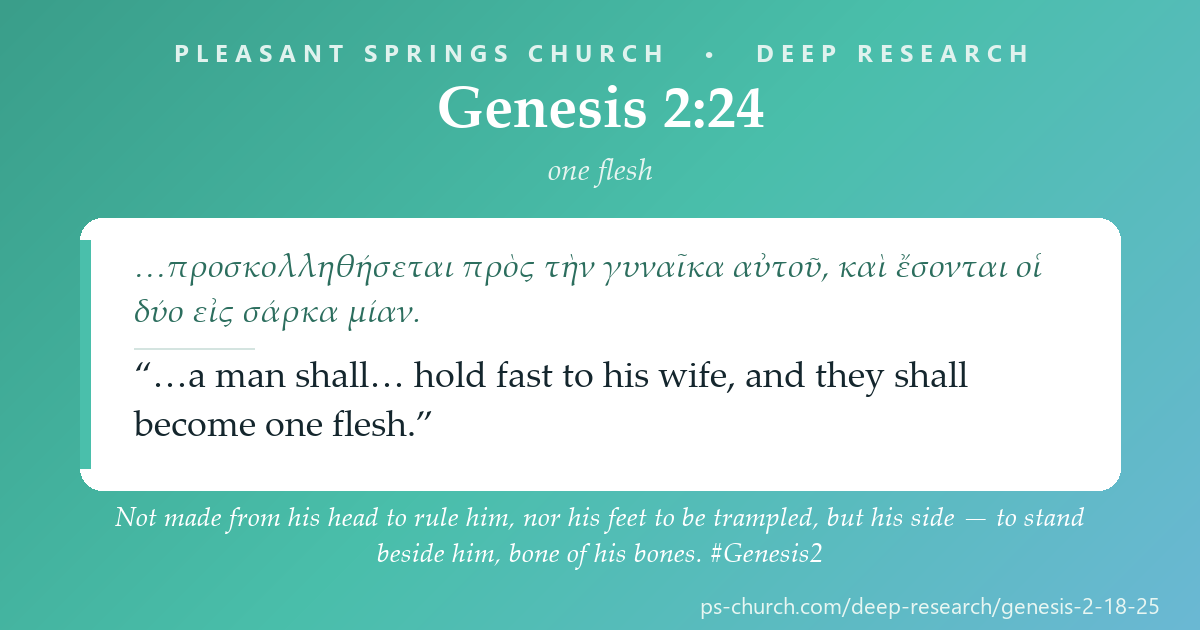
“One flesh” — a new kinship, not merely a union of bodies. LXX adds “the two” (οἱ δύο), the form the NT quotes.
How the New Testament reuses Genesis 2:24:
- Matthew 19:4–6 // Mark 10:6–8 — Jesus fuses Genesis 1:27 and 2:24 to teach the permanence of marriage: “what therefore God has joined together, let not man separate.”
- Ephesians 5:31–32 — Paul quotes 2:24 and calls it a “great mystery” — one flesh as an icon of Christ and the church.
- 1 Corinthians 6:16 — “the two will become one flesh” grounds Paul’s ethic of the body: union is never merely physical.
- Revelation 19:7–9; 21:2 — the marriage of the Lamb: history ends at a wedding, the pattern set in Eden fulfilled in the city.
From the first marriage to the marriage of the Lamb.
Trace “one flesh” through the covenant texts and into the New Testament’s marriage theology — then note Beale & Carson at Ephesians 5.
Which cross-references matter?
- Genesis 1:27–28 — male and female, blessed to be fruitful: the image-bearers whose union ch. 2 details.
- Malachi 2:14–16; Proverbs 5:15–19; Song of Songs — marriage as covenant, faithfulness, and delight, all rooted in Eden’s “one flesh.”
- Matthew 19:4–6; Mark 10:6–9 — Jesus’ charter for marriage, quoting Genesis 1 and 2 as a single word from “the beginning.”
- Ephesians 5:22–33 — the one-flesh union as the living parable of Christ and the church — the “great mystery.”
- Revelation 21:2, 9; 22:17 — the Bride, the city, the Spirit and the Bride saying “Come”: Eden’s wedding consummated at the end.
The commentary’s Ephesians treatment shows Paul reading Genesis 2:24 typologically: the one-flesh union was, from the beginning, a mystery pointing beyond itself to Christ and the church. Marriage is thus not merely a creation ordinance but a living sign — which is why the Bible that opens with a wedding in a garden (Gen 2) closes with a wedding in a city (Rev 21). Human marriage is the rehearsal; the union of Christ and his people is the play.
The scholarship on Genesis 2 and marriage.
Davidson and Ash for the theology of marriage; the commentaries for the exegesis of ezer and one flesh.
Commentaries & studies:
- Richard Davidson, Flame of Yahweh; Christopher Ash, Marriage: Sex in the Service of God.
- Wenham (WBC), Hamilton (NICOT), Sarna (JPS), von Rad, Westermann.
- R. D. Freedman, “Woman, a Power Equal to Man” (on עֵזֶר כְּנֶגְדּוֹ).
Interpretation notes worth keeping:
- “Helper” (עֵזֶר) connotes no rank; most OT uses refer to God’s help. With כְּנֶגְדּוֹ (“corresponding”) it means a matching counterpart — the exegetical key against reading inferiority into v.18.
- “Rib” or “side”? צֵלָע normally means “side” (as of the tabernacle); the point is shared substance and equal standing, not a spare part.
- Verse 24 is narrator commentary (“therefore…”) drawing the abiding pattern from the first marriage — which is exactly how Jesus uses it (Matt 19).
From the first marriage to your own relationships.
Name what you learned, why it matters, and one concrete response.
What should we carry away — and do?
- Aloneness was the first ‘not good.’ We are made for communion — in marriage for many, and in the body of Christ for all. Isolation is not the design.
- Helper is no badge of inferiority. The word Genesis uses for the woman is most often used of God’s own help to Israel (Ps 33:20; 121:2) — a strong counterpart, not a servant. Partnership, face-to-face, is the biblical picture.
- Marriage is a sign. One flesh is a “great mystery” pointing to Christ and the church (Eph 5:32). Every faithful marriage preaches a gospel bigger than itself.
Step in response: take one concrete step against isolation this week — toward a spouse, a friend, the church family — and, if married, honor the covenant “cling” (דָּבַק) in one deliberate act of faithfulness. We were not made to be alone.
Genesis 2:24 · to share
LXX + ESVEvery Deep Research page traces its passage across the whole sweep — the Old Testament, the Second-Temple world between the testaments (historical witnesses, not Scripture), and the New Testament. Follow the thread:
Pleasant Springs Church — Deep Research
Research method after Michael S. Heiser’s Bible Research Method (examine dictionaries → ancient literature → important words → textual connections → academic publications → share), with the Pleasant Springs “Author & Audience” foundation. Scripture set in the Hebrew, the Greek editions named on each page and the ESV (Old Testament), and the Greek New Testament and the ESV (New Testament), per the practice of Pleasant Springs Church. Genesis 2:18–25 research grounded in Davidson, Ash, Wenham, Hamilton, and Sarna; Second-Temple marriage material per Tobit 8, Sirach 36, and Jubilees 3 (read as witnesses, not Scripture).
Scripture quotations marked ESV are from the ESV® Bible (The Holy Bible, English Standard Version®), © 2001 by Crossway, a publishing ministry of Good News Publishers. ESV Text Edition: 2016. Used by permission. All rights reserved. The ESV text may not be quoted in any publication made available to the public by a Creative Commons license, and the ESV may not be translated in whole or in part into any other language. www.esv.org
|
Did this study bless you today? 💚 Give to Support PS Church100% of gifts go to the General Fund — thank you. |