There is no such thing as the Greek of Tobit. Two Greek texts of this book survive, they are held here in full, and they are not a text and its variants — they are two books' worth of Greek behind the same story. One runs to 248 verses and 5,503 words; the other to 232 verses and 7,233. They share 230 verse labels, and across those 230 they are identical, word for word, in three. At one verse they share no word at all. So every line on this page names which Greek it is quoting — because until this study was built, the shelf's own loader could not tell them apart, and would have printed one recension's numbers under the other's name without a murmur. What follows is a fourteen-chapter story about a man who buries the dead at night and goes blind for it, his son, a fish, a demon, a dog, and an angel who has been in the room the whole time. It is not Scripture for us: it is filed with the Apocrypha, and nothing taught here rests on it. There is no Masoretic Tobit on this disk, and the page says plainly what that costs. See the method →
Tobit is a Second-Temple Jewish novella, usually dated to the third or early second century BC and set some five centuries earlier among the deportees of the northern kingdom at Nineveh. It is canonical in the Roman Catholic and Orthodox churches, was printed among the Apocrypha in the Protestant Bibles of the Reformation era, and is absent from the Hebrew Bible. It is not Scripture for us. We read it the way we read the ancient Near Eastern texts and the other Second-Temple books — as a window into the world the New Testament was written in, and one of the clearest we have into how ordinary Jewish piety sounded in the centuries between the Testaments: prayer, fasting, alms, burial of the dead, marriage within the kindred, and a fierce confidence that heaven is listening. We read it critically, gratefully for the light it throws, and we test everything by the canon.
⚠️ What this page can and cannot measure — read this first.
HELD: both Greek recensions in full (CATSS TobitBA.mlxx, 248 rows, and TobitS.mlxx, 232 rows, both labelled 1:1–14:15, every label parsing); the Greek New Testament (7,927 verses); the Clementine Vulgate’s Tobit (298 rows, 1:1–14:17); the KJV Apocrypha’s Tobit (1769 standard text, public domain, 244 verses).
NOT HELD, AND NOT OBTAINABLE: a Masoretic Tobit — Tobit is not a book of the Tanakh, and the Masoretic corpus on this disk has 39 books and no Apocrypha. The Old Latin — not held.
HELD, BUT NOT MEASURED ON THIS PAGE: a Qumran Tobit — the Abegg/ETCBC Dead Sea Scrolls transcription (CC BY-NC 4.0), on this disk since 9 October 2026, carries all five of the Aramaic and Hebrew fragments (4Q196–200). Nothing on this page compares them with either Greek recension.
CONSEQUENCE: every Hebrew-side screen this shelf owns — the acrostic screen, the Masoretic parallel screen — cannot be run on Tobit at all, and any claim on this page about a Semitic original behind the Greek is reported from outside scholarship and labelled as such, never measured here.
Tobit — seven labels, in both Greek recensions
Greek: Tobit (BA) and Tobit (S), named on every line · English: KJV Apocrypha (1769 standard text, public domain) · Latin: Clementine VulgateTobit (S) ἐγὼ Τωβιθ ὁδοῖς ἀληθείας ἐπορευόμην καὶ ἐν δικαιοσύναις πάσας τὰς ἡμέρας τῆς ζωῆς μου καὶ ἐλεημοσύνας πολλὰς ἐποίησα τοῖς ἀδελφοῖς μου καὶ τῷ ἔθνει μου τοῖς πορευθεῖσιν μετ' ἐμοῦ ἐν τῇ αἰχμαλωσίᾳ εἰς τὴν χώραν τῶν Ἀσσυρίων εἰς Νινευη1:3KJV 1:3 “I Tobit have walked all the days of my life in the ways of truth and justice, and I did many almsdeeds to my brethren, and my nation, who came with me to Nineve, into the land of the Assyrians.”
The hero’s name is not the same in the two Greek files: BA writes Τωβιτ, S writes Τωβιθ, and the Latin calls him Tobias. And the Greek says I; the Latin says he.
VULGATE 1:2–3 cum captus esset in diebus Salmanasar regis Assyriorum, in captivitate tamen positus, viam veritatis non deseruit, ita ut omnia quæ habere poterat, quotidie concaptivis fratribus, qui erant ex ejus genere, impertiret.
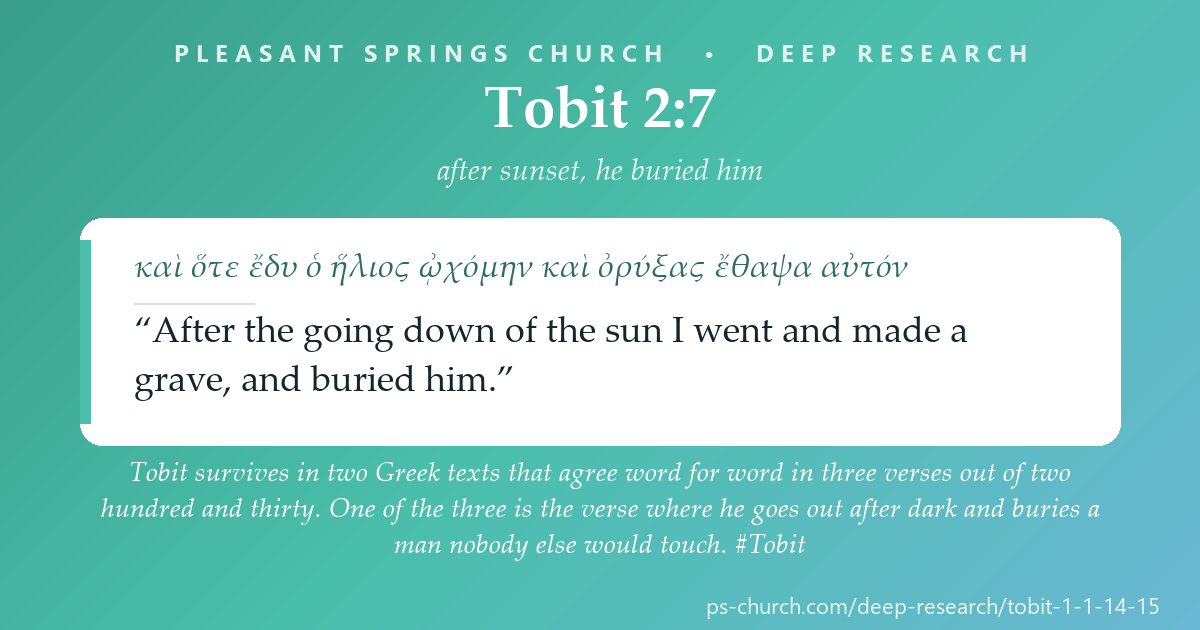
Tobit (S) καὶ ὅτε ἔδυ ὁ ἥλιος ᾠχόμην καὶ ὀρύξας ἔθαψα αὐτόν2:7KJV 2:7 “Therefore I wept: and after the going down of the sun I went and made a grave, and buried him.”
One of only THREE verses in the whole book where the two Greek texts are identical word for word — and it is the burying of a dead man after dark. The English 2:7 opens Therefore I wept, which both Greek texts have at the end of 2:6 (καὶ ἔκλαυσα).
VULGATE 2:7 Cum vero sol occubuisset, abiit, et sepelivit eum.
Tobit (S) — no row at this label in the S file —4:15KJV 4:15 “Do that to no man which thou hatest: drink not wine to make thee drunken: neither let drunkenness go with thee in thy journey.”
Tobit’s negative form of the golden rule — and the S file has no row here at all. Its chapter 4 runs 4:1–4:7 and then jumps to 4:19. The Latin has the saying one verse later, at 4:16.
VULGATE 4:16 Quod ab alio oderis fieri tibi, vide ne tu aliquando alteri facias.
Tobit (S) καὶ ὅτε εἰσῆλθεν εἰς Μηδίαν καὶ ἤδη ἤγγιζεν εἰς Ἐκβάτανα6:10KJV 6:9 “And when they were come near to Rages,”
The one label in the book where the two Greek texts share NOT ONE WORD. BA has them nearing Rages; S has them entering Media and nearing Ecbatana. The English sentence that matches BA 6:10 is numbered 6:9 in the KJV — its chapter 6 has 17 verses where BA has 19, and its 6:10 (the angel proposing to lodge with Raguel) is BA’s 6:11. The Latin printed is the Vulgate’s own 6:10, a different sentence again: Tobias asking where they should stay.
VULGATE 6:10 Et dixit ei Tobias : Ubi vis ut maneamus ?
Tobit (S) καὶ ἔπεσεν ἐπὶ τὸν τράχηλον αὐτοῦ καὶ ἔκλαυσεν καὶ εἶπεν αὐτῷ εἶδόν σε τέκνον τὸ φῶς τῶν ὀφθαλμῶν μου11:13KJV 11:13 “And the whiteness pilled away from the corners of his eyes: and when he saw his son, he fell upon his neck.”
One prefix, and the measured number changes. BA reads ἐπέπεσεν, S reads ἔπεσεν. Against Luke 15:20 that is a run of six in BA and five in S. The Latin’s own 11:13 is a different sentence altogether: Tobias anointing his father’s eyes with the gall. And the English divides differently again: its 11:13 opens with the whiteness peeling from his eyes, which BA has at the end of 11:12, and it has And he wept, and said at 11:14.
VULGATE 11:13 Tunc sumens Tobias de felle piscis, linivit oculos patris sui.
Tobit (S) ἐγώ εἰμι Ραφαηλ εἷς τῶν ἑπτὰ ἀγγέλων οἳ παρεστήκασιν καὶ εἰσπορεύονται ἐνώπιον τῆς δόξης κυρίου12:15KJV 12:15 “I am Raphael, one of the seven holy angels, which present the prayers of the saints, and which go in and out before the glory of the Holy One.”
Three witnesses, three jobs for the seven. BA: they bring up the prayers of the holy ones. S: they stand by. The Latin: we stand before the Lord. Chapter 12 is the only chapter of fourteen where the Latin and BA agree on the verse count.
VULGATE 12:15 Ego enim sum Raphaël angelus, unus ex septem qui adstamus ante Dominum.
Tobit (S) καὶ εὐφράναι ἐν σοὶ πάντας τοὺς αἰχμαλώτους καὶ ἀγαπήσαι ἐν σοὶ πάντας τοὺς ταλαιπώρους εἰς πάσας τὰς γενεὰς τοῦ αἰῶνος13:12KJV 13:10 “…and let him make joyful there in thee those that are captives, and love in thee for ever those that are miserable.”
The English verse for this Greek row is numbered 13:10, not 13:12 — the two run two apart through the middle of the hymn, although both chapters end at verse 18. The bolded six words stand in Tobit and in one New Testament verse, Ephesians 3:21, and in no other unit screened: see Stage 4.
VULGATE 13:12 Confitere Domino in bonis tuis,/ et benedic Deum sæculorum :/ ut reædificet in te tabernaculum suum,/ et revocet ad te omnes captivos,/ et gaudeas in omnia sæcula sæculorum./
⚠️ Across those 230 shared labels, the two are word-for-word identical in THREE. They are 2:7, 5:19 and 11:6. The median longest verbatim run between the two recensions at the same verse label is five words. At one label — 6:10 — they share no word at all.
So this page names the recension on every line, and so should anything built on it. Until this study was built, the shelf’s own loader could not tell them apart: asked for “Tobit” it returned both files concatenated, 480 rows, and the first thing any caller did with that — put it in a dictionary — silently discarded one recension at every one of the 230 shared labels. That is fixed, and Stage 5 says exactly what it cost.
On the columns. The Greek is the CATSS morphological Septuagint, quoted at verse level with attribution, as on every page of this shelf. The English is the KJV Apocrypha (1769 standard text, public domain) — the verse-per-line edition published by eBible.org and held on this disk — quoted verbatim and checked character for character against that file. It is the only English this shelf prints for these books, and it is quotation, not a parallel measured against the Greek. Italic English in the prose that is not labelled KJV is this page’s own literal gloss of the Greek beside it (Tobit or New Testament), not a quotation of any published translation. The Latin is the Clementine Vulgate’s Tobit (traditionally Jerome’s translation), a third text again and not a check on either Greek one.
Versification — stated, as on every page here, including where the usual frame does not exist.
There is no Masoretic/Septuagint offset to report for Tobit, because there is no Masoretic Tobit. The versification table this shelf maintains has no entry for this book — not “verified,” not “provisional,” simply no entry — and the page will not manufacture one.
The offsets that DO exist for Tobit are between witnesses, and there are four of them:
• BA against S. Both files label 1:1–14:15 and every label parses. They share 230 labels. BA has 18 labels S has not (4:8–18, 13:8–10, 9:3, 9:4, 14:8, 14:9); S prints two pairs as single conflated labels (9:3-4 and 14:8-9). Verse counts per chapter agree in ten of fourteen chapters.
• BA against the English printed here (KJV Apocrypha, 1769 standard text). Counts agree in ten of fourteen chapters — and differ in chapters 5 (23/22), 6 (19/17), 7 (17/18) and 10 (14/12). Agreement of count is not agreement of division: chapter 13 has 18 verses in both, Greek 13:12 is English 13:10, and Greek 6:10 is English 6:9; at 2:7 and 11:13 the English verse breaks fall in different places from the Greek.
• BA against the Latin. The Clementine Vulgate’s Tobit runs 1:1–14:17 in 298 verses and agrees with BA on the verse count in exactly one chapter of fourteen — chapter 12. Its golden rule stands at 4:16 where BA’s stands at 4:15.
• Shapes, counted (verses per chapter, 1–14): BA 22·14·17·21·23·19·17·21·6·14·19·22·18·15 (248); S 22·14·17·10·23·19·17·21·5·14·19·22·15·14 (232, the conflated 9:3-4 and 14:8-9 counted once each); KJV 22·14·17·21·22·17·18·21·6·12·19·22·18·15 (244); Vulgate 25·23·25·23·28·22·20·24·12·13·21·22·23·17 (298).
• And the Swete edition on this disk is a third Greek count again — 243 labels, neither 248 nor 232. It is not used here; see Stage 5.
Neither Greek file uses lettered or verse-only references: every label in both is a plain chapter:verse, S’s two conflations (9:3-4, 14:8-9) aside.
The Shape of the Passage
Inclusio (measured) around an out-and-back sequence⚠️ And the frame is weaker in S, which the page will not hide. In the S file the same counts are four, one and eight — the single middle occurrence standing at 7:6, and most of the difference at the front end being the eleven rows S lacks in chapter 4. The inclusio is a BA measurement.
This is NOT offered as a chiasm. The outward road and the homeward road really do mirror each other — same companion, same dog, the fish’s organs going out and coming back — and the two prayers of chapter 3 really are heard together (3:16) and answered in the second half, Sarah’s in chapter 8 and Tobit’s in chapter 11. But a there-and-back journey is the natural shape of a journey, and the page claims no more than the frame it can count.
⚠️ Where this page sits. Tobit is canonical in the Roman Catholic and Orthodox churches, printed among the Apocrypha in the older Protestant Bibles, and absent from the Hebrew Bible. This library treats it as a witness worth reading closely and files it under Apocrypha / Deuterocanon. Nothing taught at Pleasant Springs rests on it.
Author
Anonymous, and writing in a borrowed voice. The book opens in the first person — I, Tobit, walked in ways of truth — and keeps that voice through three chapters before sliding into third-person narration for the rest. The narrator is a deported Israelite of the eighth century BC; the book is not.
He knows his Torah by heart. Burial of the dead, tithes, endogamy, the feasts, the prohibition on eating the bread of Gentiles — the plot runs on the law, and the text names its authority only in general terms — as it is written (1:6, both), the law of Moses (BA 6:13, 7:13; S 1:8, 7:14), the book of Moses (S 6:13, 7:12, 7:13). The prophets he names outright — and the two Greek texts do not agree on which. Both name Amos at 2:6; at 14:4, on his deathbed, BA has him trust the word of Jonah and S has him trust the word of Nahum. Measured on the two files; the page does not adjudicate it.
And he is a storyteller before he is a moralist. The fish, the demon, the bridal chamber, the gall — and a dog, which joins the journey, comes home again, and is never once explained.
Audience
Jews living a long way from Jerusalem. Everything that matters in Tobit happens in Nineveh, Ecbatana and Rages. Jerusalem is a memory in chapter 1 and a hope in chapter 13, and in between the question is how to be faithful where nobody is watching and nothing is enforced.
People burying their dead in a hostile city. The act that defines Tobit is not prayer and not almsgiving but burial — he collects the bodies the king throws over the wall, and it costs him his property, his safety and eventually his sight. The audience is anyone for whom simple decency has become dangerous.
And two people who wanted to die. Chapter 3 gives a blind old man and a slandered young woman the same prayer, on the same day, in different cities. The book is built so that both are heard in the same sentence.
Orient on the book, on its two Greek forms, and on why the second one matters.
Search by topic: Tobit; Tobit recensions; Codex Sinaiticus Tobit; Raphael; Asmodeus; Ahiqar; Deuterocanon; Old Latin Tobit; 4Q196–200.
Which articles are relevant?
- Anchor Bible Dictionary — entries on Tobit, Ahiqar, Raphael, Asmodeus and the Old Testament Apocrypha.
- Eerdmans Dictionary of Early Judaism — entries on Tobit, angels, demons and almsgiving.
- Dictionary of New Testament Background (IVP) — entries on Tobit, the Apocrypha and Pseudepigrapha, and angels. These are subjects to look up; the exact entry titles were not checked, and none of these works is held on this disk.
- On the text — any article that distinguishes GI (the shorter form, Vaticanus and Alexandrinus — our BA) from GII (the longer form, chiefly Sinaiticus — our S). An article that speaks of ‘the Greek of Tobit’ without that distinction is not usable for this book.
Bibliography surfaced:
- Joseph A. Fitzmyer, Tobit (Commentaries on Early Jewish Literature, 2003).
- Carey A. Moore, Tobit (Anchor Bible).
- Robert J. Littman, Tobit: The Book of Tobit in Codex Sinaiticus — a commentary on S specifically.
- Stuart Weeks, Simon Gathercole and Loren Stuckenbruck, The Book of Tobit: Texts from the Principal Ancient and Medieval Traditions — the synopsis that lets the traditions be compared without merging them.
- NETS (the New English Translation of the Septuagint) — which, notably, prints two English Tobits, one for each recension. Not the edition quoted on this page; named because it is the obvious next step for a reader.
A folktale, a wisdom testament and a Jewish diaspora novella, in one book.
Tobit sits at the junction of three bodies of ancient material, and the page names all three rather than choosing one.
Which parallels shed light on the world of the text?
Ahiqar is inside the book. Tobit’s nephew Ahikar — vizier at Nineveh, betrayed by his adopted nephew (Nadab in S, Aman in BA) — is the hero of an Aramaic wisdom tale commonly dated well before Tobit, of which an Aramaic copy is reported from the Jewish colony at Elephantine (no Ahiqar text is held on this disk). Tobit does not retell it; it assumes you know it, and uses it for the moral of the last chapter.
The marriage plot is commonly compared with folktale. A bride whose bridegrooms die on the wedding night, a helper met on the road who turns out to be more than a man, and a monster driven off — commentators trace these motifs widely in ancient story-telling (none of those texts is held here). What Tobit does with them is the interesting part: the helper is an angel of the God of Israel, the remedy is obedience and prayer, and the wedding night ends with the couple praying instead.
And the ethics are testamentary. Chapter 4 is a father’s instruction given when he expects to die, a form commentators compare with other Second Temple testaments — honour your mother, marry within the kindred, pay a labourer the same day, give alms, and do to no one what you hate — most of it in BA only, since the S file has no rows at 4:8–18.
- The Story and Proverbs of Ahiqar (Elephantine Aramaic, 5th c. BC) → Tobit. Measured: BA names him seven times (1:21, 1:22×2, 2:10, 11:19, 14:10×2), spelled Achiacharos every time; S names him eight times (1:21, 1:22×2, 2:10, 11:19, 14:10×3) and spells him three ways — Achicharos, Achikar/Achikaros, and once Achiacharos. Both recensions carry the sub-plot, and they name him at the same five labels. (S’s 14:15 has an Achiacharos too, but he is the king of Media — another man.) Where they genuinely part is the villain: S names the treacherous nephew Nadab/Nabad five times (11:19, 14:10×4); BA at 14:10 calls him Haman (Αμαν), the name from Esther. Counting one spelling would have hidden all of this: searching only “Achiachar-” finds one of S’s eight, and the Median king.
- Deuteronomy 24:14–15 (the labourer’s wage, paid the same day) ↔ Tobit 4:14 (BA): the wage of any man who works for you shall not lodge with you — pay him on the spot. No citation formula stands in Tobit 4; the two are set side by side and no dependence is asserted.
- Amos 8:10 → Tobit 2:6, where both Greek texts name Amos: your feasts shall be turned into mourning.
- Jonah — or Nahum. At 14:4 the prophecy of Nineveh’s fall is credited to Jonah in the BA text and to Nahum in the S text, and BA names Jonah again at 14:8. Measured on the two files; the page does not decide which the author wrote.
- Genesis 24 (a servant sent to fetch a bride from the kindred) ↔ Tobit 5–7. A bride sought within the kindred, as in Genesis 24; Tobit itself grounds the marriage in ‘the law of Moses’ (BA 6:13, 7:13). A comparison, not a claim of dependence.
Measured here, on the two files: BA has 248 verse rows and 5,503 Greek words; S has 232 rows and 7,233 words. They share 230 labels. Over those shared labels BA runs 5,077 words and S runs 7,110 — S is 1.4× longer, verse for verse. S is the longer text at 169 of the 230, equal at 18, shorter at 43.
Measured here: they are word-for-word identical in three verses. 2:7, 5:19, 11:6. The median longest verbatim run between the two at the same label is five words, ten labels manage only one word, and 6:10 manages none. The deepest agreement in the book is at 6:15 — twenty-seven consecutive words.
Measured here: the S file has no rows at 4:8–4:18 or at 13:8–13:10. And — this is the important part — the rows at the edges of both gaps are stubs. S’s 4:7 carries 5 words where BA’s carries 41. S’s 4:19 carries 28 where BA’s carries 60. S’s 13:11 carries 9 where BA’s carries 19. A shorter recension does not usually stop a sentence in the middle; a gap in transmission — physical damage, or a copyist’s eye skipping — does.
Reported from outside scholarship, NOT measured here: the commonly reported account is that Codex Sinaiticus has two gaps in Tobit, at about 4:7–19 and 13:6–10, and that editions and translations fill them from other witnesses, the Old Latin among them. This disk does not hold the Old Latin, and this page has not measured the transcription of 4Q196–200 that it does hold, so the page does not check that account — it can only report that the shape of the local file is broadly what that account describes, though the S file does carry rows at 13:6 (33 words) and 13:7 (27 words), inside the 13:6–10 range that account gives; the S file’s own gap there is 13:8–10.
Also reported, not measured: the commonly held view that S preserves the older form and that the Aramaic and Hebrew fragments from Qumran stand closer to it. That judgement rests on evidence this page has not measured, and the page does not adopt it as a finding. It is named so that a reader knows the page is not quietly treating BA as primary because BA is shorter and tidier.
Alms, an angel with a name, a demon with a name — and six words that go somewhere.
Every count below is over the Greek Old Testament files held on this disk — 30,348 verse units screened of 30,637 held, the Odes excluded — and the 7,927 verses of the Greek New Testament. It is not a count over “the Septuagint”. Italic English renderings here are the page’s own literal glosses. The page says so each time.
The word group occurs 70 times across the 30,348 Greek Old Testament units screened here, and 33 of those 70 are in Tobit — twenty in BA and thirteen in S. That counts one book twice; BA alone carries 20 of the 57 occurrences outside S. Next after Tobit come Sirach (13) and Proverbs (7). In the Greek New Testament it occurs thirteen times, and in only two clusters: Matthew 6:2–4, and Luke–Acts — where it is what Tabitha did (Acts 9:36), what Cornelius did (10:2, 4, 31), and what Paul says he came to Jerusalem to bring (24:17).
Twenty-four occurrences across the Greek Old Testament units screened here. Twenty-three are in Tobit — nine in BA, fourteen in S. The twenty-fourth is 1 Chronicles 26:7, where Raphael is a gatekeeper, a man. For comparison, Michael stands 17 times in these files (six of them the angel, in the two Greek Daniels; eleven are men) and Gabriel 4 (the two Greek Daniels only). Raphael is named 0 times in the Greek New Testament, where the angels named are Gabriel (Luke 1:19, 26), Michael (Jude 9; Revelation 12:7) and Abaddon/Apollyon, the angel of the abyss (Revelation 9:11). The Vulgate’s Tobit names him 8 times. Three witnesses, three counts.
Four occurrences in the Greek Old Testament units screened here, and all four are in Tobit — two in BA (3:8, 3:17) and two in S (3:8, 3:17). The two files do not decline him the same way: BA reads Ασμοδαυς / Ασμοδαυν, S reads Ασμοδαῖος / Ασμοδαιον. Zero occurrences in the Greek New Testament. The Greek New Testament has named figures of its own — Beelzebul, ‘ruler of the demons’ (Matthew 12:24), and the demon that answers to ‘Legion’ (Mark 5:9) — and Asmodeus is not among them.
Six words. They occur five times in the 30,348 Greek Old Testament verse units screened here, and all five are in Tobit — BA 1:4, 13:12, 14:5 and S 1:4, 13:12. They occur once in the 7,927 verses of the Greek New Testament: Ephesians 3:21. Even the three-word core all the generations stands only six times in the Greek Old Testament units screened here, five of them Tobit and one Exodus 12:14. See Stage 4 — this is the only contact of six words or more that both recensions share, and the page still does not say who is reading whom.
Twenty occurrences in BA and twenty-two in S, running from chapter 1 to chapter 14, and the burying of the dead is the act the whole plot turns on: it costs Tobit his goods, his safety, his dinner and his eyes. Of the three verses where the two Greek recensions are identical word for word, one is 2:7 — and when the sun set I went and dug and buried him. Ten words, the same in both files. And the longest verbatim agreement anywhere in the book — 27 consecutive words at 6:15 — is Tobias saying that if he dies there is no other son to bury his parents.
Counted here, not assumed:
- BA: 248 verse rows, 5,503 Greek words. S: 232 rows, 7,233 words. Both files label 1:1–14:15, and every label in both parses.
- 230 shared labels; 18 labels BA has and S has not (4:8–18, 13:8–10, 9:3, 9:4, 14:8, 14:9); 2 labels S prints as conflations BA keeps apart (9:3-4, 14:8-9) — and S’s conflated 9:3-4 runs to 30 words where BA’s two verses together run to 19. Conflating is not abridging.
- Three verses identical word for word out of 230: 2:7, 5:19, 11:6. Median longest shared run between the recensions at the same label: five words. One label, 6:10, shares none.
- “Alms” in BA: twelve times in chapters 1–4, none in 5–11, eight times in 12–14. In S: four, one (at 7:6), eight. The frame is a BA measurement and the page does not generalise it.
- At 14:4 BA credits the prophecy of Nineveh’s fall to Jonah and S credits it to Nahum. BA names Jonah again at 14:8; S names neither there. Measured on the two files. The page does not adjudicate it.
- And in the book’s LAST VERSE the two do not agree on who destroyed Nineveh. BA 14:15: which Nebuchadnezzar and Ahasuerus took captive. S 14:15: which Achiacharos king of Media took captive. Two Greek texts of one book, disagreeing in the final sentence about who ended the story.
- The dog. κύων twice in each Greek text — BA at 5:17 and 11:4, S at 6:1 and 11:4 — and twice in the Latin, at 6:1 and 11:9. Neither Greek text says anything about the dog beyond that it came along. The Latin alone gives it a wagging tail (11:9, blandimento suæ caudæ gaudebat). Among the three witnesses held here the tail is the Latin’s alone; the Old Latin is not held, so the page cannot say where the detail first appears.
A run of seven and three six-word sequences. The page says which dissolve.
Every Tobit verse screened against all 7,927 verses of the Greek New Testament, recension by recension and never merged. Contiguous runs of whole word forms; the tie band — how many New Testament verses reach the same depth — is printed beside every run, and for the deepest runs the band from the New Testament side too (that verse screened against all 30,348 Greek Old Testament units). English renderings in this stage are the page’s own literal glosses.
The distribution, both recensions, side by side:
Tobit (BA), 248 rows against 7,927 verses of the Greek New Testament: 242 reach two, 192 reach three, 61 reach four, 11 reach five, 4 reach six, and nothing reaches seven.
Tobit (S), 232 rows against the same 7,927: 229 reach two, 194 reach three, 77 reach four, 14 reach five, 4 reach six, 1 reaches seven, and nothing reaches eight.
Depth is not rarity. S 14:15 reaches five with a tie band of 18: εἰς τοὺς αἰῶνας τῶν αἰώνων, to the ages of the ages, a doxological formula that Galatians, Philippians, 1 and 2 Timothy, 1 Peter and Revelation all carry. BA 1:20 reaches the same five with a band of 1. A run is read with its band, or not at all.
S reaches four or more at 77 rows; BA at 61. S alone reaches seven. It would be easy to write that S is “closer to the New Testament.” It is not a safe inference.
S’s verses are forty per cent longer — 30.91 words against 22.07 over the 230 labels the two share. A longer verse has more places for a run to start and more room for one to continue. Some of S’s advantage is length, not contact, and this page does not try to separate the two, because it cannot.
What the two distributions are good for is the comparison they force: the same book, the same target corpus, the same screen, two answers. Anyone citing a Tobit run without naming the recension is citing a coin toss.
The deepest run in the book, and the page’s own counter-example:
Tobit 5:17, S → Mark 10:7 — a run of seven, tie band 1. It is the deepest contact either recension makes with the New Testament, and it is in S, which is why the distribution above records one row reaching seven. The seven words are τὸν πατέρα αὐτοῦ καὶ τὴν μητέρα καὶ — his father and the mother, and: in S, Tobias kissing his parents as he sets out; in Mark, the man who leaves father and mother. Measured: the seven-word sequence stands in one of the 30,348 screened Greek Old Testament units (this one) and in one of the 7,927 Greek New Testament verses (Mark 10:7). Its first six words also stand in Genesis 2:24 and Judges (B) 14:9, but Genesis 2:24 as held reads his again after mother, so the seven are not Genesis’s. From Mark’s side the deepest Greek Old Testament run is ten words, with Genesis 2:24, band 1 — this Tobit row is not Mark 10:7’s nearest Greek Old Testament text. A run of the commonest words in a family scene; no dependence is asserted either way. BA never reaches seven at all, so any statement about “Tobit’s deepest run” that does not name a recension is answering a different question depending on which file it opened.
Tobit 11:13, BA → Luke 15:20 — a run of six, tie band 1. ἐπέπεσεν ἐπὶ τὸν τράχηλον αὐτοῦ καὶ — he fell upon his neck and. A blind father, healed, embracing the son who went away; and the father of the prodigal doing exactly the same thing. It looks like the find of the page. It is not.
Those same six words stand in Genesis 46:29, where Joseph falls on Jacob’s neck. Across the 30,348 Greek Old Testament verse units screened here the six-word sequence occurs twice, and those are the two — so from Luke’s side the tie band is 2. Add a seventh word — and wept — and Genesis and Tobit still agree and Luke drops out. The shorter core upon the neck occurs 16 times in these Greek Old Testament files and three times in the New (Luke 15:20, Acts 15:10, Acts 20:37).
So: a reunion-embrace formula that Genesis 46:29 also carries, in Tobit (BA) and in Luke. It is not evidence that Luke read Tobit, and this page prints it precisely so its other runs are not read as more than they are.
And the recension changes the number. At the same label S reads ἔπεσεν without the prefix, so S’s run against Luke 15:20 is five, not six. Four verses earlier, at 11:9, the mother runs to him first and falls on his neck in nearly the same words — and there both recensions measure four.
Two that do not dissolve — six words, and nowhere else:
Tobit BA 1:4, 13:12 and 14:5 → Ephesians 3:21 — a run of six, tie band 1 at every one of the three. εἰς πάσας τὰς γενεὰς τοῦ αἰῶνος — unto all the generations of the age.
Measured: that six-word sequence occurs five times in the 30,348 Greek Old Testament verse units screened here, and all five are Tobit (BA 1:4, 13:12, 14:5; S 1:4, 13:12). It occurs once in the 7,927 verses of the Greek New Testament, and that is Ephesians 3:21 — the doxology that closes the prayer of Ephesians 3, where the sentence runs one phrase further: …of the age of the ages, Amen. The three-word core is barely commoner: six occurrences in the Greek Old Testament units screened, five of them Tobit and one Exodus 12:14. From Ephesians’ side the band is 5: screened against all 30,348 units, Ephesians 3:21’s deepest run is these six words, and the units that reach it are the five Tobit rows.
That is the opposite result from the Luke run, on the same screen. The neck embrace dissolved into Genesis; this one does not dissolve into anything. It is a phrase this shelf can find in Tobit and in one New Testament verse and nowhere else it holds.
And the page still does not say who is reading whom. Tobit uses the phrase of a temple built to last and of a Jerusalem that will comfort its captives; Ephesians uses it of glory in the church. Whether both draw on a shared liturgical ending cannot be tested here: the corpora held contain no third instance of it. Direction of influence is not measurable and is not asserted. Note too that S has the phrase twice, not three times — its 14:5 ends differently — so even here the recension changes the count.
Tobit 12:16, S → Matthew 17:6 — a run of six, tie band 1 from both sides. ἔπεσαν ἐπὶ πρόσωπον αὐτῶν καὶ ἐφοβήθησαν — they fell on their faces and were afraid: in Tobit, the two men before the angel who has just named himself; in Matthew, the disciples on the mountain when the voice speaks from the cloud. Measured: the six words stand in one of the 30,348 screened Greek Old Testament units, this one (the first five, without were afraid, also in Numbers 16:22), and in one New Testament verse; and from Matthew’s side this is its deepest run against the whole screened Greek Old Testament, band 1. And the recension changes the number again: BA 12:16 reads ἔπεσον ἐπὶ πρόσωπον ὅτι ἐφοβήθησαν and measures two. Direction is not asserted.
⚠️ Five thematic pairs, measured — one or two words each:
- Tobit 4:15 → Matthew 7:12 and Luke 6:31 — run of ONE. Tobit’s what you hate, do to no one is the line nearest the golden rule in thought, and it shares no two consecutive words with either form of it: the vocabulary in common is and (with Luke), and and plus one homograph (with Matthew — Tobit’s relative pronoun ὃ, Matthew’s article). It is also in BA only; the S file has no row at 4:15 at all.
- Tobit 3:8 → Mark 12:20 and Luke 20:29 — run of ONE. Sarah’s seven bridegrooms and the Sadducees’ seven brothers. The shared word is the numeral seven; the full shared vocabulary is seven, and, not with Mark and seven, and with Luke. The Sadducees ground their puzzle in what Moses wrote (Mark 12:19; the levirate law of Deuteronomy 25).
- Tobit 12:12 → Acts 10:4 — run of ONE. Raphael: I brought the memorial of your prayer before the Holy One. The angel to Cornelius: your prayers and your alms have gone up as a memorial. They share the word memorial and no sequence at all. The idea is nearer than any two consecutive words.
- Tobit 12:15 → Revelation 8:2 — run of ONE. I am Raphael, one of the seven and the seven angels who stand before God. Shared vocabulary: seven, before, who, and, the. The seven is an idea Tobit and Revelation share; the wording is not.
- Tobit 13:17 → Revelation 21:19 — run of ONE in BA, TWO in S. Jerusalem built with sapphire and emerald, and the city with jewelled foundations. Note the verse number: the sapphire-and-emerald line stands at 13:17 in both recensions, not 13:16 — 13:16 is the beatitude on those who mourned, and measuring it against Revelation gives BA 0 and S 1. Citing the wrong label here would have made the link look weaker than it is; the honest figures are one and two.
It settles less than it may seem to. In the 7,927 SBLGNT verses no Tobit row, in either recension, shares a verbatim run longer than seven words, and none of the four New Testament verses reached at six or more is introduced by a citation formula. The deepest contacts are a seven-word run of common words (S 5:17, Mark 10:7), a reunion formula that Genesis 46:29 also carries (BA 11:13, Luke 15:20), a fall-on-the-face sequence (S 12:16, Matthew 17:6) and a doxological phrase (both recensions, Ephesians 3:21); every thematic pair printed above comes to two words or fewer.
It does not settle whether Tobit was read. A screen for verbatim contact cannot see a shared habit of mind. Alms as the thing that “delivers from death” (ἐλεημοσύνη ἐκ θανάτου ῥύεται — S 12:9 and BA 4:10 word for word; BA 12:9 has γὰρ after the first word; S has no row at 4:10), prayer brought as a memorial before the Holy One (12:12), an angel who has been in the room unrecognised and has neither eaten nor drunk (12:19) — whether any of these stands behind anything in Luke, Acts or Matthew 6 is a question the run engine cannot answer, and the page does not answer it. Tobit 12:9 goes on to say that alms purges away every sin (BA ἀποκαθαριεῖ, future; S ἀποκαθαίρει, present). That is a claim about atonement; the page records what the two Greek texts say and does not adopt it.
The honest sentence is the narrow one: on this corpus, with this screen, Tobit’s measurable footprint in the New Testament is two six-word sequences that stand in Tobit and in one New Testament verse and in no other unit screened — with Ephesians 3:21 (both recensions) and with Matthew 17:6 (S only) — one seven-word run of common words with Mark 10:7 (S only) whose first six also stand in Genesis 2:24, and one six-word embrace with Luke 15:20 (BA only) that Genesis 46:29 carries too. Three of the four depend on which Greek Tobit is opened.
What this page could not check, what it got wrong before it started, and where it is weakest.
This is the section that makes the shelf trustworthy. It is longer than usual for Tobit, because more than usual could not be checked.
⚠️ A tool fault found while building this page — reported, not buried:
Until this study, this shelf could not load Tobit correctly, and would not have told anyone.
The corpus map had no entry for either Tobit file. The loader’s fallback matched a book name against filenames on its first four letters — and Tobit (BA) cut to four letters is tobi, which matches TobitBA.mlxx and TobitS.mlxx both. Asked for Tobit, the loader returned 480 rows: the two recensions silently concatenated. Both files use the identical bare label scheme, so the moment a caller turned that into a dictionary — which the screening code does on the first line of the run screen — one recension was discarded at every one of the 230 shared labels, and the survivor was whichever file sorted last. That is S.
Verified, not inferred: the merged dictionary’s row for 11:13 is S’s row, not BA’s. Every number this page prints for BA would have been S’s number — including the run against Luke 15:20, which would have been published as five instead of six.
Fixed: the two files are now mapped as separate books, Tobit (BA) and Tobit (S), exactly as Daniel’s two Greek texts are. Two regression checks now lock it — that the loader returns 248 and 232 rows and never 480, and that the two names never collapse into one. The whole suite re-derives every published figure on every other page unchanged. A separate binding check for this page re-reads every Greek row printed above straight out of the corpus files and compares them character for character, accents and iota subscripts included.
⚠️ And the fault is NOT confined to Tobit, which is the opposite of what the survey for this page said. Measured after the fix, at least two further collisions were still live in the same fallback and were reported here rather than quietly patched, because they belong to books this study has not measured:
• Joshua A and Joshua B. Unmapped, and Joshua (A) cut to four letters is josh, which matches JoshA.mlxx and JoshB.mlxx both — exactly the Tobit fault. Closed 24 September 2026: the two are now mapped as separate books (96 rows for Joshua (A), 659 for Joshua (B)), and the fallback now refuses, rather than concatenates, whenever a name’s first four letters match more than one file.
• Psalms of Solomon — and this one was worse. Cut to four letters it is psal, which matches Psalms1.mlxx and Psalms2.mlxx. Asking the loader for the Psalms of Solomon returned the canonical Psalter, and PsSol.mlxx was not returned at all. Closed 9 October 2026: it is now mapped by name and returns its own 310 rows.
Bel, Susanna, 2 Maccabees, Leviticus, Numbers and the Letter of Jeremiah were safe for a different reason: their names matched nothing, so the loader raised rather than guessed. All six have been mapped by name since 9 October 2026, Bel and Susanna as two Greek texts each. A loud failure is the correct behaviour; the fallback’s problem was that it sometimes succeeded.
⚠️ What this page could NOT check:
- Anything on the Hebrew or Aramaic side. At all. Tobit is not in the Masoretic corpus — 39 books, Genesis to Chronicles, no Apocrypha — so the acrostic screen and the Hebrew-parallel screen cannot be run on this book. There is no result to report, not even a null one.
- The Qumran fragments. A transcription of 4Q196–200 is on this disk — the Abegg/ETCBC Dead Sea Scrolls corpus (CC BY-NC 4.0), since 9 October 2026 — and this page has not measured it. The commonly reported claim that they stand closer to S than to BA — which is the main reason S is usually treated as primary — is reported on this page and is NOT verified by it.
- The Old Latin. Not held. It is reported as a witness editors use to fill the Sinaiticus gaps, so the page cannot check what stands in the critical editions at 4:8–18 or 13:8–10 — only that our S file has nothing there and that its surrounding rows are cut short.
- Whether the S file’s gaps are damage or text. The stub rows at 4:7, 4:19 and 13:11 look like a gap in transmission rather than a shorter text, and the external literature reports gaps there. This disk cannot prove it.
- The Swete edition on this disk was deliberately NOT used. A Greek Tobias from Swete’s diplomatic edition sits in the corpus directory (5,456 word-lines, 243 unique verse labels, per-chapter 21·14·17·21·22·18·17·21·6·12·19·22·18·15 — labels counted, no word taken). It is not wired into the tooling, has never been through the same normaliser that produced every number above, and printing one Greek edition while measuring another is a worse fault than the licence question it would solve. Its shape matches neither BA (248) nor S (232): it is a third count again.
- The commentaries and dictionaries named on this page. None is held on this disk and none was consulted for this page. The outside claims reported above — the Sinaiticus gaps, the view that S is older, the Qumran fragments, the Elephantine Ahiqar — are reported as commonly stated, not checked against those works.
- Whether the thematic parallels are dependence. The screen finds verbatim contact. It cannot see allusion, and a run of one is not proof of independence any more than a run of six is proof of copying.
⚠️ Where this page is weakest:
- The English column is quotation, not a measured parallel. Every canonical page on this shelf sets a Greek or Hebrew column beside an English translation that the tooling can align verse by verse. For Tobit there is no such English, so the page quotes a public-domain edition and says so. It is a weaker column and it is marked as one.
- And that English follows BA, not S. Measured from its own shape: the English edition’s chapter 4 has 21 verses like BA and not 10 like S; its chapter 9 has 6 like BA and not 5; chapter 13 has 18 like BA and not 15; chapter 14 has 15 like BA and not 14. Four independent diagnostics, all pointing the same way. The recension modern scholarship usually treats as primary has no English on this page at all.
- Even against BA the English does not line up everywhere. Verse counts agree in ten of fourteen chapters and differ in four — chapter 5 (BA 23, English 22), chapter 6 (19/17), chapter 7 (17/18), chapter 10 (14/12). And agreement of count is not agreement of division: chapter 13 has 18 verses in both, and the Greek row printed above as 13:12 is numbered 13:10 in the English, and Greek 6:10 is English 6:9. The page flags each printed line where it found this, rather than quietly aligning them.
- The structure diagram claims only what it counts. The frame is the distribution of one word group; the out-and-back shape is described, and is expressly not offered as a chiasm.
- The run comparison between recensions is not like-for-like. S’s verses are 40% longer, which inflates its run depths for reasons that have nothing to do with the New Testament. The page states this beside the numbers rather than in a footnote.
- Dating and provenance are taken from the commentaries, not measured. The usual range is the third to early second century BC, with a diaspora setting; nothing on this page depends on it and nothing here tests it.
Commentaries & studies:
- Joseph A. Fitzmyer, Tobit (Commentaries on Early Jewish Literature, 2003).
- Carey A. Moore, Tobit (Anchor Bible 40A).
- Robert J. Littman, Tobit: The Book of Tobit in Codex Sinaiticus — on S alone.
- Weeks, Gathercole & Stuckenbruck, The Book of Tobit: Texts from the Principal Ancient and Medieval Traditions — the ancient and medieval traditions in synopsis.
- The Qumran Tobit fragments — edited by Fitzmyer in Discoveries in the Judaean Desert XIX. The edition is not held here; a transcription of the fragments is (see “The Qumran fragments” above).
- NETS, Tobit — which prints the two recensions as two translations.
A book about burying strangers, and two Greek copies that cannot agree on a sentence.
Name what you learned, why it matters, and one concrete response.
What should we carry away — and do?
- “The Greek text” is sometimes two texts. Tobit’s two Greek forms agree word for word in three verses out of 230, and the tooling that reads them nearly merged them without saying so. Whenever someone tells you what an ancient book says, it is fair to ask which copy.
- The thematic parallels measure the least. Tobit’s golden rule shares no two consecutive words with Matthew 7:12; Sarah’s seven husbands share one numeral with Mark 12. The strongest measured contacts are a seven-word run of common words, a six-word scene of falling on the face in fear, and six words that close the doxology of Ephesians 3:21 — and which Greek Tobit you open decides whether the first two exist. Measure before you repeat.
- The book’s own subject is not the angel. It is a man who goes out at night to bury people nobody else will touch, and loses everything for it. One of the three verses where the two Greek files agree word for word is the burial verse.
- Two prayers, two cities, one moment. Chapter 3 is built so that a blind old man in Nineveh and a slandered young woman in Ecbatana — who have never met, and will not meet until 11:17 — are heard in the same sentence. Whatever else the book is, it knows something about praying when you want to die.
- One concrete response. Scripture itself gives this charge (Isaiah 58:7; Matthew 25:35–36), and Tobit’s chapter 4 puts it in the KJV’s words: Give of thy bread to the hungry, and of thy garments to them that are naked (KJV 4:16; in Greek it stands in BA only, the S file having no row at 4:16). Do one of those two this week.
Tobit 2:7 · to share
Both Greek recensions · English · LatinTobit (S) καὶ ὅτε ἔδυ ὁ ἥλιος ᾠχόμην καὶ ὀρύξας ἔθαψα αὐτόν2:7KJV 2:7 “Therefore I wept: and after the going down of the sun I went and made a grave, and buried him.”
VULGATE 2:7 Cum vero sol occubuisset, abiit, et sepelivit eum.
Every Deep Research page traces its passage across the whole sweep — the Old Testament, the Second-Temple world between the testaments (historical witnesses, not Scripture), and the New Testament. Follow the thread:
Pleasant Springs Church — Deep Research
Research method after Michael S. Heiser’s Bible Research Method (examine dictionaries → ancient literature → important words → textual connections → academic publications → share), with the Pleasant Springs “Author & Audience” foundation. Scripture set in the Hebrew, the Greek editions named on each page and the ESV (Old Testament), and the Greek New Testament and the ESV (New Testament), per the practice of Pleasant Springs Church. ⚠️ Status: Tobit is not part of the Protestant canon. It is canonical in the Roman Catholic and Orthodox churches, was printed among the Apocrypha in the Reformation-era Protestant Bibles, and is absent from the Hebrew Bible. This study is filed under Apocrypha / Deuterocanon and nothing taught at Pleasant Springs rests on it. Greek text: the CATSS morphologically analysed Septuagint, quoted at verse level with attribution — two files, TobitBA.mlxx and TobitS.mlxx, which are two recensions and are never merged; the recension is named on every line of this page. Verse rows, word counts, shared labels, run depths and tie bands were all re-derived from those two files for this study. English: quoted from the KJV Apocrypha (1769 standard text, public domain) (the verse-per-line edition from eBible.org, held here with its provenance, 244 verses in 14 chapters). Every English line on this page labelled KJV has been checked character for character against that file, and the page’s self-check re-runs that comparison. The English is quotation from a named public-domain edition, not a parallel measured against the Greek, and the page flags each printed line where its verse division differs from the Greek row; italic English that is not labelled KJV is the page’s own literal gloss. The English edition follows the BA line, demonstrated from its own chapter shape; the S recension has no English column on this page. Latin: the Clementine Vulgate (public domain), printed as a third independent witness with its own verse count (298 verses, 1:1–14:17) and not as a check on either Greek text. ⚠️ NOT HELD, and the page says so rather than working round it: there is no Masoretic Tobit (the book is not in the Tanakh, so the Hebrew-side screens cannot run at all) and no Old Latin; a Qumran Tobit is held but was not measured for this page (the Abegg/ETCBC Dead Sea Scrolls transcription of 4Q196–200, CC BY-NC 4.0, on this disk since 9 October 2026). The commonly reported account that Codex Sinaiticus has gaps at Tobit 4:7–19 and 13:6–10, and that the Qumran fragments stand closer to S, is reported here from outside scholarship and is not verified by this shelf — what is measured is only that the S file has no rows there and that its surrounding rows are cut short mid-sentence. A Swete Greek Tobias held in the same directory was deliberately not used, and Stage 5 gives the reason. Direction of influence is nowhere asserted. The works of Fitzmyer, Moore, Littman and Weeks–Gathercole–Stuckenbruck are listed for the reader; none is held here and none was consulted for this page.
Scripture quotations marked ESV are from the ESV® Bible (The Holy Bible, English Standard Version®), © 2001 by Crossway, a publishing ministry of Good News Publishers. ESV Text Edition: 2016. Used by permission. All rights reserved. The ESV text may not be quoted in any publication made available to the public by a Creative Commons license, and the ESV may not be translated in whole or in part into any other language. www.esv.org
|
Did this study bless you today? 💚 Give to Support PS Church100% of gifts go to the General Fund — thank you. |